Evidence for Earth’s magnetic field 3.7 billion years ago

If ever there was one geological locality that  ‘kept giving’ it would have to be the Isua supracrustal belt in West Greenland. Since 1971 it has been known to be the repository of the oldest known metasedimentary rocks, dated at around 3.7 Ga. Repeatedly, geochemists have sought evidence for life of that antiquity, but the Isua metasediments have yielded only ambiguous chemical signs. A more convincing hint emerged from iron-rich silica layers (jasper) in similarly aged metabasalts on Nuvvuagittuk Island in Quebec on the east side of Hudson Bay, Canada, which may be products of Eoarchaean sea-floor hydrothermal vents. X-ray micro-tomography and electron microscopy of the jaspers revealed twisted filaments, tubes, knob-like and branching structures up to a centimetre long that contain minute grains of carbon, phosphates and metal sufides, but the structures are made from hematite (Fe2O3­) so an inorganic formation is just as likely as the earliest biology. Isua’s most intriguing contribution to the search for the earliest life has been what look like stromatolites in a marble layer (see: Signs of life in some of the oldest rocks; September 2016). Such structures formed in later times on shallow sea floors through the secretion of biofilms by photosynthesising blue-green bacteria.
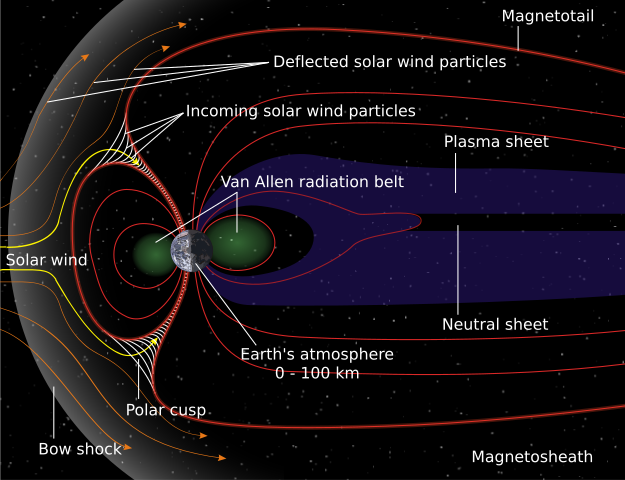
Structure of the Earth’s magnetosphere that deflects charged particles which form the solar wind. (Credit: Wikipedia Commons)

For life to form and survive depends on its complex molecules being protected from high-energy charged particles in the solar wind. In turn that depends on a strong geomagnetic field deflecting the solar wind as it does today, except for a small proportion that descend towards the poles and form aurora during solar mass ejections. In  visits to Isua in 2018 and 2019, geophysicists from the Massachusetts Institute of Technology, USA and Oxford University, UK drilled over 300 rock cores from metasedimentary ironstones (Nichols, C.I.O. and 9 others 2024. Possible Eoarchean records of the geomagnetic field preserved in the Isua Supracrustal Belt, southern West Greenland. Journal of Geophysics Research (Solid Earth), v. 129, article e2023JB027706; DOI: 10.1029/2023JB027706 Magnetisation preserved in the samples (remanent magnetism) suggest that it was formed by a geomagnetic field strength of at least 15 microtesla, similar to that which prevails today. The minerals magnetite (Fe3O4) and apatite (a complex phosphate) in the ironstones have been dated using U-Pb geochronometry and record a metamorphic event only slightly younger that the age of the Isua belt (3.69 and 3.63 Ga respectively). There is no sign of any younger heating above the temperatures that would reset the ironstones’ magnetisation. The Isua remanent magnetisation is at least 200 Ma older than that found in igneous rocks from north-eastern South Africa dated at between 3.2 to 3.45 Ga. So even in the Eoarchaean it seems likely that life, had it formed, would have avoided the hazard of exposure to the high energy solar wind. In all likelihood, however, in a shallow marine environment it would have had to protect itself somehow from intense ultraviolet radiation. That is now vastly reduced by stratospheric ozone (O3) which could only form once the atmosphere had appreciable oxygen (O2) content, i.e. after the Great Oxygenation Event beginning about 2.4 Ga ago. Undoubted stromatolites as old as 3.5 Ga suggest that early photosynthesising bacteria clearly had cracked the problem of UV protection somehow.

A 9-day seismic reverberation set off by a giant tsunami in a Greenland fjord

In September 2023 the global network of seismic recorders detected a sequence of low-strength earth movements. It resembled the reverberation of a church bell albeit one that lasted for 9 days. rising and falling in strength every 90 seconds. For months this strange event on seismograms baffled geophysicists. All they could tell was that the signals did not show signs of having been generated by earthquakes; they were too regular. It was, however, possible to triangulate the position of the source of each individual event. There turned out to be only a single location for the seismic ‘campanology’ – at about 73° N on the eastern coast of Greenland, in Dickson Fjord and isolated branch of the enormous Kong Oscar Fjord system. Greenland is not noted for volcanic activity, ruling out the rumblings of a magma chamber that sometimes presages major eruptions. Whatever the cause, there were no human witnesses at the time. The only real clue lay at the start of the signal: the very long-period (VLP) signal was preceded by a sharp, high energy signal that could be matched with some kind of landslide.

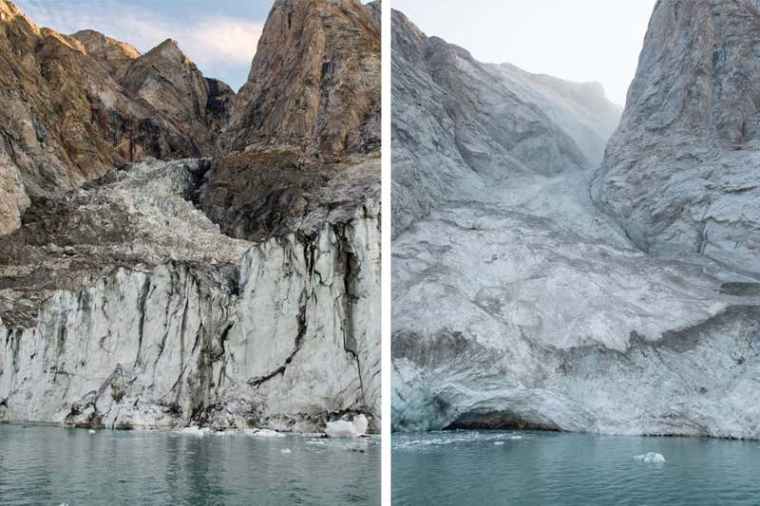
View of a side glacier on Dickson Fjord, East Greenland where the tsunami occurred. Left – August 2023; right – 19 September 2023. The rocky peak at top centre on the left fell onto the glacier below to generate a rock-ice slide into the fjord. (Credit: Søren Rysgaard/Danish Army)

On 16 September 2023 the military base for the famous Sirius Dog Sled Patrol on Ella Island was smashed by a tsunami – fortunately it had been closed for the coming winter. When the Danish Navy patrolled Dickson Fjord some days later they found clear signs that the shores opposite the site of a recent colossal rock and ice slide (see images) had been scoured to a height of 200 m. For 5 km either side shoreline scouring averaged 60 m. The initial tsunami was gigantic, yet the fjord was able to contain its worst effects because the outlet to the rest of the system was at right angles to its trend. Some energy obviously was released to reach Ella Island near the mouth of the system to destroy the Danish Army post. The bizarre seismic signal was probably a result of the displaced water sloshing around in the fjord to dissipate the enormous energy released by the collapse of a mountain peak and a substantial amount of a valley glacier. Such behaviour is known as a seiche. Topographic analysis of Dickson Fjord enabled the researchers to calculate its resonant frequency: at 11 millihertz it matched that of the fluctuating seismic signal. (Svennevig, K. and 67 others 2024. A rockslide-generated tsunami in a Greenland fjord rang Earth for 9 days. Science, v. 385, p. 1196-1205; DOI: 10.1126/science.adm9247).

Valley glaciers in Greenland bolster their rocky flanks against collapse. With climatic warming being much faster there than for the rest of the world, its almost innumerable valley glaciers are shrinking. Yet they have been eroding the crust for tens of thousand years. The fjords that they occupied at the height of the last glacial maximum have very steep sides. Likewise, the remaining glaciers have carved U-shaped valleys. So when the glaciers retreat their exposed flanks become gravitationally unstable. Despite the fact that much of Greenland is underpinned by very hard crystalline rocks, that presents a major hazard for water craft. East Greenland’s spectacular scenery draws many tourist cruisers and Innuit fishing boats each summer. Moreover, removal of the ice load allows elastic strain that had built up in the upper crust to be released along joint systems that further weaken resistance to collapse.

A great deal of publicity has been given to the rapid melting of the huge ice sheet that covers most of Greenland. That is currently the biggest contributor to sea-level rise: a few millimetres per year. The Dickson Fjord event highlights the potential deadly threat of deglaciation, although the extremely complex nature of most of its fjord systems may prevent regional tsunamis from escaping their damping effect. Bu there are increasing dangers from the largest, more open fjords, such as Scoresby Sund, which conceivably might blurt catastrophic tsunamis towards Iceland, Svalbard and the west coast of Norway. Even small ones could wreak havoc on wildlife, such as seal and walrus nurseries.

See also: Carrillo-Ponce, A. et al. 2024. The 16 September 2023 Greenland Megatsunami: Analysis and Modeling of the Source and a Week‐Long, Monochromatic Seismic Signal. The Seismic Record, v. 4, p. 172-183; DOI: 10.1785/0320240013; Le Page, M. 2024. Greenland landslide caused freak wave that shook Earth for nine days. New Scientist 12 September 2024

Changing Atlantic Ocean currents may threaten Gulf Stream warming of Europe

Climate during the last Ice Age was continually erratic. Generally fine-grained muds cored from the floor of the North Atlantic Ocean show repeated occurrences of layers containing gravelly debris. These have been ascribed to periods when ice sheets on Greenland and Scandinavia calved icebergs at an exceptionally fast rate, to release coarse debris as they melted while drifting to lower latitudes. These ‘iceberg armadas’ (known as Heinrich events) left their unmistakable signs as far south as Portugal. Their timing correlates with short-lived (1 to 2 ka) warming-cooling episodes (Dansgaard-Oeschger events) recorded in Greenland ice cores that involved variations in air temperature of up to 15°C. The process that resulted in these sudden climate shifts seems to have been changing ocean circulation brought about by vast amounts of fresh water flooding into the Arctic and North Atlantic Oceans. This lowered seawater density to the extent that its upper parts could not sink when cooled. It is this thermohaline circulation that drags warmer surface water northwards, known as the Atlantic Meridional Overturning Circulation (AMOC), part of which is the Gulf Stream. When it fails or slows the result is plummeting temperatures at high latitudes. The last major AMOC shutdown was after 8 ka of warming that followed the last glacial maximum. Between 12.9 and 11.7 ka major glaciers grew again north of about 50°N in the period known as the Younger Dryas, almost certainly in the aftermath of a flood to the Arctic Ocean of glacial meltwater from the Canadian Shield. Around 8.2 thousand years ago human re-colonisation of Northern Europe was set back by a similar but lesser cooling event.

The Atlantic Meridional Overturning Circulation (AMOC). Red – warm surface currents; cyan – cold deep-water flow. (Credit: Stefano Crivellari)

Three researchers at Utrecht University, the Netherlands have issued an early warning that the AMOC may have reached a critical condition (Van Westen, R.M., Kliphuis, M & Dijkstra, H.A. 2024. Physics-based early warning signal shows that AMOC is on tipping course. Science Advances, v. 10, article adl1189; DOI: 10.1126/sciadv.adk1189). Previous modelling of AMOC has suggested that only rapid, massive decreases in the salinity of North Atlantic surface water near the Arctic Circle could shut down the Gulf Stream in the manner of Younger Dryas and Dansgaard-Oeschger events. René van Westen and colleagues have simulated the effects of steady, long-term addition of fresh water from melting of the Greenland ice sheet. They ran a sophisticated Earth System model for six months on the Netherlands’ Snellius super computer. Their model used a slowly increasing influx of glacial meltwater to the Atlantic at high northern latitudes.

The various feedbacks in the model eventually shut down the AMOC, predicted to result in cooling of NW Europe by 10 to 15 °C in a matter of a few decades. Yet to achieve that required the model to simulate more than 2000 years of change. It took 1760 years for a persistent AMOC transport of 10 to 15 million m3 s-1 to drop over a century or so and reach near-zero. That collapse involved around 80 times more melting of Greenland’s ice sheet than at present. Yet their modelling does not take into account global warming: including that factor would have exceeded their budgeted supercomputer time by a long way. Melting of the Greenland ice sheet is, however, accelerating dramatically

Van Westen et al. have shown the possibility that steadily increasing ice-sheet melting can, theoretically, ’flip’  the huge current system associated with the Atlantic Ocean, and with it regional climate patterns. The tangible fear today is of a more than 1.5°C increase in global surface temperature, yet a warming-induced failure of AMOC may cause local annual temperatures to fall by up to ten times that. Rather than the currently heralded disappearance of sea-ice from the Arctic Ocean, it may spread in winter to as far south as the North Sea. The only way of forecasting in detail what may actually happen – and where – is ever-more sophisticated and costly modelling of ocean currents and ice melting in a warming world. Uncertain as it stands, the work by van Westen and colleagues may well be ignored: perhaps as a ‘thing we dinnae care to speak aboot’.

See also: Le Page, M. 2024. Atlantic current shutdown is a real danger, suggests simulation. New Scientist, 9 February 2024; Watts, J. 2024. Atlantic Ocean circulation nearing ‘devastating’ tipping point, study finds. The Guardian, 9 February 2024.

When giant worms roamed the seas!

At the start of the Cambrian Period animal life began to diversify from that of the Ediacaran world. For the first time sediments on the seafloor were explored for sustenance, leading to a variety of burrows that disrupted fine depositional layers. The basal Cambrian sandstones found in Britain and elsewhere are pervasively bioturbated: good evidence for the start of a ‘Worm world’ that marks the Precambrian-Phanerozoic boundary. That is probably a misnomer for the shallow seabed of that time, as fossils of burrowers with a variety of hard parts turn up in the oldest Cambrian sequences. Also appearing for the first time are tooth-like microfossils that took on such a range of bizarre shapes that they have long been used for correlating sedimentary strata in the absence of larger creatures. Some of these conodonts have been attributed to early vertebrates akin to modern lampreys and hag fish, but others may have been the grasping mouth-spines of a group of predatory worms which also survive to the present: chaetognaths. Apart from these oral spines chaetognaths lack hard parts, so anatomical details of ancient ones are only found in sites of exquisite preservation or lagerstätten. In such rare, tranquil places soft tissues such as muscles may be preserved by phosphatisation during decay.

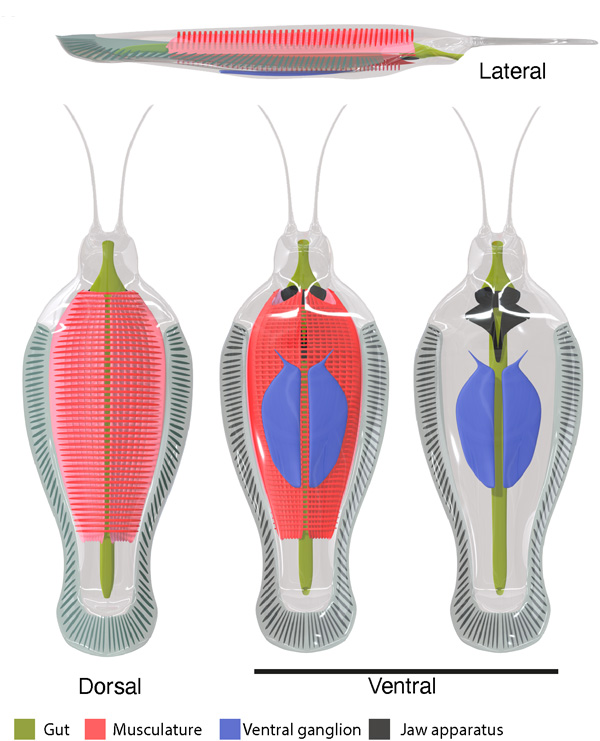
Reconstruction of Timorebestia koprii showing its musculature, nerve system and mouthparts, It probably propelled itself by fluttering its outer and rear flaps, much like a modern flatfish. Credit: Park et al., Fig 4

One of the earliest Phanerozoic lagerstätten (Sirius Passet) occurs in northern Greenland. It is curiously named after the Sirius Dog Sled Patrol, an elite pair of naval troops with a sledge and 12 dogs that enforces Danish sovereignty over the Greenlandic shore of the Arctic Ocean. The Sirius Passet fauna includes a monstrous chaetognath over 30 cm long (Park, T.-Y. S. and 12 others 2024. A giant stem-group chaetognath. Science Advances, v. 10 article eadi6678; DOI: 10.1126/sciadv.adi6678). It is called Timorebestia koprii (Timorebestia is Latin for ‘terror beast’) and was related to the living, but tiny, arrow worms that prey on zooplankton in modern oceans. This description and moniker may seem to be somewhat hyperbolic, but Timorobestia outranks in size any Early Cambrian predatory arthropods. It was probably high in the Early Cambrian trophic pyramid, but was soon relegated by the later Cambrian rise of trilobites and then of cephalopods and eventually jawed vertebrate fishes in the Silurian. One specimen contained shells of a swimming arthropod whose protective spines did not deter the ‘terrible’ chaetognath from swimming them down.

See also: ‘Giant’ predator worms more than half a billion years old discovered in North Greenland. Science Daily, 3 January 2024.

‘Smoking gun’ for Younger Dryas trigger refuted

In 2018 airborne ice-penetrating radar over the far northwest of the Greenland revealed an impact crater as large as the extent of Washington DC, USA beneath the Hiawatha Glacier. The ice surrounding it was estimated to be younger than 100 ka. This seemed to offer a measure of support for the controversial hypothesis that an impact may have triggered the start of the millennium-long Younger Dryas episode of frigidity (12.9 to 11.7 ka). This notion had been proposed by a group of scientists who claimed to have found mineralogical and geochemical signs of an asteroid impact at a variety of archaeological sites of roughly this age in North America, Chile and Syria. A new study of the Hiawatha crater by a multinational team, including the original discoverers of the impact structure, has focussed on sediments deposited beyond the edge of the Greenland ice cap by meltwater streams flowing along its base. (Kenny, G.G. et al. 2022. A Late Paleocene age for Greenland’s Hiawatha impact structure. Science Advances, v.8, article eabm2434; DOI: 10.1126/science.eabm2434).

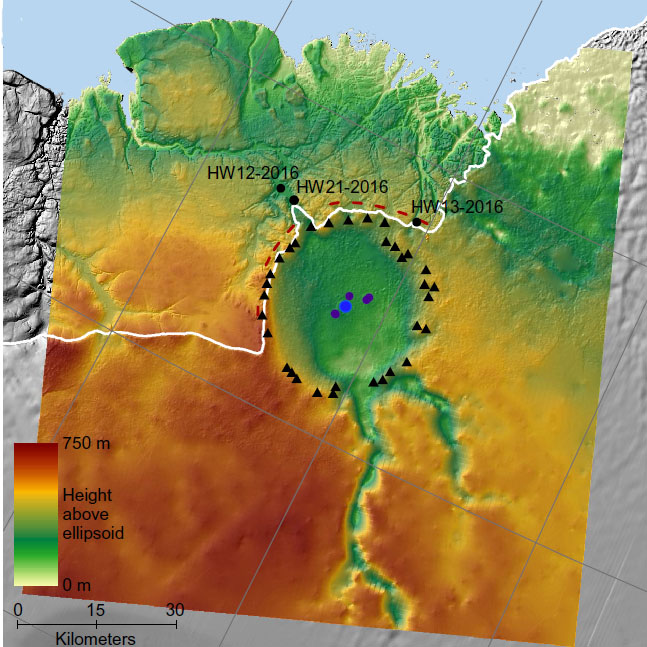
Colour-coded subglacial topography from airborne radar sounding over the Hiawatha Glacier of NW Greenland (Credit: Kjaer et al. 2018; Fig. 1D)

Where meltwater emerges from the Hiawatha Glacier downstream of the crater there are glaciofluvial sands and gravels that began to build up after 2010 when rapid summer melting began, probably due to global warming. As luck would have it, the team found quartz grains that contained distinctive planar features that are characteristic of impact shock. They also found pebbles of glassy impact melts that contain clasts of bedrock, further grains of shocked quartz and tiny needles of plagioclase feldspar that crystallised from the melt. Also present were small grains of the mineral zircon (ZrSiO4), both as pristine crystals in the bedrock clasts and porous, grainy-textured grains showing signs of deformation in the feldspathic melt rock. So, two materials that can be radiometrically dated are available: feldspars suitable for the 40Ar/39Ar method and zircons for uranium-lead (U-Pb) dating. The feldspars proved to be about 58 million years old; i.e. of Late Palaeocene age. The pristine zircon grains from bedrock clasts yielded Palaeoproterozoic U-Pb ages (~1915 Ma), which is the general age of the Precambrian metamorphic basement that underpins northern Greenland. The deformed zircon samples have a very precise U-Pb age of 57.99±0.54 Ma. There seems little doubt that the impact structure beneath the Hiawatha Glacier formed towards the beginning of the Cenozoic Era.

During the Palaeocene, Northern Greenland was experiencing warm conditions and sediments of that age show that it was covered with dense forest. The group that since 2007 has been advocating the influence of an impact over the rapid onset of the Younger Dryas acknowledges that the Hiawatha crater cannot support their view. But they have an alternative: an airburst of an incoming projectile. Although scientists know such phenomena do occur, as one did over the Tunguska area in Siberia on the morning of 30 June 1908. Research on the Tunguska Event has discovered  geochemical traces that may implicate an extraterrestrial object, but coincidentally the area affected is underlain by the giant SIberian Traps large igneous province that arguably might account for geochemical anomalies. Airbursts need to have been observed to have irrefutable recognition. Two posts from October 2021 – A Bronze Age catastrophe: the destruction of Sodom and Gomorrah? and Wide criticism of Sodom airburst hypothesis emerges – suggest that some scientists question the data used repeatedly to infer extraterrestrial events by the team that first suggested an impact origin for the Younger Dryas.

See also: Voosen, P, 2022. Controversial impact crater under Greenland’s ice is surprisingly ancient. Science, v. 375, article adb1944;DOI: 10.1126/science.adb1944

When Greenland was a warm place

On 14-15 August 2021 it rained for the first time since records began at the highest point on the Greenland ice cap. Summit Camp at 3.216 m is run by the US National Science Foundation, which set it up in 1989, and is famous for climate data gleaned from two deep ice cores there. This odd event came at a time when surface melting of the ice cap covered 870 thousand km2: over half of its total 1.7 million km2 extent: a sure sign of global warming. The average maximum temperature in August at Summit is -14°C, but since the mid 20th century the Arctic has been warming at about twice the global rate. Under naturally fluctuating climatic conditions during the Pleistocene, associated with glacial-interglacial cycles, Greenland may have been ice-free for extended periods, perhaps as long as a quarter of a million years around 1.1 Ma ago. If 75% of the up to 3 km thick ice on Greenland melted that would add 5 to 6 m to global sea level, perhaps as early as 2100 if current rates of climate warming persist.

The edge of the ice cap in NE Greenland (credit: Wikipedia)

The worst scenario is runaway warming on the scale of that which took place 56 Ma ago during the Palaeocene-Eocene Thermal Maximum (PETM) when global mean temperature rose by between 5 to 8°C at a rate comparable with what the planet is experiencing now as a result of growth in the world economy. In fact, the CO2 released during the PETM emerged at a rate that was only about tenth of modern anthropogenic emissions  Sediments that span the Palaeocene-Eocene boundary occur in NE Greenland, a study of which was recently published by scientists from Denmark, Greenland, the UK, Australia and Poland (Hovikoski, J. and 13 others 2021. Paleocene-Eocene volcanic segmentation of the Norwegian-Greenland seaway reorganized high-latitude ocean circulation. Communications Earth & Environment, v. 2, article 172; DOI: 10.1038/s43247-021-00249-w). The greenhouse world of NE Greenland that lay between 70 and 80°N then, as it still does, was an area alternating between shallow marine and terrestrial conditions, the latter characterised by coastal plain and floodplain sediments deposited in estuaries, deltas and lakes. They include coals derived from lush, wooded swamps, inhabited by hippo-like ungulates, primates and reptiles.

At that time the opening of the northern part of the North Atlantic had barely begun, with little chance for an equivalent of the Gulf Stream to have had a warming influence on the Arctic. Shortly after the PETM volcanism began in earnest, to form the flood basalts of the North Atlantic Igneous Province. Each lava flow is capped by red soil or bole: further evidence for a warm, humid climate and rapid chemical weathering. As well as lava build-up, tectonic forces resulted in uplift, effectively opening migration routes for animals and land plants to colonise the benign – for such high latitudes – conditions and perhaps escape the far hotter conditions further south.

The situation now is much different, with the potential for even more rapid melting of the Greenland ice cap to flood freshwater into the North Atlantic, as is currently beginning. Diluting surface seawater reduces its density and thus its tendency to sink, which is the main driving force that pulls warmer water towards high-latitudes in the form of the Gulf Stream. Slowing and even shutting down its influence may have an effect that contradicts the general tendency for global warming – a cooling trend at mid- to high latitudes with chaotic effects on atmospheric pressure systems, the jet stream and weather in general.

See also: Barham, M. et al. 2021. When Greenland was green: rapid global warming 55 million years ago shows us what the future may hold. The Conversation, 23 August 2021.

Arctic warmer than now half a million years ago

Just over a month since evidence emerged that the Arctic Ocean was probably filled with fresh water from 150 to 131 and 70 to 62 thousand years ago (When the Arctic Ocean was filled with fresh water, February 2021), another study has shaken ‘received wisdom’ about Arctic conditions. This time it is about the climate in polar regions, and comes not from an ice core but speleothem or calcium carbonate flowstone that was precipitated on a cave wall in north-eastern Greenland. The existence of caves at about 80°N between 350 to 670 m above sea level in a very cold, arid area is a surprise in itself, for they require flowing water to form. The speleothem is up to 12 cm thick, but none is growing under modern, relatively warm conditions, cave air being below freezing all year. For speleothem to form to such an extent suggests a long period when air temperature was above 0°C. So was it precipitated before glacial conditions were established in pre-Pleistocene times?

Limestone caves in the arid Grottedal region of north-eastern Greenland (Credit: Moseley et al. 2021; Fig 2D)

A standard means of discovering the age of cave deposits, such as speleothem or stalagmites, is uranium-series dating (see: Irish stalagmite reveals high-frequency climate changes, December 2001). In this case the sheet of flowstone turned out to have been deposited between 588 to 537 thousand years ago; a 50 ka ‘window’ into conditions that prevailed during the middle part of 100 ka climatic cycling – about 6 glacial-interglacial stages before present. (Moseley, G.E. et al. 2021. Speleothem record of mild and wet mid-Pleistocene climate in northeast Greenland. Science Advances, v. 7, online article  eabe1260; DOI: 10.1126/sciadv.abe1260). Roughly half the layer formed during an interglacial, the rest under glacial conditions that followed. Detailed oxygen-isotope studies revealed that air temperatures during which calcium carbonate was precipitated were at least 3.5°C above those prevailing in the area at present; warm enough to melt local permafrost and to increase the summer extent of ice-free conditions in the Arctic Ocean, thereby encouraging greater rainfall. These warm and wet conditions correlate with increased solar heating over the North Atlantic region at that time, as suggested by modelling based on Milankovich astronomical forcing.

Unfortunately, the climate record derived from cores through the Greenland ice sheet only reaches back to about 120 ka, during the last interglacial period. So it is not possible to match the speleothem results to an alternative data set. Yet, thanks to the rediscovery of dirt cored from the very base of the deepest part of the ice sheet (beneath Camp Century) in a freezer in Denmark – it was discarded as interest focused on the record preserved in the ice itself – there is now evidence for complete melting of the ice sheet at some time in the past. The dirt contains abundant fossil plants. Analysing radioactive isotopes of aluminium and beryllium that formed in associated quartz grains as a result of cosmic ray bombardment when the area was ice-free suggests two periods of complete melting followed by glaciation , the second  being within the last million years.

The onshore Arctic climate is clearly more unstable than previously believed.

See also:  Geologists Find Million-Year-Old Plant Fossils Deep Beneath Greenland Ice Sheet. Sci News, 16 March 2021.

The oldest known impact structure (?)

That large, rocky bodies in the Solar System were heavily bombarded by asteroidal debris at the end of the Hadean Eon (between 4.1 to 3.8 billion years ago) is apparent from the ancient cratering records that they still preserve and their matching with dating of impact-melt rocks on the Moon. Being a geologically dynamic planet, the Earth preserves no tangible, indisputable evidence for this Late Heavy Bombardment (LHB), and until quite recently could only be inferred to have been battered in this way. That it actually did happen emerged from a study of tungsten isotopes in early Archaean gneisses from Labrador, Canada (see: Tungsten and Archaean heavy bombardment, August 2002; and Did mantle chemistry change after the late heavy bombardment? September 2009). Because large impacts deliver such vast amounts of energy in little more than a second (see: Graveyard for asteroids and comets, Chapter 10 in Stepping Stones) they have powerful consequences for the Earth System, as witness the Chicxulub impact off the Yucatán Peninsula of Mexico that resulted in a mass extinction at the end of the Cretaceous Period. That seemingly unique coincidence of a large impact with devastation of Earth’s ecosystems seems likely to have resulted from the geology beneath the impact; dominated by thick evaporite beds of calcium sulfate whose extreme heating would have released vast amounts of SO2 to the atmosphere. Its fall-out as acid rain would have dramatically affected marine organisms with carbonate shells. Impacts on land would tend to expend most of their energy throughout the lithosphere, resulting in partial melting of the crust or the upper mantle in the case of the largest such events.

The further back in time, the greater the difficulty in recognising visible signs of impacts because of erosion or later deformation of the lithosphere. With a single, possible exception, every known terrestrial crater or structure that may plausibly be explained by impact is younger than 2.5 billion years; i.e. they are post-Archaean. Yet rocky bodies in the Solar System reveal that after the LHB the frequency and magnitude of impacts steadily decreased from high levels during the Archaean; there must have been impacts on Earth during that Eon and some may have been extremely large. In the least deformed Archaean sedimentary sequences there is indirect evidence that they did occur, in the form of spherules that represent droplets of silicate melts (see: Evidence builds for major impacts in Early Archaean; August 2002, and Impacts in the early Archaean; April 2014), some of which contain unearthly proportions of different chromium isotopes (see: Chromium isotopes and Archaean impacts; March 2003). As regards the search for very ancient impacts, rocks of Archaean age form a very small proportion of the Earth’s continental surface, the bulk having been buried by younger rocks. Of those that we can examine most have been subject to immense deformation, often repeatedly during later times.

The Archaean geology of part of the Akia Terrane (Manitsoq area) in West Greenland. The suggested impact structure is centred on the Finnefjeld Gneiss (V symbols) surrounded by highly deformed ultramafic to mafic igneous rocks. (Credit: Jochen Kolb, Karlsruhe Institute of Technology, Germany)

There is, however, one possibly surviving impact structure from Archaean times, and oddly it became suspected in one of the most structurally complex areas on Earth; the Akia Terrane of West Greenland. Aeromagnetic surveys hint at two concentric, circular anomalies centred on a 3.0 billion years-old zone of grey gneisses (see figure) defining a cryptic structure. It is is surrounded by hugely deformed bodies of ultramafic and mafic rocks (black) and nickel mineralisation (red). In 2012 the whole complex was suggested to be a relic of a major impact of that age, the ultramafic-mafic bodied being ascribed to high degrees of impact-induced melting of the underlying mantle. The original proposers backed up their suggestion with several associated geological observations, the most crucial being supposed evidence for shock-deformation of mineral grains and anomalous concentrations of platinum-group metals (PGM).

A multinational team of geoscientists have subjected the area to detailed field surveys, radiometric dating, oxygen-isotope analysis and electron microscopy of mineral grains to test this hypothesis (Yakymchuck, C. and 8 others 2020. Stirred not shaken; critical evaluation of a proposed Archean meteorite impact in West Greenland. Earth and Planetary Science Letters, v. 557, article 116730 (advance online publication); DOI: 10.1016/j.epsl.2020.116730). Tectonic fabrics in the mafic and ultramafic rocks are clearly older than the 3.0 Ga gneisses at the centre of the structure. Electron microscopy of ~5500 zircon grains show not a single example of parallel twinning associated with intense shock. Oxygen isotopes in 30 zircon grains fail to confirm the original proposers’ claims that the whole area has undergone hydrothermal metamorphism as a result of an impact. All that remains of the original suggestion are the nickel deposits that do contain high PGM concentrations; not an uncommon feature of Ni mineralisation associated with mafic-ultramafic intrusions, indeed much of the world’s supply of platinoid metals is mined from such bodies. Even if there had been an impact in the area, three phases of later ductile deformation that account for the bizarre shapes of these igneous bodies would render it impossible to detect convincingly.

The new study convincingly refutes the original impact proposal. The title of Yakymchuck et al.’s paper aptly uses Ian Fleming’s recipe for James Bond’s tipple of choice; multiple deformation of the deep crust does indeed stir it by ductile processes, while an impact is definitely just a big shake. For the southern part of the complex (Toqqusap Nunaa), tectonic stirring was amply demonstrated in 1957 by Asger Berthelsen of the Greenland Geological Survey (Berthelsen, A. 1957. The structural evolution of an ultra- and polymetamorphic gneiss-complex, West Greenland. Geologische Rundschau, v. 46, p. 173-185; DOI: 10.1007/BF01802892). Coming across his paper in the early 60s I was astonished by the complexity that Berthelsen had discovered, which convinced me to emulate his work on the Lewisian Gneiss Complex of the Inner Hebrides, Scotland. I was unable to match his efforts. The Akia Terrane has probably the most complicated geology anywhere on our planet; the original proposers of an impact there should have known better …

Subglacial impact structure: trigger for Younger Dryas?

Radar microwaves are able to penetrate easily through several kilometres of ice. Using the arrival times of radar pulses reflected by the bedrock at glacial floor allows ice depth to be computed. When deployed along a network of flight lines during aerial surveys the radar returns of large areas can be converted to a grid of cells thereby producing an image of depth: the inverse of a digital elevation model. This is the only means of precisely mapping the thickness variations of an icecap, such as those that blanket Antarctica and Greenland. The topography of the subglacial surface gives an idea of how ice moves, the paths taken by liquid water at its base, and whether or not global warming may result in ice surges in parts of the icecap. The data can also reveal topographic and geological features hidden by the ice (see The Grand Greenland Canyon September 2013).

Untitled-2
Colour-coded subglacial topography from radar sounding over the Hiawatha Glacier of NW Greenland (Credit: Kjaer et al. 2018; Fig. 1D)

Such a survey over the Hiawatha Glacier of NW Greenland has showed up something most peculiar (Kjaer, K.H. and 21 others 2018. A large impact crater beneath Hiawatha Glacier in northwest Greenland. Science Advances, v. 4, eaar8173; DOI: 10.1126/sciadv.aar8173). Part of the ice margin is an arc, which suggests the local bed topography takes the form of a 31km wide, circular depression. The exposed geology shows no sign of a structural control for such a basin, and is complex metamorphic basement of Palaeoproterozoic age. Measurements of ice-flow speeds are also anomalous, with an array of higher speeds suggesting accelerated flow across the depression. The radar image data confirm the presence of a subglacial basin, but one with an elevated rim and a central series of small peaks. These are characteristic of an impact structure that has only been eroded slightly; i.e. a fairly recent one and one of the twenty-five largest impact craters on Earth.. Detailed analysis of raw radar data in the form of profiles through the ice reveals  that the upper part is finely layered and undisturbed. The layering continues into the ice surrounding the basin and is probably of Holocene age (<11.7 ka), based on dating of ice in cores through the surrounding icecap. The lower third is structurally complex and shows evidence for rocky debris. Sediment deposited by subglacial streams where they emerge along the arcuate rim contain grains of shocked quartz and glass, as well as expected minerals from the crystalline basement rocks. Some of the shocked material contains unusually high concentrations of transition-group metals, platinum-group elements and gold; further evidence for impact of extraterrestrial material – probably an iron asteroid that was originally more than 1 km in diameter. The famous Cape York iron meteorite, which weighs 31 t – worked by local Innuit to forge harpoon blades – fell in NW Greenland about 200 km away.

The central issue is not that Hiawatha Glacier conceals a large impact crater, but its age. It certainly predates the start of the Holocene and is no older than the start of Greenland glaciation about 2.6 Ma ago. That only Holocene ice layers are preserved above the disrupted ice that rests immediately on top of the crater raises once again the much-disputed possibility of an asteroid impact having triggered the Younger Dryas cooling event and associated extinctions of large mammals in North America at about 12.9 ka (see Impact cause for Younger Dryas draws flak May 2008). Only radiometric dating of the glassy material found in the glaciofluvial sediments will be able to resolve that particular controversy.

When did the Greenland ice cap last melt?

The record preserved in cores through the thickest part of the Greenland ice cap goes back only to a little more than 120 thousand years ago, unlike in Antarctica where data are available for 800 ka and potentially further back still. One possible reason for this difference is that a great deal more snow falls on Greenland so the ice builds up more quickly than in Antarctica. Because ice flows under pressure this might imply that older ice on Greenland long flowed to the margins and either melted or calved off as icebergs. So, although it is certain that the Antarctic ice cap has not melted away, at least in the last million years or so, we cannot tell if Greenlandic glaciers did so over the same period of time. Knowing whether or not Greenland might have shed its carapace of ice is important, because if ever does in future the meltwater will add about 7 metres to global sea level: a nightmare scenario for coastal cities, low-lying islands and insurance companies.

Margin of the Greenland ice sheet (view from p...
Edge of the Greenland ice sheet with a large glacier flowing into a fjiord at the East Greenland coas  (Photo credit: Wikipedia)

One means of judging when Greenland was last free of ice, or at least substantially so, is based on more than a ice few metres thick being opaque to cosmic ‘rays’. Minerals, such as quartz, in rocks bared at the surface to ultra-high energy, cosmogenic neutrons accumulate short-lived isotopes of beryllium and aluminium – 10Be and 26Al with half-lives of 1.4 and 0.7 Ma. Once rocks are buried beneath ice or sediment, the two isotopes decay away and it is possible to estimate the duration of burial from the proportions of the remaining isotopes. After about 5 Ma the cosmogenic isotopes will have decreased to amounts that cannot be measured. Conversely, if the ice had melted away at any time in the past 5 Ma and then returned it should be possible to estimate the timing and duration of exposure of the surface to cosmic ‘rays’. Two groups of researchers have applied cosmogenic-isotope analysis to Greenland. One group (Schaefer, J.G. et al. 2016. Greenland was nearly ice-free for extended periods during the Pleistocene. Nature, v. 540, p. 252-255) focused on bedrock, currently buried beneath 3 km of ice, that drilling for the ice core finally penetrated. The other systematically analysed the cosmogenic isotope content of mineral grains at different depths in North Atlantic seafloor sediment cores, largely supplied from East Greenland since 7.5 Ma ago (Bierman, P.R. et al. 2016. A persistent and dynamic East Greenland Ice Sheet over the past 7.5 million years Nature, v. 540, p. 256-260). As their titles suggest, the two studies had conflicting results.

The glacigenic sediment grains contained no more than 1 atom of 10Be per gram compared with the 5000 to 6000 in grains deposited and exposed to cosmic rays along the shores of Greenland since the end of the last ice age. These results challenge the possibility of any significant deglaciation and exposure of bedrock in the source of seafloor sediment since the Pliocene.  The bedrock from the base of Greenland’s existing ice cap, however, contains up to 25 times more cosmogenic isotopes. The conclusion in that case is that there must have been a protracted, >280 ka, exposure of the rock surface in what is now the deepest ice cover at 1.1 Ma ago at most. Allowing for the likelihood of some persistent glacial cover in what would have been mountainous areas in an otherwise substantially deglaciated Greenland, the results are consistent with about 90% melting suggested by glaciological modelling.

Clearly, some head scratching is going to be needed to reconcile the two approaches. Ironically, the ocean-floor cores were cut directly offshore of the most likely places where patches of residual ice cap may have remained. Glaciers there would have transported rock debris that had remained masked from cosmic rays until shortly before calved icebergs or the glacial fronts melted and supplied sediment to the North Atlantic floor. If indeed the bulk of Greenland became ice free around a million years ago, under purely natural climatic fluctuations, the 2° C estimate for global warming by 2100 could well result in a 75% glacial melt and about 5-6 m rise in global sea level.

Read more about glaciation here and here.