Global natural hydrogen resources: a CO2 free future??

The idea of a ‘Hydrogen Economy’ has been around for at least six decades, its main attraction being that when hydrogen is burned it combines with oxygen to form H2O. It might seem to be the ultimate ‘green’ energy source, but it is currently being touted by governments and petroleum companies in what is widely regarded as ‘green washing’. The technology favoured by that axis uses steam reforming of the methane that dominates natural petroleum gas, through the reaction:

CH4 + H2O  → CO + 3H2

It’s actually not much different from producing coke gas from coal, which began in the 19th century and is now largely abadoned. Because carbon monoxide (CO) reacts with atmospheric oxygen to form CO2 this process is by no means ‘green’ and is properly referred to as ‘grey’ hydrogen. Only if the CO is stored permanently underground could steam reforming not add to greenhouse warming. That puts the approach in the same category as ‘carbon capture and storage’, with all the possible difficulties inherent in that technology, which has yet to be demonstrated on a large scale. Such hydrogen is classified as a ‘blue’. Colour coding hydrogen is described nicely by the British National Grid. They give another six varieties. Green and yellow hydrogen are produced by electrolysing water using wind or solar power respectively. The pink variety uses nuclear power in the same fashion. Black or brown hydrogen is that produced by coking coal or stewing-up brown coal (lignite) which amazingly are contemplated in Australia and Germany. There is even a turquoise variety can be produced if methane is somehow turned into hydrogen and solid carbon using renewables. There is another category (white) which is hydrogen produced by a variety of natural, geochemical processes.

Distribution of ophiolites around the Eastern Mediterranean and Black Seas. Many orogenic belts are endowed to a similar extent. (Credit: Gültekin Topuz, Istanbul Technical University)

Earth-logs discussed white hydrogen in March 2023 when news emerged of gas that was 98% hydrogen leaking from a water borehole in Mali. The local people harnessed this surprising resource to generate electricity for their village. It also emerges in springs from ultramafic rocks, having formed through weathering of the mineral olivine:

3Fe2SiO4 + 2H2O → 2 Fe3O4 + 3SiO­2 +3H2

Much the same reaction occurs beneath the ocean floor where hydrothermal fluids alter basalts and in geothermal springs that emerge from onshore basalt lavas. Such ‘white’ hydrogen emissions are widespread. So an unknown, but possibly huge amount of hydrogen is leaking into the atmosphere continuously. Because of its tiny nucleus – just a single proton – atmospheric hydrogen quickly escapes to outer space: what a waste! Equally as interesting is that inducing the breakdown of ultramafic rock to yield hydrogen, by pumping water and carbon dioxide into them, may also be a means of leak-free carbon sequestration. This produces the complex mineral serpentine and magnesium carbonate. The reaction gives off heat and so is self sustaining until pumping is stopped.

It has been estimated that by 2050 the annual global demand for hydrogen will reach 530 million t.  Just how big is the potential resource to meet such a demand? Natural weathering and hydrothermal processes have always functioned. Some of the hydrogen produced by them may have built-up in reservoirs like the one in Mali, some is escaping. Neither the magnitude of annual natural generation of hydrogen nor the amount trapped in porous sedimentary rocks are known in any detail. A recent survey of how much may be trapped gives a range from 103 to 1010 million metric tons (Ellis, G.S. & Gelman, S.E. 2024. Model predictions of global geologic hydrogen resources. Science Advances, v. 10, article eado0955; DOI: 10.1126/sciadv.ado0955), most probably 5.6 trillion t. If only a tenth of that is recoverable, replacing fossil-fuel energy with that from white hydrogen to achieve net-zero CO2 emissions would be sustainable for about 400 years. That magnitude of trapped hydrogen reserves well exceeds all proven reserves of natural gas.

This estimate assumes using only hydrogen that has been naturally produced and stored beneath the Earth’s surface. Basalts and ultramafic rocks exposed at the land surface as ophiolites – ancient oceanic crust thrust onto continental crust – are abundant on every continent. Inducing hydrogen-producing chemical reactions in them by pumping water and CO2 into them is little different from the technology being used in fracking. This potential resource is effectively limitless. Combined with renewable energy technology, a hydrogen economy has no conceivable need for fossil fuels, except as organic-chemistry feedstock. Such a scenario for stabilising climate is almost certainly feasible. It could use the capital, technology and skills currently deployed by the petroleum industry that is currently driving society and the Earth in the opposite direction. It is capable of drilling 10 km below the continental surface or the ocean floor, and even into the Earth’s mantle that is made of . . . ultramafic rock.

Best wishes for the festive season to all Earth-logs followers and visitors

A major breakthrough in carbon capture and storage?

Carbon capture and storage is in the news most weeks and is increasingly on the agenda for some governments. But plans to implement the CCS approach to reducing and stopping global warming increasingly draws scorn from scientists and environmental campaigners. There is a simple reason for their suspicion. State engagement, in the UK and other rich countries, involves major petroleum companies that developed the oil and gas fields responsible for unsustainably massive injection of CO2 into the atmosphere. Because they have ‘trousered’ stupendous profits they are a tempting source for the financial costs of pumping CO2 into porous sedimentary rocks that once contained hydrocarbon reserves. Not only that, they have conducted such sequestration over decades to drive out whatever petroleum fluids remaining in previously tapped sedimentary strata. For that second reason, many oil companies are eager and willing to comply with governmental plans, thereby seeming to be environmentally ‘friendly’. It also tallies with their ambitions to continue making profits from fossil-fuel extraction. But isn’t that simply a means of replacing the sequestered greenhouse gas with more of it generated by burning the recovered oil and natural gas; i.e. ‘kicking the can down the road’? Being a gas – technically a ‘free phase’ – buried CO2 also risks leaking back to the atmosphere through fractures in the reservoir rock. Indeed, some potential sites for its sequestration have been deliberately made more gas-permeable by ‘fracking’ as a means of increasing the yield of petroleum-rich rock. Finally, a litre of injected gas can drive out pretty much the same volume of oil. So this approach to CCS may yield a greater potential for greenhouse warming than would the sequestered carbon dioxide itself.

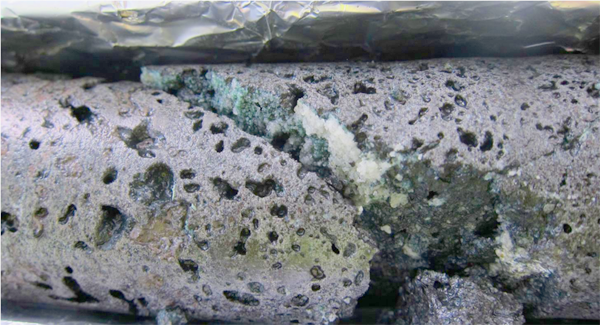
Image of calcite (white) and chlorite (cyan) formed in porous basalt due to CO2-charged water-rock interaction at the CarbFix site in Iceland. (Credit: Sandra Ósk Snæbjörnsdóttir)

Another, less widely publicised approach is to geochemically bind CO2 into solid carbonates, such as calcite (CaCO­3), dolomite (CaMgCO3), or magnesite (MgCO3). Once formed such crystalline solids are unlikely to break down to their component parts at the surface, under water or buried. One way of doing this is by the chemical weathering of rocks that contain calcium- and magnesium-rich minerals, such as feldspar (CaAl2Si2O8), olivine ([Fe,Mg]2SiO4) and pyroxene ([Fe,Mg]CaSi2O6) . Mafic and ultramafic rocks, such as basalt and peridotite are commonly composed of such minerals. One approach involves pumping the gas into a Icelandic borehole that passes through basalt and letting natural reactions do the trick. They give off heat and proceed quickly, very like those involved in the setting of concrete. In two experimental field trials 95% of injected CO2 was absorbed within 18 months. Believe it or not, ants can do the trick with crushed basalt and so too can plant roots. There have been recent experiments aimed at finding accelerants for such subsurface weathering (Wang, J. et al. 2024. CO2 capture, geological storage, and mineralization using biobased biodegradable chelating agents and seawater. Science Advances, v. 10, article eadq0515; DOI: 10.1126/sciadv.adq0515). In some respects the approach is akin to fracking. The aim is to connect isolated natural pores to allow fluids to permeate rock more easily, and to release metal ions to combine with injected CO2.

Chelating agents are biomolecules that are able to dissolve metal ions; some are used to remove toxic metals, such as lead, mercury and cadmium, from the bodies of people suffering from their effects. Naturally occurring ones extract metal ions from minerals and rocks and are agents of chemical weathering; probably used by the aforesaid ants and root systems. Wang and colleagues, based at Tohoku University in Japan, chose a chelating agent GLDA (tetrasodium glutamate diacetate –  C9H9NNa4O8) derived from plants, which is non-toxic, cheap and biodegradable. They injected CO2 and seawater containing dissolved GDLA into basaltic rock samples. The GDLA increases the rock’s porosity and permeability by breaking down its minerals so that Ca and Mg ions entered solution and were thereby able to combine with the gas to form carbonate minerals. Within five days porosity was increased by 16% and the rocks permeability increased by 26 times. Using electron microscopy the authors were able to show fine particles of carbonate growing in the connected pores. In fact these carbonate aggregates become coated with silica released by the induced mineral-weathering reactions. Calculations based on the previously mentioned field experiment in Iceland suggest that up to 20 billion tonnes of CO2 could be stored in 1.3 km3 of basalt treated in this way: about 1/25000 of the active rift system in Iceland (3.3 x 10⁴ km2 covered by 1 km of basalt lava). In 2023 fossil fuel use emitted an estimated 36.6 bllion tons of CO2 into the atmosphere.

So, why do such means of efficiently reducing the greenhouse effect not receive wide publicity by governments or the Intergovernmental Panel on Climate Change? Answers on a yellow PostIt™ please . . .

British government fracking fan fracked

In November 2019 the Conservative government of Boris Johnson declared a moratorium on development of shale gas by hydraulic fracturing (‘fracking’) in England. This followed determined public protests at a number of potential fracking sites, the most intransigent being residents of Lancashire’s Fylde peninsula. They had been repeatedly disturbed since mid 2017 by low-magnitude earthquakes following drilling and hydraulic-fluid injection tests by Cuadrilla Resources near Little Plumpton village. Their views were confirmed in a scientific study by the British Geological Survey for the Oil and Gas Authority that warned of the impossibility of predicting the magnitude of future earthquakes that future fracking might trigger. The shale-gas industry of North America, largely in areas of low population and simple geology, confirmed the substantial seismic hazard of this technology by regular occurrences of earthquakes up to destructive magnitudes greater than 5.0. The Little Plumpton site was abandoned and sealed in February 2022.

Cuadrilla’s exploratory fracking site near Little Plumpton in Fylde, Lancashire. (Credit: BBC)

On 22 September 2022 the moratorium was rescinded by Jacob Rees-Mogg, Secretary of State for Business, Energy and Industrial Strategy in the new government of Liz Truss, two weeks after his appointment. This was despite the 2019 Conservative manifesto pledging not to lift the moratorium unless fracking was scientifically proven to be safe. His decision involved suggesting that the seismicity threshold for pausing fracking operations be lifted from magnitude 0.5 to 2.5, which Rees-Mogg claimed without any scientific justification to be ‘a perfectly routine natural phenomenon’.  He further asserted that opposition to fracking was based around ‘hysteria’ and public ignorance of seismological science, and that some protestors had been funded by Vladimir Putin. In reality the Secretary of State’s decision was fuelled by the Russian Federation’s reducing gas supplies to Europe following its invasion of Ukraine, the soaring world price of natural gas and an attendant financial crisis. There was also a political need to be seen to be ‘doing something’, for which he has a meagre track record in the House of Commons. Rees Mogg claimed that lifting the moratorium would bolster British energy security. That view ignored the probable lead time of around 10 years before shale gas can become an established physical resource in England. Furthermore, an August 2018 assessment of the potential of UK shale-gas, by a team of geoscientists, including one from the British Geological Survey, suggested that shale-gas potential would amount to less than 10 years supply of UK needs: contrary to Rees-Mogg’s claim that England has ‘huge reserves of shale’. Indeed it does, but the vast bulk of these shales have no commercial gas potential.

Ironically, the former founder of Cuadrilla Resources, exploration geologist Chris Cornelius, and its former public affairs director, Mark Linder, questioned the move to unleash fracking in England, despite supporting shale-gas operations where geologically and economically appropriate. Their view is largely based on Britain’s highly complex geology that poses major technical and economic challenges to hydraulic fracturing. Globally, fracking has mainly been in vast areas of simple, ‘layer-cake’ geology. A glance at large-scale geological maps of British areas claimed to host shale-gas reserves reveals the dominance of hundreds of faults, large and small, formed since the hydrocarbon-rich shales were laid down. Despite being ancient, such faults are capable of being reactivated, especially when lubricated by introduction of fluids. Exactly where they go beneath the surface is unpredictable on the scales needed for precision drilling.  Many of the problems encountered by Cuadrilla’s Fylde programme stemmed from such complexity. Over their 7 years of operation, hundreds of millions of pounds were expended without any commercial gas production. Each prospective site in Britain is similarly compartmentalised by faulting so that much the same problems would be encountered during attempts to develop them. By contrast the shales fracked profitably in the USA occur as horizontal sheets deep beneath entire states: entirely predictable for the drillers. In Britain, tens of thousands of wells would need to be drilled on a ‘compartment-by-compartment’ basis at a rate of hundreds each year to yield useful gas supplies. Fracking in England would therefore present unacceptable economic risks to potential investors. Cornelius and Linder have moved on to more achievable ventures in renewables such as geothermal heating in areas of simple British geology.

Jacob Rees-Mogg’s second-class degree in history from Oxford and his long connection with hedge-fund management seem not to be appropriate qualifications for making complex geoscientific decisions. Such a view is apparently held by several fellow Conservative MPs, one of whom suggested that Rees-Mogg should lead by example and make his North East Somerset constituency the ‘first to be fracked’, because it is underlain by potentially gas-yielding shales. The adjoining constituency, Wells, has several sites with shale-gas licences but none have been sought within North East Somerset. Interestingly, successive Conservative governments since 2015, mindful of a ‘not-in-my-backyard’ attitude in the party’s many rural constituencies, have placed a de-facto ban on development of onshore wind power.

UK shale gas: fracking potential dramatically revised downwards

In 2013, much to the joy of the British government and the fracking industry, the British Geological Survey (BGS) declared that there was likely to be between 24 and 68 trillion m3 (TCM) of gas available to fracking ventures in the Carboniferous Bowland Shale, the most promising target in Britain. That is equivalent to up to about 90 years’ supply at the current UK demand for natural gas.  The BGS estimate was based on its huge archives of subsurface geology, including that of the Bowland Shale; they know where the rock is present and how much there is. But their calculations of potential gas reserves used data on the gas content of shales in the US where fracking has been booming for quite a while. Fracking depends on creating myriad cracks in a shale so that gas can escape what is an otherwise impermeable material.

Bowland Shale 1
Areas in Britain underlain by the Bowland Shale formation (credit: British Geological Survey)

How much gas might be available from a shale depends on its content of solid hydrocarbons (kerogen) and whether it has thermally matured and produced gas that remains locked within the rock. So a shale may be very rich in kerogen, but if it has not been heated to ‘maturity’ during burial it may contain no gas at all, and is therefore worthless for fracking. Likewise, a shale from which the gas has leaked away over millions of years. A reliable means of checking has only recently emerged. High-pressure water pyrolysis (HPWP) mimics the way in which oil and gas are generated during deep burial and then expelled as once deep rock is slowly uplifted (Whitelaw, P. et al. 2019. Shale gas reserve evaluation by laboratory pyrolysis and gas holding capacity consistent with field data. Nature Communications, v. 10, article 3659; DOI: 10.1038/s41467-019-11653-4). The authors from the University of Nottingham, BGS and a geochemical consulting company show that two samples of the Bowland Shale are much less promising than originally thought. Based on the HPWP results, it seems that the Bowland Shale as a whole may have gas reserves of only around 0.6 TCM of gas that may be recoverable from the estimated 4 TCM of gas that may reside in the shale formation as a whole. This is ‘considerably below 10 years supply at the current [UK] consumption’.

Unsurprisingly, the most prominent of the fracking companies, Cuadrilla, have dismissed the findings brusquely, despite having published analyses of other samples that consistent with results in this paper. Opinion in broader petroleum circles is that the only way of truly putting a number to potential reserves is to drill and frack many wells … The British government may well have a collective red face only a week after indicating that they were prepared to review regulation of fracking, which currently forces operations to stop if it causes seismic events above magnitude 0.5 on the Richter scale. A spokesperson for Greenpeace UK said that, ‘Fracking is our first post-truth industry, where there is no product, no profit and no prospect of either.’

See also: McGrath, M. 2019. Fracking: UK shale reserves may be smaller than previously estimated. (BBC News 20 August); Ambrose, J. 2019. Government’s shift to relax shale gas fracking safeguards condemned (Guardian 15 August); Fracking in the UK; will it happen? (Earth-logs June 2014)

Frack me nicely?

‘There’s a seaside place they call Blackpool that’s famous for fresh air and fun’. Well, maybe, not any more. If you, dear weekender couples, lie still after the ‘fun’ the Earth may yet move for you. Not much, I’ll admit, for British fracking regulations permit Cuadrilla, who have a drill rig at nearby Preston New Road on the Fylde coastal plain of NW England, only to trigger earthquakes with a magnitude less than 0.5 on the Richter scale. This condition was applied after early drilling by Cuadrilla had stimulated earthquakes up to magnitude 3. To the glee of anti-fracking groups the magnitude 0.5 limit has been regularly exceeded, thereby thwarting Cuadrilla’s ambitions from time to time. Leaving aside the view of professional geologists that the pickings for fracked shale gas in Britain [June 2014] are meagre, the methods deployed in hydraulic fracturing of gas-prone shales do pose seismic risks. Geology, beneath the Fylde is about as simple as it gets in tectonically tortured Britain. There are no active faults, and no significant dormant ones near the surface that have moved since about 250 Ma ago; most of Britain is riven by major fault lines, some of which are occasionally active, especially in prospective shale-gas basins near the Pennines. When petroleum companies are bent on fracking they use a drilling technology that allows one site to sink several wells that bend with depth to travel almost horizontally through the target shale rock. A water-based fluid containing a mix of polymers and surfactants to make it slick, plus fine sand or ceramic particles, are pumped at very high pressures into the rock. Joints and bedding in the shale are thus forced open and maintained in that condition by the sandy material, so that gas and even light oil can accumulate and flow up the drill stems to the surface. Continue reading “Frack me nicely?”

Fracking unlikely in Europe

These days, leading British politicians burdened with power have a tendency to show outwardly that they are, if little else, earnest. When busy with economic and industrial policy they wear tailored day-glo hi-viz suits and shiny new hard hats. During the great 2015 floods of Northern England, their garb was off the peg North Face gear and green wellington boots. And, of course, for social policy a hoodie is de rigueur. Rosy-cheeked Prime Minister David Cameron has been extremely earnest about fracking for shale gas for several years, and in the petroleum industry the appropriate signal of a leading politician’s enthusiasm is to wear a rigger’s blue jumpsuit; ‘We’re going all out for shale’ Cameron has said. Given the explosive success of shale-gas exploitation in North America over the last decade that’s not very surprising, but do not expect to see him looking earnestly at an exploration rig again any time soon.

Cameron’s excitement began when in 2011 the Advanced Resources Institute (ARI) in Washington DC released the results of its consultancy for the US Department of Energy on global shale-gas prospects. The star prospect in Europe was Poland, well endowed with subsurface shales, which according to ARI, had more than 5 trillion cubic metres of technically recoverable reserves, enough to satisfy Polish consumption for more than 300 years. In 2013, ARI suggested 17 trillion m3 beneath Britain, albeit only 0.7 trillion that was amenable to fracking (about a decade’s worth of British gas consumption). But still the hype was maintained. An article in the 3 March 2016 issue of Nature (Inman, M. 2016. Can fracking power Europe. Nature, v. 531, p. 22-24) tempers enthusiasm a great deal more.

The Polish Geological Institute revised the country’s reserves down to a tenth of ARI’s estimate. After an initial frenzy of interest following the ARI report, when exploration licences covered a third of Poland, during 2013 and 2014 major companies relinquished licences for fracking en masse. Their exploratory activities had been disappointing because of the depth of burial (2-5 km compared with 1-2 km in the US) and unfavourably high clay content and strength of the target shales. The less thrilling ARI prospects for Britain did not excite major petroleum players at all, what interest there is being from ‘juniors’ such as Cuadrilla. The British Geological Survey, which has huge archives of geological information, both surface and subsurface, has assessed the three main British shale-gas ‘plays’ and comes up with a reserve figure of between 24 and 68 trillion m3. But that high figure is based on the situation in mid-west North American shale-gas fields, where the geology is a great deal simpler than here. In Britain, orogenies at the end of the Carboniferous and the outermost ripples of that which formed the Alps in late Mesozoic and Palaeogene times created far more deformation than beneath the central plains of North America. Widespread faults, even though few in Britain have large displacements, pose two sets of problems. As the minor earthquakes set off by fracking in the tectonically simple Fylde area of western Lancashire indicate, pumping fluids into faulted rock can release pent-up elastic strain. But such leakage into faults and smaller fractures may also cause the injection pressure to fall, making the fracking process less efficient.

https://i0.wp.com/www.agentsofchangefoundation.org/wp-content/uploads/2014/06/4596344953.jpg
Fracking information sheet from the British Geological Survey

Inman reports that fracking is now moribund throughout Europe, partly because of the disappointing results and also because environmental concerns for densely populated regions have spurred widespread moratoria, including those in three of Britain’s four nations; Scotland, Wales and Northern Ireland. The only current European fracking activity is in England, conducted by a handful of junior companies. A stumbling block in England actually lies with the quality of subsurface data for what has been described at the most close examined geology in the world. Since the early 1980s there has been a succession of onshore licensing rounds for oil and conventional gas, the 14th of which is still active. The early ones were accompanied by a great deal of seismic reflection surveying, mainly using the truck mounted ‘Vibroseis’ method where the ground is mechanically thumped rather than subject to explosive shot firing that is favoured in sparsely populated areas. According to BGS, the guardians of the onshore seismic exploration repository, compared with the onshore seismic data available in North America that for Britain is ‘sparse, and fairly poor’.

Fracking in the UK; will it happen?

Whether or not one has read the Tractatus Logico-Philosophicus of Ludwig Wittgenstein, there can be little doubt that one of his most famous quotations can be applied to much of the furore over hydraulic fracturing (fracking) of hydrocarbon-rich shale in south-eastern Britain: ‘Whereof one cannot speak, one must remain silent’ (more pithily expressed by Mark Twain as ‘Better to remain silent and be thought a fool than to speak and remove all doubt’). A press release by the British Geological Survey  in late May 2014 caused egg to appear on the shirts of both erstwhile ‘frackmeister’ David Cameron (British Prime Minister) and anti-fracking protestors in Sussex. While there are oil shales beneath the Weald, these Jurassic rocks have never reached temperatures sufficient to generate any significant gas reserves (see: Upfront, New Scientist, 31 May 2014 issue, p. 6). Yet BGS estimate the oil shales to contain a total of 4.4 billion barrels of oil. That might sound a lot, but the experience of shale fracking companies in the US is that, at best, only about 5% can be recovered and, in cases that are geologically similar to the Weald, as little as 1% might be expected. Between 44 and 220 million barrels is between two and six months’ worth of British oil consumption; and that is only if the entire Wealden shales are fracked.

Areas where petroleum-rich shales occur at the surface in Britain. (credit: British Geological Survey)

Why would any commercial exploration company, such as Cuadrilla, go to the trouble of drilling wells, even of an ‘exploratory nature’, for such meager potential returns? Well, when there is sufficient hype, and the British Government has gushed in this context for a few years, bigger fish tend to bite and cash flows improve. For instance, Centrica the owner of British Gas forked out $160 million to Cuadrilla in June 2013 for a quarter share in the well-publicised licence area near Blackpool in Lancashire; the grub stake to allow Cuadrilla to continue exploration in exchange for 25% of any profit should commercial quantities of shale-gas be produced.

Sedimentary rock sequences further north in Britain whose geological evolution buried oil shales more deeply are potential gas producers through fracking; an example is the Carboniferous Bowland Shale beneath the Elswick gasfield in west Lancashire, targeted by Cuadrilla. Far greater potential may be present in a large tract of the Pennine hills and lowlands that flank them where the Bowland Shale occurs at depth.

Few people realize just how much detail is known about what lies beneath their homes apart from maps of surface geology. That is partly thanks to BGS being the world’s oldest geological survey (founded in 1835) and partly the sheer number of non-survey geologists who have prowled over Britain for 200 years or more and published their findings. Legally, any excavation, be it an underground mine, a borehole or even the footings for a building, must be reported to BGS along with whatever geological information came to light as a result. The sheer rarity of outcropping rock in Britain is obvious to everyone: a legacy of repeated glaciation that left a veneer of jumbled debris over much of the land below 500m that lies north of the northern outskirts of the London megalopolis. Only highland areas where glacial erosion shifted mullock to lower terrains have more than about 5% of the surface occupied by bare rock. Of all the data lodged with BGS by far the most important for rock type and structure at depth are surveys that used seismic waves generated by vibrating plates deployed on specialized trucks. These and the cables that connected hundreds of detectors were seen along major and minor roads in many parts of Britain during the 1980s during several rounds of licenced onshore exploration for conventional petroleum resources. That the strange vehicles carried signs saying Highway Maintenance lulled most people apart from professional geologists as regards their actual purpose. Over 75 thousand kilometers of seismic sections that penetrated thousands of metres into the Earth now reside in the UK Onshore Geophysical Library (an Interactive Map at UKOGL allows you to see details of these surveys, current areas licenced for exploration and the locations of various petroleum wells).

Seismic survey lines in northern England (green lines) from the interactive map at the UK Onshore Geophysical Library

Such is the detail of geological knowledge that estimates of any oil and gas, conventional or otherwise, residing beneath many areas of Britain are a lot more reliable than in other parts of the world which do not already have or once had a vibrant petroleum industry. So you can take it that when the BGS says there is such and such a potential for oil or gas beneath this or that stretch of rural Britain they are pretty close to the truth. Yet it is their raw estimates that are most often publicized; that is, the total possible volumes. Any caveats are often ignored in the publicity and hype that follows such an announcement. BGS recently announced that as much as 38 trillion cubic metres of gas may reside in British shales, much in the north of England. There followed a frenzy of optimism from Government sources that this 40 years’ worth of shale gas would remove at a stroke Britain’s exposure to the world market of natural gas, currently dominated by Russia, and herald a rosy economic future to follow the present austerity similar to the successes of shale-gas in North America. Equally, there has been fear of all kinds of catastrophe from fracking on our ‘tight little island’ especially amongst those lucky enough not to live in urban wastelands. What was ignored by both tendencies was reality. In the US, fracking experience shows that only 10% at most of the gas in a fractured shale can be got out; even the mighty Marcellus Shale of the NE US underlying an area as big as Britain can only supply 6 years of total US gas demand. Britain’s entire shale-gas endowment would serve only 4 years of British gas demand.

To tap just the gas in the upper part of the Bowland basin would require 33 thousand fracking wells in northern Britain. Between 1902 and 2013 only 19 onshore petroleum wells were drilled here in an average year. To make any significant contribution to British energy markets would require 100 per annum at a minimum. Yet, in the US, the flow rate from fracked wells drops to a mere zephyr within 3 years. Fracking on a large scale may well never happen in Britain, such are the largely unstated caveats. But the current hype is fruitful for speculation that it will, and that can make a lot of cash sucked in by the prospect – without any production whatsoever.

Enhanced by Zemanta

Fracking and earthquakes

Review of Fracking Issues posted on 31 May 2013 briefly commented on a major academic study of the impact of shale gas exploitation on groundwater. The 12 July 2013 issue of Science follows this up with a similar online, extensive treatment of how underground disposal of fracking fluids might influence seismicity in new gas fields (Ellsworth, W.J. 2013. Injection-induced earthquakes. Science, v. 341, p. 142 and doi: 10.1126/science.1225942) plus a separate paper on the same topic (van der Elst, N.J. et al. 2013. Enhanced remote earthquake triggering at fluid-injection sites in the Midwestern United States. Science, v. 341, p.164-167).

English: Map of major shale gas basis all over...
Major shale gas basins (credit: Wikipedia)

It was alarm caused by two minor earthquakes (<3 local magnitude) that alerted communities on the Fylde peninsula and in the seaside town of Blackpool to worrisome issues connected to Cuadrilla Resources’ drilling of exploratory fracking wells. These events were put down to the actual hydraulic fracturing taking place at depth. Such low-magnitude seismic events pose little hazard but nuisance. The two reports in Science look at longer-term implications associated with regional shale-gas development. All acknowledge that the fluids used for hydraulic fracturing need careful disposal because of their toxic hazards. The common practice in the ‘mature’ shale-gas fields in the US is eventually to dispose of the fluids by injecting them into deep aquifers, which Vidic et al.  suggested that ‘due diligence’ in such injection of waste water should ensure limited leakage into shallow domestic groundwater.

The studies, such as that by William Ellsworth, of connection between deep waste-water injection and seismicity are somewhat less reassuring. From 1967 to 2001 the central US experienced a steady rate of earthquakes with magnitudes greater than 3.0, which can be put down to the natural background of seismicity in the stable lithosphere of mid North America. In the last 12 years activity at this energy level increased significantly, notably in areas underlain by targets for shale-gas fracking such as the Marcellus Shale of the north-eastern US. The increase coincides closely with the history of shale-gas development in the US. The largest such event (5.6 local magnitude) destroyed 14 homes in Oklahoma near to such a waste-injection site. Raising the fluid pressure weakens faults in the vicinity thereby triggering them to fail, even if their tectonic activity ceased millions of years ago: many retain large elastic strains dependent on rock strength.

Apart from the mid-continent New Madrid seismic zone associated with a major fault system parallel to the Mississippi, much of the central US is geologically simple with vast areas of flat-bedded sediments with few large faults. The same cannot be said for British geology which is riven with major faults formed during the Caledonian and Variscan orogenies, some of which in southern Britain were re-activated by tectonics associated with the Alpine events far off in southern Europe. Detailed geological maps show surface-breaking faults everywhere, whereas deep coal mining records and onshore seismic reflection surveys reveal many more at depth. A greater population density living on more ‘fragile’ geology may expect considerably more risk from industrially induced earthquakes, should Britain’s recently announced ‘dash’ for shale gas materialise to the extent that its sponsors hope for.

Nicholas van der Elst and colleagues’ paper indicates further cause for alarm. They demonstrate that large remote earthquakes. In the 10 days following the 11 March 2011 Magnitude 9.0 Sendai earthquake a swarm of low-energy events took place around waste injection wells in central Texas, to be followed 6 months later by a larger one (4.5 local magnitude). Similar patterns of injection-related seismicity followed other distant great earthquakes between 2010 and 2012. Other major events seem not to have triggered local responses. The authors claim that the pattern of earth movements produced by such global triggering might be an indicator of whether or not fluid injection has brought affected fault systems to a critical state. That may be so, but it seems little comfort to know that one’s home, business or community is potentially to be shattered by intrinsically avoidable seismic risk.

Review of fracking issues

The release and exploitation of natural gas from shales using the unconventional means of in situ hydraulic fracturing – ‘fracking’ – has had plenty of bad press, including some hammering in Earth Pages. Now, what seems to be a balanced academic review has appeared on-line in Science magazine (Vidic, R.D. et al. 2013. Impact of shale gas development on regional water quality. Science, v. 340, DOI: 10.1126/science.1235009). The review focuses on hazards to groundwater resources from a variety of environmental effects, primarily gas migration, contaminant transport through induced and natural fractures, wastewater discharge, and accidental spills.

English: Protests against shale gas drilling i...
Protests against shale gas drilling in Bulgaria (credit: Wikipedia)

Much attention has centred on faulty seals put in place to stop gas escaping from drill targets. Yet fewer than 3% of seals are said to have proved problematic, with some finger-pointing at natural gas leakage from the hydrocarbon-rich shales. After all, there are plenty of natural fractures and completely ‘tight’ stratigraphic sequences are rare. in fact toxic effects of natural gas leakage on surface vegetation have been widely used as exploration indicators for conventional petroleum. The review does point out that there are so few pre-drilling studies of natural leakage that this controversy – including widely publicised blazing household water supplies – can not yet be resolved. Obviously more independent monitoring of areas above prospective shales are essential; but who will fund them? The one well-documented before-and-after study, from 48 water wells in Pennsylvania, USA, showed no change, though it seems that monitoring after fracking was short-lived.

The chemically-charged water used to induce the hydrofracturing obviously leaves an unmistakable mark when leaks occur, and there have been cases of considerable environmental release. The fluids are indeed a wicked brew of acids, organic thickeners, biocides, alkalis and inorganic surfactants, to name but a few infredients. To some extent re-use of such fluids, which are costly, ought to mitigate risks. However, once a shale-gas field is fully developed, large volumes of the fracking fluids remain in the subsurface and may leak into shallow groundwater sources. But what pathways do these fluids follow when they are pumped into shales under very high pressure? The review warns of the lesson of toxic fluid leakage from underground coal mines.

The University of Pittsburgh team who compiled the review usefully outline why shale gas is both profitable and feasible. They deal with what methane does in an environmental chemistry sense. It isn’t a solvent, so carries no other materials such as toxic ions, but its interaction with bacteria creates reducing conditions. A now well-known hazard of subsurface reduction is dissolution of iron hydroxide, naturally an important component of many rocks, that can adsorb a great range of dangerous ions at potentially high concentrations, including those involving arsenic. Reductive dissolution lets such ions loose into natural waters, even at shallow depths. Yet methane is emitted by a host of sources other than hydrocarbon-rich shale: landfill; swamps; other bacterial action; conventional petroleum fields both active and abandoned; and even deep water boreholes themselves. A recent study of groundwater geochemistry in relation to fracking in Arkansas, USA (Warner, N.R. et al. 2013. Geochemical and isotopic variations in shallow groundwater in areas of the Fayetteville shale development, north-central Arkansas. Applied Geochemistry, v. 33, doi/10.1016/j.apgeochem.2013.04.013) does address changes in groundwater chemistry, but not for all the ions cited by the WHO as potential hazards.

Whereas the mechanisms involved in vertical and lateral migration of subsurface fluids are well understood there is little knowledge of natural structural features such as deep jointing, fractures and fault fragmentation that control actual migration from area to area. The use of natural seepage as an exploration guide was largely abandoned when many studies showing apparently high-priority targets proved to be far removed from the actual source of the moving fluids. The most easily investigated route for leakage is the actual ‘plumbing’ that fracking uses. This is held together by cement that high pressures can disrupt before it sets, resulting in leaks. A lot depends on ‘due diligence’ deployed by the contractors, whose regulation can leave a lot to be desired. Vidic and colleagues devote most space to the matter of wastewater and deep formation water, yet make little if any case for routine geochemical monitoring of domestic groundwater supplies in shale-gas fields. Much is directed at the industry itself rather than independent surveys.

Resource snippets

Wasted natural gas

Much attention has centred on fracking shales to release otherwise locked-in gas, while production of liquid petroleum by the same kind of process is also increasing with little publicity, especially in the US. From a purely economic standpoint wells that yield oil and gas from fractured shale might seem to be quite a boon. Well, they probably are, if the gas can be sold. One of the biggest shale-oil targets is the Late Devonian to Early Carboniferous Bakken Shale in the Williston Basin that stretches across 360 thousand km2‑ beneath parts of the Dakotas, Wyoming and Montana in the US and Saskatchewan in Canada. This shale is the source rock for most of the conventional oil production from the Williston basin since the 1940s. At the start of the 21st century direct production of oil from the Bakken began in North Dakota, unleashing a major drilling boom and a ten-fold increase in land-leases for production. The state is now the second largest US oil producer after Alaska warranting a major feature National Geographic. Trouble is North Dakota is not well served by pipelines of any kind and oil is shipped by rail, much as it was in the early days of the US oil industry.

Flame at PTT (ปตท.) (Map Ta Phut, Rayong, Thai...
Typical natural gas flare with black-carbon plume (credit: Wikipedia)

The natural gas released by fracking is simply wasted, partly by flaring at the wellhead but an unknown volume of pure methane is simply vented to the atmosphere. At rough 25 times the greenhouse warming capacity of CO2 the perverted economics of waste methane is, unsurprisingly, becoming scandalous and increasingly dangerous. Such is the magnitude of shale-gas production in the US the price of natural gas has fallen dramatically so that from the Williston Basin simply carries no profit and therefore has nowhere to go except up in flames or directly to the air. The US Environmental Protection Agency apparently can do little to halt the venting. British onshore source rocks, such as the Upper Jurassic Kimmeridge Shale,  which has a hydrocarbon content up to 70% and is regarded as the most important rock in Europe being the source for much of the petroleum beneath the North Sea and other oil provinces, are likely targets for fracking now the UK government has given the go-ahead in a new ‘dash for gas’. Chances are it may become a dash for onshore shale-oil .

Manganese nodules finally tagged for production

Manganese nodules taken from the bottom of the...
Manganese nodules taken from the bottom of the Pacific. (credit: Wikipedia)

Almost 40 years ago my desk was almost buried under tomes of information about dull black nodules looking like blighted potatoes as I worked on the now abandoned Level-2 Open University course on The Earth’s Physical Resources. Made mainly out of manganese and iron minerals they also contain ore-grade amounts of nickel, copper and cobalt together with other metals. Were they beneath the crust they would be mined eagerly, but such manganese nodules litter vast areas at the surface of the oceans’ abyssal plains. Such was their potential that around half a billion dollars was spent on oceanographic and geochemical surveys to map the richest nodule fields. Part of the attraction at a time when the non-renewable nature of conventional metal deposits was touted as a threat to civilisation as we know it, as in The Limits to Growth, was that the nodules were zoned and clearly growing: they appear to be renewable metal resources.

Mining them is likely to be hugely costly: they will have to be dredged or sucked-up from the deep ocean basins; intricate metallurgical methods are needed to separate and smelt the paying metals and the risks of deep-sea pollution are obvious. As with shale gas, the UK Tory premier David Cameron has leapt onto Lockheed Martin UK’s announcement that it is finally profitable to get at the nodules, in the manner of the proverbial ‘rat up a drainpipe’. Cameron believes that the venture to harvest one of the most metalliferous patches on the east Pacific floor off Mexico may rake the UK’s economic potatoes out of the fire to the tune of US$60 billion over the next 30 years. Lockheed Martin is an appropriate leader in this scramble having designed some of the equipment aboard a ship financed by Howard Hughes, the 50 thousand tonne Glomar Explorer. A curious vessel, the Glomar Explorer was widely publicised in the mid-70s as the flagship for a manganese nodule pilot project. In fact it was built to snaffle a Soviet submarine (K-129) and its contents of codebooks, technical equipment and nuclear missiles that sank to the abyssal plains in the Pacific about 2500 km to the north-west of Hawaii. It did grapple the submarine, some cryptographic equipment, a couple of nuclear tipped torpedoes and six of the dead crew members. It is still operational, but as an ultra-deep water drill rig.

We will have to wait to see if nodule mining is a ‘go-er’, and very little information has emerged about methodology. The target metal is probably nickel with its importance in rechargeable batteries, plus rare-earth metals that are in notoriously short supply. Whether or not raking, dredging or sucking-up the nodules will have insupportable environmental impact depends on the amount of on-board processing; the nodules themselves are pretty much insoluble. Extracting and separating the metals will probably involve some kind of solution chemistry rather than the beneficiation common in most on-shore metal mines. Such hydrometallurgy has considerable potential for pollution, unless the raw nodules are shipped to shoreline facilities, at a hefty cost. One thing occurred to me while writing about manganese nodules as a major resource was that their blends of metals would not match the proportions actually required in commerce. On a grand scale their exploitation could well play havoc with currently booming metal prices and drive on-shore mining to the wall. But, to be frank, I think this is a bit of tropical sea-bed bubble fraught with legal tangles connected with the United Nations Convention on the Law of the Sea.