Large-animal extinction in Australia linked to human hunters

Diprotodon optatum, Pleistocene of Australia. ...
Artist's impression of a giant Australian wombat (Diprotodon) (credit: Wikipedia)

In North America, between 13 and 11.5 ka, around 30 species of large herbivorous mammals became extinct. Much the same occurred in Australia around 45 ka. Both cases roughly coincided with the entry of anatomically modern humans, where neither they nor earlier hominids had lived earlier. Such extinctions are not apparent in the Pleistocene records of Africa or Eurasia. An obvious implication is that initial human colonisation and a collapse of local megafaunas are somehow connected, perhaps even that highly efficient early hunting bands slaughtered and ate their way through both continents. But other possibilities can not be ruled out, including coincidences between colonisation and climate or ecosystem change. As many as thirteen different hypotheses await resolution, one that inevitably makes headline news repeatedly: that both the early Clovis culture and North American megafaunas met their end around the same time as the start of the Younger Dryas millennial cold snap because a meteorite exploded above North America (http://earth-pages.co.uk/2009/03/01/comet-slew-large-mammals-of-the-americas/). One problem in assessing the various ideas is accurately dating the actual extinctions, partly because terrestrial environments rarely undergo the continual sedimentation that builds up easily interpreted stratigraphic sequences. Another is that it is not easy to prove, say, that all giant kangaroos died in a short period of time because of the poor record of preservation of skeletons on land. A cautionary take concerns the demise of the woolly mammoth that roamed the frigid deserts of northern Eurasia and definitely was hunted by both modern humans and Neanderthals. It was eventually discovered that herds still survived on Wrangell Island until the second millennium BC. There is a need for a proxy that charts indirectly the fate of megafaunas plus accurate estimates of the timing of human colonisation. In North America there is a candidate for the first criterion: traces of a fungus (Sporormiella – see Fungal clue to fate of North American megafauna in EPN of January 2010) that exclusively lives in the dung of large herbivores. Fungal spores get everywhere, being wind-dispersed, and in NE US lake cores they fell abruptly at about 13.7 ka. Sporormiella needs to pass through the gut of herbivores to complete its life cycle.

Aboriginal Rock Art, Anbangbang Rock Shelter, ...
Aboriginal Rock Art, Kakadu National Park, Australia (Photo credit: Wikipedia)

The same genus of fungus breaks down dung in Australia. Measuring spore content in sediment on the floor of a Queensland lake shows the same abrupt decline in abundance at between 43 to 39 ka before present (Rule, S. et al. 2012. The aftermath of a megafaunal extinction: ecosystem transformation in Pleistocene Australia. Science, v. 335, p. 1483-1486). Moreover, the fungal collapse is accompanied by a marked increase in fine-grained charcoal – a sign of widespread fires – and is followed by a steady increase in pollen of scrub vegetation at the expense of that of tropical rain forest trees. The shifts do not correlate with any Southern Hemisphere climatic proxy for cooling and drying that might have caused ecosystem collapse. That still does not mark out newly arrived humans as the culprits, as the early archaeological record of Australia, as in North America, is sparse and only estimated to have started at around 45 ka. Yet this is quite strong circumstantial evidence. The 20 or more animals – marsupials, birds and reptiles – with a mass more than 40 kg that formerly inhabited the continent would probably have been ‘naive’ as regards newly arrived, organised, well-armed and clever new predators, as would those of North America and much later in New Zealand, and would have been ‘easy prey’. Incidentally, faunas of both Africa and Eurasia are extremely wary of humans, possibly as a result of a far longer period of encounters with human hunter-gatherers.  In Australia’s case, the use of deliberate fire clearing to improve visibility of game may have had a major role, although it is equally likely that the demise of large herbivores would have left large amounts of leaf litter and dry grasses to combust naturally. Yet the Earth as a whole around 40 ka was slowly cooling and drying towards the last glacial maximum around 20 ka, so human influence may merely have pushed the megafauna towards extinction, such is the fragility of Australia’s ecosystems.

A cuddly tyrannosaur

Feathered Dinosaurs 1
Feathered dinosaur Deinonychus (Photo credit: Aaron Gustafson)

Feathered and fluffy dinosaurs in the families that may have led to birds have become almost commonplace, thanks to wonderful preservation in some Chinese Mesozoic sedimentary rocks (see http://earth-pages.co.uk/2003/03/01/flying-feathers/)  and what has become a cottage industry for local people, under professional direction. Most have been small theropods in the Coelurosauria taxonomic branch that span the Jurassic and Cretaceous Periods. The famous Lower Cretaceous Liaoning lagerstätte in NE China recently yielded something truly awesome: three well-preserved specimens of a feathered dinosaur almost as large as the giant tyrannosaurs of the Late Cretaceous (i.e. > 1 tonne in life) (Xu, X. et al.2012. A gigantic feathered dinosaur from the Lower Cretaceous of China. Nature, v. 484. P. 92-95). In fact Yutyrannus huali (‘beautiful feathered tyrant)is a member of the same subgroup as the Upper Cretaceous T. rex and was clearly a top predator in its day. Equally fortuitous is that the three specimens  comprise one with a living body weight of about 1.4 t, the other two being between 500 and 600 kg. Various differences between the largest and the two smaller individuals suggest that thee find represents two generations, the largest perhaps 8 years older than the two smaller ones. All three preserve densely packed filaments suggesting that they were fluffy rather than truly feathered. So why the difference from its probably scaly relative tyrannosaurs from about 50 Ma later?

Around 125 Ma global climate was considerably cooler than the Late Cretaceous greenhouse world, Liaoning probably having mean annual air temperatures around 10°C compared with 18°C late in the Period. Yutyrannus huali and some of its contemporary theropods probably evolved high TOG insulation to ensure all-season sprightliness. It is also possible that a display function was also involved, as seems to have been the case for other dinosaurs.

Possible snags and boons for CO2 disposal

Partial panorama of a colossal mountain of asb...
Asbestos mine tailingsat Thetford in Quebec, Canada.(Photo credit: Wikipedia)

Not many people would like to visit a waste heap at an asbestos mine. That is not because waste heaps are generally boring but all forms of asbestos are carcinogens when inhaled. Encountering pits in the tailings that emits puffs of warm air would cause health and safety alarm bells to ring. Yet that is exactly what has attracted researchers to the huge asbestos mining complex at Thetford in Quebec, Canada: the air leaving the vents can be extremely depleted in carbon dioxide (Pronost, J. and 10 others 2012. CO3-depleted warm air venting from chrysotile milling waste (Thetford Mines, Canada): Evidence for in-situ carbon capture and storage. Geology, v. 40, p. 275-278). More precisely, the depletion – down to less than 10 parts per million (ppm) compared with normal atmospheric levels of 385 ppm – occurs in winter, when the puffing pits emit warm air far above the frigid air temperatures encountered in winter Quebec. The chrysotile must be reacting with groundwater and CO2, and is therefore a potential means of using near-surface natural materials for carbon capture and storage (CCS). The end product is an innocuous carbonate – Mg5(OH)2(CO3)4·4H2O – and dissolved silica. Quite a find, it might seem, as the reaction is exothermic too: CCS plus geothermal energy plus safe decomposition of a major environmental hazard. In fact any magnesium-rich silicates are likely to undergo the same carbonation reaction, especially if ground-up to increase the net surface area exposed to moist air.

Schematic showing both terrestrial and geologi...
scheme for carbon sequestration and storage at a coal-fired power plant. Rendering by LeJean Hardin and Jamie Payne. Source: http://www.ornl.gov/info/ornlreview/v33_2_00/research.htm

The parent asbestos rock at Thetford is a metamorphic derivative from mantle ultramafic rocks in an ophiolite, and the asbestos insulation business, both for extremely hazardous blue (crocidolite) and less dangerous white (chrysotile) asbestos has been hugely profitable since the 19th century. Consequently, wherever there are altered ophiolites, generally in collision-zone orogenic belts, asbestos has been exposed either naturally or through mining and processing. There are many related cancer ‘hot spots’ in populous mining areas of Canada, India, the Alps and southern Africa, and in dry climates even natural exposures pose considerable risk. Could these blighted areas take on a new role in lessening the chance of global warming? About 30 billion tonnes of CO2 are emitted by burning fossil fuels each year. To keep pace, at the current atmospheric concentration of CO, some 75 trillion tonnes of air would have to react annually with about 100 billion tonnes of magnesian silicate, making this form of CCS the largest industry on the planet (http://www.newscientist.com/article/mg21428593.800-stripping-co2-from-air-requires-largest-industry-ever.html).

Another factor tempering somewhat forced optimism for CCS as a way of having our fossil fuel cake and eating it is that direct injection of greenhouse gases into deep storage may have an unforeseen down-side. Deep drilling and injection of fluids may trigger earthquakes. The alarm raised by small yet disturbing seismicity accompanying sites for shale-gas development by ‘fracking’ (http://earth-pages.co.uk/2011/11/04/fracking-check-list/ and http://earth-pages.co.uk/2011/10/14/britain-to-be-comprehensively-fracked/) has died down to some extent following detailed analysis of small earthquakes around drilling sites. It turns out that they are triggered not by the drilling itself but the subsurface disposal of the large amounts of fluids that have to be passed through the oil shales to make the tight rock permeable to gas (Kerr, R.A. 2012 Learning how to NOT make earthquakes. Science, v. 23 p. 1436-1437). Safe subsurface disposal requires injection wells penetrating 1 to 3 km below the surface, often below the cover of sedimentary strata and into crystalline basement. Such hard rocks store elastic strain induced by burial and tectonics, and release it when lubricated by fluids, especially if they contain dormant faults. Once impermeable rock can thus be hydrofractured in the same manner as ‘fracked’ gas-prone shales and old, often unsuspected faults reactivate: a catastrophic prospect for injected CO2. In sedimentary sequences, drilling CCS wells into porous rocks capped by impermeable ones – the scenario for ‘safe’ gas storage – could also induce ‘fracking’ of the sealing rocks and thereby causing leakage (see also http://www.newscientist.com/article/dn21633-fracking-could-foil-carbon-capture-plans.html).

Feet of the ancients

Cast of Footprints, Laetoli Museum
Cast of footprints, probably of Au. afrensis, from the famous trackway of Laetoli in Tanzania (Photo credit: GIRLintheCAFE)

Much of what palaeoanthropologists have surmised about the evolution of humans and their hominin forebears has come from fossils of their heads. Crania, jaws and teeth can reveal a lot about human ancestors and related species, and inevitably smart modern humans would dearly like to know how brainy and clever they were and when possible intellectual changes, such as the acquisition of language, might have taken place. But only the rest of the body gives us clues about what they did and potentially might have done. If, like Darwin, and following his lead Frederick Engels (http://www.marxists.org/archive/marx/works/1876/part-played-labour/index.htm), we believe that the single most important development was adopting an upright gait and thereby freeing the hands to manipulate the world, then fossil hands and feet are of very high importance. Yet they are among the most fragile appendages consisting of a great many separate bones, each being small enough to be transported by flowing water once soft tissues decay and a corpse falls apart. And they are easily bitten off by scavengers.  Heads are a lot bigger, heavier and robust, and being round and smooth, quite difficult for, say, a hyena or porcupine to gnaw. Moreover, disaggregated hominin foot and hand bones are not easy to recognise in fossiliferous sediments, especially if they have been scattered far and wide: the big prize being heads jaws and teeth, professional hominin hunters become expert at spotting them, but not necessarily the other 80% of skeletons.

Ardi (Ardipithecus ramidus)
Artists reconstruction of female Ardipithecus ramidus (Photo credit: Mike Licht, NotionsCapital.com)

So, the discovery of hominin hands or feet is a rare cause for celebration. A new partial foot has turned up in the hominin ‘bran-tub’ that is the Afar depression of NE Ethiopia (Haile-Selassie, Y. et al. 2012. A new hominin foot from Ethiopia shows multiple Pliocene bipedal adaptations. Nature, v. 483, p. 565-569) and has caused quite a stir. It is significantly different from the few other feet known from the hominin record. Moreover, it adds a sixth design to those already know, leaving out those of chimps, taken as likely to be similar to those of our shared common ancestor, Homo sapien, Neanderthals and H. erectus whose feet are much the same. While being easily distinguished from the feet of Homo species, those of australopithecines are sufficiently like them in basic morphology to suggest that Au. africanus and sediba both walked the savannas as upright as we do. But one of the earlier hominins, Ardipithecus ramidus, also from Afar but dated at more than 4 Ma, has provided an almost complete foot whose geometry , including a spayed-out, short big toe capable of grasping, almost certainly indicates that the creature was equally at home in trees as it was on the ground. Ardipithecus walked upright, but probably could not run as its gait placed the side of the foot on the ground, much like a chimpanzee, instead of proceeding heel-to-toe as we do (Lieberman, D.E. 2012. Those feet in ancient times. Nature, v. 483, p. 550-551). The new find seems similar, although better adapted for upright walking. Yet no other body parts have been found so it has not been assigned to a species, though it almost certainly represents a new one. The excitement concerns its age, which at 3.4 Ma is within the time range of Australopithecus afarensis, a family of which left the famous trackway at Laetoli in Tanzania whose foot prints strongly suggest full adaptation to human-like gait: walking, running and abandonment of partially habitual life in the trees.

It seems therefore that the multiplicity of co-existing hominins from 2 million years ago to very recently existed much further back in their evolutionary history. That raises several possibilities, among which is the possibility of repeated evolution of bipedality, hinted at by some similarities to the feet of modern gorillas in that of the newly found foot. Another implication is that simply being able to walk upright did not lead quickly to a tool-making ability because the earliest stone tools capable of cutting through meat, skin and sinew did not arise until 2.6 Ma. Like fossils of feet, those of hominin hands are extremely rare. The first crucial evidence of a hand with potential to manipulate objects delicately and with purpose is around 2 Ma, with the astonishingly well preserved hand of a young Au. sediba unearthed in South Africa (http://earth-pages.co.uk/2011/10/12/another-candidate-for-earliest-direct-human-ancestor/). Frustratingly, the 2.6 Ma tools are not associated with fossil hominins, and the Au. sediba skeletons had no tools.

Charting the growth of continental crust

Česky: Budynáž nedaleko obce Kangerlussuaq, zá...
Archaean gneisses from West Greenland (Photo credit: Wikipedia)

When continents first appeared; the pace at which they grew; the tectonic and magmatic processes responsible for continental crust, and whether or not crustal material is consumed by the mantle to any great extent have been tough issues for geologists and geochemists to ponder on for the last four decades. Clearly, continental material was rare if not absent in the earliest days of the solid Earth, otherwise Hadean crust should have been found by now. Despite the hints at some differentiated, high silica rocks that may have hosted >4 billion-year old zircon crystals from much younger sediments, the oldest tangible crust – the Acasta Gneiss of northern Canada – just breaks the 4 Ga barrier: half a billion years short of the known age of the Earth (http://earth-pages.co.uk/2008/11/01/at-last-4-0-ga-barrier-broken/). Radiometric ages for crustal rocks steadily accumulated following what was in the early 1970s the astonishing discovery by Stephen Moorbath and colleagues at Oxford University and the Geological Survey of Greenland of a 3.8 billion year age for gneisses from West Greenland.  For a while it seemed as if there had been great pulses that formed new crust, such as one between 2.8 and 2.5 Ga (the Neoarchaean) separated by quieter episodes. Yet dividing genuinely new material coming from the mantle from older crust that later thermal and tectonic events had reworked and remelted required – and still does – lengthy and expensive radiometric analysis of rock samples with different original complements of radioactive isotopes.

One approach to dating has been to separate tiny grains of zircon from igneous and metamorphic rocks and date them using the U-Pb method as a route to the age at which the rock formed, but that too was slow and costly. Yet zircons, being among the most intransigent of Earth materials, end up in younger sedimentary rocks after their parents have been weathered and eroded. It was an investigation of what earlier history a sediment’s zircons might yield that lead to the discovery of grains almost as old as the Earth itself (http://earth-pages.co.uk/2011/12/21/mistaken-conclusions-from-earths-oldest-materials/ http://earth-pages.co.uk/2005/05/01/zircon-and-the-quest-for-life%E2%80%99s-origin/). That approach is beginning to pay dividends as regards resolving crustal history as a whole. Almost 7000 detrital zircon grains separated from sediments have been precisely dated using lead and hafnium isotopes. Using the age distribution alone suggests that the bulk of continental crust formed in the Precambrian, between 3 and 1 Ga ago, at a faster rate than it formed during the Phanerozoic. However, that assumes that a zircon’s radiometric age signifies the time of separation from the mantle of the magmas from which the grain crystallised. Yet other dating methods have shown that zircon-bearing magmas also form when old crust is remelted, and so it is important to find a means of distinguishing zircons from entirely new blocks of crust and those which result from crustal reworking. It turns out that zircons from mantle-derived crust have different oxygen isotope compositions from those which crystallised from remelted crust.

U-Pb ages of detrital zircons from sediments o...
An example of ages of detrital zircons from sediments, in this case from five Russian rivers (credit: Wikipedia)

Bruno Dhuime and colleagues from St.Andrew’s and Bristol universities in the UK measures hafnium model ages and δ18O  values in a sample of almost 1400 detrital zircons collected across the world from sediments of different ages (Dhuime, B. et al. 2012. A change in the geodynamics of continental growth 3 billion years ago. Science, v. 335, p. 1334-1336). Plotting δ18O  against Hf model age reveals two things: there are more zircons from reworked crust than from mantle-derived materials; plotting the proportion of new crust ages to those of reworked crust form 100 Ma intervals through geological time reveals dramatic changes in the relative amounts of ‘mantle-new’ crust being produced. Before 3 Ga about three quarters of all continental crust emerged directly from the mantle. Instead of the period from 3 to 1 Ga being one of massive growth in the volume of the crust, apparently the production rate of new crust fell to about a fifth of all crust in each 100 Ma time span by around 2 Ga and then rose to reach almost 100% in the Mesozoic and Cenozoic. This suggests that the late Archaean and most of the Proterozoic were characterised by repeated reworking of earlier crust, perhaps associated with the repeated formation and break-up of supercontinents by collision orogeny and then tectonic break up and continental drift.

Dhuine and colleagues then use the record of varying new crust proportions to ‘correct’ the much larger database of detrital zircon ages. What emerges is a well-defined pattern in the rate of crustal growth through time. In the Hadean and early Archaean the net growth of the continents was 3.0 km3 yr-1, whereas throughout later time this suddenly fell to and remained at 0.8 km3 yr-1. Their explanation is that the Earth only came to be dominated by plate tectonic processes mainly driven by slab-pull at subduction zones after 3 Ga. Subduction not only produces mantle-derived magmas but inevitably allows continents to drift and collide, thereby leading to massive deformation and thermal reworking of older crust in orogenic belts and an apparent peak in zircon ages. The greater rate of new crust generation before 3 Ga may therefore have been due to other tectonic processes than the familiar dominance of subduction. Yet, since there is convincing evidence for subduction in a few ancient crustal blocks, such as west Greenland and around Hudson’s Bay in NE Canada, plate tectonics must have existed but was overwhelmed perhaps by processes more directly linked to mantle plumes.

More on continental growth can be found here

Two smoking barrels on the Moon

This image is an elevation map of the South Po...
Elevation map of the South Pole-Aitken basin on the Moon, from the NASA/SDIO probe Clementine mission. magenta and blue show the lowest elevation rising through a rainbow spectrum to red, the highest elevations

The South Pole and the farside of the Moon contain, at 2500 km across and 13 km deep, the largest impact structure in the Solar System: the South Pole-Aitken (SPA) basin. Being partly camouflaged by many later craters up to several 100 km across, typical of the lunar far side and the lunar highlands in general, the SPA basin formed early in the Moon’s cratering history, and is unlike the mare basins of the near side that are filled with basalt lavas. The light colour of the lunar highlands into which the SPA basin was excavated signifies that they are dominated by almost pure feldspar in the form of anorthosite rock. These anorthosites are prime evidence for the former melting of much if not all of the Moon at the time of its formation: low-density feldspar with a very high melting point could only have accumulated with the degree of purity of anorthosite if early-formed crystals floated to the top of the magma ocean.

Total magnetic field strength at the surface o...
Total magnetic field strength at the surface of the Moon from the NASA Lunar Prospector mission

The other feature of feldspars is that they are among the least magnetic of minerals, so it came as a surprise that the northern rim of the SPA basin is studded with positive magnetic anomalies (Wieczorek, M.A. et al. 2012. An impactor origin for lunar magnetic anomalies. Science, v. 335, p. 1212-1215). Lunar samples returned by the Apollo Programme are consistently lacking in all but the weakest remanent magnetism, suggesting that the Moon either never had a magnetic field or if it did the field was extremely weak. Even if it did once have a magnetic field, the anomaly patterns are small with high amplitude and reminiscent of a target hit by a shotgun blast. Similar anomalies are scattered on the near side.

The SPA basin is elliptical, suggesting that the projectile responsible for it struck at an oblique angle. The far=side magnetic anomalies cluster exactly where impact modelling would suggest for debris displaced by impact from a northward travelling body. The interpretation arrived at by Mark Wieczorek of the Parisian Institut de Physique du Globe and colleagues from MIT and Harvard University in the US is that the anomalies mark landing sites for large fragments of an easily magnetised,  iron-rich asteroid that excavated the basin. Moreover, the same impact might explain magnetic anomalies much further from the basin, on the lunar near side. The remaining mystery is how fragments of the impactor came to be magnetised. The impact would have ensured their being heated well above the temperature of the Curie point at which even the most magnetically susceptible materials lose their magnetisation. The most likely possibility is that the fragments attained their magnetised state at a time when the moon did have a core-generated magnetic field, albeit weak.

Denisovans scooped?

In late 2010 it emerged from genomic studies of a finger bone from Denisova Cave in eastern Siberia that a probably archaic human group had shared genes with ancestors of some modern humans who colonised West Pacific islands around 45 Ka ago, well before the last glacial maximum. Melanesians, including tpeople living in Papua-New Guinea have DNA that contains on average around 6% contributed from fertile interbreeding with Denisovans. This ancient groups are suggested by comparative studies of their and Neanderthal mitochondrial DNA to have split from them as lond as a million years ago. Now it seems possible that much more complete fossils of Denisovans may have been discovered in China (Curnoe, D. And 16 others 2012. Human Remains from the Pleistocene-Holocene Transition of Southwest China Suggest a Complex Evolutionary History for East Asians. PLoS ONE, http://www.plosone.org/article/info:doi/10.1371/journal.pone.0031918).

Skull from Red Deer Cave in Guanxi Province, southern China. Darren Curnoe

A block of sediment from Longlin Cave in Guanxi Province in southern China that was collected more than 30 years ago, has yielded skull fragments whose reconstruction reveals a most unusual individual, very different from anatomically modern humans, Neanderthals and from H. erectus. It had a wide flat face with highly prominent cheek bones, strong brow ridges and a diminutive chin.  Remains of three other individuals found by recent excavations in Maludong (Red Deer) Cave 300 km to the south of Longlin share similar characteristics. Yet there are similarities to moderns, for instance CT-scans show that the brain likely had a height and frontal lobes similar to ours, but different from Neanderthals.

These are not truly ancient fossils; radiocarbon and uranium-series dating give an age range from 14.3 to 11.5 ka, around the time of the Younger Dryas cold episode that preceded the Holocene. These two individuals lived when East Asia had long been home to fully modern humans.

The finds perhaps open a major new focus for human evolution, directed towards less-well studied older fossils from elsewhere in the East including those referred to by Jonathan Kingdon as ‘Mapas’ from both southern and northern China. Certainly it will boost palaeoanthropological research within China

Tiny shrinking horses

English: This reproduction of a painting of an...
Reconstruction of Sifrhippus. Image via Wikipedia

The earliest known ancestors of modern horses occur in Palaeogene mammal-rich terrestrial sediments of the northwestern US, particularly those of the Wind and Bighorn Basins. The first with clear horse-like features was Sifrhippus (formely Eohippus, or Hyracotherium), but famously it had four hoofed toes and was about the size of a household cat. Subsequent development to a single load-bearing toe has long formed one of the classic cases for evolution. Sifrhippus lived at the end of the Palaeocene. From the large numbers of well-preserved skeletons, this was a herding animal. The large numbers of fossils have also made it a candidate for testing a hypothesis that individuals of a mammal and bird species become smaller as climate warms: Bergmann’s Rule. The background to this view is that in modern warm-blooded or endothermic animal species individuals tend to be smaller the closer they are to the Equator.

The end of the Palaeocene was marked by a now well-documented rise in global surface temperature that left a marked sign of increased 13C in sediments spanning the Palaeocene-Eocene boundary, which is widely believed to have resulted from massive exhalations of methane from the seafloor. Bergmann’s Rule arose because there appears to be a general decrease in size of most mammal fossils through the P-E Thermal Maximum.  Sifrhippus lived through the event and indeed did undergo 30% decrease in size at the start of the carbon-isotope shift marking the PETM. Moreover, after the isotopic excursion its fossils indicate a 70% increase in size (Secord, R. and 8 others 2012. Evolution of the earliest horses driven by climate change in the Paleocene-Eocene Thermal Maximum. Science, v. 335, p. 959-962).

The study was of Sifrhippus and other mammals over a period representing several thousand generations. It broke new ground in two ways: it used the size of the horses’ teeth to estimate body mass, and teeth of a variety of mammals afforded systematic measurements of both carbon and oxygen isotopes. The carbon isotopic analyses pin-pointed the span of the PETM locally, while oxygen isotopes charted local changes in average temperature. The results show remarkable coherence with Bergmann’s Rule, but reveal other interesting aspects of the PETM in North America. Oxygen-isotope in the teeth of different mammal species give some idea of their diet and habitat. Sifrhippus shows the highest enrichment of 18O in its teeth, which suggests that it ate leaves from which water evaporation selectively removed the lighter 16O, i.e. in open, dry areas. Another ubiquitous fossil, Coryphodon, consistently has lower 18O than other mammals, signifying that it was water-loviong and ate aquatic plants, i.e. not subject to evaporation. Matching O-isotopes for the two species across the PETM shows a greater shift in 18O for Sifrhippus than for Coryphodon, which suggests that hidden in the O-isotope record of temperature is information about rainfall variations during the PETM. To further support Bergmann’s Rule, changes in the size of Sifrhippus, do not correlate with the aridity index. So it seem that heat alone was responsible for dwarfing – the other possibility considered by the researchers was that decreased availability or quality of diet could have been responsible.

Coryphodon
Reconstruction of Coryphodon. Image via Wikipedia

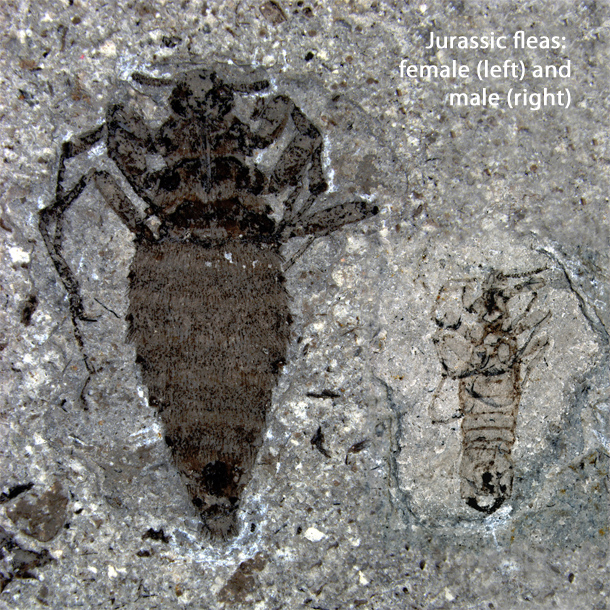
Mesozoic fleas

Giant Mesozoic fleas from China, 1.4 and 0.8 cm long. From Huang et al. (2012)

Strange as it might seem, rather than bringing to mind the opening pages of Michael Crichton’s Jurassic Park ancient fleas suggest to me Frederick Engels’s Dialectics of Nature (1883). In his lampoon of determinism, which might today be directed at a famous evolutionary biologist, Engels wrote:

‘…last night I was bitten by a flea at four o’clock in the morning, and not at three or five o’clock, and on the right shoulder and not on the left calf – these are all facts which have been produced by an irrevocable concatenation of cause and effect, by an unshatterable necessity of such a nature indeed that the gaseous sphere, from which the solar system was derived, was already so constituted that these events had to happen thus and not otherwise.’

But a paper about fossil fleas from the time of the dinosaurs was always going to catch the eye (Huang, D. et al. 2012. Diverse transitional giant fleas from the Mesozoic era of China. Nature, v. 483, p. 201-204), and that they come from China does have an element of inevitability that arises from that country’s rich endowment with sites of exceptional preservation. The fleas are not at all like the shiny creatures that are so difficult to trap in the fur of a cat’s ear, and they are big: up to 2 cm long. Two species come from Middle Jurassic and one from the Lower Cretaceous. The fascinating thing about fleas, however, is that they evolved to live and thrive in fur and feathers.  This niche is signified by their claws, whose form and articulation avoid entanglement with fibres: which is why cat fleas are so nimble. While cat fleas are flattened laterally to help them slip though fur and have powerful legs that allows them to leap from host to host, the Mesozoic fleas are flat from back to front and are not so leggy.

English: This photo was taken by Andy Brookes ...
Cat flea ~1.5 mm long. Image via Wikipedia

Being so large, it seems unlikely that these Mesozoic fleas would have parasitized mammals that were probably far smaller on average than now. But by the Jurassic fossil evidence, largely from China, shows that dinosaurs had developed feather-like cover. Their evolution itself created a niche occupied thereafter by fleas and other bloodsuckers. They are wingless relatives of flies (Order: Diptera) that first appear in the Triassic fossil record, both thought to have stemmed from more primitive scorpionflies (Order: Mecoptera)

Greening and changing the land

English: Liverwort Liverworts are small plants...
A very British liverwort mat. Image via Wikipedia

Evidence for the earliest colonisation of the continents by plants is in the form of spores and body fragments from terrestrial sediments of Middle Ordovician age (~470 Ma) (Rubinstein, C.  et al. 2010. Early Middle Ordovician evidence for land plants in Argentina (eastern Gondwana). New Phytologist, v. 188, p. 365-369)suggest that the first vegetation cover involved simple ground-hugging plants that lacked stems of roots, very like the liverworts that I struggle to deter from my gravel drive. Vinegar is the only solution, preferably boiling, but that does not harm their spores and inevitably they re-emerge. Rearranging the gravel, of a pale pink limestone, is one of a very few means of keeping fit that I can bear, and I suppose the liverworts spice that up a little: but I do detest them. Part of their irritation is that they form an impermeable coating to what once was a passable if minor aquifer that channelled rainfall that would otherwise repeat the house-flooding that greeted me within a day of my moving in. So it was with some solemnity that I read a paper on how these damnable organisms transformed the Ordovician continental surface and the geomorphological processes that shaped it (Gibling, M.R. & Davies, N.S 2012. Palaeozoic landscapes shaped by plant evolution. Nature Geocience, v. 5, p. 99-105).

Sedimentologists have shown that rivers of earlier times formed wide tracts of ephemeral braided channels that transported and reworked sands and gravels that were not hampered by any vegetable binding agent. Floods merely accelerated the braiding and spread coarse sediment across valley floors, repeated spates washing out almost of the fines to take them ultimately to the continental shelves: there are few if any relics of Cambrian and older muddy floodplains. Moreover, untrammelled by vegetation any remaining fine material would be picked up by wind, even in humid climates, to meet the same marine fate. Overbank deposits of silts and clays, unsurprisingly, demand banks over or through which floodwater  escapes from defined channels and is then delayed by low gradients away from the main flow, so to deposit the fines carried by its sluggish speed. Except in arid terrains where braided channels are still the rule, in succeeding geological time evidence grows for nowadays familiar channels, meanders with point bars and eroded opposite banks, levées and floodplains on every conceivable scale. Apparently, they became conspicuous in Silurian times and then forming 30% of all fluvial sediments by the Devonian.

Meanwhile, plants were diversifying though evolution of vascular systems that transport sap up supporting structures that emerged in parallel eventually to form trunks and branches. The consequent rise in volume and in area exposed to sunlight and photosynthesis of a plant’s tissues increased the potential to draw CO2 from the air, witnessed by changes in carbon isotopes that show carbon burial rising shortly after the mid-Ordovician from far lower values in earlier times. (Incidentally, it seems likely that such meagre colonisers as early liverworts thrived sufficiently to contribute to the cooling in the Upper Ordovician that led to sporadic glacial episodes).  Preservation of wood in peats – liverworts are not implicated in any kind of fossil-fuel production – helped to maximise carbon burial by the end of the Palaeozoic Era. But trees make logs and, carried by rivers, logjams. By the Upper Carboniferous effects of damming become common in fluvial sediments, which seemed to serve the formation of islands within wide river channels.

By the present day, vegetation has come to dominate all but the most arid river systems. Even in central Australia sturdy gums able only to get water from below ephemeral river beds end up defining the flow regime and stabilising it on low relief plains that would otherwise be ravaged by sheet floods every rainy season. The authors support stratigraphic observations through the use of scaled down models of channels in vegetated areas by the cunning use of alfalfa seeded to sprout during simulated dry conditions then resuming channel flow in a flume tank.

Gilboa Fossils - Gilboa, New York
Fossils tree stumps from Gilboa, New York (Photo credit: Dougtone)

The earliest substantial trees, represented by wood fragments rarely assignable to any particular structure, occur in the Middle Devonian (385-400 Ma). Although some groups can be differentiated, how their encompassing woodland ecosystems looked has been a mystery until recently . Being ‘priitive’ it has been assumed to be very simple, unlike the well-documented forests of the Carboniferous coal swamps. But, once in a while, a site of exceptional preservation is unearthed, one such being a palaeosol that clearly formed on the floor of a Middle Devonian woodland exposed by quarrying in New York state, USA (Stein, W.E. et al. 2012. Surprisingly complex community found in the mid-Devonian fossil forest at Gilboa. Nature, v. 483, p. 78-81). Once backfill accumulated during the quarry’s active life was removed it became possible to plot the arrangement of roots systems of the last trees to live at the site before inundation and preservation.  Together with other plant material found in the ancient soil, the growing sites have been reconstructed to assess the full ecosystem involved. It was a great deal more complex than previously thought possible, with a series of tiers formed by three large tree types: tall, lollipop-like Eospermatopteris; smaller lycopsid-like trees and subsurface propagators related to gymnosperms that sprouted to form an understorey that may have climbed the larger trees in the manner of vines. Its setting was akin to that of modern mangrove swamps – by the sea – subject to sea-level change that inundated, killed and preserved the coastal woodland.