The subduction pulley: a new feature of plate tectonics

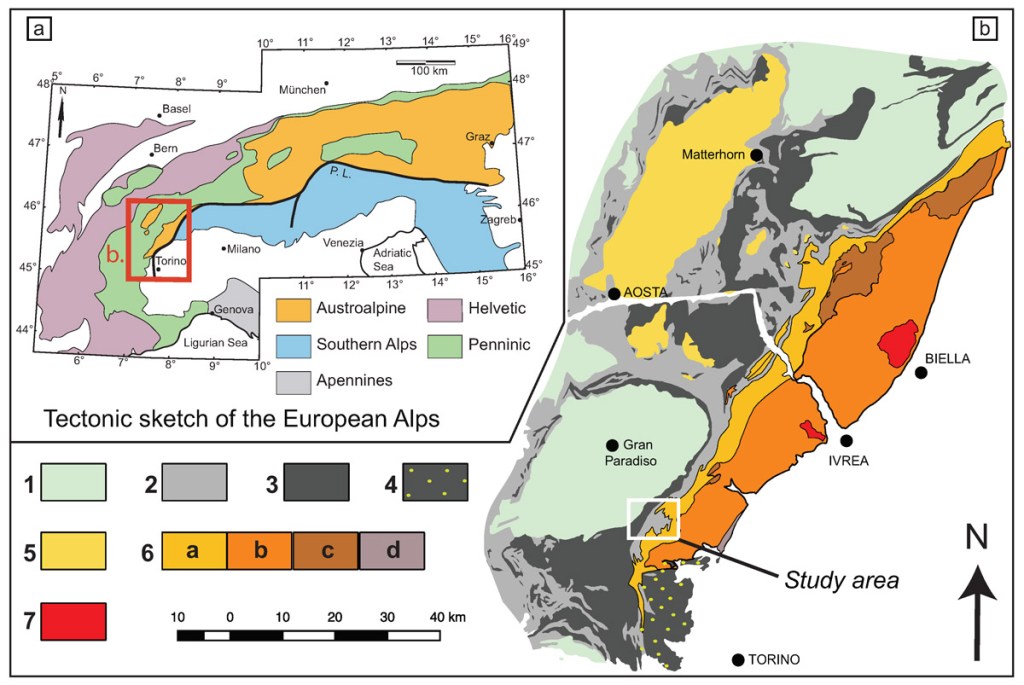
Geological map of part of the Italian Alps. The Sesia-Lanzo Zone is 6 in the Key: a – highly deformed gneisses; b – metasedimentary schists with granite intrusions; c – mafic rocks; d – mixed mantle and crystalline basement rocks. (Credit: M. Assanelli, Universita degli Studi di Milano)

To a first approximation, as they say, the basis of plate tectonics is that the lithosphere is divided up into discrete, rigid plates that are bounded by lines of divergent, convergent and sideways relative motions: constructive, destructive and conservative plate margins. These are characterised by zones of earthquakes whose senses of motion roughly correspond to the nature of each boundary: normal, reverse and strike-slip, respectively. The seismicity is mainly confined to the lithosphere in the cases of constructive and conservative boundaries (i.e. shallow) but extends as deep as 700 km into the mantle at destructive margins, thereby defining the subduction of lithosphere that remains cool enough to retain its rigidity. Although the definition assumes that there is no deformation within plates, in practice that does occur for a wide variety of reasons in the form of intra-plate seismicity, mainly within continental lithosphere. Oceanic plate interiors are much stronger and largely ‘follow the rules’; they are generally seismically quiet.

One important feature of plate tectonics is the creation of new subduction zones when an earlier one eventually ceases to function. Where these form in an oceanic setting volcanism in the overriding plate creates island arcs. They create precursors of new continental crust because the density of magmas forming the new lithosphere confers sufficient buoyancy for them to be more difficult to subduct. Eventually island arcs become accreted onto continental margins through subduction of the intervening oceanic lithosphere. Joining them in such ‘docking’ are microcontinents, small fragments spalled from much older continents because of the formation of new constructive plate margins within them. It might seem that arcs and microcontinents behave like passive rafts to form the complex assemblages of terranes that characterise continental mountain belts, such as those of western North America, the Himalaya and the Alps. Yet evidence has emerged that such docking is much more complicated (Gün, E. et al. 2021. Pre-collisional extension of microcontinental terranes by a subduction pulleyNature Geoscience, v. 14, online publication; DOI: 10.1038/s41561-021-00746-9).

Erkan Gün and colleagues from the University of Toronto and Istanbul Technical University examined one of the terranes in the Italian Alps – the Sesia-Lanzo Zone (SLZ) – thought to have been a late-Carboniferous microcontinental fragment in the ocean that once separated Africa from Europe. When it accreted the SLZ was forced downwards to depths of up to 70 km and then popped up in the latter stages of the Alpine orogeny. It is now a high-pressure, low-temperature metamorphic complex, having reached eclogite facies during its evolution. Yet its original components, including granites that contain the high-pressure mineral jadeite instead of feldspar, are still recognisable. Decades of geological mapping have revealed that the SLZ sequence shows signs of large-scale extensional tectonics. Clearly that cannot have occurred after its incorporation into southern Europe, and must therefore have taken place prior to its docking. Similar features are present within the accreted microcontinental and island-arc terranes of Eastern Anatolia in Turkey. In fact, most large orogenic belts comprise hosts of accreted terranes that have been amalgamated into older continents.
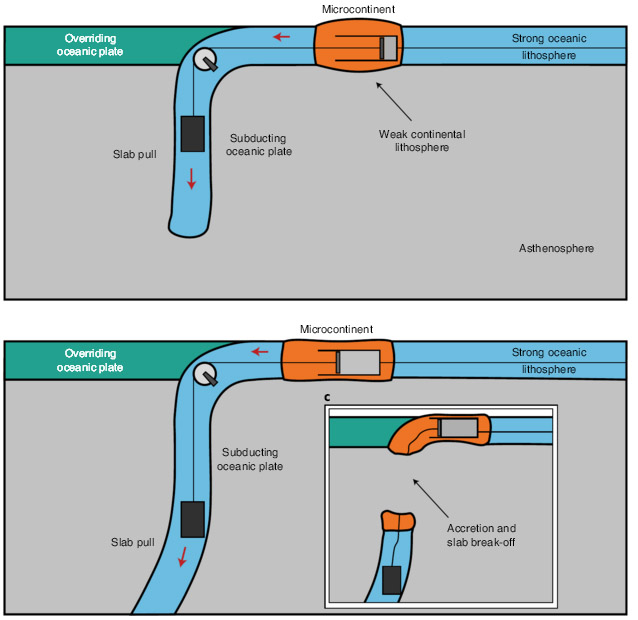
An ‘engineering’ simplification of the subduction pulley. Different elements represent slab weight (slab pull force) transmitted through a pulley at the trench to a weak microcontinent and a strong oceanic lithosphere. (Credit: Gün et al., Fig. 4)

Lithospheric extension associated with convergent plate margins has been deduced widely in the form of back-arc basins. But these form in the plate being underidden by a subduction zone. Extension of the SLZ, however, must have taken place in the plate destined to be subducted. Gün et al. modelled the forces, lithospheric structure, deformation and tectonic consequences that may have operated to form the SLZ, for a variety of microcontinent sizes. The pull exerted by the subduction of oceanic lithosphere (slab pull) would exert extensional forces on the lithosphere as it approached the destructive plate boundary. Oceanic lithosphere is very strong and would remain intact, simply transmitting slab-pull force to the weaker continental lithosphere, which ultimately would be extended. This is what the authors call a subduction ‘pulley’ system. At some stage the microcontinent fails mechanically, part of it being detached to continue with the now broken slab down the subduction zone. The rest would become a terrane accreted to the overriding plate. Subduction at this site would stop because the linkage to the plate has broken. It may continue by being transferred to a new destructive margin ‘behind’ the accreted microcontinent. This would allow other weak continental and island-arc ‘passengers’ further out on the oceanic plate eventually to undergo much the same process.

The observed complexity of tectonic terranes in other vast assemblies of them, such as the northern Pacific coast of North America and in many more ancient orogenic belts, is probably as much a result of extension before accretion as the compressional deformation suffered afterwards. The theoretical work by Erkan Gün and colleagues will surely spur tectonicians to re-evaluate earlier models of orogenesis.

Note: Figure 2 in the paper by Gün et al. shows how the width (perpendicular to the subduction zone) affects the outcomes of the subduction pulley. View an animation of a subduction pulley

When did supercontinents start forming?

Plate tectonics is easily thought of as being dominated by continental drift, the phenomenon that Alfred Wegener recognised just over a century ago. So it is at present, the major continents being separated by spreading oceans. Yet, being placed on a near-spherical planet, continents also move closer to others; eventually to collide and weld together. Part of Wegener’s concept was that modern continents formed from the breakup of a single large one that he called Pangaea; a supercontinent. The current drifting apart began in earnest around the end of the Triassic Period (~200 Ma), after 200 Ma  of Pangaea’s dominance of the planet along with a single large ocean (Panthalassa) covering 70% of the Earth’s surface. Wegener was able to fit Pangaea together partly on the basis of evidence from the continents’ earlier geological history. In particular the refit joined up zones of intense deformation from continent to continent. Although he did not dwell on their origin, subsequent research has shown these zones were the lines of earlier collisions between older continental blocks, once subduction had removed the intervening oceanic lithosphere; Pangaea had formed from an earlier round of continental drift. Even older collision zones within the pre-Pangaea continental blocks suggested the former existence of previous supercontinents.

Aided by the development of means to divine the position of the magnetic poles relative to differently aged blocks on the continents, Wegener’s basic methods of refitting have resulted in the concept of supercontinent cycles of formation and break-up. It turns out that supercontinents did not form by all earlier continental clanging together at one time. The most likely scenario is that large precursors or ‘megacontinents’ (Eurasia is the current example) formed first, to which lesser entities eventually accreted  A summary of the latest ideas on such global tectonic cycles appeared in the November 2020 issue of Geology (Wang, c. et al. 2020. The role of megacontinents in the supercontinent cycle. Geology, v. 49  p. 402-406; DOI: 10.1130/G47988.1). Chong Wang of the Chinese Academy of Sciences and colleagues from Finland and Canada identify three such cycles of megacontinent formation and the accretion around them of the all-inclusive supercontinents of Columbia, Rodinia and Pangaea since about 1750 Ma (Mesoproterozoic). They also suggestion that a future supercontinent (Amasia) is destined to agglomerate around Eurasia.

Known megacontinents in relation to suggested supercontinents since the Mesoproterozoic (credit: Wang et al.; Fig 2)

The further back in time, the more cryptic are ancient continent-continent collision zone or sutures largely because they have been re-deformed long after they formed. In some cases younger events that involved heating have reset their radiometric ages. The oldest evidence of crustal deformation lies in cratons, where the most productive source of evidence for clumping of older continental masses is the use of palaeomagnetic pole positions. This is not feasible for the dominant metamorphic rocks of old suture zones, but palaeomagnetic measurements from old rocks that have been neither deformed nor metamorphosed offer the possibility of teasing out ancient supercontinents. Commonly cratons show signs of having been affected by brittle extensional deformation, most obviously as swarms of vertical sheets or dykes of often basaltic igneous rocks. Dykes can be dated readily and do yield reliable palaeomagnetic pole positions. Some cratons have multiple dyke swarms. For example the Archaean Yilgarn  Craton of Western Australia, founded on metamorphic and plutonic igneous crust that formed by tectonic accretion between 3.8 to 2.7 Ga, has five of them spanning 1.4 billion years from late-Archaean (2.6 Ga) to Mesoproterozoic (1.2 Ga). Throughout that immense span of time the Yilgarn remained as a single continental block. Also, structural trends end abrubtly at the craton margins, suggesting that it was once part of a larger ‘supercraton’ subsequently pulled apart by extensional tectonics.  The eleven known cratons show roughly the same features.

On the strength of new, high quality pole positions from dykes of about the same ages (2.62 and 2.41 Ga) cutting the Yilgarn and Zimbabwe cratons, geoscientists from Australia, China, Germany, Russia and Finland, based at Curtin University in Western Australia, have attempted to analyse all existing Archaean and Palaeoproterozoic pole positions (Liu, Y. et al. 2021. Archean geodynamics: Ephemeral supercontinents or long-lived supercratons. Geology, v. 49  ; DOI: 10.1130/G48575.1). The Zimbabwe and Yilgarn cratons, though now very far apart, were part of the same supercraton from at least 2.6 Ga ago. Good cases can be made for several other such large entities, but attempting fit them all together as supercontinents by modelling is unconvincing. The modelled fit for the 2.6 Ga datum is very unlike that for 2.4 Ga; in the intervening 200 Ma all the component cratons ould have had to shuffle around dramatically, without the whole supercontinent edifice breaking apart. However, using the data to fit cratons together at two supercratons does seem to work, for the two assemblies remain in the same configurations for both the 2.6 and 2.4 Ga data.

Interestingly, all cratonic components of one of the supercratons show geological evidence of the major 2.4 Ga glaciation, whereas those of the other show no such climatic indicator. Yet the entity with glacial evidence was positioned at low latitudes around 2.4 Ga, the ice-free one spanning mid latitudes. This may imply that the Earth’s axial tilt was far higher than at present. The persistence of two similar sized continental masses for at least 200 Ma around the end of the Archaean Eon also hints at a different style of tectonics from that with which geologists are familiar. Only palaeomagnetic data from the pre 2.6 Ga Archaean can throw light on that possibility. That requires older, very lightly or unmetamorphosed rocks to provide palaeopole positions. Only two cratons, the Pilbara of Western Australia and the Kaapvaal of South Africa, are suitable. The first yielded the oldest-known pole dated at 3.2 Ga, the oldest from the second is 2.7 Ga. A range of evidence suggests that Pilbara and Kaapvaal cratons were united during at least the late Archaean.

The only answer to the question posed by this item’s title is ‘There probably wasn’t a single supercontinent at the end of the Archaean, but maybe two megacontinents or supercratons’. Lumps of continental lithosphere would move and – given time – collide once more than one lump existed, however the Earth’s tectonics operated …

The oldest known impact structure (?)

That large, rocky bodies in the Solar System were heavily bombarded by asteroidal debris at the end of the Hadean Eon (between 4.1 to 3.8 billion years ago) is apparent from the ancient cratering records that they still preserve and their matching with dating of impact-melt rocks on the Moon. Being a geologically dynamic planet, the Earth preserves no tangible, indisputable evidence for this Late Heavy Bombardment (LHB), and until quite recently could only be inferred to have been battered in this way. That it actually did happen emerged from a study of tungsten isotopes in early Archaean gneisses from Labrador, Canada (see: Tungsten and Archaean heavy bombardment, August 2002; and Did mantle chemistry change after the late heavy bombardment? September 2009). Because large impacts deliver such vast amounts of energy in little more than a second (see: Graveyard for asteroids and comets, Chapter 10 in Stepping Stones) they have powerful consequences for the Earth System, as witness the Chicxulub impact off the Yucatán Peninsula of Mexico that resulted in a mass extinction at the end of the Cretaceous Period. That seemingly unique coincidence of a large impact with devastation of Earth’s ecosystems seems likely to have resulted from the geology beneath the impact; dominated by thick evaporite beds of calcium sulfate whose extreme heating would have released vast amounts of SO2 to the atmosphere. Its fall-out as acid rain would have dramatically affected marine organisms with carbonate shells. Impacts on land would tend to expend most of their energy throughout the lithosphere, resulting in partial melting of the crust or the upper mantle in the case of the largest such events.

The further back in time, the greater the difficulty in recognising visible signs of impacts because of erosion or later deformation of the lithosphere. With a single, possible exception, every known terrestrial crater or structure that may plausibly be explained by impact is younger than 2.5 billion years; i.e. they are post-Archaean. Yet rocky bodies in the Solar System reveal that after the LHB the frequency and magnitude of impacts steadily decreased from high levels during the Archaean; there must have been impacts on Earth during that Eon and some may have been extremely large. In the least deformed Archaean sedimentary sequences there is indirect evidence that they did occur, in the form of spherules that represent droplets of silicate melts (see: Evidence builds for major impacts in Early Archaean; August 2002, and Impacts in the early Archaean; April 2014), some of which contain unearthly proportions of different chromium isotopes (see: Chromium isotopes and Archaean impacts; March 2003). As regards the search for very ancient impacts, rocks of Archaean age form a very small proportion of the Earth’s continental surface, the bulk having been buried by younger rocks. Of those that we can examine most have been subject to immense deformation, often repeatedly during later times.

The Archaean geology of part of the Akia Terrane (Manitsoq area) in West Greenland. The suggested impact structure is centred on the Finnefjeld Gneiss (V symbols) surrounded by highly deformed ultramafic to mafic igneous rocks. (Credit: Jochen Kolb, Karlsruhe Institute of Technology, Germany)

There is, however, one possibly surviving impact structure from Archaean times, and oddly it became suspected in one of the most structurally complex areas on Earth; the Akia Terrane of West Greenland. Aeromagnetic surveys hint at two concentric, circular anomalies centred on a 3.0 billion years-old zone of grey gneisses (see figure) defining a cryptic structure. It is is surrounded by hugely deformed bodies of ultramafic and mafic rocks (black) and nickel mineralisation (red). In 2012 the whole complex was suggested to be a relic of a major impact of that age, the ultramafic-mafic bodied being ascribed to high degrees of impact-induced melting of the underlying mantle. The original proposers backed up their suggestion with several associated geological observations, the most crucial being supposed evidence for shock-deformation of mineral grains and anomalous concentrations of platinum-group metals (PGM).

A multinational team of geoscientists have subjected the area to detailed field surveys, radiometric dating, oxygen-isotope analysis and electron microscopy of mineral grains to test this hypothesis (Yakymchuck, C. and 8 others 2020. Stirred not shaken; critical evaluation of a proposed Archean meteorite impact in West Greenland. Earth and Planetary Science Letters, v. 557, article 116730 (advance online publication); DOI: 10.1016/j.epsl.2020.116730). Tectonic fabrics in the mafic and ultramafic rocks are clearly older than the 3.0 Ga gneisses at the centre of the structure. Electron microscopy of ~5500 zircon grains show not a single example of parallel twinning associated with intense shock. Oxygen isotopes in 30 zircon grains fail to confirm the original proposers’ claims that the whole area has undergone hydrothermal metamorphism as a result of an impact. All that remains of the original suggestion are the nickel deposits that do contain high PGM concentrations; not an uncommon feature of Ni mineralisation associated with mafic-ultramafic intrusions, indeed much of the world’s supply of platinoid metals is mined from such bodies. Even if there had been an impact in the area, three phases of later ductile deformation that account for the bizarre shapes of these igneous bodies would render it impossible to detect convincingly.

The new study convincingly refutes the original impact proposal. The title of Yakymchuck et al.’s paper aptly uses Ian Fleming’s recipe for James Bond’s tipple of choice; multiple deformation of the deep crust does indeed stir it by ductile processes, while an impact is definitely just a big shake. For the southern part of the complex (Toqqusap Nunaa), tectonic stirring was amply demonstrated in 1957 by Asger Berthelsen of the Greenland Geological Survey (Berthelsen, A. 1957. The structural evolution of an ultra- and polymetamorphic gneiss-complex, West Greenland. Geologische Rundschau, v. 46, p. 173-185; DOI: 10.1007/BF01802892). Coming across his paper in the early 60s I was astonished by the complexity that Berthelsen had discovered, which convinced me to emulate his work on the Lewisian Gneiss Complex of the Inner Hebrides, Scotland. I was unable to match his efforts. The Akia Terrane has probably the most complicated geology anywhere on our planet; the original proposers of an impact there should have known better …

Weak lithosphere delayed the formation of continents

There are very few tangible signs that the Earth had continents at the surface before about 4 billion years (Ga) ago. The most cited evidence that they may have existed in the Hadean Eon are zircon grains with radiometric ages up to 4.4 Ga that were recovered from much younger sedimentary rocks in Western Australia. These tiny grains also show isotopic anomalies that support the existence of continental material, i.e. rocks of broadly granitic composition, only 100 Ma after the Earth formed (see: Zircons and early continents no longer to be sneezed at; February 2006). So, how come relics of such early continents have yet to be discovered in the geological record? After all granitic rocks – in the broad sense – which form continents are so less dense than the mantle that modern subduction is incapable of recycling them en masse. Indeed, mantle convection of any type in the hotter Earth of the Hadean seems unlikely to have swallowed continents once they had formed. Perhaps they are hiding in another guise among younger rocks of the continental crust. But, believe me; geologists have been hunting for them, to no avail, in every scrap of existing continental crust since 1971 when gneisses found in West Greenland by New Zealander Vic McGregor turned out to be almost 3.8 Ga old. This set off a grail-quest, which still continues, to negate James Hutton’s ‘No vestige of a beginning …’ concept of geological time.

There is another view. Early continental lithosphere may have returned to the mantle piece by piece by other means. One that has been happening since the Archaean is as debris from surface erosion and its transportation to the ocean floor, thence to be subducted along with denser material of the oceanic lithosphere. Another possibility is that before 4 Ga continental lithosphere had far less strength than characterised it in later times; it may have been continually torn into fragments small enough for viscous drag to defy buoyancy and consign them into the mantle by convective processes. Two things seem to confer strength on continental lithosphere younger than 4 billion years: its depleted surface heat flow and heat-production that stem from low concentrations of radioactive isotopes of uranium, thorium and potassium in the lower crust and sub-continental mantle; bolstering by cratons that form the cores of all major continents. Three geoscientists at Monash University in Victoria, Australia have examined how parts of early convecting mantle may have undergone chemical and thermal differentiation (Capitanio, F.A. et al. 2020. Thermochemical lithosphere differentiation and the origin of cratonic mantle.  Nature, v. 588, p. 89-94; DOI: 10.1038/s41586-020-2976-3). These processes are an inevitable outcome of the tendency for mantle melting to begin as it becomes decompressed when pressure decreases when it rises during convection. Continual removal of the magmas produced in this way would remove not only much of the residue’s heat-producing capacity – U, Th and K preferentially enter silicate melts – but also its content of volatiles, especially water. Even if granitic magmas were completely recycled back to the mantle by the greater vigour of the hot, early Earth, at least some of the residue of partial melting would remain. Its dehydration would increase its viscosity (strength). Over time this would build what eventually became the highly viscous thick mantle roots (tectosphere) on which increasing amounts of the granitic magmas could stabilise to establish the oldest cratons. Over time more and more such cratonised crust would accumulate, becoming increasingly unlikely to be resorbed into the mantle. Although cratons are not zoned in terms of the age of their constituent rocks, they do jumble together several billion years’ worth of continental crust in what used to be called ‘the Basement Complex’.

Development of depleted and viscous sub-continental mantle on the early Earth – a precedes b – TTG signifies tonalite-trondhjemite-granodiorite rocks typical of Archaean cratons (Credit, Capitanio et al.; Fig 5)

Early in this process, heat would have made much of the lithosphere too weak to form rigid plates and the tectonics with which geologists are so familiar from the later parts of Earth’s history. The evolution that Capitanio et al. propose suggests that the earliest rigid plates were capped by Archaean continental crust. That implies subduction of oceanic lithosphere starting at their margins, with intra-oceanic destructive plate margins and island arcs being a later feature of tectonics. It is in the later, Proterozoic Eon that evidence for accretion of arc terranes becomes obvious, plastering their magmatic products onto cratons, further enlarging the continents.

Kerguelen Plateau: a long-lived large igneous province

It’s easy to think of the Earth’s largest outpourings of lava as being restricted to the continents; continental flood basalts with their spectacular stepped topography made up of hundreds of individual massive flows and intervening soil horizons. The Deccan Traps of western India are the epitome, having been so named by natural scientists of the late 18th century from the Swedish word for ‘stairs’ (trappa). Examples go back to the Proterozoic Era, younger ones still retaining much of their original form as huge plateaus. All began life within individual tectonic plates, although some presaged continental break-up and the formation of new oceanic spreading centres. They must have been spectacular events, up to millions of cubic kilometres of magma belched out in a few million years. They have been explained as manifestations of plumes of hot mantle rock rising from as deep as the core-mantle boundary. Unsurprisingly, the biggest continental flood-basalt outpourings coincided with mass extinction events. Otherwise known as large igneous provinces (LIPs), they are not the only signs of truly huge production of magma by partial melting in the mantle. The biggest LIP, with an estimated volume of 80 million km3, lies deep beneath the Western Pacific Ocean. To the northeast of New Guinea, the Ontong Java Plateau formed over a period of about 3 Ma in the mid-Cretaceous (~120 Ma) and blanketed one percent of the Earth’s solid surface with lavas erupted at a rate of 22 km3 per year. Possibly because this happened on the Pacific’s abyssal plains beneath around 4 km of sea water, there is little sign of any major perturbation of mid-Cretaceous life, but it is associated with evidence for global oceanic anoxia. Ontong Java isn’t the only oceanic LIP. Bearing in mind that oceanic lithosphere only goes back to the start of the Jurassic Period (200 Ma) – earlier material has largely been subducted – they are not as abundant as continental flood-basalt provinces. One of them is the Kerguelen Plateau 3000 km to the SE of Australia, which is about three times the area of Japan and the second largest LIP of the Phanerozoic Eon. The Plateau was split into two large fragments while sea-floor spreading progressed along the Southeast Indian Ridge.

Bathymetry of the Indian Ocean south-west of Australia, showing the Kerguelen Plateau and South-east Indian Ridge. The red arrows show the amount of sea-floor spreading on either side of the Ridge since it began to open. The pale blue area at the NE end of the arrow was formerly part of the Plateau (credit: Google Earth)

Long regarded as a microcontinental  fragment left when India parted company with Antarctica – based on isolated occurrences of gneisses – there is evidence that during the formation of the Kerguelen LIP the basalts rose above sea level. Because earlier radiometric dating of basalts from ocean-floor drill cores were of low quality, an Australian-Swedish group of geoscientists have re-evaluated those data and supplemented them with 25 new Ar-Ar dates from 12 sites (Jiang, Q. et al. 2020. Longest continuously erupting large igneous province driven by plume-ridge interaction. Geology, v. 48, online; DOI: 10.1130/G47850.1). Rather than a cluster of ages around a short time range as expected from the short life of most other LIPs, those from Kerguelen span 32 Ma during the Cretaceous (from 122 to 90 Ma). The magmatic pulse began at roughly the same time as that of Ontong Java, but continued for much longer. Smaller oceanic LIPs do seem to have lingered for unusually lengthy periods, but all seem to have constructed in several separate pulses. Large-volume eruption at Kerguelen was continuous for at least 32 Ma; the drilling did not penetrate the oldest of the plateau basalts. It seems that the Kerguelen LIP is unique in that respect and requires an explanation other than simply a mantle plume, however large.

Jiang et al. suggest a model of continuous interaction between a long-lived plume and the development of the Southeast Indian Ridge oceanic spreading centre. Their model involves the line of continental splitting between India and Antarctic taking place close to a major deep-mantle plume at around 128 Ma. There is nothing unique about that; incipient ocean rifting in the Horn of Africa and formation of the Red Sea and Gulf of Aden ridges is currently associated with the active Afar plume. This was followed by a kind of tectonic shuffling of the Ridge back and forth across the head of the Kerguelen plume: not far different from the Palaeogene North Atlantic LIP, where the mid-Atlantic Ridge and the still-active Iceland plume, except the ridge and plume seem more intimately involved there. However, there are probably many subtle relationships between plumes and various kind of oceanic plate margins that are still worth exploring. Since the first discovery of mantle plumes as an explanation for volcanic island chains (e.g. the Hawaiian chain) where volcanism becomes progressively older in the direction of plate movement, there is still much to discover.

See also: Magma .conveyor belt’ fuelled world’s longest erupting supervolcanoes (Science Daily, 4 November 2020)

Environmental change and early-human innovation

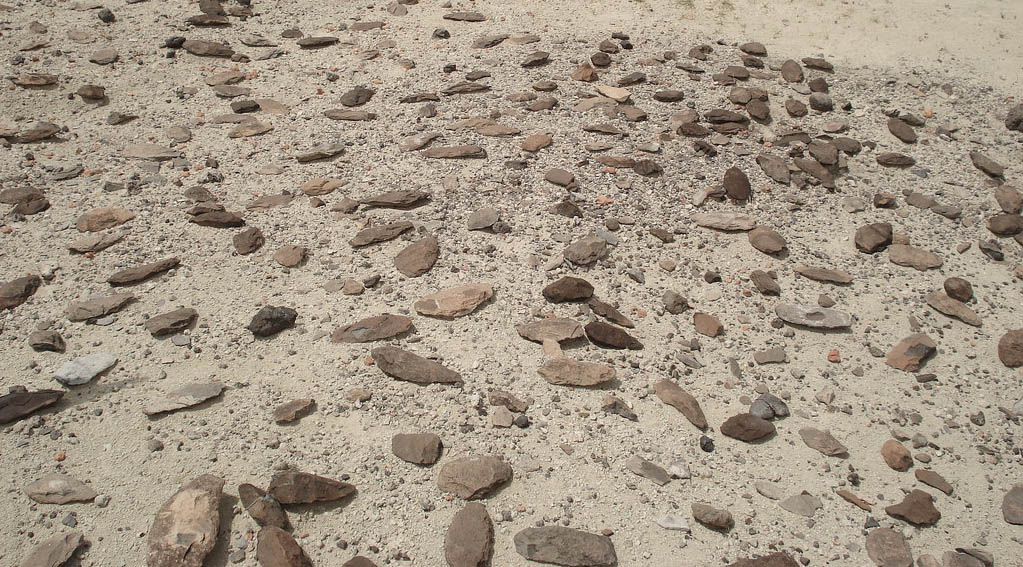
Acheulean biface tools strewn on a bedding surface in the Olorgesailie Basin, Kenya (credit: mmercedes_78 Flickr)

The Olorgesailie Basin in Southern Kenya is possibly the world’s richest source for evidence of ancient stone-tool manufacture. For early humans, it certainly was rich in the necessary resources from which to craft tools. Lying in East Africa’s active rift system, its stratigraphy contains abundant beds of hydrothermal silica (chert), deposited by hot springs, and flows of fine grained lavas. Its sediments spanning the last 1.2 million years show that the Basin hosted lakes and extensive river systems for the earlier part of this period: it was rich in food resources too. The tools, together with bones from dismembered prey, bear witness to long-term human occupation, but hominin remains themselves have yet to be discovered. The time span suggests early occupation by Homo erectus, who probably manufactured Acheulean biface stone tools in large quantities that litter the surface at some archaeological sites.

There is a break in the stratigraphic sequence from about 500 to 320 thousand years ago caused by erosion during a period of tectonic uplift. Younger sediments reveal a striking change in archaeology. The earlier large cutting tools give way to a more diverse ‘toolkit’ of smaller tools produced by more sophisticated techniques than those used to make the Acheulean ‘hand axes’. In African archaeological parlance, the <320 ka-old tools mark the onset of the Middle Stone Age (NB not equivalent to the much younger Mesolithic of Europe). The sedimentary gap also marks what seems to have been very different human behaviour. The stone resources used in the 1.2 to 0.5 Ma sequence were local: no more than 5 km from the tool-yielding sites. After the gap a much more varied range of lithologies was used, from as far afield as 95 km. Not only that, but rock unsuitable for tools appears: soft pigments such as hematite.

The foregoing was known from three major papers that appeared in March 2018 (see: Human evolution and revolution in Africa, March 2018 – specifically the section Hominin cultural revolution 320,000 years ago). Now, many members of the teams who produced that published evidence report detailed analysis of samples from a deep drill core through the stratigraphy in a similar, nearby basin (Potts, R. and 21 others 2020. Increased ecological resource variability during a critical transition in hominin evolutionScience Advances, v. 6, article eabc8975; DOI:10.1126/sciadv.abc8975). As well as calibrating the timing of stratigraphic changes using 40Ar/39Ar dating from 22 volcanic layers, the team analysed sedimentary structures, body- and trace fossils, variations in sediment geochemistry, palaeobotany and carbon isotopes, to suggest variations in environmental conditions and ecology throughout the section in greater detail than previously achieved anywhere in Africa.

They conclude that as well as a change in topography resulting from the 500-320 ka period of tectonic uplift and erosion, the climate of this part of East Africa became more unstable. Combined, these two factors transformed the ecosystems of the Olorgesailie Basin. Between 1.2 to 0.5 Ma the Acheulean tool makers inhabited dominantly grassy plains with substantial, permanent lakes – a stable period of 700 thousand years, well suited to large herbivores and thus to these early humans. Tectonic and climatic change disrupted a ‘land of plenty’; the herbivores left to be replaced by smaller prey animals; vegetation shifted back and forth from grassland to woodland with the unstable climate; lakes became smaller and ephemeral. The problem in linking environmental change to changed human practices in this case, however, is the 180 thousand-year gap in the geological record. Lead author Richard Potts, director of the Human Origins Program at the Smithsonian’s National Museum of Natural History, and his team suggest that the change contributed to the ecological flexibility of the probable Homo sapiens who left the fancier, more diverse tools during the later phase. Yet 1.6 million years beforehand early H. erectus had sufficient flexibility to cross 30 to 40 degrees of latitude and end up on the shores of the Black Sea in Georgia! The likely late-stage H. erectus of Olorgesailie may have moved out around 500 ka ago and sometime later early H. sapiens moved in with new technology developed elsewhere. We know that the earliest known anatomically modern humans lived in Morocco at around 315 ka (see: Origin of anatomically modern humans, June 2017): but we don’t know what tools they had or where they went next. There are all sorts of possibilities that cannot be addressed by even the most intricate analysis of secondary evidence. The important issue seems, I think, to centre on the transition from erects to sapiens, in anatomical, cognitive and behavioural contexts, via some intermediary such as H. antecessor, to which this study can contribute very little. That needs complete stratigraphic records: ironically, the other basin from which the core was drilled is apparently more complete, especially for the 500 to 320 ka ‘gap’. That seems likely to offer more potential. Yet, such big questions also demand a much broader brush: perhaps on a continental scale. It’s to early to tell …

See also: Turbulent era sparked leap in human behavior, adaptability 320,000 years ago (Science Daily,21 October 2020)

How continental keels and cratons may have formed

There is Byzantine ring to the word craton: hardly surprising as it stems from the Greek kratos meaning ‘might’ or ‘strength’. Yes, the ancient cores of the continents were well named, for they are mighty. Some continents, such as Africa, have several of them: probably relics of very ancient supercontinents that have split and spread again and again. Cratons overlie what are almost literally the ‘keels’ of continents. Unlike other mantle lithosphere beneath continental crust (150 km on average) cratonic lithosphere extends down to 350 km and is rigid. Upper mantle rocks at that depth elsewhere are mechanically weaker and constitute the asthenosphere. Geologists only have evidence from the near-surface on which to base ideas of how cratons formed. Their exposed rocks are always Precambrian in age, from 1.5 to 3.5 billion years old, though in some cases they are covered by a thin veneer of later sedimentary rocks that show little sign of deformation. No cratons formed after the Palaeoproterozoic and they are the main repositories of Archaean rock. Their crust is thicker than elsewhere and dominated at the surface by crystalline rocks of roughly granitic composition. Cratons have the lowest amount of heat flowing out from the Earth’s interior; i.e. heat produced by the decay of long-lived radioactive isotopes of uranium, thorium and potassium. This relative coolness provides an explanation for the rigidity of cratons relative to younger continental lithosphere. Because granitic rocks are well-endowed with heat-producing isotopes, the implication of low heat flow is that the deeper parts of the crust are strongly depleted in them. As a result the deep mantle in cratonic keels is at higher pressure and lower temperature than elsewhere beneath the continental surface. Ideal conditions for the formation of diamonds in mantle rock, so that cratonic keels are their main source – they get to the surface in magma pipes when small amounts of partial melting take place in the lithospheric mantle.

The low heat flow through cratons beckons the idea that the heat-producing elements U, Th and K were at some stage driven from depth. An attractive hypothesis is that they were carried in low-density granitic magmas formed by partial melting of mantle lithosphere during the Precambrian that rose to form continental crust. Yet there is an abundance of younger granite plutons that are associated with thinner continental lithosphere. This seeming paradox suggests different kinds of magmagenesis and tectonics during the early Precambrian. Russian and Australian geoscientists have proposed an ingenious explanation (Perchuk, A.L. et al. 2020. Building cratonic keels in Precambrian plate tectonics. Nature, v. 586, p. 395-401; DOI: 10.1038/s41586-020-2806-7). The key to their hypothesis lies in the 2-layered nature of mantle keels beneath cratons, as revealed by seismic studies. Modelling of the data suggests that the layering resulted from different degrees of partial melting in the upper mantle during Precambrian subduction.

Development of a cratonic keel from melt-depleted lithospheric mantle during early Precambrian subduction. Mantle temperature is 250°C higher than it is today. The oceanic lithosphere being subducted in (a) has become a series of stagnant slabs in (b) (credit: Perchuk et al.; Fig. 2)

Perchuk et al. suggest that high degrees of partial melting of mantle associated with subduction zones produced the bulk of magma that formed the Archaean and Palaeoproterozoic crust. This helps explain large differences between the bulk compositions of ancient and more recent continental crust, which involves less melting. The residue left by high degrees of melting of mantle rock in the early Precambrian would have had a lower density than the rest of the mantle. While older oceanic crust at ancient subduction zones would be transformed to a state denser than the mantle as a whole and thus able to sink, this depleted lithospheric mantle would not. In its hot ductile state following partial melting, this mantle would be ‘peeled’ from the associated oceanic crust to be emplaced below. The figure shows one of several outcomes of a complex magmatic-thermomechanical model ‘driven’ by assumed Archaean conditions in the upper mantle and lithosphere An excellent summary of modern ideas on the start of plate tectonics and evolution of the continents is given by:Hawkesworth, C.J., Cawood, P.A. & Dhuime, B. 2020. The evolution of the continental crust and the onset of plate tectonics. In Topic: The early Earth crust and its formation, Frontiers in Earth Sciences; DOI: 10.3389/feart.2020.00326

Diamonds and the deep carbon cycle

When considering the fate of the element carbon and CO2, together with all their climatic connotations, it is easy to forget that they may end up back in the Earth’s mantle from which they once escaped to the surface. In fact all geochemical cycles involve rock, so that elements may find their way into the deep Earth through subduction, and they could eventually come out again: the ‘logic’ of plate tectonics. Teasing out the various routes by which carbon might get to mantle is not so easily achieved. Yet one of the ways it escapes is through the strange magma that once produced kimberlite intrusions, in the form of pure-carbon crystals of diamond that kimberlites contain. A variety of petrological and geochemical techniques, some hinging on other minerals that occur as inclusions, has allowed mineralogists to figure out that diamonds may form at depths greater than about 150 km. Most diamonds of gem quality formed in unusually thick lithosphere beneath the stable, and relatively cool blocks of ancient continental crust known as cratons, which extends to about 250 km. But there are a few that reflect formation depths as great as 800 km that span two major discontinuities in the mantle (at 410 and 660 km depth). These transition zones are marked by sudden changes in seismic speed due to pressure-induced transformations in the structure and density of the main mantle mineral, olivine.

Diamond crystal containing a garnet and other inclusions (Credit: Stephen Richardson, University of Cape Town, South Africa)

Carbon-rich rocks that may be subducted are not restricted to limestones and carbon-rich mudstones. Far greater in mass are the basalts of oceanic crust. Not especially rich in carbon when they crystallised as igneous rocks, their progress away from oceanic spreading centres exposes them to infiltration by ocean water. Once heated, aqueous fluids cause basalts to be hydrothermally altered. Anhydrous feldspars, pyroxenes and olivines react with the fluids to break down to hydrated-silicate clays and dissolved metals. Dissolved carbon dioxide combines with released calcium and magnesium to form pervasive carbonate minerals, often occupying networks of veins. So there has been considerable dispute as to whether subducted sediments or igneous rocks of the oceanic crust are the main source of diamonds. Diamonds with gem potential form only a small proportion of recovered diamonds. Most are only saleable for industrial uses as the ultimate natural abrasive and so are cheaply available for research. This now centres on the isotopic chemistry of carbon and nitrogen in the diamonds themselves and the various depth-indicating silicate minerals that occur in them as minute inclusions, most useful being various types of garnet.

The depletion of diamonds in ‘heavy’ 13C once seemed to match that of carbonaceous shales and the carbonates in fossil shells, but recent data from carbonates in oceanic basalts reveals similar carbon, giving three possibilities. Yet, when their nitrogen-isotope characteristics are taken into account, even diamonds that formed at lithospheric depths do not support a sedimentary source (Regier, M.E. et al. 2020. The lithospheric-to-lower-mantle carbon cycle recorded in superdeep diamonds. Nature, v. 585, p. 234–238; DOI: 10.1038/s41586-020-2676-z). That leaves secondary carbonates in subducted oceanic basalts as the most likely option, the nitrogen isotopes more reminiscent of clays formed from igneous minerals by hydrothermal processes than those created by weathering and sedimentary deposition. However, diamonds with the deepest origins – below the 660 km mantle transition zone – suggest yet another possibility, from the oxygen isotopes of their inclusions combined with those of C and N in the diamonds. All three have tightly constrained values that most resemble those from pristine mantle that has had no interaction with crustal rocks. At such depths, unaltered mantle probably contains carbon in the form of metal alloys and carbides. Regier and colleagues suggest that subducted slabs reaching this environment – the lower mantle – may release watery fluids that mobilise carbon from such alloys to form diamonds. So, I suppose, such ultra-deep diamonds may be formed from the original stellar stuff that accreted to form the Earth and never since saw the ‘light of day’.

Submarine landslides and formation of the East African Rift System

The East African Rift System (Credit: P.C. Neupane, M.Sc thesis 2011; Fig. 1)

East Africa is traversed from the Afar Depression in the north to Malawi in southern Africa by several great depressions bounded by active normal fault systems: grabens in the old terminology. They are regions of active crustal extension and thinning decorated by chains of active volcanoes. The last 50 years has witnessed more than 3400 major earthquakes (magnitude 4 to 7); unsurprising for the Earth’s largest active continental rift system. In Afar, the East African Rift system links to two others that have extended sufficiently to create oceanic crust: the Red Sea and the Gulf of Aden rifts. Afar is the site of the best documented tectonic triple junction. In Ethiopia, the rifting began after the whole of the Horn of Africa and Yemen had been smothered by continental flood basalts 30 Ma ago, during the Oligocene Epoch. The East African rifts are repositories for younger sediments that contain a continuous record of hominid evolution from about 5 Ma ago. This is no coincidence, for adjacent bulging of the continental crust resulted both from its unloading by thinning along the rifts and the buoyancy conferred by high heat flow in the mantle beneath. The uplifted areas have risen as high as 4 kilometres elevation (in Ethiopia), and present some of the world’s most spectacular land forms. This N-S barrier disrupted earlier climatic patterns that had much of tropical Africa blanketed by dense woodland and resulted in a strongly seasonal climate during the last few million years and the development of open savannah land. Put simply, open grassland with widely spaced trees was no place for diminutive forest apes to scamper on all-fours. Being able to leg-it nimbly on two gave the apes that developed such a gait a decisive evolutionary advantage: the rest, as they say, is human evolutionary history.

The extension and rapid uplift along the rift flanks to this day pose severe risk of landslides. Indeed, some are so large as to resemble fault blocks in their own right. Vast amounts of the upper crust have been stripped off by rapid erosion driven by the uplift. The debris has not only ended-up on the rift floors as sedimentary fill but far more has made its way eastward to be deposited on the Indian Ocean continental shelf. Until recently, piecing together the history of rifting and uplift has been restricted to the rifts themselves and their adjacent flanks. Such terrains have extremely complex and usually discontinuous geological sequences, so signs of the onset of extensional tectonics and uplift may differ from region to region. Agreement is limited to some time between 25 and 17 Ma. The whole tectonic process may, in fact, have begun at different times along the length of the rift. A clearer picture should emerge from studies of the post-30 Ma sedimentary pile along the Indian Ocean continent shelf. A sure-fire way of getting the needed data is from offshore areas that are prospective for oil and natural gas. Such is the case off the Tanzanian coastline at the southern limit of the rift system.

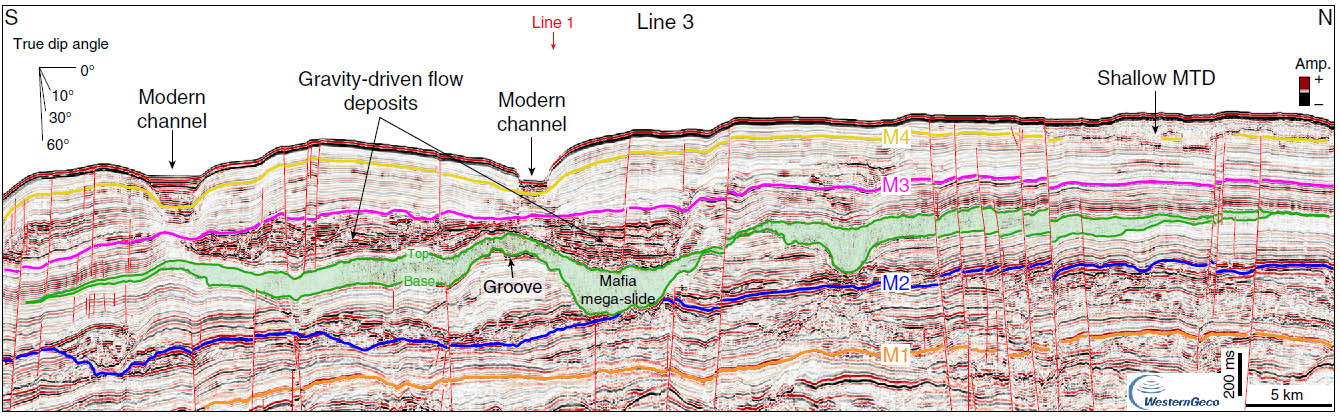
Seismic reflection profile parallel to the Tanzanian coastline with the Mafia mega-slide highlighted in green (Credit: Maselli et al. 2020; Fig. 5) Click to view full resolution

The Tanzania Petroleum Development Corporation and Shell have conducted seismic reflection surveys and drilled some test wells to the SE of Zanzibar Island, an area of major deposition from the eastward flowing Ruaha–Rufiji and Rovuma Rivers. Vittorio Maselli of Dalhousie University in Halifax Nova Scotia and colleagues from the UK, Italy and the Netherlands analysed a wealth of data from these surveys, to discover one of the biggest landslides on Earth (Maselli, V. and 10 others 2020. Large-scale mass wasting in the western Indian Ocean constrains onset of East African rifting. Nature Communications, v. 11, article 3456; DOI: 10.1038/s41467-020-17267-5). The Mafia mega-slide is represented in seismic profiles by a sedimentary unit, up to 300 m thick. It has a highly irregular base that cuts across strata in late-Oligocene to early-Miocene (25-23 Ma) sediments. It covers an area of more than 11,600 km2 and has a volume of at least 2500 km3. The unit’s upper surface is also irregular, suggesting that the unit’s thickness varies considerably. Younger sediments are draped across the irregular top of the slide body. In other, parallel sections the deposit is absent. Unlike the clearly bedded nature of sediments above and below it, the seismic response of the slide deposit is featureless, except for zones of chaotic stratification that reveal slump-folds. Nor is this the only sign of major submarine slides: there are others of lesser extent that predate the base of the Pliocene (5.3 Ma).

A mass movement of this magnitude would have generated a tsunami larger than that which possibly wiped out Mesolithic habitation on the east coast of Britain 8200 years ago due to the even larger Storegga Slide at the edge of the Norwegian continental shelf. The Mafia slide event would have flooded wide tracts of the East African coast. Its estimated age, between 22.9 to 19.8 Ma, is roughly coeval with the initiation of volcanism in the Tanzanian segment of the East African Rift and the onset of rifting and uplift of its flanks. It was probably launched by a major earthquake (>7 on the Richter scale). Such is the pace of current deposition and the thickness of sedimentary build-up since the Pliocene, there is a danger of future slides, albeit of lesser magnitude: the system continues to be seismically active, with recently recorded quakes offshore of Tanzania.

What controls the height of mountains?

‘Everybody knows’ that mountains grow: the question is, ‘How?’ There is a tale that farmers once believed that they grew from pebbles: ‘every year I try to rid my field of stones, but more are back the following year, so they must grow’… Geoscientists know better – or so they think[!] – and for 130 years have referred to ‘orogeny’, a classically-inspired term (from the Ancient Greek óros and geneia – high-ground creation’) adopted by the US geologist Grove Gilbert. It incorporates the concept of crustal thickening that results from lateral forces and horizontal compression. Another term, now rarely used, is ‘epeirogeny’ (coined too by G.K. Gilbert), wherein the continental surface rises or falls in response to underlying gravitational forces. That could include: changing mantle density over a hot, rising plume; detachment or delamination into the mantle of dense lower lithosphere; loading or unloading by ice during glacial cycles. Epeirogeny is bound up with isostasy, the maintenance of gravitational balance of mass in the outermost Earth.

A small part of the High Himalaya (credit: Access-Himalaya)

In 1990, Peter Molnar and Philip England pointed out that the incision of deep valleys into mountain ranges results in stupendous and rapid removal of mass from orogenic belts, which adds a major isostatic force to mountain building (Molnar, P. & England, P. 1990. Late Cenozoic uplift of mountain ranges and global climate change: chicken or egg? Nature, v. 346, p. 29–34; DOI: 10.1038/346029a0). In their model, the remaining peaks are driven higher by isostasy. They, and others, coupled climate change with compressional tectonics in a positive feedback that drives peaks to elevations that they would otherwise never achieve. Molnar and England’s review saw complex interplays contributing to mountain building, accompanying chemical weathering even changing global climate by sequestering atmospheric CO2 into the minerals that it produces. As well as the height of peaks in active zones of crustal shortening and thickening, such as the Himalaya, Molnar and England’s theory explained the aberrant high peaks at the edge of high plateaus that are passively subject to erosion. Examples of the latter are the isolated peaks beyond the eastern edge of the Ethiopian Plateau that locally have the greatest elevation than the flood basalts that form the plateau: unloading around these peaks has caused them to rise isostatically.

Thirty years on, this paradigm is being questioned, at least as regards active orogens (Dielforder, A. et al. 2020. Megathrust shear force controls mountain height at convergent plate margins. Nature, v. 582, p. 225–229; DOI: 10.1038/s41586-020-2340-7). Armin Dielforder and colleagues at the German Research Centre for Geosciences in Potsdam and The University of Münster consider that overall mountain height is sustained by interactions between three forces. 1. They are prevented from falling apart under their own weight or being pushed up further against gravity by lateral tectonic force. 2. Climate controlled erosion limits mountain height by removing material from the highest elevations. 3. Isostasy keeps the mountains ‘afloat’ above the asthenosphere. The authors have attempted to assess and balance all three major forces that determine the overall elevation of mountain belts.

At a convergent plate margin where one plate is shoved beneath another, the megathrust above the subduction zone behaves in a brittle fashion, with associated friction, towards the surface. At depth this transitions to a zone of ductile deformation dominated by viscosity. A major assumption in this work is that stress in the crust below a mountain belt is neutral; i.e. horizontal, tectonic compression is equal to the weight of the mountains themselves and thus to their height. So, the greater the tectonic compressive force the higher the mountain range that it can support. The test is to compare the actual elevation with that predicted from plate-tectonic considerations. For 10 active orogenic belts there is a remarkable correspondence between the model and actuality. the authors conclude that variation over time of mountain height reflects log-term variations in the force balance, in which they find little sign of a climatic/erosional control. But that doesn’t resolve the issue satisfactorily, at least for me.

The study focuses on the mean elevation, and this leaves out the largest mountains; for instance, their maximum mean elevation for the Himalaya is about 5.46 km (in fact for a narrow  NE-SW swath that may not be representative of the whole range). Yet the Himalaya contains 10 of the world’s highest mountains, all over 8 km high and 50 peaks that top 7 km, adjacent to the Tibetan Plateau. The mean elevation of the whole Himalayan range is 6.1 km. Consequently, it seems to me, the range’s maximum mean elevation must be somewhat higher than that reported by Dielforder et al.  The difference suggests that non-tectonic forces do contribute significantly to Himalayan terrain

See also:  Wang, K. 2020. Mountain height may be controlled by tectonic force, rather than erosion. Nature, v. 582, p. 189-190; DOI: 10.1038/d41586-020-01601-4