The prospect of climate chaos following major volcano eruptions

It hardly needs saying that volcanoes present a major hazard to people living in close proximity. The inhabitants of the Roman cities of Herculaneum and Pompeii in the shadow of Vesuvius were snuffed out by an incandescent pyroclastic during the 79 CE eruption of the volcano. Since December 2023 long-lasting eruptions from the Sundhnúksgígar crater row on the Reykjanes Penisula of Iceland have driven the inhabitants of nearby Grindavík from their homes, but no injuries or fatalities have been reported. Far worse was the 1815 eruption of Tambora on Sumbawa, Indonesia, when at least 71,000 people perished. But that event had much wider consequences, which lasted into 1817 at least. As well as an ash cloud the huge plume from Tambora injected 28 million tons of sulfur dioxide into the stratosphere. In the form of sulfuric acid aerosols, this reflected so much solar energy back into space that the Northern Hemisphere cooled by 1° C, making 1816 ‘the year without a summer’. Crop failures in Europe and North America doubled grain prices, leading to widespread social unrest and economic depression. That year also saw unusual weather in India culminate in a cholera outbreak, which spread to unleash the 1817 global pandemic. Tambora is implicated in a global death toll in the tens of millions. Thanks to the record of sulfur in Greenland ice cores it has proved possible to link past volcanic action to historic famines and epidemics, such as the Plague of Justinian in 541 CE. If they emit large amounts of sulfur gases volcanic eruptions can result in sudden global climatic downturns.

The ash plume towering above Pinatubo volcano in the Philippines on 12 June 1991, which rose to 40 km (Credit: Karin Jackson U.S. Air Force)

With this in mind Markus Stoffel, Christophe Corona and Scott St. George of the University of Geneva, Switzerland, CNRS, Grenoble France and global insurance brokers WTW, London, respectively, have published a Comment in Nature warning of this kind of global hazard (Stoffel, M., Corona, C. & St. George, S. 2024.  The next massive volcano eruption will cause climate chaos — we are unprepared. Nature v. 635, p. 286-289; DOI: 10.1038/d41586-024-03680-z). The crux of their argument is that there has been nothing approaching the scale of Tambora for the last two centuries. The 1991 eruption of Pinatubo fed the stratosphere with just over a quarter of Tambora’s complement of SO2, and decreased global temperatures by around 0.6°C during 1991-2. Should one so-called Decade Volcanoes – those located in densely populated areas, such as Vesuvius – erupt within the next five years actuaries at Lloyd’s of London estimate economic impacts of US$ 3 trillion in the first year and US$1.5 trillion over the following years. But that is based on just the local risk of ash falls, lava and pyroclastic flows, mud slides and lateral collapse, not global climatic effects. So, a Tambora-sized or larger event is not countenanced by the world’s most famous insurance underwriter: probably because its economic impact is incalculable. Yet the chances of such a repeat certainly are conceivable. A 60 ka record of sulfate in the Greenland ice cores allows the probability of eruptions on the scale of Tambora to be estimated. The data suggest that there is a one-in-six chance that one will occur somewhere during the 21st century, but not necessarily at a site judged by volcanologists to be precarious . Nobody expected the eruption from the Pacific Ocean floor of the Hunga Tonga-Hunga Ha’apai volcano on January 15, 2022: the largest in the last 30 years.

The authors insist that climate-changing eruptions now need to be viewed in the context of anthropogenic global warming. Superficially, it might seem that a few volcanic winters and years without a summer could be a welcome, albeit short-term, solution. However, Stoffel, Corona and St. George suggest that the interaction of a volcano-induced global cooling with climatic processes would probably be very complex. Global warming heats the lower atmosphere and cools the stratosphere. Such steady changes will affect the height to which explosive volcanic plumes may reach. Atmospheric circulation patterns are changing dramatically as the weather of 2024 seems to show. The same may be said for ocean currents that are changing as sea-surface temperatures increase. Superimposing volcano-induced cooling of the sea surface adds an element of chaos to what is already worrying. What if a volcanic winter coincided with an el Niño event? The Intergovernmental Panel on Climate Change that projects climate changes is ‘flying blind’ as regards volcanic cooling. Another issue is that our knowledge of the effects in 1815 of Tambora concerned a very different world from ours: a global population then that was eight times smaller than now; very different patterns of agriculture and habitation; a world with industrial production on a tiny proportion of the continental surface. Stoffel, Corona and St. George urge the IPCC to shed light on this major blind spot. Climate modellers need to explore the truly worst-case scenarios since a massive volcanic eruption is bound to happen one day. Unlike global warming from greenhouse-gas emission, there is absolutely nothing that can be done to avert another Tambora.

How did African humans survive the 74 ka Toba volcanic supereruption?

The largest volcanic eruption during the 2.5 million year evolution of the genius Homo, about 74 thousand years (ka) ago, formed a huge caldera in Sumatra, now filled by Lake Toba. A series of explosions lasting just 9 to 14 days was forceful enough to blast between 2,800 to 6,000 km3 of rocky debris from the crust. An estimated 800 km3 was in the form of fine volcanic ash that blanketed South Asia to a depth of 15 cm. Thin ash layers containing shards of glass from Toba occur in marine sediments beneath the Indian Ocean, the Arabian and South China Seas. Some occur as far off as sediments on the floor of Lake Malawi in southern Africa. A ‘spike’ of sulfates is present at around 74 ka in a Greenland ice core too. Stratospheric fine dust and sulfate aerosols from Toba probably caused global cooling of up to 3.5 °C over a modelled 5 years following the eruption. To make matters worse, this severe ‘volcanic winter’ occurred during a climatic transition from warm to cold caused by changes in ocean circulation and falling atmospheric CO2 concentration, known as a Dansgaard-Oeschger event.

There had been short-lived migrations of modern humans out of Africa into the Levant since about 185 ka. However, studies of the mitochondrial DNA (mtDNA) of living humans in Eurasia and Australasia suggest that permanent migration began about 60 ka ago. Another outcome of the mtDNA analysis is that the genetic diversity of living humans is surprisingly low. This suggests that human genetic diversity may have been sharply reduced globally roughly around the time of the  Toba eruption. This implies a population bottleneck with the number of humans alive at the time to the order of a few tens of thousands (see also: Toba ash and calibrating the Pleistocene record; December 2012). Could such a major genetic ‘pruning’ have happened in Africa? Over six field seasons, a large team of geoscientists and archaeologists drawn from the USA, Ethiopia, China, France and South Africa have excavated a rich Palaeolithic site in the valley of the Shinfa River, a tributary of the Blue Nile in western Ethiopia. Microscopic studies of the sediments enclosing the site yielded glass shards whose chemistry closely matches those in Toba ash, thereby providing an extremely precise date for the human occupation of the site: during the Toba eruption itself (Kappelman, Y. and 63 others 2024. Adaptive foraging behaviours in the Horn of Africa during Toba supereruption. Nature, v. 627; DOI: 10.1038/s41586-024-07208-3).

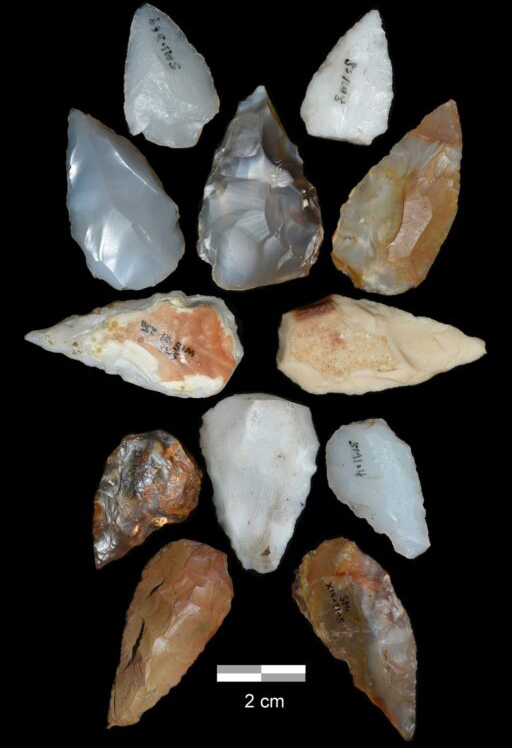
Selection of possible arrowheads from the Shinfa River site (Credit: Kappelman et al.; Blue Nile Survey Project)

The artifacts and bones of what these modern humans ate suggest a remarkable scenario for how they lived. Stone tools are finely worked from local basalt lava, quartz and flint-like chalcedony found in cavities in lava flows. Many of them are small, sharp triangular points, some of which show features consistent with their use as projectile tips that fractured on impact; they may be arrowheads, indeed the earliest known. Bones found at the site are key pointers to their diet. They are from a wide variety of animal, roughly similar to those living in the area at present: from monkeys to giraffe, guinea fowl to ostrich, and even frogs. There are remains of many fish and freshwater molluscs. Although there are no traces of plant foods, clearly those people who loved through the distant effects of Toba were well fed. Although a period of global cooling may have increased aridity at tropical latitudes in Africa, the campers were able to devise efficient strategies to obtain victuals. During wet seasons they lived off terrestrial prey animals, and during the driest times ate fish from pools in the river valley. These are hardly conditions likely to devastate their numbers, and the people seem to have been technologically flexible. Similar observations were made at the Pinnacle Point site in far-off South Africa in 2018, where Toba ash is also present. Both sites refute any retardation of human cultural progress 74 ka ago. Rather the opposite: people may have been spurred to innovation, and the new strategies may have allowed them to migrate more efficiently, perhaps along seasonal drainages. In this case that would have led them or their descendants to the Nile and a direct route to Eurasia; along ‘blue highway’ corridors as Kappelman et al. suggest.

Yet the population bottleneck implied by mtDNA analyses is only vaguely dated: it may have been well before or well after Toba. Moreover, there is a 10 ka gap between Toba and the earliest accurately dated migrants who left Africa – the first Australians at about 65 ka. However, note that there is inconclusive evidence that modern humans may have occupied Sumatra by the time of the eruption.  Much closer to the site of the eruption in southeast India, stone artifacts have been found below and above the 74 ka datum marked by the thick Toba Ash. Whether these were discarded by anatomically modern humans or earlier migrants such as Homo erectus remains unresolved. Either way, at that site there is no evidence for any mass die-off, even though conditions must have been pretty dreadful while the ash fell. But that probably only lasted for little more than a month. If the migrants did suffer very high losses to decrease the genetic diversity of the survivors, it seems just as likely to have been due to attrition on an extremely lengthy trek, with little likelihood of tangible evidence surviving. Alternatively, the out-of-Africa migrants may have been small in number and not fully representative of the genetic richness of the Africans who stayed put: a few tens of thousand migrants may not have been very diverse from the outset.

Repeated climate and ecological stress during the run-up to the K-Pg extinction

The Cretaceous-Palaeogene mass extinction is no longer an event that polarises geologists’ views between a slow volcanic driver (The Deccan large igneous province) and a near instantaneous asteroid impact (Chicxulub). There is now a broad consensus that both processes were involved in weakening the Late Cretaceous biosphere and snuffing out much of it around 66 Ma ago. Yet is still no closure as regards the details. From a palaeontologist’s standpoint the die-off varied dramatically between major groups of animals. For instance, the non-avian dinosaurs disappeared completely while those that evolved to modern birds did not. Crocodiles came through it largely unscathed unlike aquatic dinosaurs. In the seas those animals that lived in the water column, such as ammonites, were far more affected than were denizens of the seafloor. But much the same final devastation was visited on every continent and ocean. However, lesser and more restricted extinctions occurred before the Chicxulub impact.

Scientists from Norway, Canada, the US, Italy, the UK and Sweden have now thrown light on the possibility that climate change during the last half-million years of the Cretaceous may have been eroding biodiversity and disrupting ecosystems (Callegaro, S. et al. 2023. Recurring volcanic winters during the latest Cretaceous: Sulfur and fluorine budgets of Deccan Traps lavas. Science Advances, v. 9, article eadg8284; DOI: 10.1126/sciadv.adg8284). Almost inevitably, they turned to the record of Deccan volcanism that overlapped the K-Pg event, specifically the likely composition of the gases that the magmas may have belched into the atmosphere. Instead of choosing the usual suspect carbon dioxide and its greenhouse effect, their focus was on sulfur and fluorine dissolved in pyroxene grains from 15 basalts erupted in the 10 Formations of the Deccan flood-basalt sequence. From these analyses they were able to estimate the amounts of the two elements in the magma erupted in each of these 10 phases.

Exposed section through a small part of the Deccan Traps in the Western Ghats of Maharashtra, India. (Credit: Gerta Keller, Princeton University)

The accompanying image of a famous section through the Deccan Traps SE of Mumbai clearly shows that 15 sampled flows could reveal only a fraction of the magmas’ variability: there are 12 flows in the foreground alone. The mountain beyond shows that the pale-coloured sequence is underlain by many more flows, and the full Deccan sequence is about 3.5 km thick. Clearly, flood-basalt volcanism is in no way continuous, but builds up from repeated lava flows that can be as much as 50 m thick. Each of them is capped by a red, clay-rich soil or bole – from the Greek word bolos (βόλος) meaning ‘clod of earth’. Weathering of basalt would have taken a few centuries to form each bole. Individual Deccan flows extend over enormous areas: one can be traced for 1500 km. At the end of volcanism the pile extended over roughly 1.5 million km2 to reach a volume of half a million km3.

Fluorine is a particularly toxic gas with horrific effects on organisms that ingest it. In the form of hydrofluoric acid (HF) – routinely used to dissolve rock – it penetrates tissue very rapidly to react with calcium in the blood to form calcium fluoride. This causes very severe pain, bone damage and other symptoms of skeletal fluorosis. The 1783-4 eruption of the Laki volcanic fissure in Iceland emitted an estimated 8,000 t of HF gas that wiped out more than half the domestic animals as a result of their eating contaminated grass. The famine that followed the eruption killed 20 to 25% of Iceland’s people: exhumed human skeletons buried in the aftermath show the distinctive signs of endemic skeletal fluorosis. This small flood-basalt event had global repercussions, as the Wikipedia entry for Laki documents. Volcanic sulfur emissions in the form of SO2 gas react with water vapour to form sulphuric acid aerosols in a reflective haze. If this takes place in the stratosphere as a result of powerful eruptions, as was the case with the 1991 Pinatubo eruption in the Philippines, the high-altitude haze lingers and spreads. This results in reduced solar warming: a so-called ‘volcanic winter’. In the Pinatubo aftermath global temperatures fell by about 0.5°C during 1991-3. Unsurprisingly, volcanic sulfur emissions also result in acid rainfall. Moreover, inhaling the sulphur-rich haze at low altitudes causes victims to choke as their respiratory tissues swell: an estimated 23,000 people in Britain died in this way when the 1783-4 Laki eruption haze spread southwards Sara Calegaro and colleagues found that the fluorine and sulfur contents of Deccan magmas fluctuated significantly during the eruptive phases. They suggest that fluorine emissions were far above those from Laki, perhaps leading to regional fluorine toxicity around the site of the Deccan flood volcanism but not extinctions. Global cooling due to sulphuric acid aerosols in the stratosphere is suggested to have happened repeatedly, albeit briefly, as eruption waxed and waned during each phase. Magmas rich in volatiles would have been more likely to erupt explosively to inject SO2 to stratospheric altitudes (above 10 to 20 km). The authors do not attempt to model when such cooling episodes may have occurred: data from only 15 levels in the Deccan Traps do not have the time-resolution to achieve that. They do, however, show that this large igneous province definitely had the potential to generate ‘volcanic winters’ and toxic episodes. Time and time again ecosystems globally and regionally would have experienced severe stress, the most important perhaps being disruption of the terrestrial and marine food chains.

Volcanism and the Justinian Plague

Between 541 and 543 CE, during the reign of the Roman Emperor Justinian, bubonic plague spread through countries bordering the Mediterranean Sea. This was a decade after Justinian’s forces had had begun to restore the Roman Empire’s lost territory in North Africa, Spain, Italy and the present-day Balkans by expeditions out of Byzantium (the Eastern Empire). At its height, the Plague of Justinian, was killing 5000 people each day in Constantinople, eventually to consume 20 to 40% of its population and between 25 to 50 million people across the empire. Like the European Black Death of the middle 14th century. The bacterium Yersinia pestis originated in Central Asia and is carried in the gut of fleas that live on rats. The ‘traditional’ explanation of both plagues was that plague spread westwards along the Silk Road and then with black rats that infested ship-borne grain cargoes. Plausible as that might seem, Yersinia pestis, fleas and rats have always existed and remain present to this day. Trade along the same routes continued unbroken for more than two millennia. Although plagues with the same agents recurred regularly, only the Plague of Justinian and the Black Death resulted in tens of million deaths over short periods. Some other factor seems likely to have boosted fatalities to such levels.

407458aa.2
Monk administering the last rites to victims of the Plague of Justinian

Five years before plague struck the Byzantine historian Procopius recorded a long period of fog and haze that continually reduced sunlight; typical features of volcanic aerosol veils. Following this was the coldest decade in the past 2300 years, as recorded by tree-ring studies. It coincides with documentary evidence of famine in China, Ireland, the Middle East and Scandinavia.. A 72 m long ice core extracted from the Colle Gnifetti glacier in the Swiss Alps in 2013 records the last two millennia of local climatic change and global atmospheric dust levels. Sampled by laser slicing, the core has yielded a time series of data at a resolution of months or better. In 536 an Icelandic volcano emitted ash and probably sulfur dioxide over 18 months during which summer temperature fell by about 2°C. A second eruption followed in 540 to 541. ‘Volcanic winter’ conditions lasted from 536 to 545, amplifying the evidence from tree-ring data from the 1990’s.

The Plague of Justinian coincided with the second ‘volcanic winter’ after several years of regional famine. This scenario is paralleled by the better documented Great Famine of 1315-17 that ended the two centuries of economic prosperity during the 11th to 13th centuries. The period was marked by extreme levels of crime, disease, mass death, and even cannibalism and infanticide. In a population weakened through malnutrition to an extent that we can barely imagine in modern Europe, any pandemic disease would have resulted in the most affected dying in millions. Another parallel with the Plague of Justinian is that it followed the ending of four centuries of the Medieval Warm Period, during which vast quantities of land were successfully brought under the plough and the European population had tripled. That ended with a succession of major, sulfur-rich volcanic eruption in Indonesia at the end of the 13th century that heralded the Little Ice Age. Although geologists generally concern themselves with the social and economic consequences of a volcano’s lava and ash in its immediate vicinity– the ‘Pompeii view’ – its potential for global catastrophe is far greater in the case of really large (and often remote) events.

Chemical data from the same ice core reveals the broad economic consequences of the mid-sixth century plague. Lead concentrations in the ice, deposited as airborne pollution from smelting of lead sulfide ore to obtain silver bullion, fell and remained at low levels for a century. The recovery of silver production for coinage is marked by a spike in glacial lead concentration in 640; another parallel with the Black Death, which was followed by a collapse in silver production, albeit only for 4 to 5 years.

Related article: Gibbons, A. 2018. Why 536 was ‘the worst year to be alive’. Science, v. 362,p. 733-734; DOI:10.1126/science.aaw0632

Read more on Geohazards, Magmatism and Palaeoclimatology