A ‘worm’ revolution and ecological transition before the Cambrian explosion

Bioturbated ‘pipe rock’ of the basal Cambrian sandstones of NW Scotland. Credit: British Geological Survey photograph P531881

About 530 Ma ago most of the basic body plans of today’s living organisms can be detected as fossils, i.e. preserved hard parts. Yet studies of trace fossils (ichnofossils) – marks left in sediments by active soft bodied creatures suggest that many modern phyla arose before the start of the Cambrian (~539 Ma), as early as 545 Ma. So the term ‘Cambrian explosion’ seems to be a bit of a misnomer on two counts: it lasted around 15 Ma and began before the Cambrian. Preceding it was the Ediacaran Period that began around 100 Ma earlier in the Neoproterozoic Era. Traces of its eponymous fauna of large soft-bodied organisms are found on all continents, but apparently none of them made it into the Phanerozoic fossil record. Another characteristic of the Ediacaran is that its sedimentary rocks – and those of earlier times – show no signs of burrowing: they are not bioturbated. That may be why the Ediacaran pancake-, bun-, bag- and pen-like lifeforms are so remarkably well preserved. But a lack of burrowing did not extend to the beginning of Cambrian times. The most likely reason why it was absent during the early Ediacaran Period is that sea-floor sediments then were devoid of oxygen so eukaryote animals could not live in them. But the presence of these large organisms showed that seawater must have been oxygenated. Now clear signs of burrowing have emerged from study of Ediacaran rocks exposed in the Yangtze Gorge of Hubei,southern China ( Zhe Chen & Yarong Liu 2025. Advent of three-dimensional sediment exploration reveals Ediacaran-Cambrian ecosystem transition. Science Advances, v. 11, article eadx9449; DOI: 10.1126/sciadv.adx9449).
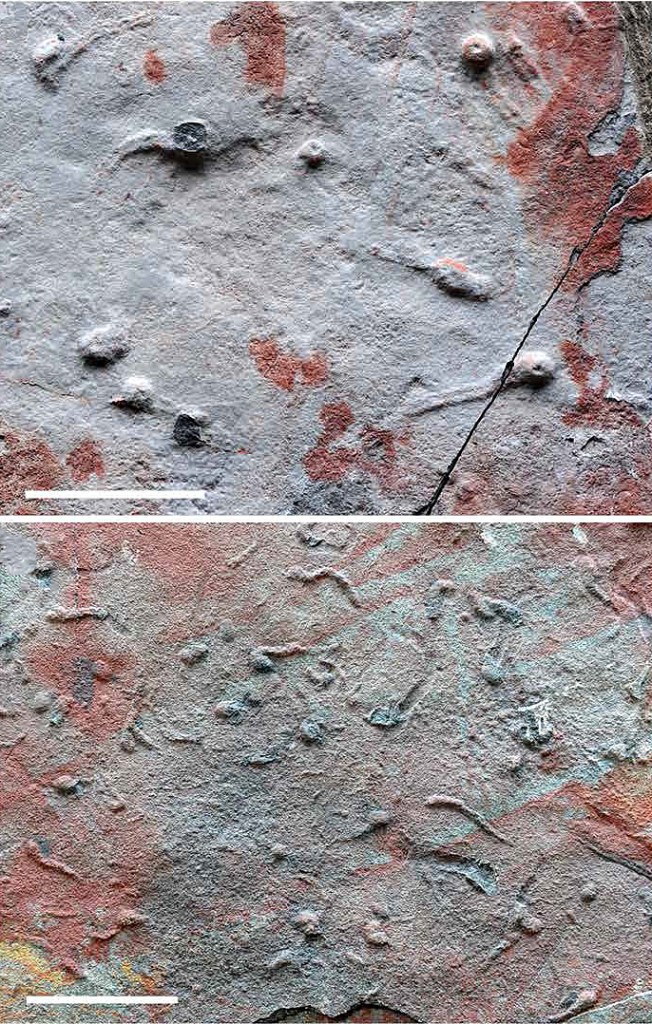
Tadpole-like trace fossils from the Ediacaran Dengying Formation in the Yangtze Gorge: 5 cm scale bars. The ‘heads’ show tiny depressions suggesting that there maker probed into the sediments as well as foraging horizontally. Credit: Zhe Chen & Yarong Liu; Figs 3B and 3D

Zhe Chen and Yarong Liu of the Nanjing Institute of Geology and Palaeontology and Chinese Academy of Sciences in China examined carbonates of the upper Ediacaran Dengying Formation. This overlies the Doushantuo Formation (550 to 635 Ma), known for tiny fossils of possibly the oldest deuterostome Saccorhytus coronaries; a potential candidate for the ancestor of modern bilaterian phyla. In the Yangtze Gorge locality sediments at this level show only traces of browsing of bacterial mats on the sediment surface; i.e. 2-D feeders. The basal Dengying sediments host clear signs that organisms could then penetrate into the sediments. These 3-D feeders , would have had access to buried organic remains, hitherto unexploited by living organisms. Such animal-sediment interactions would have disturbed and diminished the living microbial mats that held the sediment surface in place, and thus began to dismantle the substrate for the typical Edicaran fauna. Similar 3-D feeders occur throughout the 11 Ma represented by the Dengying Formation to the start of the Cambrian. This beginning of bioturbation heralded a period during which the Ediacaran fauna steadily waned. It also released nutrients into deep water, and opened up new ecological niches for more advanced animals on the seabed.  Dissolved oxygen could only slowly enter the sediments since atmospheric and oceanic O2 levels were low. But by the earliest Cambrian it had risen to about 5 to 10% by volume to support many other kinds of burrowing animals that could penetrate more deeply, as witnessed by the abundant sandstones that occur at the base of the Cambrian in Britain.

Detecting oxygenic photosynthesis in the Archaean Earth System

For life on Earth, one of the most fundamental shifts in ecosystems was the Great Oxygenation Event 2.5 to 2.3 billion years (Ga) ago. The first evidence for its occurrence was from the sedimentary record, particularly ancient soils (palaeosols) that mark exposure of the continental surface above sea level and rock weathering. Palaeosols older than 2.4 Ga have low iron contents that suggest iron was soluble in surface waters, i.e. in its reduced bivalent form Fe2+. Sediments formed by flowing water also contain rounded grains of minerals that in today’s oxygen-rich environments are soon broken down and dissolved through oxidising reactions, for instance pyrite (FeS2) and uraninite (UO2). After 2.4 Ga palaeosols are reddish to yellowish brown in colour and contain insoluble oxides and hydroxides of Fe3+ principally hematite (Fe2O3) and goethite (FeO.OH). After this time sediments deposited by wind action and rivers are similar in colour: so-called ‘redbeds’. Following the GOE the atmosphere initially contained only traces of free oxygen, but sufficient to make the surface environment oxidising. In fact such an atmosphere defies Le Chatelier’s Principle: free oxygen should react rapidly with the rest of the environment through oxidation. That it doesn’t shows that it is continually generated as a result of oxygenic photosynthesis. The CO2 + H2O = carbohydrate + oxygen equilibrium does not reach a balance because of continual burial of dead organic material.

Free oxygen is a prerequisite for all multicelled eukaryotes, and it is probably no coincidence that fossils of the earliest known ones occur in sediments in Gabon dated at 2.1 Ga: 300 Ma after the Great Oxygenation Event. However, the GOE relates to surface environments of that time. From 2.8 Ga – in the Mesoarchaean Era – to the late Palaeoproterozoic around 1.9 Ga, vast quantities of Fe3+ were locked in iron oxide-rich banded iron formations (BIFs): roughly 105 billion tons in the richest deposits alone (see: Banded iron formations (BIFs) reviewed; December 2017). Indeed, similar ironstones occur in Archaean sedimentary sequences as far back as 3.7 Ga, albeit in uneconomic amounts. Paradoxically, enormous amounts of oxygen must have been generated by marine photosynthesis to oxidise Fe2+ dissolved in the early oceans by hydrothermal alteration of basalt lava upwelling from the Archaean mantle. But none of that free oxygen made it into the atmosphere. Almost as soon as it was released it oxidised dissolved Fe2+ to be dumped as iron oxide on the ocean floor. Before the GOE that aspect of geochemistry did obey Le Chatelier!

A limestone made of stromatolites

The only likely means of generating oxygen on such a gargantuan scale from the earliest Archaean onwards is through teeming prokaryote organisms capable of oxygenic photosynthesis. Because modern cyanobacteria do that, the burden of the BIFs has fallen on them. One reason for that hypothesis stems from cyanobacteria in a variety of modern environments building dome-shaped bacterial mats. Their forms closely resemble those of Archaean stromatolites found as far back as 3.7 Ga. But these are merely peculiar carbonate bodies that could have been produced by bacterial mats which deploy a wide variety of metabolic chemistry. Laureline Patry of the Université de Bretagne Occidentale, Plouzané, France, and colleagues from France, the US, Canada and the UK have developed a novel way of addressing the opaque mechanism of Archaean oxygen production (Patry, L.A. and 12 others. Dating the evolution of oxygenic photosynthesis using La-Ce geochronology. Nature, v. 642, p. 99-104; DOI: 10.1038/s41586-025-09009-8).

They turned to the basic geochemistry of rare earth elements (REE) in Archaean stromatolitic limestones from the Superior Craton of northern Canada. Of the 17 REEs only cerium (Ce) is capable of being oxidised in the presence of oxygen. As a result Ce can be depleted relative to its neighbouring REEs in the Periodic Table, as it is in many Phanerozoic limestones. Five samples of the limestones show consistent depletion of Ce relative to all other REE. It is also possible to date when such fractionation occurred using 138La– 138Ce geochronology.  The samples were dated at 2.87 to 2.78 Ga (Mesoarchaean), making them the oldest limestones that show Ce anomalies and thus oxygenated seawater in which the microbial mats thrived. But that is only 300 Ma earlier than the start of the GOE. Stromatolites are abundant in the Archaean record as far back as 3.4 Ga, so it should be possible to chart the link between microbial carbonate mats and oxygenated seawater to a billion years before the GOE, although that does not tell us about the kind of microbes that were making stromatolites.

See also: Tracing oxygenic photosynthesis via La-Ce geochronology. Bioengineer.org, 29 May 2025; Allen, J.F. 2016. A proposal for formation of Archaean stromatolites before the advent of oxygenic photosynthesis. Frontiers in Microbiology, v. 7; DOI: 10.3389/fmicb.2016.01784.

Direct measurements of ancient atmospheric composition

For decades, research into the composition of the Earth’s early atmosphere depended on indirect means. An example is the preservation of water-worn grains of sulphides and uranium oxides in coarse terrestrial sediments older than about 2,200 Ma. Their survival on the continental surface suggested that the atmosphere before then had vanishingly low O2. Such grains would have otherwise been broken down by oxidation reactions. Younger sediments simply do not contain such detrital grains. This suggested the appearance of an oxidising atmosphere around 2.2 Ga ago: the Great Oxygenation Event. The greenhouse gases – carbon dioxide and methane – are also difficult to estimate directly, especially in the Precambrian. Once plants colonised the land surface, their photosynthesis depended on inhaling and exhaling air through stomata on the surface of leaves (see: Ancient CO2 estimates worry climatologists; January 2017). The number of stomata per unit area of a leaf surface is expected to increase with lowering of atmospheric CO2 and vice versa, which has been observed in plants grown in different air compositions. By comparing stomatal density in fossilised leaves of modern plants back to 800 ka allows the change to be calibrated against the record of CO­2 inside air bubbles trapped in ice-cores. This proxy method has given a guide to CO2 variations through the Cenozoic, Mesozoic and upper Palaeozoic Eras. However, the reliability of extinct plant leaves as proxies is suspect.

A fluid inclusion (about 0.2 mm) trapped in a crystal of halite (NaCl). Credit: alchetron.com

Is it possible to find air trapped by other means than in glacial ice? It may be. Tiny pockets of liquid and gas – fluid inclusions – are often found in minerals that crystallised at the Earth’s surface. The most common are crystals of salt (NaCl) and carbonates from ancient lake deposits. A 2019 study revealed that Late Triassic carbonates from Colorado, USA record an increase of atmospheric oxygen levels from 15 to 19% about 215 Ma ago over a period of just 3 million years as dinosaurs first spread into North America, then at equatorial latitudes in the Pangaea supercontinent. This sudden increase in the availability of oxygen may also be linked to the trend towards larger and larger dinosaurs worldwide.  Going further back in time trace-metal chemistry of 1,400 Ma old marine sediments from China indicates oxygenated water that suggests an atmospheric oxygen level greater than 4% of that at present. Small as that might seem, it would have been sufficient to sustain animal respiration about half a billion years before the first evidence for the earliest animals. Further work on ancient salt and carbonate deposits confirms much higher oxygen levels  than geochemists have expected previously.

Source: Voosen, P, 2025. Earth’s rocks hold whiffs of air from billions of years ago. Science, v.387, articlezhst73x; DOI: 10.1126/science.zhst73x

Origin of animals at a time of chaotic oxygen levels

Every organism that you can easily see is a eukaryote, the vast majority of which depend on the availability of oxygen molecules. The range of genetic variation in a wide variety of eukaryotes suggests, using a molecular ‘clock’, that the first of them arose between 2000 to 1000 Ma ago. It possibly originated as a symbiotic assemblage of earlier prokaryote cells ‘bagged-up’ within a single cell wall: Lynn Margulis’s hypothesis of endosymbiosis. It had to have happened after the Great Oxygenation Event (GOE 2.4 to 2.2 Ga), before which free oxygen was present in the seas and atmosphere only at vanishingly small concentrations. Various single-celled fossil possibilities have been suggested to be the oldest members of the Eukarya but are not especially prepossessing, except for one bizarre assemblage in Gabon. The first inescapable sign that eukaryotes were around is the appearance of distinctive organic biomarkers in sediments about 720 Ma old. The Neoproterozoic is famous for its Snowball Earth episodes and the associated multiplicity of large though primitive animals during the Ediacaran Period (see: The rise of the eukaryotes; December 2017).

The records of carbon- and sulfur isotopes in Neo- and Mesoproterozoic sedimentary rocks are more or less flat lines after a mighty hiccup in the carbon and sulfur cycles that followed the GOE and the earliest recorded major glaciation of the Earth. The time between 2.0 and 1.0 Ga has been dubbed ‘the Boring Billion’. At about 900 Ma, both records run riot. Sulfur isotopes in sediments reveal the variations of sulfides and sulfates on the seafloor, which signify reducing and oxidising conditions respectively.  The δ13C record charts the burial of organic carbon and its release from marine sediments related to reducing and oxidising conditions in deep water. There were four major ‘excursions’ of δ13C during the Neoproterozoic, which became increasingly extreme. From constant anoxic, reducing conditions throughout the Boring Billion the Late Neoproterozoic ocean-floor experienced repeated cycles of low and high oxygenation reflected in sulfide and sulfate precipitation and by fluctuations in trace elements whose precipitation depends on redox conditions. By the end of the Cambrian, when marine animals were burgeoning, deep-water oxic-anoxic cycles had been smoothed out, though throughout the Phanerozoic eon anoxic events crop up from time to time.

Atmospheric levels of free oxygen relative to that today (scale is logarithmic) computed using combined carbon- and sulfur isotope records from marine sediments since 1500 Ma ago. The black line is the mean of 5,000 model runs, the grey area represents ±1 standard deviations. The pale blue area represents previous ‘guesstimates’. Vertical yellow bars are the three Snowball Earth events of the Late Neoproterozoic (Sturtian, Marinoan and Gaskiers). (Credit: Krause et al., Fig 1a)

The Late Neoproterozoic redox cycles suggest that oxygen levels in the oceans may have fluctuated too. But there are few reliable proxies for free oxygen. Until recently, individual proxies could only suggest broad, stepwise changes in the availability of oxygen: around 0.1% of modern abundance after the GOE until about 800 Ma; a steady rise to about 10% during the Late Neoproterozoic; a sharp rise to an average of roughly 80% at during the Silurian attributed to increased photosynthesis by land plants. But over the last few decades geochemists have devised a new approach based on variations on carbon and sulfur isotope data from which powerful software modelling can make plausible inferences about varying oxygen levels. Results from the latest version have just been published (Krause, A.J. et al. 2022. Extreme variability in atmospheric oxygen levels in the late Precambrian. Science Advances, v. 8, article 8191; DOI: 10.1126/sciadv.abm8191).

Alexander Krause of Leeds University, UK, and colleagues from University College London, the University of Exeter, UK and the Univerisité Claude Bernard, Lyon, France show that atmospheric oxygen oscillated between ~1 and 50 % of modern levels during the critical 740 to 540 Ma period for the origin and initial diversification of animals. Each major glaciation was associated with a rapid decline, whereas oxygen levels rebounded during the largely ice-free episodes. By the end of the Cambrian Period (485 Ma), by which time the majority of animal phyla had emerged, there appear to have been six such extreme cycles.

Entirely dependent on oxygen for their metabolism, the early animals faced periodic life-threatening stresses. In terms of oxygen availability the fluctuations are almost two orders of magnitude greater than those that animal life faced through most of the Phanerozoic. Able to thrive and diversify during the peaks, most animals of those times faced annihilation as O2 levels plummeted. These would have been periods when natural selection was at its most ruthless in the history of metazoan life on Earth. Its survival repeatedly faced termination, later mass extinctions being only partial threats. Each of those Phanerozoic events was followed by massive diversification and re-occupation of abandoned and new ecological niches. So too those Neoproterozoic organism that survived each massive environmental threat may have undergone adaptive radiation involving extreme changes in their form and function. The Ediacaran fauna was one that teemed on the sea floor, but with oxygen able to seep into the subsurface other faunas may have been evolving there exploiting dead organic matter. The only signs of that wholly new ecosystem are the burrows that first appear in the earliest Cambrian rocks. Evolution there would have ben rife but only expressed by those phyla that left it during the Cambrian Explosion.

There is a clear, empirical link between redox shifts and very large-scale glacial and deglaciation events. Seeking a cause for the dramatic cycles of climate, oxygen and life is not easy. The main drivers of the greenhouse effect COand methane had to have been involved, i.e. the global carbon cycle. But what triggered the instability after the ‘Boring Billion’? The modelled oxygen record first shows a sudden rise to above 10% of modern levels at about 900 Ma, with a short-lived tenfold decline at 800 Ma. Could the onset have had something to do with a hidden major development in the biosphere: extinction of prokaryote methane generators; explosion of reef-building and oxygen-generating stromatolites? How about a tectonic driver, such as the break-up of the Rodinia supercontinent? Then there are large extraterrestrial events … Maybe the details provided by Krause et al. will spur others to imaginative solutions. See also: How fluctuating oxygen levels may have accelerated animal evolution. Science Daily, 14 October 2022

Photosynthesis, arsenic and a window on the Archaean world

At the very base of the biological pyramid life is far simpler than that which we can see.  It takes the form of single cells that lack a nucleus and propagate only by cloning: the prokaryotes as opposed to eukaryote life such as ourselves. It is almost certain that the first viable life on Earth was prokaryotic, though which of its two fundamental divisions – Archaea or Bacteria – came first is still debated. At present, most prokaryotes metabolise other organisms’ waste or dead remains: they are heterotrophs (from the Greek for ‘other nutrition’). But there are others that are primary producers getting their nutrition by themselves, exploiting the inorganic world in a variety of ways: the autotrophs. Biogeochemical evidence from the earliest sedimentary rocks suggests that, in the Archaean prokaryotic autotrophs were dominant, mainly exploiting chemical reactions to gain energy necessary for building carbohydrates. Some reduced sulfate ions to those of sulphide, others combined hydrogen with carbon dioxide to generate methane as a by-product. Sunlight being an abundant energy resource in near-surface water, a whole range of prokaryotes exploit its potential through photosynthesis. Under reducing conditions some photosynthesisers convert sulfur to sulfuric acid , yet others combine photosynthesis with chemo-autotrophy. Dissolved material capable of donating electrons – i.e. reducing agents – are exploited in photosynthesis: hydrogen, ferrous iron (Fe2+), reduced sulfur, nitrite, or some organic molecules. Without one group, which uses photosynthesis to convert CO2 and water to carbohydrates and oxygen, eukaryotes would never have arisen, for they depend on free oxygen. A transformation 2400 Ma ago marked a point in Earth history when oxygen first entered the atmosphere and shallow water (see: Massive event in the Precambrian carbon cycle; January, 2012), known as Great Oxygenation Event (GOE). It has been shown that the most likely sources of that excess oxygen were extensive bacterial mats in shallow water made of photosynthesising blue-green bacteria that produced the distinctive carbonate structures known as stromatolites. These had formed in Archaean sedimentary basins for 1.9 billion years. It has been generally assumed that blue-green bacteria had formed them too, before the oxygen that they produced overcame the reducing conditions that had generally prevailed before the GOE. But that may not have been the case …

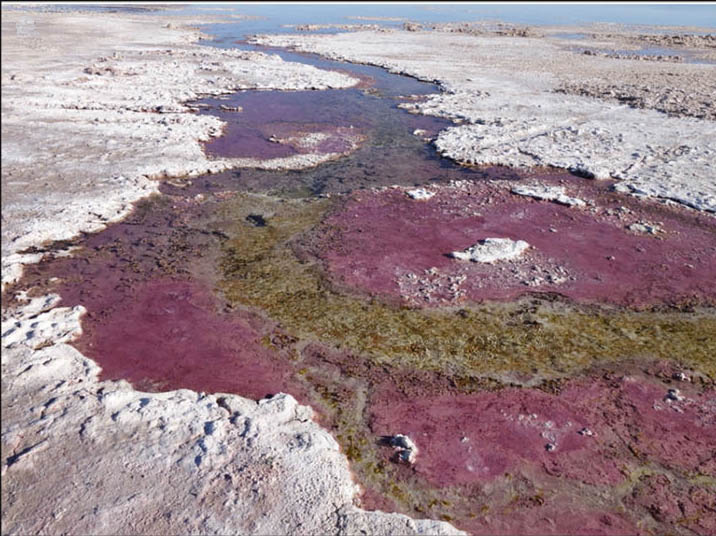
Microbial mats made by purple sulfur bacteria in highly toxic spring water flowing into a salt-lake in northern Chile. (credit: Visscher et al. 2020; Fig 1c)

Prokaryotes are a versatile group and new types keep turning up as researchers explore all kinds of strange and extreme environments, for instance: hot springs; groundwater from kilometres below the surface and highly toxic waters. A recent surprise arose from the study of anoxic springs laden with dissolved salts, sulfide ions and arsenic that feed parts of hypersaline lakes in northern Chile (Visscher, P.T. and 14 others 2020. Modern arsenotrophic microbial mats provide an analogue for life in the anoxic ArcheanCommunications Earth & Environment, v. 1, article 24; DOI: 10.1038/s43247-020-00025-2). This is a decidedly extreme environment for life, as we know it, made more challenging by its high altitude exposure to high UV radiation. The springs’ beds are covered with bright-purple microbial mats. Interestingly the water’s arsenic concentration varies from high in winter to low in summer, suggesting that some process removes it, along with sulfur, according to light levels: almost certainly the growth and dormancy of mat-forming bacteria. Arsenic is an electron donor capable of participating in photosynthesis that doesn’t produce oxygen. The microbial mats do produce no oxygen whatever – uniquely for the modern Earth – but they do form carbonate crusts that look like stromatolites. The mats contain purple sulfur bacteria (PSBs) that are anaerobic photosynthesisers, which use sulfur, hydrogen and Fe2+ as electron donors. The seasonal changes in arsenic concentration match similar shifts in sulfur, suggesting that arsenic is also being used by the PSBs. Indeed they can, as the aio gene, which encodes for such an eventuality, is present in the genome of PSBs.

Pieter Visscher and his multinational co-authors argue for prokaryotes similar to modern PSBs having played a role in creating the stromatolites found in Archaean sedimentary rocks. Oxygen-poor, the Archaean atmosphere would have contained no ozone so that high-energy UV would have bathed the Earth’s surface and its oceans to a considerable depth. Moreover, arsenic is today removed from most surface water by adsorption on iron hydroxides, a product of modern oxidising conditions (see: Arsenic hazard on a global scale; May 2020): it would have been more abundant before the GOE. So the Atacama springs may be an appropriate micro-analogue for Archaean conditions, a hypothesis that the authors address with reference to the geochemistry of sedimentary rocks in Western Australia deposited in a late-Archaean evaporating lake. Stromatolites in the Tumbiana Formation show, according to the authors, definite evidence for sulfur and arsenic cycling similar to that in that Atacama springs. They also suggest that photosynthesising blue-green bacteria (cyanobacteria) may not have viable under such Archaean conditions while microbes with similar metabolism to PSBs probably were. The eventual appearance and rise of oxygen once cyanobacteria did evolve, perhaps in the late-Archaean, left PSBs and most other anaerobic microbes, to which oxygen spells death, as a minority faction trapped in what are became ‘extreme’ environments when long before they ‘ruled the roost’. It raises the question, ‘What if cyanobacteria had not evolved?’. A trite answer would be, ‘I would not be writing this and nor would you be reading it!’. But it is a question that can be properly applied to the issue of alien life beyond Earth, perhaps on Mars. Currently, attempts are being made to detect oxygen in the atmospheres of exoplanets orbiting other stars, as a ‘sure sign’ that life evolved and thrived there too. That may be a fruitless venture, because life happily thrived during Earth’s Archaean Eon until its closing episodes without producing a whiff of oxygen.

See also: Living in an anoxic world: Microbes using arsenic are a link to early life. (Science Daily, 22 September 2020)

Salt and Earth’s atmosphere

It is widely known that glacial ice contains a record of Earth’s changing atmospheric composition in the form of bubbles trapped when the ice formed. That is fine for investigations going back about a million years, in particular those that deal with past climate change. Obviously going back to the composition of air tens or hundreds of million years ago cannot use such a handy, direct source of data, but has relied on a range of indirect proxies. These include the number of pores or stomata on fossil plant leaves for CO2, variations in sulfur isotopes for oxygen content and so on. Variation over time of the atmosphere’s content of oxygen has vexed geoscientists a great deal, partly because it has probably been tied to biological evolution: forming by some kind of oxygenic photosynthesis and being essential for the rise to dominance of eukaryotic animals such as ourselves. Its presence or absence also has had a large bearing on weathering and the associated dissolution or precipitation of a variety of elements, predominantly iron. Despite progressively more clever proxies to indicate the presence of oxygen, and intricate geochemical theory through which its former concentration can be modelled, the lack of an opportunity to calibrate any of the models has been a source of deep frustration and acrimony among researchers.

Yet as is often said, there are more ways of getting rid of cats than drowning them in butter. The search has been on for materials that trap air in much the same way as does ice, and one popular, if elusive target has been the bubbles in crystals of evaporite minerals. The trouble is that most halite deposits formed by precipitation of NaCl from highly concentrated brines in evaporating lakes or restricted marine inlets. As a result the bubbles contain liquids that do a grand job of preserving aqueous geochemistry but leave a lot of doubt as regards the provenance of gases trapped within them. For that to be a sample of air rather than gases once dissolved in trapped liquid, the salt needs to have crystallized above the water surface. That may be possible if salt forms from brines so dense that crystals are able to float, or perhaps where minerals such as gypsum form as soil moisture is drawn upwards by capillary action to form ‘desert roses’. A multinational team, led by Nigel Blamey of Brock University in Canada, has published results from Neoproterozoic halite whose chevron-like crystals suggest subaerial formation (Blamey, N.J.F. and 7 others, 2016. Paradigm shift in determining Neoproterozoic atmospheric oxygen. Geology, v. 44, p. 651-654). Multiple analyses of five halite samples from an ~815 Ma-old horizon in a drill core from the Neoproterozoic Canning Basin of Western Australia contained about 11% by volume of oxygen, compared with 25% from Cretaceous salt from China, 20% of late-Miocene age from Italy, and 19 to 22% from samples modern salt of the same type.

Salar de Atacama salt flat in the Chilean puna
Evaporite salts in the Salar de Atacama Chile (credit: Wikipedia)

Although the Neoproterozoic result is only about half that present in modern air, it contradicts results that stem from proxy approaches, which suggest a significant rise in atmospheric oxygenation from 2 to about 18% during the younger Cryogenian and Ediacaran Periods of the Neoproterozoic, when marine animal life made explosive developments at the time of repeated Snowball Earth events. Whether or not this approach can be extended back to the Great Oxygenation Event at around 2.3 Ga ago and before depends on finding evaporite minerals that fit stringent criteria for having formed at the surface: older deposits are known even from the Archaean.

Breathing spaces or toxic traps in the Archaean ocean


The relationship between Earth’s complement of free oxygen and life seems to have begun in the Archaean, but it presented a series of paradoxes: produced by photosynthetic organisms oxygen would have been toxic to most other Archaean life forms; its presence drew an important micronutrient, dissolved iron-2, from sea water by precipitation of iron-3 oxides; though produced in seawater there is no evidence until about 2.4 Ga for its presence in the air. It has long been thought that the paradoxes may have been resolved by oxygen being produced in isolated patches, or ‘oases’ on the Archaean sea floor, where early blue-green bacteria evolved and thrived.


A stratigraphic clue to the former presence of such oxygen factories is itself quite convoluted. The precipitation of calcium carbonates and therefore the presence of limestones in sedimentary sequences are suppressed by dissolved iron-2: the presence of Fe2+ ions would favour the removal of bicarbonate ions from seawater by formation of ferrous carbonate that is less soluble than calcium carbonate. Canadian and US geochemists studied one of the thickest Archaean limestone sequences, dated at around 2.8 Ga, in the wonderfully named Wabigoon Subprovince of the Canadian Shield which is full of stromatolites, bulbous laminated masses probably formed from bacterial biofilms in shallow water (Riding, R. et al. 2014. Identification of an Archean marine oxygen oasis. Precambrian Research, v. 251, p. 232-237).

English: Stromatolites in the Hoyt Limestone (...
Limestone formed from blue-green bacteria biofilms or stromatolites (credit: Wikipedia)

Limestones from the sequence that stable isotope analyses show to remain unaltered all have abnormally low cerium concentrations relative to the other rare-earth elements. Unaltered limestones from stromatolite-free, deep water limestones show no such negative Ce anomaly. Cerium is the only rare-earth element that has a possible 4+ valence state as well one with lower positive charge. So in the presence of oxygen cerium can form an insoluble oxide and thus be removed from solution. So cerium independently shows that the shallow water limestones formed in seawater that contained free oxygen. Nor was it an ephemeral condition, for the anomalies persist through half a kilometer of limestone.


The study shows that anomalous oxygenated patches existed on the Archaean sea floor, probably shallow-water basins or shelves isolated by the build up of stromatolite reef barriers. For most prokaryote cells they would have harboured toxic conditions, presenting them with severe chemical stress. Possibly these were the first places where oxygen defence measures evolved, that eventually led to more complex eukaryote cells that not only survive oxygen stress but thrive on its presence. That conjecture is unlikely to be fully proved, since the first undoubted fossils of eukaryote cells, known as acritarchs, occur in rocks that are more than 800 Ma years younger.