Human interventions in geological processes

During the Industrial Revolution not only did the emission of greenhouse gases by burning fossil fuels start to increase exponentially, but so too did the movement of rock and sediment to get at those fuels and other commodities demanded by industrial capital. In the 21st century about 57 billion tons of geological materials are deliberately moved each year. Global population followed the same trend, resulting in increasing expansion of agriculture to produce food. Stripped of its natural cover on every continent soil began to erode at exponential rates too. The magnitude of human intervention in natural geological cycles has become stupendous, soil erosion now shifting on a global scale about 75 billion tons of sediment, more than three times the estimated natural rate of surface erosion. Industrial capital together with society as a whole also creates and dumps rapidly growing amounts of solid waste of non-geological provenance. The Geological Society of America’s journal Geology recently published two research papers that document how capital is transforming the Earth.

Dust Bowl conditions on the Minnesota prairies during the 1930s.

One of the studies is based on sediment records in the catchment of a tributary of the upper Mississippi River. The area is surrounded by prairie given over mainly to wheat production since the mid 19th century. The deep soil of the once seemingly limitless grassland developed by the prairie ecosystem is ideal for cereal production. In the first third of the 20th century the area experienced a burst of erosion of the fertile soil that resulted from the replacement of the deep root systems of prairie grasses by shallow rooted wheat. The soil had formed from the glacial till deposited by the Laurentide ice sheet than blanketed North America as far south as New York and Chicago. Having moved debris across almost 2000 km of low ground, the till is dominated by clay- and silt-sized particles. Once exposed its sediments moved easily in the wind. Minnesota was badly affected by the ‘Dust Bowl’ conditions of the 1930s, to the extent that whole towns were buried by up to 4.5 metres of aeolian sediment. For the first time the magnitude of soil erosion compared with natural rates has been assessed precisely by dating layers of alluvium deposited in river terraces of one of the Mississippi’s tributaries  (Penprase, S.B. et al. 2025. Plow versus Ice Age: Erosion rate variability from glacial–interglacial climate change is an order of magnitude lower than agricultural erosion in the Upper Mississippi River Valley, USA. Geology, v. 53, p. 535-539; DOI: 10.1130/G52585.1).

Shanti Penprase of the University of Minnesota and her colleagues were able to date the last time sediment layers at different depths in terraces were exposed to sunlight and cosmic rays, by analysing optically stimulated luminescence (OSL) and cosmogenic 10Be content of quartz grains from the alluvium. The data span the period since the Last Glacial Maximum 20 thousand years ago during which the ecosystem evolved from bare tundra through re-vegetation to pre-settlement prairie. They show that post-glacial natural erosion had proceeded at around 0.05 mm yr-1 from a maximum of 0.07 when the Laurentide Ice Sheet was at its maximum extent. Other studies have revealed that after the area was largely given over to cereal production in the 19th century erosion rates leapt to as high as 3.5 mm yr-1 with a median rate of 0.6 mm yr-1, 10 to 12 times that of post-glacial times. It was the plough and single-crop farming introduced by non-indigenous settlers that accelerated erosion. Surprisingly, advances in prairie agriculture since the Dust Bowl have not resulted in any decrease in soil erosion rates, although wind erosion is now insignificant. The US Department of Agriculture considers the loss of one millimetre per year to be ‘tolerable’: 14 times higher than the highest natural rate in glacial times.

The other paper has a different focus: how human activities may form solid rock. The world over, a convenient means of disposing of unwanted material in coastal areas is simply to dump waste in the sea. That has been happening for centuries, but as for all other forms of anthropogenic waste disposal the volumes have increased at an exponential rate. The coast of County Durham in Britain began to experience marine waste disposal when deep mines were driven into Carboniferous Coal Measures hidden by the barren Permian strata that rest unconformably upon them. Many mines extended eastwards beneath the North Sea, so it was convenient to dump 1.5 million tons of waste rock annually at the seaside. The 1971 gangster film Get Carter starring Michael Caine includes a sequence showing ‘spoil’ pouring onto the beach below Blackhall colliery, burying the corpse of Carter’s rival. The nightmarish, 20 km stretch of grossly polluted beach between Sunderland and Hartlepool also provided a backdrop for Alien 3. Historically, tidal and wave action concentrated the low-density coal in the waste at the high-water mark, to create a free resource for locals in the form of ‘sea coal’ as portrayed in Tom Scott Robson’s 1966 documentary Low Water. Closure of the entire Duham coalfield in the 1980s and ‘90s halted this pollution and the coast is somewhat restored – at a coast of around £10 million.
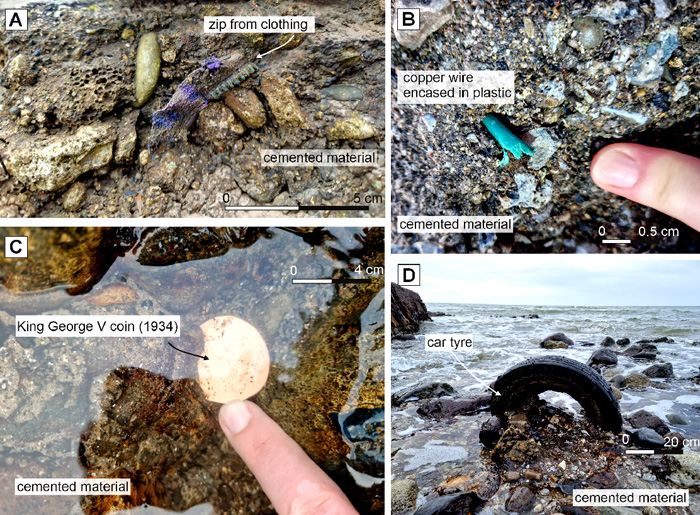
‘Anthropoclastic’ conglomerate formed from iron-smelting slag dumped on the West Cumbrian coast. It incorporates artefacts as young as the 1980s, showing that it was lithified rapidly. Credit: Owen et al, Supplementary Figure 2

On the West Cumbrian coast of Britain another industry dumped millions of tons of waste into the sea. In the case it was semi-molten ‘slag’ from iron-smelting blast furnaces poured continuously for 130 years until steel-making ended in the 1980s. Coastal erosion has broken up and spread an estimated 27 million cubic metres of slag along a 2 km stretch of beach. Astonishingly this debris has turned into a stratum of anthropogenic conglomerate sufficiently well-bonded to resist storms (Owen, A., MacDonald, J.M. & Brown, D.J 2025. Evidence for a rapid anthropoclastic rock cycle. Geology, v. 53, p. 581–586; DOI: 10.1130/G52895.1). The conglomerate is said by the authors to be a product of ‘anthropoclastic’ processes. Its cementation involves minerals such as goethite, calcite and brucite. Because the conglomerate contains car tyres, metal trouser zips, aluminium ring-pulls from beer cans and even coins lithification has been extremely rapid. One ring-pull has a design that was not used in cans until 1989, so lithification continued in the last 35 years.

Furnace slag ‘floats’ on top of smelted iron and incorporates quartz, clays and other mineral grains in iron ore into anhydrous calcium- and magnesium-rich aluminosilicates. This purification is achieved deliberately by including limestone as a fluxing agent in the furnace feed. The high temperature reactions are similar to those that produce aluminosilicates when cement is manufactured. Like them, slag breaks down in the presence of water to recrystallis in hydrated form to bond the conglomerate. This is much the same manner as concrete ‘sets’ over a few days and weeks to bind together aggregate. There is vastly more ‘anthropoclastic’ rock in concrete buildings and other modern infrastructure. Another example is tarmac that coats millions of kilometres of highway.

See also: Howell, E. 2025. Modern farming has carved away earth faster than during the ice age. Science, v. 388

The ‘Anthropocene Epoch’ bites the dust?

The International Commission on Stratigraphy (ICS) issues guidance for the division of geological history that has evolved from the science’s original approach: that was based solely on what could be seen in the field. That included: variations in lithology and the law of superposition; unconformities that mark interruptions through deformation, erosion and renewed deposition; the fossil content of sediments and the law of faunal succession; and more modern means of division, such as geomagnetic changes detected in rock over time. That ‘traditional’ approach to relative time is now termed chronostratigraphy, which has evolved since the 19th century from the local to the global scale as geological research widened its approach. Subsequent development of various kinds of dating has made it possible to suggest the actual, absolute time in the past when various stratigraphic boundaries formed – geochronology. Understandably, both are limited by the incompleteness of the geological record – and the whims of individual geologists. For decades the ICS has been developing a combination of both approaches that directly correlates stratigraphic units and boundaries with accurate geochronological ages. This is revised periodically, the ICS having a detailed protocol for making changes.  You can view the Cenozoic section of the latest version of the International Chronostratigraphic Chart and the two systems of units below. If you are prepared to travel to a lot of very remote places you can see a monument – in some cases an actual Golden Spike – marking the agreed stratigraphic boundary at the ICS-designated type section for 80 of the 93 lower boundaries of every Stage/Age in the Phanerozoic Eon. Each is a sonorously named Global Boundary Stratotype Section and Point or GSSP (see: The Time Lords of Geology, April 2013). There are delegates to various subcommissions and working groups of the ICS from every continent, they are very busy and subject to a mass of regulations

Chronostratigraphic Chart for the Cenozoic Era showing the 5 tiers of stratigraphic time division. The little golden spikes mark where a Global Boundary Stratotype Section and Point monument has been erected at the boundary’s type section.

On 11 May 2011, the Geological Society of London hosted a conference, co-sponsored by the British Geological Survey, to discuss evidence for the dawn of a new geological Epoch: the Anthropocene, supposedly marking the impact of humans on Earth processes. There has been ‘lively debate’ about whether or not such a designation should be adopted. An Epoch is at the 4th tier of the chronostratigraphic/geochronologic systems of division, such as the Holocene, Pleistocene, Pliocene and Miocene, let alone a whole host of such entities throughout the Phanerozoic, all of which represent many orders of magnitude longer spans of time and a vast range of geological events. No currently agreed Epoch lasted less than 11.7 thousand years (the Holocene) and all the others spanned 1 Ma to tens of Ma (averaged at 14.2 Ma). Indeed, even geological Ages (the 5th tier) span a range from hundreds of thousands to millions of years (averaged at 6 Ma). Use ‘Anthropocene’ in Search Earth-logs to read posts that I have written on this proposal since 2011, which outline the various arguments for and against it.

In the third week of May 2019 the 34-member Anthropocene Working Group (AWG) of the ICS convened to decide on when the Anthropocene actually started. The year 1952 was proposed – the date when long-lived radioactive plutonium first appears in sediments before the 1962 International Nuclear Test-Ban Treaty. Incidentally, the AWG proposed a GSSP for the base of the Anthropocene in a sediment core through sediments in the bed of Crawford Lake an hour’s drive west of Toronto, Canada.   After 1952 there are also clear signs that plastics, aluminium, artificial fertilisers, concrete and lead from petrol began to increase in sediments. The AWG accepted this start date (the Anthropocene ‘golden spike’) by a 29 to 5 vote, and passed it into the vertical ICS chain of decision making. This procedure reached a climax on Monday 4 March 2024, at a meeting of the international Subcommission on Quaternary Stratigraphy (SQS): part of the ICS. After a month-long voting period, the SQS announced a 12 to 4 decision to reject the proposal to formally declare the Anthropocene as a new Epoch. Normally, there can be no appeals for a losing vote taken at this level, although a similar proposal may be resubmitted for consideration after a 10 year ‘cooling off’ period. Despite the decisive vote, however, the chair of the SQS, palaeontologist Jan Zalasiewicz of the University of Leicester, UK, and one of the group’s vice-chairs, stratigrapher Martin Head of Brock University, Canada have called for it to be annulled, alleging procedural irregularities with the lengthy voting procedure.

Had the vote gone the other way, it would marked the end of the Holocene, the Epoch when humans moved from foraging to the spread of agriculture, then the ages of metals and ultimately civilisation and written history. Even the Quaternary Period seemed under threat: the 2.5 Ma through which the genus Homo emerged from the hominin line and evolvd. Yet a pro-Anthropocene vote would have faced two more, perhaps even more difficult hurdles: a ratification vote by the full ICS, and a final one in August 2024 at a forum of the International Union of Geological Sciences (IUGS), the overarching body that represents all aspects of geology.  

There can be little doubt that the variety and growth of human interferences in the natural world since the Industrial Revolution poses frightening threats to civilisation and economy. But what they constitute is really a cultural or anthropological issue, rather than one suited to geological debate. The term Anthropocene has become a matter of propaganda for all manner of environmental groups, with which I personally have no problem. My guess is that there will be a compromise. There seems no harm either way in designating the Anthropocene informally as a geological Event. It would be in suitably awesome company with the Permian and Cretaceous mass extinctions, the Great Oxygenation Event at the start of the Proterozoic, the Snowball Earth events and the Palaeocene–Eocene Thermal Maximum. And it would require neither special pleading nor annoying the majority of geologists. But I believe it needs another name. The assault on the outer Earth has not been inflicted by the vast majority of humans, but by a tiny minority who wield power for profit and relentless growth in production. The ‘Plutocracene’ might be more fitting. Other suggestions are welcome …

See also: Witze, A. 2024. Geologists reject the Anthropocene as Earth’s new epoch — after 15 years of debate. Nature, v. 627, News article; DOI: 10.1038/d41586-024-00675-8; Voosen, P. 2024. The Anthropocene is dead. Long live the Anthropocene. Science, v. 383, News article, 5 March 2024.

Anthropocene more an Event than an Epoch.

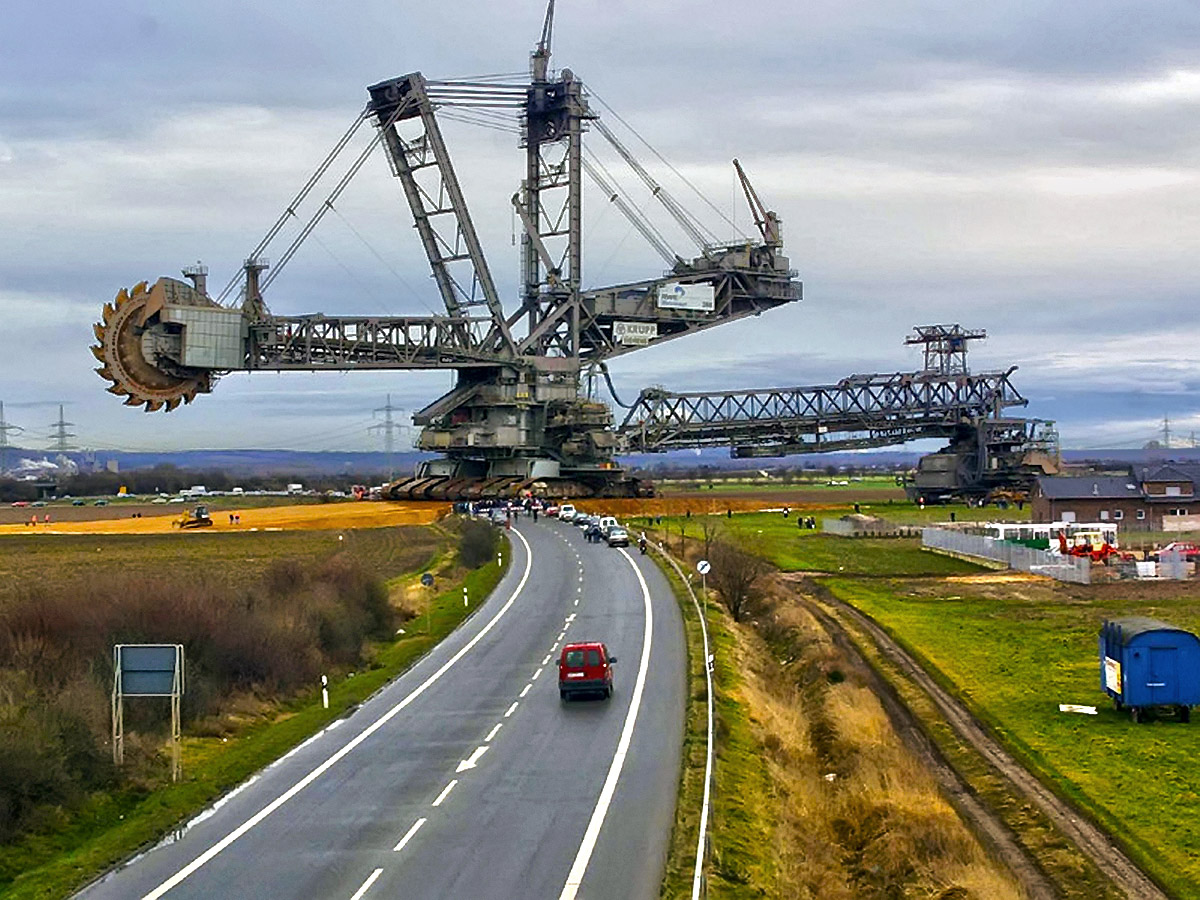
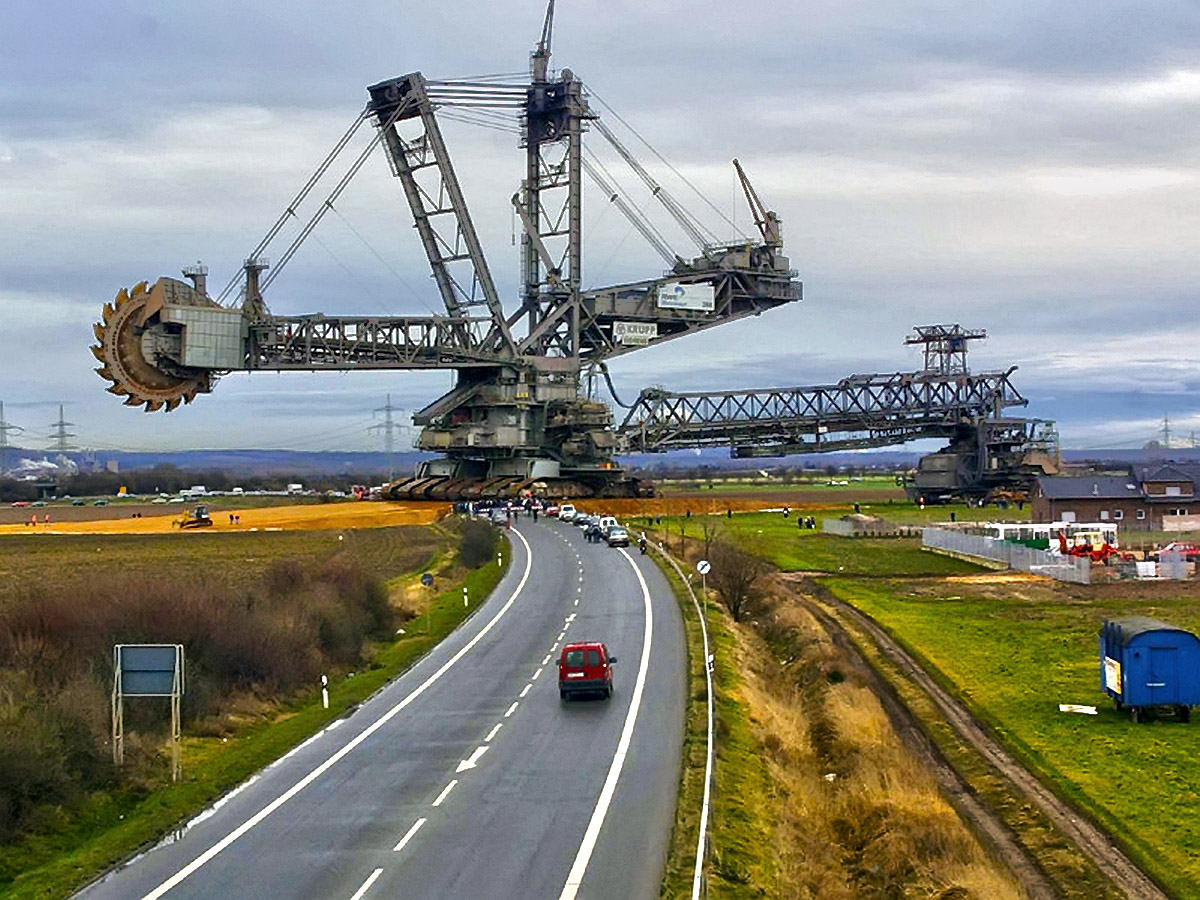
The Vattenfall lignite mine in Germany; the Anthropocene personified

The issue of whether or not to assign the time span during which human activities have been significantly affecting the planet and its interwoven Earth Systems has been dragging on since the term ‘Anthropocene’ was first proposed more than two decades ago. A suggestion that may resolve matters, both amicably and with a degree of scientific sense, has emerged in a short letter to the major scientific journal Nature, written by six eminent scientists (Bauer, A.M. et al. 2021. Anthropocene: event or epoch? Nature, v. 597, p. 332; DOI: 10.1038/d41586-021-02448-z). The full text is below

The concept of the Anthropocene has inspired more than two decades of constructive scholarship and public discussion. Yet much of this work seems to us incompatible with the proposal to define the Anthropocene as an epoch or series in the geological timescale, with a precise start date and stratigraphic boundary in the mid-twentieth century. As geologists, archaeologists, environmental scientists and geographers, we have another approach to suggest: recognize the Anthropocene as an ongoing geological event.

The problems with demarcating the Anthropocene as a globally synchronous change in human–environment relations, occurring in 1950 or otherwise, have long been evident (P. J. Crutzen and E. F. Stoermer IGBP Newsletter 41, 17–18; 2000). As an ongoing geological event, it would be analogous to other major transformative events, such as the Great Oxidation Event (starting around 2.4 billion years ago) or the Great Ordovician Biodiversification Event (around 500 million years ago).

Unlike formally defined epochs or series, geological events can encompass spatial and temporal heterogeneity and the diverse processes — environmental and now social — that interact to produce global environmental changes. Defining the Anthropocene in this way would, in our view, better engage with how the term has been used and criticized across the scholarly world.”

AUTHORS: Andrew M. Bauer, Stanford University, Stanford, California, USA; Matthew Edgeworth, University of Leicester, Leicester, UK;  Lucy E. Edwards, Florence Bascom Geoscience Center, Reston, Virginia, USAErle C. Ellis, University of Maryland, Baltimore County, Maryland, USA ; Philip Gibbard, Scott Polar Research Institute, University of Cambridge, Cambridge, UK;  Dorothy J. Merritts, Franklin and Marshall College, Lancaster, Pennsylvania, USA.

I have been grousing about the attempt to assign Epoch/Series status to the Anthropocene for quite a while (you can follow the development of my personal opinions by entering ‘Anthropocene’ in the Search Earth-logs box). In general I believe that the proposal being debated is scientifically absurd, and a mere justification for getting a political banner to wave. What the six authors of this letter propose seems eminently sensible. I hope it is accepted by International Commission on Stratigraphy as a solution to the increasingly sterile discussions that continue to wash to and fro in our community. Then perhaps the focus can be on action rather than propaganda.

As things have stood since 21 May 2019, a proposal to accept the Anthropocene as a formal chrono-stratigraphic unit defined by a GSSP at its base around the middle of the 20th century is before the ICS and the International Union of Geological Sciences (IUGS) for ratification. It was accepted by 88% of the 34-strong Anthropocene Working Group of the ICS Subcommission on Quaternary Stratigraphy. But that proposal has yet to be ratified by either the ICS or IUGS. Interestingly, one of the main Anthropocene proponents was recently replaced as chair of the Working Group.

The Great Anthropocene debate

The Bagger 288 bucket wheel reclaimer moves from one lignite mine to another in Germany: an apt expression of modern times

Followers of Earth-logs and its predecessor, should be familiar with the concept of ‘The Anthropocene’. More recent readers can hardly have escaped it, for it has become a recurrent motif that extends far beyond science to the media, the social sciences and even the arts. Some circles among the ‘chattering classes’ speak of little else. It has become a trope – a word with figurative or metaphorical meaning. In 2000, atmospheric chemist and Nobel Laureate Paul Crutzen suggested that the increasingly clear evidence that human society is having growing impacts on the Earth system should be recognised by a new stratigraphic Epoch. Some Fellows of the Geological Society of London launched an attempt to formalise the suggestion through the society’s Stratigraphic Commission (Zalasiewicz, J. and 20 others 2008. Are we now living in the Anthropocene? GSA Today, v.18(ii), p. 4-8; DOI: 10.1130/GSAT01802A.1). In 2009 Jan Zalasiewicz of the University of Leicester became the first chair of the Anthropocene Working Group (AWG) within the International Commission on Stratigraphy (ICS).  A dozen years on, stratigraphers continue to debate the Anthropocene (See: Brazil, R. 2021. Marking the Anthropocene. Chemistry World, 29 January 2021). One of the problems facing its supporters is the lack of agreement about what it is and when it started.

Since 1977 the ICS has been searching for localities, known as Global Boundary Stratotype Sections and Points, or GSSPs, that mark the actual beginning of each basic division of the geological record: Eons, Eras, Periods, Epochs and Ages. So far, those for Epochs and longer divisions have been agreed and GSSP markers have been cemented in place, sometimes with quite large monuments, if not actual golden spikes. Those for the shortest timespans – Ages – are proving more difficult to agree on. These GSSPs have to have global significance, yet the very nature of stratigraphy means that a fair number of the most brief rock sequences revealed by field work either formed at different times across the globe, or there is no incontrovertible dating method to record their beginning and end.

Currently, we live in the Holocene Epoch whose beginning marked the global climate system’s exit from the frigid Younger Dryas at 11.7 ka ago. The Holocene (‘entirely recent’) Epoch marks the latest interglacial. When it began every human being was Homo sapiens, made a living as a hunter-gatherer and eventually expanded into every ecosystem that offered sustenance on all continents bar Antarctica. Within a few thousand years some began sedentary life as farmers and herders after their domestication of a range of plant and animal species. A few millennia later agriculture had a growing foothold everywhere except in Australia. Natural tree cover began to be cleared and organised grazing steadily changed other kinds of ecosystem. Human influences, other than scattered artefacts and bones, became detectable in geological formations such as lake-bed sediments and peat mires. The geological record of the Holocene is by no means consistent globally, there being lots of gaps. That is partly because sedimentary systems continually deposited, eroded and transported sediments on the landmasses. In the tropics and much of the Southern Hemisphere the Younger Dryas is, in any case, barely recognisable in post-Ice Age deposits, so the start of the Holocene there is vague. Things are simpler on the deep sea floor, as muds accumulate with no interruption. But it was only when data became available from drill cores through continental ice masses on Antarctica, Greenland and scattered high mountains that any detailed sense of changes and their pace emerged. The major climatic perturbation of the Younger Dryas and its end only became clear from the undisturbed annual layering in Greenland ice cores. It proved to have been extremely fast: a couple of decades at most. The GSSP for the start of the Holocene therefore lies in a single Greenland ice core preserved by cold storage in Copenhagen. It is a somewhat ephemeral record.

Leaving aside for the moment that the Anthropocene adds the future to the geological record, when was it supposed to start? Its name demands that it be linked to some human act that began to change the world. That is implicit in the beginning of agriculture which held out the prospect of continuous growth in human populations by securing food resources rather than having to seek them. But such an event is not so good from the standpoint of purist stratigraphy as it happened at different times at different places and probably for different reasons (See: Mithen, S. 2004. After the Ice: A Global Human History, 20,000 – 5000 BC. Weidenfeld and Nicolson, London; ISBN-13: 978-0753813928 [A superb read]). A case has been made for the European conquest and colonisation of the Americas which was eventually followed by the death from European diseases of tens of millions of native people, many of whom were farmers in the Amazon basin. The Greenland ice records a decline in atmospheric CO2 between 1570 to 1620 CE, which has been ascribed to massive regrowth of previously cleared tropical rainforest. That would define a start for the Anthropocene at around 1610 CE. Yet the main driver for erecting an Anthropocene Epoch is global warming, which has grown exponentially with the burning of fossil fuels and CO2 emissions since the ill-defined start of the Industrial Revolution (late 18th – early 19th century). It looks like in a year or so the ICS is due to debate a much later start at the peak of nuclear weapon fallout in 1964, which its champions claim to coincide with the ‘Great Acceleration’ in world economic growth, emissions and warming.

If that is accepted, anyone still alive who was born before 1964 is a relic of the Holocene, as Philip Gibbard secretary-general of ICS wryly observed, whereas our children and grandchildren will be wholly of the Anthropocene. We Holocene relics only grasped the change at the start of the 21st century! The very nature of exponential growth is that its tangible effects always come as a surprise. The build-up of human influence on the world has been proceeding stealthily since not long after the Holocene began. Annoyingly, the very name Anthropocene lays the blame on the whole of humanity. In reality it is an outcome of a mode of economy that demands continual exponential growth. That mode – the World Economy – lies completely beyond the reach of social and political control. It is effectively inhuman. So, why the pessimism – can’t human beings get rid of an ethos that is obviously alien to their interests? Perhaps ‘Anthropocene’ might be an apt name for the aftermath of such a reckoning, which may last long enough to be properly regarded as an Epoch …

Sedimentary deposits of the ‘Anthropocene’

Economic activity since the Industrial Revolution has dug up rock – ores, aggregate, building materials and coal. Holes in the ground are a signature of late-Modern humanity, even the 18th century borrow pits along the rural, single-track road that passes the hamlet where I live. Construction of every canal, railway, road, housing development, industrial estate and land reclaimed from swamps and sea during the last two and a half centuries involved earth and rock being pushed around to level their routes and sites. The world’s biggest machine, aside from CERN’s Large Hadron Collider near Geneva, is Hitachi’s Bertha the tunnel borer (33,000 t) currently driving tunnels for Seattle’s underground rapid transit system. But the record muck shifter is the 14,200 t MAN TAKRAF RB293 capable of moving about 220,000 t of sediment per day, currently in a German lignite mine. The scale of humans as geological agents has grown exponentially. We produce sedimentary sequences, but ones with structures that are very different from those in natural strata. In Britain alone the accumulation of excavated and shifted material has an estimated volume six times that of our largest natural feature, Ben Nevis in NW Scotland. On a global scale 57 billion t of rock and soil is moved annually, compared with the 22 billion t transported by all the world’s rivers. Humans have certainly left their mark in the geological record, even if we manage to reverse  terrestrial rapacity and stave off the social and natural collapse that now pose a major threat to our home planet.

A self propelled MAN TAKRAF bucketwheel excavator (Bagger 293) crossing a road in Germany to get from one lignite mine to another. (Credit: u/loerez, Reddit)

The holes in the ground have become a major physical resource, generating substantial profit for their owners from their infilling with waste of all kinds, dominated by domestic refuse. Unsurprisingly, large holes have become a dwindling resource in the same manner as metal ores. Yet these stupendous dumps contain a great deal of metals and other potentially useful material awaiting recovery in the eventuality that doing so would yield a profit, which presently seems a remote prospect. Such infill also poses environmental threats simply from its composition which is totally alien compared with common rock and sediment. Three types of infill common in the Netherlands, of which everyone is aware, have recently been assessed (Dijkstra, J.J. et al. 2019. The geological significance of novel anthropogenic materials: Deposits of industrial waste and by-products. Anthropocene, v. 28, Article 100229; DOI: 10.1016/j.ancene.2019.100229). These are: ash from the incineration of household waste; slags from metal smelting; builders’ waste. What unites them, aside from their sheer mass, is the fact that are each products of high-temperature conditions: anthropogenic metamorphic rocks, if you like. That makes them thermodynamically unstable under surface conditions, so they are likely to weather quickly if they are exposed at the surface or in contact with groundwater. And that poses threats of pollution of soil-, surface- and groundwater

All are highly alkaline, so they change environmental pH. Ash from waste incineration is akin to volcanic ash in that it contains a high proportion of complex glasses, which easily break down to clays and soluble products. Curiously, old dumps of ash often contain horizons of iron oxides and hydroxides, similar to the ‘iron pans’ in peaty soils. They form at contacts between oxidising and reducing conditions, such as the water table or at the interface with natural soils and rocks. Soluble salts of a variety of trace elements may accumulate, such copper, antimony and molybdenum. Slags not only contain anhydrous silicates rich in the metals of interest and other trace metals, which on weathering may yield soluble chromium and vanadium, but they also have high levels of calcium-rich compounds from the limestone flux used in smelting, i.e. agents able to create high alkalinity. Portland cement, perhaps the most common material in builders’ waste, is dominated by hydrated calcium-aluminium silicates that break-down if the concrete is crushed, again with highly alkaline products. Another component in demolition debris is gypsum from plaster, which can be a source of highly toxic hydrogen sulfide gas generated in anaerobic conditions by sulfate-sulfide reducing bacteria.

Anthropocene edging closer to being ‘official’

The issue of erecting a new stratigraphic Epoch encompassing the time since humans had a global effect on the Earth System has irked me ever since the term emerged for discussion and resolution by the scientific community in 2000. An Epoch in a chronostratigraphic sense is one of several arbitrary units that encompass all the rocks formed during a defined interval of time. The last 541 million years (Ma) of geological time is defined as an Eon – the Phanerozoic. In turn that comprises three Eras – Palaeozoic, Mesozoic and Cenozoic. The third level of division is that of Periods, of which there are 11 that make up the Phanerozoic. In turn the Periods comprise a total of 38 fourth-level Epochs and 85 at the fifth tier of Ages. All of these are of global significance, and there are even finer local divisions that do not appear on the International Chronostratigraphic Chart . If you examine the Chart you will find that no currently agreed Epoch lasted less than 11.7 thousand years (the Holocene) and all the others spanned 1 Ma to tens of Ma (averaged at 14.2 Ma). Indeed, even Ages span a range from hundreds of thousands to millions of years (averaged at 6 Ma).

lignite
The Vattenfall lignite mine in Germany; the Anthropocene personified

In the 3rd week of May 2019 the 34-member Anthropocene Working Group (AWG) of the International Commission on Stratigraphy (ICS) sat down to decide on when the Anthropocene actually started. That date would be passed on up the hierarchy of the geoscientific community  eventually to meet the scrutiny of its highest body, the executive committee of the International Union of Geological Sciences, and either be ratified or not. In the meantime the AWG is seeking a site at which the lower boundary of the Anthropocene would be defined by the science’s equivalent of a ‘golden spike’; the Global boundary Stratotype Section and Point (GSSP). Continue reading “Anthropocene edging closer to being ‘official’”

Humans and mass extinction

It is often said that the biosphere is currently undergoing species losses that may rival those of the ‘Big Five’ mass extinction, with the rate of new extinctions being estimated at about 100 times the background rate during geological time. Scientifically, this is probably a dodgy assumption for palaeobiologists simply do not have the evidence to suggest what such a ‘normal’ rate might be. The fossil record is notoriously incomplete for a whole variety of reasons largely to do with both preservation and fossil collection strategies. For instance, as today, some genera may have been very common and widespread in past times, whereas others rare and restricted to small ecological niches. The record of life is prone to huge errors so that only huge, global shifts in diversity, such as mass extinctions, can be viewed with statistical rigour; and then only with caveats. For sure, the rapid demise of species today is cause for alarm and dismay, and more taxa – mainly of smaller and more restricted groups – probably have escaped identification, and will continue to do so. In the context of growing human impacts on ecosystems across the globe extinction is an increasingly emotive topic, as witness the clamour among some geoscientists for adding a new Anthropocene Epoch to the to the Stratigraphic Column. Does that require renaming the Holocene, beginning 11,700 years ago at the end of the last Ice Age, during which agriculture began? Should its start be assigned to some event during recorded history, such as the European invasion of the Americas after 1493, the beginning of the Industrial Revolution or the explosion of the first thermonuclear weapons in the 1940s and 50s? Or did humans begin significantly to affect the biosphere once their spread from Africa started after about 130 ka ago, i.e. in the late Pleistocene? That argument may well run and run: it is foremost a scientific issue, to which rules apply. A cogent example is that of the fate of megafaunas on the major continents except Antarctica as humans migrated far and wide.

The demise of the large flightless birds of Madagascar and New Zealand form a well known case as they almost certainly followed first colonisation by humans around 200 BC and 1300 CE respectively. The megafaunas of the much larger continents of Australia and the Americas have been deemed to have been more than decimated in the same way after about 65 ka and 15 ka respectively. There are no longer giant armadillos and ground sloths in South America, mammoths ceased to roam North America, and giant wombats, marsupial predators and kangaroos only remain as bones, to name but a few. It has been argued that their extinctions stemmed from the first human migrants literally eating their way through vast terrains. Yet the vast herds of Africa seem not to have been affected in the same way, until much more recently as population grew and modern projectile weapons became widely available. That has been suggested to have resulted from co-evolution of humans and megafauna over two million years, together with instinctive caution among large African beasts, whereas the ‘naivety’ of their counterparts in the Americas and Australia doomed them to extinction. Of course, it is likely that things were a great deal more complicated in every case, as argued in a review of Late Pleistocene megafaunal extinctions by Gilbert Price of the University of Queensland, and colleagues from Australia, the US and Denmark (Price, G.J. et al. 2018. Big data little help in megafauna mysteries. Nature, v. 558, p. 23-25;  doi:10.1038/d41586-018-05330-7).

The gist of Price and colleagues’ critique of meta-analyses of data – 32 since 1997 – concerning allegedly human-induced extinctions is that much of the pertinent data is either low quality or poorly understood. For starters, much of the dating is questionable, either using inaccurate and outdated methods or based on inference. For instance, fossils of some alleged victim, e.g.  Australian land crocodiles (Quinkana) and giant wombats (Ramsayia), have never been dated. Moreover, dates of the last known fossils are used when they may have remained extant until more recently: wooly Eurasian mammoths were long supposed not to have survived the last glacial maximum, yet recently mammoth bones from Wrangel island were found to be as young as the second millennium BCE. In 2010 spores of the fungus Sporormiella, in sediment cores, which grows only on digested plant matter in herbivore dung, was used as a proxy for the former presence or absence of large herbivore herds. Its decline in sediments after 13 ka in North America happened to coincide roughly with the start of the North American Clovis hunter culture, which was used to show that extinctions of large herbivores were linked to human predation. Yet such fungi also live on excrement of many animals both large and small, and its preservation is affected by changes in climate and water flow. To properly link declines and extinctions in human prey animals requires concrete evidence of predation, such as cut marks on identifiable bones within middens associated with human habitation, such as hearths.

When emotion, ambition and bandwagon tendencies become associated with science, objectivity sometimes gets compromised.

A fully revised edition of Steve Drury’s book Stepping Stones: The Making of Our Home World can now be downloaded as a free eBook

A ‘proper’ stratigraphic view of the ‘Anthropocene’

Readers may recall my occasional rants over the years against the growing bandwagoning for an  ‘Anthropocene‘ epoch at the top of the stratigraphic column. I , for one, was delighted to find in the latest issue of GSA Today a more sober assessment of the campaign by two stratigraphers who are well placed to have a real say in whether or not the ‘Anthropocene’ is acceptable, one serving on the International Commission on Stratigraphy, the other on the North American Commission on Stratigraphic Nomenclature (Finney, S.C. & Edwards, L.E. 2016. The “Anthropocene” epoch: Scientific decision or political statement? GSA Today, v. 26 (3–4).

A rational view of the start of human influences on Life and Geology

Regular readers will know that I have strong views on attempts to burden stratigraphy with a new Epoch: the Anthropocene. The central one is that the lead-in to a putsch has as much to do with the creation of a bandwagon, to whose wheels all future geologists will be shackled, as it does to any scientific need for such a novelty. Bound up as it is with the fear that Earth may be experiencing its sixth mass extinction, the mooted Anthropocene will likely become a mere boundary marked by future stratigraphers as a Global Boundary Stratotype Section and Point or GSSP between the existing Holocene Epoch and that sequence of sedimentary strata and their fossil record that will be laid down on top of it. Or not, if humanity becomes extinct should the economically induced, dangerous modifications of our homeworld of the last few decades or centuries not be halted. Either way, it defies the stratigraphic ‘rule book’.

No one can deny that humanity’s activities are now immensely disruptive to surface geological processes. Nor is it possible to rule out such disruptive change to the biosphere in the near-future that a latter-day equivalent of the K/Pg or end-Permian events is on the cards: such confidence does not spring from the interminable succession of grand words and global inaction reiterated in December 2015 by the UN Paris Agreement on economically-induced climate change. Still, it was a bit of a relief to find that palaeontological evidence, or rather statistics derived from the fossil record in North American sedimentary rocks since the Carboniferous, emphasises that there is no need for the adoption of Anthropocene as an acceptable geological adjective.

To ecologists, extinctions are not the be all and end all of disruption of the biosphere. Major shifts in life’s richness are also recorded by the way entire ecosystems become disrupted. A classic, if small-scale, example is that way in which the ecosystem of the US Yellowstone National Park changed since the eradication by 1926 of the few hundred grey wolves that formerly preyed mainly on elk. In the 20 years since wolf reintroduction to the Park in 1995 the hugely complex but fragile Yellowstone ecosystem has showed clear signs of recovery of its pre-extirpation structure and diversity.

A consortium of mainly US ecologists, led by Kathleen Lyons of the National Museum of Natural History at the Smithsonian Institution in Washington DC, has assessed linkages between species of fossil animal and plants since the Carboniferous (S.K. Lyons and 28 others, 2015. Holocene shifts in the assembly of plant and animal communities implicate human impacts. Nature, published on-line 16 December 2015 doi:10.1038/nature16447). They found that of the 350 thousand pairs of species that occurred together at different times throughout the late Palaeozoic to the last Epoch of the Cenozoic, the Holocene, some pairs appeared or clustered together more often than might be expected from random chance. Such non-random association suggests to ecologists that the two members of such a pair somehow shared ecological resources persistently, hinting at relationships that helped stabilise their shared ecosystem. For most of post-300 Ma time an average of 64% of non-random pairs prevailed, but after 11.7 ka ago – the start of the Holocene – that dropped to 37%, suggesting a general destabilisation of many of the ecosystems being considered. This closely correlates with the first human colonisation of the Americas, the last of the habitable continents to which humans migrated. This matches the empirical evidence of early Holocene extinctions of large mammals in the Americas, which itself is analogous to the decimation of large fauna in Australasia during the late Pleistocene following human arrival from about 50 to 60 ka ago. Significant human-induced ecological impact seems to have accompanied their initial appearance everywhere. The ecological effects of animal domestication and agriculture in Eurasia and the Americas mark the Holocene particularly. In fact, in Europe the presence of Mesolithic hunter gatherers is generally inferred, in the face of very rare finds of artefacts and dwellings, from changes in pollen records from Holocene lake and wetland sediments, which show periods of tree clearance that can not be accounted for by climate change.

There is no need for Anthropocene, other than as a political device.

Anthropocene: what (or who) is it for?

The made-up word chrononymy could be applied to the study of the names of geological divisions and their places on the International Stratigraphic Chart. Until 2008 that was something of a slow-burner, as careers go. It all began with Giovanni Arduino and Johann Gotlob Lehman in the mid- to late 18th century, during the informal historic episode known as the Enlightenment. To them we owe the first statements of stratigraphic principles and the beginning of stratigraphic divisions: rocks divided into the major segments of Primitive, Secondary, Tertiary and Quaternary (Arduino). Thus stratigraphy seeks to set up a fundamental scale or chart for expressing Earth’s history as revealed by rocks. The first two divisions bit the dust long ago; Tertiary is now an informal synonym for the Cenozoic Era; only Quaternary clings on as the embattled Period at the end of the Cenozoic.  All 11 Systems/Periods of the Phanerozoic, their 37 Series/Epochs and 85 Stages/Ages in the latest version of the International Stratigraphic Chart have been thrashed out since then, much being accomplished in the late 19th and early 20th centuries. Curiously, the world body responsible for sharpening up the definition of this system of ‘chrononymy’, the International Commission on Stratigraphy (ICS), seems not to have seen fit to record the history of stratigraphy: a great mystery. Without it geologists would be unable to converse with one another and the world at large.

Yet now an increasing number of scientists are seriously proposing a new entry at the 4th level of division after Eon, Era and Period: a new Epoch that acknowledges the huge global impact of human activity on atmosphere, hydrosphere, biosphere and even lithosphere. They want it to be called the Anthropocene, and for some its eventual acceptance ought to relegate the current Holocene Epoch, in which humans invented agriculture, a form of economic intercourse and exchange known as capital and all the trappings of modern industry, to the 5th division or Stage. Earth-pages has been muttering about the Anthropocene for the past decade, as charted in a number of the links above, so if you want to know which way its author is leaning and how he came to find the proposal an unnecessary irritation, have a look at them. Last week things became sufficiently serious for another comment. Simon Lewis and Mark Maslin of the Department of Geography at University College London have summarised the scientific grounds alleged to justify an Anthropocene Epoch and its strict definition in a Nature Perspective (Lewis, S.J. & Maslin, M.A. 2015. Defining the Anthropocene. Nature, v. 519, p. 171-180).-=, which is interestingly discussed in the same Issue by Richard Monastersky.

Lewis and Maslin present two dates that their arguments and accepted stratigraphic protocols suggest as candidates for the start of the Anthropocene: 1610 and 1964 CE, both of which relate to features that are expressed by geological records that should last indefinitely. The first is a decline and eventual recovery in the atmospheric CO2 level recorded in high-resolution Antarctic ice core records between 1570 and 1620 CE that can be ascribed to the decline in the population of the Americas’ native peoples from an estimated 60 to 6 million. This result of the impact of European first colonisation – disease, slaughter, enslavement and famine – reduced agriculture and fire use and saw the regeneration of 5 x 10⁷ hectares of forest, which drew down CO2 globally. It also coincides with the coolest part of the Little Ice Age from 1594-1677 CE. They caution against the start of the Industrial Revolution as an alternative for a ‘Golden Spike’ since it was a diachronous event, beginning in Europe. Instead, they show that the second proposal for a start in 1964 has a good basis in the record of global anthropogenic effects on the Earth marked by the peak fallout of radioactive isotopes generated by atomic weapons tests during the Cold War, principally 14C with a 5730 year half life, together with others more long-lived. The year 1964 is also roughly when growth in all aspects of human activity really took off, which some dub in a slightly Tolkienesque manner the ‘Great Acceleration’. [There is a growing taste for this kind of hyperbole, e.g. the ‘Great Oxygenation Event’ around 2.4 Ga and the ‘Great Dying’ for the end-Permian mass extinction]. Yet they neglect to note that the geochronological origin point for times past has been defined as 1950 CE when nucleogenic 14C contaminated later materials as regards radiocarbon dating, which had just become feasible.   Lewis and Maslin conclude their Perspective as follows:

To a large extent the future of the only place where life is known to exist is being determined by the actions of humans. Yet, the power that humans wield is unlike any other force of nature, because it is reflexive and therefore can be used, withdrawn or modified. More widespread recognition that human actions are driving far-reaching changes to the life-supporting infrastructure of Earth may well have increasing philosophical, social, economic and political implications over the coming decades.

So the Anthropocene adds the future to the stratigraphic column, which seems more than slightly odd. As Richard Monastersky notes, it is in fact a political entity: part of some kind of agenda or manifesto; a sort of environmental agitprop from the ‘geos’. As if there were not dozens of rational reasons to change human impacts to haul society back from catastrophe, which many people outside the scientific community have good reason to see as  hot air on which there is never any concrete action by ‘the great and the good’. Monastersky also notes that the present Anthropocene record in naturally deposited geological materials accounts for less than a millimetre at the top of ocean-floor sediments. How long might the proposed Epoch last? If action to halt anthropogenic environmental change does eventually work, the Anthropocene will be  very short in historic terms let alone those which form the currency of geology. If it doesn’t, there will be nobody around able to document, let alone understand, the epochal events recorded in rocks. At its worst, for some alien, visiting planetary scientists, far in the future, an Anthropocene Epoch will almost certainly be far shorter than the 104 to 105 years represented by the hugely more important Palaeozoic-Mesozoic and Mesozoic-Cenozoic boundary sequences; but with no Wikipedia entry.

Not everybody gets a vote on these kinds of thing, such is the way that science is administered, but all is not lost. The final arbiter is the Executive Committee of the International Union of Geological Sciences (IUGS), but first the Anthropocene’s status as a new Epoch has to be approved by 60% of the ICS Subcommission on Quaternary Stratigraphy, if put to a vote. Then such a ‘supermajority’ would be needed from the chairs of all 16 of the ICS subcommissions that study Earth’s major time divisions. But first, the 37 members of the Subcommission on Quaternary Stratigraphy’s ‘Anthropocene’ working group have to decide whether or not to submit a proposal: things may drag on at an appropriately stratigraphic pace. Yet the real point is that the effect of human activity on Earth-system processes has been documented and discussed at length. I’ll give Marx the last word in this ‘The philosophers have only interpreted the world, in various ways. The point, however, is to change it’. A new stratigraphic Epoch doesn’t really seem to measure up to that…