Una parodia della giustizia?

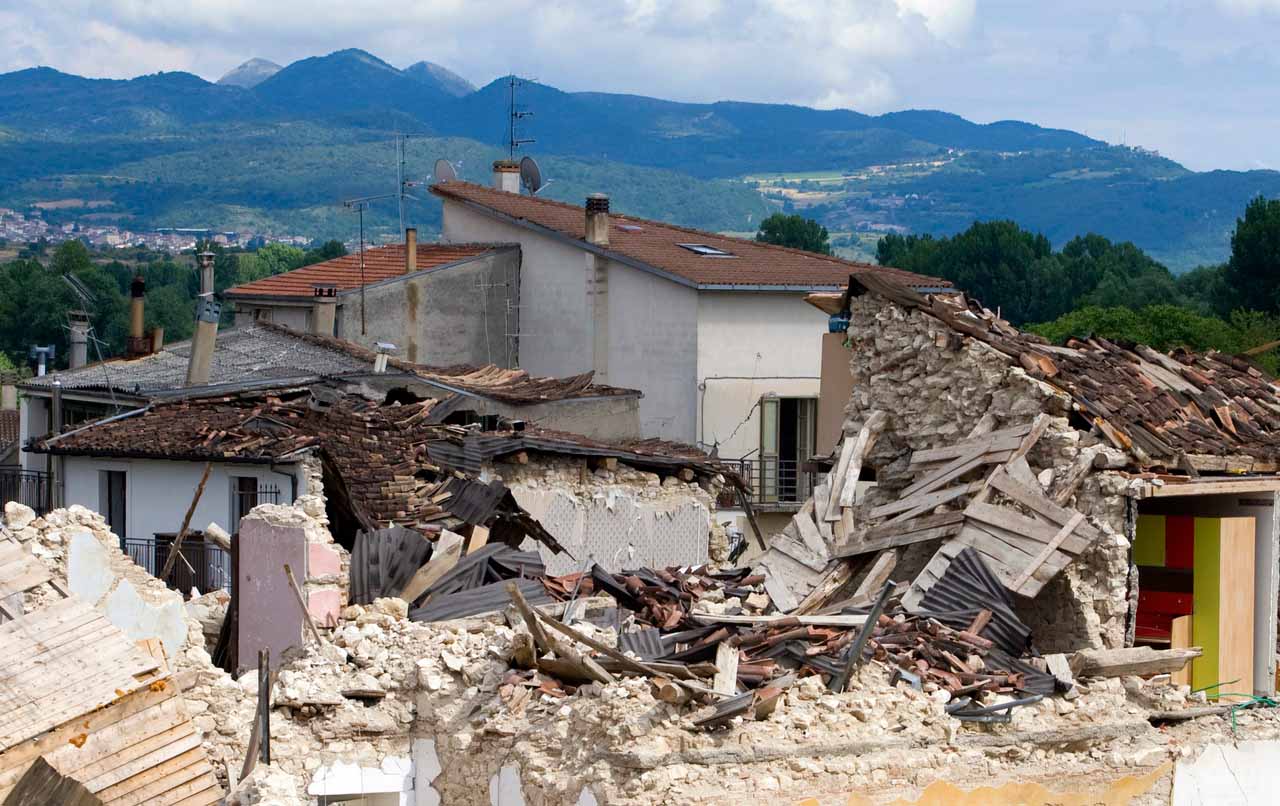
Damage caused by the L’ Aquila earthquake of 6 April 2009. (credit: Reuters)

Lying above a destructive plate margin, albeit a small one, Italy is prone to earthquakes. Seismometers detect a great many of low magnitude that no one notices and that do no obvious damage to buildings. From 2006 to autumn 2008 the Abruzzo region on the eastern flank of the Appenine mountains of central Italy experienced a background of one low-magnitude tremor every day (Papadopoulos, G.A. et al. 2010. Strong foreshock signal preceding the L’Aquila (Italy) earthquake (Mw 6.3) of 6 April 2009. Natural Hazards and Earth System Sciences, v. 10, p. 19-24). In the following 6 months the rate more than doubled but the epicentres continued to be almost randomly situated. Things changed dramatically in the 10 days following 27 March 2009: the pace increased to twenty times the normal ‘background’ and epicentres clustered directly beneath the regional capital L’ Aquila (population 73 thousand) close to a known fault line. At 3.32 am on 6 April 2009 the Paganica fault failed less than 10 km below L’ Aquila, directing most of the Magnitude 6.3 energy at the town. This was the deadliest earthquake in Italy for three decades; 308 people died 1500 were injured and 40 thousand found themselves homeless. Silvio Berlusconi, not a man to flinch from controversy, commented on German TV about the homeless, ‘Of course, their current lodgings are a bit temporary. But they should see it like a weekend of camping’.

English: Silvio Berlusconi in a meeting with J...
Former Italian President Silvio Berlusconi (credit: Wikipedia)

L’ Aquila has a dismal history of seismic damage, having been devastated before: 7 times since the 14th century. Having grown on a foundation of lake-bed sediments, notorious for amplifying ground movements, the city was clearly in a high-risk status in much the same manner as Mexico City. Shaken several times before and built with no regard to seismicity, much of L’ Aquila’s centuries-old building stock was incapable of resisting the event of 6 April 2009: up to 11 thousand building were damaged, some collapsing completely.

Not only was the earthquake preceded by an increasing pace of foreshocks, but many local people reported strange ‘earth lights’ during the months beforehand (Fidani, C. The earthquake lights (EQL) of the 6 April 2009 Aquila earthquake, in Central Italy.Natural Hazards and Earth System Sciences, v. 10, p. 967-978). In fact, so many sightings were made that plans have been outlined for a CCTV monitoring network in rural areas.

So, this disaster was not short of signs that all was not well in Abruzzo, in a seismic sense: historical precedent; poor urban siting; foreshocks and oddities that have come to be associated with impending energy release. But was this litany sufficient to predict the place, date, and magnitude of what was coming? Plate tectonics, local structural geology and worldwide seismicity allow geophysicists to assess risk from earthquakes in the same way as hydrologists can outline flood-prone areas: literally on flood plains. Yet there are few if any records of a devastating earthquake having been predicted anywhere with sufficient accuracy to allow evacuation and mitigation of death and injury. That is despite the fact that teams of seismologists in the western US, Japan, Italy and several other well-off countries continually monitor seismic events even with a power many orders of magnitude less than those which kill or injure. Such bodies are faced with a dreadful choice in the face of evidence like that summarised above: warn tens of thousands to evacuate, organise such an exodus in a few days and prepare accommodation for them, or advise that similar seismic escalations rarely lead to massive damage with an estimate of the probability of risk. Both choices are guesswork for there are no rigorous equations that spell ‘doom’ or ‘all clear’ from such data. Earthquakes are not rainstorms or hurricanes, as 250 thousand dead people on the shores of the Indian Ocean bear grim witness.

Despite broad knowledge of the deep uncertainty associated with earthquakes and volcanic eruptions – no longer privy to specialist scientists these days, even in the least developed parts of the world – the Italian authorities saw fit to prosecute six earth scientists and a public official for multiple manslaughter.  Because they provided “inaccurate, incomplete and contradictory” information about what might have been the aftermath of tremors felt ahead of 6 April 2009 earthquake, a regional court sentenced all of them to six years in prison – two years more than even the prosecution demanded – and they are to pay the equivalent of £6.7 million in compensation. This was not a jury verdict, but the decision of a single judge, Marco Billi. No scientist, even one poring over data from the Large Hadron Collider in search of the Higgs boson, would every claim that what they report is perfectly accurate, complete and incontrovertible. The L’Aquila Seven never said they were certain that no earthquake would ensue, and the city’s people were well aware of what risk they faced in much the same way that Neapolitans living on the slopes of Vesuvius know that one day they may be incinerated.

This is a travesty of justice so bizarre that one must look to the famous adage of Roman Law: qui bono? Certainly not the victims and their mourners, and definitely not science because any sensible Italian geophysicist will in future simply play dumb. There is already a huge world wide outcry, not just from outraged scientists.

Added 25 October 2012: The 12 October issue of Science carried a lengthy summary of proceedings early in the trial (Cartlidge, E. 2012. Aftershocks in the courtroom. Science, v. 338, p. 185-188). Read Nature‘s editorial on the L’ Aquila verdict here and further comment.

New twist on lunar origin

English: Giant impact - artist impression. Čes...
Artistic impression of the moon-forming giant impact. (credit: Wikipedia)

Although a few would-be space faring countries have ambitions, a post-Apollo crewed mission to the Moon is unlikely for quite a while. Yet moon-struck curiosity goes on: currently there is a surge in re-examining the lunar samples brought back more than 40 years ago. The Lunar Sample Laboratory Facility in Houston holds about a third of a ton of rock and regolith. I suppose part of the reason why lunar rocks are being re-analysed – in fact some for the first time – is because new or improved methods are available, but frustration among  a growing community of planetary geochemists having little more than meteorites to peer at probably plays a role as well. Since Hartman and Davis first suggested it, the giant impact theory for the Moon’s origin has dominated geochemical ideas. Most tangible is that of a magma ocean, floated plagioclase crystals from its fractional crystallisation probably having formed the glaring white lunar highlands composed of anorthosite. More subtle are ideas about what happened to the Mars-sized planet that did the damage to Earth and flung vaporised rock into orbit to accrete into the new Moon, and the effects of the stupendous energy on the geochemistry of all three bodies. Directed at all that is new research on isotopes of zinc (Paniello, R.C. et al. 2012. Zinc isotope evidence for the origin of the Moon. Nature, v. 490, p. 376-379).

The focus on zinc is because it is easily vaporised compared with more refractory materials, such as calcium an titanium, and as well as being ‘volatile’ it has five naturally occurring isotopes with relative atomic masses of 64 (the most abundant), 66, 67, 68 and 70. In general, isotopes of an element behave in slightly different ways during geological and cosmological processes, which changes their proportions in the products; a process known as ‘mass-fractionation’. Paniello and colleagues from Washington University, Missouri and the Scripps Institution of Oceanography, California USA found that Moon rocks are enriched in the heavier isotopes of zinc yet depleted in total zinc compared with terrestrial rocks and meteorites supposed to have come from Mars. Unlike those two planets the Moon’s zinc deviates from its abundance relative to other elements recorded by chondritic meteorites. This zinc depletion tallies with volatile loss from incandescent vapour blurted from the colliding planets. But it doesn’t help with the detailed predictions from the giant-impact model. A variety of scenarios suggest that the Moon should be made from remnants of the inbound impactor’s mantle, yet studies of other elements’ isotopes indicate that the Moon is rather Earth-like. But not those of zinc, so it looks like they have to be explained by a complete rethink of the whole hypothesis (Elliott, T. 2012. Galvanized lunacy. Nature, v. 490, p. 346-7).

The shuffling poles

The mechanical disconnection of the lithosphere from the Earth’s deep mantle by a more ductile zone in the upper mantle – the asthenosphere – suggests that the lithosphere might move independently. If that were the case then points on the surface would shift relative to the axis of rotation and the magnetic poles, irrespective of plate tectonics.  So it makes sense to speak of absolute and relative motions of tectonic plates. The second relates to plates’ motions relative to each other and to the ancient position of the magnetic poles, assumed to be reasonably close to that of the past pole of rotation, yet measurable from the direction of palaeomagnetism retained in rocks on this or that tectonic plate. Plotting palaeomagnetic pole positions through time for each tectonic plate gives the impression that the poles have wandered. Such apparent polar wandering has long been a key element in judging ancient plate motions.  Absolute plate motion judges the direction and speed of plates relative to supposedly fixed mantle plumes beneath volcanic hot spots, the classic case being Hawaii, over which the Pacific Plate has moved to leave a chain of extinct volcanoes that become progressively older to the west. But it turns out that between about 80 to 50 Ma there are some gross misfits using the hot-spot frame of reference. An example is the 60° bend of the Hawaiian chain to become the Emperor seamount chain that some have ascribed to hot spots shifting (see http://earth-pages.co.uk/2009/05/01/the-great-bend-of-the-pacific-ocean-floor/).

English: Age of ocean floor, with fracture zon...
Age of Pacific Ocean floor, showing the Hawaii-Emperor seamount chain in black. (credit: Wikipedia)

Ideas have shifted dramatically since it became clear that hot spots can shift, and there has been an attempt to estimate their actual motions (Doubrovine, P.V. et al. 2012. Absolute plate motions in a reference frame defined by moving hot spots in the Pacific, Atlantic, and Indian oceans. Journal of Geophysics Research: Solid Earth, v. 117, B09101, doi:10.1029/2011JB009072). It is early days for the revised view of absolute motion of the lithosphere and estimates go back only 120 Ma. However, one outcome has been a realistic examination of whether the positions of the poles have shifted through time; a possibility that is hidden in apparent polar wander paths. Since the mid-Cretaceous it seems that a slow and hesitant, but significant polar shuffle has taken place, varying between 0.1 and 1.0° Ma-1, starting in one direction and then the movement retraced its steps to achieve the current proximity of magnetic poles to the poles of rotation.

Landslides and multiple dangers

English: A rock landslide in Guerrero, Mexico....
A landslide in Guerrero, Mexico in August, 1989. (credit: Wikipedia)

Just as modern humans were establishing a permanent foothold in Britain and engaging in the transition to settled farming and livestock husbandry disaster struck some of the most attractive Mesolithic real estate. Around 8 000 years ago the east coast of Scotland, from the Shetland Isles to the Firth of Forth, was struck by a tsunami as big as that affecting the north eastern island of Honshu in the Japan archipelago in 2011. It washed over low lying islands of Shetland and Orkney and roiled up the great inlets or firths of eastern mainland Scotland to leave thick sand deposits containing carcases of whales and other large sea mammals. At that time, Britain was joined to the rest of Europe by marshy lowlands linking East Anglia and the Netherlands dubbed ‘Doggerland’ at the southern end of a huge gulf that became the North Sea. Final sea level rise removed that initial gateway to Britain, so we cannot judge what damage the tsunami wrought, but tools and animal bones dredged from the area show that it was full of game and people. A disaster, but not one linked to seismicity. The driving force has been recognised in a series of submarine scars off the west coast of Norway that witness massive slides of sediment on the sea bed area known as Storegga. Similar scars around the Hawaiian Islands and those making up the Azores and Canaries in the mid Atlantic bear witness to many large slippage events, on the sea bed and from the islands themselves. Recognising signs of past tsunami damage in coastal areas worldwide reveals plenty of cases triggered by landslides rather than earthquakes.

The March 2011 Sendai tsunami and those which ravaged lands around the Indian Ocean in late 2004 formed because of vertical movements on major faults that dropped or shoved up the oceanic crust itself. Yet any sudden change in the shape of the sea floor will displace all the ocean water above, the difference from seismic tsunamis lies in the energy source: instead of tectonic plate forces, gravitational potential energy is released by slumps and slides. That may happen because of erosion producing unstable steep slopes, build up of sedimentary piles, large outpourings of lavas or slopes being destabilised by minor earthquakes or release of gases from the sediments themselves. The Mesolithic submarine slide at Storegga may have been set in motion by massive release of methane from gas-hydrate deposits, and such is the extent of scarring of the sea floor there that it must have happened before and may do so again.

1755 copper engraving showing Lisbon in flames...
Copper engraving showing the 1755 Lisbon tsunami overwhelming ships in the harbor. (credit: Wikipedia)

Realisation of the potential for tsunamis to be triggered by submarine and coastal and slides has spurred bathymetric studies in a number of likely areas, including the Gorringe Bank that lies on the Atlantic floor just west of the Iberian Peninsula. It is tectonic in origin but has a thick veneer of sediment brought by Iberian river systems. On its northern flank is a 35 km long scar of a slip that moved 80 km3 of sediment (Lo Iacono, C. And 11 others 2012. Large, deepwater slope failures: implications for landslide generated tsunamis.  Geology, v. 40, p. 931-934). The Spanish-British-Italian group estimate that the slip would have generated a 15 m tsunami most likely to have affected the Iberian coast south of Lisbon. Conditions for slides of si,ilar magnitude still exist on the Gorringe Bank. One unstable system ripe for collapse is present far out in the Atlantic on the south-east coast of the island of Picos in the Azores (Hildenbrand, A. et al. 2012. Large-sale active slump on the southeast flan of Picos Island, Azores. Geology, v. 40, p. 939-942). This is in a coastal area where repeated volcanism has piled up lavas on the flanks of the island’s main volcanic edifice. Failure has already started, with a number of prominent arcuate scars having developed. The Picos slide moves very slowly sideways but vertical displacements ar estimated at up to a centimetre a year. The volume of the slowly moving mass is an order of magnitude less that the fossil slide on the Gorringe Bank. Yet should it fail entirely, the slopes involved, the absence of water’s slowing effect and the height of the mass might ensure comparable energy is delivered to the Atlantic Ocean, though the likely trajectory of tsunamis would be parallel to the coast of Africa rather than directly towards it.

Landslides of all kinds, though hazardous, have long been thought to be less of a risk to life globally than the more spectacular seismic and volcanic hazards, but there are few data to support that view. In an attempt to assess the annual risk properly, David Petley of Durham University, UK ‘mined’ world-wide landslide records for the seven years since 2004 (Petley, D. 2012. Global patterns of loss of life from landslides. Geology, v. 40, p. 927-930). There were more than 2600 recorded slope-failures that killed people and caused a total of more than 32 thousand fatalities: ten time more than previous vague estimates. This is a minimum because many landslides occur in very remote areas, especially in the mountainous regions of China and the Himalaya. The number of fatalities accompanying each event shows distinct signs, on a country-by-country basis, of a relationship with population density. Several international agencies are emerging that aim at means of measuring disaster risk, one being the Integrated Global Observing Strategy for Geohazards (IGOS).

Early animals and Snowball Earth

"SNOWBALL EARTH" - 640 million years ago
The Earth 640 million years ago during the Marinoan ‘Snowball’ event (credit: Cornell University via Flickr)

Palaeobiologists generally believe that without a significant boost to oxygen levels in the oceans macroscopic eukaryotes, animals in particular, could not have evolved. Although the first signs of a rise in atmospheric oxygen enter the stratigraphic record some 2.4 billion years ago and eukaryote microfossils appeared at around 2 Ga, traces of bulky creatures suddenly show up much later at ~610 Ma with possible fossil bilaterian embryos preserved in 630 Ma old sediments. An intriguing feature of this Ediacaran fauna is that it appeared shortly after one of the Neoproterozoic global glaciations, the Marinoan ‘Snowball’ event: a coincidence or was there some connection? It has looked very like happenstance because few if any signs of a tangible post-Marinoan rise in environmental oxygen have been detected. Perhaps the sluggish two billion-year accumulation of free oxygen simply passed the threshold needed for metazoan metabolism. But there are other, proxy means of assessing the oxidation-reduction balance, one of which depends on trace metals whose chemistry hinges on their variable valency. The balance between soluble iron-2 and iron-3 that readily forms insoluble compounds is a model, although iron itself is so common in sediments that its concentration is not much of a guide. Molybdenum, vanadium and uranium, being quite rare, are more likely to chart subtle changes in the redox conditions under which marine sediments were deposited.

English: Cropped and digitally remastered vers...
Dickinsonia; a typical Ediacaran animal. Scale in cm (credit: Wikipedia)

Swapan Sahoo of the University of Nevada and colleagues from the USA, China and Canada detected a marked increase in the variability of Mo, V and U content of the basal black shales of the Doushantuo Formation of southern China, which contain the possible eukaryote embryos (Sahoo, S.K and 8 others 2012. Ocean oxygenation in the wake of the Marinoan glaciation. Nature, v. 489, p. 546-549). These rocks occur just above the last member of the Marinoan glacial to post-glacial sedimentary package and are around 632 Ma old. Since the black shales accumulated at depths well below those affected by surface waves that might have permitted local changes in the oxygen content of sea water the geochemistry of their formative environment ought not to have changed if global chemical conditions had been stable: the observed fluctuations may represent secular changes in global redox conditions. The earlier variability settles down to low levels towards the top of the analysed sequence, suggesting stabilised global chemistry.

What this might indicate is quite simple to work out. When the overall chemistry of the oceans is reducing Mo, V and U are more likely to enter sulfides in sediments, thereby forcing down their dissolved concentration in sea water. With a steady supply of those elements, probably by solution from basalt lavas at ocean ridges, sedimentary concentrations should stabilise at high levels in balance with low concentrations in solution. If seawater becomes more oxidising it holds more Mo, V and U in solution and sediment levels decline. So the high concentrations in sediments mark periods of global reducing conditions, whereas low values signal a more oxidising marine environment. Sahoo et al.’s observations suggest that marine geochemistry became unstable immediately after the Marinoan glaciation but settled to a fundamentally more oxidising state than it had been in earlier times, perhaps by tenfold increase in atmospheric oxygen content. So what might have caused this and the attendant potential for animals to get larger in the aftermath of the Snowball Earth event? One possibility is that the long period of glaciers’ grinding down continental crust added nutrients to the oceans. Once warmed and lit by the sun they hosted huge blooms of single-celled phytoplankton whose photosynthesis became an oxygen factory and whose burial in pervasive reducing conditions on the sea bed formed a permanent repository of organic carbon. The outcome an at-first hesitant oxygenation of the planet and then a permanent fixture opening a window of opportunity for the Ediacarans and ultimately life as we know it.

Carbon capture and storage: dissolving it

Amassador Jacobson, centre, visits the carbon ...
A Canadian carbon capture and storage project in Saskatchewan (credit: US Mission to Canada via Flickr)

Tucking away vast amounts of atmospheric carbon dioxide (carbon capture and storage or CCS), or at least that emitted by fossil-fuel power stations, is a widely suggested and well supported approach to slowing down global warming. It has two main downsides: if successful it helps maintain the dominance of fossil fuels and vast amounts of buried greenhouse gas might simply leak out some time. Ideally, the storage part of CCS would involve CO2 being taken up by an inert solid. Carbonates may be stable enough but arranging the chemical reactions to make them seem difficult, the most widely considered being by encouraging weathering of ultramafic rocks to form magnesium carbonates as a by-product: huge areas would have be coated with finely-ground peridotite. A less satisfactory approach would to dissolve the gas in water held at great depths in sedimentary aquifers, but if that water doesn’t move and doesn’t get warmed it might do the trick.

Unsurprisingly, a lot of funds are available to research CCS  and ideas are pouring forth, a recent, sober assessment focussing on the solubility option (Steele-MacInnis, M. et al. 2012. Volumetrics of CO2 storage in deep saline formations. Environmental Science and Technology (August 2012 online) DOI: 10.1021/es301598t). The team from Virginia Tech and the US Department of Energy conclude that solution in brines trapped in deep aquifers may help, although solution is an equilibrium between gas and dissolved CO2, so that a gas layer in the aquifer is always likely to be present, even at high pressures. The only way of avoiding that is if the dissolved gas reacted with carbonate in the aquifer so that calcium and hydrogen-carbonate (HCO3) ions entered solution. That ‘enhanced’ solution is not so easy since, although it mimics the calcite-weathering effect by acid rain that naturally takes CO2 from the atmosphere, calcite dissolves very sluggishly. But solution adds to the density of already dense brine so that it is less likely to leak upwards into more shallow aquifers. Their preferred technology is to liquefy the gas under pressure and pump that to deep aquifers where eventually the supercritical CO2 liquid will dissolve. The problem is this: while experiment and theory suggest the approach will work, nobody knows how long CO2 solution in brine will take. There needs to be a sizeable pilot study…

Birth of a plate boundary rocks the planet

English: Historical seismicity across the Sund...
Historical seismicity across the Sunda trench(credit: Wikipedia)

Few people will fail to remember the Indian Ocean tsunamis of 26 December 2004 because of their quarter-million death toll. The earthquake responsible for them resulted from thrusting movements on the subduction zone where part of the India-Australia plate descends beneath Sumatra. There have been some equally large but far less devastating events and many lesser earthquakes in the same region since. Some have been on the massive Wadati-Benioff zone but many, including two with magnitudes >8 in April 2012, have occurred well off the known plate boundary. Oddly, those two had strike-slip motions and were the largest such events since seismic records have been kept. Such motions where masses of lithosphere move past one another laterally can be devastating on land, yet offshore ones rarely cause tsunamis, for a simple reason: they neither lift nor drop parts of the ocean floor. So, to the world at large, both events went unreported.

To geophysicists, however, they were revealing oddities, for there is no bathymetric sign of an active sea-floor strike-slip fault. But there is a series of linear gravity anomalies running roughly N-S thought to represent transform faults that were thought to have shut down about 45 Ma ago (Delescluse, M. et al. 2012. April 2012 intra-oceanic seismicity off Sumatra boosted by the Banda-Aceh megathrust. Nature (on-line 27 September issue) doi:10.1038/nature11520). Examining the post-December 2004 seismic record of the area the authors noted a flurry of lesser events, mostly in the vicinity of the long dead fracture zones. Their analysis leads them to suggest not only that the Banda-Aceh earthquake and others along the Sumatran subduction zone reactivated the old strike-slip faults but that differences in the motion of the India-Australia plate continually stress the lithosphere. Indian continental crust is resisting subduction beneath the Himalaya thereby slowing plate movement in its wake. Ocean lithosphere north of Australia slides more easily down the subduction zone, so its northward motion is substantially faster, creating a torque in the region affected by the strike-slip motions. Ultimately, it is thought, this will split the plate into separate Indian and Australian plates.

Another surprising outcome of this complex seismic linkage in the far-east of the Indian Ocean is that the April strike-slip earthquake set the Earth ringing. For six days afterwards there was a five-fold increase in events of magnitudes greater than 5.5 more than 1500 km away, including some of around magnitude 7.0 (Polliitz, F.F. et al. 2012. The 11 April 2012 east Indian Ocean earthquake triggered large aftershocks worldwide. Nature (on-line 27 September issue) doi:10.1038/nature11504). Although distant minor shocks often follow large earthquakes, this is the first time that a swarm of magnitude 5.5 and greater has been noticed.

Erosion by jostling

Inca wall of dry stone in Sacsayhuamán fortres...
Inca dry stone wall in Sacsayhuamán fortress, Cusco, Peru (credit: Håkan Svensson via Wikipedia)

These days it is a rare thing for an entirely novel surface process to be discovered; two centuries of geomorphological and sedimentological studies seem to have exhausted all the basic possibilities with only a few bits and pieces to be filled in.

Go to the foot of any steep slope topped by hard rock in an arid or semi-arid area and you are sure to find a boulder field formed by a variety of mass-wasting processes, such as rockfalls. As often as not such boulders are rounded, the usual explanation being that the rounding has resulted either from chemical weathering in the up-slope colluvium or exfoliation (‘onion-skin’ formation) through physical weathering in situ. Boulders are simply too big to have been moved other than by toppling or glacial transport at high latitudes, so rounding by abrasion seems unlikely. Aeolian sandblasting tends to favour just one side of boulders and ‘scallops’ their surface.

The driest place on Earth, Chile’s Atacama Desert, has plenty of boulder fields next to areas of high relief, and sure enough they are beautifully rounded, even though it has barely rained there for around 10 million years. Jay Quade of the University of Arizona, USA, with US, Australian and Israeli colleagues noticed that many of the boulders are surrounded by moat-like depressions and their sides, but not their tops, are nicely smoothed. These features suggested that some process had caused the boulders to move around and to rub one another, but whatever that was it had not caused even quite tall boulders to topple over (Quade, J. et al. 2012. Seismicity and the strange rubbing boulders of the Atacama Desert, northern Chile. Geology, 40, 851-854). An explanation was clearly something to puzzle over, until, that is, two of the authors returned to the area to make further observations. They were caught on the exposure by a magnitude 5.2 earthquake – a not uncommon experience in the foothills of the Andes – when the ton-sized boulders began to sway, rotate and jostle together with a great deal of noise. Here was the novel mechanism of erosion and ‘granulation’: seismic rubbing.

By dating the age of the exposed surfaces using cosmic-ray generated isotopes of beryllium and aluminium, the authors have been able to  estimate that over the past 1.3 Ma the boulders have experienced between 40 to 70 thousand hours of rubbing. Indeed, it is quite likely that the whole boulder field, the upslope mass wasting and the sediment in which the boulders are embedded are products of seismicity. Oddly, just such jostling and rubbing of boulders and cobbles is characteristic of Inca architecture in the Andes, whose stonework used no cement but has minimal  gaps between the blocks. Who is to deny that the Incas learned their unique building method from observing seismic rubbing.

Are Martian clays magmatic in origin?

593496main pia14840 full Curiosity Touching Do...
Artist’s Concept of Curiosity’s touchdown(credit: Wikipedia)

The remote detection of spectral features in the infrared that suggest abundant clay minerals on the surface of Mars is the basis for a widely-held view that Mars may once have had moist climatic conditions that encouraged life to form (see The Martian ‘sexy beast’ in September 2012  EPN). The presence of clays, along with suggestive landforms, has also been used to speculate that Mars once harboured long-lived lakes and perhaps even a huge ocean on its northern hemisphere, between 3.7 to 4.1 Ga. It was the clays that pitched the recently arrived Curiosity (aka Mars Exploration)Rover at the Gale crater and its central Aeolis Mons. The latter, also known as Mount Sharp, preserves about 5 km of layered rocks, the lowest of which are clay-rich and hypothesised to be sediments laid down in a lake that filled the crater. Provided Curiosity operates according to plan, we will know soon enough whether or not the layered rocks of Mount Sharp are indeed sediments, but a soon-to-be-published article suggests another explanation than weathering for the production of abundant clay minerals on Mars (Meunier, A. et al. 2012. Magmatic precipitation as a possible origin of Noachian clays on Mars. Nature Geoscience, published online 9 September 2012; DOI: 10.1038/NGEO1572).

Focusing the 100-millimeter Mastcam [detail]
Layered rocks on the flanks of Mount Sharp in Gale crater from Curiosity’s Mastcam (NASA Goddard via Flickr)
The French-US team provides evidence from terrestrial lavas that abundant iron- and magnesium-rich clays, known as smectites, may form at a late stage during crystallization of magma. If magma contains water – and most magmas do – as more and more anhydrous silicates crystallise during cooling water builds up in the remaining liquid. Once silicate crystallisation is complete there remains a watery fluid capable of reacting with some of the silicates to form clay minerals; a process often referred to as pneumatolysis. How much clay is formed depends on the initial water content of the magma. Pneumatolysisoperates on hot lava, whereas weathering occurs at ambient temperature provided the climate is able to support liquid water at the surface. Mars is currently far too cold for that, and ideas of a wet surface environment earlier in the planet’s history demand an explanation for a much warmer climate. Clay minerals do not appear to be present in Mars’s younger rocks, so Meunier and colleagues suggest that as the planet’s mantle evolved early water-rich magmas were gradually replaced by ones with less water: interior Mars was gradually de-gassed and its magmas lost the ability to alter minerals that crystallised from them.

Now, clay minerals are extremely resistant to change except through high-temperature metamorphism. Once formed they can be blown around – Mars has probably always been a very windy place – to end up in aeolian sediments that are plentiful on Mars.  Also, if occasionally water flowed on the surface perhaps by subsurface water venting suddenly, fine-grained pneumatolytic clays would easily be picked up, concentrated as flow speed lessened and deposited in waterlain sedimentary layers.  A dilemma that faces the Curiosity science team is what significance to assign to clays in sediment layers, when they no longer provide unequivocal evidence of weathering.  But will the resistant layers on Mount Sharp turn out to be pneumatolytically altered lava flows?
Note added 28 September 2012: The first scientific triumph of the Curiosity Rover is imagery of sediments in what had been suggested to be an alluvial fan washed into Gale crater. They show gravels with rounded pebbles.

Brittle-ductile deformation in subduction zones

Almenning, Norway. The red-brown mineral is ga...
Eclogite: the red-brown mineral is garnet, omphacite is green and there is some white quartz.(credit: Kevin Walsh via Wikipedia)

The ultra-dense form of basalt, eclogite made from mainly garnet and a strange high-pressure, low-temperature pyroxene (omphacite) that forms from plagioclase and some of the basalt’s ferromagnesian minerals, is possibly the most important rock there is. Without the basalt to eclogite transition that takes place when ocean-floor is subducted the density of the lithosphere would be insufficient to pull more ocean floor to destruction and maintain the planetary circulation otherwise known as plate tectonics. Since the transition involves the formation of anhydrous eclogite from old, cold and wet basalt water is driven upwards into the mantle wedge that lies over subduction zones. The encourages partial melting which creates andesite magmas and island arcs, the ultimate source of the Earth’s continental crust.

Despite being cold and rigid, subducted oceanic lithosphere somehow manages to be moved en masse, showing its track by earthquakes down to almost 700 km below the Earth’s surface.  A major ophiolite in the Western Alps on the Franco-Italian border escaped complete loss to the mantle by rebounding upwards after being subducted and metamorphosed under high-P, Low-T condition when the Alps began to form. So the basaltic crustal unit is eclogite and that preserves a petrographic  record of what actually happened as it descended (Angiboust, S. et al. 2012. Eclogite breccia in a subducted ophiolite: A record of intermediate depth earthquakes? Geology, v.  40, p. 707-710). The French geologists found breccias consisting of gabbroic eclogite blocks set in a matrix of serpentinite and talc. The blocks themselves are breccias too, with clasts of eclogite mylonite set in fine-grained lawsonite-bearing eclogite. The relationships in the breccias point to possibly earthquake-related processes, grinding and fracturing basalt as it was metamorphosed: an essentially brittle process, yet the shearing that forms mylonites does seem reminiscent of ductile deformation too.

The deformation seems to have been at the middle level of oceanic crust where oceanic basalt lavas formed above cumulate gabbro, their plutonic equivalents. Yet much deformation was also at the gabbro-serpentinite or crust-mantle boundary, where water loss from serpentine may have helped lubricate some of the processes. Clearly the Monviso ophiolite will soon become a place to visit for geophysicists as well as metamorphic petrologists.