The effect of surface processes on tectonics

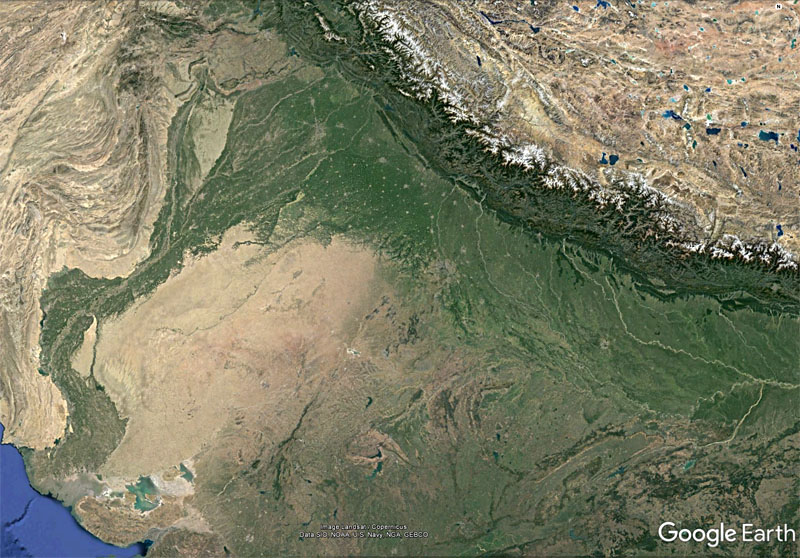
Active sedimentation in the Indus and Upper Ganges plains (green vegetated) derived from rapid erosion of the Himalaya (credit: Google Earth)

The Proterozoic Eon of the Precambrian is subdivided into the Palaeo-, Meso- and Neoproterozoic Eras that are, respectively, 900, 600 and 450 Ma long. The degree to which geoscientists are sufficiently interested in rocks within such time spans is roughly proportional to the number of publications whose title includes their name. Searching the ISI Web of Knowledge using this parameter yields 2000, 840 and 2700 hits in the last two complete decades, that is 2.2, 1.4 and 6.0 hits per million years, respectively. Clearly there is less interest in the early part of the Proterozoic. Perhaps that is due to there being smaller areas over which they are exposed, or maybe simply because what those rocks show is inherently less interesting than those of the Neoproterozoic. The Neoproterozoic is stuffed with fascinating topics: the appearance of large-bodied life forms; three Snowball Earth episodes; and a great deal of tectonic activity, including the Pan-African orogeny. The time that precedes it isn’t so gripping: it is widely known as the ‘boring billion’ – coined by the late Martin Brazier – from about 1.75 to 0.75 Ga. The Palaeoproterozoic draws attention by encompassing the ‘Great Oxygenation Event’ around 2.4 Ga, the massive deposition of banded iron formations up to 1.8 Ga, its own Snowball Earth, emergence of the eukaryotes and several orogenies. The Mesoproterozoic witnesses one orogeny, the formation of a supercontinent (Rodinia) and even has its own petroleum potential (93 billion barrels in place in Australia’s Beetaloo Basin. So it does have its high points, but not a lot. Although data are more scanty than for the Phanerozoic Eon, during the Mesoproterozoic the Earth’s magnetic field was much steadier than in later times. That suggests that motions in the core were in a ‘steady state’, and possibly in the mantle as well. The latter is borne out by the lower pace of tectonics in the Mesoproterozoic. Continue reading “The effect of surface processes on tectonics”

Neanderthal demographics and their extinction

About 39 thousand years ago all sign of the presence of Neanderthal bands in their extensive range across western Eurasia disappears. Their demise occurred during a period of relative warmth (Marine-Isotope Stage-3) following a cold period at its worst around 65 ka (MIS-4). They had previously thrived since their first appearance in Eurasia at about 250 ka, surviving at least two full glacial cycles. Their demise occurred around 5 thousand years after they were joined in western Eurasia by anatomically modern humans (AMH). During their long period of habitation they had adapted well to a range of climatic zones from woodland to tundra. During their overlap both groups shared much the same food resources, dominated by large herbivores whose numbers burgeoned during the warm period, with the difference that Neanderthals seemed to have depended on ranges centred on fixed sites of habitation while AMH maintained a nomadic lifestyle. Having shared a common African ancestry about 400 thousand years ago, DNA studies  have revealed that the two populations interbred regularly, probably in the earlier period of overlap in west Asia from around 120 thousand years ago and possibly in Europe too after 44 ka. Considering their previous tenacity, how the Neanderthals met their end is something of a mystery. It may have been a result of competition for resources with AMH, which could be countered by the increase in food resources. Maybe physical conflict was involved, or perhaps disease imported with AMH from warmer climes. Genetic absorption through interbreeding of a small population with a larger one of AMH is a possibility, although DNA evidence is lacking. An inability to adapt to climate change contradicts the Neanderthals long record and their disappearance during MIS-3. Previous population estimates of changing Neanderthal populations in the Iberian Peninsula (see Fig. 2 in Roberts, M.F. & Bricher, S.E 2018. Modeling the disappearance of the Neanderthals using principles of population dynamics and ecology. Journal of Archaeological Science, v. 100, p.16-31; DOI: 10.1016/j.jas.2018.09.012) show decline from about 70,000 to 20,000 before MIS-4, then recovery to about 40,000 before the arrival of AMH at 44 ka followed by a decline to extinction thereafter. Roberts and Bricher developed a model for investigating demographics from archaeological evidence that is neutral as regards any particular hypothesis for Neanderthal extinction.

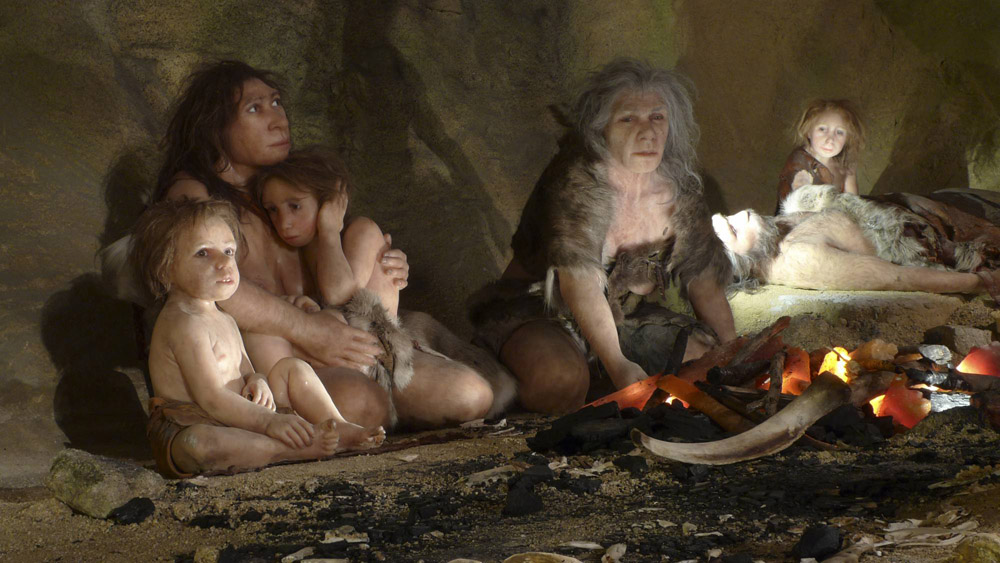
Nea family
Artistic reconstruction of Neanderthal family group (credit: Nikola Solic, Reuters)

Continue reading “Neanderthal demographics and their extinction”

Earth’s water and the Moon

Where did all our water come from? The Earth’s large complement of H2O, at the surface, in its crust and even in the mantle, is what sets it apart in many ways from the rest of the rocky Inner Planets. They are largely dry, tectonically torpid and devoid of signs of life. For a long while the standard answer has been that it was delivered by wave after wave of comet impacts during the Hadean, based on the fact that most volatiles were driven to the outermost Solar System, eventually to accrete as the giant planets and the icy worlds and comets of the Kuiper Belt and Oort Cloud, once the Sun sparked its fusion reactions That left its immediate surroundings depleted in them and enriched in more refractory elements and compounds from which the Inner Planets accreted. But that begs another question: how come an early comet ‘storm’ failed to ‘irrigate’ Mercury, Venus and Mars? New geochemical data offer a different scenario, albeit with a link to the early comet-storms paradigm.

Simulated view of the Earth from lunar orbit: the ‘wet’ and the ‘dry’. (credit: Adobe Stock)

Three geochemists from the Institut für Planetologie, University of Münster, Germany, led by Gerrit Budde have been studying the isotopes of the element molybdenum (Mo) in terrestrial rocks and meteorite collections. Molybdenum is a strongly siderophile (‘iron loving’) metal that, along with other transition-group metals, easily dissolves in molten iron. Consequently, when the Earth’s core began to form very early in Earth’s history, available molybdenum was mostly incorporated into it. Yet Mo is not that uncommon in younger rocks that formed by partial melting of the mantle, which implies that there is still plenty of it mantle peridotites. That surprising abundance may be explained by its addition along with other interplanetary material after the core had formed. Using Mo isotopes to investigate pre- and post-core formation events is similar to the use of isotopes of other transition metals, such as tungsten (see Planetary science, May 2016). Continue reading “Earth’s water and the Moon”

Anthropocene edging closer to being ‘official’

The issue of erecting a new stratigraphic Epoch encompassing the time since humans had a global effect on the Earth System has irked me ever since the term emerged for discussion and resolution by the scientific community in 2000. An Epoch in a chronostratigraphic sense is one of several arbitrary units that encompass all the rocks formed during a defined interval of time. The last 541 million years (Ma) of geological time is defined as an Eon – the Phanerozoic. In turn that comprises three Eras – Palaeozoic, Mesozoic and Cenozoic. The third level of division is that of Periods, of which there are 11 that make up the Phanerozoic. In turn the Periods comprise a total of 38 fourth-level Epochs and 85 at the fifth tier of Ages. All of these are of global significance, and there are even finer local divisions that do not appear on the International Chronostratigraphic Chart . If you examine the Chart you will find that no currently agreed Epoch lasted less than 11.7 thousand years (the Holocene) and all the others spanned 1 Ma to tens of Ma (averaged at 14.2 Ma). Indeed, even Ages span a range from hundreds of thousands to millions of years (averaged at 6 Ma).

lignite
The Vattenfall lignite mine in Germany; the Anthropocene personified

In the 3rd week of May 2019 the 34-member Anthropocene Working Group (AWG) of the International Commission on Stratigraphy (ICS) sat down to decide on when the Anthropocene actually started. That date would be passed on up the hierarchy of the geoscientific community  eventually to meet the scrutiny of its highest body, the executive committee of the International Union of Geological Sciences, and either be ratified or not. In the meantime the AWG is seeking a site at which the lower boundary of the Anthropocene would be defined by the science’s equivalent of a ‘golden spike’; the Global boundary Stratotype Section and Point (GSSP). Continue reading “Anthropocene edging closer to being ‘official’”

Chang’E-4 and the Moon’s mantle

The spacecraft Chang’E-4 landed on the far side of the Moon in January; something of a triumph for the Peoples’ Republic of China as it was a first. It was more than a power gesture at a time of strained relations between the PRC and the US, for it carried a rover (Yutu2) that deploys a panoramic camera, ground penetrating radar, means of assessing interaction of the solar wind with the lunar surface, and a Visible and Near-infrared Imaging Spectrometer (VNIS). The lander module itself bristles with instrumentation, but Yutu2 (meaning Jade Rabbit) has relayed the first scientific breakthrough.

ChangE
Variation in topography (blue – low to red – high) over the Moon’s South Pole, showing the Aitken Basin and the Chang’E-4 landing site. (Credit: NASA/Goddard)

Continue reading “Chang’E-4 and the Moon’s mantle”

Frack me nicely?

‘There’s a seaside place they call Blackpool that’s famous for fresh air and fun’. Well, maybe, not any more. If you, dear weekender couples, lie still after the ‘fun’ the Earth may yet move for you. Not much, I’ll admit, for British fracking regulations permit Cuadrilla, who have a drill rig at nearby Preston New Road on the Fylde coastal plain of NW England, only to trigger earthquakes with a magnitude less than 0.5 on the Richter scale. This condition was applied after early drilling by Cuadrilla had stimulated earthquakes up to magnitude 3. To the glee of anti-fracking groups the magnitude 0.5 limit has been regularly exceeded, thereby thwarting Cuadrilla’s ambitions from time to time. Leaving aside the view of professional geologists that the pickings for fracked shale gas in Britain [June 2014] are meagre, the methods deployed in hydraulic fracturing of gas-prone shales do pose seismic risks. Geology, beneath the Fylde is about as simple as it gets in tectonically tortured Britain. There are no active faults, and no significant dormant ones near the surface that have moved since about 250 Ma ago; most of Britain is riven by major fault lines, some of which are occasionally active, especially in prospective shale-gas basins near the Pennines. When petroleum companies are bent on fracking they use a drilling technology that allows one site to sink several wells that bend with depth to travel almost horizontally through the target shale rock. A water-based fluid containing a mix of polymers and surfactants to make it slick, plus fine sand or ceramic particles, are pumped at very high pressures into the rock. Joints and bedding in the shale are thus forced open and maintained in that condition by the sandy material, so that gas and even light oil can accumulate and flow up the drill stems to the surface. Continue reading “Frack me nicely?”

Younger Dryas impact trigger: evidence from Chile

A sudden collapse of global climate around 12.8 ka and equally brusque warming 11.5 ka ago is called the Younger Dryas. It brought the last ice age to an end. Because significant warming preceded this dramatic event palaeoclimatologists have pondered its cause since it came to their attention in the early 20th century as a stark signal in the pollen content of lake cores – Dyas octopetala, a tundra wild flower, then shed more pollen than before or afterwards; hence the name. A century on, two theories dominate: North Atlantic surface water was freshened by a glacial outburst flood that shut down the Gulf Stream [June 2006]; a large impact event shed sufficient dust to lower global temperatures [July 2007]. An oceanographic event remains the explanation of choice for many, whereas the evidence for an extraterrestrial cause – also suggested to have triggered megafaunal extinctions in North America – has its supporters and detractors. The first general reaction to the idea of an impact cause was the implausibility of the evidence [November 2010], yet the discovery by radar of a major impact crater beneath the Greenland ice cap [November 2018] resurrected the ‘outlandish’ notion. A recent paper in Nature: Scientific Reports further sharpens the focus.

407458aa.2
Temperature fluctuations over the Greenland ice cap during the past 17,000 years, showing the abrupt cooling during the Younger Dryas. (credit: Don Easterbrook)

Continue reading “Younger Dryas impact trigger: evidence from Chile”

Denisovan on top of the world

Who the Denisovans were is almost completely bound up with their DNA. Until 2019 their only tangible remains were from a single Siberian cave and amounted to a finger bone, a toe bone three molars and fragment of limb bone. Yet they provided DNA from four individuals who lived in Denis the Hermit’s cave from 30 to more than 100 thousand years ago. The analyses revealed that the Denisovans, like the Neanderthals, left their genetic mark in modern people who live outside of Africa, specifically native people of Melanesia and Australia . Remarkably, one of them revealed that a 90 ka female Denisovan was the offspring of a Denisovan father and  a Neanderthal mother whose DNA suggested that she may have come from the far-off Balkans. Living, native Tibetans, whose DNA has been analysed, share a gene (EPAS1) with Denisovans, which regulates the body’s production of haemoglobin and enables Tibetans and Nepalese Sherpas to thrive at extremely high altitudes (see The earliest humans in Tibet).

407458aa.2
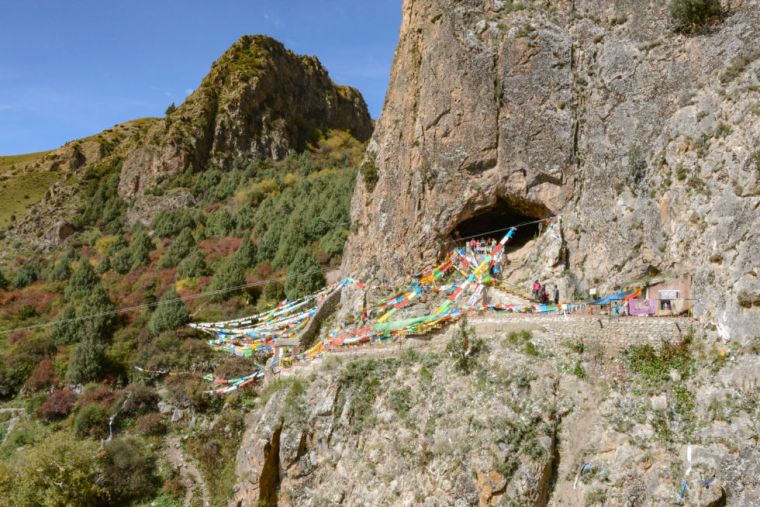
The Baishiya Karst Cave in eastern Tibet, with Buddhist prayer flags (credit: Dongju Zhang, Lanzhou University )

Part of a hominin lower jaw unearthed by a Buddhist monk in 1980 from a cave on the Tibetan Plateau, at a height of 3280 m, found its way by a circuitous route to the Max Planck Institute for Evolutionary Anthropology in Leipzig in 2016. It carries two very large molars comparable in size with those found at the Denisova Cave, and which peculiarly have three roots rather than the four in the jaws of non-Asian, living humans. East Asians commonly show this trait. This and other aspects of the fossil teeth resemble those of some uncategorised early hominin fossils from China. Dating of speleothem calcium carbonate with which the jaw is encrusted suggests that the fossil dates back to at least 160 thousand years ago, around the oldest date recovered from Denisova Cave; during the glacial period before the last one. So the individual was able to survive winter conditions worse than those experienced today on the Tibetan Plateau. Further excavation in the cave found numerous stone artefacts and cut-marked animal bones (Chen, F. and 18 others 2019. A late Middle Pleistocene Denisovan mandible from the Tibetan Plateau. Nature, v. 569, published online; DOI: 10.1038/s41586-019-1139-x).

Unfortunately the Tibetan Jaw did not yield DNA capable of being sequenced, so the issues of inheritance of the ‘high-altitude’ gene and wider relatedness of the individual could not be checked. However, one of the teeth did contain preserved protein that can be analysed in an analogous way to DNA, but with less revealing detail. The results were sufficient to demonstrate that the mandible was consistent with a hominin population closely related to the Denisovans of the Siberian cave.

No doubt a path has already been beaten to the Tibetan cave, in the hope of further hominin material. To me the resemblance of the Tibetan fossil jaw to other hominin finds in China, including those from Xuchang, summarised here, is exciting. None of them have been subject to modern biological analysis. Perhaps the ‘real Denisovan’ will emerge from them.

See also: Mysterious ancient human found on the ‘roof of the world’ (National Geographic magazine); Major discovery suggests Denisovans lived in Tibet 160,000 years ago (New Scientist); Finally, a Denisovan specimen from somewhere beyond Denisova Cave (Ars Technica)

Read more on Human evolution and migrations

A role for iron in the origin of life

Experiments aimed at suggesting how RNA and DNA – prerequisites for life, reproduction and evolution – might have formed from a ‘primordial soup’ have made slow progress. Another approach to the origin of life is investigation of the most basic chemical reactions that it engages in. Whatever the life form, prokaryote or eukaryote, its core processes involve reducing carbon dioxide, or other simple carbon-bearing compounds, and water to synthesise organic molecules that make up cell matter. Organisms also engage in metabolising biological compounds to generate energy. At their root, these two processes mirror each other; a creative network of reactions and another that breaks compounds down, known as the Krebs- and the reverse-Krebs cycles. In living organisms both are facilitated by other organic compounds that, of course, are themselves produced by cells. How such networks arose under inorganic conditions remains unknown, but three biochemists at the University of Strasbourg in France (Muchowska, K.B. et al. 2019. Synthesis and breakdown of universal metabolic precursors promoted by iron. Nature, v. 569, p. 104-107;  DOI: 10.1038/s41586-019-1151-1) have designed an inorganic experiment. They aimed to investigate how two simple organic compounds, which conceivably could have formed in a lifeless early environment, might have been encouraged to kick-start basic living processes. These are glyoxylate (HCOCO2) and pyruvate (CH3COCO2).

The most difficult chemical step in building complex organic compounds is inducing carbon atoms to bond together through C-C bonds; a process that thermodynamics tends to thwart but is accomplished in living cells by adenosine tri-phosphate (ATP). Previous workers focussed on interactions between reactive compounds, such as cyanide and formaldehyde, as candidates for the precursors of life, but such chemistry is totally different from what actually goes on in organisms. Joseph Moran, one of the co-authors of the paper, and his research group recently settled on five fundamental linkages of C, H and O as ‘universal hubs’ at the core of the Krebs cycle and its reverse. Kamila Muchowska and co-workers found that glyoxylate and pyruvate introduced into a simulated hydrothermal fluid that contains ions of ferrous iron (reduced Fe2+) were able to combine in producing all five ‘universal hubs. Ferrous iron clearly acted as a catalyst, through being a powerful reducing agent or electron donor, to get around the stringencies of classic thermodynamics. Moran’s team had previously shown that pyruvate itself can form inorganically from CO2 in water laced with iron, cobalt and nickel ions. Formation of glyoxylate in such a manner has yet to be demonstrated. Nevertheless, the two together in a watery soup of transition metal ions seem destined to produce an abundance of exactly the compounds at the root of living processes. In fact the experiment showed that all but two of the eleven components of the Krebs cycle can be synthesised inorganically.

407458aa.2
Metal-rich ‘black smoker’ at a hydrothermal vent on the mid-Atlantic ridge(credit: MARUM, Germany)

Until the rise of free oxygen in the Earth system some 2400 Ma ago, the oceans would have been awash with soluble ferrous iron. This would have been especially the case around hydrothermal vents that result from the interaction between water and hot mafic lavas of the oceanic crust, together with less abundant transition-metal ions, such as those of nickel and cobalt. The ocean-vent hypothesis for the origin of life seems set for a surge forward.

See also: Katsnelson, A. 2019. Iron can catalyse metabolic reactions without enzymes.

Read more on Palaeobiology

‘Hobbits’ found in the Philippines

The earliest signs that hominins had colonised the island of Luzon in the Philippines took the form of crude stone tools found around half a century ago. Re-excavation of one of the sites uncovered yet more tools buried in a river-channel deposit, along with remains of a butchered rhinoceros dated at around 700 ka by two methods (see Clear signs of a hominin presence on the Philippines at around 700 ka May 2018). The primitive nature of the tools and their age suggested that Asian Homo erectus had managed to reach the Philippine archipelago, despite it being separated from larger islands by deep water.  Even during large falls in sea level (up to 130 m) during glacial periods that exposed Sundaland, which linked the larger islands of Indonesia to mainland Eurasia, at best only a narrow stretch of sea (~20 km) connected the Philippines to the wider world. For most of the time since the earliest known colonisation any hominins on the islands would have been cut off from other populations.

407458aa.2
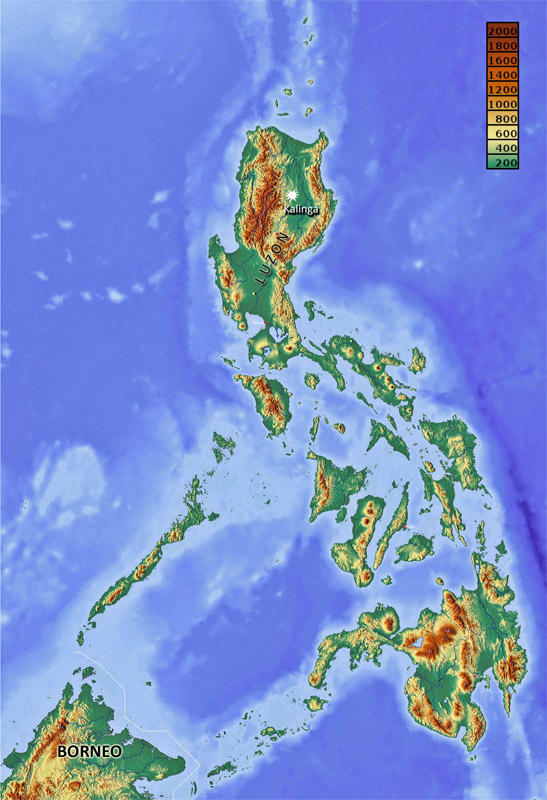
Topography of the Philippines, showing location of the Kalinga site. Palest blue sea may have been above sea level only during extreme glacial maxima. (credit: Wikipedia)

The first hominin fossil found by archaeologists in 2007 was a 67 ka old toe bone (metatarsal) in cave sediments from Northern Luzon. It was undoubtedly from Homo, but which species was unclear.  More recent excavations added a mere 12 fossil fragments, probably from three individuals; 7 teeth, 4 adult finger- and toe bones and part of the femur of a juvenile (Détroit, F. and 8 others 2019. A new species of Homo from the Late Pleistocene of the Philippines. Nature, v.  568, p. 181–186; DOI: 10.1038/s41586-019-1067-9). The finger bones, being curved, are unlike those of modern humans and H. erectus. The teeth are even more different; for instance the premolars show two or three roots – ours have but one – and their unusually tiny molars only a single root. The combined features are sufficiently distinct to suggest a separate species (H. luzonensis). The small teeth may indicate that the adults may have been even smaller that the ‘Hobbits’ of Flores and anatomically different.

Like H. floresiensis, as a result of isolation the new human species probably evolved to become small, possibly from very low number of H. erectus original colonisers. But an even stranger possibility is suggested by their curved toe and finger bones. They may have been habitual climbers as much as walkers – unlike us and H. erectus. Could that indicate that their ancestors left Africa already distinct from the rest of Late Pleistocene humans? That is also a disputed hypothesis for the origins of H. floresiensis  remains of whom are more complete. Similarly, they pose the issue of how their progenitors managed to get to the archipelago: deliberately by boat or being carried there clinging in desperation to vegetation torn-up by tsunamis and transported seawards by the back-wash.

Read more on Human evolution and migrations