How humans might have migrated into the Americas

When and how humans first migrated into the Americas are issues that have exercised anthropologists for the last two decades, often sparking off acrimonious debate. In the 20th century both seemed to well established: hunters using the celebrated Clovis fluted spear blades arrived first, no earlier than 13 ka ago. The Beringia land bridge across what is now the Bering Strait was exposed by falling sea level as early as 30 thousand years ago in the lead-up to the last glacial maximum (LGM) to link eastern Siberia and Alaska. However, ice sheets expanding to the south-west of the main area of glaciation on the Canadian Shield barred passage through Interior Alaska and NW Canada. Only around 13 ka had a N-S ice-free corridor opened through the mountains during glacial retreat. Nevertheless, humans had entered Alaska at least ten thousand years earlier, during the LGM, to occupy caves in its western extremity: Alaska was habitable but they were stuck there.

In the early 21st century, it became clear that the ‘Clovis First’ hypothesis was mistaken. Sediments in Texas that contained Clovis blades were found to be underlain by those of an older culture, reliably dated to about 15.5 ka. Furthermore, analysis of the DNA of all groups of native Americans (north and south) indicated a last common ancestor in Siberia more than 30 ka ago: they descended from that ancestor outside of Asia. More recently excavated sites in Mexico and Chile point to human populations having reached there as early at 33 ka (see: Earliest Americans, and plenty of them; July 2020), and there is a host of pre-Clovis sites in North and Central America dating back to 18.2 ka. Such ancient groups could not have walked from the Beringia land bridge because the present topographic grain in the Western Cordillera would have been blocked by ice since about 25 thousand years ago. The only viable possibility was that they followed the Alaskan coast to move southwards, either in boats or over sea ice.
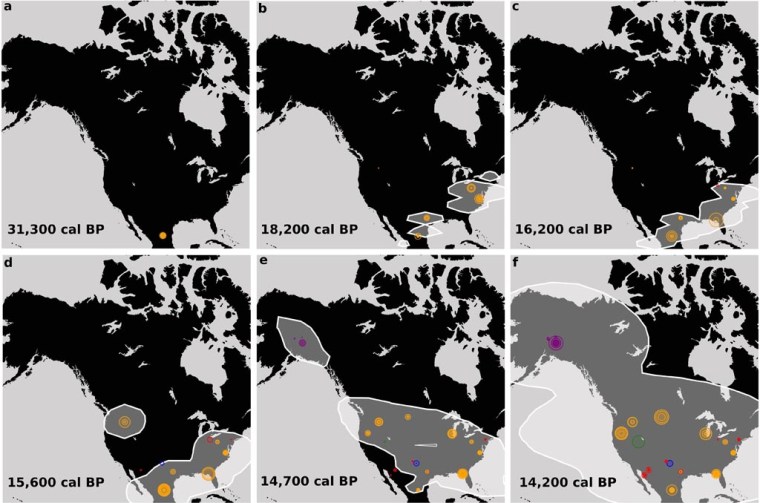
Dated pre-Clovis sites in Mexico and North America and possible expanding distribution of people from 31.3 to 14.2 ka (Credit; Becerra-Valdivia and Higham; Extended Data Fig. 4)

A new focus on when such journeys would have been feasible was published in February 2023 (Praetorius, S.K et al. 2023. Ice and ocean constraints on early human migrations into North America along the Pacific coast. Proceedings of the National Academy of Science, v. 120, article e2208738120; DOI: 10.1073/pnas.2208738120). One advantage of moving along the coast is that, though it would be pretty cold, the warming effect of the Pacific Ocean would make it more bearable than travelling inland, where winter temperatures even today regularly reach -50°C. More important, there would be no shortage of food; fish, marine mammals and shellfish abound at the ice margin or onshore, at any season. But a coastal route may not have been possible at all times during the period either side of the LGM. Large glaciers still reach the ocean from Alaska and there is little more perilous than crossing the huge crevasse fields that they present. Boating would have been highly dangerous because of continual calving of icebergs from extensive ice shelves. Moreover, the Alaska Coastal Current flows northwards and would likely have sped up during episodes of glacial melting as the current is affected by fresh water influx. Yet there may sometimes have been episodes of open water at the ice front frozen to relatively flat sea ice in winter. That would making boat- or foot travel relatively safe. Sea ice would also make glacier-free islands accessible for encampments over the harsh winters or even for hundreds of years, with plenty of marine food resources.

Summer Praetorius of the US Geological Survey and colleagues from Woods Hole Oceanographic Institution, Oregon State University, and the Universities of California (Santa Cruz) and Oregon have attempted to model conditions since 32.5 ka ago in coastal waters off Northwest America. They used simulations of the behaviour of the Alaska Coastal Current during varying climate conditions before and during the LGM, while glaciers were in  retreat that followed and during the Holocene. Their modelling is based on the effects of changing sea level and water salinity on general circulation in the Northern Pacific. The relative abundance of sea ice can be tracked using variation in an alkenone produced by phytoplankton that wax and wane according to sea-surface temperature and sea-ice cover. The other input is the well-documented changing extent of continental glaciation in Alaska and the Yukon Territory. Based on their model they estimate that the most favourable environmental conditions for coastal migration occurred just before the LGM (24.5 to 22 ka) and between 16.4 and 14.8 ka during the initial stages of warming and extensive melting of ice sheets. The Alaskan Coastal Current probably doubled in intensity during the LGM making the use of boats highly dangerous

By 35 ka ocean-going boats are known to have been used by people in northern Japan. Traversing sea-ice was the way in which Inuit people occupied all the Arctic coastal areas of North America and Greenland during the last five thousand years, and is the form of travel favoured by the authors. It is not yet possible to prove and date such coastal journeys because campsites or settlements along the coast would now be inundated by 100 m of post-glacial sea-level rise. Yet such migration was necessary to establish settlements at lower latitudes in North America and Mexico in the period when overland routes from Beringia were blocked by ice sheets. By 32.5 ka falling sea level probably made it possible to cross the Bering Strait for the first time and for the next 7.5 ka an ice-free corridor made it possible for the rest of North America and points further south to be reached on-foot from Alaska. That window of opportunity might have allowed humans to have reached Mexico and South America, where the earliest dates of occupation have been found. But many of the early sites across North America date to the period (25 to 13 ka) when overland access was blocked. Of course, those sites might have been established by expansion from the very earliest migrants who crossed the Beringia land bridge and took advantage of overland passage before 25 ka. But if later migrants from Asia could follow the coastal route, then it seems likely that they did. Later Inuit spread along  the shores of the Arctic Ocean since 5000 years ago probably with a material culture little different from that of the earlier migrants from Siberia.

Who invented stone tools? A great surprise from Kenya

Up to now the earliest stone tools are objects dated to about 3.3 Ma (Late Pliocene) found in the Turkana basin of Kenya in 2015. They are sharp-edged pieces of rock that seem to have been made simply by striking two lumps of rock together (see: Stone tools go even further back; May 2015). These Lomekwian artefacts are similar to the basic tools made today by some chimpanzees in parts of Africa. Their age matches that for the earliest known animal bones that show signs of having meat cut from them, which were unearthed in Dikika, Ethiopia (see: Another big surprise; September 2010) which, like the Lomekwian tools, are not accompanied by tools or hominin remains. The earliest tools associated with members of the genus Homo are significantly more sophisticated. They were found in close association with H. habilis at what seems to have been a well-used butchering site, dated at 2.0 Ma, in Tanzania’s Olduvai Gorge, hence their designation as the Oldowan ‘industry’. The Oldowan ‘tool kit’ includes choppers and blades deliberately shaped to be wielded by hand and made by striking large cobbles with distinctive hammer stones. Earlier tools with this level of deliberate crafting come from the 2.6 Ma Ledi-Geraru site in the Afar Depression of NE Ethiopia but with no sign of their makers.

Oldowan tools used for pounding and cutting from Nyayanga, Kenya (Credit: Thomas Plummer, James Oliver and Emma Finestone/Homa Peninsula Paleoanthropology Project/SWNS)

The presence of Oldowan tools has now been pushed further back, by about 400 ka, thanks to excavations in Late Pliocene sediments at Nyayanga on the shore of Lake Victoria in western Kenya by Thomas Plummer of Queens College in New York State, USA, and his numerous collaborators from the US, Germany, the UK, China, Italy, Australia, Kenya, South Africa and Poland (Plummer, T.W. and 31 others 2023. Expanded geographic distribution and dietary strategies of the earliest Oldowan hominins and Paranthropus. Science, v. 379, p. 561-566; DOI: 10.1126/science.abo7452). Their work also expands the range of Oldowan culture by about 1300 km. The Nyayanga site yielded over 300 artefacts that closely resemble the previously known range of Oldowan tool shapes. Their makers struck flakes from suitable corestones – made of rhyolite, quartz and quartzite – and trimmed them by more intricate means. They seem to have been used to cut up mainly hippo and buffalo, bones of which bear clear cut marks, but had other uses. Analysis of the wear on tool surfaces not only show signs of butchery, but also processing of plant tissue by pounding; the latter resulted in pitting and polishing of tools that seem to have been used many times. Stable-isotope analysis of the bones and animal teeth suggests that in the Pliocene Nyayanga was a grassy and partly wooded savannah close to a substantial water body needed by hippos.

Reconstruction of a Paranthropus head (Credit: Jerry Humphrey, Pinterest)

The ‘great surprise’ is that the only hominin remains associated with the site are two damaged molar teeth. They are so large that their most likely source was a species of Paranthropus.Paranthropoids have long been considered to be a gorilla-like, ‘robust’ branch of australopithecines. Their large cranial crests anchoring jaw muscles and enormous teeth were reckoned to indicate a diet of tough vegetation – the discoverer of the first specimen of P. boisei dubbed it ‘Nutcracker Man’ – although the wear on individual teeth suggests otherwise. But there is no reason to suppose that they could not eat meat. They survived australopithecines by more than a million years to cohabit the East African savannahs with H. ergaster until about 1 Ma ago.

Lead author Thomas Plummer wonders if paranthropoids would have needed tools because they had the largest jaws and teeth of any hominin. But had his team found close association with smaller H.habilis teeth would he have held a similarly negative view? There is evidence from younger sites in South Africa that paranthropoids used a wide diversity of bone tools and may even have been among the earliest fire users. So why the negativity about stone tools? To paraphrase Ali G, ‘Is it because they is ugly?’

See also: Devlin, H, Discovery of 3m-year-old stone tools sparks prehistoric whodunit. The Guardian, 9 February 2023

Neanderthal elephant hunters

In the 1980s miners in the Neumark-Nord area of Saxony-Anhalt, central Germany uncovered an extensive assemblage of animal bones and stone tools in opencast ‘brown coal’ (lignite) workings. Archaeologists working over a ten-year period recovered bones from an estimated 70 straight-tusked elephants (Palaeoloxodon antiquus), as well as many other large herbivores, while huge bucket-wheel excavators advanced through the deposit. Most of the elephants were adult males, some preserved as entire skeletons others as disarticulated bones. Weighing as much 15 tonnes – equivalent to ten medium SUVs – and standing up to 4 m high at the shoulder, they were twice as large as the biggest modern African elephants and had far longer legs. Being so tall they could browse vegetation up to 8 metres above the ground surface using an 80 cm tongue as well as a long trunk and their huge tusks.

The lignite deposits formed in marshes and shallow lakes that occupied low-lying depressions left in the wake of retreating glaciers during the last (Eemian) interglacial (130 to 115 ka ago). The warming encouraged temperate forest to extend much further north than it does today. The fauna too would have changed substantially once the ice sheets began to retreat. For instance, mammoths that grazed low tundra vegetation during the preceding ice age disappeared from Central Europe to be replaced by straight-tusked elephants migrating from much further south that had plenty of trees, shrubs and grasses to feed on, as did other herbivores. So the central European plains teemed with big game. The marshes and lakes had little outflow and became depleted in oxygen so that dead vegetation built up to form extensive peat deposits: just the conditions for organic preservation.

Artistic impression of Neanderthal elephant butchery site (Credit: Tom Bjorklund, Science)

The Neumark-Nord sites yielded literally tonnes of fossils, including 3400 elephant bones. But these were not simply the remains of animals that had become bogged down and died of exhaustion. Sabine Gaudzinski-Windheuser and Lutz Kindler of the Johannes Gutenberg University of Mainz, Germany and Katherine MacDonald and Wil Roebroeks of Leiden University, Netherlands have examined every bone for signs of post-mortem modification by humans (Gaudzinski-WindHeuser, S. et al. 2023. Hunting and processing of straight-tusked elephants 125.000 years ago: Implications for Neanderthal behaviour. Science Advances, v. 9, article add8186; DOI: https://doi.org/10.1126/sciadv.add8186). Some bones are so large as to require a forklift to shift or turn them in the laboratory. Most of the bones bear deliberate cut marks made by stone blades: far more than signs of gnawing by carnivores. Neanderthals had got to them before scavengers. The density of cuts and gouges suggests that almost every scrap of meat and fat had systematically been harvested from the corpses, even the fat-rich feet and brains. The sheer number of cuts needed to skin and deflesh the elephants strongly suggests that their meat was fresh: rotten meat could simply have been pulled from the skin and bone quite easily. Little was left for scavengers to gnaw.

Each elephant would have yielded enough meat and fat for an estimated 2500 portions, each with a calorific value of around 4000 kcal. To fully butcher each beast and then to dry and/or smoke the produce can be estimated – by comparison with such work on a modern African elephant – would take around 1500 person hours. To achieve that would require 3 to 5 days of very heavy labour by 25 people. Some means of preservation would have been needed, unless hundreds of people had scoffed the lot at one or two sittings. The authors consider the bounty to imply  that a considerably larger collective of Neanderthals than the previously estimated ~25 per band probably benefitted from a single elephant, whether it was eaten on the spot or preserved in some way and either carried off or cached. But 70 elephants …?

The geographic context suggests a pile of corpses built up in lignite close to or on a lake shore had accumulated over a lengthy period. Using likely sedimentation rates backed by counting of annual tree rings from stumps in the lignite the authors estimate that the pile formed over about 300 years at a rate of one kill every 5 to 6 years. But this site is one of several found in the Neumark-Nord area, albeit not quite so large, and there are probably more, either remaining buried or destroyed by the brutal lignite mining technique. Taking on a herd of animals would be far more risky than hunting individuals. This is where the sex of the elephant remains gives an idea of the hunters’ strategy. Those that could be sexed – about 23  – were all adult males that were estimated to be from 20 to 50 or more years old. By analogy with African elephants, adult male are generally solitary, only joining herds of females and offspring when one or more is at oestrus. Male straight-tusked elephants were more than twice the mass of adult females and when keeping themselves to themselves would have been a safer and more profitable target than females and juveniles in a herd. Solitary males would have been easy to approach, being confidant  that their size would deter direct predation by the largest carnivores, such as lions. In a peaty swamp, simply driving an individual into deep mud would bog it down to be dispatched by spear thrusts. The earliest known thrusting spears have been unearthed in similar lignite beds 200 km away.

This study adds to growing understanding of Neanderthal culture. It suggests that they were not just opportunistic and wandering foragers but regularly combined resources to focus on a specific, very high-value prey. Maybe that was restricted to the special peat-swamp environment of what is now central Germany, but it speaks of an ability to plan and orchestrate spectacular communal events. And they performed such feats again and again. They were the masters of Europe through three of four glacial-interglacial cycles.

Consider Homo erectus …

Championed as the earliest commonly found human species and, apart from anatomically modern humans (AMH), the most widespread through Africa and Eurasia. It also endured longer (~1.75 Ma) than any other hominin species, appearing first in East Africa around 2 Ma ago, the youngest widely accepted fossil – found in China – being around 250 ka old. The ‘erects’ arguably cooked their food and discovered the use of fire 1.7 to 2 Ma ago. The first fossils discovered in Java by Eugene Dubois are now known to be associated with the oldest-known art (430 to 540 ka) The biggest issue surrounding H. erectus has been its great diversity, succinctly indicated by a braincase capacity ranging from 550 to 1250 cm3: from slightly greater than the best endowed living apes to within the range of AMH. Even the shape of their skulls defies the constraints placed on those of other hominin species. For instance, some have sagittal crests to anchor powerful jaw muscles, whereas others do not. What they all have in common are jutting brow ridges and the absence of chins along with all more recently evolved human species, except for AMH.

This diversity is summed up in 9 subspecies having been attributed to H. erectus, the majority by Chinese palaeoanthropologists. Chinese fossils from over a dozen sites account for most of the anatomical variability, which perhaps even includes Denisovans, though their existence stems only through the DNA extracted from a few tiny bone fragments. So far none of the many ‘erect’ bones from China have been submitted to genetic analysis, so that connection remains to be tested. Several finds of diminutive humans from the Indonesian and Philippine archipelagos have been suggested to have evolved from H. erectus in isolation. All in all, the differences among the remains of H. erectus are greater than those used to separate later human species, i.e. archaic AMH, Neanderthals, Denisovans, H. antecessor etc. So it seems strange that H. erectus has not been split into several species instead of being lumped together, in the manner of the recently proposed Homo bodoensis. Another fossil cranium has turned up in central China’s Hubei province, to great excitement even though it has not yet been fully excavated (Lewis, D. 2022. Ancient skull uncovered in China could be million-year-old Homo erectus. Nature News 29 November 2022; DOI: 10.1038/d41586-022-04142-00; see also a video). Chances are that it too will be different from other examples. It also presents a good excuse to consider H. erectus.

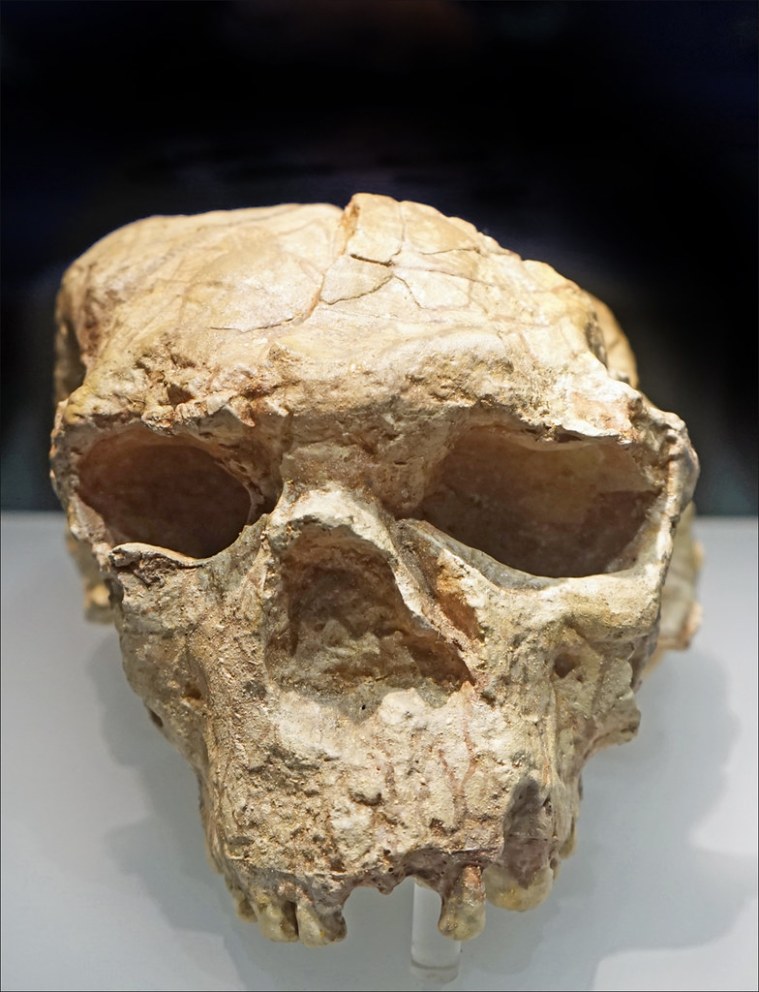
Cranium of a Chinese Homo erectus, somewhat distorted by burial, from a site close to the latest find. (Credit: Hubei Museum, Wuhan, China)

The complications began in Africa with H. ergaster, the originator of the bifacial or Acheulean multi-purpose stone tool at around 1.6 Ma (see: Flirting with hand axes; May 2009), the inventor of cooking and discoverer of the controlled use of fire. ‘Action Men’ were obviously smarter than any preceding hominin, possibly because of an increase of cooked protein and plant resources that are more easily digested than in the raw state and so more available for brain growth. The dispute over nomenclature arose from a close cranial similarity of H. ergaster to the H. erectus discovered in Java in the 19th century: H. erectus ergaster is now its widely accepted name. In 1991-5 the earliest recorded hominins outside Africa were found at Dmanisi, Georgia, in sediments dated at around 1.8 Ma (see: First out of Africa; November 2003) Among a large number of bones were five well-preserved skulls, with brain volumes less than 800 cm3 (see: An iconic early human skull; October 2013). These earliest known migrants from Africa were first thought to resemble the oldest humans (H.habilis) because of their short stature, but now are classified as H. erectus georgicus. They encapsulate the issue of anatomical variability among supposed H. erectus fossils, each being very different in appearance, one even showing ape-like features. Another had lost all teeth from the left side of the face, yet had survived long after their loss, presumably because others had cared for the individual.

The great variety of cranial forms of the Asian specimens of H. erectus may reflect a number of factors. The simplest is that continuous presence of a population there for as long as 1.5 Ma inevitably would have resulted in at least as much evolution as stemmed from the erects left behind in Africa, up to and including the emergence of AMH in North Africa about 300 ka ago. If contact with the African human population was lost after 1.8 Ma, the course of human evolution in Africa and Asia would clearly have been different. But that leaves out the possibility of several waves of migrants into Asia that carried novel physiological traits evolved in Africa to mix with those of earlier Asian populations. From about 1 Ma ago a succession of migrations from Africa populated Europe – H. antecessor, H. heidelbergensis, and Neanderthals and then AMH. So a similar succession of migrants could just as well have gone east instead of west on leaving Africa. Asia is so vast that migration may have led different groups to widely separated locations, partially cut-off by mountain ranges and deserts so that it became very difficult for them to maintain genetic contact. Geographic isolation of small groups could lead to accelerated evolution, similar to that which may have led to the tiny H. floresiensis and H. luzonensisdiscovered on Indonesian and Philippine islands.

 Another aspect of the Asian continent is its unsurpassed range of altitude, latitude and climate zones. Its ecologically diversity offers a multitude of food resources, and both climate and elevation differences pose a range of potential stresses to which humans would have had to adapt. The major climate cycles of the Pleistocene would have driven migration across latitudes within the continent, thereby mixing groups with different physical tolerances and diets to which they had adapted. Equally, westward migration was possible using the Indo-Gangetic plains and the shore of the Arabian Sea: yet more opportunities for mixing between established Asians and newly arrived African emigrants.

Family links among the Neanderthals of Siberia

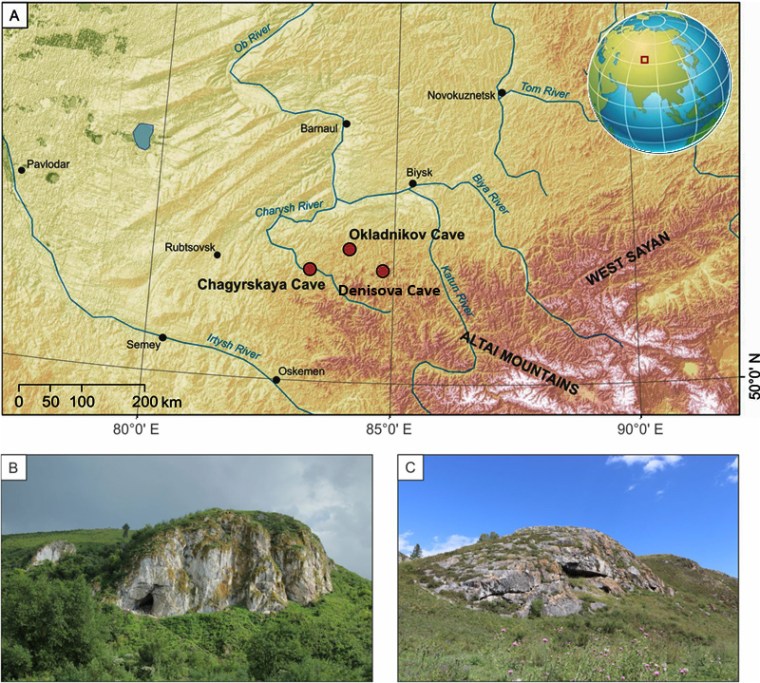
Caves used by the Neanderthals of southern Siberia: A – location map; B – Chagyrskaya Cave; C – Okladnikov Cave. (Credit: adapted from Skov et al.; Extended Data Fig. 1)

The early focus on Neanderthals was on remains found in Western Europe from the 19th century onwards. That has shifted in recent years to southern Siberia in the foothills of the Altai mountains, despite the fossils’ fragmentary nature: a few teeth and bits of mandible. The Denisova Cave became famous not just because it contained the easternmost evidence of Neanderthal occupation but through the genetic analysis of a tiny finger-tip bone. It proved not to be from a Neanderthal but a distinctly different hominin species, dubbed Denisovan (see: Other rich hominin pickings; May 2010). What Denisovans looked like remains unknown but genetic traces of them are rife among living humans of the western Pacific islands and Australia, whose ancestors interbred with Denisovans, presumably in East Asia. Modern people indigenous to Europe and the Middle East have Neanderthal genes in their genomes. Other bone fragments from Denisova Cave also yielded Neanderthal genomes, and the cave sediments yielded traces of both groups (see: Detecting the presence of hominins in ancient soil samples; April 2017). Then in 2018 DNA extracted from a limb bone from the cave clearly showed that it was from a female teenager who had had a Neanderthal mother and a Denisovan father (see: Neanderthal Mum meets Denisovan Dad; August 2018). These astonishing and unexpected finds spurred further excavations and genetic analysis in other caves within 100 km of Denisova Cave. This was largely led by current and former co-workers of Svanti Pääbo, of the Max Planck Institute for Evolutionary Anthropology, Leipzig, Germany: Pääbo was awarded the 2022 Nobel Prize in Physiology or Medicine for his coordination of research and discoveries concerning ancient human genomes. Their enormous field and laboratory efforts have paid astonishingly valuable dividends (Skov, L. and 34 others 2022. Genetic insights into the social organization of Neanderthals. Nature v. 610, p. 519–525; DOI: 10.1038/s41586-022-05283-y).

To the previously analysed 18 Neanderthal genomes from 14 archaeological sites across Eurasia (including Denisova Cave) Skov et al. have added 13 more from just two sites in Siberia (the Chagyrskaya and Okladnikov caves). Each site overlooks valleys along which game still migrates, so they may have been seasonal hunting camps rather than permanent dwellings: they are littered with bison and horse bones. Tools in the two 59-51 ka old human occupation levels are different from those at the older (130 to 91 Ka) Denisova Cave about 100 km to the east. As at the much older site, human fossils include several teeth and fragments of bones from jaws, hands, limbs and vertebrae. The detailed genomes recovered from 17 finds shows them to be from 14 individuals (12 from Chagyrskaya, 2 from Okladnikov).

Chagyrskaya yielded evidence for 5 females (3 adults and 2 children) and 7 males (3 children and 4 adults). One female estimated to have lost a premolar tooth when a teenager was the daughter of a Chagyrskaya adult male. He, in turn, was brother or father to another male, so the girl seems to have had an uncle as well. Another male and female proved to be second-degree relations (includes uncles, aunts, nephews, nieces, grandparents, grandchildren, half-siblings, and double cousins). The two people from Okladnikov were an adult female and an unrelated male child. The boy was not related to the Chagyrskaya group, but the woman was, her former presence at that cave lingering in its cave-sediment DNA. None of the newly discovered individuals were closely related to six of the seven much older Denisova Cave Neanderthals, but the Okladnikov boy had similar mtDNA to one individual from Denisova.

Further information about the Chagyrskaya group came from comparison of DNA in Y-chromosomes and mitochondria. The father of the teenage girl had two types of mtDNA – the unusual characteristic of heteroplasmy – that he shared with two other males. This suggests that three of the males shared the same maternal lineage – not necessarily a mother – and also indicates that they lived at roughly the same time. The mtDNA recovered from all Chagyrskaya individuals was much more varied than was their Y-chromosome DNA (passed only down male lineage). One way of explaining that would be females from different Neanderthal communities having migrated into the Chagyrskaya group and mated with its males, who largely remained in the group: a ‘tradition’ known as patrilocality, which is practised in traditional Hindu communities, for instance.

So, what has emerged is clear evidence for a closely related community of Neanderthals at Chagyrskaya, although it cannot be shown that all were present there at the same time, apart from the five who show first- or second-degree relatedness or mitochondrial heteroplasmy. Those represented only by individual teeth didn’t necessarily die there: adult teeth can be lost through trauma and deciduous teeth fall out naturally. There was also some individual physical connection between the two caves: The Okladnikov woman’s DNA being in the sediment at Chagyrskaya. Looking for DNA similarities more widely, it appears that all individuals at Chagyrskaya may have had some ancestral connection with Croatian Neanderthals, as did the previously mentioned mother of the Denisovan-Neanderthal hybrid girl. Four of the Chagyrskaya individuals can also be linked genetically to Neanderthals from Spain, more so than to much closer individuals found in the Caucasus Mountains. So, by around 59-51 ka the results of a wave of eastward migration of Neanderthals had reached southern Siberia. Yet the apparent matrilineal relatedness of the Okladnikov boy to the much older Neanderthals of Denisova Cave suggests that the earlier group continued to exist.

The new results are just as fascinating as the 2021 discovery that ancient DNA from Neolithic tomb burials in the Cotswolds of SW England suggests that the individual skeletons represent five continuous generations of one extended family. The difference is that they were farmers tied to the locality, whereas the Siberian Neanderthals were probably hunter gatherers with a very wide geographic range.  Laurits Skov and his colleagues have analysed less than one-quarter of the Neanderthal remains already discovered in Chagyrskaya and Okladnikov caves and only a third of the cave deposits have been excavated. Extracting and analysing ancient DNA is now far quicker, more detailed and cheaper than it was in 2010 when news of the first Neanderthal genome broke. So more Neanderthal surprises may yet come from Siberia. Progress on the genetics of their anatomically-modern contemporaries in NE Asia has not been so swift.

See also:  Callaway, E. 2022. First known Neanderthal family discovered in Siberian cave.  Nature online 19 October 2022.

Seven thousand years of cultural sharing in Europe between Neanderthals and modern humans

Two years ago material excavated from the Bacho Kiro cave in Bulgaria revealed that anatomically modern humans (AMH) had lived there between 44 and 47 ka ago: the earliest known migrants into Europe. Bacho Kiro contains evidence of occupancy by both Neanderthals and AMH. This discovery expanded the time over which Europe was co-occupied by ourselves and Neanderthals. The latter probably faded from the scene as an anatomically distinct group around 41 to 39 ka, although some evidence suggests that they lingered in Spain until ~37 ka and perhaps as late as 34 to 31 ka in the northern Ural mountains at the modern boundary of Europe and Asia. For most of Europe both groups were therefore capable of meeting over a period of seven to eight thousand years.

Aside from interbreeding, which they certainly did, palaeoanthropologists have long pondered on a range of tools that define an early Upper Palaeolithic culture known as the Châtelperronian, which also spans the same lengthy episode. But there have been sharp disagreements about whether it was a shared culture and, if so, which group inspired it. Evidence from the Grotte du Renne in eastern France suggests that the Neanderthals did abandon their earlier Mousterian culture to use the Châtelperronian approach early in the period of dual occupancy of Europe.

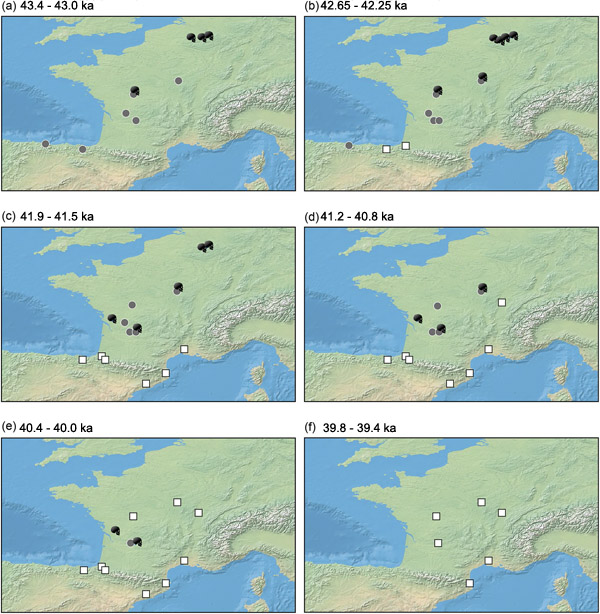
Dated appearances in France and NE Spain of Neanderthal fossils (black skulls), Châtelperronian artefacts (grey circles) and proto-Aurignacian artefacts (white squares) in different time ‘slots’ between 43.4 and 39.4 ka. (Credit: Djakovic et al., Fig. 3)

Igor Djakovic of Leiden University in the Netherlands , Alastair Key of Cambridge University, UK, and Marie Soressi, also of Leiden University have undertaken a statistical analysis of the geochronological and stratigraphic context of artefacts at Neanderthal and AMH sites in France and NW Spain during the co-occupancy period (Djakovic, I., Key, A. & Soressi, M. 2022. Optimal linear estimation models predict 1400–2900 years of overlap between Homo sapiens and Neandertals prior to their disappearance from France and northern Spain. Scientific Reports, v. 12, article  15000; DOI: 10.1038/s41598-022-19162-z). Their study is partly an attempt to shed light on the ‘authorship’ of the novel technology. The results suggest that the Châtelperronian (Ch) started around 45 ka and had disappeared by ~40.5 ka, along with the Neanderthals themselves. Early AMH artefacts are known as proto-Aurignacian (PA) and bear some resemblance to those of Châtelperronian provenance. The issue revolves around 3 conceivable scenarios: 1. the earliest AMH migrants brought the PA culture with them that Neanderthals attempted to copy, leading to their Ch tools; 2. Neanderthals independently invented the Ch methodology, which AMH adopted to produce PA artefacts; 3. both cultures arose independently.

Djakovic and colleagues have found that the data suggest that the proto-Aurignacian first appeared in the area at around 42.5 ka. Maps of dated human remains and artefacts for six 400-year time ranges from 43.4 to 39.4 ka show only Neanderthal remains and Châtelperronian artefacts from the earliest range (a in the figure). Two sites with proto-Aurignacian artefacts appears in NW Spain during the next ‘slot’ (b) then grow in numbers (c to e) relative to those of Châtelperronian provenance, which are not present after 40 ka (f) and neither are Neanderthal remains. These data suggest that local Neanderthals may have made the technological breakthrough before the appearance of the AMH proto-Aurignacian culture, which supports scenario 2 but not 1. They also suggest that the sudden appearance of Ch in France and Spain and the abandonment of earlier Neanderthal artefacts known as Mousterian could indicate that the Ch culture may have been introduced by Neanderthals migrating into the area, perhaps from further east where they may have been influenced by the earliest known European AMH in Bulgaria: i.e. tentative support for 1 or 2.

However, well documented as Djakovic et al.’s study is, it considers only 17 sites across only a fraction of Europe and a mere 28 individual artefacts each from Neanderthal and AMH associations (56 altogether). More sites and data are bound to emerge. But the study definitely opens exciting new possibilities for cultural ‘cross fertilisation’ as well as the proven physical exchange of genetic material: the two seem very likely to go hand-in-hand. Seven thousand years (~350 generations) of mutual dependence on the resources of southern Europe surely signifies too that the initially distinct groups did not engage in perpetual conflict or ecological competition, as with small numbers of both one or the other would have been extinguished within a few generations.

 See also: Devlin, H. 2022. Neanderthals and modern humans may have copied each other’s tools. The Guardian, 13 October 2022; Davis, N. 2020. Humans and Neanderthals ‘co-existed in Europe for far longer than thought’. The Guardian, 11 May 2020.

The earliest upright ape

Two decades ago the world of palaeoanthropologists was in turmoil with the publication of an account of a new find in Chad (see: Bonanza time for Bonzo; July 2002). A fossil cranium, dubbed Sahelanthropus tchadensis (nicknamed Toumaï­ or ‘hope of life’ in the Goran language), appeared like a cross between a chimpanzee and an australopithecine. The turmoil erupted partly because of its age: Upper Miocene, around 7 Ma old. Such an antiquity was difficult to reconcile with the then accepted ~5 Ma estimate for the evolutionary split between humans and chimpanzees, based on applying a ‘molecular clock’ approach to the difference between their mtDNA. The other point of contention was the size of Sahelanthropus’s canine teeth: far too large for australopithecines and humans, but more appropriate for a gorilla or chimp.

Cast of the reconstructed skull of Sahelanthropus tchadensis. (Credit: Didier Descouens, University of Toulouse)

In the absence of pelvic- and foot bones, or signs of the foramen magnum where the spinal cord enters the skull – crucial in distinguishing habitual bipedalism or being an obligate quadruped – encouraged the finders of a 6.1 to 5.7 Ma-old Kenyan hominin Orrorin tugenensis to insist that its skeletal remains – several teeth, fragments of a lower jaw, a thigh bone, an upper arm and of a finger and thumb but no cranial bones – were of ‘the earliest human ancestor’. In Orrorin’s favour were smaller canine teeth than those of later australopithecines. At the time of the dispute, centred mainly on absence of crucial evidence, doyen of hominin fossils Bernard Wood of George Washington University and an advocate of ‘untidy’ evolution, suggested that both early species may well have been evolutionary ‘dead ends’ (see: A considered view; October 2002). And there the ‘muddle’ has rested for 20 years.

In 2002 not only a cranium of Sahelanthropus had been unearthed. Three lower jaw bones and a collection of teeth suggested that as many as 5 individuals had been fossilised. A partial leg bone (femur) and three from forearms (ulna) cannot definitely be ascribed to Sahelanthropus but, in the absence of evidence of any other putative hominin species, they may well be. It has taken two decades for these remains to be analysed to a standard acceptable to peer review (Daver, G. et al. 2022. Postcranial evidence of late Miocene hominin bipedalism in Chad. Nature v. 608, published online; DOI: 10.1038/s41586-022-04901-z). The authors present convoluted anatomical evidence that Toumaï­’s femur, which had been gnawed by a porcupine and lacks joints at both ends, suggesting that it was indeed suited to upright walking. Yet the arm bones hint that it may have been equally comfortable in tree canopies. Yet it does look very like an ape rather than a hominin.

Much the same conclusion has been applied to Australopithecus afarensis, indeed its celebrated representative ‘Lucy’ met her end through falling out of a large tree ~3.2 Ma ago (see: Lucy: the australopithecine who fell to Earth?; September 2016). So, dual habitats may have been adopted by hominins long after they emerged. Yet Au afarensis was capable of trudging through mud as witnessed by the famous footprints at Laetoli in Tanzania. Only around 3 Ma has reasonably convincing evidence for upright walking similar to ours been discovered in Au africanus. The full package of signs from pelvis and foot for habitual bipedalism dates to 2 Ma ago in Au sediba. Even this latest known australopithecine seems to have had a gait oddly different from that of members of the genus Homo.

So, in many respects the benefits of full freeing of the hands to develop manipulation of objects, as first suggested by Freidrich Engels, may have had to await the appearance of early humans. Earlier hominins almost certainly did make tools of a kind, but the revolutionary breakthrough associated with humanity was more than 5 million years in the making.

See also: Callaway, E. 2022. Seven-million-year-old femur suggests ancient human relative walked upright. Nature (News)24 August 2022;

Handwerk, B. 2022. Seven Million Years Ago, the Oldest Known Early Human Was Already Walking. Smithsonion Magazine, 24 August 2022 (click the link ‘published today in Nature’ in 2nd paragraph to access complimentary PDF of Daver et al)

New dating questions previous ideas about early hominins

The Sterkfontein cave 40 km northwest of Johannesburg in South Africa first sprang to the attention of scientists in 1936, with the discovery there of an adult hominin skull. This showed clear affinities with the discovery 400 km to the SW in 1924 of the fossil skull of a juvenile primate, which Raymond Dart claimed to be ancestral to modern humans, naming it Australopithecus africanus. Sterkfontein has since yielded more than 500 hominin fossils, many of which are Au. africanus.

Limestone cave deposits are difficult to date precisely, unlike sediments that are interbedded with volcanic rocks, the most amenable material being that deposited by water flowing through the cave to form flowstone or speleothem. Using the U-Pb method of radiometric dating yielded an age of between 2.1 to 2.6 Ma for flowstone that cements the breccia in which the Au. africanus fossils occur. Clearly, the flowstone formed after burial so that was a minimum age for them, awaiting the use of a different chronological tool to suggest when burial of the bones took place

The face of an Australopithecus africanus: ‘Mrs Ples’. (Credit University of Zurich)

An almost complete skeleton of another australopithecine found in another part of the Sterkfontein cave system was dated in 2015 by a different approach. This used the decay of 10Be and 26Al isotopes that high-energy cosmic rays produce in quartz grains while they are exposed at the surface. Burial of irradiated sedimentary grains protects them from such bombardment, and the two isotopes  then steadily decay at a known rate. Quartz grains associated with this specimen (fondly known as ‘Little Foot’) turned out to be far older than the flowstone U-Pb age, with a cosmogenic burial age of about 3.7 Ma. Its much greater antiquity prompted scientists to regard ‘Little Foot’ as a different species – Au. prometheus – despite being similar to Au. africanus.

Since that success, much the same team from South Africa, the US and France has been working on sedimentary grains buried with the abundant Au. africanus specimens from Sterkfontein (Granger D.E. et al. 2022. Cosmogenic nuclide dating of Australopithecus at Sterkfontein, South AfricaProceedings of the National Academy of Sciences, v. 119, article e2123516119; DOI: 10.1073/pnas.2123516119). Their newly published efforts show that “Little Foot’s” burial took place between 3.41 and 3.49 Ma, more than a million years earlier than suggested by the flowstone U-Pb dating and just ~200 ka younger than the ‘Little Foot’ skeleton. More surprising is that Au. africanus lived during the same period (3.4 to 3.7 Ma) as did Au. afarensis – the species to which ‘Lucy’ belonged – 3500 km to the north in Ethiopia.

So it is no longer justifiable  to suggest that the first known human species (Homo habilis ~2.3 to 1.65 M) is either a more ‘advanced’ australopithecine or a direct descendant from that genus, for the new dating opens a million-year gap in the history of human evolution. That age range does contain stone tools but no plausible candidates for an australopithecine-human evolutionary connection. One of the most recently suggested link is Au. sediba (see: Another candidate for earliest, direct human ancestor, October 2011; and Australopithecus sediba: is she or is she not a human ancestor? April 2013). The snag with that candidate is that the well-established age (2.0 Ma) of known specimens falls in the middle of the range for H. habilis. The two may have been cohabiters of Africa but are very different.

The million years that separated Au. africanus together with afarensis from H. habilis is the period when the defining character of humans, tool making, evolved. So the hunt is on for hominins associated with stone tools in that huge stratigraphic gap. One of the drawbacks with famous sites, such as the ‘Cradle of Humankind’ that includes Sterkfontein, is that they almost become clichés so that scientists return to them again and again, while the key that they seek may well lie elsewhere.

Wider traces of the elusive Denisovans

We know that when anatomically modern humans (AMH) arrived in Asia they shared the landscape with ‘archaic’ humans that had a much longer pedigree. In 2010 an individual’s little-finger bone dated to around 30 to 49 ka old was found in the Denisova Cave in central Siberia (at 50°N). It yielded a full genome that was distinctly different from those of AMH and Neanderthals (see: Other rich hominin pickings; May 2010). Four other fossils found subsequently in the Denisova Cave contained similar DNA. Checking the DNA of living humans and fossil Neanderthal remains revealed that the newly discovered human group had interbred with both. In the case of AMH, segments of Denisovan DNA are found in the genomes of indigenous people living in East and South Asia, Australia, the Pacific Islands and the Americas, at levels of 0.2%, rising to 6% in Melanesian people of Papua-New Guinea. But such introgressions have not been found in Europeans (but see below), suggesting that the Denisovans were restricted to Asia.

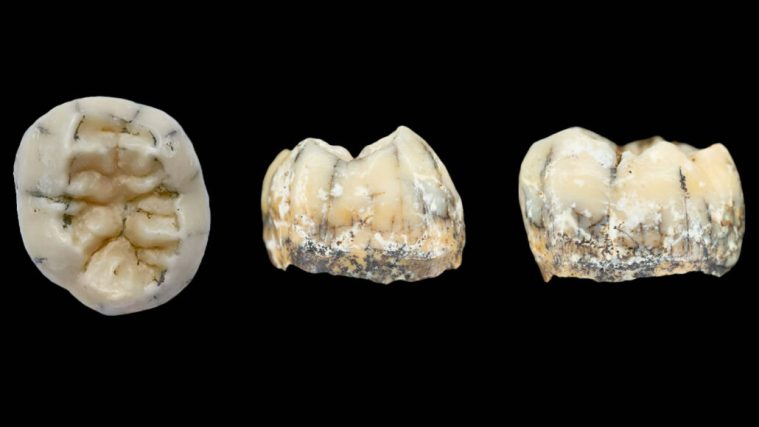
There have been suggestions that at least some of the ‘archaic’ human remains found widely and abundantly in China may have been Denisovans; although they might equally be of Homo erectus. But none of the Chinese fossils have been subjected to gene sequencing – those found in caves outside tropical and sub-tropical climates might retain DNA just as well as Neanderthal and even older remains in temperate Europe. Yet a partial lower jaw discovered in a cave on the Tibetan Plateau (at 35°N) did yield proteins that had close affinities to those recovered from Siberian Denisovans. Now similar analyses have been performed on an abnormally large molar found in a cave in Northern Laos, showing that it too is most likely to be from a young (as suggested by its being little worn), possibly female (it lacks male-specific peptides), Denisovan. The locality lies at about 20°N, far to the south of the other two Denisovan sites (Demeter, F. et al. A Middle Pleistocene Denisovan molar from the Annamite Chain of northern Laos. Nature Communications, v. 13, article 2557; DOI: 10.1038/s41467-022-29923-z). Sparse as the evidence is, Denisovans were able to tolerate climate differences across 30 degrees of latitude.

A probable Denisovan molar from 164 to 131 ka old cave sediments in northern Laos. (credit: Demeter, et al.; Fig. 2)

The Wikipedia entry for Denisovans is a mine of additional information. For instance, detailed analysis of the roughly 5% of their genome that indigenous people of New Guinea carry suggests that the two groups may have interbred there as late as 30 ka. Since Both New Guinea and Australia were until 8 thousand years ago part of the Sahul landmass when sea level was low during the last ice age, these inferences add tropical occupancy to the Denisovan range. Does this suggest that Papuans and indigenous Australians migrated with Denisovans, or had the latter crossed the sea from Timor earlier and independently, after moving from Asia by ‘hopping’ from island to island through eastern Indonesia? There is a possibility that Denisovans could even have survived in Sahul until as late as 14.5 ka. Even more odd, modern Icelandic people are unique among Europeans in having detectable traces of Denisovan DNA. However, rather than having been directly shared between Denisovans and ancestral Scandinavians – a possibility – it may have been carried by Neanderthal-Denisovan hybrids migrating westwards from Siberia with whom the Icelanders’ ancestors interbred. There are other interesting points in the Wikipedia entry. One is that the consistently lower Denisovan ancestry in living East Asians compared with people of Oceania, may indicate two separate waves of eastward migration by AMH. The latter may have arrived first, had greater contact with Denisovans and then moved on across seaways to remain isolated from the later migrants.

Finally, something that puzzles me as a non-geneticist. If both Denisovans and Neanderthals died out as genetically distinct groups tens of millennia ago how could the genetic traces of interbreeding with AMH have been retained at such high levels until the present; i.e. through thousands of generations? Each of us carries a 50% deal of genes from our parents. Then with each subsequent generation the proportion is diluted, so that we inherit 25% from grandparents, 12.5 % from great-grandparents and so on. Yet Papuans still have 5 to 6 percent of Denisovan DNA: much the same holds for Europeans’ Neanderthal heritage. Does such a high level of retention of this ancestry suggest that a large proportion of the earliest migrating AMH individuals stemmed from generation to generation interbreeding on a massive scale? Did the ‘newcomers’ and ‘locals’ band eventually together almost completely to merge genetically, or am I missing something … ? Probably

Did earliest modern humans in Europe share a cave with Neanderthals?

The cave of Grotte Mandrin in the Rhône Valley, France. (Credit: Slimak et al Fig 1c)

Since 1999 a cave (Grotte Mandrin) on the west flank of the lower Rhône valley in sothern France has been revealing archaeological remains from 3 metres of sediment that can be divided into 12 distinct layers (Slimak, L. and 22 others 2022. Modern human incursion into Neanderthal territories 54,000 years ago at Mandrin, France. Science Advances, v. 8, article eabj9496; DOI: 10.1126/sciadv.abj9496). Tens of thousands of objects have been recovered, mostly from a layer just below midway in the sequence, which is dominated by small (<1 cm), ‘standardised’ stone points that are also found at other sites in the local area. This veritable industry – dubbed the ‘Neronian’ from the nearby Grotte de Néron – seems to have been focussed hereabouts. Older artefacts in layers F and G are considered to be Mousterian, that is generally ascribed to late Neanderthals. Horse, bison and deer bones suggest that these were the main source of animal protein for the cave’s occupants. The site also contained a few objects that show simple decoration. The way in which the Neronian points were produced resembles the working of similar artefacts in Lebanon by anatomically modern humans (AMH) about 45 ka ago; so it is possible that the technology had spread westward with the earliest AMH migrants into Europe. Yet precise radiocarbon and optically stimulated luminescence dating of the Grotte Mandrin site suggests that the sediment accumulated between 84 to 44 thousand years ago. The Mousterian/Neanderthal objects occur in layers F and G between 79 and 57 ka, whereas the Neronian layer E spans 56.8 to 51.7.

Grotte Mandrin has yielded very few hominin remains, except for 9 teeth in layers C to G. Those from C, D, F and G showed clear Neanderthal dental features. However, shape analysis of one damaged, deciduous (infant) molar from Layer E suggests that it matches Upper Pleistocene AMH dental morphology. That seems to place Grotte Mandrin as by far the oldest AMH occupation site in Europe, up 11 thousand years earlier than the 45 to 43 ka AMH site at Bacho Kiro in Bulgaria. To some extent that tallies with the tiny tooth’s association with a prolific, standardised and delicate industry new to the area: probably points for small projectiles. Neanderthals re-occupied the site in Layers D to B, yet in the upper part of layer B, from 44.1 to 41.5, there is a return of Neronian-like points, probably made by AMH.

A curious detail from layer E (not reported in this paper) is the occurrence of soot trapped in thin, annually deposited layers of carbonate on the cave walls. Fragments of the sooty speleothem continually fell onto the cave floor to be incorporated into the sediments. The base of layer E that contains Neronian, possibly AMH artefacts and the top of layer F that shows preceding Neanderthal occupation, contain such sooty speleothem fragments. Precise dating of them is claimed to suggest a very short period of transition between the two kinds of occupants: perhaps only a few years. Neanderthals and AMH may not have met in the cave, but may well have been co-occupants of the surrounding area at the same time.

A great deal of effort over more than two decades has gone into this publication, and several of its findings have caused quite a stir. Because permanent AMH occupation of the Levant began at least 55 ka ago, there is no reason to suppose that AMH migrating along the northern shores of the Mediterranean could not have arrived a little earlier in what is now southern France. What has been emphasised in the broad media is the exchange of a Neanderthal to an AMH population in the Grotte Mandrin, as if it was done in a friendly, indeed neighbourly spirit (!). That hinges on the ultra-precise dating of the sooty speleothem fragments to reveal just a few years between the Neanderthals doing a ‘flit’ and the AMH starting a ‘squat’ in the vacant premises to set up a cottage industry. The time of the replacement before present is, in fact, very close to the limit at which radiocarbon dating is feasible, almost all 14C formed at that time having decayed away since then. There can be no doubt that layer E did mark a major change in sophistication of stone technology, but was it really an AMH development? The only definite evidence is the single deciduous molar, and that is damaged to such an extent that an independent dental paleoanthropologist who has specialised in distinguishing AMH from Neanderthal dentition isn’t convinced. But,surely, DNA from the tooth would resolve the issue. The paper notes that trial extraction and sequencing of 6 horse teeth from layer E failed to yield results, which suggests degradation of genetic teril. So the team did not commit the tooth to sequencing, which would have further damaged it. Finally, four separate groups occupying what certainly looks like a nice little cave over the course of about 40 thousand years is hardly a surprise. Many caves throughout Europe and southern Africa show evidence of multiple occupancy. After all, before 11 ka all humans and their forebears were of necessity foragers and migrants; just think of how many times your neighbours have changed since you moved in …

See also: Price, M. 2022. Did Neanderthals and modern humans take turns living in a French cave? Science, v, 375, p. 598-599; DOI: 10.1126/science.ada1114