Former Senior Lecturer at British Open University, research in remote sensing of arid lands, groundwater exploration, Precambrian tectonics and geochemistry
For those of us living in what was the heart of Pangaea – Europe and North America – more than 250 Ma ago this item’s title might seem like the ultimate truism. However, despite our vision of desert dune sands and evaporating inland seas, glaciation blanketed much of the Gondwana part of the supercontinent until the Middle Permian then lying athwart the South Pole. That would go a long way to accounting for extreme dryness at low to mid-latitudes, especially in the deep interior of Pangaea, but just how hot might tropical climates have been? The deglaciation of Gondwana was abrupt and has been touted as an analogue for a possible anthropogenic closure to the Cenozoic glacial epoch that began around 34 Ma in Antarctica and has periodically gripped land at northern latitudes as low as 40°N for the last 2.5 Ma. Since the present distribution of continents is totally different from the unique pole-to-pole shape of Pangaea, that is probably a view that is not widely held by palaeoclimatologists. Nonetheless, getting hard data on Permian conditions has an intrinsic interest for most geoscientists.
Playa lake in Death Valley, USA (credit: Wikipedia)
One of the best ways of measuring past temperatures, whether surficial or deep within the crust, almost directly is based on fluids trapped within minerals formed at the time of interest. In Permian strata there is no shortage of suitable material in the form of evaporite minerals, especially common salt or halite. A distinctive chevron-like texture develops in halite that forms at the water-atmosphere interface in playa lakes that dry out every year. When thin sections of samples that contain fluid inclusions are slowly heated the air bubbles trapped in salt during crystallisation gradually homogenise with the other trapped fluids. Based on samples that have formed at the present day under a range of air temperatures, the temperature of homogenisation indicates the prevailing air temperature accurately. So well, in fact, that it is possible to assess diurnal temperature variations in suitable halite crystals.
Results have been obtained from Middle Permian halites in Kansas, USA (Zambito, J.J. & Benison, K.C. 2013. Extremely high temperatures and paleoclimate trends recorded in Permian ephemeral lake halite. Geology, v. 41, p. 587-590). In part of the section studied air temperatures reached 73°C, compared with a modern maximum of 57°C recorded in halites from the playas of Death Valley. Moreover, they exhibit changes of more than 30°C during daily cycles. But that kind of weather is common in other hot dry areas today, such as the Dasht-e Lut in eastern Iran. Also, the full data show crystallisation at lower temperatures (maxima of 30-40°C) in part of the sequence. What is noteworthy is that these data are the first quantitative indicators of weather before the last 2.5 Ma. Since evaporites extend back into the Precambrian, the method will undoubtedly extend accuracy and precision to paleoclimate where only proxies and a modicum of guesswork were previously available.
Mass extinctions and smaller but significant die-offs in the marine and terrestrial domains have been linked in the geoscientific imagination with many things: asteroid impacts; gamma-ray bursts from distant supernovae; belches of methane from the sea floor; emissions of hydrogen sulfide gas from seawater itself during ocean anoxia events; sea-level changes and more. The most intriguing, since it suggests a causal link between the core-mantle boundary and the biosphere, is the influence of flood basalt events and the gases, both greenhouse and toxic, that they undoubtedly released.
The famous K-T extinction (now K-Pg since the Palaeogene became the Period following the Cretaceous rather than the Tertiary) has swayed back and forth between the Chicxulub impact in Mexico’s Yucatán Peninsula and the flood basalts of the Deccan Traps in western India as likely mechanisms, Chicxulub currently being in pole position. The equally devastating event at the close of the Triassic (at 201 Ma) that presaged the rise of the dinosaurs has had a similar external versus internal causality controversy, both the Rochechouarte crater and the Central Atlantic Magmatic Province being candidates.
CAMP flood basalts in Morocco (credit: Wikipedia)
Rochechouarte, however, was nowhere near as energetic an event as the Chicxulub impact. The problem is, as with all events for which the weight of evidence points to very short time scales – of the order of tens to hundreds of thousand years, is the dating of candidate causes. Rochechouarte happened at 201±2 Ma: it may or may not have coincided with faunal change. Yet timing of the CAMP flood basalts has hitherto been even more coarsely tagged. This imprecision is not unconnected with the choice of radiometric dating methods, the 40Ar/39Ar approach being ‘easy’ and hence popular, but limited in its precision and accuracy. The ‘gold standard’ is zircon U-Pb geochronology that depends on the far greater reluctance of the host mineral to lose either parent or daughter isotopes compared with the feldspars, micas and amphiboles used in many other methods. Zircon still in its igneous parent is crucial: it is so durable that vastly older zircons are often found in sediments. Yet basalts contain few zircons.
Zircon crystal under the microsope; length about 250 µm. (Photo credit: Wikipedia)
Zircon geochronology has now emerged from the CAMP flood basalts of eastern Canada, the Atlantic seaboard of the US and that of Morocco, which has a precision of around 30 ka, one to two orders of magnitude better than other methods (Blackburn, T.J. and 8 others 2013. Zircon U-Pb geochronology links the end-Triassic extinction with the Central Atlantic Magmatic Province. Science, v. 340, p. 941-945). The extinction is defined most readily by a sudden change in fossil pollen and spores, possibly within less than 10 ka, as well as extinction of Triassic marine fauna and large numbers of terrestrial reptile and amphibian taxa followed by diversification of early Jurassic dinosaurs. The oldest CAMP basalts are from Morocco immediately above spores of clearly Triassic age; i.e. before the extinction, whereas the basalt flows in Canada and the eastern US (a mere 3 to 13 ka younger)are above the turnover. So, the start of the CAMP flood volcanism brackets the extinction.
But did CAMP cause, indeed could it have caused the extinction? Blackburn and colleagues cannot be certain. A negative carbon-isotope spike associated with the extinction is estimated to have required almost a million km3 of magma to have been erupted almost instantaneously to inject excess CO2 into the atmosphere. The dating suggests four major pulses of eruption in the areas studied spread over around 600 ka, the last three being associated with biological diversification and recovery in the earliest Jurassic. In fact the research seems merely to suggest strongly that flood volcanism accompanied the extinction, but leaves its causing the death toll still an open question.
The CAMP events marked the beginning of Pangaea’s break-up and the formation of Tethys separating Eurasia and North America from the old Gondwana continental mass. That tropical seaway became the site of massive production of marine carbonates, presumably to draw down any carbon dioxide excess in the atmosphere.
The release and exploitation of natural gas from shales using the unconventional means of in situhydraulic fracturing – ‘fracking’ – has had plenty of bad press, including some hammering in Earth Pages. Now, what seems to be a balanced academic review has appeared on-line in Science magazine (Vidic, R.D. et al. 2013. Impact of shale gas development on regional water quality. Science, v. 340, DOI: 10.1126/science.1235009). The review focuses on hazards to groundwater resources from a variety of environmental effects, primarily gas migration, contaminant transport through induced and natural fractures, wastewater discharge, and accidental spills.
Protests against shale gas drilling in Bulgaria (credit: Wikipedia)
Much attention has centred on faulty seals put in place to stop gas escaping from drill targets. Yet fewer than 3% of seals are said to have proved problematic, with some finger-pointing at natural gas leakage from the hydrocarbon-rich shales. After all, there are plenty of natural fractures and completely ‘tight’ stratigraphic sequences are rare. in fact toxic effects of natural gas leakage on surface vegetation have been widely used as exploration indicators for conventional petroleum. The review does point out that there are so few pre-drilling studies of natural leakage that this controversy – including widely publicised blazing household water supplies – can not yet be resolved. Obviously more independent monitoring of areas above prospective shales are essential; but who will fund them? The one well-documented before-and-after study, from 48 water wells in Pennsylvania, USA, showed no change, though it seems that monitoring after fracking was short-lived.
The chemically-charged water used to induce the hydrofracturing obviously leaves an unmistakable mark when leaks occur, and there have been cases of considerable environmental release. The fluids are indeed a wicked brew of acids, organic thickeners, biocides, alkalis and inorganic surfactants, to name but a few infredients. To some extent re-use of such fluids, which are costly, ought to mitigate risks. However, once a shale-gas field is fully developed, large volumes of the fracking fluids remain in the subsurface and may leak into shallow groundwater sources. But what pathways do these fluids follow when they are pumped into shales under very high pressure? The review warns of the lesson of toxic fluid leakage from underground coal mines.
The University of Pittsburgh team who compiled the review usefully outline why shale gas is both profitable and feasible. They deal with what methane does in an environmental chemistry sense. It isn’t a solvent, so carries no other materials such as toxic ions, but its interaction with bacteria creates reducing conditions. A now well-known hazard of subsurface reduction is dissolution of iron hydroxide, naturally an important component of many rocks, that can adsorb a great range of dangerous ions at potentially high concentrations, including those involving arsenic. Reductive dissolution lets such ions loose into natural waters, even at shallow depths. Yet methane is emitted by a host of sources other than hydrocarbon-rich shale: landfill; swamps; other bacterial action; conventional petroleum fields both active and abandoned; and even deep water boreholes themselves. A recent study of groundwater geochemistry in relation to fracking in Arkansas, USA (Warner, N.R. et al. 2013. Geochemical and isotopic variations in shallow groundwater in areas of the Fayetteville shale development, north-central Arkansas. Applied Geochemistry, v. 33, doi/10.1016/j.apgeochem.2013.04.013) does address changes in groundwater chemistry, but not for all the ions cited by the WHO as potential hazards.
Whereas the mechanisms involved in vertical and lateral migration of subsurface fluids are well understood there is little knowledge of natural structural features such as deep jointing, fractures and fault fragmentation that control actual migration from area to area. The use of natural seepage as an exploration guide was largely abandoned when many studies showing apparently high-priority targets proved to be far removed from the actual source of the moving fluids. The most easily investigated route for leakage is the actual ‘plumbing’ that fracking uses. This is held together by cement that high pressures can disrupt before it sets, resulting in leaks. A lot depends on ‘due diligence’ deployed by the contractors, whose regulation can leave a lot to be desired. Vidic and colleagues devote most space to the matter of wastewater and deep formation water, yet make little if any case for routine geochemical monitoring of domestic groundwater supplies in shale-gas fields. Much is directed at the industry itself rather than independent surveys.
People have a keen eye for unusual objects and an even keener one for the aesthetic. Fossil echinoderms with their five-fold starry shape have been enduringly popular as trinkets since the Palaeolithic. Astonishingly, the gravel terrace at Swanscombe that yielded skull fragments of 400 ka Homo erectus plus many Acheulean tools also contained a flint bi-face ‘hand axe’ with a near perfect echinoid in its blunt grip. It cannot be proven, but the object seems to refute the idea that an artistic sense only arose with anatomically modern humans in the last 100 ka. Our immediate ancestors of the Neolithic sometimes took collecting to extremes in graves half full of fossil sea urchins (McNamara, K.J. 2007. Shepherds’ crowns, fairy loaves and thunderstones: the mythology of fossil echinoids in England. In: Piccardi, L. & Masse, W.B. Myth and Geology. Geological Society, London, Special Publication 273, 279–294).
Before the invention of metal smelting native gold, iron and copper appear in the archaeological record, undoubtedly because they look and indeed feel so different from the usual pebbles on the beach or just lying around. It is just that element of the odd that continues to draw people, including scientists, into a perpetually stooped posture when the walk across surfaces scattered with pebbles and boulders. The habit is especially hard to shake off for the meteoriticist whose hunting grounds are desert plains and ice caps where oddities are easy to spot, even when rare. So it is interesting when such dogged searchers encounter evidence of long-dead people having done much the same.
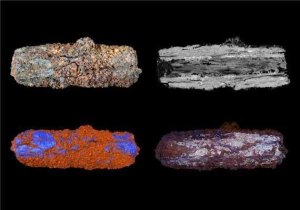
By 5300 years ago people had settled in small farming communities in the Nile Valley eventually to develop on the shores of lake – now represented by several smaller water bodies – what is regarded as the world’s first city near modern Faiyum. These Predynastic people buried their dead nearer to the Nile at Gerzeh, often sending them off with grave goods. The site has been continually excavated by professional archaeologists for more than a century, beginning with Sir Flinders Petrie. Two of the graves contained metallic iron beads, which presented a puzzle as iron smelting is only known from the 6th century BCE onwards. Unsurprisingly, the beads came to be regarded as artefacts wrought from an iron meteorite, though their highly altered nature and intrinsic value thwarted attempts at full analysis. Geochemists from the Open and Manchester Universities, and the Natural History Museum have now resolved the issue (Johnson, D. et al. 2013. Analysis of a prehistoric Egyptian iron bead with implications for the use and perception of meteorite iron in ancient Egypt. Meteoritics and Planetary Science, on-line, DOI: 10.1111/maps.12120). Non-destructive electron microscopy and X-ray tomography reveal, respectively, clear signs of the banded Widmanstätten structures and traces of nickel-rich iron alloy (taenite) that typify iron meteorites but are absent from smelted iron. The beads were clearly beaten and rolled into shape, but this working did not destroy the tell-tale evidence of their origin.
Optical, microprobe and CT-scan images of Predynastic iron bead from the Nile Valley (credit: Open University)
This provenance tallies with the appearance in early New Kingdom hieroglyphs of the term biA-n-pt – literally iron-from-the-sky – which was adopted for smelted iron when first made in the 26 to 27th Dynasties. But pharaonic iron was not a poor relation of gold, regarded as flesh of the gods and hence featuring in the masks of Pharaohs such as Tutankhamen, but supposedly what their bones were made from.
Way back in the mists of time, say around 1970-71, an idea was doing the rounds that because the thermal conductivity of continental crust is lower than that of the ocean floor it should allow thermal energy to build up in the mantle beneath. In turn that might somehow encourage the formation of hot spots and a shallower depth to the asthenosphere: the outcome might be to encourage rifting of weakened lithosphere and ultimately a new round of sea-floor spreading. The case often cited was the Atlantic – North and South – since there are eight hotspots currently on the mid-Atlantic ridge. Africa was another popularised case with a great many broad domes associated with Cenozoic volcanism, and the link between formation of the East African Rift System, hot spots and doming had already been suggested. Africa has barely drifted for around 100 Ma and the domes were supposed to have formed by the build up of heat in the mantle beneath. Geoscience moved on to clearly demonstrate the coincidence of large igneous provinces and flood basalt volcanism with the initiation of Atlantic spreading in the form of the Central Atlantic and Brito-Arctic LIPs during initial opening of the South and North Atlantic at the end of the Triassic and during the Palaeocene respectively. But the role of continental insulation became a bit of backwater compared with notions of mantle plumes emanating at the core-mantle boundary. Well, it’s back.
The Mid-Atlantic Ridge (credit: Wikipedia)
There is now a vast repository of ocean-floor lavas that formed at mid-ocean ridges in the past, thanks to the international Deep Sea and Ocean Drilling Programmes begun in 1968 about when the heyday of plate tectonics really got underway. In the last 45 years there have also been great advances in igneous geochemistry and its interpretation, including relations with mantle melting temperatures. Geochemists at the Friedrich-Alexander-Universiteit in Erlangen, Germany have re-examined the major-element geochemistry of 184 glassy ocean-floor basalts from drill sites of different ages on the floor of the Atlantic Ocean and compared them with 157 from the Pacific. To avoid the possible influence of plume-related heating, the sites were chosen well away from the tracks of existing hot spots. Mantle temperature can be assessed from the sodium and iron content of basalts, Na decreasing with higher temperatures and Fe doing the reverse (Brandl, P.A. et al. 2013. High mantle temperatures following rifting cause by continental insulation. Nature Geoscience, v. 6, p. 391-394). Atlantic samples show increasing Na and decreasing Fe contents in progressively younger basalts, i.e. a trend with time of decreasing mantle temperature such that the oldest (~166 Ma) record 150°C higher mantle temperature than the youngest, with a similar result for the Indian Ocean floor. No such trend is present in samples from the same age range of the Pacific Ocean floor. At around 170 Ma the mid-Atlantic Ridge was close to the continental lithosphere of the Americas and Africa, whereas the East Pacific Rise was at least 2000 km from any continental margin. Younger Atlantic samples formed progressively further from its shores record cooling of the mantle source.
A prediction of the model is that the converse, continental accretion to form supercontinents such as Pangaea, should rapidly have caused considerable warming in the mantle beneath them. This suggests that the formation of supercontinents, or even less substantial continents, should carry the seeds of their re-fragmentation, as Africa is currently demonstrating by the separation of Arabia since the Red Sea began to open some 15 Ma ago, which Somalia and much of eastern Kenya and Tanzania seem destined to follow once the East African Rift System ‘gets steam up’.
Related articles
Langmuir, C. 2013. Older and hotter. Nature Geoscience, v. 6, p. 332-333
Around 73 thousand years ago a supervolcano in Sumatra erupted on a scale unprecedented in the last 2 million years. It left a 100 by 30 km elliptical caldera now occupied by Lake Toba, and explosively ejected 2800 of magma, about 800 km3 falling as ash as far afield as the Greenland ice cap. Although ice-core records show little if any sign of associated climate change in polar regions, the vast amount of ash and sulfate aerosols blasted into the stratosphere must have had some ‘global winter’ effect. Large areas of South Asia were blanketed by thick beds of ash. Human migration from Africa into Eurasia was probably underway at the time, indeed stone tools are found directly beneath and above the Toba ash in southern India and Malaysia. Some palaeoanthropologists have seen the stresses imposed by the Toba eruption as possible means of reducing the entire human population to a mere few thousand: a genetic ‘bottleneck’ that could have led to rapid evolution among surviving generations that may have shaped changes in human behaviour and culture.
Landsat image of Lake Toba, the largest volcanic crater lake in the world. (credit: Wikipedia)
There is a widening range of views on the climate changes that may have followed Toba. It has even been suggested that global mean surface temperature fell by as much as 10°C (Robock, A. et al. 2009. Did the Toba volcanic eruption of ∼74 ka B.P. produce widespread glaciation?Journal of Geophysical Research: Atmospheres, v. 114, DOI: 10.1029/2008JD011652), although not so far as to produce a worldwide glacial surge but sufficient to devastate vegetation. This bleak look back to a critical point in human affairs resulted from modeling of the effects of a global reflective cloud of ash and sulfate. A later modeling study factored in particle and aerosol sizes (Timmreck, C. et al. 2010. Aerosol size confines climate response to volcanic super-eruptions. Geophysical Research Letters, v. 37, doi:10.1029/2010GL045464) to give a less dramatic, but still severe maximum global cooling due to Toba of ~3.5°C.
The focus has now shifted from modelling to a more direct look at the environmental effects of the Toba super-eruption, preserved in sediments beneath Lake Malawi in southern Africa (Lane, C.S. et al. 2013. Ash from the Toba supereruption in Lake Malawi shows no volcanic winter in East Africa at 75 ka. Proceedings of the National Academy of Science, v. 110, doi/10.1073/pnas.1301474110). The sediments contain a thin ash layer that is very different from those produced by East African Rift volcanism but chemically and texturally similar to the Toba ash from the Indian Ocean and India. The sediments, diatom fossils and chemical biomarkers immediately above the ash show little sign of a significant temperature fall. At most it records a 1.5°C fall, and the authors conclude little chance of a human genetic bottleneck among Africans living at the time.
There is clearly a conflict between results of modeling and real-world climatic data, which is interesting in its own right. But the Malawi findings do not rule out ‘bottlenecks’ resulting from severe stress in South Asia where the ash itself would have severely affected game and vegetation for long enough to face migrating human bands with the prospect of starvation. Obviously, some survived to move on and to leave their tools behind on top of the Toba Ash.
Australopithecus sediba 1 (MH1) left, Au. afarensis( AL 288-Lucy) centre and Au. sediba 2 (MH2) right. (credit: L. R. Berger, University of the Witwatersrand, via Wikipedia)
The remarkable find of two well-preserved skeletons of a 2 Ma hominin in a South African cave in 2008 and publication of their preliminary analysis in 2011 seemed set to shake up human origins research. There was a more or less complete hand – indeed an entire arm and shoulder – a lower leg with ankle bones, a near-complete head and lots more besides. Most was from one female individual, but significant bits from two others that allowed a well-supported reconstruction of the new species Au. sediba. The discoverer, Lee Berger of The University of the Witwatersrand, South Africa (well he initiated the dig, but his young son found the first critical material) is so excited 5 years on that he uses hip-hop phraseology, she ‘got swag’, presumably assuming that means pretty cool (Gibbons, A. 2013. A human smile and funny walk for Australopithecus sediba. Science, v. 340, p. 132-133), but on the street there are other meanings and attitudes towards the phrase and unwary use is not advised.
More details now have emerged in a special issue of Science introduced by Berger in less fulsome language (Berger, L.R. 2013. The mosaic nature of Australopithecus sediba. Science, v. 340, p. 163). As the title suggests, the surprise lies in almost every critical part of the species. Although the spine shows curvature (lordosis) needed for an animal evolved from a quadruped to bipedality in order to balance when upright, the ankle bone is unlike the flat-based human one, being pointed as is that of chimpanzees. As a result walking would have involved an unusual and perhaps unsteady gait; the individuals did fall over into a death pit and one commentator thought the gait might have seemed ‘provocative’. An unusual knee bone is thought to be an evolved countermeasure to such exaggerated mincing. Despite the very human-like hand, extremely long arms and shoulders remarkably like those of the favoured jacket of a star of the BBC series The Dragons’Den point to habitual clambering in trees. Authors of a report on dentition suggest a close similarity to that of the Au. africanus, living at the same time and also found in the same system of fossil-rich caves north-west of Johannesburg, South Africa. Controversially, the tooth team suggests a closer similarity of both to early Homo species than to earlier australopithecines in East Africa, which would shift the focus of human origins to southern Africa. Counter to that view is a find of 400 ka-older, putative human remains in Ethiopia. Yet they take the form of a lower jaw that resembles that of Au. sediba.
The emerging, more detailed picture is not tidy, as suspected from early examination of the Malapa hominins. One thing is for sure, the South African caves are being swarmed over, which paid dividends in 2011 just 15 km from the Malapa cave with another embarrassment of riches at Sterkfonein in the form of abundant foot bones of a currently un-named species of roughly the same age. Things are beginning to take on an element of national pride, with ‘The Birthplace’ at stake: Kenya, Tanzania, Ethiopia or South Africa?
Time Lord, possibly outside the offices of the International Commission on Stratigraphy (credit: Sorcyress via Flickr)
Because it is the ultimate historical discipline, the essence of geology centres on time, measuring its passage and establishing correlations in time on a global scale so that an interlinked story of Earth evolution can be told. In fact geology is not just about a record of what happened in the four dimensions of place and time; it is a great deal more multidimensional, involving temperature, strain, chemistry, erosion, deposition, sea-level , the course of life and much more besides. Ever more multifaceted and, sadly, divided into subdisciplines and interfaces with other aspects of natural science that few if any individuals can grasp, an almost legally enforceable set of rules is needed to keep the order orderly. Unlike history and more akin to archaeology geological time is of two kinds, its precisely quantitative measure being a relative newcomer.
Since it emerged in the Enlightenment that began in the late 17th century geology has been dominated by a relative sense of timing: Steno’s Law of Superposition, and those relating to deformation, igneous eructations, erosion and deposition, first addressed systematically by James Hutton, being the most familiar. The notion of an absolute time scale into which events separated relative to one another could be fitted with confidence is a real latecomer. Although first attempted between 1650 and 1654 by Archbishop of Armagh James Ussher – he reckoned from the Old Testament that everything began at dusk on Saturday 22 October 4004 BCE – the only useful and broadly believable approach to absolute time has been based on the decay of radioactive isotopes incorporated into minerals once they had formed within a rock. But that is no panacea for the simple reason that most of them form through igneous or metamorphic processes and only rarely in the course of sedimentation. It also has only become reliable and precise in the last two or three decades.
Tying together global records of all the kinds of process that have made, shaped and changed the Earth has therefore become an increasingly complex blend between local relative dating, burgeoning regional to global means of correlation and the odd point in absolute time. What has arisen is a dual system that, if truth were told, is often used in a cavalier fashion. Equally to the point, the rules have of late become unfit for purpose and are in need of revision, which is a task for the Time Lords, properly known as the International Commission on Stratigraphy (ICS). The trouble is, the rules have themselves evolved somewhat episodically while their subject is appropriately in continual motion and change, if not anarchic. To the outsider things can seem very odd indeed. Most reasonably well-read souls will have heard of the Cambrian and the Jurassic, largely because of the popularity of trilobites that blossomed in the one and dinosaurs that strutted the land in the other. What is less well known is that the two names have different usages as adjectives: one to signify an interval of time called a Period, the other a System of essentially piled-up sedimentary rocks.
There are greater dualisms that group the Period/System divisions: the largest Eon/Eonothem groupings of Archaean, Proterozoic and Phanerozoic; the Era/Erathem signifiers such as Palaeoproterozoic, Mesozoic and Cenozoic. Incidentally, the time between the formation of the Earth and the first palpable rocks, from about 4550 to 4000 Ma, has been called the Hadean but has no designated status, possibly because it has no rock record whatsoever. Divisions of Periods/Systems apply only to the time since fossils became abundant 541 Ma ago, and in order of fineness of division are Epoch/Series and Age/Stage. Example of the first can be Lower, Middle and Upper – to spice things up, Middle maybe omitted from some Periods/Systems – or they might be given names derived from type areas, such as the ever popular Llandovery at the base of the Silurian Period/System. Helpfully, the Cambrian contains Terreneuvian, Series 2, Series 3 and Furongian from early to late/bottom to top. The final global division has always floored undergraduates and shows little sign of relief – there are a great many Ages/Stages, in fact a round 100 (I may have miscounted), 98 with names, 2 currently unnamed and 4 in the Cambrian called Stages 2 to 5: confusing, that… has anyone spoken of the Stage 3 Stage or the Stage 5 Age of the Cambrian?
Worryingly, in my hasty overview of the ICS International Stratigraphic Chart above I have reversed the official designation of chronstratigraphic/geochronological nomenclature: is this likely to have me committed to the geoscientific equivalent of Guantanamo Bay, or merely limbo?
I have by no means exhausted officialise. Readers may not be surprised to learn that the Time Lords have bent Heaven and Earth literally to concretise the double entendres of geology. The base of almost every Age/Stage in the Phanerozoic Eonothem/Eon is defined at a suitably agreed point on the ground by, in a few cases, a real golden spike (I may be mistaken on this, as the only one I tried to visit was at the base of a Welsh cliff suitable only to be visited by – in the timeless phrase – ‘a strong party’). More prosaically there are monuments of various ethically appealing designs that go by the sonorous name Global Boundary Stratotype Section and Point. I have it on reasonably good authority that ICS delegates have, on occasion, needed to be physically restrained from fist fights over which nation shall host a particular GSSP (the ‘B’ in the acronym is aspirated).
This is the point that all readers will have been waiting for: it has been suggested to ICS that the whole edifice is looked at very closely and perhaps revised (Zalasiewicz, J, et al. 2013. Chronostratigraphy and geochronology: A proposed realignment. GSA Today, v. 23 (March 2013), p. 4-8). For professionals this is an obligatory read, for others optional: there is no excuse as it is downloadable for free – click on the title. While you are about it, you can also download from GSA Today the famous proposal for an entirely new series/epoch called the Anthropocene (see also A sign of the times: the ‘Anthropocene’ in EPN issue of May 2011)
A press release from the Max Planck Institute for Evolutionary Anthropology in Leipzig, Germany, announces the completion of the most precise genome from a third Neanderthal individual. For the first time it is possible to distinguish copies of the genes inherited by the individual from both parents. The data release coincided with a review of genetic evidence for interbreeding between early Homo sapiens and other species.
Modern human migration out of and within Africa relative to the domains of coeval archaic humans 1 = modern humans 2 = Neanderthals 3 = other archaic humans (credit: Wikipedia)
One of the key areas for unravelling the range of tectonic processes involved in the assembly of continents lies in the Western Cordillera of North America, made up of dozens of slivers of mutually exotic terranes. Their exposed upper parts remain largely intact and are dateable using fossils or radiometric dating. Through assiduous palaeomagnetic research it is sometimes possible to chart their motions over time to see the manner in which they approached and collided with one another. Geoscientists are now able to link such a complex process with underlying tectonics, not by inference but through direct seismological observation of the remains of subducted slabs in the mantle deep beneath.
The crumpled Farallon Plate beneath North America, colours showing different depths in the mantle (credit: Karin Sigloch)
This item can be read in full at Earth-logs in the Tectonics archive for 2013