What drove the Cambrian Explosion?

The origin of animals occurred sometime during the Proterozoic Eon, perhaps as early as 2.1 Ga (billion years ago) after the Great Oxygenation Event. Available oxygen is a prerequisite for animal life, and that is about as far back as palaeobiologists can push it. More familiar are the trace fossils known as the Ediacaran fauna which emerged after the environmentally highly stressful Cryogenian Period that was marked by two Snowball Earth events. Traces of these animals may have been big enough to be easily found, but they were not particularly diverse and are difficult to place in any particular modern group. Most modern animals have front- and rear ends, tops and bottoms, and input and output orifices. The earliest of these bilaterian beasts may have emerged during the Ediacaran as well, but were not very prepossessing. It was during the Cambrian Period (541 to 485 Ma) that most modern animal phyla became recognisable to palaeobiologists. That carnival of diversification is widely known as the Cambrian Explosion. Yet it was later in geological time that the full panoply of Phanerozoic diversity among taxa below the level of the phylum truly exploded, punctuated by mass extinctions and the diversification that followed each of them. So, what lay behind the initial emergence of the characteristics that form the basic templates of the phyla themselves?

Cartoon of the Cambrian Explosion in benthic faunas. Credit: Gabriela Mangano and Luis A. Buatois, 2016 The Cambrian Explosion, Fig 3.15

A multinational team of modellers and geoscientists have moved the focus from long-term shifts in climate and atmospheric chemistry to what might change from day to night in an ecosystem during the diel cycle (Hammarlund, E.U. and 13 others 2025. Benthic diel oxygen variability and stress as potential drivers for animal diversification in the Neoproterozoic-Palaeozoic Nature Communications, v. 16, article 2223; DOI:10.1038/s41467-025-57345-0). During the Neoproterozoic oxygen levels in Earth atmosphere rose to about half the amount present today. But animals arose and evolved in sea water. The most prolific source of food for them would have been in shallow water (the benthic zone), simply because sunlight in the photic zone encourages photosynthesis. As well as a thriving base for animal life’s food chain shallow water is where oxygen is produced; but only during daylight hours. At night decay of organic matter on the seabed draws down dissolved oxygen. Emma Hammarlund and colleagues wondered if day-night changes in oxygen levels might have exerted sufficient stress to force early animals to adapt and thus diversify. Their model shows that in warm, shallow water the lower oxygen levels at the start of the Phanerozoic could change dramatically in the diel cycle. Algae at the base of the food chain would swiftly oxygenate the water in daylight, but at night would consume it to produce much lower levels. Animals that were better adapted to the stress of this daily ‘feast-and-famine’ cycle in oxygen availability would outcompete others that were less resilient for the available nutrients. Environmental stress had flipped from an obstacle to evolution to a catalyst for it. The earliest appearances of organisms in the 10 modern phyla seem to coincide with global warming at low latitudes to an air temperature of about 25° C at the start of the Cambrian, perhaps when this shift began.

Another empirical coincidence lies in the sedimentary rock record. On modern continents the base of Phanerozoic sediments is widely marked by shallow-water sandstones often at an unconformity. Often white and containing abundant burrows, the sandstones are signs of abundant life, though rarely contain body fossils. They represent global sea-level rise that flooded the existing continents, so the highly productive benthic environment became about four times more widespread at the end of the Cambrian than it was during the previous Ediacaran Period. Abundant life forms were under stress more or less everywhere. Thereafter these ‘shelf seas’ halved in total area, but the basic ‘templates’ for animal life were well-established and the numbers of classes, orders, families etcetera steadily burgeoned. By the end of the Cambrian oxygen production rose so that atmospheric concentration of the gas reached 25%, higher then it is at present.

See also: Hammarlund, E. 2025. How dramatic daily swings in oxygen shaped early animal life. The Conversation, 21 March 2025.

The earliest known impact structure

Earth has been through a great many catastrophes, but the vast majority of those of which we know were slow-burning in a geological sense. They resulted in unusually high numbers of extinctions at the species- to family levels over a few million years and the true mass extinctions seem to have been dominated by build ups of greenhouse gases emitted by large igneous provinces. Even the most famous at the end of the Cretaceous Period, which did for the dinosaurs and considerably more organisms that the media hasn’t puffed, was partly connected to the eruption of the Deccan flood basalts of western India. Yet the event that did the real damage was a catastrophe that appeared in a matter of seconds: the time taken for the asteroid that gouged the Chicxulub crater to pass through the atmosphere. Its energy was huge and because it was delivered in such a short time its sheer power was unimaginable. Gradually geologists have recognised signs of an increasing number of tangible structures produced by Earth’s colliding with extraterrestrial objects, which now stands at 190 that have been confirmed.

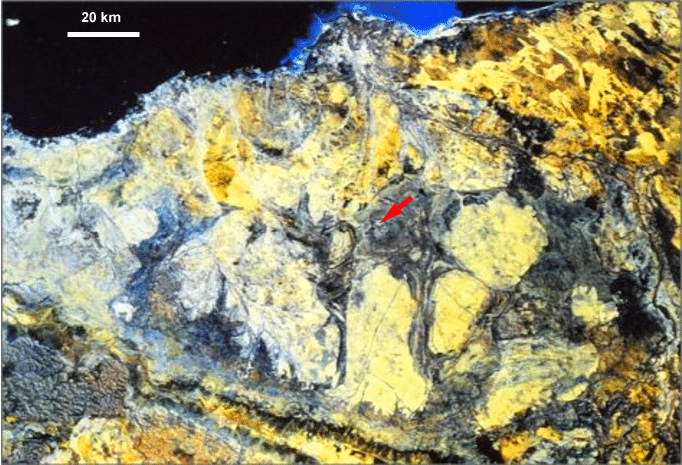
Landsat image mosaic of the Palaeoarchaean granite-greenstone terrain of the Pilbara Craton, Western Australia. Granite bodies show as pale blobs, the volcanic and sedimentary greenstone belts in shades of grey. The site of Kirkland et al.’s study site is at the tip of the red arrow

The frequency of impact craters falls off with age, most having formed in the last ~550 million years (Ma) during the Phanerozoic Eon, only 25 being known from the Precambrian, which spanned around 88 percent of geological time. That is largely a consequence of the dynamic processes of tectonics, erosion and sedimentation that may have obliterated or hidden a larger number. Earth is unique in that respect, the surfaces of other rocky bodies in the Solar System showing vastly more. The Moon is a fine example, especially as it has been Earth’s companion since it formed 4.5 billion years ago (Ga) after the proto-Earth collided with a now vanished planet about the size of Mars. The relative ages of lunar impact structures combined with radiometric ages of the surfaces that they hit has allowed the frequency of collisions to be assessed through time. Applied to the sizes of the craters such data can show how the amount of kinetic energy inflicted on the lunar surface has changed with time. During what geologists refer to as the Hadean Eon (before 4 Ga), the moon underwent continuous bombardment that reached a crescendo between 4.1 and about 3.8 Ga. Thereafter impacts tailed off. Always having been close to the Moon, the Earth cannot have escaped the flux of objects experienced by the lunar surface. Because of Earth’s much greater gravitation pull it was probably hit by more objects per unit area. Apart from some geochemical evidence from Archaean rocks (see: Tungsten and Archaean heavy bombardment; July 2002) and several beds of 3.3 Ga old sediment in South Africa that contain what may have been glassy spherules there are no signs of actual impact structures earlier than a small crater dated at around 2.4 Ga in NE Russia.

Shatter cones in siltstone near Marble Bar in the Pilbara Province: finger for scale. Credit: Kirkland et al.; Fig 2a

Now a group of geologists from Curtin University, Perth Western Australia, and the Geological Survey of Western Australia have published their findings of indisputable signs of an impact site in the northern part of Western Australia (Kirkland, C.L. et al. 2025. A Paleoarchaean impact crater in the Pilbara Craton, Western Australia. Nature Communications, v. 16, article 2224; DOI: 10.1038/s41467-025-57558-3). In fact there is no discernible crater at the locality, but sedimentary strata show abundant evidence of a powerful impact in the form of impact-melt droplets in the form of spherules together with shatter cones. These structures form as a result of sudden increase in pressure to 2 to 30 GPa: an extreme that can only be generated in underground nuclear explosions, and thus likely to bear witness to large asteroid impacts. The shocked rocks are immediately overlain by pillow lavas dated at 3.47 Ga, making the impact the earliest known. It has been speculated that impacts during the Archaean and Hadean Eons helped create conditions for the complex organic chemistry that eventually to the first living cells. Considering that entry of hypervelocity asteroids into the early Earth’s atmosphere probably caused such compression that temperatures were raised by adiabatic heating to about ten times that of the Sun’s surface, their ‘entry flashes’ would have sterilised the surface below; the opposite of such notions. Impacts may, however, have delivered both water and simple, inorganic hydrocarbons. Together with pulverisation of rock to make ‘fertiliser’ elements (e.g. K and P) more easily dissolved, they may have had some influence. Their input of thermal energy seems to me to be of little consequence, for decay of unstable isotopes of U, Th and K in the mantle would have heated the planet quite nicely and continuously from Year Zero onwards.

A fully revised edition of Steve Drury’s book Stepping Stones: The Making of Our Home World can now be downloaded as a free eBook

Bone tools widened hominins foraging options 1.5 Ma ago

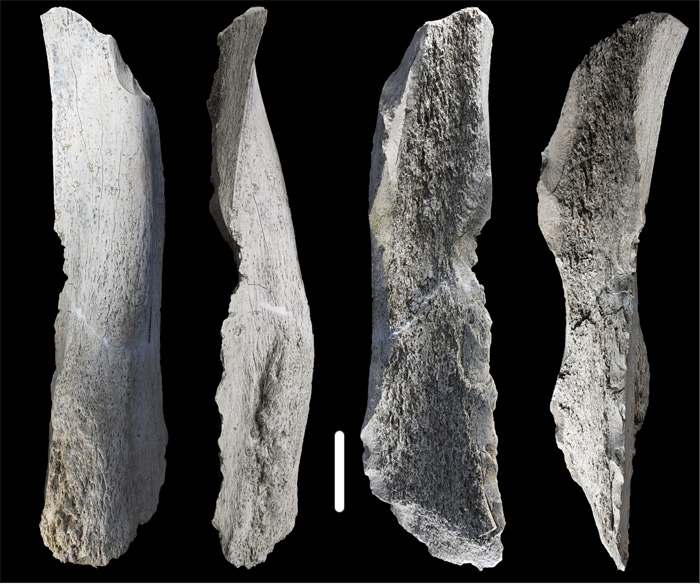
Hominins have been making and using stone tools since at least 3.4 Ma, as shown by cut marks on bones and stone artefacts themselves. I use the sack term ‘hominin’ because the likely makers and users of the oldest tools are either australopithecines or paranthropoids, there being no fossils designates to the genus Homo of late-Pliocene age. So it might seem  un-newsworthy to report that the oldest tools deliberately made from bone are now known to occur in 1.5 Ma old sediments from the famous sedimentary sequence at Olduvai Gorge in Tanzania (de la Torre, I and 8 others2025. Systematic bone tool production at 1.5 million years ago. Nature, v. 639; DOI: 10.1038/s41586-025-08652-5). To be clear, there is abundant evidence that hominins had used bones, especially sturdy long bones, for digging perhaps, much earlier in hominin history. Again, paranthropoids have been implicated in their use. The bones found at Olduvai actually show signs of manufacture into useful objects prior to their use: they show clear signs of knapping to produce points and blades. The bones are among the sturdiest known from the Pleistocene, being from elephants and hippos. Before de la Torre and colleagues found what is essentially a bone-tool factory, it was thought that systematic use of bones in such a sophisticated manner only arose between 400 to 250 ka ago among early Homo in Europe. Sadly, fossils of whoever made the tools were not found at the site. Once again, paranthropoids as well as early Homo  are known to have cohabited the area at that time.

‘Front, back and side’ views of a 1.5 Ma old tool made from an elephant humerus – its upper foreleg. The scale bar represents 5 cm. (Credit: de la Torre et al.; Fig 3a)

Bifacial Acheulean stone artefacts first appear in the rock record about 300 ka before these bone tools were made. So one idea that the authors put forward is that the same kind of stone knapping technique was transferred to the more abundant massive bones of the East African Pleistocene megafauna (in the absence or rarity of suitable blocks of stone?). But it remains unclear whether or not such tools were simply selected from very large bones smashed to get at their nutritious marrow. The first possibility implies a cultural shift, whereas the latter points simply to expedience. The authors are at pains to point out that the curious million-year gap in the record of bone tools may be ascribed either to the disappearance of bone technology or simply to archaeologists who worked elsewhere having not regarding bone fragments as the products of skills. That applies equally to earlier times, when bones were indeed used, though with not so much in the way of a ‘mental template’. As de la Torre et al. conclude ‘Future research needs to investigate whether similar bone tools were already produced in earlier times, persisted during the Acheulean and eventually evolved into Middle Pleistocene bone bifaces similar in shape, size and technology to their stone counterparts’.

Direct measurements of ancient atmospheric composition

For decades, research into the composition of the Earth’s early atmosphere depended on indirect means. An example is the preservation of water-worn grains of sulphides and uranium oxides in coarse terrestrial sediments older than about 2,200 Ma. Their survival on the continental surface suggested that the atmosphere before then had vanishingly low O2. Such grains would have otherwise been broken down by oxidation reactions. Younger sediments simply do not contain such detrital grains. This suggested the appearance of an oxidising atmosphere around 2.2 Ga ago: the Great Oxygenation Event. The greenhouse gases – carbon dioxide and methane – are also difficult to estimate directly, especially in the Precambrian. Once plants colonised the land surface, their photosynthesis depended on inhaling and exhaling air through stomata on the surface of leaves (see: Ancient CO2 estimates worry climatologists; January 2017). The number of stomata per unit area of a leaf surface is expected to increase with lowering of atmospheric CO2 and vice versa, which has been observed in plants grown in different air compositions. By comparing stomatal density in fossilised leaves of modern plants back to 800 ka allows the change to be calibrated against the record of CO­2 inside air bubbles trapped in ice-cores. This proxy method has given a guide to CO2 variations through the Cenozoic, Mesozoic and upper Palaeozoic Eras. However, the reliability of extinct plant leaves as proxies is suspect.

A fluid inclusion (about 0.2 mm) trapped in a crystal of halite (NaCl). Credit: alchetron.com

Is it possible to find air trapped by other means than in glacial ice? It may be. Tiny pockets of liquid and gas – fluid inclusions – are often found in minerals that crystallised at the Earth’s surface. The most common are crystals of salt (NaCl) and carbonates from ancient lake deposits. A 2019 study revealed that Late Triassic carbonates from Colorado, USA record an increase of atmospheric oxygen levels from 15 to 19% about 215 Ma ago over a period of just 3 million years as dinosaurs first spread into North America, then at equatorial latitudes in the Pangaea supercontinent. This sudden increase in the availability of oxygen may also be linked to the trend towards larger and larger dinosaurs worldwide.  Going further back in time trace-metal chemistry of 1,400 Ma old marine sediments from China indicates oxygenated water that suggests an atmospheric oxygen level greater than 4% of that at present. Small as that might seem, it would have been sufficient to sustain animal respiration about half a billion years before the first evidence for the earliest animals. Further work on ancient salt and carbonate deposits confirms much higher oxygen levels  than geochemists have expected previously.

Source: Voosen, P, 2025. Earth’s rocks hold whiffs of air from billions of years ago. Science, v.387, articlezhst73x; DOI: 10.1126/science.zhst73x

Life’s origins: a new variant on Darwin’s “warm little pond”

In 1871 Charles Darwin wrote to his friend Joseph Hooker, a botanist:

“It is often said that all the conditions for the first production of a living organism are now present, which could ever have been present. But if (& oh what a big if) we could conceive in some warm little pond with all sorts of ammonia & phosphoric salts, light, heat, electricity &c present, that a protein compound was chemically formed, ready to undergo still more complex changes, at the present day such matter wd be instantly devoured, or absorbed, which would not have been the case before living creatures were formed.”

There have been several attempts over the last 150 years, starting with Miller and Urey in 1952, to create physical analogues for this famous insight (See:  The origin of life on Earth: new developments). What such a physico-chemical environment on the early Earth could have been like has also been a fertile topic for discussion: literally warm pools at the surface; hot springs; seawater around deep-ocean hydrothermal vents; even droplets in clouds in the early atmosphere. Attention has recently moved to Darwin’s original surface pools through examination of modern ones. The most important content would be dissolved phosphorus compounds, because that element helps form the ‘backbone’ of the helix structure of RNA and DNA. But almost all natural waters today have concentrations of phosphorus that are far too low for such linkages to form by chemical processes, and also to produce lipids that form cell membranes and the ATP (adenosine triphosphate) so essential in all living metabolism. Phosphorus availability has been too low for most of geological time simply because living organisms are so efficient at removing what they need in order to thrive.

Mono Lake in semi-arid eastern California – a ‘soda lake’- is so concentrated by evaporation that pillars of carbonate grow above its surface

For the first life to form, phosphorus would somehow have had to be concentrated in watery solution as phosphate ions – [PO ₄]³⁻. The element’s source, like that of all others in the surface environment, is in magmas and the volcanic rocks that they form. Perhaps early chemical weathering or reactions between lavas and hydrothermal fluids could have released phosphate ions to solution from a trace mineral present in all lavas: the complex phosphate apatite (Ca10(PO4)6(OH,F,Cl)2). But that would still require extreme concentration for it to be easily available to the life-forming process. In January 2024 scientists at the University of Washington in Seattle, USA (Haas, S. et al. 2024. Biogeochemical explanations for the world’s most phosphate-rich lake, an origin-of-life analog. Nature Communications, v. 5, article 28; DOI: 10.1038/s43247-023-01192-8) showed that the highest known concentrations of dissolved phosphorus occur in the so called “soda lakes” that are found in a variety of modern environments, from volcanically active continental rifts to swampy land. They contain dissolved sodium carbonate (washing soda) at very high concentrations so that they are extremely alkaline and often highly salty. Usually, they are shallow and have no outlet so that dry weather and high winds evaporate the water. Interestingly, the streams that flow into them are quite fresh, so soda lakes form where evaporation exceeds annual resupply of rainwater.

The high evaporation increases the dissolved content of many ions in such lakes to levels high enough for them for them to combine and precipitate calcium, sodium and magnesium as carbonates. In some, but not all soda lakes, such evaporative concentration also increases their levels of dissolved phosphate ions higher than in any other bodies of water. That is odd, since it might seem that phosphate ions should combine with dissolved calcium to form solid calcium phosphate making the water less P-rich.  Haas et al. found that lakes which precipitate calcium and magnesium together in the form of dolomite (Ca,Mg)CO3 have high dissolved phosphate. Removal of Ca and other metal ions through bonding to carbonate (CO3) deprives dissolved phosphate ions in solution of metal ions with which they can bond. But why has dissolved phosphate not been taken up by organisms growing in the lakes: after all, it is an essential nutrient. The researchers found that some soda lakes that contain algal mats have much lower dissolved phosphate – it has been removed by the algae. But such lakes are not as salty as those rich in dissolved phosphate. They in turn contain far less algae whose metabolism is suppressed by high levels of dissolved NaCl (salt). Hass et al.’s hypothesis has now been supported by more research on soda lakes.

In an early, lifeless world phosphate concentrations in alkaline, salty lakes would be controlled by purely inorganic reactions. This strongly suggests that ‘warm little soda lakes’ enriched in dissolved sodium carbonate by evaporation, and which precipitated dolomite could have enabled phosphorus compounds to accumulate to levels needed for life to start. They might have been present on any watery world in the cosmos that sustained volcanism.

See also: Service, R.F. 2025. Early life’s phosphorus problem solved? Science, v. 387, p. 917; DOI: 10.1126/science.z78227f; Soda Lakes: The Missing Link in the Origin of Life? SciTechDaily, 26 January 2024. .

A fully revised edition of Steve Drury’s book Stepping Stones: The Making of Our Home World can now be downloaded as a free eBook