Over the last few decades improved analytical techniques have made it possible to analyse tiny mineral grains for a variety of trace elements and several isotopes. Zircons obtained directly from crushed granitic igneous rocks vary in chemistry according to the magmatic processes that generated them and their tectonic context. Elevated ratios between uranium and niobium (U/Nb) and scandium and ytterbium (Sc/Yb) are characteristic of zircons in intermediate granites. These contain 52 to 63 % SiO2 – between mafic and felsic magmas – which formed by melting of hydrated mafic crust in settings akin to modern continental arcs; i.e. in subduction zones. But such partial melting can also take place where the base of continental crust delaminates and ‘drips’ into the mantle. That process is part of what is known as stagnant lid tectonics, believed by many to have been important in the Palaeoarchaean and Hadean. Such a process would have involved nearly anhydrous conditions and thus different geochemical partitioning of elements in the magmas and minerals that crystallised from them. Exposures of crystalline continental crust become increasingly rare further back in geological time, and there are none older than 4.0 Ga – i.e. of Hadean age – with a granitic component. Consequently studying the generation of continental crust in the Hadean and the early Archaean is almost entirely dependent on ancient zircons that found their way into much younger sedimentary rocks. The most famous of these occur as detrital grains in the 3.6 Ga Jack Hills conglomerate of Western Australia. Others have been extracted from similar ~3.3 Ga sedimentary rocks in the Barberton Greenstone Belt of South Africa and Eswatini.
Cartoon of possible Hadean stagnant lid tectonics, dominated by mantle plumes. (Credit: Bédard, J.H. 2018, Fig 3B, DOI: 10.1016/j.gsf.2017.01.005)
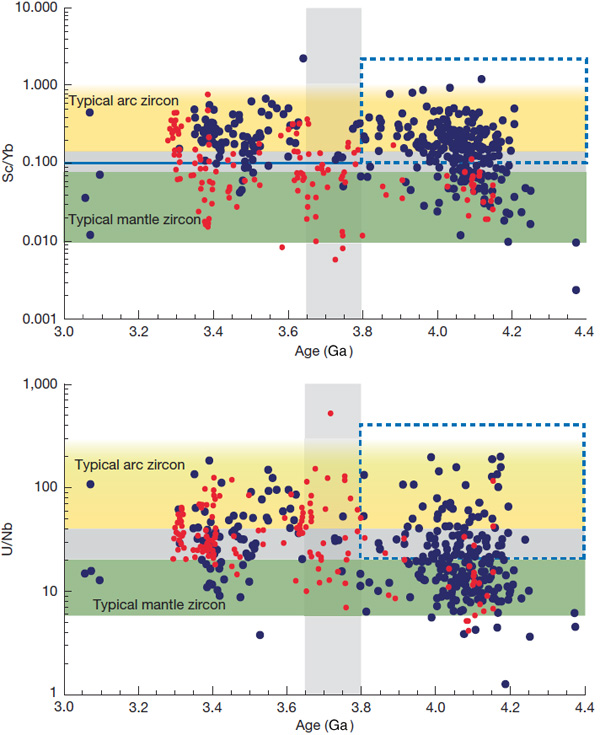
John Valley of the University of Wisconsin-Madison, USA, and co-workers from the US, Germany, Australia and France have worked on a large number of zircons newly extracted from Jack Hills. They have radiometrically dated them, and analysed Nb, Sc, U and Yb trace elements and hafnium (Hf) and oxygen isotopes Together with data from earlier studies, including Barberton zircons, they have teased out some remarkable insights into ‘continent-forming’ magmatism as far back in time as 4.4 billion years ago (Valley, J.W. and 11 others 2026. Contemporaneous mobile- and stagnant-lid tectonics on the Hadean Earth. Nature, Open access; DOI: 10.1038/s41586-025-10066-2). More than 70% of the >4.0 Ga Jack Hills zircons have elevated U/Nb and Sc/Yb ratios, which suggest that they formed in a setting akin to continental-arc subduction (CAS) zones, to produce now-vanished Hadean continental crust. The remainder seem to represent processes at mid-ocean ridge (MOR) and oceanic island (OI) settings. In contrast, the bulk of Barberton zircons of Hadean age show OI affinities, with only around 22% showing Nb–Sc–U–Yb signatures of probable CAS origins. From about 4.4 to 3.8 Ga two distinct forms of continental crust generation seem to have operated on Earth. In the erosional source region for the Barberton zircons their host granites seem to have formed during the Hadean and Eoarchaean by remelting of foundered lower crust, i.e. probably in a stagnant-lid-like tectonic setting. But at around 3.6 Ga they ‘flip’ to a subduction-like setting. The zircons yielded by Jack Hills conglomerates suggest substantially different conditions: alternating CAS and OI settings during the Hadean and a fall-off in crust generation during the Eoarchaean (4.0 to 3.8 Ga).
Plots of Sc/Yb and U/Nb against ages of zircons (vertical scale logarithmic). Black points are from Jack Hills, red from Barberton. The yellow field represents zircons formed in subduction zones; green suggests stagnant lid tectonics; grey the overlap between the two settings. Credit: Valley et al. Fig 3 a and b.
The mixed Hadean zircon signatures from Jack Hills possibly indicate that they were derived by erosion and transport from several distinct terranes that had been generated by two different processes: some kind of upper crustal recycling and stagnant lid tectonics. Meanwhile, that part of the Hadean Earth represented by the Barberton zircons may have been a long-lived regime of stagnant lid tectonics, replaced by dominant subduction at the end of the Eoarchaean. Yet the data suggest that into the Palaeoarchaean (3.6 to 3.2 Ga) and perhaps later, lid tectonics continued to operate somewhere, but at no time after 4.4 Ga was the Earth entirely subject to lid tectonics. Likewise, the authors insist that subduction was not of the plate-tectonic style, referring to some form of recycling of hydrated upper crustal mafic and ultramafic rocks into the mantle to undergo partial melting. Plate tectonics as we know it probably developed later in the Archaean. The early Earth had much higher heat flow than in later times, and thus the lithosphere was more ductile rather than brittle. The essence of modern tectonics is a series of rigid plates that extend down to the asthenosphere. When they deform it is largely through brittle failure of the entire lithosphere.
Much of the Archaean Eon is represented by cratons, which occur at the core of continental parts of tectonic plates. Having low geothermal heat flow they are the most rigid parts of the continental crust. The Superior Craton is an area that makes up much of the eastern part of the Canadian Shield, and formed during the Late Archaean from ~4.3 to 2.6 billion years (Ga) ago. Covering an area in excess of 1.5 million km2, it is the world’s largest craton. One of its most intensely studied components is the Abitibi Terrane, which hosts many mines. A granite-greenstone terrain, it consists of volcano-sedimentary supracrustal rocks in several typically linear greenstone belts separated by areas of mainly intrusive granitic bodies. Many Archaean terrains show much the same ‘stripey’ aspect on the grand scale. Greenstone belts are dominated by metamorphosed basaltic volcanic rock, together with lesser proportions of ultramafic lavas and intrusions, and overlying metasedimentary rocks, also of Archaean age. Various hypotheses have been suggested for the formation of granite-greenstone terrains, the latest turning to a process of ‘sagduction’. However the relative flat nature of cratonic areas tells geologists little about their deeper parts. They tend to have resisted large-scale later deformation by their very nature, so none have been tilted or wholly obducted onto other such stable crustal masses during later collisional tectonic processes. Geophysics does offer insights however, using seismic profiling, geomagnetic and gravity surveys.
The Geological Survey of Canada has produced masses of geophysical data as a means of coping with the vast size and logistical challenges of the Canadian Shield. Recently five Canadian geoscientists have used gravity data from the Canadian Geodetic Survey to model the deep crust beneath the huge Abitibi granite-greenstone terrain, specifically addressing variations in its density in three dimensions. They also used cross sections produced by seismic reflection and refraction data along 2-D survey lines (Galley, C. et al. 2025. Archean rifts and triple-junctions revealed by gravity modeling of the southern Superior Craton. Nature Communications, v. 16, article 8872; DOI: 10.1038/s41467-025-63931-z). The group found that entirely new insights emerge from the variation in crustal density down to its base at the Moho (Mohorovičić discontinuity). These data show large linear bulges in the Moho separated by broad zones of thicker crust.
Geology of the Abitibi Terrane (upper),; Depth to the Moho beneath the Abitibi Terrane with rifts and VMS deposits superimposed (lower). Credit: After Galley et al. Figs 1 and 5.
Galley et al. suggest that the zones are former sites of lithospheric extensional tectonics and crustal thinning: rifts from which ultramafic to mafic magmas emerged. They consider them to be akin to modern mid-ocean and continental rifts. Most of the rifts roughly parallel the trend of the greenstone belts and the large, long-lived faults that run west to east across the Abitibi Terrain. This suggests that rifts formed under the more ductile lithospheric condition of the Neoarchaean set the gross fabric of the granites and greenstones. Moreover, there are signs of two triple junctions where three rifts converge: fundamental features of modern plate tectonics. However, both rifts and junctions are on a smaller scale than those active at present. The rift patterns suggest plate tectonics in miniature, perhaps indicative of more vigorous mantle convection during the Archaean Eon.
There is an interesting spin-off. The Abitibi Terrane is rich in a variety of mineral resources, especially volcanic massive-sulfide deposits (VMS). Most of them are associated with the suggested rift zones. Such deposits form through sea-floor hydrothermal processes, which Archaean rifting and triple junctions would have focused to generate clusters of ‘black smokers’ precipitating large amounts of metal sulfides. Galley et al’s work is set to be applied to other large cratons, including those that formed earlier in the Archaean: the Pilbara and Kaapvaal cratons of Australia and South Africa. That could yield better insights into earlier tectonic processes and test some of the hypotheses proposed for them
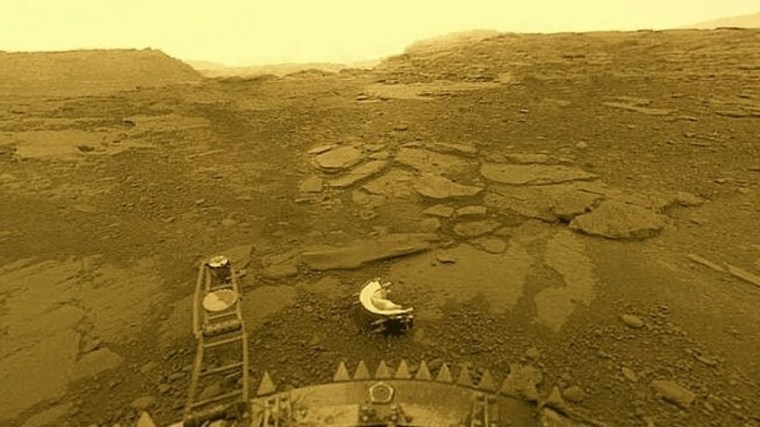
The surface of Venus from the USSR Venera 14 lander
It is often said that Earth has a twin: Venus, the second planet from the Sun. That isn’t true, despite the fact that both have similar size and density. Venus, in fact, is even more inhospitable that either Mars or the Moon, having surface temperatures (~465°C) that are high enough to melt lead or, more graphically, those in a pizza oven. The only vehicles successfully to have landed on Venus (the Russian Venera series) survived for a mere 2 hours, but some did did send back data and images. That near incandescence is masked by the Venusian atmosphere that comprises 96.5% carbon dioxide, 3.5% nitrogen and 0.05 % sulfur dioxide, with mere traces of other gases including extremely low amounts of water vapour (0.002%) and virtually no oxygen. The dense atmosphere imposes a pressure at Venus’s surface tht is 92 times that on Earth: so dense that CO2 and N2 are, strictly speaking, not gases but supercritical fluids at the surface. At present Venus is definitely inimical to any known type of life. It is the victim of an extreme, runaway greenhouse effect.
As it stands, Venus’s geology is also very different from that of the Earth. Because its upper atmosphere contains clouds of highly reflective sulfuric acid aerosols only radar is capable of penetrating to the surface and returning to have been monitored by a couple of orbital vehicles: Magellan (NASA 1990 to 1994) and Venus Express (European Space Agency 2006 to 2014). The latter also carried means of mapping Venus’s surface gravitational field. The radar imagery shows that 80% of the Venusian surface comprises somewhat wrinkled plains that suggests a purely volcanic origin. Indeed more that 85,000 volcanoes have been mapped, 167 of which are over 100 km across. Much of the surface appears to have been broken into polygonal blocks or ‘campuses’ (campus is Latin for field) that give the impression of ‘crazy paving’. A peculiar kind of local-scale tectonics has operated there, but nothing like the plate tectonics on Earth in either shape or scale.
Polygonal blocks or ‘campuses’ on the lowland surface of Venus. Note the zones of ridges that roughly parallel ‘campus’ margins. Credit: Paul K. Byrne, North Carolina State University and Sean C. Solomon, Lamont-Doherty Earth Observatory
Many of the rocky bodies of the solar system are pocked by impact craters – the Earth has few, simply because erosion and sedimentary burial on the continents, and subduction of ocean floors have removed them from view. The Venusian surface has so few that it can, in its entirety, be surmised to have formed by magmatic ‘repaving’ since about 500 Ma ago at least. Earlier geological process can only be guessed at, or modelled in some way. A recent paper postulates that ‘there are several lines of evidence that suggest that Venus once did have a mobile lithosphere perhaps not dissimilar to Earth …’ (Weller, M.B. & Kiefer, W.S. 2025. The punctuated evolution of the Venusian atmosphere from a transition in mantle convective style and volcanic outgassing. Science Advances, v. 11, article eadn986; DOI: 10.1126/sciadv.adn986). One large, but subtle feature may have formed by convergence similar to that of collision tectonics. There are also gravitational features that hint at active subduction at depth, although the surface no longer shows connected features such as trenches and island arcs. Local extension has been inferred from other data.
Weller and Kiefer suspect that Venus in the past may have shifted between a form of mobile plate tectonics and stagnant ‘lid’ tectonics, the vast volcanic plains having formed by processes akin to flood volcanism on a planetary scale. Venus’s similar density to that of Earth suggests that it is made of similar rocky material surrounding a metallic core. However, that planet has a far weaker magnetic field suggesting that the core is unable to convect and behave like a dynamo to generate a magnetic field. That may explain why the atmosphere of Venus is almost completely dry. With no magnetic field to deflect it the solar wind of charged particles directly impacts the upper atmosphere, in contrast to the Earth where only a very small proportion descends at the poles. Together with the action of UV solar radiation that splits water vapour into its constituent hydrogen and oxygen ions, the solar wind adds energy to them so that they escape to space. This atmospheric ‘erosion’ has steadily stripped the atmosphere of Venus – and thus its solid surface – of all but a minute trace of water, leaving behind higher mass molecules, particularly carbon dioxide, emitted by its volcanism. Of course, this process has vastly amplified the greenhouse effect that makes Venus so hot. Early on the planet may have had oceans and even primitive life, which on Earth extract CO2 by precipitating carbonates and by photosynthesis, respectively. But they no longer exist.
The high surface temperature on Venus has made its internal geothermal gradient very different from Earth’s; i.e. increasing from 465°C with depth, instead of from about 15°C on Earth. As a result, everywhere beneath the surface of Venus its mantle has been more able to melt and generate magma. Earlier in its history it may have behaved more like Earth, but eventually flipped to continual magmatic ‘repaving’. To investigate how this evolution may have occurred Weller and Kiefer created 3-D spherical models of geological activity, beginning with Earth-like tectonics – a reasonable starting point because of the probable Earth-like geochemistry of Venus. My simplified impression of what they found is that the periodic blurting of magma well-known from Earth history to have created flood-basalt events without disturbing plate tectonics proceeded on Venus with progressively greater violence. Such events here emitted massive amounts of CO2 into the atmosphere over short (~1 Ma) time scales and resulted in climate change, but Earth’s surface processes have always returned to ‘normal’. Flood-basalt episodes here have had a rough periodicity of around 35 Ma. Weller and Kiefer’s modelling seems to suggest that such events on Venus may have been larger. Repetition of such events, which emitted CO2 that surface processes could not erase before the next event, would progressively ramp up surface temperatures and the geothermal gradient. Eventually climatic heating would drive water from the surface into the atmosphere, to be lost forever through interaction with the solar wind. Without rainfall made acid by dissolved CO2, rock weathering that tempers the greenhouse effect on Earth would cease on Venus. The increased geothermal gradient would change any earlier rigid, Earth-like lithosphere to more ductile material, thereby shutting down the formation of plates, the essence of tectonics on Earth. It may have been something along those lines that made Venus inimical to life, and some may fear that anthropogenic global warming here might similarly doom the Earth to become an incandescent and sterile crucible orbiting the Sun. But as Mark Twain observed in 1897 after reading The New York Herald’s account that he was ill and possibly dying in London, ‘The report of my death was an exaggeration’. It would suit my narrative better had he said ‘… was premature’!
The Earth has a very large Moon because of a stupendous collision with a Mars-sized planet shortly after it accreted. That fundamentally reset Earth’s bulk geochemistry: a sort of Year Zero event. It endowed both bodies with magma oceans from which several tectonic scenarios developed on Earth from Eon to Eon. There is no evidence that Venus had such a catastrophic beginning. By at least 3.7 billion years ago Earth had a strong magnetic field. Protected by that thereafter from the solar wind, it has never lost its huge endowment of water; solid, liquid or gaseous. It seems that it did go through a stagnant lid style of tectonics early on, that transitioned to plate tectonics around the end of the Hadean Eon (~4.0 Ga), with a few hiccups during the Archaean Eon. And it did develop life as an integral part of the rock cycle. Venus, fascinating as it is, shows no sign of either, and that’s hardly surprising. Those factors and its being much closer to the Sun may have condemned it from the outset.
A fully revised edition of Steve Drury’s book Stepping Stones: The Making of Our Home World can now be downloaded as a free eBook
The theory of plate tectonics had a long gestation. Continental drift, one of its central tenets, was first proposed by the meteorologist Alfred Wegener in 1912. Apart from a few enthusiasts of such a dynamic aspect of geology, such as Alex du Toit and Arthur Holmes, the majority of geoscientists remained with the non-revolutionary fixist ideology of their Victorian predecessors. Wegener’s stumbling block was his proposed driving mechanism – polflucht (flight from the poles) – which assumed that supercontinents had formed in polar regions to be subject to centrifugal force resulting from Earth’s rotation. This broke them apart to be driven towards the Equator. Such a mechanism being easily invalidated, most contemporary geologists preferred to ‘throw Wegener’s baby out with the bathwater’. Yet every piece of his evidence that continents had moved around and most of his ideas about the nature of their movements were steadily verified and amplified over the next six decades, which attracted more curious and flexible scientists. What is now the central paradigm of the Earth Sciences had to wait for a set of major discoveries in the 1950s and ‘60s enabled by emerging technologies, such as the magnetometers used by Fred Vine and Drummond Matthews to discover sea-floor magnetic striping and thus sea-floor spreading. Their breakthrough presented a plausible mechanism for continental drift and launched a near frenzy of collaborative research among a global milieu of young geoscientists, one of whom being W. Jason Morgan.
W. Jason Morgan outside the Department of Earth Sciences, Princeton University. (Credit: Denise Applewhite, Princeton University)
His initial interest was in the great fracture zones on the floors of the Atlantic and Pacific Oceans. He grasped that each of them was very nearly a great circle. This was a central key to unifying seafloor spreading and continental drift – to move across a spherical surface every point on the seafloor had to follow such a path. Morgan recognised that the fracture zones could only result from rigid plates having to fracture to accommodate that motion. Using spherical geometry he was able to link together ridges, trenches and these huge transform faults with poles of rotation and triple junctions to predict plate motions in a quantitative manner. That insight provided a key to active earthquakes, mountain belts and volcanoes. His scientific unification was a result of genius: in just a few weeks Morgan established the fundamentals of what became known as plate tectonics.
W. Jason Morgan was one of the revolutionaries who made geology dynamic and launched its resurrection from the boring province of damp field workers in anoraks tramping across tracts of extremely puzzling rocks and structures, noses to the ground. He died at the age of 87 on 31 July 2023.
A central feature of the Earth’s climate system is the way that carbon bound in two gases – carbon dioxide (CO2) and methane (CH4) – controls the amount of incoming solar energy that is retained by the atmosphere. Indeed, without one or the other our home world would have been locked in frigidity since shortly after its formation: a sterile, ice-covered planet. The ‘greenhouse effect’ has been ever-present because the material from which the Earth accreted contained carbon as well as every other chemical element from hydrogen to uranium. Naturally reactive, it readily combines with hydrogen and oxygen to form methane and carbon dioxide, which would have escaped the inner Earth as gases to enter the earliest atmosphere as a ‘comfort blanket’, along with water vapour, another greenhouse gas. Their combined effects have remained crudely balanced so that neither inescapable frigidity nor surface temperatures high enough to boil-off the oceans have ever occurred in the last 4.5 billion years. Earth has remained like the wee bear’s porridge in the Goldilocks story! Even so, global climate has fluctuated again and again from that akin to a steamy greenhouse, through long periods of moderation to extensive glacial conditions, including three that extended from pole-to-pole – ‘Snowball’ Earths – during in the Precambrian. During the Phanerozoic the Earth has entered three long periods of generally low global temperatures, in the Ordovician, the Carboniferous and during the last 2.5 Ma that allowed polar ice caps and sea-ice to extend a third of the way to the Equator. These were forced back and forth repeatedly by cyclical influences apparently triggered by astronomically controlled changes to Earth’s orbital and rotational parameters – the Milankovich Effect. Anthropogenic emissions of greenhouse gases in vast and increasing amounts now threaten to disrupt natural climate variation, effectively overthrowing the gravitational influences of distant giant planets that have controlled climate changes that shaped our own evolution since the genus Homo first emerged.
Bubbles of air trapped in cores through the ice sheets of Antarctica and Greenland record decreased volumes of land ice as CO2 content increased and the opposite during glacial episodes. Somehow in step with the astronomical forcing the Earth released greenhouse gas to warm the climate and drew it down to bring on cooling. Since all life forms are built from carbon-rich compounds and some extract it from the environment to build carbonate hard parts, climate and life on land and in the oceans are interlinked. In fact life and death are involved, because once dead organisms and their hard parts are buried before being oxidised in sediments on land, as in peat and ultimately coal, and on the ocean floors as limestones or carbonaceous mudstones, atmospheric carbon is sequestered. Exposed to acid water containing dissolved CO2 from the atmosphere or to oxygen, respectively, the two forms of carbon in solid form are released as greenhouse gas once more. Both take place when sedimentary deposits are exhumed as a result of erosion and tectonics. Another factor is the abundance of available nutrients, themselves released and distributed by erosion and agents of transportation. At present surface waters of the most distant parts of the oceans contains plenty of such nutrients, except for a vital one, dissolved iron. So they are wet ‘deserts’. It seems that during the much dustier times of glacial episodes iron in fine form reached far out into the world’s oceans so that phytoplankton at the base of the food chain ‘bloomed ‘and so did planktonic animals. Dead organisms ‘rained’ to the ocean floor so drawing down CO2 from the atmosphere and decreasing the greenhouse effect. The surface parts of the carbon and rock cycles are extremely complex and climatologists have yet to come to grips with modelling its future climates convincingly. Yet the carbon cycle and much deeper parts of the rock cycle are interwoven too.
Carbon in sedimentary rock can be heated by burial, and some can be subducted to great depths at destructive plate margins together. The same applies to in ocean-floor basalts that have been permeated by circulating sea water through hydrothermal circulation to form carbonates in the altered volcanic rock. In both cases carbon stored for hundreds of million years can be released by metamorphism in orogenic belts at zones of continental collision and deep below island arcs. Carbon from mantle depths that has never ‘seen the light of day’ is also added to the atmosphere when magmas form below oceanic constructive margins, hot spots and subduction zones, and where magmas flood the continental surface. Consequently, plate tectonics and deep mantle convection have surely played a long-term role in the evolution of our planet’s climate system. Geoscientists based in Australia and the UK have used geochemical data to reconstruct the stores of carbon in oceanic plates and thermodynamic modelling to track what may have happened to it and the climate through the last 250 Ma (Müller, R.D. et al. 2022. Evolution of Earth’s tectonic carbon conveyor belt. Nature, v. 605, p. 629-639; DOI: 10.1038/s41586-022-04420-x). Their review is an important step in understanding what underpins climate on a geological time scale, onto which much shorter-term surface influences are superimposed.
The amount of carbon being outgassed as CO2 each year along plate boundaries in the early Jurassic (185 Ma) shown in dark purple (low) to yellow (high). Also shown in shades of blue is the accumulation of carbon stored in each square metre of the ocean plates. Plate motions are shown as grey arrows (credit: Müller, R.D. et al. Clip from video in Supplementary Information)
At mid-ocean ridges basaltic magma wells up from mantle depths and loses much of its content of dissolved CO2. The annual outgassing at ridges, which depends on the global rate of plate formation, has varied from 13 to 30 million tonnes of carbon (MtC yr-1) since the start of the Mesozoic Era 250 Ma ago. Similarly, there is greenhouse-gas escape from volcanic arcs above subduction zones, estimated to have ranged from 0 to 18 MtC yr-1. As an oceanic plate moves away from its source various processes sequester CO2 into the oceanic crust and upper mantle through accumulation of deep-sea sediments and hydrothermal alteration of basaltic crust and peridotite mantle (ranging from 30 to 311 MtC yr-1). Of this influx of carbon into oceanic plates between 36 to 103 MtC yr-1 has gone down subduction zones in descending slabs. Between 0 to 49 MtC yr-1 of that has been outgassed by arc volcanic activity or absorbed into the overriding plate. The rest continues down into the deep mantle, perhaps to form diamonds. Overall, when the rate at which oceanic plates grow is rapid and plate motion speeds up, outgassing should be high. When plate growth slows, so does the rate of CO2 release. Variations in plate growth can be estimated from the magnetic reversal stripes above the ocean floors. The authors have released an animation of the break-up of Pangaea (well worth watching at full screen – you can skip the ad at the start), with the rate of carbon emission at ridges and volcanic arcs being colour-coded. Also shown is the storage of carbon within oceanic plats plates as time passes.
Length of mid-ocean ridges (orange) and subduction zones (blue) through the last 250 Ma (top). The areas of oceanic crust produced at ridges and consumed by subduction (bottom) (credit: Müller, R.D. et al., Figs 1a, 1c)
Before Pangaea began to break up at the end of the Triassic (200 Ma) the total length of mid-ocean ridges was at a minimum of about 40 thousand km. Through the Jurassic it never exceeded 50,000 km, but rose to a maximum of 80,000 km during the Cretaceous then declined slowly to the current length of 60,000 km. Throughout the last 250 Ma the length of subduction zones stayed roughly the same at about 65 thousand km – not always in the same places – although the overall rate of subduction changed in line with the rate of oceanic plate growth (the volume that is added must be balanced roughly by the amount that returns to the mantle). Between the end of the Jurassic and the mid-Cretaceous crustal production and destruction doubled, shown by the bottom plot in the figure above. The very fast movement of plates and an increase in the global length of ridges during Jurassic to mid-Cretaceous times led to a dramatic increase in CO2 outgassing from ridges so that its content in the atmosphere rose as high as 1200 ppm – more than four times that before the Industrial Revolution. That level resulted in global ‘hothouse’ conditions during the Cretaceous. Another factor behind the Cretaceous climate was a decrease in the global complement of mountains. That led to decreases in erosion and the weathering of silicates by acid rain, thus reducing natural sequestration of carbon.
During the Cenozoic (after 65 Ma) declining ridge outgassing was actually outpaced by that associated with subduction, according to the modelling. That is strange, for by around 35 Ma glaciation had begun on Antarctica as the Earth was cooling, which implies a major, unexpected sink for excess CO2. The most likely way this might have arisen is through increased erosion and silicate weathering on the exposed continents that consumed CO2 faster than tectonics was releasing the gas. The length of continental arcs shows no sign of a major increase during the Cenozoic, which might have accelerated that kind of sequestration, but a variety of proxies for signs of weathering definitely suggests that there was an upsurge. Also there was increased storage of carbon on the deep ocean floor, shown by the video. Increased calcium released by weathering to enter ocean water in solution would allow more planktonic organisms to secrete calcite (CaCO3) skeletons that would then fall to the ocean floor when they died.
There may be more to be discovered in this hugely complex interplay between tectonics and climate. For instance, when the bottom waters of the oceans are oxygenated by deep currents of cold dense seawater sinking from polar regions, carbon in tissues of sunken dead organism is oxidised to release CO2. If bottom waters are anoxic, this organic carbon is preserved in sediments. The authors mention this as something to be considered in their future work on the ‘tectonic carbon conveyor belt’.
The surface of Venus is not easily observed because of the almost opaque nature of its atmosphere. The planet is veiled by a mixture of CO2 (96.5%) and nitrogen (3.5%), with a little sulfur dioxide and noble gases. The atmosphere’s mass is almost 100 times that of the Earth’s, and has a density about 6.5% that of liquid water at the surface. The opacity stems from a turbulent upper layer of mainly sulfuric acid. Venus is the victim of runaway greenhouse conditions. Despite that, radar can penetrate the atmosphere to reveal details of its surface morphology – roughness and elevation – at a spatial resolution of 150 m. Although coarser than that available from radar remote sensing of the Earth from orbit, the Magellan data are still geologically revealing.
Earlier interpretation of Venus radar images revealed the surface to be far simpler than that of the Earth, Mars and all other rocky bodies in the Solar System. Yet it has more volcanoes than does the Earth or Mars. However, despite being subject to very little erosion – Venus is a dry world – only around 1000 impact craters have been found: far short of the number seen on Mars or the Moon. This deficiency of evidence for bombardment suggests that Venus was ‘repaved’ by vast volcanic outpourings in the geologically recent past, estimated to have occurred 300 to 600 Ma ago. This early work concluded that plate tectonics was absent; indeed that for half a billion years the lithosphere on Venus had been barely deformed. It has been suggested that Venus has been involved in megacycles of sudden, planet-wide magmatic activity separated by long periods of quiescence. This could be attributed to the lack of plate tectonics, which is the principal means that Earth continuously rids itself of heat produced at depth by decay of radioactive isotopes in the mantle. Venus has been suggested to build up internal temperatures until they reach a threshold that launches widespread partial melting of its mantle. Planet-wide eruption of magma then reduces internal temperatures.
Polygonal blocks or ‘campuses’ on the lowland surface of Venus. Note the zones of ridges that roughly parallel ‘campus’ margins. Credit: Paul K. Byrne, North Carolina State University and Sean C. Solomon, Lamont-Doherty Earth Observatory
It comes as a surprise that 26 years after Magellan plunged into the Venusian atmosphere new interpretation of its radar images suggests a completely different scenario (it may be that academic attention generally switched to research on Mars because of all the missions to the ‘Red Planet’ since Magellan disappeared). It is based on features of the surface of Venus so large that their having been missed until now may be a planetary-scale example of ‘not seeing the woods for the trees’! Geoscientists from the US, Turkey, the UK and Greece have mapped out features ranging from 100 to 1000 km across that cover the lowland parts of Venus (Byrne, P.K. et al. 2021. A globally fragmented and mobile lithosphere on Venus. Proceedings of the National Academy of Science, v. 118, article e2025919118; DOI: 10.1073/pnas.2025919118). They resemble 1950s ‘crazy paving’ or floes in Arctic pack ice, but on a much larger scale. Extending the ice floe analogy, the polygonal blocks are separated by what resemble pressure ridges that roughly parallel the block margins. Paul Byrne of North Carolina State University, USA, and co-workers also found evidence that the large blocks of lithosphere had rotated and moved laterally relative to one another: they had ‘jostled’. Moreover, some of the movement has disturbed the youngest materials on the surface.
To distinguish what seem to be characteristic of Venus’s tectonics from Earthly tectonic plates, the team hit on the name ‘campus’, meaning ‘field’ in Latin. Rather than having remained a single spherical skin of lithosphere, the surface of at least part of Venus has broken into a series of ‘campuses’. It does display tectonics, but not as we know it on planet Earth. This could be ascribed to an outcome of stress transfer from deep convective motion in the Venerean mantle. Being in the virtually non-magmatic phase of Venus’s thermal cycling, there is neither formation of new lithosphere nor subduction of old, cold plates that characterise terrestrial plate tectonics. ‘Campus’ tectonics seems likely to be another form of planetary energy and matter redistribution, and Byrne et al. have likened it to how the Earth may have functioned during the ‘missing’ 600 Ma of the Hadean Eon on Earth. But perhaps not …
The runaway greenhouse has resulted in surface temperatures on Venus being 450°C higher than on Earth: enough to melt lead. It is not just solar heat that is trapped by the atmosphere, but that from the Venerean interior. This must result in a very different geotherm (the way temperature varies with depth in a planet) from that characterising the Earth. The temperature of the beginning of mantle melting – about 1200°C – must be much shallower on Venus. On Earth that is at depths between 50 and 100 km below active plate margins and within-plate hotspots, and is not reached at all for most of the Earth that lies beneath the tectonic plates. If the mantle of Venus contained a similar complement of heat-producing isotopes to that of Earth wouldn’t we expect continual volcanism on Venus rather than the odd dribble that has been observed by Magellan? Or does the jostling of ‘campuses’ absorb the thermal energy and help direct it slowly to space by radiation through the dense, greenhouse atmosphere. Here’s another poser: If the Earth and Venus are geochemically similar and Hadean Earth went through such a phase of ‘campus tectonics’ – perhaps our world had a CO2-rich atmosphere too – what changed to allow plate tectonics here to replace that system of thermal balance? And, why hasn’t that happened on Venus? Perhaps some light will be thrown on these enigmas once a series of new missions to Venus are launched between now and the 2030s, by NASA and the European Space Agency.
‘Everybody knows’ that mountains grow: the question is, ‘How?’ There is a tale that farmers once believed that they grew from pebbles: ‘every year I try to rid my field of stones, but more are back the following year, so they must grow’… Geoscientists know better – or so they think[!] – and for 130 years have referred to ‘orogeny’, a classically-inspired term (from the Ancient Greek óros and geneia – high-ground creation’) adopted by the US geologist Grove Gilbert. It incorporates the concept of crustal thickening that results from lateral forces and horizontal compression. Another term, now rarely used, is ‘epeirogeny’ (coined too by G.K. Gilbert), wherein the continental surface rises or falls in response to underlying gravitational forces. That could include: changing mantle density over a hot, rising plume; detachment or delamination into the mantle of dense lower lithosphere; loading or unloading by ice during glacial cycles. Epeirogeny is bound up with isostasy, the maintenance of gravitational balance of mass in the outermost Earth.
A small part of the High Himalaya (credit: Access-Himalaya)
In 1990, Peter Molnar and Philip England pointed out that the incision of deep valleys into mountain ranges results in stupendous and rapid removal of mass from orogenic belts, which adds a major isostatic force to mountain building (Molnar, P. & England, P. 1990. Late Cenozoic uplift of mountain ranges and global climate change: chicken or egg? Nature, v. 346, p. 29–34; DOI: 10.1038/346029a0). In their model, the remaining peaks are driven higher by isostasy. They, and others, coupled climate change with compressional tectonics in a positive feedback that drives peaks to elevations that they would otherwise never achieve. Molnar and England’s review saw complex interplays contributing to mountain building, accompanying chemical weathering even changing global climate by sequestering atmospheric CO2 into the minerals that it produces. As well as the height of peaks in active zones of crustal shortening and thickening, such as the Himalaya, Molnar and England’s theory explained the aberrant high peaks at the edge of high plateaus that are passively subject to erosion. Examples of the latter are the isolated peaks beyond the eastern edge of the Ethiopian Plateau that locally have the greatest elevation than the flood basalts that form the plateau: unloading around these peaks has caused them to rise isostatically.
Thirty years on, this paradigm is being questioned, at least as regards active orogens (Dielforder, A. et al. 2020. Megathrust shear force controls mountain height at convergent plate margins. Nature, v. 582, p. 225–229; DOI: 10.1038/s41586-020-2340-7). Armin Dielforder and colleagues at the German Research Centre for Geosciences in Potsdam and The University of Münster consider that overall mountain height is sustained by interactions between three forces. 1. They are prevented from falling apart under their own weight or being pushed up further against gravity by lateral tectonic force. 2. Climate controlled erosion limits mountain height by removing material from the highest elevations. 3. Isostasy keeps the mountains ‘afloat’ above the asthenosphere. The authors have attempted to assess and balance all three major forces that determine the overall elevation of mountain belts.
At a convergent plate margin where one plate is shoved beneath another, the megathrust above the subduction zone behaves in a brittle fashion, with associated friction, towards the surface. At depth this transitions to a zone of ductile deformation dominated by viscosity. A major assumption in this work is that stress in the crust below a mountain belt is neutral; i.e. horizontal, tectonic compression is equal to the weight of the mountains themselves and thus to their height. So, the greater the tectonic compressive force the higher the mountain range that it can support. The test is to compare the actual elevation with that predicted from plate-tectonic considerations. For 10 active orogenic belts there is a remarkable correspondence between the model and actuality. the authors conclude that variation over time of mountain height reflects log-term variations in the force balance, in which they find little sign of a climatic/erosional control. But that doesn’t resolve the issue satisfactorily, at least for me.
The study focuses on the mean elevation, and this leaves out the largest mountains; for instance, their maximum mean elevation for the Himalaya is about 5.46 km (in fact for a narrow NE-SW swath that may not be representative of the whole range). Yet the Himalaya contains 10 of the world’s highest mountains, all over 8 km high and 50 peaks that top 7 km, adjacent to the Tibetan Plateau. The mean elevation of the whole Himalayan range is 6.1 km. Consequently, it seems to me, the range’s maximum mean elevation must be somewhat higher than that reported by Dielforder et al. The difference suggests that non-tectonic forces do contribute significantly to Himalayan terrain









 Earth-logs