The ‘boring billion’ years of the Mesoproterozoic: plate tectonics and the eukaryotes

The emergence of the eukaryotes – of which we are a late-entry member – has been debated for quite a while. In 2023 Earth-logs reportedthat a study of ‘biomarker’ organic chemicals in Proterozoic sediments suggests that eukaryotes cannot be traced back further than about 900 Ma ago using such an approach. At about the same time another biomarker study showed signs of a eukaryote presence at around 1050 Ma. Both outcomes seriously contradicted a ‘molecular-clock’ approach based on the DNA of modern members of the Eukarya and estimates of the rate of genetic mutation. That method sought to deduce the time in the past when the last eukaryotic common ancestor (LECA) appeared. It pointed to about 2 Ga ago, i.e. a few hundred million years after the Great Oxygenation Event got underway. Since eukaryote metabolism depends on oxygen, the molecular-clock result seems reasonable. The biomarker evidence does not. But were the Palaeo- and Mesoproterozoic Eras truly ‘boring’? A recent paper by Dietmar Müller and colleagues from the Universities of Sydney and Adelaide, Australia definitely shows that geologically they were far from that (Müller, R.D. et al. 2025. Mid-Proterozoic expansion of passive margins and reduction in volcanic outgassing supported marine oxygenation and eukaryogenesis. Earth and Planetary Science Letters, v. 672; DOI: 10.1016/j.epsl.2025.119683).
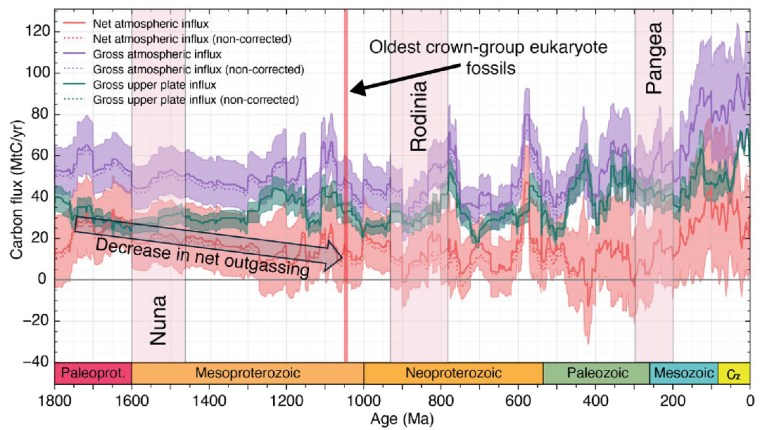
Carbon influx (million tons per year) into tectonic plates and into the ocean-atmosphere system from 1800 Ma to present. The colour bands represent: total carbon influx into the atmosphere (mauve); sequestered in tectonic plates (green); net atmospheric influx i.e. total minus carbon sequestered into plates (orange). The widths of the bands show the uncertainties of the calculated masses shown as darker coloured lines.

From 1800 to 800 Ma two supercontinents– Nuna-Columbia and Rodinia – aggregated nearly all existing continental masses, and then broke apart. Continents had collided and then split asunder to drift. So plate tectonics was very active and encompassed the entire planet, as Müller et al’s palaeogeographic animation reveals dramatically. Tectonics behaved in much the same fashion through the succeeding Neoproterozoic and Phanerozoic to build-up then fragment the more familiar supercontinent of Pangaea. Such dynamic events emit magma to form new oceanic lithosphere at oceanic rift systems and arc volcanoes above subduction zones, interspersed with plume-related large igneous provinces and they wax and wane. Inevitably, such partial melting delivered carbon dioxide to the atmosphere. Reaction on land and in the rubbly flanks of spreading ridges between new lithosphere and dissolved CO2 drew down and sequestered some of that gas in the form of solid carbonate minerals. Continental collisions raised the land surface and the pace of weathering, which also acted as a carbon sink. But they also involved metamorphism that released carbon dioxide from limestones involved in the crustal transformation. This protracted and changing tectonic evolution is completely bound up through the rock cycle with geochemical change in the carbon cycle.

From the latest knowledge of the tectonic and other factors behind the accretion and break-up of Nuna and Rodinia, Müller et al. were able to model the changes in the carbon cycle during the ‘boring billion’ and their effects on climate and the chemistry of the oceans. For instance, about 1.46 Ga ago, the total length of continental margins doubled while Nuna broke apart. That would have hugely increased the area of shallow shelf seas where living processes would have been concentrated, including the photosynthetic emission of oxygen. In an evolutionary sense this increased, diversified and separated the ecological niches in which evolution could prosper. It also increased the sequestration of greenhouse gas through reactions on the flanks of a multiplicity of oceanic rift systems, thereby cooling the planet. Translating this into a geochemical model of the changing carbon cycle (see figure) suggests that the rate of carbon addition to the atmosphere (outgassing) halved during the Mesoproterozoic. The carbon cycle and probable global cooling bound up with Nuna’s breakup ended with the start of Rodinia’s aggregation about 1000 Ma ago and the time that biomarkers first indicate the presence of eukaryotes.
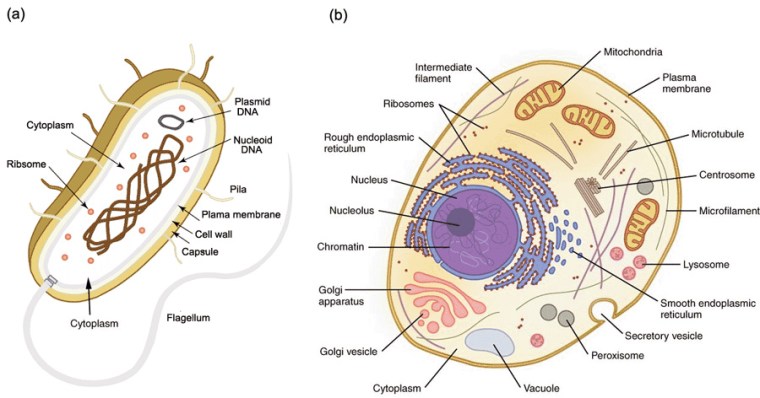
Simplified structures of (a) a prokaryote cell; (b) a simple eukaryote animal cell. Plants also contain organelles called chloroplasts

So, did tectonics play a major role in the rise of the Eukarya? Well, of course it did, as much as it was subsequently the changing background to the appearance of the Ediacaran animals and the evolutionary carnival of the Phanerozoic. But did it affect the billion-year delay of ‘eukaryogenesis’ during prolonged availability of the oxygen that such a biological revolution demanded? Possibly not. Lyn Margulis’s hypothesis of the origin of the basic eukaryote cell by a process of ‘endosymbiosis’ is still the best candidate 50 years on. She suggested that such cells were built from various forms of bacteria and archaea successively being engulfed within a cell wall to function together through symbiosis. Compared with prokaryote cells those of the eukaryotes are enormously complex. At each stage the symbionts had to be or become compatible to survive. It is highly unlikely that all components entered the relationship together. Each possible kind of cell assembly was also subject to evolutionary pressures. This clearly was a slow evolutionary process, probably only surviving from stage to stage because of the global presence of a little oxygen. But the eukaryote cell may also have been forced to restart again and again until a stable form emerged.

See also: New Clues Show Earth’s “Boring Billion” Sparked the Rise of Life. SciTechDaily, 3  November 2025

A new explanation for the Neoproterozoic Snowball Earth episodes

The Cryogenian Period that lasted from 860 to 635 million years ago is aptly named, for it encompassed two maybe three episodes of glaciation. Each left a mark on every modern continent and extended from the poles to the Equator. In some way, this series of long, frigid catastrophes seems to have been instrumental in a decisive change in Earth’s biology that emerged as fossils during the following Ediacaran Period (635 to 541 Ma). That saw the sudden appearance of multicelled organisms whose macrofossil remains – enigmatic bag-like, quilted and ribbed animals – are found in sedimentary rocks in Australia, eastern Canada and NW Europe. Their type locality is in the Ediacara Hills of South Australia, and there can be little doubt that they were the ultimate ancestors of all succeeding animal phyla. Indeed one of them Helminthoidichnites, a stubby worm-like animal, is a candidate for the first bilaterian animal and thus our own ultimate ancestor. Using the index for Palaeobiology or the Search Earth-logs pane you can discover more about them in 12 posts from 2006 to 2023. The issue here concerns the question: Why did Snowball Earth conditions develop? Again, refresh your knowledge of them, if you wish, using the index for Palaeoclimatology or Search Earth-logs. From 2000 onwards you will find 18 posts: the most for any specific topic covered by Earth-logs. The most recent are Kicking-off planetary Snowball conditions (August 2020) and Signs of Milankovich Effect during Snowball Earth episodes (July 2021): see also: Chapter 17 in Stepping Stones.

One reason why Snowball Earths are so enigmatic is that CO2 concentrations in the Neoproterozoic atmospheric were far higher than they are at present. In fact since the Hadean Earth has largely been prevented from being perpetually frozen over by a powerful atmospheric greenhouse effect. Four Ga ago solar heating was about 70 % less intense than today, because of the ‘Faint Young Sun’ paradox. There was a long episode of glaciation (from 2.5 to 2.2 Ga) at the start of the Palaeoproterozoic Era during which the Great Oxygenation Event (GOE) occurred once photosynthesis by oxygenic bacteria became far more common than those that produced methane. This resulted in wholesale oxidation to carbon dioxide of atmospheric methane whose loss drove down the early greenhouse effect – perhaps a narrow escape from the fate of Venus. There followed the ‘boring billion years’ of the Mesoproterozoic during which tectonic processes seem to have been less active. in that geologically tedious episode important proxies (carbon and sulfur isotopes) that relate to the surface part of the Earth System ‘flat-lined’.  The plethora of research centred on the Cryogenian glacial events seems to have stemmed from the by-then greater complexity of the Precambrian Earth System.

Since the GOE the main drivers of Earth’s climate have been the emission of CO2 and SO2 by volcanism, the sedimentary burial of carbonates and organic carbon in the deep oceans, and weathering. Volcanism in the context of climate is a two-edged sword: CO2 emission results in greenhouse warming, and SO2 that enters the stratosphere helps reflect solar radiation away leading to cooling. Silicate minerals in rocks are attacked by hydrogen ions (H+) produced by the solution of CO2 in rain water to form a weak acid (H2CO3: carbonic acid). A very simple example of such chemical weathering is the breakdown of calcium silicate:

CaSiO3  +  2CO2  + 3H2O  =  Ca2+  +  2HCO3  +  H4SiO4  

The reaction results in calcium and bicarbonate ions being dissolved in water, eventually to enter the oceans where they are recombined in the shells of planktonic organisms as calcium carbonate. On death, their shells sink and end up in ocean-floor sediments along with unoxidised organic carbon compounds. The net result of this part of the carbon cycle is reduction in atmospheric CO2 and a decreased greenhouse effect: increased silicate weathering cools down the climate. Overall, internal processes – particularly volcanism – and surface processes – weathering and carbonate burial – interact. During the ‘boring billion’ they seem to have been in balance. The two processes lie at the core of attempts to model global climate behaviour in the past, along with what is known about developments in plate tectonics – continental break-up, seafloor spreading and orogenies – and large igneous events resulting from mantle plumes. A group of geoscientists from the Universities of Sydney and Adelaide, Australia have evaluated the tectonic factors that may have contributed to the first and longest Snowball Earth of the Neoproterozoic: the Sturtian glaciation (717 to 661 Ma) (Dutkiewicz, A. et al. 2024. Duration of Sturtian “Snowball Earth” glaciation linked to exceptionally low mid-ocean ridge outgassing. Geology, v. 52, online early publication; DOI: 10.1130/G51669.1).

Palaeogeographic reconstructions (Robinson projection) during the early part of the Sturtian global glaciation: LEFT based on geological data from Neoproterozoic terrains on modern continents; RIGHT based on palaeomagnetic pole positions from those terrains. Acronyms refer to each terrains, e.g. Am is Amazonia, WAC is the West African Craton. Orange lines are ocean ridges, those with teeth are subduction zone. (Credit: Dutkiewicz et al., parts of Fig. 1)

Shortly before the Sturtian began there was a major flood volcanism event, forming the Franklin large igneous province, remains of which are in Arctic Canada. The Franklin LIP is a subject of interest for triggering the Sturtian, by way of a ‘volcanic winter’ effect from SO2 emissions or as a sink for CO through its weathering. But both can be ruled out as no subsequent LIP is associated with global cooling and the later, equally intense Marinoan global glaciation (655 to 632 Ma) was bereft of a preceding LIP. Moreover, a world of growing frigidity probably could not sustain the degree of chemical weathering to launch a massive depletion in atmospheric CO2. In search of an alternative, Adriana Dutkiewicz and colleagues turned to the plate movements of the early Neoproterozoic. Since 2020 there have been two notable developments in modelling global tectonics of that time, which was dominated by the evolution of the Rodinia supercontinent. One is based largely on geological data from the surviving remnants of Rodinia (download animation), the other uses palaeomagnetic pole positions to fix their relative positions: the results are very different (download animation).

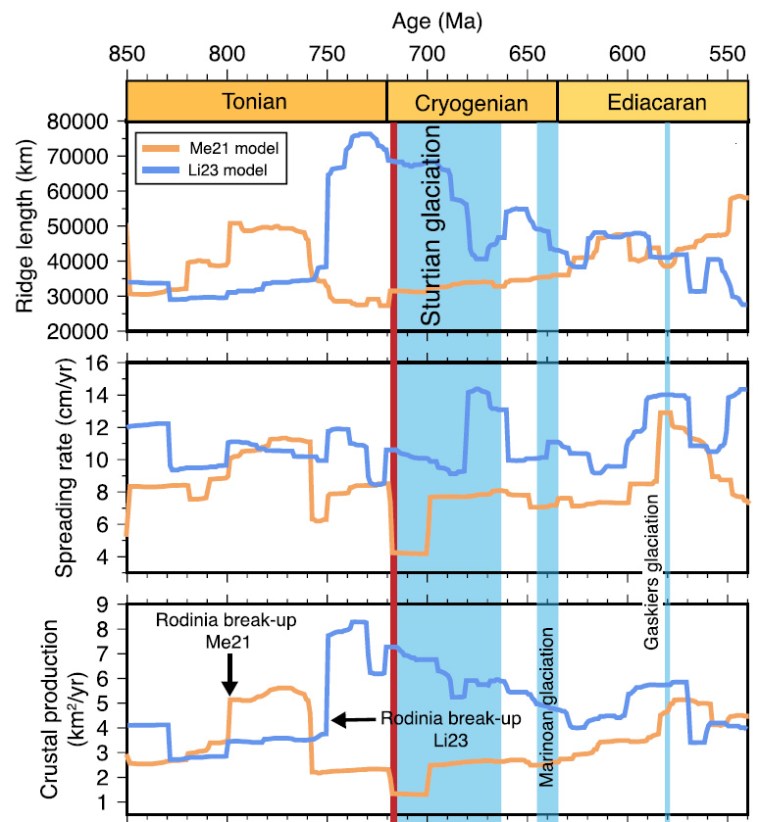
Variations in ocean ridge lengths, spreading rates and oceanic crust production during the Neoproterozoic estimated from the geological (orange) and palaeomagnetic (blue) models. Credit: Dutkiewicz et al., parts of Fig. 2)

The geology-based model has Rodinia beginning to break up around 800 Ma ago with a lengthening of global constructive plate margins during disassembly. The resulting continental drift involved an increase in the rate of oceanic crust formation from 3.5 to 5.0 km2 yr-1. Around 760 Ma new crust production more than halved and continued at a much slowed rate throughout the Cryogenian and the early part of the Ediacaran Period.  The palaeomagnetic model delays breakup of the Rodinia supercontinent until 750 Ma, and instead of the rate of crust production declining through the Cryogenian it more than doubles and remains higher than in the geological model until the late Ediacaran. The production of new oceanic crust is likely to govern the rate at which CO2 is out-gassed from the mantle to the atmosphere. The geology-based model suggests that from 750 to 580 Ma annual CO2 additions could have been significantly below what occurred during the Pleistocene ice ages since 2.5 Ma ago. Taking into account the lower solar heat emission, such a drop is a plausible explanation for the recurrent Snowball Earths of the Neoproterozoic. On the other hand, the model based on palaeomagnetic data suggests significant warming during the Cryogenian contrary to a mass of geological evidence for the opposite.

A prolonged decrease in tectonic activity thus seems to be a plausible trigger for global glaciation. Moreover, reconstruction of Precambrian global tectonics using available palaeomagnetic data seems to be flawed, perhaps fatally. One may ask, given the trends in tectonic data: How did the Earth repeatedly emerge from Snowball episodes? The authors suggest that the slowing or shut-down of silicate weathering during glaciations allowed atmospheric CO2 to gradually build up as a result of on-land volcanism associated with subduction zones that are a quintessential part of any tectonic scenario.

This kind of explanation for recovery of a planet and its biosphere locked in glaciation is in fact not new. From the outset of the Snowball Earth hypothesis much the same escape mechanisms were speculated and endlessly discussed. Adriana Dutkiewicz and colleagues have fleshed out such ideas quite nicely, stressing a central role for tectonics. But the glaring disparities between the two models show that geoscientists remain ‘not quite there’. For one thing, carbon isotope data from the Cryogenian and Ediacaran Periods went haywire: living processes almost certainly played a major role in the Neoproterozoic climatic dialectic.

The East African Orogen: Neoproterozoic tectonics on display

Over a period of about 300 Ma the fragmentation of a supercontinent, Rodinia, drove a round of sea-floor spreading and continental drift that culminated in reassembly of the older continental pieces and entirely new crust in a new supercontinent, Gondwana. The largest source of evidence for this remarkable tectonic turnaround is a belt stretching N-S for over 3000 km from southern Israel through East Africa to Mozambique. At its widest the belt exposes Neoproterozoic  rocks and structures for some 1700 km E-W from west of the Nile in northern Sudan almost to Riyadh in Saudi Arabia.  This Arabian-Nubian Shield tapers southwards to thin out completely in northern Tanzania between far older cratons and in a state of high-grade metamorphism.

This East African Orogen has long been considered the best exposed bowels of former mountain building that there are: results of continent-continent collision and the bulldozing together of many oceanic arcs and remnants of oceanic lithosphere that once separated the cratons. This was much more complex than a case of head-on tectonics, the northward-swelling Arabian-Nubian Shield showing all the signs of being like a gigantic ‘pip’ squeezed out northwards from two cratonic jaws during the last stages of what is often called the Pan African Orogeny. Interestingly, the line of the orogen is roughly followed by East Africa’s other giant feature, the Rift Valley; actually two of them following Pan African terranes. A continental scale anisotropy has been reactivated and subject to extensional tectonics, and maybe in future a new round of sea-floor spreading as has begun in the Red Sea, some half a billion years after it formed.

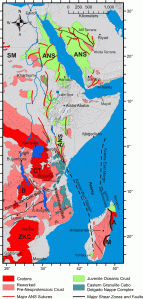
Simplified geological map of the East African Orogen courtesy of the authors of Fritz et al 2013

Now there is an opportunity for anyone to download and read a digest of East African orogenic processes compiled by researchers from several countries along the belt and their colleagues from North America, Europe and Australia who have been privileged to work in this vast area (Fritz, H and 13 others 2013. Orogen styles in the East African orogen: A review of the Neoproterozoic to Cambrian tectonic evolution. Journal of African Earth Sciences, v. 86, p. 65-106 Click on the link, scroll to the Open Access article to download the 12 Mb PDF version). The authors present superb simplified geological maps of each major part of the orogen, a vast array of references and well-written accounts of its sector-by-sector tectonic and metamorphic evolution, variations in style and broad tectonic setting.

Pan African Review

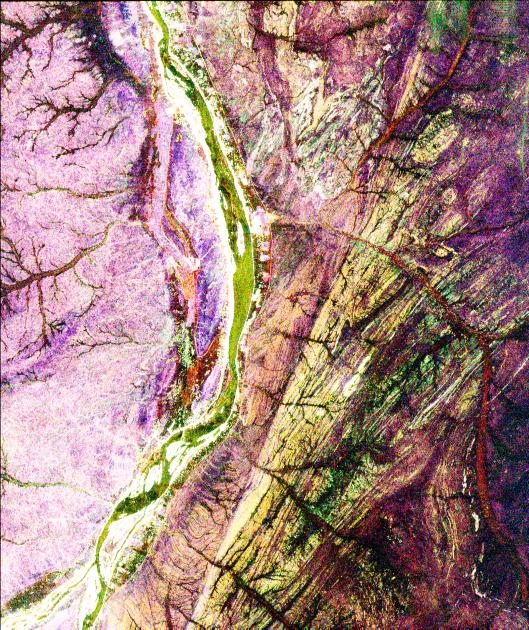
A terrane boundary close to the Nile in the Sudan, detected by radar from the Space Shuttle: the Keraf Suture. From NASA

Undoubtedly the best exposed and one of the biggest examples, the accretionary orogen of the Arabian-Nubian Shield (ANS) is a witness to the creation of a supercontinent from the remnants of an earlier one. At about 1 Ga, most of the Earth’s continental material was clumped together in the Rodinia supercontinent that existed for a quarter of a billion years. At a time of massive mantle upheaval that left most crust of that age affected by basaltic magmatism, in the form of lava flows and dyke swarms, Rodinia began to break up at 800 Ma to scatter continental fragments. Subduction zone accommodated this continental drift to form many ocean and continental-margin volcanic arcs. The ANS is a repository for many of these arcs which episodically accreted between earlier cratons to the west in Africa and those comprising Somalia and the present Indian subcontinent. Primarily the terranes are oceanic in origin and formed in the aftermath of the dismemberment of Rodinia, although a few slivers of older, reworked crust occur in Saudi Arabia and Yemen. Among the various components are ophiolites marking sutures and other major tectonic features of the orogen. The shape of the Shield is unlike that of any other major orogen of later times, for it shrinks from a width estimated at ~2000 km in Arabia to the north to vanish just south of the Equator in southern Kenya. This ‘pinched’ structure has suggested to some that the bulk of the new crust was forced laterally northwards when the African and Indian cratons collided, in the manner of toothpaste from a trodden-on tube.

Today the ANS is a harsh place, some off-limits to geologists either for political reasons or the sheer hostility and remoteness of the environment. Yet a picture has emerged, bit by bit, over the last 30 years. So a detailed review of the most extensive and varied part from 7° to 32°N and 26° to 50°E – in Egypt, Saudia Arabia, eastern Sudan, Eritrea, Yemen and northern Ethiopia is especially welcome (Johnson, P.R. et al. 2011. Late Cryogenian–Ediacaran history of the Arabian–Nubian Shield: A review of depositional, plutonic, structural, and tectonic events in the closing stages of the northern East African Orogen. Journal of African Earth Sciences, v. 61, p. 167-232). Peter Johnson himself compiled a vast amount of information during his career with the US Geological Survey Mission in Saudi Arabia and has blended the inevitably diverse ideas of his 7 co-workers – but by no means all the ideas that are in the literature. The result is a readable and well illustrated account of how the ANS assembled tectonically during times when a near-global glaciation took place, and the first macroscopic animals appear in the fossil record. Tillites and other glaciogenic rocks from the Marinoan ‘SnowBall’ occur from place to place in the ANS, as do banded iron formations that made a surprise return after a billion-year or longer absence in the Cryogenian Period . Coincidentally, glacial conditions returned to the region twice in Ordovician and Carboniferous to Permian times, forming distinctive, tectonically undisturbed sediments in the Phanerozoic cover that unconformably overlies the Neoproterozoic orogen.

Except in a few areas only recently explored, geologists have assiduously dated events in the ANS, showing nicely that all the basement rock formed after 800 Ma, and that orogenic events culminated before the start of the Cambrian period, although one or two unusual granites intruded as late as the Ordovician. The deformation is immense in places, with huge nappes, often strike-slip shear zones and exposure ranging from the lowest metamorphic grade to that in which water and granitic magma was driven from the lower Pan African crust. The range of exposed crustal levels stems partly from the tectonics, but owes a lot to the 2-3 km of modern topographic relief, unique to NE Africa and Arabia. Yet it is not uncommon to come upon delicate features such as pillowed lavas, conglomerates and finely laminated volcanoclastic tuffs. Following tectonic welding, more brittle deformation opened subsiding basins that contain exclusively sedimentary rocks derived from the newly uplifted crust, both marine and terrestrial in formation (basins of this type, in Eritrea and Ethiopia, unfortunately do not figure in the regional maps). Much of the ANS is currently the object of a gold rush, encouraged by a rising world price for the ‘inflation-proof’ comfort blanket provided by the yellow metal. Consequently, newcomers to the stampede will be well advised to mug-up on the regional picture of occurrences and gold-favourable geology provided in the review, and may be interested by other exploration possibilities for rare-earth metals and other rising stars on the London Metal Exchange, such as tin, which are often hosted in evolved granites, that stud the whole region.