Earliest hominin occupation of Sulawesi and crossing of an ocean barrier

Regular readers of Earth-logs will recall that the islands of Indonesia were reached by the archaic humans Homo erectus and H. floresiensis at least a million years ago. Anatomical comparison of their remains suggest that the diminutive H. floresiensis probably evolved from H. erectus under the stress of being stranded on the small, resource-poor island of Flores: a human example of island dwarfism. In fact there are anatomically modern humans (AMH) living on Flores that seem to have evolved dwarfism in the same way since AMH first arrived there between 50 and 5 ka. Incidentally, H. erectus fossils and artefacts were found by Eugene Dubois in the late 19th century at a famous site near Trinil in Java. In 2014, turned out that H. erectus had produced the earliest known art – zig-zag patterns on freshwater clam shells – between 540 and 430 ka ago. The episodic falls in global sea level due to massive accumulations of ice on land during successive Pleistocene glacial episodes aided migration by producing connections between the islands of SE Asia. They created a huge area of low-lying dryland known as ‘Sundaland’. The islands’ colonisation by H. erectus was made easy, perhaps inevitable.

The interconnection of SE Asian islands to form Sundaland (yellow) when sea level was 120 m lower than today. Even at that extreme the island of Sulawesi remained isolated by deep ocean water. Credit: based on Hakim et al Fig 1.

However, Flores and islands further east are separated from those to the west by a narrow but very deep strait. It channels powerful currents that are hazardous to small-boat crossings even today. Most palaeoanthropologists consider the colonisation of Flores by H. erectus most likely to have resulted by accident, reckoning that they were incapable of planning a crossing and building suitable craft. For AMH to have reached New Guinea and Australia around 60 ka ago, they must have developed sturdy craft and sea-faring skills. This paradigm suggests that the evolution of AMH, and thus their eventual occupation of all continents except Antarctica, must have involved a revolutionary ‘leap’ in their cognitive ability just before they left Africa. That view has been popularised by the presenter (Ella Al-Shamahi) of the 2025 BBC Television series Human – now on BBC iPlayer (requires viewers to create a free account) – in its second episode Into the Unknown. [The idea of a cognitive leap that ushered in the almost worldwide migration of anatomically modern humans was launched in 1995 by controversial anthropologist Chris Knight of University College London].
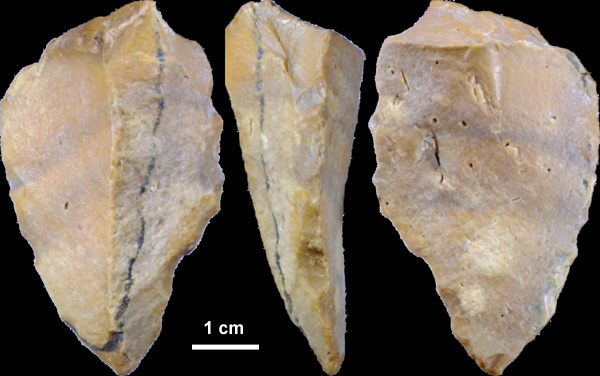
Flaked artefact, about the length of a human thumb, made of chert from excavations at Calio on Sulawesi, dated at 1.02 Ma. Credit: based on Hakim et al Fig 2

The large and peculiarly-shaped island of Sulawesi, also part of Indonesia, is notable for being the location of the earliest known figurative art; a cave painting of a Sulawesi warty pig, dated to at least 45.5 ka ago. Indonesian and Australian archaeologists working at a site near Calio in northern Sulawesi unearthed stone artefacts deep in river-terrace gravels that contain fossils of extinct pigs and dwarf elephants (Hakim, B. and 26 others 2025. Hominins on Sulawesi during the Early Pleistocene. Nature, v. 644;DOI: 10.1038/s41586-025-09348-6). The tools were struck from pebbles of hard fine-grained rocks by flaking to produce sharp edges. A combination of dating techniques – palaeomagnetism, uranium-series and electron-spin resonance – on the terrace sediments and fossils in them yielded ages ranging from 1.04 to 1.48 Ma; far older than the earliest known presence of AMH on the island (73–63 ka). The dates for an early human presence on Sulawesi tally with those from Flores. The tool makers were probably H. erectus. To reach the island from Sundaland at a time when global sea level was 120 m lower than at present would have required crossing more than 50 km of open water. It seems unlikely that such a journey could have been accidental. The migrants would have needed seaworthy craft; possibly rafts. Clearly the AMH crossings to New Guinea around 60 thousand years ago would have been far more daunting. Both land masses would have been below the horizon of any point of departure from the Indonesian archipelago, even with island ‘hopping’. Yet the Sulawesi discovery, combined with the plethora of islands both large and small, suggests that the earlier non-AMH inhabitants of Indonesia potentially could have spread further at times of very low sea level.

See also: Brumm, A. t al. 2025. This stone tool is over 1 million years old. How did its maker get to Sulawesi without a boat? The Conversation, 6 August 2025

A way for early humans to leave Africa for Eurasia via the Middle East

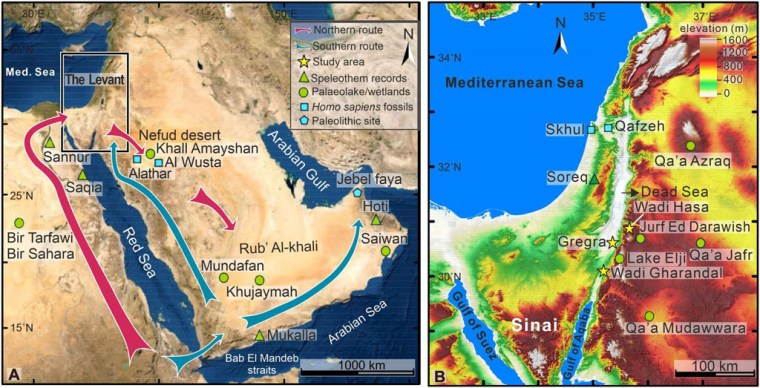
Without seafaring skills and sturdy boats, ancient humans had only two options to leave Africa for Eurasia: by crossing the Straits of Bab el Mandab at the southern end of the Red Sea and from the Nile delta to the Levant at its northern end. Both would have been difficult. The first route demanded extremely low sea level drawn down by continental ice accumulation to narrow the sea crossing, the earliest in the last glacial cycle being around 70 ka ago. The northern route, with no sea crossing, was potentially achievable throughout the history of the genus Homo. But that way is beset to the north and east by deserts with large tracts that today lack natural water sources. To leave Africa by that route seems the most obvious, being reached along the well-watered Nile valley or the Red Sea coast with its abundant marine resources. Yet moving eastwards to Arabia and further would have required climatic windows of opportunity to ensure well-watered corridors: it would be impossible today without an infrastructure of wells; and edible resources are extremely sparse. Remains of anatomically modern humans (AMH) as old as 200 ka and others in the period between 130 to 85 ka have been found around the eastern shores of the Mediterranean. Either of the two routes could have led them there during periods of increased humidity, perhaps in a series of migratory pulses. In the case of an exodus across the Straits of Bab el Mandab, people could have moved northwards along the Red Sea coast of modern Yemen and Arabia to the Levant. However, the record is patchy, and there is no direct fossil evidence to suggest they went further, into southern Asia or Europe in these earlier times. Each early venture may also have ended in extinction.  The first presence of AMH in Asia and Europe, seems to have been tens of thousand years later: about 75 ka and 45 ka, respectively, so far as we know.

Left: Satellite image of the Arabia and the Levant, showing the possible northern (red) and southern migration routes (blue) and sites that yielded various palaeoclimatic signs of formerly wet areas, Homo sapiens fossils and stone tools (see key). Right colour-coded map of topographic elevation for the study area in the Levant with sites that reveal palaeoclimatic and anthropological information. (Credit: Abbas et al., Fig 1)

Research in the Arabian Peninsula has early recorded human presence from discarded stone artefacts at widely scattered sites, as far east as the UAE and Oman, but whether these were carried by AMH or other human groups is uncertain. Yet geological research suggests that even in the presently forbidding Empty Quarter of Saudi Arabia there were from time to time abundant springs, river networks and even lakes: occasionally climate changes made much of Arabia habitable. Researchers from the University of Southampton (UK) and Shantou University (China), together with colleagues in Jordan, Australia and the Czech Republic have documented further evidence for ‘green’ episodes on the Jordan Plateau – part of the currently hyperarid  Arabian interior (Abbas, M. and 10 others 2023. Human dispersals out of Africa via the LevantScience Advances, v.9, article eadi6838; DOI: 10.1126/sciadv.adi6838).

Three sites in Jordan reveal wetland sediments incised by now dry channels or wadis, one of which yielded stone tools Luminescence dating of wetland sediment grains shows the times when they were last exposed to sunlight: some between 86 to 65 ka, others between 57 to 43 ka. Together with data from the rest of Arabia the sites help roughly to define routes that would have permitted human migration, though not the actual directions that early AMH might have travelled or their destinations – if any. They may just have wandered around surviving on the resources that they found during short periods of amenable local climate, and vegetation much as do desert dwellers today. Actually to exit Arabia to southern Asia would require migration around what is now the Persian Gulf, where relevant data are lacking and likely to remain so while poor security for research prevails. To get to Europe would require a much more intricate journey through large mountainous tracts to reach the shores of the Black Sea.

See also: Early human migrants followed lush corridor-route out of Africa. Science Daily. 4 October 2023

When and why did the North American Pleistocene megafauna collapse?

The US city of Los Angeles, originally known as El Pueblo de Nuestra Señora la Reina de los Ángeles (The Town of Our Lady the Queen of the Angels), was founded in 1781 by 44 Spanish settlers. It remained a small cattle-centred town after the annexation of California from Mexico by the USA in 1847. Once it was reached by the transcontinental Southern Pacific railroad in 1876 it had the potential for growth. But it took the discovery of oil within its limits in 1892 for its population to increase rapidly. The Los Angeles City Oil Field became the top producer in California with 200 separate oil companies crammed cheek by jowl by 1901. Now only one remains, producing just 3.5 barrels per day. That crude oil was there for the taking was pretty obvious as bitumen seeps had long been exploited by native people and the original Spanish colonists. The oilfield was developed near one such seep: the Rancho La Brea tar pits.

Rancho La Brea tar pit and derricks of the Los Angeles City Oil Field in 1901

By 1901 perfectly preserved bones of a huge variety of animals – 231 vertebrate species – as well as plants and invertebrates began to be collected from the continually roiling pond of bitumen. Thousands of specimens have been collected since then, both predators and prey of all sizes. Famous for mastodons and sabre-toothed cats, La Brea is a repository of almost the entire western Californian fauna through much of the Late Pleistocene: before about 100 ka the area lay beneath the Pacific Ocean. Tar pits are traps for unwary animals of any kind, especially as shallow water often hides the danger. Carnivores seeking easy, abundant food end up trapped too.

Because of the anaerobic nature of bitumen, bacterial decay is suppressed. Many of the bones still contain undegraded collagen: the most abundant protein in mammals, which can be dated using the radiocarbon method. So, despite the lack of stratigraphy in the tar pits, it is possible to track the history of the ecosystem by painstaking dating of individual fossils (OKeefe, F.R and 18 others 2023. Pre–Younger Dryas megafaunal extirpation at Rancho La Brea linked to fire-driven state shift. Science, v. 381, article eabo3594; DOI: 10.1126/science.abo3594). Robin OKeefe and colleagues dated 169 specimens of eight large mammal species most commonly found in the bitumen: sabre-toothed cat (Smilodon fatalis); dire wolf (Aenocyon dirus); coyote (Canis latrans); American lion (Panthera atrox); ancient bison (Bison antiquus); western horse (Equus occidentalis); Harlans ground sloth (Paramylodon harlani); and yesterdays camel (Camelops hesternus).

The authors focussed on precisely dated specimens spanning the 15.6 to 10.0 ka time range. This would allow the disappearance times of individual species to be compared with stages in the rapid change in the Californian climate during post glacial maximum warming, those during the Younger Dryas abrupt cooling (12.9 to 11.7 ka) and the earliest Holocene warming that succeeded it. The first to go extinct were the camels and giant sloths about 13.6 ka ago. At 13.2 ka the other mammals declined very rapidly, the two remaining herbivores vanishing more quickly than the four predators. By 12.9 ka the only surviving species of the chosen eight was the coyote. So seven members of the Pleistocene mammalian megafauna became extinct before the onset of the Younger Dryas cold millennium.

Part of the team examined pollen from a core through sediments deposited in a lake 100 km south of La Brea. They found that flora, and probably climate, had not changed at the time of camel and sloth extinctions around 13.6 ka. However a 300 year period between 13.2 and 12.9 ka witnessed a collapse in deciduous tree species while conifers, grasses and drought-tolerant shrubs increased. A woodland ecosystem had been replaced by semi-arid chaparral. Another feature of the lake-bed sediments was that charcoal fragments increased explosively during that 300-year episode that ended both the woodland ecosystem and the megafauna that exploited it: undoubtedly three centuries of regular wildfires. What remained was the chaparral ecosystem based on drought-tolerant, fire-adapted plants.

Were the megafauna collapse and a change in ecology results of a climatic harbinger for the Younger Dryas cool millennium, or some other cause? Interestingly, tangible evidence for the Clovis hunting culture of North America, which has long been implicated in the faunal ‘extirpation’, does not appear until 12.9 ka, and in California neither does any implicating other human groups. Yet evidence is accumulating for much earlier entry of humans into North America. Occupation sites are very rare on land, but human presence here and there implies such earlier migration, probably along the west coast that avoided the frigid interior further north than California. The question posed by OKeefe ­et al. is, ‘Were the fires ignited by humans over a 300 year period just before the Younger Dryas’? It remains to be confirmed … First human arrivals coinciding with evidence for wildfires in Australia, New Zealand and a few other areas do suggest that it is a possibility. There needs to be a motive, such as producing lush clearings in forest to attract game, or removing cover to make hunting easier. In this case, the fires immediately preceded a global climatic downturn with terrestrial drying, so they may have had natural causes: the potentially incendiary chaparral flora had been increasing steadily beforehand and decreased rapidly after the evidence for wildfires

See also: Price, M. 2023.  Death by fire. Science, v. 381, p. 724-727; DOI: 10.1126/science.adk3291

Family links among the Neanderthals of Siberia

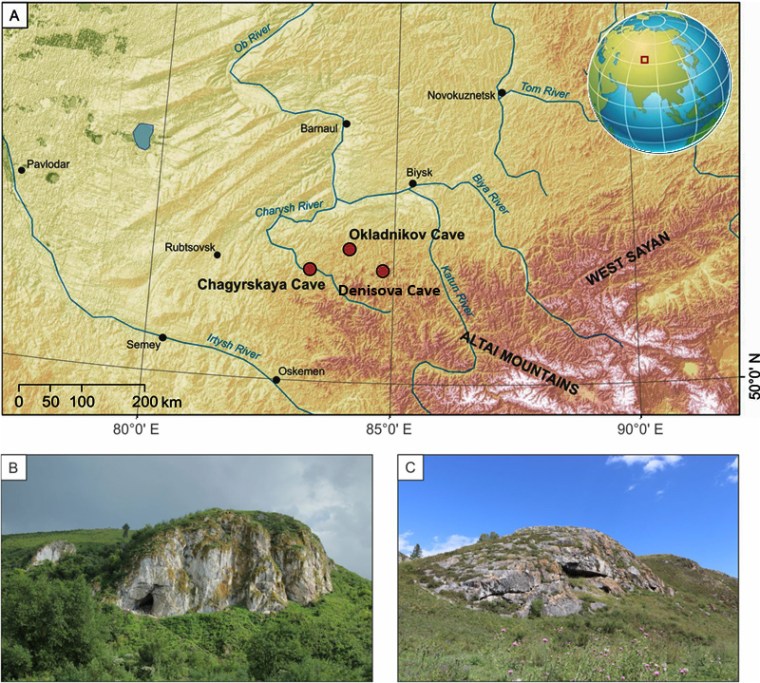
Caves used by the Neanderthals of southern Siberia: A – location map; B – Chagyrskaya Cave; C – Okladnikov Cave. (Credit: adapted from Skov et al.; Extended Data Fig. 1)

The early focus on Neanderthals was on remains found in Western Europe from the 19th century onwards. That has shifted in recent years to southern Siberia in the foothills of the Altai mountains, despite the fossils’ fragmentary nature: a few teeth and bits of mandible. The Denisova Cave became famous not just because it contained the easternmost evidence of Neanderthal occupation but through the genetic analysis of a tiny finger-tip bone. It proved not to be from a Neanderthal but a distinctly different hominin species, dubbed Denisovan (see: Other rich hominin pickings; May 2010). What Denisovans looked like remains unknown but genetic traces of them are rife among living humans of the western Pacific islands and Australia, whose ancestors interbred with Denisovans, presumably in East Asia. Modern people indigenous to Europe and the Middle East have Neanderthal genes in their genomes. Other bone fragments from Denisova Cave also yielded Neanderthal genomes, and the cave sediments yielded traces of both groups (see: Detecting the presence of hominins in ancient soil samples; April 2017). Then in 2018 DNA extracted from a limb bone from the cave clearly showed that it was from a female teenager who had had a Neanderthal mother and a Denisovan father (see: Neanderthal Mum meets Denisovan Dad; August 2018). These astonishing and unexpected finds spurred further excavations and genetic analysis in other caves within 100 km of Denisova Cave. This was largely led by current and former co-workers of Svanti Pääbo, of the Max Planck Institute for Evolutionary Anthropology, Leipzig, Germany: Pääbo was awarded the 2022 Nobel Prize in Physiology or Medicine for his coordination of research and discoveries concerning ancient human genomes. Their enormous field and laboratory efforts have paid astonishingly valuable dividends (Skov, L. and 34 others 2022. Genetic insights into the social organization of Neanderthals. Nature v. 610, p. 519–525; DOI: 10.1038/s41586-022-05283-y).

To the previously analysed 18 Neanderthal genomes from 14 archaeological sites across Eurasia (including Denisova Cave) Skov et al. have added 13 more from just two sites in Siberia (the Chagyrskaya and Okladnikov caves). Each site overlooks valleys along which game still migrates, so they may have been seasonal hunting camps rather than permanent dwellings: they are littered with bison and horse bones. Tools in the two 59-51 ka old human occupation levels are different from those at the older (130 to 91 Ka) Denisova Cave about 100 km to the east. As at the much older site, human fossils include several teeth and fragments of bones from jaws, hands, limbs and vertebrae. The detailed genomes recovered from 17 finds shows them to be from 14 individuals (12 from Chagyrskaya, 2 from Okladnikov).

Chagyrskaya yielded evidence for 5 females (3 adults and 2 children) and 7 males (3 children and 4 adults). One female estimated to have lost a premolar tooth when a teenager was the daughter of a Chagyrskaya adult male. He, in turn, was brother or father to another male, so the girl seems to have had an uncle as well. Another male and female proved to be second-degree relations (includes uncles, aunts, nephews, nieces, grandparents, grandchildren, half-siblings, and double cousins). The two people from Okladnikov were an adult female and an unrelated male child. The boy was not related to the Chagyrskaya group, but the woman was, her former presence at that cave lingering in its cave-sediment DNA. None of the newly discovered individuals were closely related to six of the seven much older Denisova Cave Neanderthals, but the Okladnikov boy had similar mtDNA to one individual from Denisova.

Further information about the Chagyrskaya group came from comparison of DNA in Y-chromosomes and mitochondria. The father of the teenage girl had two types of mtDNA – the unusual characteristic of heteroplasmy – that he shared with two other males. This suggests that three of the males shared the same maternal lineage – not necessarily a mother – and also indicates that they lived at roughly the same time. The mtDNA recovered from all Chagyrskaya individuals was much more varied than was their Y-chromosome DNA (passed only down male lineage). One way of explaining that would be females from different Neanderthal communities having migrated into the Chagyrskaya group and mated with its males, who largely remained in the group: a ‘tradition’ known as patrilocality, which is practised in traditional Hindu communities, for instance.

So, what has emerged is clear evidence for a closely related community of Neanderthals at Chagyrskaya, although it cannot be shown that all were present there at the same time, apart from the five who show first- or second-degree relatedness or mitochondrial heteroplasmy. Those represented only by individual teeth didn’t necessarily die there: adult teeth can be lost through trauma and deciduous teeth fall out naturally. There was also some individual physical connection between the two caves: The Okladnikov woman’s DNA being in the sediment at Chagyrskaya. Looking for DNA similarities more widely, it appears that all individuals at Chagyrskaya may have had some ancestral connection with Croatian Neanderthals, as did the previously mentioned mother of the Denisovan-Neanderthal hybrid girl. Four of the Chagyrskaya individuals can also be linked genetically to Neanderthals from Spain, more so than to much closer individuals found in the Caucasus Mountains. So, by around 59-51 ka the results of a wave of eastward migration of Neanderthals had reached southern Siberia. Yet the apparent matrilineal relatedness of the Okladnikov boy to the much older Neanderthals of Denisova Cave suggests that the earlier group continued to exist.

The new results are just as fascinating as the 2021 discovery that ancient DNA from Neolithic tomb burials in the Cotswolds of SW England suggests that the individual skeletons represent five continuous generations of one extended family. The difference is that they were farmers tied to the locality, whereas the Siberian Neanderthals were probably hunter gatherers with a very wide geographic range.  Laurits Skov and his colleagues have analysed less than one-quarter of the Neanderthal remains already discovered in Chagyrskaya and Okladnikov caves and only a third of the cave deposits have been excavated. Extracting and analysing ancient DNA is now far quicker, more detailed and cheaper than it was in 2010 when news of the first Neanderthal genome broke. So more Neanderthal surprises may yet come from Siberia. Progress on the genetics of their anatomically-modern contemporaries in NE Asia has not been so swift.

See also:  Callaway, E. 2022. First known Neanderthal family discovered in Siberian cave.  Nature online 19 October 2022.

Earliest Americans, and plenty of them

Who the first Americans were is barely known outside of the tools that they left in the archaeological record. For most of the late 20th century US researchers claimed that the first people to migrate into the Americas produced stone tools of the Clovis culture that first appear just before the Younger Dryas cold period, around 13.2 to 12.9 thousand years (ka) ago. The hallmark of Clovis culture is the finely-worked stone spear point, and its association with butchered large mammals: the Clovis people were apparently big-game hunters  Despite other, albeit less convincing, signs of earlier human habitation, this notion ossified for a seemingly irrefutable reason. To reach the Americas from NE Asia on foot, these people would have had to cross the Bering Straits via the Beringia land bridge exposed as sea level fell during the Last Glacial Maximum (LGM). That would have taken them to Alaska, but an exit to the south remained blocked by the huge Laurentian ice sheet until around 13 ka. Once an ice-free route had opened, the Clovis people migrated quickly to reach the site from which they take their name in New Mexico. But other archaeological sites discovered in the last couple of decades, extending as far south as Chile, have yielded ages that clearly predate the Clovis culture (see: Clovis First hypothesis dumped, May 2008). Beneath a Clovis-bearing layer at a site in Texas excavators unearthed thousands of totally different tools reliably dated to as far back as 15.5 ka (see: Clovis first hypothesis refuted, May 2011). This opened the realistic possibility that the earliest migrants had not necessarily walked from Asia, but may have followed a marine route along the Pacific coast and spread eastwards as opportunities presented themselves.

Now Mesoamerica has convincingly verified migration more than twice as long ago as that which littered North America with Clovis tools. It emerged from the Chiquihuite Cave 2.7 km high in the Astillero Mountains of northern Mexico. Almost 2000 stone artefacts were found throughout a 3 m thick layer of sediment beneath the cave floor that spans 27 to 13  ka, (Ardelean, C.F. and 27 others 2020. Evidence of human occupation in Mexico around the Last Glacial Maximum. Nature, v. 584 p. 87–92; DOI: 10.1038/s41586-020-2509-0). The technology revealed by the tools is more primitive than that of the Clovis culture. Artefacts occur throughout the layer, which extends back in time from the Younger Dryas, through the preceding period of warming and the LGM itself. Although colder than the present equitable climate of the high mountain valleys of Northern Mexico environmental data obtained from the layer show that it was viable for occupation through the LGM. Of the 42 highly precise and accurate radiocarbon dates those from some of the stratigraphically deepest part of the layer exceed 33 ka, which the authors suggest may establish the initial human occupation of the cave. Incidentally, although the paper was published online in July 2020 it was submitted to Nature in October 2018. That is a very long time in the editorial and review process. There is no indication as to why there was such a delay: maybe an indication of some continuing defence of the Clovis First hypothesis among the reviewers …

Dated pre-Clovis sites in Mexico and North America and possible expanding distribution of people from 31.3 to 14.2 ka (Credit; Becerra-Valdivia and Higham; Extended Data Fig. 4)

The radiocarbon dating in the paper was carried out at the state-of-the-art accelerator mass spectrometer unit at the University of Oxford, UK, by two of the co-authors (Lorena Becerra-Valdivia and Thomas Higham). They too published a Nature paper in late July 2020, which discusses their new dating of 42 archaeological sites in North America and Siberia (Becerra-Valdivia, L. & Higham, T. 2020. The timing and effect of the earliest human arrivals in North America. Nature, v. 584, p. 93-97; DOI: 10.1038/s41586-020-2491-6). In Mesoamerica and North America (the Clovis heartland) their results suggest that, as in Chiquihuite Cave, ‘people were present in different settings before, during and immediately following the LGM’, their ranges increasing over time. These people would likely not have followed the same route suggested for the later Clovis people, i.e. across Beringia and then parallel to the topographic grain in the Western Cordillera, ice-cap melting permitting. An interesting suggestion by Becerra-Valdivia and Higham is that post-LGM expansion in numbers and range of these early American contributed to the famous extinction of the North American Pleistocene megafauna. Dating the extinctions of different genera suggests that disappearance of the megafauna may not have been a single event during the Younger Dryas, but seems to have been during at least two other episodes peaking at about 40 and 24 ka. Both the ecological devastation supposedly associated with the Clovis people and the impact theory for its cause depend on a single event.

See also:  Gruhn, R. 2020. Evidence grows for early peopling of the Americas. Nature, v. 584, p. 47-48; DOI: 10.1038/d41586-020-02137-3; Rincon, P. 2020. Earliest evidence for humans in the Americas (BBC News, 22 July 2020); Keys, D. 2020. Humans reached the Americas 11,000 years earlier than previously thought, archaeologists discover (Independent, 22 July 2020)

Out of Africa: The earliest modern human to leave

The 2017 discovery in Morocco of fossilised, anatomically modern humans (AMH) dated at 286 ka (see: Origin of anatomically modern humans, June 2017) pushed back the origin of our species by at least 100 ka. Indeed, the same site yielded flint tools around 315 ka old. Aside from indicating our antiquity, the Jebel Irhoud discovery expanded the time span during which AMH might have wandered into Eurasia, as a whole variety of earlier hominins had managed since about 1.8 Ma ago. Sure enough, the widely accepted earliest modern human migrants from Skhul and Qafzeh caves in Israel (90 to 120 ka) were superseded in 2018 by AMH fossils at Misliya Cave, also in Israel, in association with 177 ka stone artefacts (see Earliest departure of modern humans from Africa, January 2018). Such early dates helped make more sense of very old ages for unaccompanied stone tools in the Arabian Peninsula as tracers for early migration routes. Unlike today, Arabia was a fertile place during a series of monsoon-related cycles extending back to about 160 ka (see: Arabia : staging post for human migrations? September 2014; Wet spells in Arabia and human migration, March 2015). The ‘record’ has now shifted to Greece.

hominin sites
Key ages of early H. sapiens, Neanderthals and Denisovans (credit: Delson, 2019; Fig. 1)

Fossil human remains unearthed decades ago often undergo revised assessment as more precise dating methods and anatomical ideas become available. Such is the case for two partial human skulls found in the Apidima Cave complex of southern Greece during the late 1970s. Now, using the uranium-series method, one has been dated at 170 ka, the other being at least 210 ka old (Harvati, K. and 11 others 2019. Apidima Cave fossils provide earliest evidence of Homo sapiens in Eurasia. Nature, v. 571 online; DOI: 10.1038/s41586-019-1376-z). These are well within the age range of European Neanderthals. Indeed, the younger one does have the characteristic Neanderthal brow ridges and elongated shape. Albeit damaged, the older skull is more rounded and lacks the Neanderthals’ ‘bun’-like bulge at the back; it is an early member of Homo sapiens. In fact 170 ka older than any other early European AMH, and a clear contemporary of the long-lived Neanderthal population of Eurasia; in fact the age relations could indicate that Neanderthals replaced these early AMH migrants.

Given suitable climatic conditions in the Levant and Arabia, those areas are the closest to Africa to which they are linked by an ‘easy’, overland route. To reach Greece is not only a longer haul from the Red Sea isthmus but involves the significant barrier of the Dardanelles strait, or it requires navigation across the Mediterranean Sea. Such is the ‘specky’ occurrence of hominin fossils in both space and time that a new geographic outlier such as Apidima doesn’t help much in understanding how migration happened. Until – and if – DNA can be extracted it is impossible to tell if AMH-Neanderthal hybridisation occurred at such an early date and if the 210 ka population in Greece vanished without a trace or left a sign in the genomics of living humans. Yet, both time and place being so unexpected, the discovery raises optimism of further discoveries to come

See also: Delson, E. 2019. An early modern human outside Africa. Nature, v. 571 online; DOI: 10.1038/d41586-019-02075-9

Earliest departure of modern humans from Africa

In June 2017 the likely age of the earliest anatomically modern humans (AMH) was pushed back to almost 300 ka with the dating of their remains found at Jebel Irhoud in Morocco. It seemed only a matter of time before their first departure from Africa would also be shown to be earlier than generally believed at between 90 to 120 ka measured from AMH remains in the Skhul and Qafzeh caves of Israel. Such an exodus may be reflected by dates (80 to 113 ka) from fragmentary and indeterminate human remains in China, but a more definite, far-travelled AMH presence in east Asia is, so far, limited to about 60 ka. Yet there is genetic evidence from Neanderthal DNA from Germany and Siberia for human-Neanderthal interbreeding at some time between 219 and 460 thousand years before present: a very hazy intimation but one that needs accounting for. The main phase of genetic introgression from Neanderthals into Homo sapiens has been estimated to have occurred at between 50 to 60 ka; more easily explained by the known AMH peregrination into Asia in that period.

Misliya Cave on Mount Carmel, Israel has now added to the Levantine AMH record. A partial upper jaw and some teeth provide morphological data that fall within the range of H. sapiens fossils, along with tools ascribed to the Levallois technology. This involved striking flakes from a prepared core – a tortoise-like bulge on the flake that detaches when struck properly to form a pre-sharpened flake, flat on one side and rounded on the other. This method was shared by both AMH and Neanderthals, and examples of the tools extend as far back as 500 ka in Africa and may have been invented by a common ancestor of both human groups. Levallois tools were found with the AMH fossils at Jebel Irhoud and also in the Levant at Tabun, dated at 190 to 260 ka, but with no associated fossil remains of their makers. Those at Mislya Cave yielded a mean age from the use of three different dating methods at least 177 ka ago, making the fossil jaw found with them the earliest direct sign of AMH outside Africa (Hershkovitz, I. and 34 others 2018. The earliest modern humans outside Africa. Science, v. 359, p. 456-459; doi: 10.1126/science.aap8369).

So, Mislya supports the genetic evidence of human-Neanderthal Introgression in Eurasia (see; Stringer, C & Galway-Witham, J. 2018. When did modern humans leave Africa? Science, v. 359, p. 389-390; doi: 10.1126/science.aas8954) and provides a spur to extend work in China and between Arabia and eastern Asia. For decades the anatomically modern human remains in the Levant have been sidelined, that near-Mediterranean area being widely regarded as a ‘boulevard of broken dreams’. That is, until Levalloisian tools dated at up to 125 ka were found in the United Arab Emirates and Arabia as a whole had been shown to have had a monsoonal climate during the glacial period that preceded the last, Eemian interglacial and in several later episodes. Once in the Levant, and provided they continually had a foothold there, AMH had many windows of opportunity to move further east without having to await falls in sea-level to open routes such as that across the Red Sea via Straits of Bab el Mandab.

Out of Africa: a little less blurred?

DNA from the mitochondria of humans who live on all the habitable continents shows such a small variability that all of us must have had a common maternal ancestor, and she lived in Africa about 160 ka ago. Since this was first suggested by Rebecca Cann, Mark Stoneking and Allan Wilson of the University of California, Berkeley in 1987 there has been a stream of data and publications – subsequently using Y-chromosome DNA and even whole genomes – that both confirm an African origin for Homo sapiens and illuminate it. Analyses of the small differences in global human genetics also chart the routes and – using a ‘molecular clock’ technique – the timings of geographic and population branchings during migration out of Africa. As more and better quality data emerges so the patterns change and become more intricate: an illustration of the view that ‘the past is always a work in progress’. The journal Nature published four papers online in the week ending 25 September 2016 that demonstrate the ‘state of the art’.

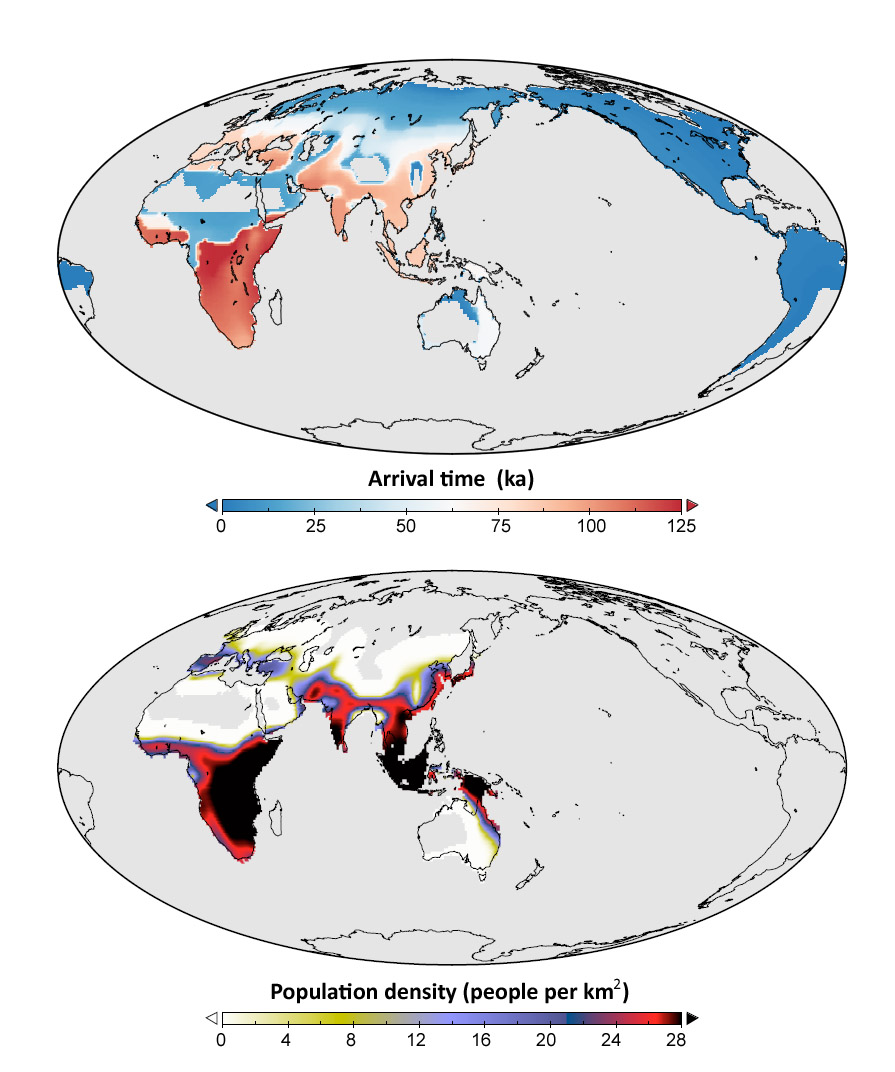
Three of these papers add almost 800 new, high-quality genomes to the 1000 Genomes Project that saw completion in 2015. The new data cover 270 populations from around the world including those of regions that have previously been understudied for a variety of reasons: Africa, Australia and Papua-New Guinea. All three genomic contributions are critically summarized by a Nature News and Views article (Tucci, S & Akey, J.L. 2016. A map of human wanderlust. http://dx.doi.org/10.1038/nature19472). The fourth paper pieces together accurately dated fossil and archaeological findings with data on climate and sea-level changes derived mainly from isotopic analyses of marine sediments and samples from polar ice sheets (Timmermann, A & Friedrich, T. 2016. Late Pleistocene climate drivers of early human migration. Nature, doi:10.1038/nature19365). Axel Timmermann and Tobias Friedrich of the University of Hawaii have attempted to simulate the overall dispersal of humans during the last 125 ka according to how they adapted to environmental conditions; mainly the changing vegetation cover as aridity varied geographically, together with the opening of potential routes out of Africa via the Straits of Bab el Mandab and through what is now termed the Middle East or Levant. They present their results as a remarkable series of global maps that suggest both the geographic spread of human migrants and how population density may have changed geographically through the last glacial cycle. Added to this are maps of the times of arrival of human populations across the world, according to a variety of migration scenarios. Note: the figure below estimates when AMH may have arrived in different areas and the population densities that environmental conditions at different times could have supported had they done so. Europe is shown as being possibly settled at around 70-75 ka, and perhaps having moderately high densities for AMH populations. Yet no physical evidence of European AMH is known before about 40 ka. Anatomically modern humans could have been in Europe before that time but failed to diffuse towards it, or were either repelled by or assimilated completely into its earlier Neanderthal population: perhaps the most controversial aspect of the paper.

timmermann
Estimated arrival time since the last continuous settlement of anatomically modern human migrants from Africa (top); estimated population densities around 60 thousand years ago. (Credit: Axel Timmermann University of Hawaii)

The role of climate change and even major volcanic activity – the 74 ka explosion of Toba in Indonesia – in both allowing or forcing an exodus from African homelands and channelling the human ‘line of march’ across Eurasia has been speculated on repeatedly. Now Timmermann and Friedrich have added a sophisticated case for episodic waves of migration across Arabia and the Levant at 106-94, 89-73, 59-47 and 45-29 ka. These implicate the role of Milankovich’s 21 ka cycle of Earth’s axial precession in opening windows of opportunity for both the exodus and movement through Eurasia; effectively like opening and closing valves for the flow of human movement. The paper is critically summarised by a Nature News and Views article (de Menocal, P.B. & Stringer, C. 2016. Climate and peopling of the world. Nature, doi:10.1038/nature19471.

This multiple-dispersal model for the spread of anatomically modern humans (AMH) finds some support from one of the genome papers (Pangani, L. and 98 others 2016. Genomic analyses inform on migration events during the peopling of Eurasia. Nature (online). http://dx.doi.org/10.1038/nature19792). A genetic signature in present-day Papuans suggests that at least 2% of their genome originates from an early and largely extinct expansion of AMH from Africa about 120 ka ago, compared with a split of all mainland Eurasians from African at around 75 ka. It appears from Pangani and co-workers’ analyses that later dispersals out of Africa contributed only a small amount of ancestry to Papuan individuals. The other two genome analyses (Mallick, S. and 79 others 2016. The Simons Genome Diversity Project: 300 genomes from 142 diverse populations. Nature (online) http://dx.doi.org/10.1038/nature18964; Malaspinas, A.-S. and 74 others 2016. A genomic history of Aboriginal Australia. Nature (online). http://dx.doi.org/10.1038/nature18299) suggest a slightly different scenario, that all present-day non-Africans branched from a single ancestral population. In the case of Malaspinas et al. an immediate separation of two waves of AMH migrants led to settlement of Australasia in one case and to the rest of Mainland Eurasia. Yet their data suggest that Australasians diverged into Papuan and Australian population between 25-40 ka ago. Now that is a surprise, because during the lead-up to the last glacial maximum at around 20 ka, sea level dropped to levels that unified the exposed surfaces of Papua and Australia, making it possible to walk from one to the other. These authors appeal to a vast hypersaline lake in the emergent plains, which may have deterred crossing the land bridge. Mallick et al. see an early separation between migrants from Africa who separately populated the west and east of Eurasia, with possible separation of Papuans and Australians from the second group.  These authors also show that the rate at which Eurasians accumulated mutations was about 5% faster than happened among Africans. Interestingly, Mallick et al. addressed the vexed issue of the origin of the spurt in cultural, particularly artistic, creativity after 50 ka that characterizes Eurasian archaeology. Although their results do not rule out genetic changes outside Africa linked to cultural change, they commented as follows:

‘… however, genetics is not a creative force, and instead responds to selection pressures imposed by novel environmental conditions or lifestyles. Thus, our results provide evidence against a model in which one or a few mutations were responsible for the rapid developments in human behaviour in the last 50,000 years. Instead, changes in lifestyles due to cultural innovation or exposure to new environments are likely to have been driving forces behind the rapid transformations in human behaviour …’.

Variations in interpretation among the four papers undoubtedly stem from the very different analytical approaches to climate and genomic data sets, and variations within the individual sets of DNA samples. So it will probably be some time before theoretical studies of the drivers of migration and work on global human genomics and cultural development find themselves unified. And we await with interest the pooling of results from all the different genetics labs and agreement on a common data-mining approach.

Wet spells in Arabia and human migration

In September 2014, Earth Pages  reported how remote sensing had revealed clear signs of extensive fossil drainage systems and lakes at the heart of the Arabian Peninsula, now the hyper-arid Empty Quarter (Rub al Khali). Their association with human stone artifacts dated as far back as 211 ka, those with affinities to collections from East Africa clustering between 74-90 ka, supported the sub-continent possibly having been an early staging post for fully modern human migrants from Africa. Member of the same archaeological team based at Oxford University have now published late Pleistocene palaeoclimatic records from alluvial-fan sediments in the eastern United Arab Emirates that add detail to this hypothesis (Parton, A. ­et al. 2015. Alluvial fan records from southeast Arabia reveal multiple windows for human dispersal. Geology, advance online publication doi:10.1130/G36401.1).

The eastern part of the Empty Quarter is a vast bajada formed from coalesced alluvial fans deposited by floods rising in the Oman Mountains and flowing westwards to disappear in the great sand sea of dunes. Nowadays floods during the Arabian Sea monsoons are few and far between, and restricted to the west-facing mountain front. Yet, older alluvial fans extend far out into the Empty Quarter, some being worked for aggregate used in the frantic building boom in the UAE. In one of the quarries, about 100 km south of the Jebel Faya Upper Palaeolithic tool site , the alluvial deposit contains clear signs of cyclical deposition in the form of 13 repeated gradations from coarse to fine waterlain sediment, each capped by fossil soils and dune sands. The soils contain plant remains that suggest they formed when the area was colonized by extensive grasslands formed under humid conditions.

Dating the sequence reveals that 6 of the cycles formed over a 10 thousand-year period between 158 to 147 ka, which coincides with a peak in monsoon intensity roughly between 160 and 150 ka during the glacial period that preceded the last one. Three later cycles formed at times of monsoon maxima during the last interglacial and in the climatic decline leading to the last glacial maximum, at ~128 to 115 ka, 105 to 95 ka, 85 to 74 ka. So, contrary to the long-held notion that the Arabian Peninsula formed a hostile barrier to migration, from time to time it was a well watered area that probably had abundant game. Between times, though, it was a vast, inhospitably dry place.

English: SeaWiFS collected this view of the Ar...
Satellite view of the Arabian Peninsula. The Oman mountains sweep in a dark arc south eastwards from the Staits of Hormuz at the mouth of the Persian Gulf. The brownish grey area to the south of the arc is the bajada that borders the bright orange Empty Quarter (credit: NOAA)

The authors suggest that the climatic cyclicity was dominated by a 23 ka period. As regards the southern potential migration route out of Africa, via the Straits of Bab el Mandab, which has been highly favoured by palaeoanthropologists lately, opportunities for migration in the absence of boats would have depended on sea-level lows. They do not necessarily coincide with wet windows of opportunity for crossing the cyclically arid Arabian peninsula that would allow both survival and proceeding onwards to south and east Asia. So far as I can judge, the newly published work seems to favour a northward then eastward means of migration, independent of fluctuations in land-ice volume and sea level, whenever the driest areas received sufficient water to support vegetation and game. In fact most of NE Africa is subject to the Arabian Sea monsoons, and when they were at their least productive crossing much of Ethiopia’s Afar depression and the coastal areas of Eritrea, Sudan and Egypt would have been almost as difficult as the challenge of the Empty Quarter.

Arabia : staging post for human migrations?

English: SeaWiFS collected this view of the Ar...
The Arabian Peninsula from the SeaWIFS satellite (credit: Wikipedia)

From time to time between 130 and 75 ka fully modern humans entered the Levant from Africa, which is backed up by actual fossils. But up to about 2010 most palaeoanthropologists believed that they moved no further, because of the growth of surrounding deserts, and probably did not return to the Middle East until around 45 ka. The consensus for the decisive move out of Africa to Eurasia centred on crossings of the Straits of Bab el Mandab at the entrance to the Red Sea, when sea level fell to a level that would have allowed a crossing by rafting over narrow seaways. The most likely time for such n excursion was during a brief cool/dry episode around 67 ka that coincided with an 80 m fall in global sea level: the largest since the previous glacial maximum (see Evidence for early journeys from Africa to Asia).

In 2011 finds reported from the United Arab Emirates of ‘East African-looking’ Middle Palaeolithic tools in sediment layers dated at 125, 95 and 40 ka led some to speculate that there must have been an eastward move from the Levant by anatomically modern humans (see Human migration – latest news). That view stemmed from the fact that the earliest date was during the last interglacial when sea level would have been as high as it is today, and around 95 ka it would have been little different. That report coincided with others about freshwater springs having emanated from uplifted reefs around the edges of the Arabian Peninsula during the last interglacial, and the existence of substantial lakes deep within the subcontinent around that time (see Water sources and early migration from Africa). Substantial funding followed such exciting news and results of new research are just beginning to emerge (Lawler, A. 2014. In search of Green Arabia. Science, v. 345, p. 994-999).

Oasis of Green Mubazzarah near Al Ain
Al Ain, a rare spring-fed oasis in the eastern Rub al Khali near the UAE-Oman border (credit: Wikipedia)

A team led by Michael Petraglia of the University of Oxford has used field surveys and remote sensing to reveal a great many, now-vanished lakes across the Arabian Peninsula, including many in the fearsome Rub al Khali or Empty Quarter. They are linked by an extensive, partly sand-hidden network of palaeochannels, which include several of the major wadis; a system that once drained towards the Persian Gulf. As well as abundant freshwater molluscs and other invertebrates, former lakeshore sediments are littered with huge numbers of stone tools, also with East African affinities (Scerri, E.M.L. et al. 2014. Unexpected technological heterogeneity in northern Arabia indicates complex Late Pleistocene demography at the gateway to Asia. Journal of Human Evolution, In Press http://dx.doi.org/10.1016/j.jhevol.2014.07.002). Using optically stimulated luminescence dating, which shows how long stone objects have been buried, the British team has found tools dating back as long as 211 ka, with a cluster of dates between 90 to 74 ka. Modern humans, Neanderthals and even Denisovans may have made these tools; only associated fossil remains will tell. Yet it is already clear that for lengthy periods – perhaps of a few hundred or thousand years – the hyper-arid interior of Arabia was decidedly habitable. It may have been a thriving outpost of emigrants from Africa, whose abandonment as climate shifted to extreme dryness as the last interglacial gave way to Ice Age conditions, could well have been the source of the great migration that colonised the rest of the habitable world. Petraglia’s team has already courted controversy with their claim for anatomically modern humans’ tools in South Indian volcanic ash beds that date to the Toba eruption around 74 ka: considerably earlier than the more widely accepted post-65 ka dates of human eastward migration.