Detecting oxygenic photosynthesis in the Archaean Earth System

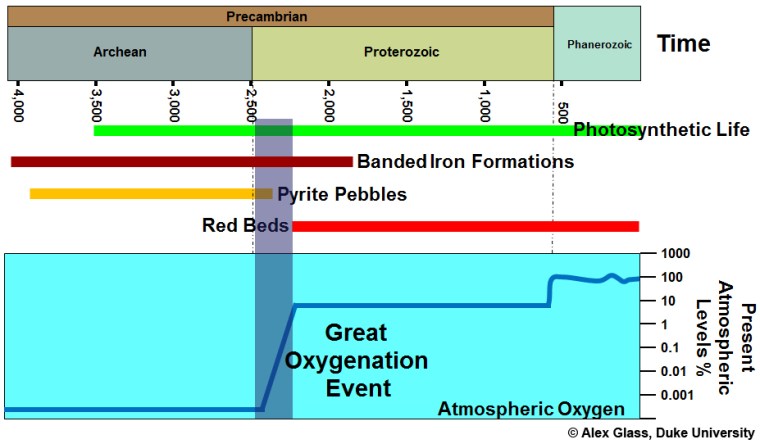
For life on Earth, one of the most fundamental shifts in ecosystems was the Great Oxygenation Event 2.5 to 2.3 billion years (Ga) ago. The first evidence for its occurrence was from the sedimentary record, particularly ancient soils (palaeosols) that mark exposure of the continental surface above sea level and rock weathering. Palaeosols older than 2.4 Ga have low iron contents that suggest iron was soluble in surface waters, i.e. in its reduced bivalent form Fe2+. Sediments formed by flowing water also contain rounded grains of minerals that in today’s oxygen-rich environments are soon broken down and dissolved through oxidising reactions, for instance pyrite (FeS2) and uraninite (UO2). After 2.4 Ga palaeosols are reddish to yellowish brown in colour and contain insoluble oxides and hydroxides of Fe3+ principally hematite (Fe2O3) and goethite (FeO.OH). After this time sediments deposited by wind action and rivers are similar in colour: so-called ‘redbeds’. Following the GOE the atmosphere initially contained only traces of free oxygen, but sufficient to make the surface environment oxidising. In fact such an atmosphere defies Le Chatelier’s Principle: free oxygen should react rapidly with the rest of the environment through oxidation. That it doesn’t shows that it is continually generated as a result of oxygenic photosynthesis. The CO2 + H2O = carbohydrate + oxygen equilibrium does not reach a balance because of continual burial of dead organic material.

Free oxygen is a prerequisite for all multicelled eukaryotes, and it is probably no coincidence that fossils of the earliest known ones occur in sediments in Gabon dated at 2.1 Ga: 300 Ma after the Great Oxygenation Event. However, the GOE relates to surface environments of that time. From 2.8 Ga – in the Mesoarchaean Era – to the late Palaeoproterozoic around 1.9 Ga, vast quantities of Fe3+ were locked in iron oxide-rich banded iron formations (BIFs): roughly 105 billion tons in the richest deposits alone (see: Banded iron formations (BIFs) reviewed; December 2017). Indeed, similar ironstones occur in Archaean sedimentary sequences as far back as 3.7 Ga, albeit in uneconomic amounts. Paradoxically, enormous amounts of oxygen must have been generated by marine photosynthesis to oxidise Fe2+ dissolved in the early oceans by hydrothermal alteration of basalt lava upwelling from the Archaean mantle. But none of that free oxygen made it into the atmosphere. Almost as soon as it was released it oxidised dissolved Fe2+ to be dumped as iron oxide on the ocean floor. Before the GOE that aspect of geochemistry did obey Le Chatelier!

A limestone made of stromatolites

The only likely means of generating oxygen on such a gargantuan scale from the earliest Archaean onwards is through teeming prokaryote organisms capable of oxygenic photosynthesis. Because modern cyanobacteria do that, the burden of the BIFs has fallen on them. One reason for that hypothesis stems from cyanobacteria in a variety of modern environments building dome-shaped bacterial mats. Their forms closely resemble those of Archaean stromatolites found as far back as 3.7 Ga. But these are merely peculiar carbonate bodies that could have been produced by bacterial mats which deploy a wide variety of metabolic chemistry. Laureline Patry of the Université de Bretagne Occidentale, Plouzané, France, and colleagues from France, the US, Canada and the UK have developed a novel way of addressing the opaque mechanism of Archaean oxygen production (Patry, L.A. and 12 others. Dating the evolution of oxygenic photosynthesis using La-Ce geochronology. Nature, v. 642, p. 99-104; DOI: 10.1038/s41586-025-09009-8).

They turned to the basic geochemistry of rare earth elements (REE) in Archaean stromatolitic limestones from the Superior Craton of northern Canada. Of the 17 REEs only cerium (Ce) is capable of being oxidised in the presence of oxygen. As a result Ce can be depleted relative to its neighbouring REEs in the Periodic Table, as it is in many Phanerozoic limestones. Five samples of the limestones show consistent depletion of Ce relative to all other REE. It is also possible to date when such fractionation occurred using 138La– 138Ce geochronology.  The samples were dated at 2.87 to 2.78 Ga (Mesoarchaean), making them the oldest limestones that show Ce anomalies and thus oxygenated seawater in which the microbial mats thrived. But that is only 300 Ma earlier than the start of the GOE. Stromatolites are abundant in the Archaean record as far back as 3.4 Ga, so it should be possible to chart the link between microbial carbonate mats and oxygenated seawater to a billion years before the GOE, although that does not tell us about the kind of microbes that were making stromatolites.

See also: Tracing oxygenic photosynthesis via La-Ce geochronology. Bioengineer.org, 29 May 2025; Allen, J.F. 2016. A proposal for formation of Archaean stromatolites before the advent of oxygenic photosynthesis. Frontiers in Microbiology, v. 7; DOI: 10.3389/fmicb.2016.01784.

Did Precambrian BIFs ‘fall’ into the mantle to trigger mantle plumes?

How the Earth has been shaped has depended to a large extent on a very simple variable among rocks: their density. Contrasts in density between vast rock masses are expressed when gravity attempts to maintain a balance of forces. The abrupt difference in elevation of the solid surface at the boundaries of oceans and continents – the Earth’s hypsometry – stems from the contrasted densities of continental and oceanic crust: the one dominated by granitic rocks (~2.8 t m-3) the other by those of basaltic composition (~ 3.0 t m-3). Astronomers have estimated that Earth’s overall density is about 5.5 t m-3 – it is the densest planet in the Solar System. The underlying mantle makes up 68% of Earth’s mass, with a density that increases with depth from 3.3 to 5.4 t m-3 in a stepwise fashion, at a number of discontinuities, because mantle minerals undergo changes induced by pressure. The remaining one third of Earth’s mass resides in the iron-nickel core at densities between 9.5 to 14.5 t m-3. Such density layering is by no means completely stable. Locally increased temperatures in mantle rocks reduce their density sufficiently for masses to rise convectively to be replaced by cooler ones, albeit slowly. By far the most important form of convection affecting the lithosphere involves the resorption of oceanic lithosphere plates at destructive margins, which results in subduction. This is thought to be due to old, cold oceanic basalts undergoing metamorphism as pressure increases during subduction. They are transformed at depth to a mineral assemblage (eclogite) that is denser (3.4 to 3.5 t m-3) than the enveloping upper mantle. That density contrast is sufficient for gravity to pull slabs of oceanic lithosphere downwards. This slab-pull force is transmitted through oceanic lithosphere that remains at the surface to become the dominant driver of modern plate tectonics. As a result, extension of the surface oceanic lithosphere at constructive margins draws mantle upwards to partially melt at reduced pressure, thus adding new basaltic crust at mid-ocean rift systems to maintain a form of mantle convection. Seismic tomography shows that active subducted slabs become ductile about 660 km beneath the surface and below that no earthquakes are detected. Quite possibly, the density of the reconstituted lithospheric slab becomes less than that of the mantle below the 660 km discontinuity. So the subducted slab continues by moving sideways and buckling in response to the ‘push’ from its rigid upper parts above. But it has been suggested that some subducted slabs do finally sink to the core-mantle boundary, but that is somewhat conjectural.

Typical banded iron formation

There are sedimentary rocks whose density at the surface exceeds that of the upper mantle: banded iron formations (BIFs) that contain up to 60% iron oxides (mainly Fe2O3) and have an average density at the surface of around 3.5 t m-3. BIFs formed mainly in the late Archaean and early Proterozoic Eons  (3.2 to 1.0 Ga) and none are known from the last 400 Ma. They formed when soluble iron-2 (Fe2+) – being added to ocean water by submarine hydrothermal activity –was precipitated as Fe3+ in the form of iron oxide (Fe2O3) where oxygen was present in ocean water. With little doubt this happened only in shallow marine basins where cyanobacteria that appeared about 3.5 Ga ago had sufficient sunlight to photosynthesise. Until about 2.4 Ga the atmosphere and thus the bulk of ocean water contained very little oxygen so the oceans were pervaded by soluble iron so that BIFs were able to form wherever such biological activity was going on. Conceivably (but not proven), that BIF-forming biochemical reaction may even have operated far from land in ocean surface water, slowly to deposit Fe2O3 on the deep ocean floor. After 2.4 Ga oxygen began to build in the atmosphere after the Great Oxidation Event had begon. That time was also when the greatest production of BIFs took place. Strangely, the amount of BIF in the geological record fell during the next 600 Ma to rise again to a very high peak at 1.8 Ga. Since there must have been sufficient soluble iron and an increasing amount of available oxygen for BIFs to form throughout that ‘lean’ period the drop in BIF formation is paradoxical. After 1.0 Ga BIFs more or less disappear. By then so much oxygen was present in the atmosphere and from top to bottom in ocean water that soluble iron was mostly precipitated at its hydrothermal source on the ocean floor. Incidentally, modern ocean surface water far from land contains so little dissolved iron that little microbiological activity goes on there: iron is an essential nutrient so the surface waters of remote oceans are effectively ‘wet deserts’.

Plots of probability of LIPs and BIFs forming at the Earth’s surface during Precambrian times, based on actual occurrences (Credit: Keller, et al., modified Fig 1A)

Spurred by the fact that if a sea-floor slab dominated by BIFs was subducted it wouldn’t need eclogite formation to sink into the mantle, Duncan Keller of Rice University in Texas and other US and Canadian colleagues have published a ‘thought experiment’ using time-series data on LIPs and BIFs compiled by other geoscientists (Keller, D.S. et al. 2023. Links between large igneous province volcanism and subducted iron formations. Nature Geoscience, v. 16, article; DOI: 10.1038/s41561-023-01188-1.). Their approach involves comparing the occurrences of 54 BIFs through time with signs of activity in the mantle during the Palaeo- and Mesoproterozoic Eras, as marked by large igneous provinces (LIPs) during that time span. To do this they calculated the degree of correlation in time between BIFs and LIPs. The authors chose a minimum area for LIPs of 400 thousand km2 – giving a total of 66 well-dated examples. Because the bulk of Precambrian flood-basalt provinces, such as occurred during the Phanerozoic, have been eroded away, most of their examples are huge, well-dated dyke swarms that almost certainly fed such plateau basalts. Rather than a direct time-correlation, what emerged was a match-up that covered 74% of the LIPs with BIFs that had formed about 241 Ma earlier. They also found a less precise correlation between LIPs associated with 241 Ma older BIFs and protracted periods of stable geomagnetic field, known as ‘superchrons’. These are thought by geophysicists to be influenced by heat flow through the core-mantle boundary (CMB).

The high bulk density of BIFs at the surface would be likely to remain about 15 % greater than that of peridotite as pressure increased with depth in the mantle. Such slabs could therefore penetrate the 660 mantle discontinuity. Their subduction would probably result in their eventually ‘piling up’ in the vicinity of the CMB. The high iron content of BIFs may also have changed the way that the core loses heat, thereby triggering mantle plumes. Certainly, there is a complex zone of ultra-low seismic velocities (ULVZ) that signifies hot, ductile material extending above the CMB. Because BIFs’ high iron-content makes them thermally highly conductive compared with basalts and other sediments, they may be responsible. Clearly, Keller et al’s hypothesis is likely to be controversial and they hope that other geoscientists will test it with new or re-analysed geophysical data. But the possibility of BIFs falling to the base of the mantle spectacularly extends the influence of surface biological processes to the entire planet. And, indeed, it may have shaped the later part of its tectonic history having changed the composition of the deep mantle. The interconnectedness of the Earth system also demands that the consequences – plumes and large igneous provinces – would have fed back to the Precambrian biosphere. See also: Iron-rich rocks unlock new insights into Earth’s planetary history, Science Daily, 2 June 2023

Multiple impacts set back oxygen build-up in the Archaean

Earth’s present atmosphere contains oxygen because of one form of photosynthesis that processes water and carbon dioxide to make plant carbohydrates, leaving oxygen at a waste product. The photochemical trick that underpins oxygenic photosynthesis seems only to have evolved once. It was incorporated in a simple, single-celled organism or prokaryote, which lacks a cell nucleus but contains the necessary catalyst chlorophyll. Such an organism gave rise to cyanobacteria or blue-green bacteria, which still make a major contribution to replenishing atmospheric oxygen. Chloroplasts that perform the same function in plant cells are so like cyanobacteria that they were almost certainly co-opted during the evolution of a section of nucleus-bearing eukaryotes that became the ancestors of plants. A range of evidence suggests that oxygenic photosynthesis appeared during the Archaean Eon, the most tangible being the presence of stromatolites, which cyanobacteria mats or biofilms form today. These knobbly structures in carbonate sediments extend as far back as 3.5 billion years ago (see: Signs of life in some of the oldest rocks; September 2016). Yet it took a billion years before the first inklings of biogenic oxygen production culminated in the Great Oxygenation Event or GOE (see: Massive event in the Precambrian carbon cycle; January, 2012) at around 2400 Ma. Then, for the first time, oxidised iron in ancient soils turned them red. If oxygen was being produced, albeit in small amounts, in shallow, sunlit Archaean seas, why didn’t it build up in the atmosphere of those times? Geochemical analyses of Archaean sediments do point to trace amounts, with a few ‘whiffs’ of more substantial amounts. But they fall well below those of Meso- and Neoproterozoic and Phanerozoic times. One hypothesis is that Archaean oceans contained dissolved, ferrous iron (Fe2+) – a powerful reducing agent – with which available oxygen reacted to form insoluble ferric iron (Fe3+) oxides and hydroxides that formed banded iron formations (BIFS). The Fe2+ in this hypothesis is attributed to hydrothermal activity in basaltic oceanic crust. There is, however, another possibility for suppression of atmospheric oxygen accumulation in the Archaean and early-Palaeoproterozoic.

Summary of the evolution of atmospheric oxygen and related geological features. The percentage scale is logarithmic with the modern level being100%. Credit Alex Glass, Duke University

Simone Marchi of the Southwest Research Institute of Boulder, CO, USA and colleagues from the US, Austria and Germany suggest that planetary bombardment offers a plausible explanation (Marchi, S. et al 2021. Delayed and variable late Archaean atmospheric oxidation due to high collision rates on Earth. Nature Geoscience, v. 14 advance publication; DOI: 10.1038/s41561-021-00835-9). Over the last 20 years evidence of extraterrestrial impacts has emerged, in the form of thin spherule-bearing layers in Archaean sedimentary strata, probably formed by impacts of objects around 10 km across. So far 35 such layers have been identified from several locations in South Africa and Western Australia. They span the last billion years of the Archaean and the earliest Palaeoproterozoic, although they are not evenly spaced in time. The spherules represent droplets of mainly crustal but some meteoritic rocks that were vaporised by impacts and then condensed as liquid. Meteorites in particular contain reduced elements and compounds, including iron, whose oxidation by would remove free oxygen.

The evidence from spherule beds is supplemented by the team’s new calculations of the likely flux of impactors during the Archaean. These stem from re-evaluation of the lunar cratering record that is used to estimate the number and size of impacts on Earth up to 2.5 Ga ago. This flux amounts to the ‘leftovers’ of the catastrophic period around 4.1 Ga when the giant planets Jupiter and Saturn ran amok before they settled into their present orbits. Their perturbation of gravitational fields in the solar system injected a long-lived supply of potential impactors into the inner solar system, which is recorded by craters on the post-4.1 Ga lunar maria. The calculations suggest that the known spherule layers underestimate the true number of such collisions on Earth. Modelling by Marchi et al., based on the meteorite flux and the oxidation of vaporised materials produced by impacts, plausibly accounts for the delay in atmospheric oxygen build-up.

It is worth bearing in mind, however, that large impacts and their geochemical aftermath are, in a geological sense, instantaneous events widely spaced in time. They may have chemically ‘sucked’ oxygen out of the Archaean and early-Palaeoproterozoic atmosphere. Yet photosynthesising bacteria would have been generating oxygen continuously between such sudden events. The same goes for the supply of reduced ferrous iron and its circulation in the oceans of those times, capable of scavenging available oxygen through simple chemical reactions. In fact we can still observe that in action around ocean-floor hydrothermal vents where a host of reduced elements and compounds are oxidised by dissolved oxygen. The difference is that oxygen is now produced more efficiently on land and in the upper oceans and a less vigorous mantle is adding less iron-rich basalt magma to the crust: the balance has changed. Another issue is that the Great Oxygenation Event terminated the oxygen-starved conditions of the Archaean and Palaeoproterozoic in about 200 million years, despite the vast production of BIFs before and after it happened. The Wikipedia entry for the GOE provides a number of hypotheses for how that termination came about. Interestingly, one idea looks to a shortage of dissolved nickel that is vital for methane generating bacteria: a nickel ‘famine’. A geochemical setback for methanogens would have been a boost for oxygenic photosynthesisers and especially their waste product oxygen: methane quickly reacts with oxygen in the atmosphere to produce CO2 and water. Anomalously high nickel is a ‘signature element’ for meteorite bombardment, though it can be released by hydrothermal alteration of basalt. Had meteoritic nickel been fertilising methane-generating bacteria in the oceans prior to the GOE?

See also: A new Earth bombardment model. Science Daily, 21 October 2021.

Breathing spaces or toxic traps in the Archaean ocean


The relationship between Earth’s complement of free oxygen and life seems to have begun in the Archaean, but it presented a series of paradoxes: produced by photosynthetic organisms oxygen would have been toxic to most other Archaean life forms; its presence drew an important micronutrient, dissolved iron-2, from sea water by precipitation of iron-3 oxides; though produced in seawater there is no evidence until about 2.4 Ga for its presence in the air. It has long been thought that the paradoxes may have been resolved by oxygen being produced in isolated patches, or ‘oases’ on the Archaean sea floor, where early blue-green bacteria evolved and thrived.


A stratigraphic clue to the former presence of such oxygen factories is itself quite convoluted. The precipitation of calcium carbonates and therefore the presence of limestones in sedimentary sequences are suppressed by dissolved iron-2: the presence of Fe2+ ions would favour the removal of bicarbonate ions from seawater by formation of ferrous carbonate that is less soluble than calcium carbonate. Canadian and US geochemists studied one of the thickest Archaean limestone sequences, dated at around 2.8 Ga, in the wonderfully named Wabigoon Subprovince of the Canadian Shield which is full of stromatolites, bulbous laminated masses probably formed from bacterial biofilms in shallow water (Riding, R. et al. 2014. Identification of an Archean marine oxygen oasis. Precambrian Research, v. 251, p. 232-237).

English: Stromatolites in the Hoyt Limestone (...
Limestone formed from blue-green bacteria biofilms or stromatolites (credit: Wikipedia)

Limestones from the sequence that stable isotope analyses show to remain unaltered all have abnormally low cerium concentrations relative to the other rare-earth elements. Unaltered limestones from stromatolite-free, deep water limestones show no such negative Ce anomaly. Cerium is the only rare-earth element that has a possible 4+ valence state as well one with lower positive charge. So in the presence of oxygen cerium can form an insoluble oxide and thus be removed from solution. So cerium independently shows that the shallow water limestones formed in seawater that contained free oxygen. Nor was it an ephemeral condition, for the anomalies persist through half a kilometer of limestone.


The study shows that anomalous oxygenated patches existed on the Archaean sea floor, probably shallow-water basins or shelves isolated by the build up of stromatolite reef barriers. For most prokaryote cells they would have harboured toxic conditions, presenting them with severe chemical stress. Possibly these were the first places where oxygen defence measures evolved, that eventually led to more complex eukaryote cells that not only survive oxygen stress but thrive on its presence. That conjecture is unlikely to be fully proved, since the first undoubted fossils of eukaryote cells, known as acritarchs, occur in rocks that are more than 800 Ma years younger.