Modelling climate change since the Devonian

A consortium of geoscientists from Australia, Britain and France, led by Andrew Merdith of the University of Adelaide examines the likely climate cooling mechanisms that may have set off the two great ‘icehouse’ intervals in the last 541 Ma (Merdith, A.S. et al. 2025. Phanerozoic icehouse climates as the result of multiple solid-Earth cooling mechanisms. Science Advances, v. 11, article eadm9798: DOI: 10.1126/sciadv.adm9798). They consider the first to be the global cooling that began in the latter part of the Devonian culminating in the Carboniferous-Permian icehouse. The second is the Cenozoic global cooling to form the permanent Antarctic ice cap around 34 Ma and culminated in cyclical ice ages on the northern continents after 2.4 Ma during the Pleistocene. They dismiss the 40 Ma long, late Ordovician to early Silurian glaciation that left its imprint on North Africa and South America –  then combined in the Gondwana supercontinent. The data about two of the parameters used in their model – the degree of early colonisation of the continents by plants and their influence on terrestrial weathering are uncertain in that protracted event.  Yet the Hirnantian glaciation reached 20°S at its maximum extent in the Late Ordovician around 444 Ma to cover about a third of Gondwana: it was larger than the present Antarctic ice cap. For that reason, their study spans only Devonian and later times.

Fluctuation in evidence for the extent of glacial conditions since the Devonian: the ‘ice line’ is grey. The count of glacial proxy occurrences in each 10° of latitude through time is shown in the colour key. Credit: Merdith et al., Fig 2A.

Merdith et al. rely on four climatic proxies. The first of these comprises indicators of cold climates, such as glacial dropstones, tillites and evidence in sedimentary rocks of crystals of hydrated calcium carbonate (ikaite – CaCO3.6H2O) that bizarrely forms only at around 0°C . From such occurrences it is possible to define an ‘ice line’ linking different latitudes through geological time. Then there are estimates of global average surface temperature; low-latitude sea surface temperature; and estimates of atmospheric CO2. The ‘ice-line’ data records an additional, long period of glaciation in the Jurassic and early Cretaceous, but evidence does not extend to latitudes lower than 60°. It is regarded by Merdith et al. as an episode of ‘cooling’ rather than an ‘icehouse’. Their model assesses sources and sinks of COsince the Devonian Period.

The main natural source of the principal greenhouse gas CO2 is degassing through volcanism expelled from the mantle and breakdown of carbonate rock in subducted lithosphere. Natural sequestration of carbon involves weathering of exposed rock that releases dissolved CO2 and ions of calcium and magnesium.   A recently compiled set of plate reconstructions that chart the waxing and waning of tectonics since the Devonian Period allows them to model the tectonically driven release of carbon over time, with time scales on the order of tens to hundreds of Ma. The familiar Milanković forcing cycles on the order of tens to hundreds of ka are thus of no significance in Merdith et al.’s  broader conception of icehouse episodes  Their modelling shows high degassing during the Cretaceous, modern levels during the late Palaeozoic and early Mesozoic, and low emissions during the Devonian. The model also suggests that cooling stemmed from variations in the positions and configuration of continents over time.  Another crucial factor is the tempo of exposure of rocks that are most prone to weathering. The most important are rocks of the ocean lithosphere incorporated into the continents to form ophiolite masses. The release of soluble products of weathering into ocean basins through time acts as a fluctuating means of ‘fertilising’ so that more carbon can be sequestered in deep sediments in the form of organisms’ unoxidised tissue and hard parts made of calcium carbonates and phosphates. Less silicate weathering results in a boost to atmospheric CO2.

Only two long, true icehouse episodes emerge from the empirical proxy data, expressed by the ‘ice-line’ plots. Restricting the modelling to single global processes that might be expected to influence degassing or carbon sequestration produces no good fits to the climatic proxy data. Running the model with all the drivers “off” produces more or less continuous icehouse conditions since the Devonian. The model’s climate-related outputs thus imply that many complex processes working together in syncopation may have driven the gross climate vagaries over the last 400 Ma or so. A planet of Earth’s size without such complexity would throughout that period have had a high-CO2 warm climate. According to Andrew Merdith its fluctuation from greenhouse to icehouse conditions in the late Palaeozoic and the Cenozoic were probably due to “coincidental combination of very low rates of global volcanism, and highly dispersed continents with big mountains, which allow for lots of global rainfall and therefore amplify reactions that remove carbon from the atmosphere”.

Geological history is, almost by definition, somewhat rambling. So, despite despite the large investment in seeking a computed explanation of data drawn from the record, the outcome reflects that in a less than coherent account. To state that many complex processes working at once may have driven climate vagaries over the last 400 Ma or so, is hardly a major advance: palaeoclimatologists have said more or less the same for a couple of decades or more, but have mainly proposed single driving mechanisms. One aspect of Merdith et al.’s  results seems to be of particular interest. ‘Icehouse’ conditions seem to be rare events interspersed with broader ice-free periods. We evolved within the mammal-dominated ecosystems on the continents during the latest of these anomalous climatic episodes. And we and those ecosystems now rely on a cool world. As the supervisor of the project commented, ‘Over its long history, the Earth likes it hot, but our human society does not’.

Readers may like to venture into how some philosophers of science deal with a far bigger question; ‘Is intelligent life a rare, chance event throughout the universe?’ That is, might we be alone in the cosmos? In the same issue of Science Advances is a paper centred on just such questions (Mills, D.B. et al. 2025. A reassessment of the “hard-steps” model for the evolution of intelligent life. Science Advances, v. 11, article eads5698; DOI: 10.1126/sciadv.ads5698). It stems from cosmologist Brandon Carter’s ‘Anthropic Principle’ first developed at Nicolas Copernicus’s 500th birthday celebrations in 1973. This has since been much debated by scientists and philosophers – a gross understatement as it knocks the spots off the Drake Equation. To take the edge off what seems to be a daunting task, Mills et al. consider a corollary of the Anthropic Principle, the ‘hard steps model’. That, in a nutshell, postulates that the origin of humanity and its ability to ponder on observations of the universe required a successful evolutionary passage through a number of hard steps. It predicts that such intelligence is ‘exceedingly rare’ in the universe. Icehouse conditions are respectable candidates for evolutionary ‘hard steps’, and in the history of Earth there have been five of them.

A fully revised edition of Steve Drury’s book Stepping Stones: The Making of Our Home World can now be downloaded as a free eBook

Influence of massive igneous intrusions on end-Triassic mass extinction

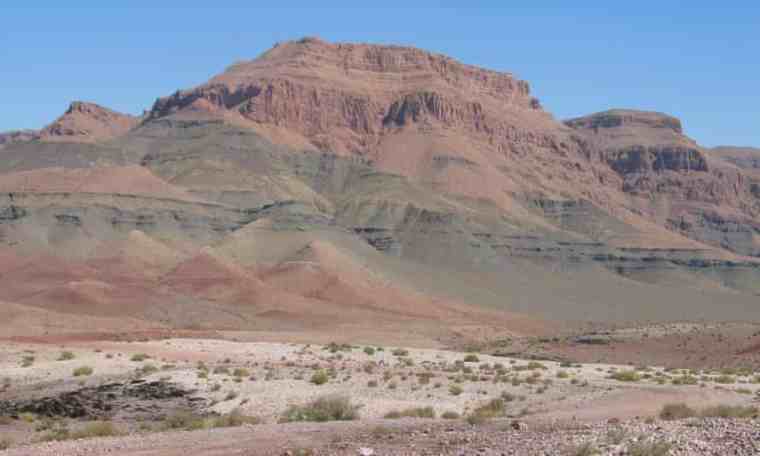
About 200 Ma ago, the break-up of the Pangaea supercontinent was imminent. The signs of impending events are spread through the eastern seaboard of North America, West Africa and central and northern South America. Today, they take the form of isolated patches of continental flood basalts, dyke swarms – probably the feeders for much more extensive flood volcanism – and large intrusive sills. Break-up began with the separation of North America from Africa and the start of sea-floor spreading that began to form the Central Atlantic Ocean: hence the name Central Atlantic Magmatic Province (CAMP) for the igneous activity. It all kicked off at the time of the Triassic-Jurassic stratigraphic boundary, and a mass extinction with a similar magnitude to that at the end of the Cretaceous. Disappearances of animals in the oceans and on continents were selective rather than general, as were extinctions of land plants. The mass extinction is estimated to have taken about ten thousand years. It left a great variety of ecological niches ready for re-occupation. On land a small group of reptiles with a substantial destiny entered some of these vacant niches. They evolved explosively to the plethora of later dinosaurs as their descendants became separated as a result of continental drift and adaptive radiation.

Flood basalts of the Central Atlantic Magmatic Province in Morocco (Credit: Andrea Marzoli)

The end-Triassic mass extinction, like three others of the Big Five, was thus closely associated in time with massive continental flood volcanism: indeed one of the largest such events. Within at most 10 ka large theropod dinosaurs entered the early Jurassic scene of eastern North America. The Jurassic was a greenhouse world whose atmosphere had about five times more CO2, a mean global surface temperature between 5 and 10°C higher and deep ocean temperatures 8°C above those at present. Was mantle carbon transported by CAMP magmas the main source (widely assumed until recently) or, as during the end-Permian mass extinction, was buried organic carbon responsible? A multinational group of geoscientists have closely examined samples from a one million cubic kilometre stack of intrusive basaltic sills, dated at 201 Ma, in the Amazon basin of Brazil that amount to about a third of all CAMP magmatism (Capriolo, M. and 11 others 2021. Massive methane fluxing from magma–sediment interaction in the end-Triassic Central Atlantic Magmatic ProvinceNature Communications, v. 12, article 5534; DOI: 10.1038/s41467-021-25510-w).

The team focussed on fluid inclusions in quartz within the basaltic sills that formed during the late stages of their crystallisation. The tiny inclusions contain methane gas and tiny crystals of halite (NaCl) as well as liquid water. Such was the bulk composition of the intrusive magma that the presence of around 5% of quartz in the basalts would be impossible without their magma having assimilated large volumes of silica-rich sedimentary rocks such as shales. The host rocks for the huge slab of igneous sills are sediments of Palaeozoic age: a ready source for contamination by both organic carbon and salt. The presence of methane in the inclusions suggests that more complex hydrocarbons had been ‘cracked’ by thermal metamorphism. Moreover, it is highly unlikely to have been derived from the mantle, partly because methane has been experimentally shown not to be soluble in basaltic magmas whereas CO2 is. The authors conclude that both quartz and methane entered the sills in hydrothermal fluids generated in adjacent sediments. Thermal metamorphism of the sediments would also have driven such fluids to the surface to inject methane directly to the atmosphere. Methane is 25 times as potent as carbon dioxide at trapping heat in the atmosphere, yet it combines with the hydroxyl (OH) radical to form CO2 and water vapour within about 12 years. Nevertheless during continuous emission methane traps 84 times more heat in the atmosphere than would an equivalent mass of carbon dioxide.

Calculations suggest about seven trillion tonnes of methane were generated by the CAMP intrusions in Brazil. Had the magmas mainly been extruded as flood basalts then perhaps global warming at the close of the Triassic would have been far less. Extinctions and subsequent biological evolution would have taken very different paths; dinosaurs may not have exploded onto the terrestrial scene so dramatically during the remaining 185 Ma of the Mesozoic. So it seems important to attempt an explanation of why CAMP magmas in Brazil did not rise to the surface but stayed buried as such stupendous igneous intrusions. Work on smaller intrusive sills suggests that magmas that are denser than the rocks that they pass through – as in a large, thick sedimentary basin – are forced by gravity to take a lateral ‘line of least resistance’ to intrude along sedimentary bedding. That would be aided by the enormous pressure of steam boiled from wet sedimentary rocks forcing beds apart. In areas where only thin sedimentary cover rests on crystalline, more dense igneous and metamorphic rocks, basaltic magma has a greater likelihood of rising through vertical dyke swarms to reach the surface and form lava floods.

Hot-spot track beneath the Greenland ice cap

Around 63 Ma ago, during the Palaeocene Epoch, major igneous activity broke out in what are now both sides of the North Atlantic Ocean. After initial sputtering it culminated massively between 57 and 53 Ma. Relics are to be seen in Baffin Island, West and East Greenland, the Faeroes and north-western parts of the British Islands, in the form of flood basalts, dyke swarms and scattered remnants of central volcanoes. Offshore drilling on the North Atlantic’s continental shelves suggests that the volcanism extended over 1.3 million km2 and blurted out around 6.6 million km3 of magma. Not for nothing have the products of this event been categorised as a Large Igneous Province. Its formation took place before the North Atlantic existed. It began to form as this precursor magmatic paroxysm waned.  Continued basaltic magma production created the ocean floor each side of the mid-Atlantic Ridge system to divide North America and Greenland from northern Europe. Sea floor spreading continues, rising above sea level in Iceland, which is underlain by a large mantle plume.

The plume beneath Iceland may have been present at a fixed position in the mantle for tens of million years. A hot spot over which plate movements have shifted lithosphere to be heated in a similar way to a sheet of paper dragged slowly over a candle flame. The Iceland plume may have left a hot-spot track similar to that involved in the Hawaiian island chain. The ocean floor to the east and west of Iceland is shallower and forms broad rides at right angles to the trend of the Mid-Atlantic Ridge system, judged to be such tracks that are still warm and buoyant after formation over the plume. But are there traces of earlier passage of drifting lithosphere over the plume. A way to detect older hot-spot tracks is through variations in geothermal heat flow through the continental surface, a linear pattern raising suspicions of such trace of passage. There is no sign to the east beneath Europe, so what about to the west. Greenland, being mainly blanketed in ice, is not a good place to conduct such a search as it would involve deep drilling through the ice at huge cost for each hole. But there is a roundabout way of obtaining geothermal information without even setting foot on Greenland’s icy wastes.

The geomagnetic field measured at the surface records anomalies in rock magnetisation in the solid Earth beneath. Near-surface variations due to large variations in rock types that comprise the continental crust appear as sharp, high frequency signals. Aeromagnetic surveys over Greenland are characterised by such noisy patterns because the subsurface geology is extremely complicated. However, the underlying upper mantle beneath all continents is geologically quite bland, but being uniformly rich in iron it contains a high proportion of magnetic minerals such as magnetite (Fe3O4). The upper mantle should therefore leave a signal in the surface geomagnetic field, albeit a commensurately bland one. Like radio signals that span a large range of wavelengths, Earth properties that vary spatially, such as the geomagnetic field, may be analysed using filters. Once the high-frequency geomagnetic features of the crust are filtered out what should remain is a signal that reflects the magnetic structure of the upper mantle. It should be more or less featureless, yet beneath Greenland it isn’t.

greenland hot spot
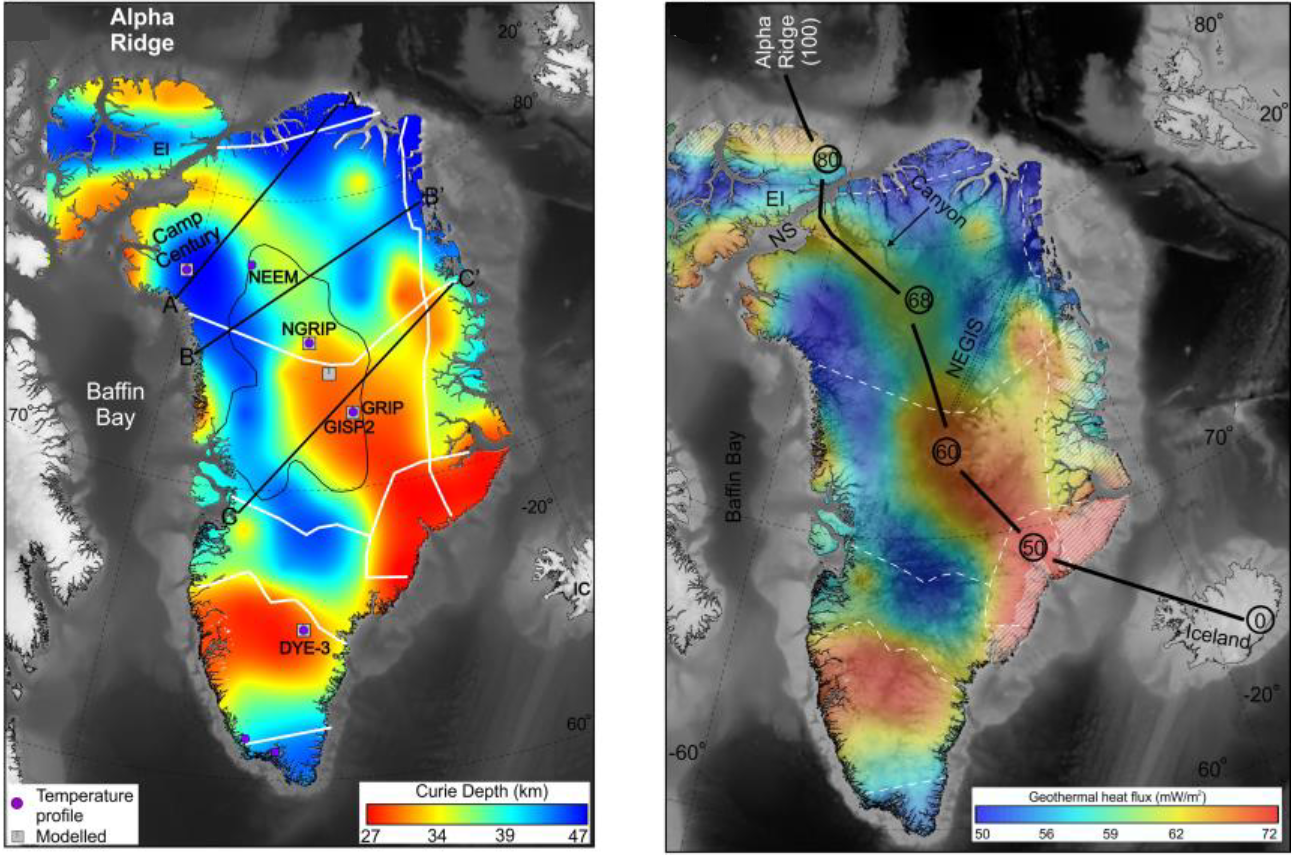
Estimated Curie depth variation below Greenland (left) converted to geothermal heat flow variation (right). (Credit: Martos et al. 2018; Figures 1b and 1c)

Magnetic anomalies are created by magnetisation induced in magnetic minerals in rocks by the Earth’s magnetic field. Yet minerals lose their ability to be magnetised at temperatures above a threshold known as the Curie point, which is 580 °C for magnetite, the most abundant magnetic mineral. Depending on the geothermal heat flow the Curie point is exceeded at some depth in the lithosphere. So magnetic anomalies can safely be assumed to be produced only by rocks above the so-called Curie depth. Yasmina Martos of the British Antarctic Survey (now at the University of Maryland) and scientists from Britain, the US and Spain used a complex procedure, including gravity data and a few direct measurements of heat flow below Greenland as well as filtered aeromagnetic data, to estimate the variation in Curie depth beneath the ice cap. (Martos, Y.M. et al. 2018. Geothermal heat flux reveals the Iceland hotspot track underneath Greenland. Geophysical Research Letters, v. 45, online publication; doi: 10.1029/2018GL078289). Using that as an inverse proxy for heat flow they were able to map the likely geothermal variation beneath the island. Rather than a random and narrow variation in depth, as would be expected for roughly uniform heat flow, the Curie depth varied in a non-random way by over 20 km, equivalent to roughly 20 mW m-2.

The shallowest Curie depth and highest estimated heat flow occurs in East Greenland around Scoresby Sund where the largest sequence of Palaeocene flood basalts occur. It is also on a line perpendicular to the mid-Atlantic Rift system that meets the active Iceland plume. Running north-west from Scoresby Sund is a zone of locally high estimated heat flow. Martos et al. suggest that this is the track of Greenland’s motion over the Iceland hot spot from about 80 Ma to the period of maximum on-shore volcanism and the start of sea-floor spreading at around 50 Ma.

A fully revised edition of Steve Drury’s book Stepping Stones: The Making of Our Home World can now be downloaded as a free eBook

Global Tectonics Centenary: Any Inspiring Papers?

Although Alfred Wegener first began to present his ideas on Continental Drift in 1912 his publication in 1915 of The Origin of Continents and Oceans (Die Entstehung der Kontinente und Ozeane) is generally taken as the global launch of his hypothesis. Apart from support from Alexander du Toit and Arthur Holmes, geoluminaries of the day panned it unmercifully because, in the absence of evidence for a driving mechanism, he speculated that his proposed ‘urkontinent’ (primal continent) Pangaea had been split apart by a centrifugal mechanism connected to the precession of Earth’s rotational axis. This ‘polflucht’ (flight from the poles) is in fact far too weak to have any such influence. Wegener’s masterly assembly of geological evidence for former links between the major continents was ignored by the critics, suggesting that their motive for excoriation of his suggested mechanism was as much spite against an ‘outsider’ as a full consideration of his hypothesis. It must have been hurtful in the extreme, yet Wegener defended himself with a series of revised editions that amassed yet more concrete evidence. What is often overlooked, even now that his ideas have become part of the geoscientific canon, is that in his initial Geologische Rundschau paper in 1912 he mused that the floor of the Atlantic is continuously spreading by tearing apart at the mid-Atlantic Ridge where ‘relatively fluid and hot sima’ rises. Strangely, he dropped that idea in later works. Anyhow, neither 2012 nor 2015 was celebrated in the manner of the centenary-and-a-half of Darwin’s On the Origin of Species: 2009 was marked by palaeobiologists and geneticists metaphorically dancing in the streets, if not foaming at the mouth. There have been a few paragraphs, and some minor symposia about Wegener’s dragging geology out of the 18th century and into the 20th, but that’s about it. The best centenary item I have seen is by Marco Romano and Richard Cifelli (Romano, M. & Cifelli, R.L. 2015. 100 years of continental drift. Science, v. 350, p. 916-916).

In the shape of plate tectonics the Earth sciences hosted what was truly a revolution in science, albeit 50 years on from its discoverer’s announcement. It was through the persistent agitation by his tiny band of supporters, that the upheaval was unleashed when the revelations from palaeomagnetism, seismology and many other lines of evidence were resolved as plate tectonics by the discovery of ocean-floor magnetic stripes by Vine, Matthews and Morley in 1963. Despite an explosion of papers that followed, elaborating onthe new theory and showing examples of its influence on ‘big’ geology , counter-revolutionary resistance lasted almost to the first years of the new century. By then so much evidence had emerged from every geological Eon that opponents looked truly stupid. Even so, the skepticism among those sub-disciplines that were ‘left out’ of geodynamic thought continued to blurt out with the emergence of other exciting aspects of the Earth’s history. I remember that, when three of us in the Open University’s Department of Earth Sciences proposed in 1994 that the influence of impacts by extraterrestrial objects ought to figure in a new course on the evolution of Earth and Life we were sneered at as ‘whizz-bang kids’ by those more earth-bound. Trying belatedly in 1996 to introduce students to another revolutionary development – the use of sedimentary and glacial oxygen isotopes in unraveling past climate change – became a huge struggle in the OU’s Faculty of Science. It went to the press eventually and for 2 years our students had the benefit. But the murmuration of dissent ended with a force-majeur re-edit of the course, by someone who had played no role in its development, expunged the lot and changed the ‘offending’ section back to the way it had been a decade before.  As they say: ho hum!

Oddly, in the last 15 years or so of trying to follow in Earth-Pages what I considered to be the most exciting developments in the geosciences, it has become increasing difficult to find papers in the top journals that are truly ground-breaking. Of course that may just be ageing and a certain cynicism that often companies it. From being spoiled for choice week after week it has become increasingly difficult from month to month to maintain the standards that I have set for new work. Has Earth science entered the fifth phase of a ‘paradigm shift’ predicted by philosopher Thomas Kuhn in his 1962 book The Structure of Scientific Revolutions? According to him once a science has entered a period when there is little consensus on the theories that might lie at the root of natural processes there is a drift in opinion to a few conceptual frameworks that seem to work, albeit leaving a lot to be desired. Weaknesses at the frontier between theory and empirical knowledge become increasingly burdensome as a result of the steady plod of ‘normal science’ until the science in question reaches a crisis. If existing paradigms fail repeatedly, science is ripe for the metaphorical equivalent of a ‘Big Bang’: maybe an entirely new discovery or hypothesis, or an idea that has been suppressed which new data fits better than any others that have been common currency. Plate Tectonics is the second kind. After the revolution much is reexamined and new lines of work emerge, until in Kuhn’s 5th phase scientists return to ‘normal science’. That looks like a pretty good story, on paper, but other forces are at work in science; external to scientific objectives. Most of these are a blend of economics, political ideologies and managerial ‘practicalities’. If the Earth sciences have entered the doldrums of novelty, I suspect it is these forces that are bearing some kind of glum fruit.

The old concept of academic freedom has gone by the board. Institutions demand that research is externally funded – the more the better as the institution, at least in the UK, demands a kind of tax (40% of that proposed) supposedly to cover corporate overheads including salaries of support staff. If an academic doesn’t pull in the dosh, she is not much favoured. If the individual doesn’t publish regularly either, there is a weasel sanction: Josephine Soap is declared ‘research inactive’. Consortia of researchers are more and more in vogue: managers and funders like ‘team players’, so individuals who are bright and confident enough to ‘stick their necks out’ cannot do that in a consortium publication and as often as not are ‘left on the bench’. Risk taking is more dangerous now and to stay ‘research active’, and in many cases of non-tenured posts getting a salary, an individual, even a few like-minded colleagues have to publish 2 or 3 papers a year.

It’s worth mentioning that open access publishing is not just all the rage, it has become more or less compulsory. Of course, it has some benefits for scientists in less well-heeled countries, but there is a downside. You have to raise the cash demanded by journals for the privilege or potentially universal access – at least US$1000 a pop, depending on a journals Impact Factor, and that of course is an odiously essential corporate consideration – and having done that woe betide those who do not publish and spend it. Academic publishing is the most profitable sector of the trade, the more so as print is supplanted by electronic delivery – the 50 free reprints is a thing of the past. So there are more and more journals and each of them strives to get out more issues per year, and of course those have to be filled. To me, this all adds up to more and more ‘pot-boiler’ articles and a tendency to maximise the flesh rendered from the body of research work and into the pot. Taken together with the stresses of commodification in higher education and the now vertical corporate structures from which it is constituted, it shouldn’t be a surprise that excitement and inspiration are at a premium in the weekly and monthly output of such a marginal science as that concerned with how the world works.