The ‘boring billion’ years of the Mesoproterozoic: plate tectonics and the eukaryotes

The emergence of the eukaryotes – of which we are a late-entry member – has been debated for quite a while. In 2023 Earth-logs reportedthat a study of ‘biomarker’ organic chemicals in Proterozoic sediments suggests that eukaryotes cannot be traced back further than about 900 Ma ago using such an approach. At about the same time another biomarker study showed signs of a eukaryote presence at around 1050 Ma. Both outcomes seriously contradicted a ‘molecular-clock’ approach based on the DNA of modern members of the Eukarya and estimates of the rate of genetic mutation. That method sought to deduce the time in the past when the last eukaryotic common ancestor (LECA) appeared. It pointed to about 2 Ga ago, i.e. a few hundred million years after the Great Oxygenation Event got underway. Since eukaryote metabolism depends on oxygen, the molecular-clock result seems reasonable. The biomarker evidence does not. But were the Palaeo- and Mesoproterozoic Eras truly ‘boring’? A recent paper by Dietmar Müller and colleagues from the Universities of Sydney and Adelaide, Australia definitely shows that geologically they were far from that (Müller, R.D. et al. 2025. Mid-Proterozoic expansion of passive margins and reduction in volcanic outgassing supported marine oxygenation and eukaryogenesis. Earth and Planetary Science Letters, v. 672; DOI: 10.1016/j.epsl.2025.119683).
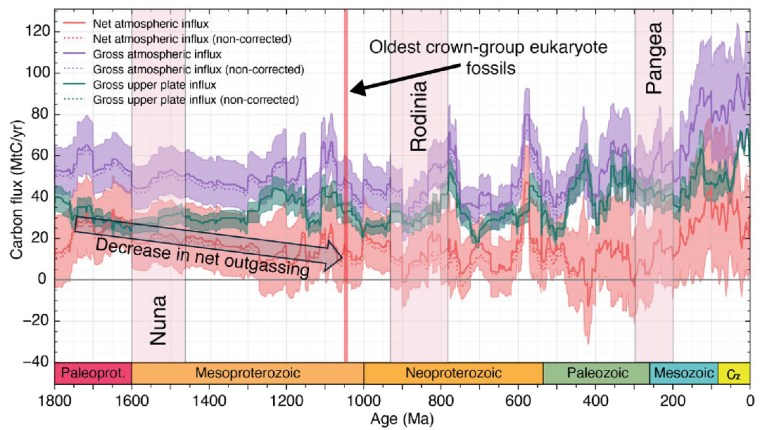
Carbon influx (million tons per year) into tectonic plates and into the ocean-atmosphere system from 1800 Ma to present. The colour bands represent: total carbon influx into the atmosphere (mauve); sequestered in tectonic plates (green); net atmospheric influx i.e. total minus carbon sequestered into plates (orange). The widths of the bands show the uncertainties of the calculated masses shown as darker coloured lines.

From 1800 to 800 Ma two supercontinents– Nuna-Columbia and Rodinia – aggregated nearly all existing continental masses, and then broke apart. Continents had collided and then split asunder to drift. So plate tectonics was very active and encompassed the entire planet, as Müller et al’s palaeogeographic animation reveals dramatically. Tectonics behaved in much the same fashion through the succeeding Neoproterozoic and Phanerozoic to build-up then fragment the more familiar supercontinent of Pangaea. Such dynamic events emit magma to form new oceanic lithosphere at oceanic rift systems and arc volcanoes above subduction zones, interspersed with plume-related large igneous provinces and they wax and wane. Inevitably, such partial melting delivered carbon dioxide to the atmosphere. Reaction on land and in the rubbly flanks of spreading ridges between new lithosphere and dissolved CO2 drew down and sequestered some of that gas in the form of solid carbonate minerals. Continental collisions raised the land surface and the pace of weathering, which also acted as a carbon sink. But they also involved metamorphism that released carbon dioxide from limestones involved in the crustal transformation. This protracted and changing tectonic evolution is completely bound up through the rock cycle with geochemical change in the carbon cycle.

From the latest knowledge of the tectonic and other factors behind the accretion and break-up of Nuna and Rodinia, Müller et al. were able to model the changes in the carbon cycle during the ‘boring billion’ and their effects on climate and the chemistry of the oceans. For instance, about 1.46 Ga ago, the total length of continental margins doubled while Nuna broke apart. That would have hugely increased the area of shallow shelf seas where living processes would have been concentrated, including the photosynthetic emission of oxygen. In an evolutionary sense this increased, diversified and separated the ecological niches in which evolution could prosper. It also increased the sequestration of greenhouse gas through reactions on the flanks of a multiplicity of oceanic rift systems, thereby cooling the planet. Translating this into a geochemical model of the changing carbon cycle (see figure) suggests that the rate of carbon addition to the atmosphere (outgassing) halved during the Mesoproterozoic. The carbon cycle and probable global cooling bound up with Nuna’s breakup ended with the start of Rodinia’s aggregation about 1000 Ma ago and the time that biomarkers first indicate the presence of eukaryotes.
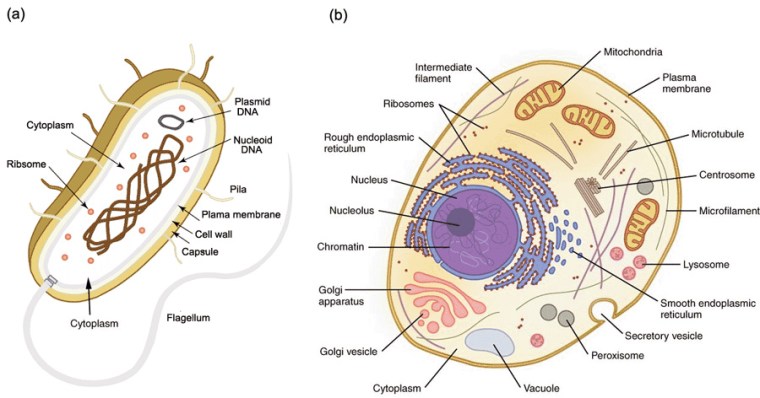
Simplified structures of (a) a prokaryote cell; (b) a simple eukaryote animal cell. Plants also contain organelles called chloroplasts

So, did tectonics play a major role in the rise of the Eukarya? Well, of course it did, as much as it was subsequently the changing background to the appearance of the Ediacaran animals and the evolutionary carnival of the Phanerozoic. But did it affect the billion-year delay of ‘eukaryogenesis’ during prolonged availability of the oxygen that such a biological revolution demanded? Possibly not. Lyn Margulis’s hypothesis of the origin of the basic eukaryote cell by a process of ‘endosymbiosis’ is still the best candidate 50 years on. She suggested that such cells were built from various forms of bacteria and archaea successively being engulfed within a cell wall to function together through symbiosis. Compared with prokaryote cells those of the eukaryotes are enormously complex. At each stage the symbionts had to be or become compatible to survive. It is highly unlikely that all components entered the relationship together. Each possible kind of cell assembly was also subject to evolutionary pressures. This clearly was a slow evolutionary process, probably only surviving from stage to stage because of the global presence of a little oxygen. But the eukaryote cell may also have been forced to restart again and again until a stable form emerged.

See also: New Clues Show Earth’s “Boring Billion” Sparked the Rise of Life. SciTechDaily, 3  November 2025

How did the earliest animals feed?

Among the strange early animals of the latest Precambrian, known as the Ediacaran fauna, is the slug-like Kimberella. Unlike most of its cohort, which are impressions in sediment or trace fossils,  Kimberella is a body fossil in which can be seen signs of a front and back, i.e. mouth and anus (See also: A lowly worm from the Ediacaran?). In that respect they are the same as us: bilaterians both. Indeed, Kimberella may be one of the oldest of our broad kind that we will ever be able to see. Rare examples have fans of grooves radiating from their ‘front’. It may have grated its food, a bit like a slug does, but drew it in to its mouth. Some enthusiasts have likened the little beasty to a JCB digger, able to rotate and rake stuff into its mouth. In that case, Kimberella would have moved ‘backwards’ while feeding. If it can be likened to any modern animals, it may be a simple mollusc.

A Kimberella fossil, about 10 centimetres long, and a speculative reconstruction showing its feeding apparatus.

Other Ediacaran animals show no such mouth-gut-anus symmetry. Some have tops and bases, but most show no symmetry at all, being flaccid bag-like creatures. Palaeontologists provisionally suggest that they are primitive sponges, ctenophores, placozoans and cnidarians. Such animals excrete through pores on their surfaces and draw food in either through a simple mouth or their skins. The early bilaterians probably ‘grazed’ on bacterial or algal mats, but until now that has been conjectural. Ilya Bobrovskiy of the Australian National University and colleagues from Russia and Australia have managed to extract and analyse biomarker chemicals contained in well-preserved specimens of three Ediacaran animals from strata on the White Sea coast of Russia (Bobrovskiy, I. et al. 2022. Guts, gut contents, and feeding strategies of Ediacaran animals. Current Biology, v. 32,   ; DOI: 10.1016/j.cub.2022.10.051). Biomarkers are molecules, such as fatty acids, phospholipids, triglycerides, hopanes and steranes, that definitively indicate metabolic processes of once living organisms, sometimes referred to as ‘molecular fossils’. Their varying proportions relative to one another are key to recognising the presence of different groups of organisms.

Specifically, hopane molecules are the best indicators of the former metabolism of bacteria whereas steranes (based on linked chains of carbon atoms bonded in rings) are typical products of degradation of sterols in eukaryotes. One sterane group involving 27 carbon atoms (C27 steranes) are typically formed when and animal dies and decays.   C28 and C29 steranes likely form when algae decay, as when they are digested in the gut of a herbivore. Specimens of one of the Ediacaran animals analysed by the team – Dickinsonia – contained far more C27 steranes than C28 and C29, a sign of biomarkers associated with its decay. It probably absorbed food, weirdly, through its skin. Kimberella and a worm-like animal – Calyptrina – had sterane proportions which suggested that they digested algae or bacteria in a gut, as befits bilaterians. Simple as they may appear, these are among the earliest ancestors of modern animals, including us: of course!

See also: Lu, D. 2022. The real paleo diet: researchers find traces of world’s oldest meal in 550m-year-old fossil. The Guardian, 22 November 2022.;  World’s oldest meal helps unravel mystery of our earliest animal ancestors. scimex, 23 November 2022

Greening the Earth, Devonian forest fires and a mass extinction

Land plants begin to appear in the fossil record as early as the late Ordovician (~450 Ma), show signs of diversification during the Silurian and by the end of the Devonian Period most of the basic features of plants are apparent. During the Carboniferous Period terrestrial biomass became so high as to cause a fall in atmospheric carbon dioxide, triggering the longest period of glaciation of the Phanerozoic, and such a boost to oxygen in the air (to over 30%) that insects, huge by modern standards, were able to thrive and the risk of conflagration was perhaps at its highest in Earth’s history. Yet surprisingly, the first signs of massive forest fires appear in the Devonian when vegetation was nowhere near so widespread and luxuriant as it became in the Carboniferous (Kaiho, K. et al. 2013. A forest fire and soil erosion event during the Late Devonian mass extinction. Palaeogeography, Palaeoclimatology, Palaeoecology, v. 392, p. 272-280). Moreover, Devonian oxygen levels were well below those of the present atmosphere and CO2 was more than 10 times even the post-industrial concentration (387 parts per million in 2013). Such atmospheric chemistry would probably have suppressed burning.

Kunio Kaiho of Tohoku University in Japan and colleagues from Japan, the US and Belgium analysed organic molecules in Belgian marine sediments from the time of the late-Devonian mass extinction (around the Frasnian-Famennian boundary at 372 Ma). A range of compounds produced by hydrocarbon combustion show marked ‘spikes’ at the F-F boundary. The thin bed that marks the extinction boundary also shows sudden increase then decrease in δ13C and total organic carbon, indicative of increase burial of organic material and a likely increase in atmospheric oxygen levels. Another biomarker that is a proxy for soil erosion follows the other biogeochemical markers, perhaps signifying less of a binding effect on soil by plant colonisation: a likely consequence of large widlfires. Unlike the biomarkers, magnetic susceptibility of the boundary sediments is lower than in earlier and later sediments. This is ascribed to a decreased supply of detrital sediment to the Belgian marine Devonian basin, probably as a result of markedly decreased rainfall around the time of the late-Devonian mass extinction. But the magnetic data from 3 metres either side of the boundary also reveal the influence of the 20, 40, 100 and 405 ka Milankovich cycles.

Juan Ricardo Cortes , a placoderm from the Dev...
Dunkleosteus, a giant (10 m long) placoderm fish from the Devonian, which became extinct in the late Devonian along with all other placoderms (credit: Wikipedia)

This set of environmentally-related data encourages the authors to suggest a novel, if not entirely plausible, mechanism for mass extinction related to astronomically modulated dry-moist climate changes that repeatedly killed off vegetation so that dry woody matter could accumulate en masse during the Frasnian while atmospheric oxygen levels were too low for combustion. A mass burial of organic carbon at the end of that Age then boosted oxygen levels above the burning threshold to create widespread conflagration once the wood pile was set ablaze. Makes a change from continental flood basalts and extraterrestrial impacts… Yet it was about this time that vertebrates took it upon themselves to avail themselves of the new ecological niche provided by vegetation to haul themselves onto land.