A rough-and-ready way of assessing the rate at which silicic magmatic activity has varied through time is to separate out grains of zircon that have accumulated in sedimentary rocks of different ages. Zircon is readily datable using the U-Pb method, if you have access to mass spectrometry. While some of the zircons will date from much older continental crust that was exposed while the sediments originated, sometimes there are grains that formed only a few million years before the sediments accumulated. Those are likely to have crystallized from silica-rich volcanic rocks above subduction zones where ocean-floor has been driven beneath continental crust; i.e. at continental volcanic arcs. Such young zircons therefore help assess the tectonic conditions close to sedimentary basins. The potential of detrital zircon geochronology was first suggested to me by Dr M.V.N. Murthy of the Geological Survey of India in 1978, long before anyone could aspire to mass zircon dating. M.V.N. had by then amassed kilograms of zircon grains from every imaginable source in India, and may have been the first geologist to realise their potential. It has become a lot quicker and cheaper in the last two decades, thanks to methods of dating single zircon grains both precisely and accurately and M.V.N.’s prescient suggestion has been borne out globally.
A detrital zircon grain about 0.25 mm long. (Photo credit: Wikipedia)
Results for the late Precambrian to early Palaeozoic have recently been compiled (McKenzie, N.R. et al. 2014. Plate tectonic influences on Neoproterozoic-early Paleozoic climate and animal evolution. Geology, online publication doi:10.1130/G34962.1). One of the striking correlations is between the abundance of ‘young’ zircons relative to Cambrian sedimentary deposition and the pace of diversification of animal faunas during the Cambrian. During the Cambrian Period there may have been far more continental-margin arc volcanism than in the preceding late Neoproterozoic or later in the early Palaeozoic. That would match with evidence for the Cambrian atmosphere having reached the greatest CO2 concentration of Phanerozoic times and the fact that the Gondwana supercontinent (comprising the present southern continents plus India) was assembled at that time by collision of several Precambrian continental masses. Global temperatures must have been rising.
Earth at abround the start of the Cambrian showing the cratons that collided to form Gondwana (Photo credit: Wikipedia)
The rapid emergence of all the major animal groups by the middle Cambrian – the Cambrian Explosion – took place during and despite climatic warming. Environmental stress, perhaps increased calcium and bicarbonate ions in sea water as a result of acid conditions, may have forced animals to develop means of getting both ions out of their cells to form carbonate skeletons: the Cambrian Explosion really marks the first appearance of shelly faunas and a good chance of fossilisation. Yet at the peak of volcanically-induced warming faunal diversity, especially of reef-building animals, fell-off dramatically to create what some palaeobiologsts have termed the Cambrian ‘dead interval’. Marine life really took-off in a big way during the Ordovician while temperatures were falling globally; so much so that the close of the Ordovician was marked by the first major glaciation focused on Gondwana. The zircon record indicates that continental-arc volcanism also declined during the Ordovician, and maybe the Cambrian silicic volcanics were chemically weathered during that Period to remove carbon-dioxide from the atmosphere, along with renewed reef building to bury carbonate fossils.
The great Tohoku earthquake (moment magnitude 9.0) of 11 March 2011 beneath the Pacific Ocean off the largest Japanese island of Honshu resulted in the devastating tsunami that tore many kilometres inland along its northern coast line and affected the entire Pacific Basin (see NOAA animation of the tsunami’s propagation) .
Railway locomotive thrown aside by the 11 March 2011 Tsunami in Japan. (credit: Wikipedia)
This article can now be read in full at Earth-logs in the Geohazardsarchive for 2017
Tectonics on any rocky planet is an expression of the way heat is transferred from its deep interior to the surface to be lost by radiation to outer space. Radiative heat loss is vastly more efficient than either conduction or convection since the power emitted by a body is proportion to the fourth power of its absolute temperature. Unless it is superheated from outside by its star, a planet cannot stay molten at its surface for long because cooling by radiation releases all of the heat that makes its way to the surface. Any football supporter who has rushed to get a microwaved pie at half time will have learned this quickly: a cool crust can hide a damagingly hot centre.
Thermal power is delivered to a planet’s surface by convection deep down and conduction nearer the surface because rocks, both solid and molten, are almost opaque to radiation. The vigour of the outward flow of heat might seem to be related mainly to the amount of internal heat but it is also governed by limits imposed by temperature on the form of convection. Of the Inner Planets only Earth shows surface signs of deep convection in the form of plate tectonics driven mainly by the pull exerted by steep subduction of cool, dense slabs of old oceanic lithosphere. Only Jupiter’s moon Io shows comparable surface signs of inner dynamics, but in the form of immense volcanoes rather than lateral movements of slabs. Io has about 40 times the surface heat flow of Earth, thanks largely to huge tidal forces imposed by Jupiter. So it seems that a different mode of convection is needed to shift the tidal heat production; similar in many ways to Earth’s relatively puny and isolated hot spots and mantle plumes.
An analogy for the early Earth, Jupiter’s moon Io is speckled with large active volcanoes; signs of vigorous internal heat transport but not of plate tectonics. Its colour is dominated by various forms of sulfur rather than mafic igneous rocks. (credit: Wikipedia)
Shortly after Earth’s accretion it would have contained far more heat than now: gravitational energy of accretion itself; greater tidal heating from a close Moon and up to five times more from internal radioactive decay. The time at which plate tectonics can be deduced from evidence in ancient rocks has been disputed since the 1970s, but now an approach inspired by Io’s behaviour approaches the issue from the opposite direction: what might have been the mode of Earth’s heat transport shortly after accretion (Moore, W.B. & Webb, A.A.G. 2013. Heat-pipe Earth. Nature, v. 501, p. 501-505). The two American geophysicists modelled Rayleigh-Bénard convection – multicelled convection akin to that of the ‘heat pipes’ inside Io – for a range of possible thermal conditions in the Hadean. The modelled planet, dominated by volcanic centres turned out to have some surprising properties.
The sheer efficiency of heat-pipe dominated heat transfer and radiative heat lost results in development of a thick cold lithosphere between the pipes, that advects surface material downwards. Decreasing the heat sources results in a ‘flip’ to convection very like plate tectonics. In itself, this notion of sudden shift from Rayleigh-Bénard convection to plate tectonics is not new – several Archaean specialists, including me, debated this in the late 1970s – but the convincing modelling is. The authors also assemble a plausible list of evidence for it from the Archaean geological record: the presence in pre- 3.2 Ga greenstone belts of abundant ultramafic lavas marking high fractions of mantle melting; the dome-trough structure of granite-greenstone terrains; granitic magmas formed by melting of wet mafic rocks at around 45 km depth, extending back to second-hand evidence from Hadean zircons preserved in much younger rocks. They dwell on the oldest sizeable terranes in West Greenland (the Itsaq gneiss complex), South Africa and Western Australia (Barberton and the Pilbara) as a plausible and tangible products of ‘heat-pipe’ tectonics. They suggest that the transition to plate-tectonic dominance was around 3.2 Ga, yet ‘heat pipes’ remain to the present in the form of plumes so nicely defined in the preceding item Mantle structures beneath the central Pacific.
Since it first figured in Earth Pages 13 years ago seismic tomography has advanced steadily as regards the detail that can be shown and the level of confidence in its accuracy: in the early days some geoscientists considered the results to be verging on the imaginary. There were indeed deficiencies, one being that a mantle plume which everyone believed to be present beneath Hawaii didn’t show up on the first tomographic section through the central Pacific. Plumes are one of the forms likely to be taken by mantle heat convection, and many now believe that some of them emerge from great depths in the mantle, perhaps at its interface with the outer core.
The improvements in imaging deep structure stem mainly from increasingly sophisticated software and faster computers, the data being fed in being historic seismograph records from around the globe. The approach seeks out deviations in the speed of seismic waves from the mean at different depths beneath the Earth’s surface. Decreases suggest lower strength and therefore hotter rocks while abnormally high speeds signify strong, cool parts of the mantle. The hotter mantle rock is the lower its density and the more likely it is to be rising, and vice versa.
Using state-of-the-art tomography to probe beneath the central Pacific is a natural strategy as the region contains a greater concentration of hot-spot related volcanic island chains than anywhere else and that is the focus of a US-French group of collaborators (French, S. et al. 2013. Waveform tomography reveals channeled flow at the base of the oceanic lithosphere. Science, v. 342, 227-230; doi 10.1126/science.1241514). The authors first note the appearance on 2-D global maps for a depth of 250 km of elongate zones of low shear-strength mantle that approximately parallel the known directions of local absolute plate movement. The most clear of these occur beneath the Pacific hemisphere, strongly suggesting some kind of channelling of hot material by convection away from the East Pacific Rise.
Seismic tomographic model of the mantle beneath the central Pacific. Yellow to red colours represent increasingly low shear strength. (credit: Global Seismology Group / Berkeley Seismological Laboratory)
Visually it is the three-dimensional models of the Pacific hot-spot ‘swarm’ that grab attention. These show the low velocity zone of the asthenosphere at depths of around 50 to 100 km, as predicted but with odd convolutions. Down to 1000 km is a zone of complexity with limb-like lobes of warm, low-strength mantle concentrated beneath the main island chains. That beneath the Hawaiian hot spot definitely has a plume-like shape but one curiously bent at depth, turning to the NW as it emerges from even deeper mantle then taking a knee-like bend to the east . Those beneath the hot spots of the west Pacific are more irregular but almost vertical. Just what kind of process the peculiarities represent in detail is not known, but it is almost certainly a reflection of complex forms taken by convection in a highly viscous medium.
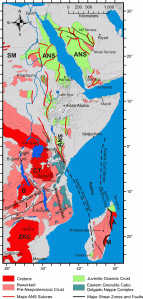
Over a period of about 300 Ma the fragmentation of a supercontinent, Rodinia, drove a round of sea-floor spreading and continental drift that culminated in reassembly of the older continental pieces and entirely new crust in a new supercontinent, Gondwana. The largest source of evidence for this remarkable tectonic turnaround is a belt stretching N-S for over 3000 km from southern Israel through East Africa to Mozambique. At its widest the belt exposes Neoproterozoic rocks and structures for some 1700 km E-W from west of the Nile in northern Sudan almost to Riyadh in Saudi Arabia. This Arabian-Nubian Shield tapers southwards to thin out completely in northern Tanzania between far older cratons and in a state of high-grade metamorphism.
This East African Orogen has long been considered the best exposed bowels of former mountain building that there are: results of continent-continent collision and the bulldozing together of many oceanic arcs and remnants of oceanic lithosphere that once separated the cratons. This was much more complex than a case of head-on tectonics, the northward-swelling Arabian-Nubian Shield showing all the signs of being like a gigantic ‘pip’ squeezed out northwards from two cratonic jaws during the last stages of what is often called the Pan African Orogeny. Interestingly, the line of the orogen is roughly followed by East Africa’s other giant feature, the Rift Valley; actually two of them following Pan African terranes. A continental scale anisotropy has been reactivated and subject to extensional tectonics, and maybe in future a new round of sea-floor spreading as has begun in the Red Sea, some half a billion years after it formed.
Simplified geological map of the East African Orogen courtesy of the authors of Fritz et al 2013
Now there is an opportunity for anyone to download and read a digest of East African orogenic processes compiled by researchers from several countries along the belt and their colleagues from North America, Europe and Australia who have been privileged to work in this vast area (Fritz, H and 13 others 2013. Orogen styles in the East African orogen: A review of the Neoproterozoic to Cambrian tectonic evolution. Journal of African Earth Sciences, v. 86, p. 65-106 Click on the link, scroll to the Open Access article to download the 12 Mb PDF version). The authors present superb simplified geological maps of each major part of the orogen, a vast array of references and well-written accounts of its sector-by-sector tectonic and metamorphic evolution, variations in style and broad tectonic setting.
In its 125th year the Geological Society of America is publishing invited reviews of central geoscience topics in its Bulletin. They seem potentially useful for both undergraduate students and researchers as accounts of the ‘state-of-the-art’ and compendia of references. The latest focuses on major controls on past sea-level changes by processes that operate in the solid Earth (Conrad, C.P. 2013. The solid Earth’s influence on sea level. Geological Society of America Bulletin, v. 125, p. 1027-1052), a retrospective look at how geoscientists have understood large igneous provinces (Bryan, S. E. & Ferrari, L. 2013. Large igneous provinces and silicic large igneous provinces: Progress in our understanding over the last 25 years. Geological Society of America Bulletin, v. 125, p. 1053-1078) and the perennial topic of how granites form and end up in intrusions (Brown, M. 2013. Granite: From genesis to emplacement Geological Society of America Bulletin, v. 125, p. 1079-1113).
Sea level change
Conrad covers sea-level changes on the short- (1 to 100 years), medium- (1 to 100 ka) and long term (1 to 100 Ma). The first two mainly result from local deformation of different kinds associated with glacial loading and unloading. These result in changes in the land surface, the sea surface nearby and on thousand year to 100 ka timescales to ups and downs of the sea-bed. Global sea-level changes due to melting of continental glaciers at the present day amount to about half the estimated 2 to 3 mm of rise each year. But increasingly sensitive measures show it is more complex as the rapid shifts of mass involved in melting ice also result in effects on the solid Earth. At present solid mass is being transferred polewards, but at rates that differ in Northern and Southern hemispheres and which are changing with anthropogenic influences on glacial melting. Viscous movement of the solid Earth is so slow that effects from previous glacial-interglacial episodes continue today. As a result rapid elastic movements are tending to produce relative sea-level falls in polar regions of up to 20 mm per year with rising sea level focusing on areas between 30°N and 30°S. The influence of the slower viscous mass transfer has an opposite sense: sea-level rise at high latitudes. Understanding the short- and medium-term controls is vital in predicting issues arising in the near future from natural and anthropogenic change.
Comparison of two sea level reconstructions during the last 500 Ma. (credit: Wikipedia)
Most geologists are concerned in practice with explanations for major sea-level changes in the distant past, which have a great deal to do with changes in the volumes of the ocean basins. If the global sea-floor rises on average water is displaced onto former land to produce transgressions, and subsidence of the sea floor draws water down from the land. Conrad gives a detailed account of what has been going on since the start of the Cretaceous Period, based on the rate of sea-floor spreading, marine volcanism and sedimentation, changes in the area of the ocean basins and the effects of thermally-induced uplift and subsidence of the continents, showing how each contribution acted cumulatively to give the vast transgressions and regressions that affected the late Phanerozoic. On the even longer timescale of opening and closing of oceans and the building and disintegration of supercontinents the entire mantle becomes involved in controls on sea level and a significant amount of water is chemically exchanged with the mantle.
Large igneous provinces
The Web of Science database marks the first appearance in print of “large igneous province” in 1993, so here is a topic that is indeed new, although the single-most important attribute of LIPs, ‘flood basalt’ pops up three decades earlier and the term ‘trap’ that describes their stepped topography is more than a century old. Bryan and Ferrari are therefore charting progress in an exciting new field, yet one that no human – or hominin for that matter – has ever witnessed in action. One develops, on average, every 20 Ma and since they are of geologically short duration long periods pass with little sign of one of the worst things that our planet can do to the biosphere. In the last quarter century it has emerged that they blurt out the products of energy and matter transported as rising plumes from the depths of the mantle; they, but not all, have played roles in mass extinctions; unsuspected reserves of precious metals occur in them; they play some role in the formation of sedimentary basins and maturation of petroleum and it seems other planets have them – a recipe for attention in the early 21st century. Whatever, Bryan and Ferrari provide a mine of geological entertainment.
In comparison, granites have always been part of the geologist’s canon, a perennial source of controversy and celebrated by major works every decade, or so it seems, with twenty thousand ‘hits’ on Web of Science since 1900 (WoS only goes back that far). Since the resolution of the plutonist-neptunist wrangling over granite’s origin one topic that has been returned to again and again is how and where did the melting to form granitic magma take place? If indeed granites did form by melting and not as a result of ‘granitisation. Lions of the science worried at these issues up to the mid 20th century: Bowen, Tuttle, Read, Buddington, Barth and many others are largely forgotten actors, except for the credit in such works as that of Michael Brown. Experimental melting under changing pressure and temperature, partial pressures of water, CO2 and oxygen still go on, using different parent rocks. One long-considered possibility has more or less disappeared: fractional crystallisation from more mafic magma might apply to other silicic plutonic rocks helpfully described as ‘granitic’ or called ‘granitoids’, but granite (sensu stricto) has a specific geochemical and mineralogical niche to which Brown largely adheres. For a while in the last 40 years classification got somewhat out of hand, moving from a mineralogical base to one oriented geochemically: what Brown refers to as the period of ‘Alphabet Granites’ with I-, S- A- and other-type granites. Evidence for the dominance of partial melting of pre-existing continental crust has won-out, and branched into the style, conditions and heat-source of melting.
Typical granite tor near Kisumu, Kenya (credit: Wikipedia)
All agree that magmas of granitic composition are extremely sticky. The chemical underpinnings for that and basalt magma’s relatively high fluidity were established by physical chemist Bernhardt Patrick John O’Mara Bockris (1923-2013) but barely referred to, even by Michael Brown. Yet that high viscosity has always posed a problem for the coalescence of small percentages of melt into the vast blobs of low density liquid able to rise from the deep crust to the upper crust. Here are four revealing pages and ten more on how substantial granite bodies are able to ascend, signs that the puzzle is steadily being resolved. Partial melting implies changes in the ability of the continental crust to deform when stressed, and this is one of the topics on which Brown closes his discussion, ending, of course, on a ‘work in progress’ note that has been there since the days of Hutton and Playfair.
The extremely hazardous seaway through the Straits of Gibraltar and the waterless deserts of the Levant presented considerable barriers to natural exchange of animal groups between Africa and Eurasia throughout the period of hominin evolution known from the African Pliocene and Pleistocene record. These barriers were breached by hominins only occasionally. Through most of the Miocene and back to the Mesozoic Era Iberia and what is now Morocco were separated by a wide seaway preventing faunal exchange. That Betic Seaway eventually closed with the tectonic collision of the two sides to form the modern Betic Cordillera in southern Spain towards the end of the Miocene. This left parts of the Mediterranean to evaporate during what is known as the Messinian Salinity Crisis, which reached completion at 5.59 Ma. Yet this Europe-Africa connection was short-lived, being breached by what is regarded as one of the most dramatic events in Cenozoic history: the Zanclean Flood. At 5.33 Ma the Atlantic burst through what is now the Straits of Gibraltar to refill the Mediterranean Basin within a period between a few months and two years. The flooding began as a vast system of rapids some 1 km high with an estimated flow a thousand times that of the modern Amazon.
Strait of Gibraltar from space, with Spain on the left and Morocco on the right.) (credit: Wikipedia)
During the existence of the Europe-Africa land bridge it was possible for animals to move between north-west Africa and western Europe. Evidence that such an exchange did take place comes from a number of Late Miocene localities in southern Spain and North Africa. The first recorded migrants into Spain were African gerbils, then evidence mounted for larger animals, including hippos and early camels moving into Europe and a reverse migration of rabbits and mice. One of the Spanish sites (Gibert, L. et al. 2013. Evidence for an African-Iberian mammal dispersal during the pre-evaporitic Messinian. Geology, v. 41, p. 691-694) has allowed precise magnetostratigraphic dates to be put on the migrations. The Spanish-US team suggests conditions ripe for migration were in three distinct phases: around 6.3 Ma when hippos managed to swim to Europe; around 6.2 Ma which saw European small mammals making the journey south and camels moving to Europe; in a 300 ka window of opportunity from 5.6 to 5.3 Ma for African mice to make the journey into Europe. Several distinct episodes probably reflect some ups and downs of sea level related to glacial retreats and advances in Antarctica.
One implication of the short-lived Messinian land bridge is that it may have been followed by primates, though evidence has yet to be found. A particularly interesting genus, suggested by some as a possible common ancestor for hominins and chimpanzees, is Oreopithecus a bipedal ape recorded from the Miocene of Italy
The Afar Depression of Ethiopia and Eritrea is a feature of tectonic serendipity. It is unique in showing on land the extensional processes and related volcanism that presage sea-floor spreading. Indeed it hosts three rift systems and a triple junction between the existing Red Sea and Gulf of Aden spreading centres and the East African Rift System that shows signs of future spalling of Somalia from Africa. Afar has been a focus of geoscientific attention since the earliest days of plate theory but practical interest has grown rapidly over the last decade or so when the area has become significantly more secure and safe to visit. Two recent studies seem to have overturned one of the most enduring assumptions about what drives this epitome of continental break-up.
Simulated perspective view of the Afar depression from the south (credit: Wikipedia)
From the obvious thermal activity deep below Afar, linked with volcanism and high heat flow, a mantle host spot and rising plume of deep mantle has been central to ideas on the tectonics of the area. A means of testing this hypothesis is the use of seismic data to assess the ductility and temperature structure of deep mantle through a form of tomography. The closer the spacing of seismic recording stations and the more sensitive the seismometers are the better the resolution of mantle structure. Afar now boasts one of the densest seismometer networks, rivalling the Earthscope USArray. http://earth-pages.co.uk/2009/11/01/the-march-of-the-seismometers/ and it is paying dividends (Hammond, J.O.S. and 10 others 2013. Mantle upwelling and initiation of rift segmentation beneath the Afar Depression. Geology, v. 41, p.635-638). The study brought together geoscientists from Britain, the US, Ethiopia, Eritrea and Botswana, who used data from 244 seismic stations in the Horn of Africa to probe depths down to 400 km with a resolution of about 50 km.
The tomographic images show no clear sign of the kind of narrow plume generally aasociated with the notion of a ‘hot spot’. Instead they pick out shallow (~75 km depth) P- and S-wave low-velocity features that follow the axes of the three active rift systems. The features coalesce at depth; in some respects the opposite of a classic plume that has a narrow ‘stem’ that swells upwards to form a broad ‘head’. If there ever was an Afar Plume it no longer functions. Instead, the rifts and associated lithospheric thinning are associated with a mantle upwelling that is being emplaced passively in the space made available by extensional tectonics. This is closely similar to what goes on beneath active and well-established mid-ocean spreading centres where de-pressuring of the rising mantle results in partial melting and basaltic magmatism along the rift system. Perhaps this is a sign that full sea-floor spreading in Afar is imminent, at least on geological timescales.
Simplified geologic map of the Afar Depression. (credit: Wikipedia after Beyene and Abdelsalam (2005))
For once, mantle geochemists and geophysicists have data that support a common hypothesis (Ferguson, D.J. and 8 others 2013. Melting during late-stage rifting in Afar is hot and deep. Nature, v. 499, p. 70-73). This US-British-Ethiopian team compares the trace element geochemistry of Recent basaltic lavas erupted along the axis of the Afar rift that links with the Red Sea spreading centre with equally young lavas from volcanoes some 20 km from the axis. Both sets of lavas are a great deal more enriched in incompatible trace elements that are generally enriched in melt compare with source than are ocean-floor basalts sampled from the mid-Red Sea rift. Modelling rare-earth element patterns in particular suggests that partial melting is going on at depths where garnet is stable in the mantle instead of spinel. This suggests that a strong layer, about 85 km down in the upper mantle is beginning to melt – magmas formed by small degrees of partial melting generally contain higher amounts of incompatible trace elements than do the products of more extensive melting. Estimates of the temperature of melting from lavas extruded at the rift axis than off-axis are significantly higher than expected at this depth suggesting that deeper mantle is rising faster than it can lose heat.
The depth of melting tallies with the thermal feature picked out by seismic tomography. The two teams converge on passively induced upwelling of hot asthenosphere while the Afar lithosphere is slowly being extended. The degree of melting beneath Afar is low at present, so that to become like mid-ocean ridge basalts a surge in the fraction of melting is needed. That would happen if the strong mantle layer fails plastically so that more asthenosphere can rise higher by passive means. The geochemists persist in an appeal to an Afar Plume for the 30 Ma old flood basalts that plaster much of the continental crust outside Afar. Those plateau-forming lavas, however, are little different in their trace element geochemistry from off-axis Afar basalts. Yet they are not obviously associated with an earlier episode of lithospheric extension and passive mantle upwelling. Most geologists who have studied the flood basalts would agree that they preceded the onset of rifting but have little idea of the actual processes that went on during that mid-Oligocene volcanic cataclysm.
For half a century the Earth’s planetary dynamism – plate movements, mantle convection and so on – has been ascribed to its abundance of water. Experiments on the ductility of quartz seemed to show that it became much weaker under hydrous conditions, and that was assumed to hold for all common silicates, a view backed up by experiments that deformed minerals under varying conditions. It was widely believed that even a few parts per million in a rock at depth would weaken it by orders of magnitude, a view that increasingly dominated theoretical tectonics on scales up to the whole lithosphere and at different mantle depths. Strangely, the founding assertion was not followed up with more detailed and sophisticated work until the last year or so. Though rarely seen in bulk, the dominant mineral in the mantle is olivine and that is likely to be a major control over ductility at depth, in plumes and other kinds of convection.
Peridotite xenoliths —olivines are light green crystals, pyroxenes are darker. (credit: Wikipedia)
Experimental work at the temperatures and pressures of the mantle has never been easy, and that becomes worse the more realistic the mineral composition of the materials being investigated. High-T, high-P research tends to focus on as few variables as possible: one mineral and one variable other than P and T is the norm. This applies to the latest research (Fei, H. et al. 2013. Small effect of water on upper mantle rheology based on silicon self-diffusion coefficients. Nature, v. 498, p. 213-215) but the measurements are of the rate at which silicon atoms diffuse through olivine molecules rather than direct measurements of strain. The justification for this approach is that one of the dominant processes involved in plastic deformation is a form of structural creep in which atoms diffuse through molecules in response to stress – the other is ‘dislocation creep’ achieved by the migration of structural defects in the atomic lattice.
Contrary to all expectations, changing the availability of water by 4 to 5 orders of magnitude changed silicon diffusion by no more than one order. If confirmed this presents major puzzles concerning Earth’s mantle and lithosphere dynamics. For instance, the weak zone of the asthenosphere cannot be a response to water and nor can the relative immobility of hotspots. Confirmation is absolutely central, in the sense of repeating Fei et al.’s experiments and also extending the methods to other olivine compositions – magnesium-rich forsterite was used, whereas natural olivines are solid solutions of Mg- and Fe-rich end members – and to materials more representative of the mantle, e.g. olivine plus pyroxene as a minimum (Brodholt, J. 2013. Water may be a damp squib. Nature, v. 498, p. 18-182)
Mass extinctions and smaller but significant die-offs in the marine and terrestrial domains have been linked in the geoscientific imagination with many things: asteroid impacts; gamma-ray bursts from distant supernovae; belches of methane from the sea floor; emissions of hydrogen sulfide gas from seawater itself during ocean anoxia events; sea-level changes and more. The most intriguing, since it suggests a causal link between the core-mantle boundary and the biosphere, is the influence of flood basalt events and the gases, both greenhouse and toxic, that they undoubtedly released.
The famous K-T extinction (now K-Pg since the Palaeogene became the Period following the Cretaceous rather than the Tertiary) has swayed back and forth between the Chicxulub impact in Mexico’s Yucatán Peninsula and the flood basalts of the Deccan Traps in western India as likely mechanisms, Chicxulub currently being in pole position. The equally devastating event at the close of the Triassic (at 201 Ma) that presaged the rise of the dinosaurs has had a similar external versus internal causality controversy, both the Rochechouarte crater and the Central Atlantic Magmatic Province being candidates.
CAMP flood basalts in Morocco (credit: Wikipedia)
Rochechouarte, however, was nowhere near as energetic an event as the Chicxulub impact. The problem is, as with all events for which the weight of evidence points to very short time scales – of the order of tens to hundreds of thousand years, is the dating of candidate causes. Rochechouarte happened at 201±2 Ma: it may or may not have coincided with faunal change. Yet timing of the CAMP flood basalts has hitherto been even more coarsely tagged. This imprecision is not unconnected with the choice of radiometric dating methods, the 40Ar/39Ar approach being ‘easy’ and hence popular, but limited in its precision and accuracy. The ‘gold standard’ is zircon U-Pb geochronology that depends on the far greater reluctance of the host mineral to lose either parent or daughter isotopes compared with the feldspars, micas and amphiboles used in many other methods. Zircon still in its igneous parent is crucial: it is so durable that vastly older zircons are often found in sediments. Yet basalts contain few zircons.
Zircon crystal under the microsope; length about 250 µm. (Photo credit: Wikipedia)
Zircon geochronology has now emerged from the CAMP flood basalts of eastern Canada, the Atlantic seaboard of the US and that of Morocco, which has a precision of around 30 ka, one to two orders of magnitude better than other methods (Blackburn, T.J. and 8 others 2013. Zircon U-Pb geochronology links the end-Triassic extinction with the Central Atlantic Magmatic Province. Science, v. 340, p. 941-945). The extinction is defined most readily by a sudden change in fossil pollen and spores, possibly within less than 10 ka, as well as extinction of Triassic marine fauna and large numbers of terrestrial reptile and amphibian taxa followed by diversification of early Jurassic dinosaurs. The oldest CAMP basalts are from Morocco immediately above spores of clearly Triassic age; i.e. before the extinction, whereas the basalt flows in Canada and the eastern US (a mere 3 to 13 ka younger)are above the turnover. So, the start of the CAMP flood volcanism brackets the extinction.
But did CAMP cause, indeed could it have caused the extinction? Blackburn and colleagues cannot be certain. A negative carbon-isotope spike associated with the extinction is estimated to have required almost a million km3 of magma to have been erupted almost instantaneously to inject excess CO2 into the atmosphere. The dating suggests four major pulses of eruption in the areas studied spread over around 600 ka, the last three being associated with biological diversification and recovery in the earliest Jurassic. In fact the research seems merely to suggest strongly that flood volcanism accompanied the extinction, but leaves its causing the death toll still an open question.
The CAMP events marked the beginning of Pangaea’s break-up and the formation of Tethys separating Eurasia and North America from the old Gondwana continental mass. That tropical seaway became the site of massive production of marine carbonates, presumably to draw down any carbon dioxide excess in the atmosphere.