A hint of proto-Earth that predates Moon formation by giant impact  

Artist’s impression of the impact of a roughly Mars-size planet with the proto-Earth to form an incandescent cloud, from part of which the Moon formed.

Geochemists have gradually built a model of the proportions of the 92 naturally occurring elements that characterise the Solar System. It is based on systematic chemical analysis of meteorites, especially the ‘stony’ ones. One hypothesis for Earth formation is that the bulk of it chemically resembles a class of meteorites known as C1 carbonaceous chondrites. But there are important deviations between that and reality. For instance the relative proportions of the isotopes of several elements in meteorites have been found to differ. Because nuclei of all the elements and their individual isotopes have been shown to form in supernovae through nucleosynthesis, such instances are known as ‘nucleosynthetic anomalies’. An example is that of the isotopes of potassium (K), which was investigated by a team of geochemists from the Carnegie Institution for Science in Washington DC, USA and the Chengdu University of Technology, China led by Nicole Nie  (Nie, N.X. et al. 2023. Meteorites have inherited nucleosynthetic anomalies of potassium-40 produced in supernovae. Science, v.379, p, 372-376; DOI: 10.1126/science.abn1783).

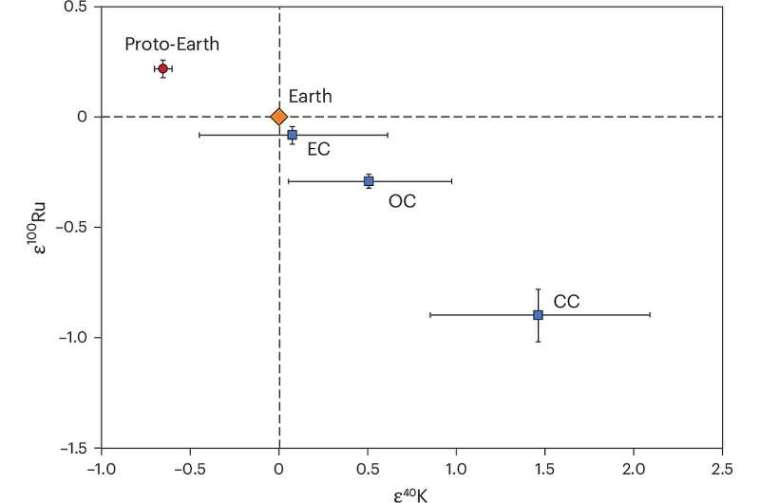
A measure for the magnitude of this nucleosynthetic anomaly  is the ratio between the abundance in a sample of potassium’s  rarest (40K) and its most common isotope (39K), divided by the ratio in an accepted standard of terrestrial rock. Since isotopically identical samples would yield a value of 1, the result has 1.0 subtracted from it to emphasise anomalies. Samples that are relatively depleted in 40K give negative values, whereas enriched samples give positive values. This measure is signified by ε40K, ε being the Greek letter epsilon. The authors found significant and variable positive anomalies of ε40K in carbonaceous chondrite (CC) meteorites, compared with non-carbonaceous (NC) meteorites. They also found that ε40K data in terrestrial rocks are quite different from those of CC meteorites. Indeed, they suggested that Earth was more likely to have formed from NC meteoritic material. Clearly, there seems to be something seriously amiss with the hypothesis that Earth largely accreted from C1 carbonaceous chondrites.

The correlation between ε40K and ε100Ru in meteorites (EC – enstatite chondrites, OC – ordinary chondrites; CC – carbonaceous chondrites), Earth and a geochemically modelled proto-Earth. Credit: Da Wang et al., Fig 2

Three of the authors of Nie et al. and other researchers from MIT in Cambridge MA and Scripps Institution of Oceanography in San Diego CA, USA and ETH in Zurich, Switzerland have produced more extensive potassium isotope data to examine Earth’s possible discrepancy with the chondritic Earth hypothesis (Da Wang et al. 2025. Potassium-40 isotopic evidence for an extant pre-giant-impact component of Earth’s mantle. Nature Geoscience, v. 18, online article; DOI: 10.1038/s41561-025-01811-3). To better approximate the bulk Earth’s potassium isotopes they analysed a large number of terrestrial rock samples of all kinds and ages to compare with meteorites of different classes. Meteorites also have variable  nucleosynthetic anomalies for ruthenium-100 (ε100Ru). So, ε40K  and ε100Ru may be useful tracers with regards to Earth’s history. But, for some reason, the research group did not analyse ruthenium isotopes in the terrestrial samples.

Most samples of igneous rocks from different kinds of Phanerozoic volcanic provinces (continental flood basalts, island arcs, and ocean ridge basalts) showed no evidence of anomalous potassium isotopes. However, some young ocean-island basalts from Réunion and Hawaii showed considerable depletion in 40K. A quarter of early Archaean (>3.5 Ga) metamorphosed basaltic rocks from greenstone belts also showed clear 40K depletion. Yet no samples of granitic crust of similar antiquity showed any anomaly and nor did marine sediments derived from younger continental crust. Even the oldest known minerals – zircon grains from Jack Hills Western Australia – showed no anomalies. The authors suggest that both the anomalous groups of young and very ancient terrestrial basalts show signs that their parent magmas may have formed by partial mantle melting of substantial bodies of the relics of proto-Earth. To account for this anomalous mantle Da Wang et al. suggest from modelling that proto-Earths 40K deficit may have arisen from early accretion of meteorites with that property. Later addition of material more enriched with that isotope, perhaps as meteorites or through the impact with a smaller planet that triggered Moon-formation. That cataclysm was so huge that it left the Earth depleted in ‘volatile’ elements and in a semi-molten state. It reset Earth geochemistry as a result of several processes including the mixing induced by very large-scale melting. No radiometric dating has penetrated that far back in Earth history. However, in February 2004, Alex Halliday used evidence from several isotopic systems (Pb, Xe, Sr, W) to show that about two thirds of Earth’s final mass may have accreted in the first 11 to 40 Ma of its history.

Curiously, none of the hundreds of meteorites that have been geochemically analysed show the level of 40K depletion in the terrestrial samples. Nicole Nie has comments, “… our study shows that the current meteorite inventory is not complete, and there is much more to learn about where our planet came from.”

I’m persuaded to write this by ‘Piso Mojado’. And today – 23rd October – is the anniversary of the Creation of Earth, Life and the Universe in 4004 BCE, according to Archbishop James Ussher (1581-1656) by biblical reckoning, which always tickles me!

See also: Chu, J. 2025. Geologists discover the first evidence of 4.5-billion-year-old “proto Earth”. MIT News, 14 October 2025.

The world’s oldest crust in the Nuvvuagittuq Greenstone Belt, Quebec

Since 1999, the rocks generally acknowledged to be the oldest on Earth were part of the Acasta gneisses in the Slave Craton in Canada’s Northwest Territories; specifically the Idiwhaa tonalitic gneisses. Zircons extracted from that unit yielded an age of 4.02 billion years (Ga) using U-Pb radimetric dating, revealing the time of their crystallisation from granitic magma. But nine years later some metabasaltic rocks from the tiny (20 km2) Nuvvuagittuq Greenstone Belt on the eastern shore of Hudson Bay were dated using the Sm-Nd method at almost 4.3 Ga (see: At last, 4.0 Ga barrier broken; November 2008). Taken at face value the metabasaltic rocks seemed to be well within the Hadean Eon (4.6 to 4.0 Ga) and could thus represent primary crust of that antiquity. However, U-Pb dating of zircons from thin sodium-rich granitic rocks (trondhjemites) that intrude them yielded ages no older than about 3.8 Ga. Similar ages emerged from zircons found in metasediments interleaved in the dominant mafic unit. Discrepancies between the two completely different dating methods resulted in the Hadean antiquity of the mafic rocks having been disputed since 2008. It was possible that the Sm-Nd results from the metabasalts may have resulted from the original mafic magmas having inherited a Hadean Sm-Nd isotopic ‘signature’ from their mantle source. That is, they may have been contaminated and could have formed in the early Archaean.

Glacially smoothed outcrops near Inukjuak, Quebec that reveals rocks of the Nuvvuagittuq Greenstone Belt. Credit: Jonathan O’Neil, University of Ottawa

Jonathan O’Neil, now at Ottawa University in Canada, led the first isotopic investigation of the Nuvvuagittuq Greenstone Belt and has engaged in research there ever since. Further field and laboratory studies revealed that the previously dated mafic rocks had been intruded by large, chemically differentiated gabbro sills. A team of geochemists from the University of Ottawa and Carleton University, including O’Neil, has now published isotopic evidence from the intrusions that suggests a Hadean age for their parent magma (C. Sole et al. 2025. Evidence for Hadean mafic intrusions in the Nuvvuagittuq Greenstone Belt, CanadaScience, v. 388, p. 1431-1435. DOI: 10.1126/science.ads8461). The authors used the decay schemes of two radioactive samarium isotopes 147Sm and 146Sm; a significant advance in radiometric dating. The first decays to 143Nd with a half-life of about 1011 years, the second to 142Nd with a much shorter half life of about 108 years. Due to its more rapid decay, in geological terms,146Sm is now much rarer than 147Sm. Consequently, using the short-lived 146Sm-142Nd decay system is technically more difficult than that of the 147Sm-143Nd system. But the team managed to get good results from both the ‘fast’ and the ‘slow’ decay schemes. They tally nicely, yielding ages of 4157 and 4196 Ma.  The gabbros provide a minimum age for the metabasalts that they cut through. The original 4.3 Ga Sm-Nd date for the metabasalts is thus plausible. Sole and colleagues consider the dominant metabasaltic rocks to have formed a primary crust in late Hadean times that was invaded by later mantle-derived mafic magma about 100 Ma later. The granitic rocks that constitute about one third of the Nuvvuagittuq terrain seem to have been generated by partial melting more than 300 Ma later still, during the Palaeoarchaean.

Perhaps similar techniques will now be deployed in granite-greenstone terrains in other cratons. Many of the older ones, generally designated as Palaeoarchaean in age, also contain abundant metamorphosed mafic and ultramafic igneous rocks. Perhaps their origin was akin to those of Nuvvuagittuq; i.e. more Hadean crust may await unmasking. Meanwhile, there seems to be more to discover from Nuvvuagittuq. For instance, some of the rocks suggested to be metasediments interleaved in the metabasalts show intricate banding that resembles products of bacterial mat accumulation in younger terrains. Signs of Hadean life?

Since the first reliable radiometric dating of Archaean rocks in 1971, there has been an element of competition to date the oldest rocks on Earth: to push history back towards the initial formation of the Earth. It is one of the most disputatious branches of Earth history. Rivalry may play a significant part in driving the science, as well as the development of novel dating techniques and the continuing discovery of clearly old relationships using ‘old-fashioned’ relative dating, such as signs of intrusion, unconformities etcetera. But in some cases there is a darker side: the potential for profit. Recently, samples from Nuvvuagittuq appeared for sale on the Internet, priced at $10,000. They may have been collected under the guise of supplying museums by a group that shipped-in mechanical excavators in 2016. Unsurprisingly this angered the local Innuit community of Inukjuak. They were also worried about bona fide collection for scientific research that had left parts of the small, once pristine area somewhat battered, including cultural features such as an inukshuk navigational monument. Their fury at commercial exploitation of their homeland resulted in the community council closing the area to collecting in 2024. I emphasise that this violation of basic geological ethics was by commercial rock collectors and dealers, not academic geologists. The local people are now considering careful issue of research permits so that important research can continue. But further rock collecting may remain banned.

See also: New Research Verifies Northern Canada Hosts Earth’s Oldest Rocks. Scienmag, 26 June 2025; Gramling, C. 2025. Earth’s oldest rocks may be at least 4.16 billion years old. ScienceNews.

PS With many thanks to ‘Piso Mojado’ for alerting me to this paper

Impact debris in Neoproterozoic sediments of Scotland and biological evolution?

False-colour electron microscope image of a shocked grain of zircon recovered from the Stac Fada Member. The red and pink material is a high-pressure polymorph of zircon, arranged in shock lamellae. Zircon is rendered in cyan, some of which is in granulated form. Credit: Kirkland et al. 2025, Fig 2C

Judging by its content of shards and spherules made of murky green glass, one of the lowest units in the Torridonian continental sediments of NW Scotland had long been regarded as simply red sandstone that contained volcanic debris. This Stac Fada Member was thus celebrated as the only sign of a volcanic contribution to a vast thickness (up to 2.5 km) of Neoproterozoic lake and fluviatile sediments. Current flow indicators suggested that the Torridonian was laid down by large alluvial fans derived by erosion of much older crystalline basement far to what is today the west. That is, the Archaean core of the ancient continent of Laurentia, now the other side of the North Atlantic. In 2002 more sophisticated sedimentological and geochemical analysis of the Stac Fada Member revealed a surprise: it contains anomalously elevated platinum-group elements, quartz grains that show signs of shock and otherworldly chromium isotope concentrations. The 10 m thick bed is made from ejecta, perhaps from a nearby impact crater to the WNW concluded from brittle fractures that may have been produced by the impact. Some idea of its age was suggested by Ar-Ar dating of feldspar crystals (~1200 Ma) believed to have formed authigenically in the hot debris. Being the only decent impactite known in Britain, it continues to attract attention.

A group of geoscientists from Western Australia, NASA and the UK, independent of the original discoverers, have now added new insights ( Kirkland, C.L. and 12 others 2025. A one-billion-year old Scottish meteorite impact. Geology, v. 53, early online publication; DOI: 10.1130/G53121.1). They dated shocked zircon grains using U-Pb analyses at 990 ± 22 Ma; some 200 Ma younger than the previously dated, authigenic feldspars.  Detrital feldspar grains in the Stac Fada Member yield Rb-Sr radiometric ages of 1735 and 1675, that are compatible with Palaeoproterozoic granites in the underlying Lewisian Gneiss Complex.

Photomicrograph of Bicellum brazieiri: scale bar = 10μm; arrows point to dark spots that may be cell nuclei (credit: Charles Wellman, Sheffield University)

In a separate publication (Kirkland, C.L et al 2025. 1 billion years ago, a meteorite struck Scotland and influenced life on Earth. The Conversation, 29 April 2025) three of the authors take things a little further, as their title suggests. In this Conversation piece they ponder, perhaps unwarily, on the spatial and temporal association of the indubitable impact with remarkably well-preserved spherical fossils found in Torridonian lake-bed sediments (Bicellum brasieri, reported in Earth-logs in May 2021), which are the earliest-known holozoan animal ancestors. The Torridonian phosphatic concretions in which these important fossils were found at a different locality are roughly 40 Ma younger than the Stac Fada impactite. The authors of the Conversation article appeal to the residual thermal effect of the impact as a possible driver for the appearance of these holozoan organisms. Whether a residual thermal anomaly would last long enough for them to evolve to this biological status would depend on the magnitude of the impact, of which we know nothing.  Eukaryote fossils are known from at least  650 Ma older sedimentary rocks in northern China and perhaps as far back as 2.2 Ga in a soil that formed in the Palaeoproterozoic of South Africa. Both the Torridonian organism and impactite were found in a small area of fascinating geology that has been studied continuously in minute detail since Victorian times, and visited by most living British geologists during their undergraduate days. Ideas will change as curiosity draws geologists and palaeobiologists to less-well studied sites of Proterozoic antiquity, quite possibly in northern China.

A fully revised edition of Steve Drury’s book Stepping Stones: The Making of Our Home World can now be downloaded as a free eBook

A sign of life on another planet? Should we be excited?

Judging by the coverage in the media, there is huge excitement about a possible sign of life on a very distant planet. It emerged from a Letter to The Astrophysical Journal posted by a British-US team of astronomers led by Nikku Madhusudhan that was publicised by the Cambridge University Press Office (Madhusudhan, N.et al. 2025. New Constraints on DMS and DMDS in the Atmosphere of K2-18 b from JWST MIRI. The Astrophysical Journal, v. 983, article adc1c8; DOI: 10.3847/2041-8213/adc1c8). K2-18 b is a planet a bit smaller than Neptune that orbits a red dwarf star (K2-18) about 124 light years away. The planet was discovered by NASA’s now-defunct Kepler space telescope tasked with the search for planets orbiting other stars. An infrared spectrometer on the Hubble Space Telescope revealed in 2019 that the atmosphere of K2-18 b contained water vapour, making the planet a target for further study as it may possess oceans. The more sophisticated James Webb Space Telescope IR spectrometer was trained on it a year later to reveal methane and CO2: yet more reason to investigate more deeply, for water and carbon compounds imply both habitability and the potential for life forms being there.

The latest results suggest that that the atmosphere of K2-18 b may contain simple carbon-sulfur gases: dimethyl sulfide ((CH3)2S) and dimethyl disulfide (CH3SSCH3). Bingo! for exobiologists, because on Earth both DMS and DMDS are only produced by algae and bacteria. Indeed they are responsible for the odour of the seaside. They became prominent in 1987 when biogeochemist James Lovelock fitted them into his Gaia Hypothesis. He recognised that they encourage cloud formation and thus increase Earth’s reflectivity (albedo) and also yield sulfuric acid aerosols in the stratosphere when they oxidise: that too increases albedo. DMS generates a cooling feedback loop to counter the warming feedback of greenhouse emissions. That is an idea of planetary self-regulation not much mentioned nowadays. Such gases were proposed by Carl Sagan as unique molecular indicators that could be used to search for extraterrestrial life.

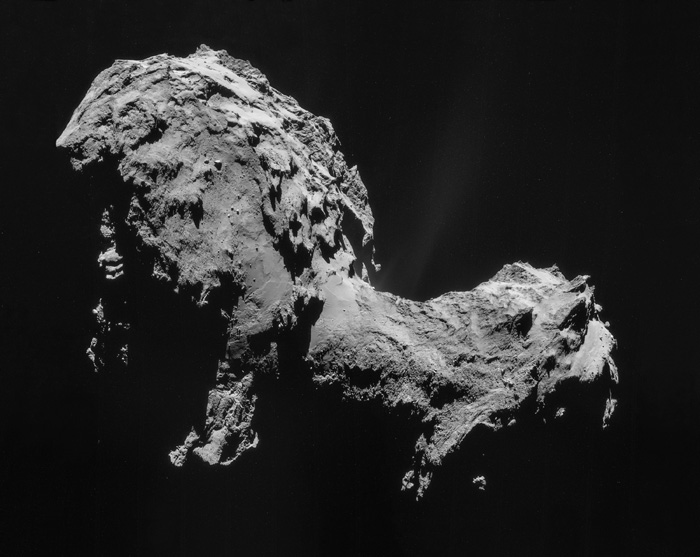
The coma of Comet Churyumov-Gerasimenko yielded both dimethyl sulfide and amino acids to the mass spectrometer carried by ESA’s Rosetta. Credit: ESA.

The discovery of possible DMS and DMDS in K2-18 b’s atmosphere is, of course, currently under intense scientific scrutiny. For a start, the statistics inherent in Madhusudhan et al.’s methodology (3σ or 99.7% probability) fall short of the ‘gold standard’ for discoveries in physics (5σ or 99.99999% probability). Moreover, there’s also a chance that exotic, inorganic chemical processes could also create the gases, such as lightning in an atmosphere containing C, H and S. But this is not the first time that DMS has been discovered in an extraterrestrial body. Comets, having formed in the infancy of the Solar System much further from the Sun than any planets, are unlikely to be ‘teeming with life’. The European Space Agency’s Rosetta spacecraft chased comet 67P/Churyumov-Gerasimenko for 2 years, directly sampling dust and gas that it shed while moving closer to the Sun. A single day’s data from Rosetta’s mass spectrometer showed up DMS, and also amino acids. Both could have formed in comets or interstellar dust clouds by chemistry driven by radiation, possibly to contaminate planetary atmospheres. Almost certainly, further remote sensing of K2-18 b will end up with five-sigma precision and some will say, ‘Yes, there is life beyond Earth!’ and celebrate wildly. But that does not constitute proof, even by the ‘weight of evidence’ criterion of some judiciaries. To me such a conclusion would be unseemly romanticism. Yet such is the vastness of the material universe and the sheer abundance of the elements C H O N and P that make up most living matter that life elsewhere, indeed everywhere, (but not life as we know it) is a near certainty. The issue of intelligent lifeforms ‘out there’ is, however, somewhat less likely to be resolved . . .

The earliest known impact structure

Earth has been through a great many catastrophes, but the vast majority of those of which we know were slow-burning in a geological sense. They resulted in unusually high numbers of extinctions at the species- to family levels over a few million years and the true mass extinctions seem to have been dominated by build ups of greenhouse gases emitted by large igneous provinces. Even the most famous at the end of the Cretaceous Period, which did for the dinosaurs and considerably more organisms that the media hasn’t puffed, was partly connected to the eruption of the Deccan flood basalts of western India. Yet the event that did the real damage was a catastrophe that appeared in a matter of seconds: the time taken for the asteroid that gouged the Chicxulub crater to pass through the atmosphere. Its energy was huge and because it was delivered in such a short time its sheer power was unimaginable. Gradually geologists have recognised signs of an increasing number of tangible structures produced by Earth’s colliding with extraterrestrial objects, which now stands at 190 that have been confirmed.

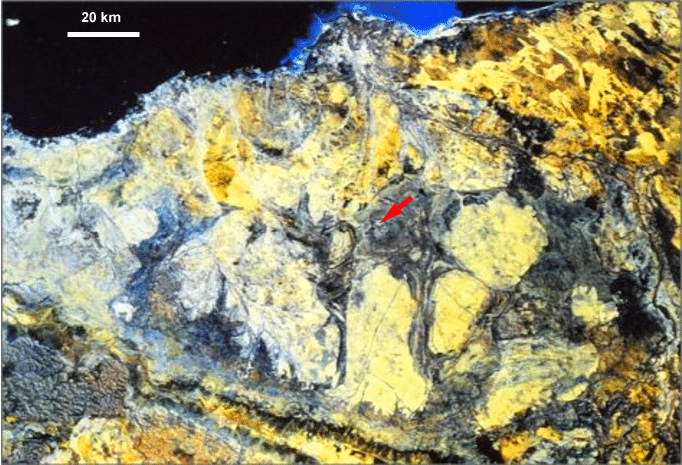
Landsat image mosaic of the Palaeoarchaean granite-greenstone terrain of the Pilbara Craton, Western Australia. Granite bodies show as pale blobs, the volcanic and sedimentary greenstone belts in shades of grey. The site of Kirkland et al.’s study site is at the tip of the red arrow

The frequency of impact craters falls off with age, most having formed in the last ~550 million years (Ma) during the Phanerozoic Eon, only 25 being known from the Precambrian, which spanned around 88 percent of geological time. That is largely a consequence of the dynamic processes of tectonics, erosion and sedimentation that may have obliterated or hidden a larger number. Earth is unique in that respect, the surfaces of other rocky bodies in the Solar System showing vastly more. The Moon is a fine example, especially as it has been Earth’s companion since it formed 4.5 billion years ago (Ga) after the proto-Earth collided with a now vanished planet about the size of Mars. The relative ages of lunar impact structures combined with radiometric ages of the surfaces that they hit has allowed the frequency of collisions to be assessed through time. Applied to the sizes of the craters such data can show how the amount of kinetic energy inflicted on the lunar surface has changed with time. During what geologists refer to as the Hadean Eon (before 4 Ga), the moon underwent continuous bombardment that reached a crescendo between 4.1 and about 3.8 Ga. Thereafter impacts tailed off. Always having been close to the Moon, the Earth cannot have escaped the flux of objects experienced by the lunar surface. Because of Earth’s much greater gravitation pull it was probably hit by more objects per unit area. Apart from some geochemical evidence from Archaean rocks (see: Tungsten and Archaean heavy bombardment; July 2002) and several beds of 3.3 Ga old sediment in South Africa that contain what may have been glassy spherules there are no signs of actual impact structures earlier than a small crater dated at around 2.4 Ga in NE Russia.

Shatter cones in siltstone near Marble Bar in the Pilbara Province: finger for scale. Credit: Kirkland et al.; Fig 2a

Now a group of geologists from Curtin University, Perth Western Australia, and the Geological Survey of Western Australia have published their findings of indisputable signs of an impact site in the northern part of Western Australia (Kirkland, C.L. et al. 2025. A Paleoarchaean impact crater in the Pilbara Craton, Western Australia. Nature Communications, v. 16, article 2224; DOI: 10.1038/s41467-025-57558-3). In fact there is no discernible crater at the locality, but sedimentary strata show abundant evidence of a powerful impact in the form of impact-melt droplets in the form of spherules together with shatter cones. These structures form as a result of sudden increase in pressure to 2 to 30 GPa: an extreme that can only be generated in underground nuclear explosions, and thus likely to bear witness to large asteroid impacts. The shocked rocks are immediately overlain by pillow lavas dated at 3.47 Ga, making the impact the earliest known. It has been speculated that impacts during the Archaean and Hadean Eons helped create conditions for the complex organic chemistry that eventually to the first living cells. Considering that entry of hypervelocity asteroids into the early Earth’s atmosphere probably caused such compression that temperatures were raised by adiabatic heating to about ten times that of the Sun’s surface, their ‘entry flashes’ would have sterilised the surface below; the opposite of such notions. Impacts may, however, have delivered both water and simple, inorganic hydrocarbons. Together with pulverisation of rock to make ‘fertiliser’ elements (e.g. K and P) more easily dissolved, they may have had some influence. Their input of thermal energy seems to me to be of little consequence, for decay of unstable isotopes of U, Th and K in the mantle would have heated the planet quite nicely and continuously from Year Zero onwards.

A fully revised edition of Steve Drury’s book Stepping Stones: The Making of Our Home World can now be downloaded as a free eBook

Modelling climate change since the Devonian

A consortium of geoscientists from Australia, Britain and France, led by Andrew Merdith of the University of Adelaide examines the likely climate cooling mechanisms that may have set off the two great ‘icehouse’ intervals in the last 541 Ma (Merdith, A.S. et al. 2025. Phanerozoic icehouse climates as the result of multiple solid-Earth cooling mechanisms. Science Advances, v. 11, article eadm9798: DOI: 10.1126/sciadv.adm9798). They consider the first to be the global cooling that began in the latter part of the Devonian culminating in the Carboniferous-Permian icehouse. The second is the Cenozoic global cooling to form the permanent Antarctic ice cap around 34 Ma and culminated in cyclical ice ages on the northern continents after 2.4 Ma during the Pleistocene. They dismiss the 40 Ma long, late Ordovician to early Silurian glaciation that left its imprint on North Africa and South America –  then combined in the Gondwana supercontinent. The data about two of the parameters used in their model – the degree of early colonisation of the continents by plants and their influence on terrestrial weathering are uncertain in that protracted event.  Yet the Hirnantian glaciation reached 20°S at its maximum extent in the Late Ordovician around 444 Ma to cover about a third of Gondwana: it was larger than the present Antarctic ice cap. For that reason, their study spans only Devonian and later times.

Fluctuation in evidence for the extent of glacial conditions since the Devonian: the ‘ice line’ is grey. The count of glacial proxy occurrences in each 10° of latitude through time is shown in the colour key. Credit: Merdith et al., Fig 2A.

Merdith et al. rely on four climatic proxies. The first of these comprises indicators of cold climates, such as glacial dropstones, tillites and evidence in sedimentary rocks of crystals of hydrated calcium carbonate (ikaite – CaCO3.6H2O) that bizarrely forms only at around 0°C . From such occurrences it is possible to define an ‘ice line’ linking different latitudes through geological time. Then there are estimates of global average surface temperature; low-latitude sea surface temperature; and estimates of atmospheric CO2. The ‘ice-line’ data records an additional, long period of glaciation in the Jurassic and early Cretaceous, but evidence does not extend to latitudes lower than 60°. It is regarded by Merdith et al. as an episode of ‘cooling’ rather than an ‘icehouse’. Their model assesses sources and sinks of COsince the Devonian Period.

The main natural source of the principal greenhouse gas CO2 is degassing through volcanism expelled from the mantle and breakdown of carbonate rock in subducted lithosphere. Natural sequestration of carbon involves weathering of exposed rock that releases dissolved CO2 and ions of calcium and magnesium.   A recently compiled set of plate reconstructions that chart the waxing and waning of tectonics since the Devonian Period allows them to model the tectonically driven release of carbon over time, with time scales on the order of tens to hundreds of Ma. The familiar Milanković forcing cycles on the order of tens to hundreds of ka are thus of no significance in Merdith et al.’s  broader conception of icehouse episodes  Their modelling shows high degassing during the Cretaceous, modern levels during the late Palaeozoic and early Mesozoic, and low emissions during the Devonian. The model also suggests that cooling stemmed from variations in the positions and configuration of continents over time.  Another crucial factor is the tempo of exposure of rocks that are most prone to weathering. The most important are rocks of the ocean lithosphere incorporated into the continents to form ophiolite masses. The release of soluble products of weathering into ocean basins through time acts as a fluctuating means of ‘fertilising’ so that more carbon can be sequestered in deep sediments in the form of organisms’ unoxidised tissue and hard parts made of calcium carbonates and phosphates. Less silicate weathering results in a boost to atmospheric CO2.

Only two long, true icehouse episodes emerge from the empirical proxy data, expressed by the ‘ice-line’ plots. Restricting the modelling to single global processes that might be expected to influence degassing or carbon sequestration produces no good fits to the climatic proxy data. Running the model with all the drivers “off” produces more or less continuous icehouse conditions since the Devonian. The model’s climate-related outputs thus imply that many complex processes working together in syncopation may have driven the gross climate vagaries over the last 400 Ma or so. A planet of Earth’s size without such complexity would throughout that period have had a high-CO2 warm climate. According to Andrew Merdith its fluctuation from greenhouse to icehouse conditions in the late Palaeozoic and the Cenozoic were probably due to “coincidental combination of very low rates of global volcanism, and highly dispersed continents with big mountains, which allow for lots of global rainfall and therefore amplify reactions that remove carbon from the atmosphere”.

Geological history is, almost by definition, somewhat rambling. So, despite despite the large investment in seeking a computed explanation of data drawn from the record, the outcome reflects that in a less than coherent account. To state that many complex processes working at once may have driven climate vagaries over the last 400 Ma or so, is hardly a major advance: palaeoclimatologists have said more or less the same for a couple of decades or more, but have mainly proposed single driving mechanisms. One aspect of Merdith et al.’s  results seems to be of particular interest. ‘Icehouse’ conditions seem to be rare events interspersed with broader ice-free periods. We evolved within the mammal-dominated ecosystems on the continents during the latest of these anomalous climatic episodes. And we and those ecosystems now rely on a cool world. As the supervisor of the project commented, ‘Over its long history, the Earth likes it hot, but our human society does not’.

Readers may like to venture into how some philosophers of science deal with a far bigger question; ‘Is intelligent life a rare, chance event throughout the universe?’ That is, might we be alone in the cosmos? In the same issue of Science Advances is a paper centred on just such questions (Mills, D.B. et al. 2025. A reassessment of the “hard-steps” model for the evolution of intelligent life. Science Advances, v. 11, article eads5698; DOI: 10.1126/sciadv.ads5698). It stems from cosmologist Brandon Carter’s ‘Anthropic Principle’ first developed at Nicolas Copernicus’s 500th birthday celebrations in 1973. This has since been much debated by scientists and philosophers – a gross understatement as it knocks the spots off the Drake Equation. To take the edge off what seems to be a daunting task, Mills et al. consider a corollary of the Anthropic Principle, the ‘hard steps model’. That, in a nutshell, postulates that the origin of humanity and its ability to ponder on observations of the universe required a successful evolutionary passage through a number of hard steps. It predicts that such intelligence is ‘exceedingly rare’ in the universe. Icehouse conditions are respectable candidates for evolutionary ‘hard steps’, and in the history of Earth there have been five of them.

A fully revised edition of Steve Drury’s book Stepping Stones: The Making of Our Home World can now be downloaded as a free eBook

The origin of life on Earth: new developments

Debates around the origin of Earth’s life and what the first organism was like resemble the mythical search for the Holy Grail. Chivalric romanticists of the late 12th and early 13th centuries were pretty clear about the Grail – some kind of receptacle connected either with the Last Supper or Christ’s crucifixion – but never found it. Two big quests that engage modern science centre on how the chemical building blocks of the earliest cells arose and the last universal common ancestor (LUCA) of all living things. Like the Grail’s location, neither is likely to be fully resolved because they can only be sought in a very roundabout way: both verge on the imaginary. The fossil record is limited to organisms that left skeletal remains, traces of their former presence, and a few degraded organic molecules. The further back in geological time the more sedimentary rock has either been removed by erosion or fundamentally changed at high temperatures and pressures. Both great conundrums can only be addressed by trying to reconstruct processes and organisms that occurred or existed more than 4 billion years ago.

Artistic impression of the early Earth dominated by oceans (Credit: Sci-news.com)

In the 1950s Harold Urey of the University of Chicago and his student Stanley Miller mixed water, methane, ammonia and hydrogen sulfide in lab glassware, heated it up and passed electrical discharges through it. They believed the simple set-up crudely mimicked Hadean conditions at the Earth surface. They were successful in generating more complex organic chemicals than their starting materials, though the early atmosphere and oceans are now considered to have been chemically quite different. Such a ‘Frankenstein’ approach has been repeated since with more success (see Earth-logs April 2024), creating 10 of the 20 amino acids plus the peptide bonds that link them up to make all known proteins, and even amphiphiles, the likely founders of cell walls. The latest attempt has been made by Spanish scientists at the Andalusian Earth Sciences Institute, the Universities of Valladolid and Cadiz, and the International Physics Centre in San Sebastian (Jenewein, C. et al 2024. Concomitant formation of protocells and prebiotic compounds under a plausible early Earth atmosphere. Proceedings of the National Academy of Sciences, v. 122, article 413816122; DOI: 10.1073/pnas.241381612).

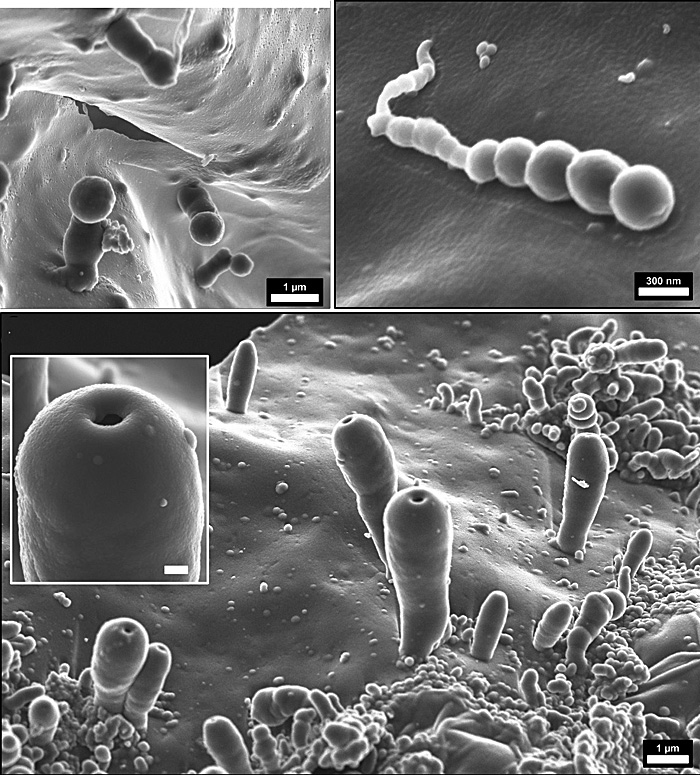
Biomorphs formed by polymerisation of HCN (Credit: Jenewein, C. et al 2024, Figure 2)

Jenewein and colleagues claim to have created cell-like structures, or ‘biomorphs’ at nanometre- and micrometre scale – spheres and polyp-like bodies – from a more plausible atmosphere of CO2 , H2O, and N2. These ‘protocells’ seem to have formed from minutely thin (150 to 3000 nanometres) polymer films built from hydrogen cyanide that grew  on the surface of the reaction chamber as electric discharges and UV light generated HCN and more complex ‘prebiotic’ chemicals. Apparently, these films were catalysed by SiO2 (silica) molecules from the glass reactor. Note:  In the Hadean breakdown of olivine to serpentinite as sea water reacted with ultramafic lavas would have released abundant silica. Serpentinisation also generates hydrogen. Intimate release of gas formed bubbles to create the spherical and polyp-like ‘protocells’. The authors imagine the Hadean global ocean permanently teeming with such microscopic receptacles. Such a veritable ‘primordial soup’ would be able to isolate other small molecules, such as amino acids, oligopeptides, nucleobases, and fatty acids, to generate more complex organic molecules in micro-reactors en route  to the kind of complex, self-sustaining systems we know as life.

So, is it possible to make a reasonable stab at what that first kind of life may have been? It was without doubt single celled. To reproduce it must have carried a genetic code enshrined in DNA, which is unique not only to all species, but to individuals. The key to tracking down LUCA is that it represents the point at which the evolutionary trees of the fundamental domains of modern life life – eukarya (including animals, plants and fungi), bacteria, and archaea – converge to a single evolutionary stem. There is little point in using fossils to resolve this issue because only multicelled life leaves tangible traces, and the first of those was found in 2,100 Ma old sediments in Gabon (see: The earliest multicelled life; July 2010). The key is using AI to compare the genetic sequences of the hugely diverse modern biosphere. Modern molecular phylogenetics and computing power can discern from their similarities and differences the relative order in which various species and broader groups split from others. It can also trace the origins of specific genes that provides clues about earlier genetic associations. Given a rate of mutation the modern differences provide estimates of when each branching occurred. The most recent genetic delving has been achieved by a consortium based at various institutions in Britain, the Netherlands, Hungary and Japan  (Moody, E.R.R. and 18 others 2024. The nature of the last universal common ancestor and its impact on the early Earth system. Nature Ecology & Evolution, v.8, pages 1654–1666; DOI: 10.1038/s41559-024-02461-1).

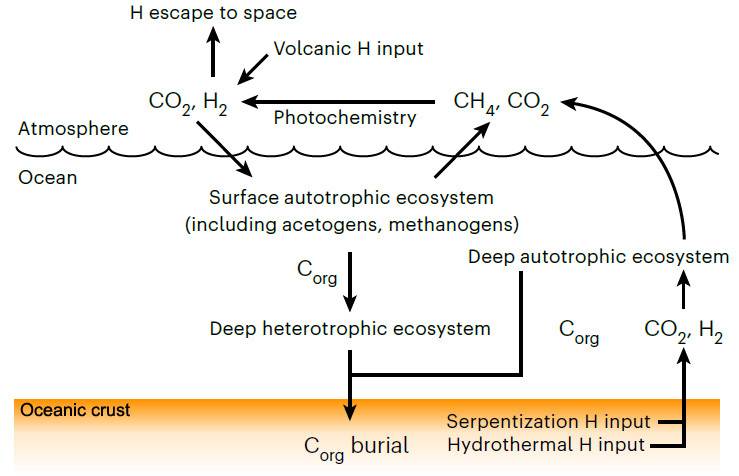
Moody et al have pushed back the estimated age of LUCA to halfway through the Hadean, between 4.09 to 4.33 billion years (Ga), well beyond the geologically known age of the earliest traces of life (3.5 Ga). That age for LUCA in itself is quite astonishing: it could have been only a couple of hundred million years after the Moon-forming interplanetary collision. Moreover, they have estimated that Darwin’s Ur-organism had a genome of around 2 million base pairs that encoded about 2600 proteins: roughly comparable to living species of bacteria and archaea, and thus probably quite advanced in evolutionary terms. The gene types probably carried by LUCA suggest that it may have been an anaerobic acetogen; i.e. an organism whose metabolism generated acetate (CH3COO) ions. Acetogens may produce their own food as autotrophs, or metabolise other organisms (heterotrophs). If LUCA was a heterotroph, then it must have subsisted in an ecosystem together with autotrophs which it consumed, possibly by fermentation. To function it also required hydrogen that can be supplied by the breakdown of ultramafic rocks to serpentinites, which tallies with the likely ocean-world with ultramafic igneous crust of the Hadean (see the earlier paragraphs about protocells). If an autotroph, LUCA would have had an abundance of CO2 and H2 to sustain it, and may have provided food for heterotrophs in the early ecosystem. The most remarkable possibility discerned by Moody et al is that LUCA may have had a kind of immune system to stave off viral infection.

The carbon cycle on the Hadean Earth (Credit: Moody et al. 2024; Figure 3e)

The Hadean environment was vastly different to that of modern times: a waterworld seething with volcanism; no continents; a target for errant asteroids and comets; more rapidly spinning with a 12 hour day; a much closer Moon and thus far bigger tides. The genetic template for the biosphere of the following four billion years was laid down then. LUCA and its companions may well have been unique to the Earth, as are their descendants. It is hard to believe that other worlds with the potential for life, even those in the solar system, could have followed a similar biogeochemical course. They may have life, but probably not as we know it  . . .

See also: Ball, P. 2025. Luca is the progenitor of all life on Earth. But its genesis has implications far beyond our planet. The Observer, 19 January 2025.

A fully revised edition of Steve Drury’s book Stepping Stones: The Making of Our Home World can now be downloaded as a free eBook

Was Venus once habitable?

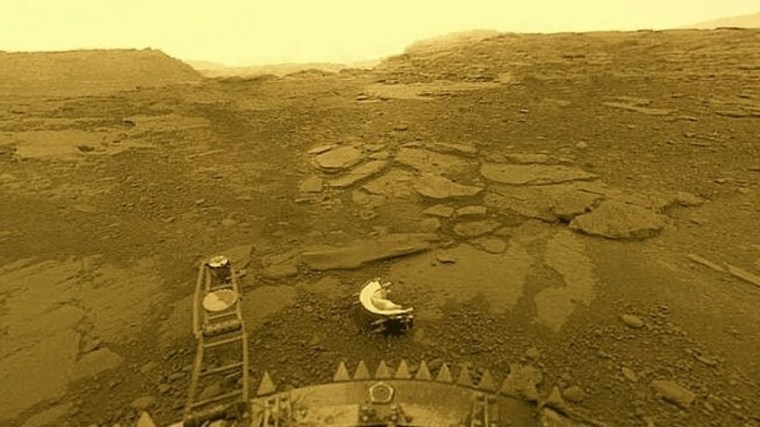
The surface of Venus from the USSR Venera 14 lander

It is often said that Earth has a twin: Venus, the second planet from the Sun. That isn’t true, despite the fact that both have similar size and density. Venus, in fact, is even more inhospitable that either Mars or the Moon, having surface temperatures (~465°C) that are high enough to melt lead or, more graphically, those in a pizza oven. The only vehicles successfully to have landed on Venus (the Russian Venera series) survived for a mere 2 hours, but some did did send back data and images. That near incandescence is masked by the Venusian atmosphere that comprises 96.5% carbon dioxide, 3.5% nitrogen and 0.05 % sulfur dioxide, with mere traces of other gases including extremely low amounts of water vapour (0.002%) and virtually no oxygen. The dense atmosphere imposes a pressure at Venus’s surface tht is 92 times that on Earth: so dense that CO2 and N2 are, strictly speaking, not gases but supercritical fluids at the surface. At present Venus is definitely inimical to any known type of life. It is the victim of an extreme, runaway greenhouse effect.

As it stands, Venus’s geology is also very different from that of the Earth. Because its upper atmosphere contains clouds of highly reflective sulfuric acid aerosols only radar is capable of penetrating to the surface and returning to have been monitored by a couple of orbital vehicles: Magellan (NASA 1990 to 1994) and Venus Express (European Space Agency 2006 to 2014). The latter also carried means of mapping Venus’s surface gravitational field. The radar imagery shows that 80% of the Venusian surface comprises somewhat wrinkled plains that suggests a purely volcanic origin. Indeed more that 85,000 volcanoes have been mapped, 167 of which are over 100 km across. Much of the surface appears to have been broken into polygonal blocks or ‘campuses’ (campus is Latin for field) that give the impression of ‘crazy paving’. A peculiar kind of local-scale tectonics has operated there, but nothing like the plate tectonics on Earth in either shape or scale.

Polygonal blocks or ‘campuses’ on the lowland surface of Venus. Note the zones of ridges that roughly parallel ‘campus’ margins. Credit: Paul K. Byrne, North Carolina State University and Sean C. Solomon, Lamont-Doherty Earth Observatory

Many of the rocky bodies of the solar system are pocked by impact craters – the Earth has few, simply because erosion and sedimentary burial on the continents, and subduction of ocean floors have removed them from view. The Venusian surface has so few that it can, in its entirety, be surmised to have formed by magmatic ‘repaving’ since about 500 Ma ago at least. Earlier geological process can only be guessed at, or modelled in some way. A recent paper postulates that ‘there are several lines of evidence that suggest that Venus once did have a mobile lithosphere perhaps not dissimilar to Earth …’ (Weller, M.B. & Kiefer, W.S. 2025. The punctuated evolution of the Venusian atmosphere from a transition in mantle convective style and volcanic outgassing. Science Advances, v. 11, article eadn986; DOI: 10.1126/sciadv.adn986). One large, but subtle feature may have formed by convergence similar to that of collision tectonics. There are also gravitational features that hint at active subduction at depth, although the surface no longer shows connected features such as trenches and island arcs. Local extension has been inferred from other data.

Weller and Kiefer suspect that Venus in the past may have shifted between a form of mobile plate tectonics and stagnant ‘lid’ tectonics, the vast volcanic plains having formed by processes akin to flood volcanism on a planetary scale. Venus’s similar density to that of Earth suggests that it is made of similar rocky material surrounding a metallic core. However, that planet has a far weaker magnetic field suggesting that the core is unable to convect and behave like a dynamo to generate a magnetic field. That may explain why the atmosphere of Venus is almost completely dry. With no magnetic field to deflect it the solar wind of charged particles directly impacts the upper atmosphere, in contrast to the Earth where only a very small proportion descends at the poles. Together with the action of UV solar radiation that splits water vapour into its constituent hydrogen and oxygen ions, the solar wind adds energy to them so that they escape to space. This atmospheric ‘erosion’ has steadily stripped the atmosphere of Venus – and thus its solid surface – of all but a minute trace of water, leaving behind higher mass molecules, particularly carbon dioxide, emitted by its volcanism. Of course, this process has vastly amplified the greenhouse effect that makes Venus so hot. Early on the planet may have had oceans and even primitive life, which on Earth extract CO2 by precipitating carbonates and by photosynthesis, respectively. But they no longer exist.

The high surface temperature on Venus has made its internal geothermal gradient very different from Earth’s; i.e. increasing from 465°C with depth, instead of from about 15°C on Earth. As a result, everywhere beneath the surface of Venus its mantle has been more able to melt and generate magma. Earlier in its history it may have behaved more like Earth, but eventually flipped to continual magmatic ‘repaving’. To investigate how this evolution may have occurred Weller and Kiefer created 3-D spherical models of geological activity, beginning with Earth-like tectonics – a reasonable starting point because of the probable Earth-like geochemistry of Venus. My simplified impression of what they found is that the periodic blurting of magma well-known from Earth history to have created flood-basalt events without disturbing plate tectonics proceeded on Venus with progressively greater violence. Such events here emitted massive amounts of CO2 into the atmosphere over short (~1 Ma) time scales and resulted in climate change, but Earth’s surface processes have always returned to ‘normal’. Flood-basalt episodes here have had a rough periodicity of around 35 Ma. Weller and Kiefer’s modelling seems to suggest that such events on Venus may have been larger. Repetition of such events, which emitted CO­2 that surface processes could not erase before the next event, would progressively ramp up surface temperatures and the geothermal gradient.  Eventually climatic heating would drive water from the surface into the atmosphere, to be lost forever through interaction with the solar wind. Without rainfall made acid by dissolved CO2, rock weathering that tempers the greenhouse effect on Earth would cease on Venus. The increased geothermal gradient would change any earlier rigid, Earth-like lithosphere to more ductile material, thereby shutting down the formation of plates, the essence of tectonics on Earth. It may have been something along those lines that made Venus inimical to life, and some may fear that anthropogenic global warming here might similarly doom the Earth to become an incandescent and sterile crucible orbiting the Sun. But as Mark Twain observed in 1897 after reading The New York Herald’s account that he was ill and possibly dying in London, ‘The report of my death was an exaggeration’. It would suit my narrative better had he said ‘… was premature’!

The Earth has a very large Moon because of a stupendous collision with a Mars-sized planet shortly after it accreted. That fundamentally reset Earth’s bulk geochemistry: a sort of Year Zero event. It endowed both bodies with magma oceans from which several tectonic scenarios developed on Earth from Eon to Eon. There is no evidence that Venus had such a catastrophic beginning. By at least 3.7 billion years ago Earth had a strong magnetic field. Protected by that thereafter from the solar wind, it has never lost its huge endowment of water; solid, liquid or gaseous. It seems that it did go through a stagnant lid style of tectonics early on, that transitioned to plate tectonics around the end of the Hadean Eon (~4.0 Ga), with a few hiccups during the Archaean Eon. And it did develop life as an integral part of the rock cycle. Venus, fascinating as it is, shows no sign of either, and that’s hardly surprising. Those factors and its being much closer to the Sun may have condemned it from the outset.

A fully revised edition of Steve Drury’s book Stepping Stones: The Making of Our Home World can now be downloaded as a free eBook

Multiple Archaean gigantic impacts, perhaps beneficial to some early life

In March 1989 an asteroid half a kilometre across passed within 500 km of the Earth at a speed of 20 km s-1. Making some assumptions about its density, the kinetic energy of this near miss would have been around 4 x 10¹⁹ J: a million times more than Earth’s annual heat production and humanity’s annual energy use; and about half the power of detonating every thermonuclear device ever assembled. Had that small asteroid struck the Earth all this energy would have been delivered in a variety of forms to the Earth System in little more than a second – the time it would take to pass through the atmosphere. The founder of “astrogeology” and NASA’s principal geological advisor for the Apollo programme, the late Eugene Shoemaker, likened the scenario to a ‘small hill falling out of the sky’. (Read a summary of what would happen during such an asteroid strike).  But that would have been dwarfed by the 10 to 15 km impactor that resulted in the ~200 km wide Chicxulub crater and the K-Pg mass extinction 66 Ma ago. Evidence has been assembled for Earth having been struck during the Archaean around 3.6 billion years (Ga) ago by an asteroid 200 to 500 times larger: more like four Mount Everests ‘falling out of the sky’ (Drabon, N. et al. 2024. Effect of a giant meteorite impact on Paleoarchean surface environments and life. Proceedings of the National Academy of Sciences, v. 121, article e2408721121; DOI: 10.1073/pnas.2408721121

Impact debris layer in the Palaeoarchaean Barberton greenstone belt of South Africa, which contains altered glass spherules and fragments of older carbonaceous cherts. (Credit: Credit: Drabon, N. et al., Appendix Fig S2B)

In fact the Palaeoarchaean Era (3600 to 3200 Ma) was a time of multiple large impacts. Yet their recognition stems not from tangible craters but strata that contain once glassy spherules, condensed from vaporised rock, interbedded with sediments of Palaeoarchaean ‘greenstone belts’ in Australia and South Africa (see: Evidence builds for major impacts in Early Archaean; August 2002, and Impacts in the early Archaean; April 2014), some of which contain unearthly proportions of different chromium isotopes (see: Chromium isotopes and Archaean impacts; March 2003). Compared with the global few millimetres of spherules at the K-Pg boundary, the Barberton greenstone belt contains eight such beds up to 1.3 m thick in its 3.6 to 3.3 Ga stratigraphy. The thickest of these beds (S2) formed by an impact at around 3.26 Ga by an asteroid estimated to have had a mass 50 to 200 times that of the K-Pg impactor.

Above the S2 bed are carbonaceous cherts that contain carbon-isotope evidence of a boom in single-celled organisms with a metabolism that depended on iron and phosphorus rather than sunlight. The authors suggest that the tsunami triggered by impact would have stirred up soluble iron-2 from the deep ocean and washed in phosphorus from the exposed land surface, perhaps some having been delivered by the asteroid itself. No doubt such a huge impact would have veiled the Palaeoarchaean Earth with dust that reduced sunlight for years: inimical for photosynthesising bacteria but unlikely to pose a threat to chemo-autotrophs. An unusual feature of the S2 spherule bed is that it is capped by a layer of altered crystals whose shapes suggest they were originally sodium bicarbonate and calcium carbonate. They may represent flash-evaporation of up to tens of metres of ocean water as a result of the impact. Carbonates are less soluble than salt and more likely to crystallise during rapid evaporation of the ocean surface than would NaCl.   

Time line of possible events following a huge asteroid impact during the Palaeoarchaean. (Credit: Drabon, N. et al. Fig 8)

So it appears that early extraterrestrial bombardment in the early Archaean had the opposite effect to the Chicxulub impactor that devastated the highly evolved life of the late Mesozoic. Many repeats of such chaos during the Palaeoarchaean could well have given a major boost to some forms of early, chemo-autotrophic life, while destroying or setting back evolutionary attempts at photo-autotrophy.

See also: King, A. 2024. Meteorite 200 times larger than one that killed dinosaurs reset early life. Chemistry World 23 October 2024.

Evidence for Earth’s magnetic field 3.7 billion years ago

If ever there was one geological locality that  ‘kept giving’ it would have to be the Isua supracrustal belt in West Greenland. Since 1971 it has been known to be the repository of the oldest known metasedimentary rocks, dated at around 3.7 Ga. Repeatedly, geochemists have sought evidence for life of that antiquity, but the Isua metasediments have yielded only ambiguous chemical signs. A more convincing hint emerged from iron-rich silica layers (jasper) in similarly aged metabasalts on Nuvvuagittuk Island in Quebec on the east side of Hudson Bay, Canada, which may be products of Eoarchaean sea-floor hydrothermal vents. X-ray micro-tomography and electron microscopy of the jaspers revealed twisted filaments, tubes, knob-like and branching structures up to a centimetre long that contain minute grains of carbon, phosphates and metal sufides, but the structures are made from hematite (Fe2O3­) so an inorganic formation is just as likely as the earliest biology. Isua’s most intriguing contribution to the search for the earliest life has been what look like stromatolites in a marble layer (see: Signs of life in some of the oldest rocks; September 2016). Such structures formed in later times on shallow sea floors through the secretion of biofilms by photosynthesising blue-green bacteria.

Structure of the Earth’s magnetosphere that deflects charged particles which form the solar wind. (Credit: Wikipedia Commons)

For life to form and survive depends on its complex molecules being protected from high-energy charged particles in the solar wind. In turn that depends on a strong geomagnetic field deflecting the solar wind as it does today, except for a small proportion that descend towards the poles and form aurora during solar mass ejections. In  visits to Isua in 2018 and 2019, geophysicists from the Massachusetts Institute of Technology, USA and Oxford University, UK drilled over 300 rock cores from metasedimentary ironstones (Nichols, C.I.O. and 9 others 2024. Possible Eoarchean records of the geomagnetic field preserved in the Isua Supracrustal Belt, southern West Greenland. Journal of Geophysics Research (Solid Earth), v. 129, article e2023JB027706; DOI: 10.1029/2023JB027706 Magnetisation preserved in the samples (remanent magnetism) suggest that it was formed by a geomagnetic field strength of at least 15 microtesla, similar to that which prevails today. The minerals magnetite (Fe3O4) and apatite (a complex phosphate) in the ironstones have been dated using U-Pb geochronometry and record a metamorphic event only slightly younger that the age of the Isua belt (3.69 and 3.63 Ga respectively). There is no sign of any younger heating above the temperatures that would reset the ironstones’ magnetisation. The Isua remanent magnetisation is at least 200 Ma older than that found in igneous rocks from north-eastern South Africa dated at between 3.2 to 3.45 Ga. So even in the Eoarchaean it seems likely that life, had it formed, would have avoided the hazard of exposure to the high energy solar wind. In all likelihood, however, in a shallow marine environment it would have had to protect itself somehow from intense ultraviolet radiation. That is now vastly reduced by stratospheric ozone (O3) which could only form once the atmosphere had appreciable oxygen (O2) content, i.e. after the Great Oxygenation Event beginning about 2.4 Ga ago. Undoubted stromatolites as old as 3.5 Ga suggest that early photosynthesising bacteria clearly had cracked the problem of UV protection somehow.