How far has geochemistry led geology?


Granite pmg ss 2006
Thin section of a typical granite: clear white and grey grains are quarts (silica); striped black and white is feldspar; coloured minerals are micas (credit: Wikipedia)

In the Solar System the Earth is unique in having a surface split into two distinct categories according to their relative elevation; one covered by water, the other not. More than 60% of its surface – the ocean basins – falls between 2 to 11 km below sea level with a mean around 4 to 5 km deep. A bit less than 40% – land and the continental shelves – stands higher than 1 km below sea level up to almost 9 km above, with a mean around 1 km high. Between 1 and 2 km below sea level is represented by only around 3 % of the surface area. This combined hypsography and wetness is reckoned to have had a massive bearing on the course of climate and biological evolution, as far as allowing our own emergence. The Earth’s bimodal elevation stems from the near-surface rock beneath each division having different densities: continental crust is less dense than its oceanic counterpart, and there is very little crustal rock with an intermediate density. Gravitational equilibrium ensures that continents rise higher than oceans. That continents were underpinned mainly by rocks of granitic composition and density, roughly speaking, was well known by geologists at the close of the 19th century. What lay beneath the oceans didn’t fully emerge until after the advent of plate tectonics and the notion of simple basaltic magmas pouring out as plates became detached.

In 1915 Canadian geologist Norman Levi Bowen resolved previously acquired knowledge of the field relations, mineralogy and, to a much lesser extent, the chemistry of igneous rocks, predominantly those on the continents in a theory to account for the origin of continents. This involved a process of distillation or fractionation in which the high-temperature crystallisation of mafic (magnesium- and iron-rich) minerals from basaltic magma left a residual melt with lower Mg and Fe, higher amounts of alkalis and alkaline earth elements and especially enriched in SiO2 (silica). A basalt with ~50% silica could give rise to rocks of roughly granitic composition (~60% SiO2) – the ‘light’ rocks that buoy-up the continental surface – through Bowen’s hypothetical fractional crystallisation. Later authors in the 1930s, including Bowen’s teacher Reginald Aldworth Daly, came up with the idea that granites may form by basalt magma digesting older SiO2-rich rocks or by partially melting older crustal rocks as suggested by British geologist Herbert Harold Read. But, of course, this merely shifted the formation of silica-rich crust further back in time

A great deal of field, microscope and, more recently, geochemical lab time has been spent since on to-ing and fro-ing between these hypotheses, as well as on the petrology of basaltic magmas since the arrival of plate theory and the discovery of the predominance of basalt beneath ocean floors. By the 1990s one of the main flaws seen in Bowen’s hypothesis was removed, seemingly at a stroke. Surely, if a basalt magma split into a dense Fe- Mg-rich cumulate in the lower crust and a less dense, SiO2-rich residual magma in the upper continental crust the bulk density of that crust ought to remain the same as the original basalt. But if the dense part somehow fell back into the mantle what remained would be more able to float proud. Although a neat idea, outside of proxy indications that such delamination had taken place, it could not be proved.

Since the 1960s geochemical analysis has became steadily easier, quicker and cheaper, using predominantly X-ray fluorescence and mass-spectrometric techniques. So geochemical data steadily caught up with traditional analysis of thin sections of rock using petrological microscopes. Beginning in the late 1960s igneous geochemistry became almost a cottage industry and millions of rocks have been analysed. Recently, about 850 thousand multi-element analyses of igneous rocks have been archived with US NSF funding in the EarthChem library. A group from the US universities of Princeton, California – Los Angeles and Wisconsin – Madison extracted 123 thousand plutonic and 172 thousand volcanic igneous rocks of continental affinities from EarthChem to ‘sledgehammer’ the issue of continent formation into a unified theory (Keller, C.B. et al. 2015. Volcanic-plutonic parity and the differentiation of the continental crust. Nature, v. 523, p. 301-307).

In a nutshell, the authors compared the two divisions in this vast data bank; the superficial volcanic with the deep-crustal plutonic kinds of continental igneous rock. The gist of their approach is a means of comparative igneous geochemistry with an even longer pedigree, which was devised in 1909 by British geologist Alfred Harker. The Harker Diagram plots all other elements against the proportionally most variable major component of igneous rocks, SiO2. If the dominant process involved mixing of basalt magma with or partial melting of older silica-rich rocks such simple plots should approximate straight lines. It turns out – and this is not news to most igneous geochemists with far smaller data sets – that the plots deviate considerably from straight lines. So it seems that old Bowen was right all along, the differing deviations from linearity stemming from subtleties in the process of initial melting of mantle to form basalt and then its fractionation at crustal depths. Keller and colleagues found an unexpected similarity between the plutonic rocks of subduction-related volcanic arcs and those in zones of continental rifting. Both record the influence of water in the process, which lowers the crystallisation temperature of granitic magma so that it freezes before the bulk can migrate to the surface and extrude as lava. Previously. rift-related magmas had been thought to be drier than those formed in arcs so that silica-rich magma should tend to be extruded.

But there is a snag, the EarthChem archive hosts only data from igneous rocks formed in the Phanerozoic, most being less than 100 Ma old. It has long been known that continental crust had formed as far back as 4 billion years ago, and many geologists believe that most of the continental crust was in place by the end of the Precambrian about half a billion years ago. Some even reckon that igneous process may have been fundamentally different before 3 billion years ago(see: Dhuime, B., Wuestefeld, A. & Hawkesworth, C. J. 2015. Emergence of modern continental crust about 3 billion years ago.  Nature Geoscience, v. 8, p.552–555). So big-science data mining may flatter to deceive and leave some novel questions unanswered .


Two happy events for plate tectonics

In an era where fears of rising sea level and loss of land are growing it is a great pleasure to announce (albeit several years late) the birth of two new islands. They emerged close to the axis of the Red Sea in Yemeni territory as new members of the volcanic Zubair Islands during episodic eruptions that began on 18 December 2011. First to form was dubbed Sholan (‘One who is Blessed’ in Arabic – a girl’s name), which ceased to be active a month later. Further submarine volcanism began on 28 September 2013, with another island, Jadid (‘New’ in Arabic – a boy’s name), breaking surface in October 2013. The double event has been described in great detail by geoscientists based at King Abdullah University of Science and Technology, Saudi Arabia (Xu, W. 2015. Birth of two volcanic islands in the southern Red Sea. Nature Communications, DOI: 10.1038/ncomms8104. After rapid growth during their initial eruptive phases both islands underwent significant marine erosion once quiescent, but seem set to remain as part of the Zubair archipelago.

'Before and after' images of the Zubair archipelago in the southern Red Sea. (Left from Bing maps, right (February 2014) from Google Earth)
‘Before and after’ images of the Zubair archipelago in the southern Red Sea. (Left from Bing maps, right (February 2014) from Google Earth)

Analysis of small earthquakes that happened during the islands’ growth together with Interferometric iradar surveys that showed coincident ground movements among the islands suggest that both eruptions took place along an active north-south fracture system, probably part of axial rifting system of the Red Sea. In more detail, magma seems to have moved upwards along N-S fissures similar to those that now show up as dykes cutting lavas on the older islands in the area. The local fracture patterns are oblique to the main Red Sea Rift that trends NNW-SSE, possibly as a result of non-linear stress trajectories in the Arabia-Africa rifting. In almost all respects the volcanism and mechanism of intrusion and effusion closely resemble that reported recently from a terrestrial setting in the nearby Afar Depression. The slow spreading Red Sea Rift rarely manifests itself by volcanism, so these events reveal a previous unsuspected zone of active melting in the mantle beneath the Zubair archipelago.

Magma rushed into largest layered intrusion

Chances are that the platinum in the catalytic converter that helps prevent your car emitting toxic gases in its exhaust fumes came from a vast igneous intrusion in South Africa known as the Bushveldt complex. The world’s most important source of noble metals formed by repeated differentiation of huge volumes of mafic magma to form thin, dense layers rich in sulfides, platinum group metals and chromium ore set in very thick layers of barren gabbro and other mafic to ultramafic rock. The intrusion is exposed over an area the size of Ireland and formed about 2 billion years ago. Its 370 000 to 600 000 km3 volume suggests that it was the magma chamber that fed flood basalts that erosion has since eroded away. Successive pulses of basaltic magma built up a total thickness of about 8 kilometres of layered rock.

English: black Chromitite and grey anorthosite...
Layered igneous rocks in the Bushveld Complex (credit: Wikipedia)

The final product of the Bushveldt differentiation process was minute pockets of material of more felsic composition trapped within overwhelmingly larger amounts of gabbro. One of the elements that ended up in these roughly granitic inclusions was zirconium that mafic minerals are unable to accommodate while basaltic magma is crystallising. That formed minute crystals of the mineral zircon (ZrSiO4) in the residual pockets, which in turn locked up a variety of other elements, including uranium. Zircon can be dated using uranium’s radioactive decay to form lead isotopes, its refusal to enter chemical reactions after its crystallisation makes U/Pb dates of zircon among the most reliable available for geochronology and the precision of such dates has become increasingly exquisite as mass spectrometry has improved. So, the Bushveldt complex now has among the best records of magma chamber evolution (Zeh, A. et al. 2015. The Bushveld Complex was emplaced and cooled in less than one million years – results of zirconology, and geotectonic implications. Earth and Planetary Science Letters, v. 418, p. 103-114).

Like a number of younger large igneous provinces, the Bushveldt complex took a very short time to form, about 950 thousand years at 2055 Ma ago. That is from magma emplacement to final crystallization when the zircon ages were set, so the accumulation of magma probably took only 100 thousand years. This suggests that magma blurted into the lower crust at an average rate of around 5 cubic kilometers per year, and quite probably even faster if the magmatism was episodic. It requires a major stretch of the imagination to suggest that this could have occurred by some passive process. Instead, the authors have suggested that while a plume of mantle material rose from well below the lithosphere a large slab of lower lithosphere, formed from dense eclogite, broke off and literally fell into the deeper mantle. The resulting changes in stress in the lower lithosphere would have acted as a pump to drive the plume upwards, causing it to melt as pressure dropped, and to squirt magma into the overlying continental crust. Although the authors do not mention it, this is reminiscent of the idea of large igneous provinces having sufficient power to eject large masses from the Earth’s surface: the Verneshot theory, recently exhumed in late 2014. The main difference is that the originators of the Verneshot theory appealed to explosive gas release.

Glacial cycles and sea-floor spreading

The London Review of Books recently published a lengthy review (Godfrey-Smith, P. 2015. The Ant and the Steam Engine. London Review of Books, v. 37, 19 February 2015 issue, p. 18-20) of the latest contribution to Earth System Science by James Lovelock, the man who almost singlehandedly created that popular paradigm through his Gaia concept of a self-regulating Earth (Lovelock, J. A Rough Ride to the Future. Allen Lane: London; ISBN 978 0 241 00476 0). Coincidentally, on 5 February 2015 Science published online a startling account of the inner-outer-inner synergism of Earth processes and climate (Crowley, J.W. et al. 2015. Glacial cycles drive variations in the production of oceanic crust. Science doi:10.1126/science.1261508). In fact serendipity struck twice: the following day a similar online article appeared in a leading geophysics journal (Tolstoy, M. 2015. Mid-ocean ridge eruptions as a climate valve. Geophysical Research Letters, doi:10.1002/2014GL063015)

Both articles centred on the most common topographic features on the ocean floor, abyssal hills. These linear features trend parallel to seafloor spreading centres and the magnetic stripes, which chart the progressive additions to oceanic lithosphere at constructive margins. Abyssal hills are most common around intermediate- and fast-spreading ridges and have been widely regarded as fault-tilt blocks resulting from extensional forces where cooling of the lithosphere causes it to sag towards the abyssal plains. However, some have suggested a possible link with variations in magma production beneath ridge axes as pressure due to seawater depth varied with rising and falling sea level through repeated glacial cycles. Mantle melting beneath ridges results from depressurization of rising asthenosphere: so-called ‘adiabatic’ melting. Pressure changes equivalent to sea-level fluctuations of around 100-130 m should theoretically have an effect on magma productivity, falls resulting in additional volumes of lava erupted on the ocean floor and thus bathymetric highs.

English: A close-up showing mid-ocean ridge to...
Formation of mid-ocean ridge topography, including abyssal hills that parallel the ridge axis. (credit: Wikipedia)

A test of this hypothesis would be see how the elevation of the sea floor adjacent to spreading axes changes with the age of the underlying crust. John Crowley and colleagues from Oxford and Harvard Universities and the Korea Polar Research Institute analysed new bathymetry across the Australian-Antarctic Ridge, whereas Maya Tolstoy of Columbia University performed similar work across the Southern East Pacific Rise. In both studies frequency analysis of changes in bathymetry through time, as calibrated by local magnetic stripes, showed significant peaks at roughly 23, 41 and 100 ka in the first study and at 100 ka in the second. These correspond to the well known Milankovitch periods due to precession, changing axial tilt and orbital eccentricity: persuasive support for a glacial control over mid-ocean ridge magmatism.

Enlarged by 100% & sharpened file with IrfanView.
Periodicities of astronomical forcing and global climate over the last million years (credit: Wikipedia)

An interesting corollary of the observations may be that pulses in sea-floor eruption rates emit additional carbon dioxide, which eventually percolates through the ocean to add to its atmospheric concentration, which would result in climatic warming. The maximum effect would correspond to glacial maxima when sea level reached its lowest, the reduction in pressure stimulating the greatest magmatism. One of the puzzling features of glacial cycles over the last million years, when the 100 ka eccentricity signal dominates, is the marked asymmetry of the sea-level record; slowly declining to a glacial maximum and then a rapid rise due to warming and melting as the Earth changed to interglacial conditions. Atmospheric CO2 concentrations recorded by bubbles in polar ice cores show a close correlation with sea-level change indicated by oxygen isotope data from oceanic sediments. So it is possible that build-up of polar ice caps in a roundabout way eventually reverse cooling once they reach their greatest thickness and extents, by modulating ocean-ridge volcanism and thereby the greenhouse effect.

Verneshots (huge volcanic gas blasts) ten years on

One of the most daring hypotheses of modern geosciences: is that of the ‘Verneshot’ reported by Earth Pages in 2004.  Jason Phipps Morgan and colleagues explored the possible consequences of a build-up of volatiles in plume-related magmas at the base of thick continental lithosphere beneath cratons, prior to the eruption of continental flood basalts. They suggested that pressure would eventually result in an explosive release at a lithospheric weak point, followed by collapse above the plume head that would propagate upwards, at hypersonic speeds. Modelling the forces involved, the authors of the novel idea considered that they would be sufficient to fling huge rock masses into orbit.  Verneshots might neatly explain the circumstances around mass extinctions, such as their coincidence with continental flood basalt events; large impact structures, most likely at the antipode of the event; global debris layers containing shocked rock, melt spherules; unusual element suites and compounds (including fullerenes); and enough toxic gas to cause biological devastation.

Ten years on, Verneshots are back, again in the prestigious journal Earth and Planetary Science Letters, and this time among the co-authors are Morgan père et fils (W. Jason a founder of plate tectonics, and Jason P. who launched the idea). This time the yet-to-be –accepted hypothesis comes with evidence of an extremely unusual and fortuitous kind (Vannucchi, P. et al. 2015. Direct evidence of ancient shock metamorphism at the site of the 1908 Tunguska event. Earth and Planetary Science Letters, v. 409, p. 168-174). The origin of the paper lies in an attempt to verify reports of shocked quartz in samples collected close to the centre of the 2000 km2 devastation that resulted from what is now accepted to have been a comet or asteroid air-burst explosion in June 1908 in the Tunguska region of Siberia. Apart from a disputed 300 m crater in the area, the Tunguska Event left no long-lived sign: it ‘merely’ knocked over millions of trees. However, its epicenter lay in a 10 km depression ringed by hills, that has been suggested to be a volcanic centre associated with the end-Permian Siberian Traps.

Trees knocked down and burned over hundreds of square km by the 1908Tunguska Event (credit: Leonid Alekseyevich Kulik deceased)
Trees knocked down and burned over hundreds of square km by the 1908 Tunguska Event (credit: Leonid Alekseyevich Kulik deceased)

The reported shocked quartz locality turned out to associated with an isolated occurrence of quartz-rich sand and rounded clasts of quartzite that contains sedimentary structures. The occurrence is surrounded by basalts of the Siberian Traps, yet is situated topographically above them. The quartzite is thought to be Permian terrestrial sandstone that commonly underlies much of the remaining extent of Siberian Traps.

Quartzite clasts do indeed contain shocked quartz, together with pseudotachylite glass veinlets, quartz and feldspar crystal growth on sedimentary grains and silica-rich glassy spherules. These features are not uniquely diagnostic of shock metamorphism, but are oddly absent from the surrounding Siberian Traps nearby, which suggests that whatever formed them predated the final eruptive stages of the end-Permian large igneous province. Indeed it would be unlikely that airburst of some extraterrestrial bolide in 1908 could produce the metamorphic features of the quartzites without setting ablaze the trees that it felled. A second possibility, that the Tunguska Depression is a Permo-Triassic impact crater and the quartzites being part of an associated central uplift runs into the unlikely coincidence of lying less than 5 km from the 1908 epicentre.

A third hypothesis is that the Tunguska Depression is a massive diatreme associated with a Verneshot. Another odd association lies 8 km to the south of the epicentre, a carbonatite that is one of many, along with smaller pipe-like structures all possibly linked to magmatic gas escape. The Tunguska Event, a mighty puzzle in its own right, may perhaps be eclipsed. Will silence return as it did after the original Verneshot hypothesis was published? Quite possibly, but another quirk about the Siberian Traps was reported by Earth Pages in mid-2014. In a contribution to a link between this massive end-Permian volcanic effusion and the Permian-Triassic mass extinction it was noted that in the Chinese sedimentary repository of evidence for the extinction there is an isolated spike in the abundance of nickel  that is almost certainly of volcanic origin, but only the one when repeated flood basalt events perhaps ought to have led to a series of nickel anomalies. One huge volcanic gas release as the Siberian Traps were building up?

November Picture of the Month

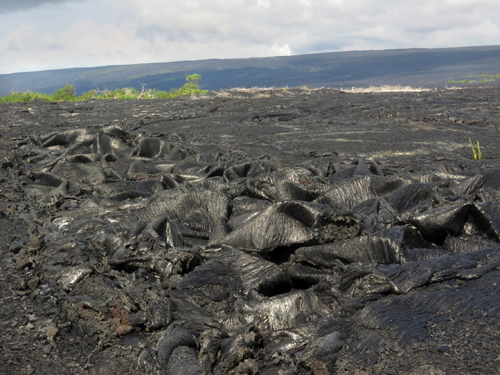
If any technical terms are likely to be remembered by anyone exposed to a bit of geological education, amongst them will be two that are Hawaiian Polynesian words: pahoehoe (‘pa hoy hoy’) and aa (‘a ah’). The first slides around the palate wonderfully while the latter give a sort of worrisome feel as if a large weight is about to land on one’s toes. Aa is lava with a blocky, broken and jagged surface, whereas pahoehoe refers to lava with the appearance of a freshly set torrent of toffee. November’s Picture of the Month is of basaltic lava that looks like it is chewable.

Pahoehoe lava from the Big Island of Hawaii. (Credit: Mila Zinkova)


A supervolcano’s plumbing system

What was the most devastating natural disaster ever to face humans? It would be tempting to suggest the Indian Ocean tsunami of 26 December 2004, but that is because most people remember it with horror. In fact the worst the Earth ever flung at us was much further back in our history and left a huge spike of sulfates in the Greenland icecap at around 73 thousand years ago. This relic of volcanic aerosols that had blasted into the stratosphere was tracked back to a 100 by 30 km caldera in Sumatra now occupied by a lake (Lake Toba) that is 500 m deep in places and almost filled by a slightly off-centre island. The eruption explosively ejected 2800 cubic kilometres of magma, of which an estimated 800 km3 fell as ash across a wide swath of the tropics westwards of Sumatra at least as far as Arabia and East Africa; the line of march taken by anatomically modern humans migrating from Africa. In India and Malaysia the Toba ash layer reaches 5-10 m thickness and probably occurs undetected as a thin layer across the entire tropics. Around 1010 tonnes of sulfuric acid belched out, some to enter and linger in the stratosphere, which is estimated to have caused an average decrease in average global temperatures of 3.0 to 3.5 °C for several years. Studies of human mtDNA hint at a genetic bottleneck around the time of Toba’s eruption and a large decrease, perhaps as much as 60%, in the global population of Homo sapiens. But humans survived or quickly filled devastated land in India, where stone tools are found both below and just above the Toba ash layer.

Landsat image of Lake Toba, the largest volcan...
Landsat image (120 km across) of Lake Toba, the largest volcanic crater lake in the world. (credit: Wikipedia)

The largest volcanic eruption in the last 26 Ma, there can be little doubt that no other natural catastrophe had as large an influence on humanity as did Toba. Of course, slower processes such as climate change and ups and downs of sea level lay behind the repeated spread of humans out of Africa and probably their evolution as a whole. The drama of the Toba event has drawn attention to the massive risk posed by supervolcanoes in general, such as that centred on Yellowstone in the NW US, which show signs of activity 640 ka after its last major explosive event. Toba certainly is not dead, for its peculiar island of Samosir has been uplifted steadily since the eruption by about 450 m, probably due to influx of magma deep beneath the surface, and experiences shallow earthquakes. What lies in the guts of supervolcanoes is literally a hot topic and a new 3-D imaging method has been applied to Toba.

English: Batak village on Samosir island, Lake...
Traditional village on Samosir island, Lake Toba. (credit: Wikipedia)

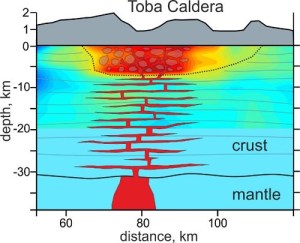
Seismic tomography that uses background or ambient seismic noise has become a powerful technique for studying the crust and lithosphere when small-amplitude short-wavelength Rayleigh and Love surface waves are monitored to pick up subsurface reflecting bodies and measure variation in wave speed with depth. The greater the density of seismometers deployed, the finer the resolution of deep crustal features and 40 such detectors are in place around Lake Toba. A team of Russian, French and German geophysicists have reported new results bearing on how magma may be accumulating beneath the vast caldera (Jaxibulatov, K. et al. 2014. A large magmatic sill complex beneath the Toba caldera. Science, v. 346, p. 617-619). Down to about 7 km the tomography has picked up a structurally homogeneous low-speed zone directly beneath Samosir Island that the authors attribute to the 73 ka explosive eruption. Beneath that several magma sills appear to dominate the sub-caldera crust, possibly responsible for the post eruption uplift within the caldera: the precursor to a layered intrusive body and each an increment towards a further huge eruption.

Interpretation of seismic tomography cross section of Toba. Greens to reds increasingly negative shear speed anomaly. Showing magma sills in lower crust and 74 ka damage zone above 7 km. (credit: Jaxibulatov et al. 2014

September’s picture: Iceland eruption

MoreHolurThis month’s stunning image from Earth Science Picture of the Day, taken on 8 September this year is of Iceland’s biggest fissure eruption (video clip) since 1875, in the Holuhraun lava field, which began on 31 August this year. The flow is about to meet the Jokulsa a Fjollum, a large river flowing from Iceland’s largest ice cap Vatnajokull. At the time of writing (29 September) lava is flowing along the river bed at around 1 km each day. So far, the flow has spread over 44 square kilometres, and risks blocking the Jokulsa a Fjollum where it flows through a narrow channel bounded by older lava flows. If that happens the river will form a substantial lake until it is able to flow over and erode the bedrock, and will also leave one of the country’s spectacular waterfalls (Sellfoss) dry.

Aerial View of Jökulsá á Fjöllum
Aerial View of Jökulsá á Fjöllum, Iceland, downstream of Holuhraun (credit: Wikipedia)

The fissure is connected to the large Bárðarbunga stratovolcano that lies beneath Vatnajokull, which is currently showing signs of subsidence, at about 40 cm each day, and seismicity. There are concerns that this activity may presage an eruption there which may melt large volumes of ice and perhaps release a flood or jökulhlaup from beneath the icecap. Such a flood would likely follow the course of the Jokulsa a Fjollum river.

Ants and carbon sequestration

Aside from a swift but highly unlikely abandonment of fossil fuels, reduction of greenhouse warming depends to a large extent, possibly entirely, on somehow removing CO2 from the atmosphere. Currently the most researched approach is simply pumping emissions into underground storage in gas permeable rock, but an important target is incorporating anthropogenic carbon in carbonate minerals through chemical interaction with potentially reactive rocks. In a sense this is a quest to exploit equilibria involving carbon compounds that dominate natural chemical weathering and to sequester CO2 in solid, stable minerals.

The two most likely minerals to participate readily in weathering that involves CO2 dissolved in water are plagioclase feldspar, a calcium-rich aluminosilicate and olivine, a magnesium silicate. Both are abundant in mafic and ultramafic rocks, such as basalt and peridotite, which themselves are among the most common rocks exposed at the Earth’s surface. The two minerals, being anhydrous, are especially prone to weathering reactions involving acid waters that contain hydrogen ions, and in the presence of CO2 they yield stable carbonates of calcium and magnesium respectively. Despite lots of exposed basalts and ultramafic rocks, clearly such natural sequestration is incapable of absorbing emissions as fast as they are produced.

One means of speeding up weathering is to grind up plagioclase- and olivine-bearing rocks and spread the resulting gravel over large areas; as particles become smaller their surface area exposed to weathering increases. Yet it doesn’t take much pondering to realise that a great deal of energy would be needed to produce sufficient Ca- and Mg-rich gravel to take up the approximately 10 billion tonnes of CO2 being released each year by burning fossil fuels: though quick by geological standards the reaction rates involved are painfully slow in the sense of what the climatic future threatens to do. So is there any way in which these reactions might be speeded up?

Two biological agencies are known to accelerate chemical weathering, or are suspected to do so: plant roots and animals that live in soil. Ronald Dorn of Arizona State University set out to investigate the extent to which such agencies do sequester carbon dioxide, under the semi-arid conditions that prevail in Arizona and Texas (Dorn, R.I. 2014. Ants as a powerful biotic agent of olivine and plagioclase dissolution. Geology, v. 42, p. 771-774). His was such a simple experiment that it is a wonder it had not been conducted long ago; but it actually took more than half his working life. Spaced over a range of topographic elevations, Dorn used an augur at each site to drill five half-metre holes into the root mats of native trees, established ant and termite colonies and bare soil surfaces free of vegetation or animal colonies, filling each with sand-sized crushed basalt.

Empire of the Ants (film)
Film poster for Empire of the Ants (starring Joan Collins) (credit: Wikipedia)

Every five years thereafter he extracted the basalt sand from one of the holes at each site and each soil environment. To assess how much dissolution had occurred he checked for changes in porosity, and heated the samples to temperatures where carbonates break down to discover how much carbonate had been deposited. That way he was able to assess the cumulative changes over a 25 year period relative to the bare-ground control sites. The results are startling: root mats achieved 11 to 49 times more dissolution than the control; termites somewhat less, at 10 to 19 times; while ants achieved 53 to 177 times more dissolution. While it was certain that the samples had been continuously exposed to root mats throughout, the degree of exposure to termites and ants is unknown, so the animal enhancements of dissolution are probably minima.

Microscopic examination of mineral grains exposed to ant activity shows clear signs of surface pitting and other kinds of decay. Chemically, the samples showed that exposure to ants consistently increased levels of carbonate in the crushed basalt sand compared with controls, with levels rising by 2 to 4% by mass, with some variation according to ant species. Clearly, there is some scope for a role for ants in carbon sequestration and storage; after all, there are estimated to be around 1013 to 1016 individual ants living in the world’s soils. In the humid tropics the total mass of ants may be up to 4 times greater than all mammals, reptiles and amphibians combined. There is more to learn, but probably a mix of acid secretions and bioturbation by ants and termites is involved in their dramatic effect on weathering. One interesting speculation is that ants may even have played a role in global cooling through the Cenozoic, having evolved around 100 Ma ago.

Breathing spaces or toxic traps in the Archaean ocean


The relationship between Earth’s complement of free oxygen and life seems to have begun in the Archaean, but it presented a series of paradoxes: produced by photosynthetic organisms oxygen would have been toxic to most other Archaean life forms; its presence drew an important micronutrient, dissolved iron-2, from sea water by precipitation of iron-3 oxides; though produced in seawater there is no evidence until about 2.4 Ga for its presence in the air. It has long been thought that the paradoxes may have been resolved by oxygen being produced in isolated patches, or ‘oases’ on the Archaean sea floor, where early blue-green bacteria evolved and thrived.


A stratigraphic clue to the former presence of such oxygen factories is itself quite convoluted. The precipitation of calcium carbonates and therefore the presence of limestones in sedimentary sequences are suppressed by dissolved iron-2: the presence of Fe2+ ions would favour the removal of bicarbonate ions from seawater by formation of ferrous carbonate that is less soluble than calcium carbonate. Canadian and US geochemists studied one of the thickest Archaean limestone sequences, dated at around 2.8 Ga, in the wonderfully named Wabigoon Subprovince of the Canadian Shield which is full of stromatolites, bulbous laminated masses probably formed from bacterial biofilms in shallow water (Riding, R. et al. 2014. Identification of an Archean marine oxygen oasis. Precambrian Research, v. 251, p. 232-237).

English: Stromatolites in the Hoyt Limestone (...
Limestone formed from blue-green bacteria biofilms or stromatolites (credit: Wikipedia)

Limestones from the sequence that stable isotope analyses show to remain unaltered all have abnormally low cerium concentrations relative to the other rare-earth elements. Unaltered limestones from stromatolite-free, deep water limestones show no such negative Ce anomaly. Cerium is the only rare-earth element that has a possible 4+ valence state as well one with lower positive charge. So in the presence of oxygen cerium can form an insoluble oxide and thus be removed from solution. So cerium independently shows that the shallow water limestones formed in seawater that contained free oxygen. Nor was it an ephemeral condition, for the anomalies persist through half a kilometer of limestone.


The study shows that anomalous oxygenated patches existed on the Archaean sea floor, probably shallow-water basins or shelves isolated by the build up of stromatolite reef barriers. For most prokaryote cells they would have harboured toxic conditions, presenting them with severe chemical stress. Possibly these were the first places where oxygen defence measures evolved, that eventually led to more complex eukaryote cells that not only survive oxygen stress but thrive on its presence. That conjecture is unlikely to be fully proved, since the first undoubted fossils of eukaryote cells, known as acritarchs, occur in rocks that are more than 800 Ma years younger.