Reconstructing the structure of ancient vegetation canopies

One of the central measures used to describe modern ecosystems is the ratio of foliage area to that of the ground surface – the leaf area index (LAI) – which expresses the openness of vegetation canopies. A high LAI helps to retain moisture in the soil, partly by shading and cooling the surface to reduce evaporation and partly by stopping surface soil from being battered to a concrete-like consistency by heavy rain, which reduces the amount of water that can infiltrate. It is possible to estimate LAI across today’s entire land area using satellite image data but a proxy for palaeoecological LAI has remained hard to find.

English: Creative Commons attribution "ph...
Hemispherical photograph used to calculate modern canopy cover. (credit: Wikipedia; photo by S.B. Weiss)

The outer coating of leaves in well-shaded (high LAI) areas tends to have protective or pavement cells that are larger and have more complicated shapes than does that of leaves in more open canopies. The framework of leaf cells is silica-based and made up of structures known as phytoliths whose morphologies vary in much the same way as the cells that they support. So theoretically it is possible to use fossil phytoliths in terrestrial sediments to estimate LAI variations through time in local canopies, but first the approach needs a means of calibration from living ecosystems. The vegetation of Central American Costa Rica varies through the entire range of possible LAI values, which leads to varying amounts of sunlight available to the leaves of cover plants. Measuring the area and the degree of shape-complexity of phytoliths in modern soils there shows that each is positively correlated with LAI.

Lowland Paca near Las Horquetas, Costa Rica. F...
A modern herbivorous mammal (lowland paca) from dense forest in Costa Rica. (Photo credit: Wikipedia)

Putting this approach to use in the Cenozoic terrestrial sediments of Patagonia, US and Argentinean palaeoecologists aimed to examine how the evolution of the teeth of herbivorous mammals – a major feature in their speciation – linked to changes in vegetation structure (Dunn, R.E. et al. 2015. Linked canopy, climate and faunal change in the Cenozoic of Patagonia. Science, v. 347, p. 258-261). Using phytoliths they were able to show that in the Eocene the area was covered by dense, closed forest canopies that gradually became more open towards the end of the Eocene to be replaced by open forest and shrubland habitats in the Oligocene and Miocene, with a brief period of regreening. It was during the period of more open vegetation that tooth structure underwent the most change. Chances are that the vegetation shifts began in response to the onset of Antarctic glaciation at the beginning of the Oligocene Epoch and related climate change at the northern margin of the Southern Ocean. Changes in the herbivore teeth may have been in response to the increasing amount of dust adhering to leaves as canopies became more open and soil increasingly dried out.

Verneshots (huge volcanic gas blasts) ten years on

One of the most daring hypotheses of modern geosciences: is that of the ‘Verneshot’ reported by Earth Pages in 2004.  Jason Phipps Morgan and colleagues explored the possible consequences of a build-up of volatiles in plume-related magmas at the base of thick continental lithosphere beneath cratons, prior to the eruption of continental flood basalts. They suggested that pressure would eventually result in an explosive release at a lithospheric weak point, followed by collapse above the plume head that would propagate upwards, at hypersonic speeds. Modelling the forces involved, the authors of the novel idea considered that they would be sufficient to fling huge rock masses into orbit.  Verneshots might neatly explain the circumstances around mass extinctions, such as their coincidence with continental flood basalt events; large impact structures, most likely at the antipode of the event; global debris layers containing shocked rock, melt spherules; unusual element suites and compounds (including fullerenes); and enough toxic gas to cause biological devastation.

Ten years on, Verneshots are back, again in the prestigious journal Earth and Planetary Science Letters, and this time among the co-authors are Morgan père et fils (W. Jason a founder of plate tectonics, and Jason P. who launched the idea). This time the yet-to-be –accepted hypothesis comes with evidence of an extremely unusual and fortuitous kind (Vannucchi, P. et al. 2015. Direct evidence of ancient shock metamorphism at the site of the 1908 Tunguska event. Earth and Planetary Science Letters, v. 409, p. 168-174). The origin of the paper lies in an attempt to verify reports of shocked quartz in samples collected close to the centre of the 2000 km2 devastation that resulted from what is now accepted to have been a comet or asteroid air-burst explosion in June 1908 in the Tunguska region of Siberia. Apart from a disputed 300 m crater in the area, the Tunguska Event left no long-lived sign: it ‘merely’ knocked over millions of trees. However, its epicenter lay in a 10 km depression ringed by hills, that has been suggested to be a volcanic centre associated with the end-Permian Siberian Traps.

Trees knocked down and burned over hundreds of square km by the 1908Tunguska Event (credit: Leonid Alekseyevich Kulik deceased)
Trees knocked down and burned over hundreds of square km by the 1908 Tunguska Event (credit: Leonid Alekseyevich Kulik deceased)

The reported shocked quartz locality turned out to associated with an isolated occurrence of quartz-rich sand and rounded clasts of quartzite that contains sedimentary structures. The occurrence is surrounded by basalts of the Siberian Traps, yet is situated topographically above them. The quartzite is thought to be Permian terrestrial sandstone that commonly underlies much of the remaining extent of Siberian Traps.

Quartzite clasts do indeed contain shocked quartz, together with pseudotachylite glass veinlets, quartz and feldspar crystal growth on sedimentary grains and silica-rich glassy spherules. These features are not uniquely diagnostic of shock metamorphism, but are oddly absent from the surrounding Siberian Traps nearby, which suggests that whatever formed them predated the final eruptive stages of the end-Permian large igneous province. Indeed it would be unlikely that airburst of some extraterrestrial bolide in 1908 could produce the metamorphic features of the quartzites without setting ablaze the trees that it felled. A second possibility, that the Tunguska Depression is a Permo-Triassic impact crater and the quartzites being part of an associated central uplift runs into the unlikely coincidence of lying less than 5 km from the 1908 epicentre.

A third hypothesis is that the Tunguska Depression is a massive diatreme associated with a Verneshot. Another odd association lies 8 km to the south of the epicentre, a carbonatite that is one of many, along with smaller pipe-like structures all possibly linked to magmatic gas escape. The Tunguska Event, a mighty puzzle in its own right, may perhaps be eclipsed. Will silence return as it did after the original Verneshot hypothesis was published? Quite possibly, but another quirk about the Siberian Traps was reported by Earth Pages in mid-2014. In a contribution to a link between this massive end-Permian volcanic effusion and the Permian-Triassic mass extinction it was noted that in the Chinese sedimentary repository of evidence for the extinction there is an isolated spike in the abundance of nickel  that is almost certainly of volcanic origin, but only the one when repeated flood basalt events perhaps ought to have led to a series of nickel anomalies. One huge volcanic gas release as the Siberian Traps were building up?

Breathing spaces or toxic traps in the Archaean ocean


The relationship between Earth’s complement of free oxygen and life seems to have begun in the Archaean, but it presented a series of paradoxes: produced by photosynthetic organisms oxygen would have been toxic to most other Archaean life forms; its presence drew an important micronutrient, dissolved iron-2, from sea water by precipitation of iron-3 oxides; though produced in seawater there is no evidence until about 2.4 Ga for its presence in the air. It has long been thought that the paradoxes may have been resolved by oxygen being produced in isolated patches, or ‘oases’ on the Archaean sea floor, where early blue-green bacteria evolved and thrived.


A stratigraphic clue to the former presence of such oxygen factories is itself quite convoluted. The precipitation of calcium carbonates and therefore the presence of limestones in sedimentary sequences are suppressed by dissolved iron-2: the presence of Fe2+ ions would favour the removal of bicarbonate ions from seawater by formation of ferrous carbonate that is less soluble than calcium carbonate. Canadian and US geochemists studied one of the thickest Archaean limestone sequences, dated at around 2.8 Ga, in the wonderfully named Wabigoon Subprovince of the Canadian Shield which is full of stromatolites, bulbous laminated masses probably formed from bacterial biofilms in shallow water (Riding, R. et al. 2014. Identification of an Archean marine oxygen oasis. Precambrian Research, v. 251, p. 232-237).

English: Stromatolites in the Hoyt Limestone (...
Limestone formed from blue-green bacteria biofilms or stromatolites (credit: Wikipedia)

Limestones from the sequence that stable isotope analyses show to remain unaltered all have abnormally low cerium concentrations relative to the other rare-earth elements. Unaltered limestones from stromatolite-free, deep water limestones show no such negative Ce anomaly. Cerium is the only rare-earth element that has a possible 4+ valence state as well one with lower positive charge. So in the presence of oxygen cerium can form an insoluble oxide and thus be removed from solution. So cerium independently shows that the shallow water limestones formed in seawater that contained free oxygen. Nor was it an ephemeral condition, for the anomalies persist through half a kilometer of limestone.


The study shows that anomalous oxygenated patches existed on the Archaean sea floor, probably shallow-water basins or shelves isolated by the build up of stromatolite reef barriers. For most prokaryote cells they would have harboured toxic conditions, presenting them with severe chemical stress. Possibly these were the first places where oxygen defence measures evolved, that eventually led to more complex eukaryote cells that not only survive oxygen stress but thrive on its presence. That conjecture is unlikely to be fully proved, since the first undoubted fossils of eukaryote cells, known as acritarchs, occur in rocks that are more than 800 Ma years younger.


Trapping Martian life forms

No matter how optimistic exobiologists might be, the current approaches to discovering whether or not Mars once hosted life or, the longest shot of all, still does are almost literally hit or miss. First the various teams involved try to select a target area using remotely sensed data to see if rocks or regolith have interacted with water; generally from the presence or absence of clay minerals and /or sulfates that hydrous alteration produces on Earth. Since funding is limited the sites with such ingredients are narrowed down to the ‘best’ – in the case of NASA’s Curiosity rover to Gale Crater  where a thick sequence of sediments shows occasional signs of clays and sulfates. But a potential site must also be logistically feasible with the least risk of loss to the lander. Even then, all that can be achieved in existing and planned mission is geochemical analysis of drilled and powdered samples. Curiosity’s ambition is limited to assessing whether the conditions for life were present. Isotopic analysis of any carbon content to check for mass fractionation that may have arisen from living processes is something for a future ESA mission.

Neither approach is likely to prove the existence now or in far-off times of Martian life, though scientists hope to whet the appetite of those holding the purse strings. Only return of rock samples stands any realistic chance of giving substance to the dreams of exobiologists. But what to collect? A random soil grab or drill core is highly unlikely to provide satisfaction one way or the other. Indeed only incontrovertible remains of some kind of cellular material can slake the yearning. Terrestrial materials might provide a guide to (probably) robotic collectors. Kathleen Benison and Francis Karmanocky of West Virginia University have followed this up by examining sulfates from one of the least hospitable places on Earth; the salt flats of the high Andes of Chile (Benison, K.C. & Karmanocky, F.J. 2014. Could microorganisms be preserved in Mars gypsum? Insights from terrestrial examples. Geology, v. 42, p. 615-618).

Evaporite minerals from Andean salars precipitated from extremely acidic and highly saline lake water originating from weathering of surrounding volcanoes. Oddly few researchers have sought cellular life trapped in crystals of salt or gypsum, the two most common minerals in the high-elevation salt pans. Fluid inclusions in sedimentary halite (NaCl) crystals from as far back as the Triassic are known to contain single-celled extremophile prokaryotes and eukaryotes, but gypsum is more likely to be found on Mars. Benison and Karmanocky document a variety of cellular material from Chilean gypsum that has been trapped in the solid mineral itself or in fluid inclusions. This is the most likely means of fossilisation of Martian life forms, if they ever existed. The salar gypsum contain cells that can be cultured and thereby revived since several species can remain dormant for long periods. The authors suggest that transparent cleavage fragments of Martian gypsum could be examined at up to 2000x magnification on future Mars landers. Finding convincing cells would see dancing in exobiology labs, and what if they should move…

Mass extinctions’ connections with volcanism: more support

Plot the times of peaks in the rates of extinction during the Mesozoic against those of flood basalt outpourings closest in time to the die-offs and a straight line can be plotted through the data. There is sufficiently low deviation between it and the points that any statistician would agree that the degree of fit is very good. Many geoscientists have used this empirical relationship to claim that all Mesozoic mass extinctions, including the three largest (end-Permian, end-Triassic and end-Cretaceous) were caused in some way by massive basaltic volcanism. The fact that the points are almost evenly spaced – roughly every 30 Ma, except for a few gaps – has suggested to some that there is some kind of rhythm connecting the two very different kinds of event.

Major extinctions and flood basalt events during the Mesozoic (credit: S Drury)
Major Mesozoic extinctions and flood basalt events (credit: S Drury)

Leaving aside that beguiling periodicity, the hypothesis of a flood-basalt – extinction link has a major weakness. The only likely intermediary is atmospheric, through its composition and/or climate; flood volcanism was probably not violent. Both probably settle down quickly in geological terms. Moreover, flood basalt volcanism is generally short-lived (a few Ma at most) and seems not to be continuous, unlike that at plate margins which is always going on at one or other place. The great basalt piles of Siberia, around the Central Atlantic margins and in Western India are made up of individual thick and extensive flows separated by fossil soils or boles. This suggests that magma blurted out only occasionally, and was separated by long periods of normality; say between 10 and 100 thousand years. Evidence for the duration of major accelerations, either from stratigraphy and palaeontology or from proxies such as peaks and troughs in the isotopic composition of carbon (e.g. EPN Ni life and mass extinction) is that they too occurred swiftly; in a matter of tens of thousand years. Most of the points on the flood-basalt – extinction plot are too imprecise in the time dimension to satisfy a definite relationship. Opinion has swung behind an instantaneous impact hypothesis for the K-P boundary event rather than one involving the Deccan Traps in India, simply because the best dating of the Deccan suggests extinction seems to have occurred when no flows were being erupted, while the thin impact-related layer in sediments the world over is exactly at the point dividing Cretaceous flora and fauna from those of the succeeding Palaeogene.

Yet no such link to an extraterrestrial factor is known to exist for any other major extinctions, so volcanism seems to be ‘the only game in town’ for the rest. Until basalt dating is universally more precise than it has been up to the present the case is ‘not proven’; but, in the manner of the Scottish criminal law, each is a ‘cold case’ which can be reopened. The previous article  hardens the evidence for a volcanic driver behind the greatest known extinction at the end of the Permian Period. And in short-order, another of the Big Five seems to have been resolved in the same way. A flood basalt province covering a large area of west and north-west Australia (known as the Kalkarindji large igneous province)has long been known to be of roughly Cambrian age but does it tie in with the earliest Phanerozoic mass extinction at the Lower to Middle Cambrian boundary? New age data suggests that it does at the level of a few hundred thousand years (Jourdan, F. et al. 2014. High-precision dating of the Kalkarindji large igneous province, Australia, and synchrony with the Early-Middle Cambrian (Stage 4-5) extinction. Geology, v. 42, p. 543-546). The Kalkarindji basalts have high sulfur contents and are also associated with widespread breccias that suggest that some of the volcanism was sufficiently explosive to have blasted sulfur-oxygen gases into the stratosphere; a known means of causing rapid and massive climatic cooling as well as increasing oceanic acidity. The magma also passed through late Precambrian sedimentary basins which contain abundant organic-rich shales that later sourced extensive petroleum fields. Their thermal metamorphism could have vented massive amounts of CO2 and methane to result in climatic warming. It may have been volcanically-driven climatic chaos that resulted in the demise of much of the earliest tangible marine fauna on Earth to create also a sudden fall in the oxygen content of the Cambrian ocean basins.

Nickel, life and the end-Permian extinction

The greatest mass extinction of the Phanerozoic closed the Palaeozoic Era at the end of the Permian, with the loss of perhaps as much as 90% of eukaryote diversity on land and at sea. It was also over very quickly by geological standards, taking a mere 20 thousand years from about 252.18 Ma ago. There is no plausible evidence for an extraterrestrial cause, unlike that for the mass extinction that closed the Mesozoic Era and the age of dinosaurs. Almost all researchers blame one of the largest-ever magmatic events that spilled out the Siberian Traps either through direct means, such as climate change related to CO2, sulfur oxides or atmospheric ash clouds produced by the flood volcanism or indirectly through combustion of coal in strata beneath the thick basalt pile. So far, no proposal has received universal acclaim. The latest proposal relies on two vital and apparently related geochemical observations in rocks around the age of the extinctions (Rothman, D.H. et al. 2014. Methanogenic burst in the end-Permian carbon cycle. Proceedings of the National Academy of the United States, v. 111, p. 5462-5467).

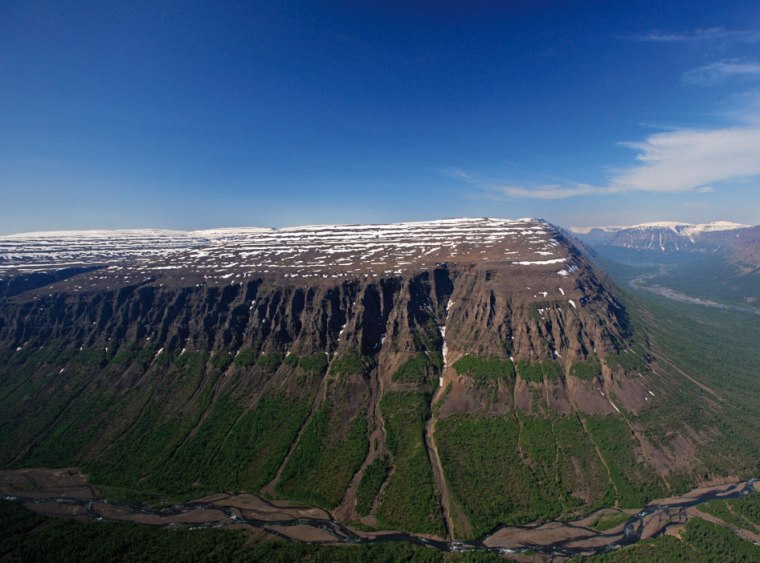
Siberian flood-basalt flows in Putorana, Taymyr Peninsula. (Credit: Paul Wignall; Nature http://www.nature.com/nature/journal/v477/n7364/fig_tab/477285a_F1.html)

In the run-up to the extinction carbon isotopes in marine Permian sediments from Meishan, China suggest a runaway growth in the amount of inorganic carbon (in carbonate) in the oceans. The C-isotope record from Meishan shows episodes of sudden major change (over ~20 ka) in both the inorganic and organic carbon parts of the oceanic carbon cycle. The timing of both ‘excursions’ from the long-term trend immediately follows a ‘spike’ in the concentration of the element nickel in the Meishan sediments. The Ni almost certainly was contributed by the massive outflow of basalt lavas in Siberia. So, what is the connection?

Some modern members of the prokaryote Archaea that decompose organic matter to produce methane have a metabolism that depends on Ni, one genus being Methanosarcina that converts acetate to methane by a process known as acetoclastic methanogenesis. Methanosarcina acquired this highly efficient metabolic pathway probably though a sideways gene transfer from Bacteria of the class Clostridia; a process now acknowledged as playing a major role in the evolution of many aspects of prokaryote biology, including resistance to drugs among pathogens. Molecular-clock studies of the Methanosarcina genome are consistent with this Archaea appearing at about the time of the Late Permian. A burst of nickel ‘fertilisation’ of the oceans may have resulted in huge production of atmospheric methane. Being a greenhouse gas much more powerful than CO2, methane in such volumes would very rapidly have led to global warming. Before the Siberian Traps began to be erupted nickel would only have been sufficiently abundant to support this kind of methanogen around ocean-floor hydrothermal springs. Spread globally by eruption plumes, nickel throughout the oceans would have allowed Methanosarcina or its like to thrive everywhere with disastrous consequences. Other geochemical processes, such as the oxidation of methane in seawater, would have spread the influence of the biosphere-lithosphere ‘conspiracy’. Methane oxidation would have removed oxygen from the oceans to create anoxia that, in turn, would have encouraged other microorganisms that reduce sulfate ions to sulfide and thereby produce toxic hydrogen sulfide. That gas once in the atmosphere would have parlayed an oceanic ‘kill mechanism’’ into one fatal for land animals.

There is one aspect that puzzles me: the Siberian Traps probably involved many huge lava outpourings every 10 to 100 ka while the magma lasted, as did all other flood basalt events. Why then is the nickel from only such eruption preserved in the Meishan sediments, and if others are known from marine sediments is there evidence for other such methanogen ‘blooms’ in the oceans?

How the first metazoan mass extinction happened

The end-Ordovician mass extinction was the first of five during the Phanerozoic, andthe first that involved multicelled organisms. It happened in two distinct phases that roughly coincided with an intense but short-lived glaciation at the South Pole, then situated within what is now the African continent. Unlike the other four, this biotic catastrophe seems unlinked to either a major impact structure or to an episode of flood volcanism.

seadiorama ordovician
Artist’s impression of an Ordovician shallow-sea community (credit: drtel)

In 2009 Earth Pages reported the curious occurrence in 470 Ma (Darriwilian Stage) Swedish limestones of a large number of altered chondritic meteorites, possible evidence that there may have been an extraterrestrial influence on extinction rates around that time. In support is evidence that the meteorite swarm coincided with megabreccias or olistostromes at what were then Southern Hemisphere continental margins: possible signs of a series of huge tsunamis. But in fact this odd coincidence occurred at a time when metazoan diversity was truly booming: the only known case of impacts possibly favouring life.

Number One of the Big Five mass extinctions occurred during the late-Ordovician Hirnantian stage (443-445 Ma) and has received much less attention than the later ones. So it is good see the balance being redressed by a review of evidence for it and for possible mechanisms (Harper, D.A.T et al. 2014. End Ordovician extinctions: A coincidence of causes. Gondwana Research, v. 25, p. 1294-1307). The first event of a double-whammy mainly affected free-swimming and planktonic organisms and those of shallow seas; near-surface dwellers such as graptolites and trilobites. The second, about a million years later, hit animals living at all depths in the sea. Between them, the two events removed about 85% of marines species – there were few if any terrestrial animals so this is close to the extinction level that closed the Palaeozoic at around 250 Ma.

No single process can be regarded as the ‘culprit’. However the two events are bracketed by an 80-100 m fall in sea level due to the southern hemisphere glaciation. That may have given rise to changes in ocean oxygen content and in the reduction of sulfur to hydrogen sulfide. Also climate-related may have been changes in the vertical, thermohaline circulation of the oceans, falling temperatures encouraging sinking of surface water to abyssal depths providing more oxygen to support life deep in the water column. Sea-level fall would have reduced the extent of shallow seas too. Those consequences would explain the early demise of shallow water, free swimming animals. Reversal of these trends as glaciation waned may have returned stagnancy and anoxia to deep water, thereby affecting life at all depths. The authors suggest generalized ‘tipping points’ towards which several global processes contributed.

Enhanced by Zemanta

Oxygen, magnetic reversals and mass extinctions

In April 2005 EPN reported evidence for a late Permian fall in atmospheric oxygen concentration to about 16% from its all-time high of 30% in the Carboniferous and earlier Permian.. This would have reduced the highest elevation on land where animals could live to about 2.7 km above sea level, compared with 4 to 5 today. Such an event would have placed a great deal of stress on terrestrial animal families. Moreover, it implies anoxic conditions in the oceans that would stress marine animals too. At the time, it seemed unlikely that declining oxygen was the main trigger for the end-Permian mass extinction as the decline would probably have been gradual; for instance by oxygen being locked into iron-3 compounds that give Permian and Triassic terrestrial sediments their unrelenting red coloration. By most accounts the greatest mass extinction of the Phanerozoic was extremely swift.

The possibility of extinctions being brought on by loss of oxygen from the air and ocean water has reappeared, though with suggestion of a very different means of achieving it (Wei, Y. and 10 others 2014. Oxygen escape from the Earth during geomagnetic reversals: Implications to mass extinction. Earth and Planetary Science Letters, v. 394, p. 94-98). The nub of the issue proposed by the Chinese-German authors is the dissociation and ionization by solar radiation of O2 molecules into O+ ions. If exposed to the solar wind, such ions could literally be ‘blown away’ into interplanetary space; an explanation for the lack of much in the way of any atmosphere on Mars today. Mars is prone to such ionic ablation because it now has a very weak magnetic field and may have been in that state for 3 billion years or more. Earth’s much larger magnetic field diverts the solar wind by acting as an electromagnetic buffer against much loss of gases, except free hydrogen and to a certain extent helium. But the geomagnetic field undergoes reversals, and while they are in progress, the field drops to very low levels exposing Earth to loss of oxygen as well as to dangerous levels of ionising radiation through unprotected exposure of the surface to the solar wind.

Artist's rendition of Earth's magnetosphere.
Artist’s rendition of Earth’s magnetosphere deflecting the solar wind. (credit: Wikipedia)

Field reversals and, presumably, short periods of very low geomagnetic field associated with them, varied in their frequency through time. For the past 80 Ma the reversal rate has been between 1 and 5 per million years. For much of the Cretaceous Period there were hardly any during a magnetic quiet episode or superchron. Earlier Mesozoic times were magnetically hectic, when reversals rose to rates as high as 7 per million years in the early Jurassic. This was preceded by another superchron that spanned the Permian and Late Carboniferous. Earlier geomagnetic data are haphazardly distributed through the stratigraphic column, so little can be said in the context of reversal-oxygen-extinction connections.

Geomagnetic polarity over the past 169 Ma, tra...
Geomagnetic polarity over the past 169 Ma (credit: Wikipedia)

Wei et al. focus on the end-Triassic mass extinction which does indeed coincide, albeit roughly, with low geochemically modelled atmospheric oxygen levels (~15%). This anoxic episode extended almost to the end of the Jurassic, although that was a period of rapid faunal diversification following the extinction event. Yet it does fall in the longest period of rapid reversals of the Mesozoic. However, this is the only clear reversal-oxygen-extinction correlation, the Cenozoic bucking the prediction. In order to present a seemingly persuasive case for their idea, the authors assign mass extinctions not to very rapid events – of the order of hundreds of thousand years at most – which is well supported by both fossils and stratigraphy, but to ‘blocks’ of time of the order of tens of million years.

My own view is that quite possibly magnetic reversals can have adverse consequences for life, but as a once widely considered causal mechanism for mass extinction they have faded from the scene; unlikely to be resurrected by this study. There are plenty of more plausible and better supported mechanisms, such as impacts and flood-basalt outpourings. Yet several large igneous provinces do coincide with the end of geomagnetic superchrons, although that correlation may well be due to the associated mantle plumes marking drastic changes around the core-mantle boundary. According to Wei et al., the supposed 6th mass extinction of the Neogene has a link to the general speeding up of geomagnetic reversals through the Cenozoic: not much has happened to either oxygen levels or biodiversity during the Neogene, and the predicted 6th mass extinction has more to do with human activity than the solar wind.

Enhanced by Zemanta

Remote sensing for fossils

With the growing diversity of data from those parts of the electromagnetic spectrum that pass freely though Earth’s atmosphere, mainly acquired from orbit, an increasing number of attributes of the surface can be mapped remotely. The initial impetus to launch remote sensing satellites in the 1960’s and early 70’s had two strands: to monitor weather conditions and assess vegetation cover with the early metsats, such as TIROS-1, and the first Landsat platform that exploited green plants’ propensity for absorbing visible and largely reflecting near-infrared (NIR) radiation. With the incorporation in the Advanced Spaceborne Thermal Emission and Reflection Radiometer (ASTER) instruments of wavelength regions in which minerals show spectral diversity, in the reflected short-wave infrared (SWIR) and emitted thermal infrared (TIR), remote sensing became a viable and useful tool for geologists. It figures strongly in lithological mapping and also in the detection of minerals related to various kinds of alteration associated with metal mineralisation and the migration of hydrocarbon-related fluids. The more wavebands with narrower coverage of radiation wavelengths, the more likely are the subtle differences in mineral spectra able to be detected and mapped. Yet, apart from one experimental system (Hyperion aboard NASA’s EO-1 orbital platform) our home planet is not as well served by such hyperspectral systems as is Mars, blessed by two which have fuelled the on-going search for past habitable zones on the Red Planet.

The May 2014 issue of Scientific American includes an article on remote sensing that follows what to many might seem an odd direction: how to increase the chance of finding rich fossil deposits (Anemone, R.L. & Emerson, C.W. 2014. Fossil GPS. Scientific American, v. 310(5), p. 34-39). Apart from targeting a particular stratigraphic unit on a geological map, palaeontological collection has generally been a hit-or-miss affair depending on persistence and a keen eye, with quite a lot of luck. Once a productive locality turns up, such as the Cambrian Burgess shale, the dinosaur-rich Cretaceous sandstone of the Red Deer River badlands of southern Alberta in Canada and the hominin sites of Ethiopia’s Afar Depression, palaeontologists often look no further until its potential is exhausted. Robert Anemone and Charles Emerson felt, as may palaeobiologists do, that one fossil ‘hotspot’ is simply not enough, yet balked at the physical effort, time and frustration needed to find more by trekking through their area of interest, the vast Tertiary sedimentary basins of Wyoming, USA. They decided to try an easier tack: using the few known fossil localities as digital ‘training areas’ for a software interrogation of Landsat Enhanced Thematic Mapper data in the hope that fossiliferous spots might be subtly different in their optical properties from those that were barren.

Satellite image of the Wyoming Basin, Wyoming,...
Satellite image of the Wyoming Basin, USA. credit: Wikipedia)

The teeth and bones of early Eocene mammals that had drawn them to Wyoming turn up in sandstone beds of the basins. They are pretty distinctive elements of landscape, forming ridges of outcrop because of their relative resistance to erosion, yet for that very reason present a huge selection of possibilities. Being simple mineralogically they also presented a seemingly daunting uniformity. Anemone and Emerson decided on a purely statistical approach using the six visible, NIR and SWIR bands sensed by Landsat ETM, rather than a spectrally oriented strategy using more sophisticated ASTER data with 14 spectral bands. Their chosen algorithm was that based on an artificial neural network that the fossil rich sandstones would train to recognise patterns present in ETM data recorded over them. This purely empirical approach seems to have worked. Of 31 sites suggested by the algorithm 25 yielded abundant vertebrate fossils. Applied to another of Wyoming’s Tertiary basins it also ‘found’ the three most productive known mammal sites there. So, what is it about the fossil-rich sandstones that sets them apart from those that are more likely to be barren? The authors do not offer an explanation. Perhaps it has something to do with reducing conditions that would help preserve organic material better than would sandstones deposited in an oxidising environment. Iron minerals and thereby colour might be a key factor, oxidised sandstones are generally stained red to orange by Fe-3 oxides and hydroxides, whereas reduced sandstone facies may be grey because of iron in the form of sulfides

Enhanced by Zemanta

Update on giant fossil squirrel

Eleven years on from his announcement in March 2003 of a giant member of the Family Sciuridae (squirrels) found in a lateritic lagerstätte in the Western Ghats of Karnataka State in India (see http://geocities.yahoo.com/pusiffli/squirrels.html – note: this site may no longer be extant) Professor Pandit U. Siffli of the emeritus faculty at the Sringeri Institute of Palaeontology has sent me further news of his investigations. The clay-filled pocket within the mottled zone has proved astonishingly fruitful now that Pandit Unmer has more free time following his retirement. He and his recently graduated colleague, Dr G.B. Harm, have unearthed several more exquisite specimens of Titanosciurus sringeriensis – long-standing readers will recall that the body cavity of the child-sized type specimen of T. sringeriensis contained bones of primitive hamsters, that no doubt the squirrel had consumed, confirming Siffli’s speculation that the creature was the only known member of the Sciuridae that was an obligate carnivore. This view stemmed originally from its formidable dentition.

Laterite
Laterite (credit: Paul J. Morris)

Confirmation of this astounding revelation comes from two new lines of evidence discovered by Harm – the principle excavator since Siffli became encumbered by what he has described to me as his ‘blessed game leg’. In his letter he says, ‘young Grivas Bodili has informed me in a mood of solemn gaiety that there are burrows in the lagerstätte which contain complete skeletons of hamsters in a cowering posture. There are also abundant coprolites associated with one of the more corpulent specimens of T. sringeriensis that are a rich source of tiny hamster bones and one example of a partly digested avian flight feather’. The pair now have a paper in press (Harm, G.B. & Siffli, P.U. in press 2014. A large predatory sciurid from the Kudremukh laterites, Karnataka, India: evidence from a well-preserved rodent warren. Earth and Sanitary Appliance Letters, doi:11.3319/esal55164).
It seems likely that the early squirrels and hamsters borrowed into the laterite soon after intense tropical weathering has ceased due to climatic cooling associated with the onset of glaciation in Antarctica, probably in late-Eocene times. At that stage the upper laterite must have been soft enough for early mammals to dig into it. Subsequently the palaeosol became indurated as a result of regional desiccation, allowing exquisite preservation. Exact dating by the Ar-Ar method may soon be possible, given samples containing potassium-rich authigenic minerals. The search is now surely on for similar subterranean lagerstätten in the lateritic veneers covering vast tracts of the southern continents, whose formation probably came to a close at roughly the same time as did those of South India.

Artist's impression of the Sringeri carnivorous squirrel (credit: network54.com)
Artist’s impression of T. sringeriensis (credit: network54.com)

Prof Siffli tells me he would welcome communications from other sciurid and laterite researchers at pusiffli@gmail.com

Enhanced by Zemanta