This month’s stunning image from Earth Science Picture of the Day, taken on 8 September this year is of Iceland’s biggest fissure eruption (video clip) since 1875, in the Holuhraun lava field, which began on 31 August this year. The flow is about to meet the Jokulsa a Fjollum, a large river flowing from Iceland’s largest ice cap Vatnajokull. At the time of writing (29 September) lava is flowing along the river bed at around 1 km each day. So far, the flow has spread over 44 square kilometres, and risks blocking the Jokulsa a Fjollum where it flows through a narrow channel bounded by older lava flows. If that happens the river will form a substantial lake until it is able to flow over and erode the bedrock, and will also leave one of the country’s spectacular waterfalls (Sellfoss) dry.
Aerial View of Jökulsá á Fjöllum, Iceland, downstream of Holuhraun (credit: Wikipedia)
The fissure is connected to the large Bárðarbunga stratovolcano that lies beneath Vatnajokull, which is currently showing signs of subsidence, at about 40 cm each day, and seismicity. There are concerns that this activity may presage an eruption there which may melt large volumes of ice and perhaps release a flood or jökulhlaup from beneath the icecap. Such a flood would likely follow the course of the Jokulsa a Fjollum river.
The 2300 km long Colorado River whose catchment covers most of Arizona and parts of the states of Colorado, California, Nevada, Utah, New Mexico and Wyoming is one of the world’s most harvested surface water resources. So much so that barely a trickle now ends up in Baja California where the huge river once flowed into the sea. The lower reaches of the river system cross arid lands and it is the water source for several major cities and areas of intensive agriculture, serving as many as 40 million people and 16 thousand km2 of irrigated fields. It has been nicknamed the US Nile because of its economic importance, but Egypt’s Nile has far less pressure put on it, although its exit flow to the Mediterranean is also hugely reduced from its former peak volume. The water crisis affecting the Colorado River and the areas that it serves has peaked during the 14-year drought over its lower reaches. To ease conditions in the former wet lands of Mexico near the river’s outlet 2014 saw deliberate major releases from giant reservoirs higher in the Colorado’s course.
The Colorado River Basin (credit: Wikipedia)
Surface abstraction is not the only drain on water resources of the Colorado River basin: groundwater pumping from the sediments beneath has grown enormously for both irrigation and urban use. That it is possible to play golf at many courses in the desert and to see monstrous musical fountains in Las Vegas is down largely to groundwater exploitation. There have been concerns about depletion of underground reserves once abstraction outpaced natural recharge by infiltration of rainfall and snow melt, but highlighting the magnitude of the problem required a rather dramatic discovery: so much water has been lost from aquifers that the missing mass has reduced the Earth’s gravitational field over the south-west US (Castle, S.L. et al. 2014. Groundwater depletion during drought threatens future water security of the Colorado River Basin. Geophysical Research Letters, doi: 10.1002/2014GL061055).
Global Gravity Anomaly Animation over land from GRACE (credit: Wikipedia)
The evidence comes from the Gravity Recovery and Climate Experiment (GRACE), jointly funded by NASA and Germany’s DLR and launched in March 2002. GRACE uses two satellites that follow the same orbit with a spacing of 220 km between them. Range finders on each measure their separation distance, and so their ups and downs as gravity varies, with far greater accuracy than any other method. Measuring the Earth’s entire gravitational field at their orbital height takes about a month. Groundwater depletion beneath the Gangetic Plains of northern India, to the tune of 109 km3, was detected in 2009 and the same approach has been applied to the Colorado Basin for nine years between 2004 and 2013. It shows that during this part of one of the longest droughts in the history of the south-west US 50 km3 have been lost from beneath, as a rate of about 5.5 km3 per year. Though the total is half the loss from beneath northern India, it should be remembered that more than ten times as many people depend on the Ganges Basin. Moreover, there is no monsoon recharge in the south-western states.
The great Tohoku earthquake (moment magnitude 9.0) of 11 March 2011 beneath the Pacific Ocean off the largest Japanese island of Honshu resulted in the devastating tsunami that tore many kilometres inland along its northern coast line and affected the entire Pacific Basin (see NOAA animation of the tsunami’s propagation) .
Railway locomotive thrown aside by the 11 March 2011 Tsunami in Japan. (credit: Wikipedia)
This article can now be read in full at Earth-logs in the Geohazardsarchive for 2017
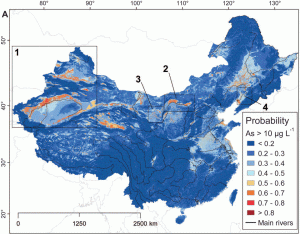
Two weeks after Earth pages featured arsenic in groundwater below the Mekong Delta another important paper has emerged about modelling risk of arsenic contamination throughout the People’s Republic of China (Rodriguez-Lado, L. et al. 2013. Groundwater arsenic contamination throughout China. Science, v. 341, p. 866-868). Scientists based in the Swiss Federal Institute of Aquatic Science and technology and the China Medical University follow up the results of geochemical testing of groundwater from almost 450 thousand wells in 12% of China’s counties; part of a nationwide aim to test millions of wells. That is a programme likely to last for decades, and their work seeks to develop a predictive model that might better focus such an enormous effort and help in other large regions where well sampling is not so advanced.
As well as the well-known release of arsenic-containing ions through the dissolution of iron oxy-hydroxides in aquifers that exhibit reducing conditions, aridity that causes surface evaporation can create alkaline conditions in groundwater that also desorbs arsenic from similar minerals. The early results from China suggested 16 environmental factors available in digital map form, mainly geological, topographic and hydrogeochemical, that possibly encourage contamination; a clear indication of the sheer complexity of the problem. Using GIS techniques these possible proxies were narrowed down to 8 that show significant correlation with arsenic levels above the WHO suggested maximum tolerable concentration of 10 micrograms per litre (10 parts per billion by volume). Geology (Holocene sediments are most likely sources), the texture of soils and their salinity, the potential wetness of soils predicted from topography and the density of surface streams carrying arsenic correlate positively with high well-water contamination, whereas slope, distance from streams and gravity (a measure of depth of sedimentary basins) show a negative correlation. These parameters form the basis for the predictive model and more than 2500 new arsenic measurements were used to validate the results of the analysis.
Estimated probability of arsenic in Chinese groundwater above the WHO acceptable maximum concentration (Credit:Rodriguez-Lado, et al. 2013)
The results graphically highlight possible high risk areas, mainly in the northern Chinese provinces that are partly confirmed by the validation. Using estimated variations in population density across the country the team discovered that as many as 19.6 million people may be affected by consumption of arsenic contaminated water. In fact if groundwater is used for irrigation, arsenic may also be ingested with locally grown food. It seems that the vast majority of Chinese people live outside the areas of risk, so that mitigating risk is likely to be more manageable that it is in Bangladesh and West Bengal.
As well as being an important input to environmental health management in the PRC the approach is appropriate for other large areas where direct water monitoring is less organised, such as Mongolia, Kazakhstan and Kyrgyzstan in central Asia, and in the arid regions of South America.
The most widely fearedrisk of poisoning through natural causes, which grossly disfigures and kills through a range of cancers, is from chronic exposure to arsenic in drinking water. Tragically, the risk is highest from what has traditionally been considered safest source, groundwater. That was the gruesome lesson of a massive transfer in Bangladesh from drinking surface water containing organic pathogens to reliance on well waters. The greatest mass poisoning in history was eventually traced to shallow aquifers in the Ganges-Brahmaputra plains that were rich in organic matter. Their reducing chemistry broke down iron hydroxide coatings on sedimentary grains. Since these minerals are among the most accommodating adsorbers of ions from the environment, including a variety of arsenic-bearing ions, their dissolution releases potential poisons from otherwise safe storage. In Bangladesh and neighbouring West Bengal in India it was found that deeper aquifers have oxidising chemistry and so the iron minerals not only hold ionic pollutants fast by adsorption but help to extract them from groundwater. Deep wells together with various kinds of treatment of shallow groundwater, some using the very iron minerals whose breakdown caused the pollution, are helping to mitigate the perilous situation for people of South Asia.
Skin lesions (keratoses) from arsenic poisoning in Bangladesh (Photo credit: waterdotorg)
Much the same kind of arsenic pollution has subsequently been revealed in groundwaters of lowland Vietnam and Cambodia. Yet the turn there to deep groundwater has revealed a new twist. That too is yielding increasingly high arsenic concentrations, but for a different reason (Erband, L.E. et al. 2013. Release of arsenic to deep groundwater in the Mekong Delta, Vietnam, linked to pumping-induced land subsidence. Proceedings of the National Academy of Science, doi/10.1073/pnas.1300503110). Scientists from Stanford University, California analysed waters from around 900 wells in the Lower Mekong Delta and found several tracts with arsenic contents well above levels deemed safe by the WHO. Some, as could be anticipated from South Asian studies, were from shallow wells along the present course of the Mekong. However, in the delta area to the southwest of Ho Chi Minh City (formerly Saigon) is a large cluster from wells 150 to 450 m deep, totally unlike the situation in other areas of thick Pliocene to Recent river sedimentation.
Comparing the distribution of affected wells with precise estimates of the subsidence rates of the land surface from orbital interferometric radar surveys shows a close correlation of arsenic contamination with rates of subsidence. This suggests that groundwater pumping from deep aquifers is causing compaction at depth, in much the same way as in the environs of Venice. But is this somehow drawing in arsenic polluted water from higher levels? It seems not. So the pollution seems most likely to be an effect of pumping itself. The authors suggest that most of the subsidence is due to compaction of clay-rich sediments rather than the sandy aquifers, well known by engineers to resist compression. They explain the increasing arsenic concentrations by the introduction into the aquifers of water expelled from the clays, either containing arsenic ions in solution or carrying organic compounds that create the reducing conditions to break down iron hydroxide grain coatings and release ions adsorbed on their surfaces.
This presents another grim prospect for South Asian people forced to make the choice between drinking polluted surface water and enteric disease and increasingly exploited deep groundwaters that seem to be safe as well as in very high volumes. Let’s hope that arsenic monitoring can be maintained in the Ganges-Brahmaputra plains in the long term.
Geologists who study turbidites assume that the distinctive graded beds from which they are constructed and a range of other textures represent flows of slurry down unstable steep slopes when submarine sediment deposits are displaced. Such turbidity currents were famously recorded by the severing of 12 transatlantic telecommunication cables off Newfoundland in 1929. This happened soon after an earthquake triggered 100 km hr-1 flows down the continental slope, which swept some 600 km eastwards.
Typical structures in Upper Carboniferous turbidites near Bude, Cornwall, UK (credit: Flickr, Earthwatcher)
Sea beds at destructive margins provide the right conditions for repeated turbidity currents and it is reasonable to suppose that patterns should emerge from the resulting turbidite beds that in some way record the seismic history of the area. British and Indonesian geoscientists set out to test that hypothesis at the now infamous plate margin off Sumatra that hosted the great Acheh Earthquake and tsunamis of 26 December 2004 to kill 250 thousand people around the rim of the Indian Ocean (Sumner, E.J. et al. 2013. Can turbidites be used to reconstruct a paleoearthquake record for the central Sumatra margin? Geology, v. 41, p.763-766).
Animation of Indonesian tsunami of 26 December 2004 (credit: Wikipedia)
Cores through turbidite sequences along a 500 km stretch of the margin formed the basis for this important attempt to test the possibility of recording long-term seismic statistics. To avoid false signals from turbidity currents stirred up by storms, floods and slope failure from rapid sediment build-up 17 sites were cored in deep water away from major terrestrial sediment supplies, which only flows triggered by major earthquakes would be likely to reach. To calibrate core depth to time involved a variety of radiometric and stratigraphic methods
Disappointingly, few of the sites on the submarine slopes recorded turbidites that match events during the 150-year period of seismic records in the area, none being correlatable with the 2004 and 2005 great earthquakes. Indeed very little correlation of distinctive textures from site to site emerged from the study. Some sites on slopes revealed no turbidites at all from the last 150 years, whereas turbidites in others that could be accurately dated occurred when there were no large earthquakes. Only cores from the deep submarine trench consistently preserved near-surface turbidites that might record the 2004 and 2005 great earthquakes.
These are surprising as well as depressing results, but perhaps further coring will discover what kind of bathymetric features might yield useful and consistent seismic records from sediments.
Review of Fracking Issues posted on 31 May 2013 briefly commented on a major academic study of the impact of shale gas exploitation on groundwater. The 12 July 2013 issue of Science follows this up with a similar online, extensive treatment of how underground disposal of fracking fluids might influence seismicity in new gas fields (Ellsworth, W.J. 2013. Injection-induced earthquakes. Science, v. 341, p. 142 and doi: 10.1126/science.1225942) plus a separate paper on the same topic (van der Elst, N.J. et al. 2013. Enhanced remote earthquake triggering at fluid-injection sites in the Midwestern United States. Science, v. 341, p.164-167).
Major shale gas basins (credit: Wikipedia)
It was alarm caused by two minor earthquakes (<3 local magnitude) that alerted communities on the Fylde peninsula and in the seaside town of Blackpool to worrisome issues connected to Cuadrilla Resources’ drilling of exploratory fracking wells. These events were put down to the actual hydraulic fracturing taking place at depth. Such low-magnitude seismic events pose little hazard but nuisance. The two reports in Science look at longer-term implications associated with regional shale-gas development. All acknowledge that the fluids used for hydraulic fracturing need careful disposal because of their toxic hazards. The common practice in the ‘mature’ shale-gas fields in the US is eventually to dispose of the fluids by injecting them into deep aquifers, which Vidic et al. suggested that ‘due diligence’ in such injection of waste water should ensure limited leakage into shallow domestic groundwater.
The studies, such as that by William Ellsworth, of connection between deep waste-water injection and seismicity are somewhat less reassuring. From 1967 to 2001 the central US experienced a steady rate of earthquakes with magnitudes greater than 3.0, which can be put down to the natural background of seismicity in the stable lithosphere of mid North America. In the last 12 years activity at this energy level increased significantly, notably in areas underlain by targets for shale-gas fracking such as the Marcellus Shale of the north-eastern US. The increase coincides closely with the history of shale-gas development in the US. The largest such event (5.6 local magnitude) destroyed 14 homes in Oklahoma near to such a waste-injection site. Raising the fluid pressure weakens faults in the vicinity thereby triggering them to fail, even if their tectonic activity ceased millions of years ago: many retain large elastic strains dependent on rock strength.
Apart from the mid-continent New Madrid seismic zone associated with a major fault system parallel to the Mississippi, much of the central US is geologically simple with vast areas of flat-bedded sediments with few large faults. The same cannot be said for British geology which is riven with major faults formed during the Caledonian and Variscan orogenies, some of which in southern Britain were re-activated by tectonics associated with the Alpine events far off in southern Europe. Detailed geological maps show surface-breaking faults everywhere, whereas deep coal mining records and onshore seismic reflection surveys reveal many more at depth. A greater population density living on more ‘fragile’ geology may expect considerably more risk from industrially induced earthquakes, should Britain’s recently announced ‘dash’ for shale gas materialise to the extent that its sponsors hope for.
Nicholas van der Elst and colleagues’ paper indicates further cause for alarm. They demonstrate that large remote earthquakes. In the 10 days following the 11 March 2011 Magnitude 9.0 Sendai earthquake a swarm of low-energy events took place around waste injection wells in central Texas, to be followed 6 months later by a larger one (4.5 local magnitude). Similar patterns of injection-related seismicity followed other distant great earthquakes between 2010 and 2012. Other major events seem not to have triggered local responses. The authors claim that the pattern of earth movements produced by such global triggering might be an indicator of whether or not fluid injection has brought affected fault systems to a critical state. That may be so, but it seems little comfort to know that one’s home, business or community is potentially to be shattered by intrinsically avoidable seismic risk.
The release and exploitation of natural gas from shales using the unconventional means of in situhydraulic fracturing – ‘fracking’ – has had plenty of bad press, including some hammering in Earth Pages. Now, what seems to be a balanced academic review has appeared on-line in Science magazine (Vidic, R.D. et al. 2013. Impact of shale gas development on regional water quality. Science, v. 340, DOI: 10.1126/science.1235009). The review focuses on hazards to groundwater resources from a variety of environmental effects, primarily gas migration, contaminant transport through induced and natural fractures, wastewater discharge, and accidental spills.
Protests against shale gas drilling in Bulgaria (credit: Wikipedia)
Much attention has centred on faulty seals put in place to stop gas escaping from drill targets. Yet fewer than 3% of seals are said to have proved problematic, with some finger-pointing at natural gas leakage from the hydrocarbon-rich shales. After all, there are plenty of natural fractures and completely ‘tight’ stratigraphic sequences are rare. in fact toxic effects of natural gas leakage on surface vegetation have been widely used as exploration indicators for conventional petroleum. The review does point out that there are so few pre-drilling studies of natural leakage that this controversy – including widely publicised blazing household water supplies – can not yet be resolved. Obviously more independent monitoring of areas above prospective shales are essential; but who will fund them? The one well-documented before-and-after study, from 48 water wells in Pennsylvania, USA, showed no change, though it seems that monitoring after fracking was short-lived.
The chemically-charged water used to induce the hydrofracturing obviously leaves an unmistakable mark when leaks occur, and there have been cases of considerable environmental release. The fluids are indeed a wicked brew of acids, organic thickeners, biocides, alkalis and inorganic surfactants, to name but a few infredients. To some extent re-use of such fluids, which are costly, ought to mitigate risks. However, once a shale-gas field is fully developed, large volumes of the fracking fluids remain in the subsurface and may leak into shallow groundwater sources. But what pathways do these fluids follow when they are pumped into shales under very high pressure? The review warns of the lesson of toxic fluid leakage from underground coal mines.
The University of Pittsburgh team who compiled the review usefully outline why shale gas is both profitable and feasible. They deal with what methane does in an environmental chemistry sense. It isn’t a solvent, so carries no other materials such as toxic ions, but its interaction with bacteria creates reducing conditions. A now well-known hazard of subsurface reduction is dissolution of iron hydroxide, naturally an important component of many rocks, that can adsorb a great range of dangerous ions at potentially high concentrations, including those involving arsenic. Reductive dissolution lets such ions loose into natural waters, even at shallow depths. Yet methane is emitted by a host of sources other than hydrocarbon-rich shale: landfill; swamps; other bacterial action; conventional petroleum fields both active and abandoned; and even deep water boreholes themselves. A recent study of groundwater geochemistry in relation to fracking in Arkansas, USA (Warner, N.R. et al. 2013. Geochemical and isotopic variations in shallow groundwater in areas of the Fayetteville shale development, north-central Arkansas. Applied Geochemistry, v. 33, doi/10.1016/j.apgeochem.2013.04.013) does address changes in groundwater chemistry, but not for all the ions cited by the WHO as potential hazards.
Whereas the mechanisms involved in vertical and lateral migration of subsurface fluids are well understood there is little knowledge of natural structural features such as deep jointing, fractures and fault fragmentation that control actual migration from area to area. The use of natural seepage as an exploration guide was largely abandoned when many studies showing apparently high-priority targets proved to be far removed from the actual source of the moving fluids. The most easily investigated route for leakage is the actual ‘plumbing’ that fracking uses. This is held together by cement that high pressures can disrupt before it sets, resulting in leaks. A lot depends on ‘due diligence’ deployed by the contractors, whose regulation can leave a lot to be desired. Vidic and colleagues devote most space to the matter of wastewater and deep formation water, yet make little if any case for routine geochemical monitoring of domestic groundwater supplies in shale-gas fields. Much is directed at the industry itself rather than independent surveys.
Much attention has centred on fracking shales to release otherwise locked-in gas, while production of liquid petroleum by the same kind of process is also increasing with little publicity, especially in the US. From a purely economic standpoint wells that yield oil and gas from fractured shale might seem to be quite a boon. Well, they probably are, if the gas can be sold. One of the biggest shale-oil targets is the Late Devonian to Early Carboniferous Bakken Shale in the Williston Basin that stretches across 360 thousand km2‑ beneath parts of the Dakotas, Wyoming and Montana in the US and Saskatchewan in Canada. This shale is the source rock for most of the conventional oil production from the Williston basin since the 1940s. At the start of the 21st century direct production of oil from the Bakken began in North Dakota, unleashing a major drilling boom and a ten-fold increase in land-leases for production. The state is now the second largest US oil producer after Alaska warranting a major feature National Geographic. Trouble is North Dakota is not well served by pipelines of any kind and oil is shipped by rail, much as it was in the early days of the US oil industry.
Typical natural gas flare with black-carbon plume (credit: Wikipedia)
The natural gas released by fracking is simply wasted, partly by flaring at the wellhead but an unknown volume of pure methane is simply vented to the atmosphere. At rough 25 times the greenhouse warming capacity of CO2 the perverted economics of waste methane is, unsurprisingly, becoming scandalous and increasingly dangerous. Such is the magnitude of shale-gas production in the US the price of natural gas has fallen dramatically so that from the Williston Basin simply carries no profit and therefore has nowhere to go except up in flames or directly to the air. The US Environmental Protection Agency apparently can do little to halt the venting. British onshore source rocks, such as the Upper Jurassic Kimmeridge Shale, which has a hydrocarbon content up to 70% and is regarded as the most important rock in Europe being the source for much of the petroleum beneath the North Sea and other oil provinces, are likely targets for fracking now the UK government has given the go-ahead in a new ‘dash for gas’. Chances are it may become a dash for onshore shale-oil .
Manganese nodules finally tagged for production
Manganese nodules taken from the bottom of the Pacific. (credit: Wikipedia)
Almost 40 years ago my desk was almost buried under tomes of information about dull black nodules looking like blighted potatoes as I worked on the now abandoned Level-2 Open University course on The Earth’s Physical Resources. Made mainly out of manganese and iron minerals they also contain ore-grade amounts of nickel, copper and cobalt together with other metals. Were they beneath the crust they would be mined eagerly, but such manganese nodules litter vast areas at the surface of the oceans’ abyssal plains. Such was their potential that around half a billion dollars was spent on oceanographic and geochemical surveys to map the richest nodule fields. Part of the attraction at a time when the non-renewable nature of conventional metal deposits was touted as a threat to civilisation as we know it, as in The Limits to Growth, was that the nodules were zoned and clearly growing: they appear to be renewable metal resources.
Mining them is likely to be hugely costly: they will have to be dredged or sucked-up from the deep ocean basins; intricate metallurgical methods are needed to separate and smelt the paying metals and the risks of deep-sea pollution are obvious. As with shale gas, the UK Tory premier David Cameron has leapt onto Lockheed Martin UK’s announcement that it is finally profitable to get at the nodules, in the manner of the proverbial ‘rat up a drainpipe’. Cameron believes that the venture to harvest one of the most metalliferous patches on the east Pacific floor off Mexico may rake the UK’s economic potatoes out of the fire to the tune of US$60 billion over the next 30 years. Lockheed Martin is an appropriate leader in this scramble having designed some of the equipment aboard a ship financed by Howard Hughes, the 50 thousand tonne Glomar Explorer. A curious vessel, the Glomar Explorer was widely publicised in the mid-70s as the flagship for a manganese nodule pilot project. In fact it was built to snaffle a Soviet submarine (K-129) and its contents of codebooks, technical equipment and nuclear missiles that sank to the abyssal plains in the Pacific about 2500 km to the north-west of Hawaii. It did grapple the submarine, some cryptographic equipment, a couple of nuclear tipped torpedoes and six of the dead crew members. It is still operational, but as an ultra-deep water drill rig.
We will have to wait to see if nodule mining is a ‘go-er’, and very little information has emerged about methodology. The target metal is probably nickel with its importance in rechargeable batteries, plus rare-earth metals that are in notoriously short supply. Whether or not raking, dredging or sucking-up the nodules will have insupportable environmental impact depends on the amount of on-board processing; the nodules themselves are pretty much insoluble. Extracting and separating the metals will probably involve some kind of solution chemistry rather than the beneficiation common in most on-shore metal mines. Such hydrometallurgy has considerable potential for pollution, unless the raw nodules are shipped to shoreline facilities, at a hefty cost. One thing occurred to me while writing about manganese nodules as a major resource was that their blends of metals would not match the proportions actually required in commerce. On a grand scale their exploitation could well play havoc with currently booming metal prices and drive on-shore mining to the wall. But, to be frank, I think this is a bit of tropical sea-bed bubble fraught with legal tangles connected with the United Nations Convention on the Law of the Sea.
The start of 2013 saw a massive puff from the British government for development of shale gas, Premier David Cameron crying ‘Britain must be at the heart of the shale gas revolution’. Fearful of the rapidly growing shift from Britain’s natural-gas self reliance to dependence on the Gulf, Russia and Norway the Conservative-Liberal Democrat coalition gave the green light for ‘frack drilling’ to restart. This followed a pause following seismicity in the Blackpool area that attended Cuadrilla’s exploratory drilling into the gas-rich Carboniferous Bowland Shale thereabouts. There is also a nice sweetener for the new industry in the form of tax breaks.
Boris Johnson holds a model London red bus (Photo credit: Wikipedia)
London Mayor Boris Johnson, a possible contender for Tory leadership, seems pleased. And perhaps he should be, as the Lib-Con coalition will be tested because the junior partners depend electorally, to some extent, on ‘green’ credentials. The Lib-Dem Energy Minister, Ed Davey, seemingly favours an automatic halt to drilling should there be seismicity greater than 0.5 on the Richter scale; an energy level less than experienced every day in London from its Underground trains. Political commentators have forecast that green issues may exacerbate tensions within the coalition in the second half of its scheduled 5-year term, especially as the electorate seems set to reduce the Liberal Democrat partners to irrelevance in future elections.
Natural gas’s biggest ‘green’ plus is that being a hydrocarbon its burning releases considerably less CO2 than does its coal energy equivalent, the hydrogen content becoming water vapour. Yet the dominant gas is methane, which has a far larger greenhouse effect than the CO2 released by its burning. To avoid that presenting increased atmospheric warming, extracting natural gas needs to avoid leakage. Unfortunately for those bawling lustily about the economic potential of fracking source rocks such as the Bowland Shale, recent aerial surveys over US gas fields will come as a major shock. At the annual meeting of the American Geophysical Union in early December 2012 methane emissions from two large gas fields in the western US were released (Tollefson, J. 2013. Methane leaks erode green credentials of natural gas. Nature, v. 493, p. 12). They amount to 9% of total production, which would more than offset the climatic ‘benefit’ of using natural gas as a coal alternative.
A shift from coal to natural gas-fuelled power generation would slow down climatic warming, if leakage is kept below the modest level of 3.2% of production. So if the latest measurements are an unavoidable norm for gas fields then natural gas burning in fact increases global warming. Even more telling is that, until the shale ‘fracking revolution’, gas was produced by drilling into permeable reservoir rocks capped by a seal rock – usually a shale. The gas would not have leaked except from the well itself. Fracking, by design, increases the permeability of what would otherwise be a seal rock – hydrocarbon-rich shale – over a large area.
Schematic cross-section illustrating types of natural gas deposits (credit: Wikipedia)
Aerial analyses to check emissions over oil and gas fields, let alone over shale-gas operations, are not widespread. However, the technology is not new. Where emissions are strictly enforced in populated areas, as over oil terminals and refineries, overflights to sample the air have been routine for several decades. Little mention is made of such precautionary measures in the promotion of fracking.
Another point is that as well as often being far from habitations, US shale-gas operations are generally into simple stratigraphy and structure. The Lower Carboniferous Bowland Shale now being touted as fuel for Britain’s escape from a descent into economic depression, with its estimated 200 trillion cubic feet of as potential, is intensely faulted and broadly folded, having experienced the Variscan orogeny at the end of the Palaeozoic Era. The complexity and pervasiveness of this brittle deformation is amply shown by geological maps of former coalfields that incorporate subsurface information from mine workings. The Bowland Shale lies below the Upper Carboniferous Coal Measures, many of the likely targets for fracking have never been subject to intensive underground mining simply because the Coal Measures were eroded away tens of million years ago. Consequently the degree to which many fracking targets may be riven by surface-breaking faults and fracture zones is not and possibly never will be known in the detail needed to assess widespread methane leakage.
Sometime in early 2013, the British Geological Survey is set to release estimates of the Bowland Shale gas reserves, in which its detailed mapping archives will have played the major role. That report will bear detailed scrutiny as regards the degree to which it also assesses potential leakage.




 Earth-logs