Former Senior Lecturer at British Open University, research in remote sensing of arid lands, groundwater exploration, Precambrian tectonics and geochemistry
Rio de Janeiro, a threatened city? Image by Alcindo Correa Filho via Flickr
Earthquake prediction has not had a good record, but it seems that vastly larger tectonic processes are now becoming the subject of risk analysis (Nikolaeva, K. et al. 2011. Numerical analysis of subduction initiation risk along the Atlantic American passive margins. Geology, v. 39, p. 463-466). The Swiss, Russian and Portuguese authors focus on the old (Jurassic ~170 Ma) and presumably cold oceanic lithosphere on the western flank of the Atlantic, against both the North and South American continents. Increased density with ageing imparts a potential downwards force, but that has to overcome resistance to plate failure at passive margins. The dominance of upper continental lithosphere by rheologically weak quartz tends to make it more likely to fail than more or less quartz-free oceanic lithosphere. So, if subduction at a passive continental margin is to take place, then where and when it begins depends on the nature of the abutting continental lithosphere. That on the Atlantic’s western flank varies a lot, ranging from 75-150 km thick. Consequently the temperature at the Moho, the junction between continental lithosphere and weaker asthenosphere, varies too. The loading by marginal sedimentation also plays a role, as do continent-wide forces associated with far-distant mountain ranges, such as the Western Cordillera and Andes, and the forces from opposed sea-floor spreading from the Juan de Fuca and East Pacific systems that affect the whole of western South America, most of Central America and the far NW of North America.
Analysing all pertinent forces acting along 9 lines of section through both North and South America, the authors’ focus fell on the relatively thin continental lithosphere of the Atlantic margin of South America. It is at its thinnest along the southernmost part of the margin adjacent to Brazil, where the Moho temperature reaches as high as 735°C: the weakest link in the American continental lithosphere, where there is seismicity and also indications of igneous activity. The modelling suggests that incipient deformation may begin off southern Brazil within 4 Ma to form a zone of overthrusting, eventually evolving towards failure of the ocean-continent interface and the start of proper subduction in the succeeding 20 Ma. Other stretches of the eastern Americas are deemed safe from subduction for considerably longer by virtue of their greater thickness, lower Moho temperatures and thus higher strength. It is an interesting situation because, insofar as I understand plate tectonics, extensional or compressional failure needed to generate plate boundaries must also propagate from the weak spots that first fail; plate boundaries are lines not points. If that does not happen, then the very strength of the overwhelming longer continent-ocean interface will surely prevent subduction at a single, albeit weak link.
Media coverage of the disasters following the magnitude 9.0 earthquake of 11 March 2011 that devastated the north-eastern coast of Honshu, Japan around the city of Sendai is now (early May) fitful and dominated by the aftermath of the tsunamis’ effect on the Fukushima Daiichi nuclear power station. For those who escaped the tsunamis the experience is irredeemably seared on their memory. Unlike the great waves that killed 10 times more people around the Indian Ocean on 26 December 2004, it will also be unforgettable for those of us far from the event who witnessed the lengthy, high-definition footage captured during the black-water torrents that swept all before them far inland. But that is no longer ‘news’…
Only 6 to 7 weeks later lessons are being learned that probably should have been anticipated long before. Japan has the world’s best disaster preparedness systems. They are centred on civil engineering that was proven to resist great earthquakes by that of 11 March; the terrifying tremors resulted in far fewer casualties than would have been the case anywhere else under such conditions. The tragedy lay with the magnitude of the tsunamis – as high as 30 m in some areas – that reached the coast within an hour of the seismic event. As well as the devastation and loss of life along the coast and up fertile low-lying valleys, waves of this size swept over defences of the coastal Fukushima Daiichi nuclear power plant cutting off emergency power supplies: the world’s largest tsunami barriers proved inadequate to the task and near-meltdown ensued.
Despite the densest network of seismometers anywhere and in-place earthquake early-warning and risk-assessment systems, the events were not forecast and the only warning was that of the earthquake itself which alerted a well-versed population to the imminence of tsunamis to follow. Public education and preparedness proved to be the major life saver, except of course for those tragically killed or lost without trace. So what went wrong?
The risk assessment and warning systems produced results that bore little relation to the actual seismic shaking; the warning was for the immediate vicinity of Sendai city to experience the highest intensities (5-6), most of the rest of Honshu, including Tokyo, having expected intensities in the 2-4 range. For Fukushima Daiichi a maximum magnitude of 7.2 in its vicinity was predicted to have less than 10% chance of occurring over the next 50 years. In reality seismometers across the whole eastern part of the Honshu north of Tokyo recorded intensities between 5-7, demonstrated graphically by numerous CCT recordings in shops and offices. The emerging opinion is that the theory and historic data used for risk and warning systems are flawed or inadequate. For instance the earthquake ripped along 400 km of the Japan Trench subduction zone rather than being a point source – a lesson also from the Sumatra earthquake of 26 December 2004, when ocean-floor thrusting extended 1200 km northwards to the Andaman Islands. Great earthquakes are far too infrequent for sufficient modern-style seismic data to have been collected for previous cases in the 20th century, but it seems clear since 2004 that: (1) stresses accumulate to unexpectedly high values where opposed plates are coupled or stuck together; (2) the ‘point-source’ model for earthquakes, which the use of seismic focuses and epicentres pinpointed by the world-wide seismic network encourages, is far from reality, the more so for the biggest stress accumulations; (3) existing approaches will fail for events with magnitudes greater than 8.0.
NOAA's Prediction of 11 March tsunami wave heights across Pacific Ocean. Image by cogito ergo imago via Flickr
Part of the problem is the sparse record of great earthquakes and the likelihood that, if they do have cyclicity, it may be of the order of hundreds to thousands of years. Historical sources record a large earthquake and tsunamis affecting Sendai district in 869 CE (Common Era), confirmed recently by geologists having located a typical tsunami deposit extending 3-4 km up the Sendai Plain, compared with more than 5 km in March 2011. The survey team claimed at the time that their discovery might indicate far higher risk now in the area than modelled ‘officially’. Sadly, evaluating the prediction was incomplete when disaster did strike. Geoscientists can map faults, infer the length of their activity and work out the mechanisms whereby they fail, but apart from historical data – often sketchy – pinpointing and quantifying past events is beyond us, Looking at more widespread secondary effects, tsunami deposits in particular that often contain dateable organic debris, seems a fruitful way forward for coastal areas likely to bear the brunt of both shaking and huge inundations and the powerful ebbing of their flood waters. That is a topic in its infancy, but likely now to burgeon.
Ominously, because great earthquakes are so rare along any plate boundary, for seven greater than magnitude 8 to occur worldwide in a matter of 6 years (Sumatra, 2004, 9.1, 2005, 8.8, and three with magnitude >7 in 2010; Kuril Islands, 2006, 8.3, 2007, 8.1; Sichuan, 2008, 8.0; Chile, 2010, 8.8; Japan, 2011, 9.0) raises the questions, do they occur in time clusters, and if so, why? Although the numbers are small enough to strain statistics, comparing the last six years with the previous century or so of seismometer recordings shows that great earthquakes have never occurred so frequently. Is there a domino effect so that, say, energy from the Sumatran earthquake of late 2004 has somehow been transmitted throughout the interconnected subduction-zone system to destabilise other highly stressed areas? It is widely acknowledged that in one subduction system there is evidence of clustering, and this may extend to the two great earthquakes (2006 and 2007) in the Kuril Islands on the same boundary as the Sendai event, and two off Sumatra (2004 and 2005) with three more with magnitude >7 in 2010 on what previously had been regarded as a relatively quiescent subduction zone. Analysing all recorded seismic events greater than magnitude 5 to improve the statistics suggests that clustering does not extend to global scales, yet great earthquakes buck other trends shown by lesser ones. Their motions both vertical and lateral could conceivably cause widespread destabilisation, yet worryingly the only test of the idea is the occurrence of yet more in the next few years.
Sources: Normile, D. et al. 2011. Devastating earthquake defied expectations. Science, v. 331, p. 1375-1376; Brahic, C. et al. 2011. Megaquake aftermath. New Scientist, v. 209 (19 March 2011), p. 6-8; Cyranoski, D. Japan faces up to failure of its earthquake preparations. Nature, v. 471, p. 556-557; Normile, D. 2011. Scientific consensus on great quake came too late. Science, v. 332, p. 22-23.
See also: Geller, R.J. 2011. Shake-up time for Japanese seismology. Nature, v. 472, p. 407-409; Kerr, R.A. 2011. New Work reinforces megaquake’s harsh lessons in geoscience. Science, v. 332, p. 911
For decades palaeoanthropologists studying the Americas were dominated by a single idea; that nobody entered the continents before those people who used the elegant fluted spear blades first found near Clovis, New Mexico in the 1930s. These were eventually dated at a maximum age of around 13 ka before the present. One reason for accepting the Clovis people as the first Americans, apart from the lack of conclusive evidence for any earlier occupation, was the fact that glaciers blocked the route from the Bering land bridge of the last Ice age until about 13 ka. But migration may have been possible as far back as 30 ka along the Pacific coast after people crossed the Beringia flatlands exposed by fallen sea-level . There have been suggestions of pre-Clovis sites, but none have carried the weight of evidence to shift the majority from their position. This now has to change because of very high-quality evidence from a site in Texas (Waters, M.R.and 12 others 2011. The Buttermilk Creek complex and the origins of Clovis at the Debra L. Friedkin site, Texas. Science, v. 331, p. 1599-1603). The site in question is in sediments that lie beneath those containing Clovis style tools. In fact it has yielded more than 15 thousand items that are well made, but bear little comparison with the iconic Clovis tools. Almost 50 optically stimulated luminescence (OSL, based on time of burial after exposure to sunlight) dates show a clear increase in age with depth in the excavations, some reaching back as far as 33 ka. The authors favour a conservative approach and restrict their estimated ages to those artefacts found in a well defined stratigraphic horizon, which span the range 13.2 to 15.5 ka. The Clovis-first case seems to be closed, but a new phase in North America aimed at pushing back the time of first human colonising will undoubtedly begin now.
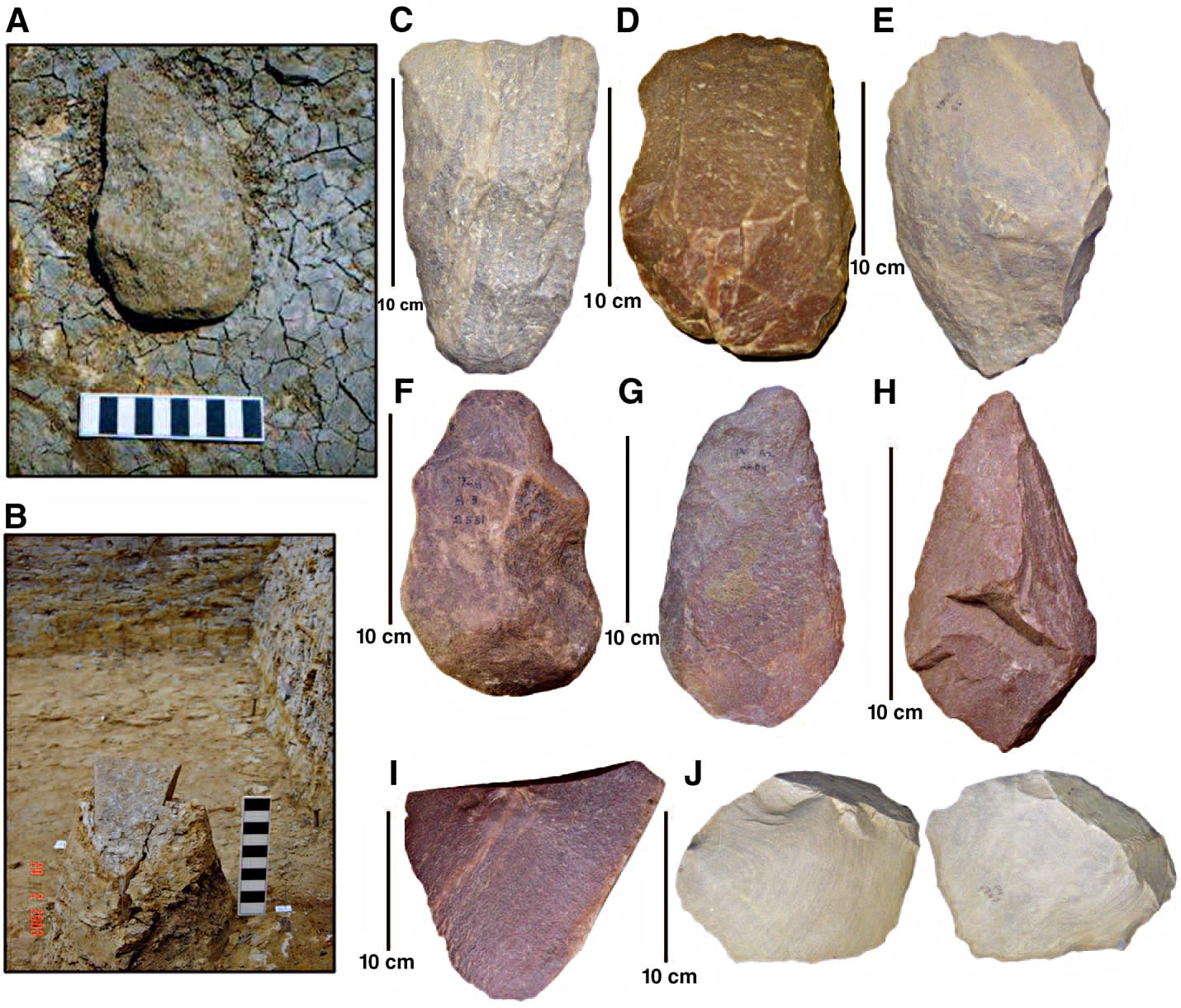
Assorted tools, including biface ‘hand axes, from Attirampakkam. Figure 2 Pappu et al 2011, with kind permission of the authors.
One of the most familiar icons of archaeology, the biface or Acheulean ‘hand axe’ was invented in Africa, presumably by H. ergaster, about 1.6 Ma ago and apart from in the Middle East, where it first occurs around 1.4 Ma, elsewhere it seemed to have been a late arrival in the artefact record. Human colonisation of Asia began as early as 1.8 Ma ago, so in its absence those early arrivals have been assumed not to have brought the Acheulean technology but used less elegant tools similar to the earliest Oldowan edged pebbles. Although parts of Asia were occupied by H. erectus until as recently as ~20 ka, they are believed not to have managed the biface breakthrough. It has been widely accepted that abundant biface tools in India date from about 500 ka ago, presumed to have been brought by H. heidelbergensis migrants.An object lesson in the way that new techniques rather than new archaeological sites can dramatically change such long-held notions has emerged from excavations at Attirampakkam about 30 km NW of Chennai (Madras) in South India (Pappu, S. et al. 2011. Early Pleistocene presence of Acheulian hominins in South India. Science, v. 331, p. 1596-1599). This was the site where Palaeolithic tools were first unearthed in the sub-continent by Robert Bruce Foote in 1863. The Indo-French research team used the cosmogenic isotope- and magnetostratigraphic dating methods to estimate when the tools were buried and discovered a much earlier age than expected, between 1.0 to 1.5 Ma. That throws into question the assumption of younger ages in general for the Acheulean technology in India, but more important, suggests that there was an eastward wave of migration from Africa shortly after the invention of biface tools. A wave of re-evaluation of the somewhat confusing Asian record of early humans seems on the cards.
See also: Dennell, R. 2011. Earlier Acheulian arrival in South Asia. Science, v. 331, p. 1532-1533
Altyn Tagh range at top - click for detail. Image via Wikipedia
The transport of sediment by wind action is generally visualised as sand dunes of all kind of shapes. Yet shifting sand particles arm strong wind in the manner of a sand blaster so that it can act as an agent of erosion to form peculiar landforms known as yardangs, which often parallel the prevailing wind as linear ridges. Yardangs very rarely form from crystalline rocks, but poorly cemented sedimentary rocks are particularly prone to wind erosion. In a few areas that are very arid it is the dominant sculpting process. One such area is the Qaidam Basin (<50 mm of rain per year) at the northern edge of the Tibetan Plateau. The basin is flanked to the north by the Altyn Tagh mountains, and major passes in that range funnel powerful winds across the basin floor. The yardangs of Qaidam are enormous, reaching up to 50 m high and show clearly on satellite images and often camouflage the trend of bedding in the sedimentary rocks from which they are carved. Formerly thought to be a basin in which sediment was accumulating and being actively folded by tectonic forces related to the India-Asia collision zone, recent work reveals several very surprising aspects of local wind action (Kapp, P. et al. 2011. Wind erosion in the Qaidam basin, central Asia: implications for tectonics, palaeoclimate, and the source of the Loess Plateau. GSA Today, v. 21 (April/May 2011) p. 4-10). Since the Late Pliocene the rate of wind erosion has reached as much as 1 mm per year, so that it is a source of sediment not a repository, to the extent that at least a third of the basin is occupied by exposed folded sediments that wind erosion has exhumed. Yet this is not an area noted for large dust storms.
Yardangs in Quaidam. Image by Joe Zhou via Flickr
The folded sediments are early Pleistocene lacustrine silts and fine sands, which sand blasting has easily sculpted, but many of the yardangs are encrusted with a crust of salt. Indeed several generations of such crusts mark wind-eroded surfaces of different relative ages. It seems that the erosion has occurred in episodes, most likely during cold-dry glacial and stadial periods when the northern jet stream probably shifted south from its present local position around 48°N to the latitude of Qaidam (around 40°N) when the Altyn Tagh’s funnelling effect would have been maximised by prevailing north westerly winds that parallels the yardangs. Such episodes can be shown to have eroded hundreds to thousands of metres of the slowly deforming sediments since about 2.8 Ma. It was at that time that folding began in earnest, and quite possibly the unloading effect of the wind erosion may have assisted the deformation. Where did such vast volumes of sediment end up? Downwind to the south east are the famous loess deposits in the headwaters of the Huang He (Yellow River), whose transport of eroded loess accounts for the great fertility of much of China’s soils and thereby its great carrying capacity for human population. Interestingly, the loess deposits show intricate alternations that match the ups and downs of climate through the late Pleistocene. The link with the Qaidam yardang fields seems convincing
In 2008 a team of geophysicists from Cambridge University, UK published an astonishingly detailed picture of about 500 km2 of a land surface complete with drainage systems (Figure 3 in Rudge, J.F. et al. 2008. A plume model of transient diachronous uplift at the Earth’s surface. Earth and Planetary Science Letters, v. 267, p. 146-160). The surprise was not its Palaeogene age (~55 Ma), but that it is buried beneath the Atlantic continental shelf about 200 km west of the Shetland Isles and had been revealed by detailed, 3-D seismic reflection surveys during oil exploration. Technically it is buried landscape unconformity that resulted from uplift (by almost 500 m) and erosion (for ~1.3 Ma) that interrupted Palaeocene to Eocene marine sedimentation and was suddenly buried to preserve the details of river channels: uplift rapidly gave way to subsidence and conditions returned to marine about 0.6 Ma later. The timing and the location of such a transient crustal bulge, during the early part of opening of the North Atlantic, suggests that it stemmed from a thermal source, probably the Iceland hot spot straddled by the mid-Atlantic Ridge. The model favoured by the authors is radially horizontal spreading of a pulse of especially hot mantle outwards from the plume beneath the Iceland hot spot; a ‘plume head’. Volumetric expansion of the lithosphere causes the uplift, and movement away from the plume of the hot mantle results in an annular, outward moving ripple. Cooling once the thermal source has passed produces subsidence.
The idea clearly has ‘legs’ for a whole number of reasons, not the least being the sheer number of long-lived hot spots above mantle plumes that affect the ocean basins and parts of the continents, Africa and North America especially. Now it has been publicised more widely than in a specialised journal (Williams, C. 2011. Pulsating planet. New Scientist, v. 209 (12 March 2011), p. 41-43). One of the original authors is reported to have suggested that the ~55 Ma thermal ripple beneath the nascent North Atlantic may have destabilised gas hydrates in the sediments causing methane to belch out in its wake. That is a possible mechanism for the Palaeocene-Eocene thermal maximum and its huge associated carbon isotope ‘spike’ likely stemming from boosted atmospheric methane.
The Grand Canyon from the South Rim. Image via Wikipedia
Probably the most famous extant bulge is the one through which the Colorado River has carved the USA’s 1.8 km deep Grand Canyon: the Colorado Plateau. Long believed to have formed above hot, low-density lithosphere too, this uplift is the subject of completely new ideas that also have stemmed in part from seismic data, though not produced by artificial reflectance methods. Geophysicists in the US have developed a system that uses hundreds of transportable seismometers that are being ‘marched’ from west to east as an array that uses seismographs from natural earthquakes world-wide to perform seismic tomography –3-D mapping of varying seismic velocities and thereby rigidity and density in the mantle – with improved resolution because of the close spacing of the recording stations. Publications from the Earthscope USarray are beginning to appear from the western USA, one of which concerns the Colorado Plateau (Levander, A.et al, 2011. Continuing Colorado plateau uplift by delamination-stylee convective lithospheric downwelling. Nature, v. 472, p. 461-465). The western part of the plateau is associated with a high-velocity anomaly that extends to around 90m km beneath, which the authors ascribe to a large blob of rigid mantle that has detached from the lithosphere and is slowly sinking. This ‘drip’ is an example of delamination where mantle that becomes detached from the lithosphere causes it to thin and reduces its overall density. The overlying crust rises in response. There is a thermal effect, as warmer, less rigid asthenosphere convects upwards to fill the gap left by the drip, but it is an effect rather than a cause of the uplift.
See also: Zandt, G. & Reiners, P. 2011. Lithosphere today… Nature, v. 472, p. 420-421.
Eclogite from Norway. Image by kevinzim via Flickr
Because the average density of the rocks making up the continental crust is about 2.7 t m-3 while that of the mantle is greater than 3.0 t m-3 it might seem as though continents cannot be subducted. Indeed, that was one of the first principles of plate tectonics, which would account for continental crust dating back to 4000 Ma, whereas there is no oceanic crust older than about 150 Ma. In the southern foothills of the Alps in Piemonte, Italy is a site which refutes the hypothesis in a stunning fashion. The minor ski resort of Monte Mucrone is backed by cliffs in what to all appearances is a common-or-garden granite: it even seems to contain phenocrysts of plagioclase feldspar. Microscopic examination of the megacrysts reveals them to be made up of a complex intergrowth between jadeite, a high-pressure sodic pyroxene, and quartz. This is exactly what should form if albite, the sodium-rich kind of plagioclase feldspar, if it descended to depths over 70 km below the surface, i.e. to mantle depths.
Monte Mucrone proves that continental materials can be subducted, but also reveals that these granites popped back up again when the forces of subduction were relieved at the end of the Alpine orogeny. Other examples have since turned up, but few so spectacular as continental rocks from Switzerland (Herwartz, D. et al. 2011. Tracing two orogenic cycles in one eclogite sample by Lu-Hf garnet chronometry. Nature Geoscience, v. 4, p. 178-183). The Adula nappe of the Swiss Lepontine Alps consists of granitoid gneisses and metasediments of continental affinities, associated with mafic and ultramafic metamorphic rocks. The mafic rocks include eclogites typical of high-pressure, low-temperature metamorphism characteristic of subduction. Their minerals record formation temperatures around 680°C at a depth of more than more than 80 km. Eclogites are beautiful green and red rocks containing high-pressure omphacite pyroxene and pyrope garnet. Garnets generally contain abundant rare-earth elements especially those with the highest atomic numbers. One of these is lutetium (Lu) that has a radioactive isotope 176Lu with a half-life of 3.78×10¹⁰ years to yield a daughter isotope of hafnium 176Hf; garnets can be dated using this method. Garnets are frequently zoned, and the Adula eclogites clearly show several generations of zonation. Zoning can form as metamorphic conditions change, so in itself is not unusual, but dating different generations is. The German team from the Universities of Bonn, Cologne and Münster found that the garnets defined two distinct isochrons, one of Variscan age of just over 330 Ma, the other Alpine around 38 Ma. Clearly the pre-Variscan crust (probably once part of the African continent) had been subducted twice but had wrested itself clear of the mantle’s clutches on both occasions, each time remaining more or less intact. One idea that stems from this coincidence is that the Variscan mountain belt that formed at the earlier subduction zone subsequently split at its high P – low T core, so that the eclogites lay at a new continental margin and could suffer the same extreme compression when new subduction began there.
It also turns out that the region in which Monte Mucrone lies, the Sesia zone of the Western Alps, also records a double whammy of continental subduction, but a repetition that occurred during the early events of the Alpine orogeny (Rubatto, D. et al. 2011. Yo-yo subduction recorded by accessory minerals in the Italian Western Alps. Nature Geoscience, v. 4, p. 338-342). The team of Australian, Swiss and Italian geologists focused on the P-T record preserved in zoned garnets, allanites and zircons and evidence for two generation of white micas in eclogites and blueschists. Backed by U-Pb dating of zircon and allanite zones, the authots uncovered two episodes of deep subduction separated by period of rapid exhumation over the period between 79 to 65 Ma ago. The double subduction took place while the African plate converged obliquely with Eurasia; a strike-slip configuration that probably resulted in large-scale switches from compression to extension.
See also: Bruekner, H.K. 2011. Double-dunk tectonics. Nature Geoscience, v. 4, p. 136-138
Harvey was an imaginary, 2 m tall rabbit which befriended Elwood P. Dowd in Mary Chase’s 1944 comedy of errors named after the said rabbit, filmed in 1950 and starring James Stewart as the affable though deranged Dowd. Though not so tall, a giant fossil rabbit (relative to modern rabbits) weighing it at 12 kg has emerged from the prolific Late Neogene cave deposits of Minorca (Quintana, J. Et al. 2011. Nuralagus rex, gen. et sp. nov., an endemic insular giant rabbit from the Neogene of Minorca (Balearic Islands, Spain). Journal of Vertebrate Paleontology, v. 31, p. 231-240). At about 3 times heavier than Barrington my lagomorphophagic (rabbit-eating to the uninitiated) cat, this would have been, to him, a beast best avoided, as the name N. rex might suggest. So unexpected was a gigantic rabbit that, interestingly, it was first mistaken for a fossil tortoise, albeit one lacking a carapace.
Island faunas have long been recognized as havens for peculiar trends in evolutionary successions, either towards dwarfism as in the case of the tiny elephants on which H. floresiensis preyed until quite recently on the Indonesian island of Flores or gigantism as in this remarkable case. As the authors infer, on account of the creature’s ‘…(short manus and pes with splayed phalanges, short and stiff vertebral column with reduced extension/flexion capabilities), and the relatively small size of sense-related areas of the skull (tympanic bullae, orbits, braincase, and choanae)…’ this was a rabbit which sadly could not hop. This un-rabbit-like locomotion may well have been a result of it not having needed to hop, being so large as to challenge seriously the largest Neogene predators on the island – lizards – and thereby saving energy. For much the same evolutionary logic, neither did N. rex have long ears, having less need to detect a stealthy nemesis.
The demise of Late Neogene megafaunas in general has often been ascribed to human intervention. Though N. rex became extinct at around 3 Ma and avoided human predation, later giants did not fare so well. A case in point is the celebrated wooly mammoth, the last of the steppe mammoths, that first appeared in the fossil record of Siberia around 750 ka ago (Nicholls H. 2011. Last days of the mammoth. New Scientist, v. 209 (26 March 2011), p. 54-57). DNA evidence from hairs preserved in permafrost suggests that ancestors of the steppe mammoth line diverged with that of Asian elephants from African elephant ancestors around 5 Ma. Interestingly, ancestral steppe mammoths – without shaggy coats but having the archetypical curved tusks – roamed Africa until 3 Ma when they disappear to reappear in Europe and Asia, yet without adaptation to cold until the onset of northern glaciations around 2.5 Ma. At that point the true steppe mammoths evolved increased tooth enamel needed for a diet of mainly silica-rich grasses to resist wear. The family spread to North America when sea-level fell to expose the sea floor of the Bering Straits. The woolly mammoth is the star partly because specimens periodically turn up almost perfectly preserved in permafrost. This has allowed almost half of a full DNA sequence to be restored. Preserved haemoglobin from a woolly mammoth shares with that from modern musk oxen an ability to release oxygen at temperatures well below zero so that they could function even if their extremities became chilled.
Reconstructed woolly mammoth at the Royal BC Museum, Victoria, British Columbia (Image via Wikipedia)
Astonishingly, all elephants urinate so copiously that they soak their range lands in DNA, though it only lingers in ultra cold climes. This bizarre fact encouraged a large team of palaeobiologists to comb frozen soils in an alluvium section in Arctic Alaska for mammoth DNA (Haile, J and 17 others, 2009. Ancient DNA reveals late survival of mammoth and horse in interior Alaska. Proceedings of the National Academy of Sciences of the USA, v. 106, p. 22352–22357). Mammoth DNA turned up in soils as young as 10.5 ka. Moreover mammoth overlapped with human occupation for several millennia, casting doubt on theories that mammoth extinction resulted either from human predation or the introduction of epidemic disease that might have felled mammoths quickly: they declined gradually. Yet the empirical fact that steppe mammoths in general and the woolly mammoth in particular survived through at least 8 major glacial-interglacial transitions only to become extinct at the start of the current Holocene interglacial period at the same time as humans recolonised the frigid desert of Arctic latitudes, where woolly mammoths could survive except at the last glacial maximum surely points to some influence that arose from human activity.
The Geologic Time Spiral: A Path to the Past. Designed by Joseph Graham, William Newman, and John Stacy. Get it from http://pubs.usgs.gov/gip/2008/58/
The Système International d’Unités (SI) is the agreed arbiter that defines the units in which phenomena are measured. There are 7 SI base units (length, mass, time, electric current, temperature, intensity of radiation and amount of substance) from which others are derived as they become necessary. Geoscientists have striven to comply, though not always happily. For instance the doubly-derived SI unit for pressure, the pascal (Pa) is a newton (derived unit of force) per square metre (N m-2), and in base units 1 kg m-1 s-2. The pascal replaced the long employed arbitrary unit, the kilobar (1 kb = 1000 x surface atmospheric or barometric pressure) one of which represents about 3.5 km depth in the earth. The reluctance to shift units is probably innate conservatism, for 1 kb = 100 MPa: simples!
Another problem has arisen as regards the SI base unit for time – the second. This is unwieldy for geological time, the Earth having formed approximately 1.435 x 10¹⁷ seconds ago. It’s not so handy for history either, about 3 x 10¹⁰ seconds having elapsed since William of Normandy won the Battle of Hastings.
The year is what we remember, but even that in a historical sense has its problems, for instance the BC/AD division where some scholars even dare to suggest that Christ was born in 4 BC. The more politically correct Common Era (CE) and Before the Common Era (BCE) of course don’t fool anyone. Interestingly, Wikipedia (en.wikipedia.org/wiki/Year) indicates, there are over ten current versions of a ‘year’ depending on context (for instance, astronomers favour the Julian year). Historical and thus geological time has the unnerving habit of continually getting longer, and it is a major problem to measure historical time precisely, either from increasingly vague records as one delves back in historical documents or because of the inherent imprecision in measuring radioactive isotopes and their daughter products that underpins archaeological and geological time. Archaeologists have a very hard time of it, for their workhorse is radiocarbon dating that depends on the production of radioactive 14C in the atmosphere by cosmic ray’s interaction with nitrogen. The rate of 14C production varies over time with the cosmic ray flux from extra-solar sources, and even worse, a very large amount was produced by testing nuclear weapons in the atmosphere in the mid 20th century. Abandoning the BC/AD division that lurks still with historians and archaeologists, geoscientists speak of time ‘before present’ (bp), which doesn’t matter a damn for geological Periods, Eras and Eons which are immensely long whatever the unit. But it does for the Holocene, mainly calibrated by radiocarbon methods: bomb-test production of 14C , which will linger about 50 thousand years before near-complete decay, has forced the ‘present’ to be set at 1950 AD!
So the year is here to stay, even though it is arbitrary and changes all the time, along with kilo, mega and giga prefixes for thousands, millions and billions of years. Yet teeth are now being ground over what the unit’s symbol should be (Biever, C. 2011. Push to define year sparks time war. New Scientist, v. 210 (30 April 2011), p. 10). A task group of geoscientists and chemists set up by the International Union of Pure and Applied Chemistry, IUPAC, and the International Union of Geological Sciences, IUGS in 2006 have now defined the year – why chemists, you might wonder; they measure the radioactive decay constants of isotopes used in radiometric dating. The link to the SI system through the base unit of one atomic-standard second is to be standardised by the solar year; the time in seconds between one solstice and the next at the equator for year 2000: i.e. 3.1556925445 × 10⁷ s (Holden, N.E. et al. 2011. IUPAC-IUGS common definition and convention on the use of the year as a derived unit of time (IUPAC Recommendations 2011). Pure and Applied Chemistry, v. 83, p. 1159-1162). It is to be called the annus (a), applied in ka, Ma or Ga to two usages of time, the time difference between ‘now’ and an event in the past, and the time difference between two events in the past. This dual usage of the same symbol is the source of the gnashing. Whereas Ma, for instance, was quite acceptably used for the measured age of a rock relative to the present, there are at least three schools of thought for other uses of time. Some have been quite happy to use Ma for measured age, a fixed time datum in the past such as the Precambrian-Cambrian boundary, and a time duration such as that of a geological Period or some major event such as an orogeny (that has been used in Earth Pages News since its outset). Others would distinguish between the first and the other two, as for instance Ma for the first and Myr for the other two. But there are variants, the symbol mya having been used for ‘million years ago’, and the international science journal Nature currently uses Myr for the first but now takes the safe path of using ‘million years’ for the other two. Nicholas Christie-Blick of Columbia University in New York is reported as having opined that the rationalisation to one-symbol-fits-all is a huge step backwards, and he is not alone; Science editorial staff will continue to demand of their authors a distinction between age and time span, since a switch would ‘confuse its readers’, long accustomed to that usage.
Also it is so easy to write, ‘the rock has an Ar-Ar age of 25 Ma’, ‘it took 25 Ma for this trilobite to disappear from the geological record’, and ‘about 25 Ma ago, there is a gap in the fossil record of primates’. I personally welcome the simplification, especially as it will encourage authors to write more nicely.
Most people are quite content with an annual holiday abroad, yet a number of geoscientists yearn for something more adventurous. The Croatian geophysicist Andrija Mohorovičić was among the first to study estimates of speeds at which seismic waves travelled through the Earth, discovering in 1909 that below a depth of about 30 km below the continental surface they moved faster than in the uppermost layer. He had discovered the boundary between the continental crust and the underlying mantle, a discontinuity that bears his name though often shortened to the ‘Moho’. Having been traced beneath most of the Earth’s surface, a group of American scientists discussed over a drink or three at a ‘wine breakfast’ in 1957 a project to drill through the Moho to find out what the mantle was made of. The brainchild of Harry Hess, one of the first to suggest plate tectonics as a driving mechanism for continental drift, was dubbed Project Mohole. With US government support, a drilling barge designed for offshore oil drilling and a system of thrusters and pre-GPS locational instrumentation to keep the barge on station the Mohole was spudded in 1961 on the seabed near Guadalupe Island off Baha California in Mexico; about the time that John F. Kennedy declared his belief that the USA could land a man on the Moon by the end of the 1960s. There was something of a thrill factor about Project Mohole, and its first attempts were reported in Life Magazine by John Steinbeck, author of The Grapes of Wrath and amateur oceanographer. It turned out that sending a drill bit to the mantle was more difficult than a manned lunar landing. Only a few metres of basaltic crust was recovered and Congress cancelled Mohole funding in 1966. Nevertheless, the project was the forerunner of the highly successful Ocean Drilling Program and its predecessors, probably the most prolific international collaboration of any kind.
The drilling barge CUSS1 used for the original Mohole Project. Image via Wikipedia
Since the 1960s research into the mantle has been continued with great success by looking at upthrust masses such as those in the Alps and in ophiolite complexes, nodules in alkaline basalts and kimberlites that form below 100 km into the mantle, samples dredged from oceanic fracture zones, and indirectly from the geochemistry of basalts that are derived by partial melting of mantle materials. Yet, there is still an air of frustration about some igneous petrologists and geophysicists; they want to touch the real thing! Now, at last, they may have their chance, for improved drilling and positioning technology developed by ODP and the petroleum industry make a hole through the Moho feasible. Indeed one is planned once drill-bits and lubricants suitable for the anticipated temperatures and pressures have been finalised. Three sites are under consideration: near the original Mohole; in the Cocos Plate off Costa Rica and the Pacific Plate near Hawaii, each combining the coolest crust, thinnest sediment cover and shallowest possible water – i.e. just off a mid-ocean ridge or hot-spot. The Costa Rica site (ODP site 1256) has the thinnest crust due to rapid sea-floor spreading by the East Pacific Rise there and is the most likely to be drilled. It already has a core the penetrates to 1.5 km in oceanic crust and a current project aimed at sampling the cumulate gabbro layer of the lower oceanic crust. That will still be 3.5 km above the local Moho.
There is an obvious question; will an ocean-floor site, however favourable, and a hole drilled through it help resolve fundamental issues regarding the mantle? Well, probably for oceanic lithospheric mantle, but that has had basaltic magma removed from it to form the crust above. Also mid-ocean ridge basalts have geochemical features that suggest that their source mantle had been a melt source previously, compared with the source mantle materials for alkaline and some other types of basalt that seem to have been less depleted in certain elements. The most important question posed by the mantle in general concerns how it originally formed during the Earth’s earliest history, accretion of debris from the solar nebula, the moon-forming event and extraction of the metallic core. A Mohole can contribute little to those issues.
Source: Teagle, D.A.H. & Ildefonse B. 2011. Journey to the mantle of the Earth. Nature, v. 471, p. 437-439.




 Earth-logs