Any excuse to return to the Moon

Humans first set foot on the Moon 45 years ago, yet by 42 years ago the last lunar astronaut left: by human standards staffed lunar exploration has been ephemeral. Yet for several reasons – romantic and political – once again getting living beings onto other worlds has become an obsession to some, in much the same manner that increasing numbers of countries seem hell-bent in increasing the redundancy of equipment in orbit; redundant because many of the satellites being launched all do much the same thing, especially in the remote sensing field. It’s all a bit like the choice between buying a Ferrari or hiring a perfectly serviceable vehicle when needed – prestige is high on the list of motivators. A new obsession is extraterrestrial mining and some very rich kids on the block are dabbling in that possibility: James Cameron of Aliens and Avatar fame (both films with space mining in the plot); a bunch of Google top dogs; billionaire entrepreneurs and oligarchs with cash to burn. Resource exploitation has also motivated Indian, Russian and Chinese interest in a return to the Moon, at least at an exploratory level.

NASA's proposed Moon colony concept from early...
NASA’s proposed Moon colony concept from early 2001 (image: NASA)

The main prospective targets have been water, as a source of hydrogen and oxygen through electrolysis to make portable rocket fuel, and helium, especially its rare isotope He-3, for use in fusion reactors. Helium is more abundant on the Moon than it is on Earth: only 300 grams of He-3 per year leaks out of the Earth’s depths. On the Moon there may be as much as 50 parts per billion in its dusty regolith cover where it remains supercooled in areas of permanent shadow. But to get a ton of it would require shifting 150 million tons of regolith. A decade ago geologists suggesting that metals might be mined on the Moon – noble metals and rare-earth elements have been mooted (the latter’s export being embargoed by Earth’s main producer China) – would have been laughing stocks, but now they get air time. Yet none of these materials occur on the Moon in the type of ore deposit found on Earth; if they did the anomalous nature of such enrichments on a body devoid of vegetation would have ensured their detection already. Even if there were lunar ore bodies, anyone with a passing familiarity with resource extraction knows just how much waste has to be shifted to make even a super-rich deposit economic on Earth, and that vast amounts of water are deployed in enriching the ‘paying’ metal to levels fit for smelting. For instance, while the rise in gold price since it was detached from a fixed link with paper money in 1971 has enabled very low concentrations to be mined, the methods involve grinding ore in water and then dissolving the gold in sodium cyanide solution, re-precipitating it on carbon made from coconut husks, redissolving and then precipitating the gold again by mixing the ‘liquor’ with zinc dust. Dry ore processing methods – based on density, magnetic and electrical properties – are hardly used in major mining operations nowadays.

The other, and perhaps most important issue with lunar or asteroid mining is that the undoubtedly high costs of whatever beneficiation process is deemed possible must be offset against income from the product; i.e. determined by market price on the home world which would have to be far higher than now. Such a rise in price would work to make currently uneconomic resources here worth mining, and anyone who believes that mining on the Moon would ever be competitive in that capitalist scenario risks being en route to the chuckle farm. Unless, of course, their motive is an exclusivist hobby par excellence and the bragging rights that accompany it – a bit like big game hunting, but the buzz coming from risking their billions rather than their lives.

But it turns out that a refocus on bringing stuff back from the Moon is not confined to floating stock on the financial markets. There are academic efforts to rationalise the Dan Dare spirit. There aren’t many scientific journals with a level of kudos to match the Philosophical Transactions of the Royal Society, the first journal in the world exclusively devoted to science and probably the longest running since it was established in 1665 at the same time as the Royal Society itself. Recently one of its thematic issues dubbed ‘‘Shock and blast: celebrating the centenary of Bertram Hopkinson’s seminal paper of 1914’  (Hopkinson, B. 1914. A method of measuring the pressure produced in the detonation of high explosives or by the impact of bullets. Philosophical Transactions of the Royal Society A v. 213, p. 437-456) a paper appeared that examines the likelihood of fossils surviving the shocks of a major impact (Burchell, M.J. et al. 2014. Survival of fossils under extreme shocks induced by hypervelocity impacts. Philosophical Transactions of the Royal Society A v. 372, 20130190 Open Access).

The authors, based at the University of Kent, UK, used a high-velocity air gun to fire quite fragile fossils of diatoms frozen in ice into water at speeds up to 5.34 km s-1. They then looked at solids left in the target to see if any recognisable sign of the fossils remained. Even at the highest energies of impact some diatomaceous material did indeed remain. Their conclusion was that meteorites derived by large impacts into planetary bodies, such as those supposedly from Mars or the Moon, could reasonably be expected to carry remnants of fossils from the bodies, had the impact been into sedimentary rock and that the bodies had supported living organisms that secreted hard parts. My first thought was that the paper was going to resurrect the aged notion of panspermia and a re-examination of the ALH84001 meteorite found in Antarctica claimed in 1996 to contain a Martian fossil (and believed by then US President Bill Clinton). Likewise it might be cited in support of the similar claim, made by panspermia buff Chandra Wickramasinghe, regarding fossils reputedly in a meteorite that fell in Sri Lanka on 29 December 2012: widely regarded as being mistaken. Yet Wickramasinghe’s team reported diatoms in the meteorite!

The Martian meteorite ALH84001 shows microscop...
The Martian meteorite ALH84001 shows microscopic features once suggested to have been created by life. (credit: Wikipedia)

However, Burchell has suggested that their results open up the possibility of meteorites on the Moon that had been blasted there from Earth might preserve terrestrial fossils. Moreover, such meteorites might preserve fossils from early stages in the evolution of life on Earth, since when both rocks and whatever they once contained have been removed by erosion or obliterated by deformation and metamorphism on our active planet. ‘Another reason we should hurry back to the Moon’ says Kieren Torres Howard of New York’s City University…

Breathing spaces or toxic traps in the Archaean ocean


The relationship between Earth’s complement of free oxygen and life seems to have begun in the Archaean, but it presented a series of paradoxes: produced by photosynthetic organisms oxygen would have been toxic to most other Archaean life forms; its presence drew an important micronutrient, dissolved iron-2, from sea water by precipitation of iron-3 oxides; though produced in seawater there is no evidence until about 2.4 Ga for its presence in the air. It has long been thought that the paradoxes may have been resolved by oxygen being produced in isolated patches, or ‘oases’ on the Archaean sea floor, where early blue-green bacteria evolved and thrived.


A stratigraphic clue to the former presence of such oxygen factories is itself quite convoluted. The precipitation of calcium carbonates and therefore the presence of limestones in sedimentary sequences are suppressed by dissolved iron-2: the presence of Fe2+ ions would favour the removal of bicarbonate ions from seawater by formation of ferrous carbonate that is less soluble than calcium carbonate. Canadian and US geochemists studied one of the thickest Archaean limestone sequences, dated at around 2.8 Ga, in the wonderfully named Wabigoon Subprovince of the Canadian Shield which is full of stromatolites, bulbous laminated masses probably formed from bacterial biofilms in shallow water (Riding, R. et al. 2014. Identification of an Archean marine oxygen oasis. Precambrian Research, v. 251, p. 232-237).

English: Stromatolites in the Hoyt Limestone (...
Limestone formed from blue-green bacteria biofilms or stromatolites (credit: Wikipedia)

Limestones from the sequence that stable isotope analyses show to remain unaltered all have abnormally low cerium concentrations relative to the other rare-earth elements. Unaltered limestones from stromatolite-free, deep water limestones show no such negative Ce anomaly. Cerium is the only rare-earth element that has a possible 4+ valence state as well one with lower positive charge. So in the presence of oxygen cerium can form an insoluble oxide and thus be removed from solution. So cerium independently shows that the shallow water limestones formed in seawater that contained free oxygen. Nor was it an ephemeral condition, for the anomalies persist through half a kilometer of limestone.


The study shows that anomalous oxygenated patches existed on the Archaean sea floor, probably shallow-water basins or shelves isolated by the build up of stromatolite reef barriers. For most prokaryote cells they would have harboured toxic conditions, presenting them with severe chemical stress. Possibly these were the first places where oxygen defence measures evolved, that eventually led to more complex eukaryote cells that not only survive oxygen stress but thrive on its presence. That conjecture is unlikely to be fully proved, since the first undoubted fossils of eukaryote cells, known as acritarchs, occur in rocks that are more than 800 Ma years younger.


Planet Mercury and giant collisions

Full-color image of from first MESSENGER flyby
Mercury’s sun-lit side from first MESSENGER flyby (credit: Wikipedia)

Mercury is quite different from the other three Terrestrial Planets, having a significantly higher density. So it must have a considerably larger metallic core than the others – estimated to make up about 70% of Mercury’s mass – and therefore has a far thinner silicate mantle. The other large body in the Inner Solar System, our Moon, is the opposite, having the greatest proportion of silicate mantle and a small core.

The presently favoured explanation for the Moon’s anomalous mass distribution is that it resulted from a giant collision between the proto-Earth and a Mars-sized planetary body. Moreover, planetary theorists have been postulating around 20 planetary ‘embryos’ in the most of which accreted to form Venus and Earth, the final terrestrial event being the Moon-forming collision, with smaller Mars and Mercury having been derived from the two remaining such bodies. For Mercury to have such an anomalously large metallic core has invited mega-collision as a possible cause, but with such a high energy that much of its original complement of silicate mantle failed to fall back after the event. Two planetary scientists from the Universities of Arizona, USA, and Berne, Switzerland, have modelled various scenarios for such an origin of the Sun’s closest companion (Asphaug, E. & Reuffer, A. 2014. Mercury and other iron-rich planetary bodies as relics of inefficient accretion. Nature Geoscience, published online, doi: 10.1038/NGEO2189).

Their favoured mechanism is what they term ‘hit-and-run’ collisions in the early Inner Solar System. In the case of Mercury, that may have been with a larger target planet that survived intact while proto-Mercury was blasted apart to lose much of it mantle on re-accretion. To survive eventual accretion into a larger planet the left-overs had to have ended up in an orbit that avoided further collisions. Maybe Mars had the same kind of lucky escape but one that left it with a greater proportion of silicates.

One possible scenario is that proto-Mercury was indeed the body that started the clock of the Earth-Moon system through a giant impact. Yet no-one will be satisfied with a simulation and some statistics. Only detailed geochemistry of returned samples can take us any further. The supposed Martian meteorites seem not to be compatible with such a model; at least one would expect there to have been a considerable stir in planetary-science circles if they were. For Mercury, it will be a long wait for a resolution by geochemists, probably yet to be conceived.

Trapping Martian life forms

No matter how optimistic exobiologists might be, the current approaches to discovering whether or not Mars once hosted life or, the longest shot of all, still does are almost literally hit or miss. First the various teams involved try to select a target area using remotely sensed data to see if rocks or regolith have interacted with water; generally from the presence or absence of clay minerals and /or sulfates that hydrous alteration produces on Earth. Since funding is limited the sites with such ingredients are narrowed down to the ‘best’ – in the case of NASA’s Curiosity rover to Gale Crater  where a thick sequence of sediments shows occasional signs of clays and sulfates. But a potential site must also be logistically feasible with the least risk of loss to the lander. Even then, all that can be achieved in existing and planned mission is geochemical analysis of drilled and powdered samples. Curiosity’s ambition is limited to assessing whether the conditions for life were present. Isotopic analysis of any carbon content to check for mass fractionation that may have arisen from living processes is something for a future ESA mission.

Neither approach is likely to prove the existence now or in far-off times of Martian life, though scientists hope to whet the appetite of those holding the purse strings. Only return of rock samples stands any realistic chance of giving substance to the dreams of exobiologists. But what to collect? A random soil grab or drill core is highly unlikely to provide satisfaction one way or the other. Indeed only incontrovertible remains of some kind of cellular material can slake the yearning. Terrestrial materials might provide a guide to (probably) robotic collectors. Kathleen Benison and Francis Karmanocky of West Virginia University have followed this up by examining sulfates from one of the least hospitable places on Earth; the salt flats of the high Andes of Chile (Benison, K.C. & Karmanocky, F.J. 2014. Could microorganisms be preserved in Mars gypsum? Insights from terrestrial examples. Geology, v. 42, p. 615-618).

Evaporite minerals from Andean salars precipitated from extremely acidic and highly saline lake water originating from weathering of surrounding volcanoes. Oddly few researchers have sought cellular life trapped in crystals of salt or gypsum, the two most common minerals in the high-elevation salt pans. Fluid inclusions in sedimentary halite (NaCl) crystals from as far back as the Triassic are known to contain single-celled extremophile prokaryotes and eukaryotes, but gypsum is more likely to be found on Mars. Benison and Karmanocky document a variety of cellular material from Chilean gypsum that has been trapped in the solid mineral itself or in fluid inclusions. This is the most likely means of fossilisation of Martian life forms, if they ever existed. The salar gypsum contain cells that can be cultured and thereby revived since several species can remain dormant for long periods. The authors suggest that transparent cleavage fragments of Martian gypsum could be examined at up to 2000x magnification on future Mars landers. Finding convincing cells would see dancing in exobiology labs, and what if they should move…

Fieldwork and geological education

In March 2013 EPN carried an item connected with the abandonment of field training at week-long summer schools by the UK’s Open University. After 40 years of geoscientific summer schools connected with courses at Levels-1, -2 and -3 anonymous performance statistics were available for thousands of students who had studied those OU Earth Science courses that offered summer-school experiences in the field, first as compulsory modules (1971-2001) then as an optional element (2002-2011) and finally with no such provision. The March 2013 item compared statistics for the three kinds of provision. It should be noted that the OU once had possibly the world’s largest throughput of degree-level geoscience students for a single higher educational institution.

After 2001, pass rates feel abruptly and significantly; in the Science Foundation Course the rate fell from an annual average of 69 to 54%, and in level-2 Geology from 65 to 55%. This was accompanied by a significant decrease in enrolment in equally and more popular geoscience courses that had never had a summer school element. The second statistical drop was of the order of 30 to 40%. It seemed that residential schools played a vital role in boosting confidence and reinforcing home studies, as well as transferring practical field skills. After further falls in enrolment since summer schools were removed from the curriculum in 2012, the OU is in the process of completely revising its geoscientific courses and attempting to substitute virtual, on-line field and lab ‘experiences’. Time will tell if it ever manages to reach its former level of success and acceptance

So, discovering that The Geological Society of America had surveyed attendees at its Annual Meetings (Petcovic, H.L. et al. 2014. Geoscientists’ perceptions of the value of undergraduate field education. GSA Today, v. 24 (July 2014), p. 4-10) piqued my interest. Almost 90% of those polled agreed that field studies should be a fundamental requirement of undergraduate programmes; very few agreed that becoming an expert geoscientist is possible without field experience. Field courses develop the skills and knowledge specific to ‘doing’ geoscience; teach integration of fundamental concepts and broaden general understanding of them; inculcate cooperation, time management and independent thinking that have broader applications. Fieldwork also has personal and emotional impacts: reinforcing positive attitudes to the subject; creating a geoscientific esprit de corps; helping students recognise their personal strengths and limitations. Then there is the aspect of enhanced employability, highlighted by all categories of respondents.

Set against these somewhat predictable sentiments among geoscientists are the increasing strains posed by cost, time commitment, and liability, as well as the fact that some potential students do not relish outdoor pursuits. Yet overall the broad opinion was that degree programmes should involve at least one field methods course as a requirement, with other non-compulsory opportunities for more advanced field training

Mass extinctions’ connections with volcanism: more support

Plot the times of peaks in the rates of extinction during the Mesozoic against those of flood basalt outpourings closest in time to the die-offs and a straight line can be plotted through the data. There is sufficiently low deviation between it and the points that any statistician would agree that the degree of fit is very good. Many geoscientists have used this empirical relationship to claim that all Mesozoic mass extinctions, including the three largest (end-Permian, end-Triassic and end-Cretaceous) were caused in some way by massive basaltic volcanism. The fact that the points are almost evenly spaced – roughly every 30 Ma, except for a few gaps – has suggested to some that there is some kind of rhythm connecting the two very different kinds of event.

Major extinctions and flood basalt events during the Mesozoic (credit: S Drury)
Major Mesozoic extinctions and flood basalt events (credit: S Drury)

Leaving aside that beguiling periodicity, the hypothesis of a flood-basalt – extinction link has a major weakness. The only likely intermediary is atmospheric, through its composition and/or climate; flood volcanism was probably not violent. Both probably settle down quickly in geological terms. Moreover, flood basalt volcanism is generally short-lived (a few Ma at most) and seems not to be continuous, unlike that at plate margins which is always going on at one or other place. The great basalt piles of Siberia, around the Central Atlantic margins and in Western India are made up of individual thick and extensive flows separated by fossil soils or boles. This suggests that magma blurted out only occasionally, and was separated by long periods of normality; say between 10 and 100 thousand years. Evidence for the duration of major accelerations, either from stratigraphy and palaeontology or from proxies such as peaks and troughs in the isotopic composition of carbon (e.g. EPN Ni life and mass extinction) is that they too occurred swiftly; in a matter of tens of thousand years. Most of the points on the flood-basalt – extinction plot are too imprecise in the time dimension to satisfy a definite relationship. Opinion has swung behind an instantaneous impact hypothesis for the K-P boundary event rather than one involving the Deccan Traps in India, simply because the best dating of the Deccan suggests extinction seems to have occurred when no flows were being erupted, while the thin impact-related layer in sediments the world over is exactly at the point dividing Cretaceous flora and fauna from those of the succeeding Palaeogene.

Yet no such link to an extraterrestrial factor is known to exist for any other major extinctions, so volcanism seems to be ‘the only game in town’ for the rest. Until basalt dating is universally more precise than it has been up to the present the case is ‘not proven’; but, in the manner of the Scottish criminal law, each is a ‘cold case’ which can be reopened. The previous article  hardens the evidence for a volcanic driver behind the greatest known extinction at the end of the Permian Period. And in short-order, another of the Big Five seems to have been resolved in the same way. A flood basalt province covering a large area of west and north-west Australia (known as the Kalkarindji large igneous province)has long been known to be of roughly Cambrian age but does it tie in with the earliest Phanerozoic mass extinction at the Lower to Middle Cambrian boundary? New age data suggests that it does at the level of a few hundred thousand years (Jourdan, F. et al. 2014. High-precision dating of the Kalkarindji large igneous province, Australia, and synchrony with the Early-Middle Cambrian (Stage 4-5) extinction. Geology, v. 42, p. 543-546). The Kalkarindji basalts have high sulfur contents and are also associated with widespread breccias that suggest that some of the volcanism was sufficiently explosive to have blasted sulfur-oxygen gases into the stratosphere; a known means of causing rapid and massive climatic cooling as well as increasing oceanic acidity. The magma also passed through late Precambrian sedimentary basins which contain abundant organic-rich shales that later sourced extensive petroleum fields. Their thermal metamorphism could have vented massive amounts of CO2 and methane to result in climatic warming. It may have been volcanically-driven climatic chaos that resulted in the demise of much of the earliest tangible marine fauna on Earth to create also a sudden fall in the oxygen content of the Cambrian ocean basins.

Nickel, life and the end-Permian extinction

The greatest mass extinction of the Phanerozoic closed the Palaeozoic Era at the end of the Permian, with the loss of perhaps as much as 90% of eukaryote diversity on land and at sea. It was also over very quickly by geological standards, taking a mere 20 thousand years from about 252.18 Ma ago. There is no plausible evidence for an extraterrestrial cause, unlike that for the mass extinction that closed the Mesozoic Era and the age of dinosaurs. Almost all researchers blame one of the largest-ever magmatic events that spilled out the Siberian Traps either through direct means, such as climate change related to CO2, sulfur oxides or atmospheric ash clouds produced by the flood volcanism or indirectly through combustion of coal in strata beneath the thick basalt pile. So far, no proposal has received universal acclaim. The latest proposal relies on two vital and apparently related geochemical observations in rocks around the age of the extinctions (Rothman, D.H. et al. 2014. Methanogenic burst in the end-Permian carbon cycle. Proceedings of the National Academy of the United States, v. 111, p. 5462-5467).

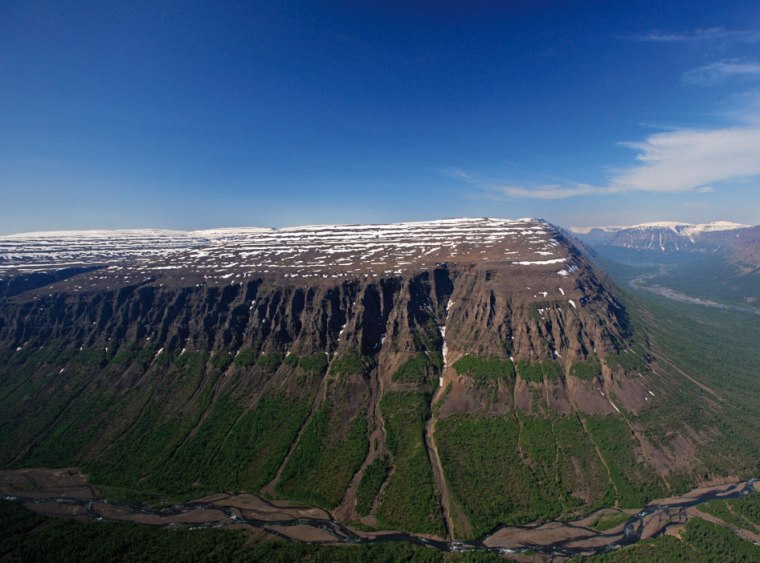
Siberian flood-basalt flows in Putorana, Taymyr Peninsula. (Credit: Paul Wignall; Nature http://www.nature.com/nature/journal/v477/n7364/fig_tab/477285a_F1.html)

In the run-up to the extinction carbon isotopes in marine Permian sediments from Meishan, China suggest a runaway growth in the amount of inorganic carbon (in carbonate) in the oceans. The C-isotope record from Meishan shows episodes of sudden major change (over ~20 ka) in both the inorganic and organic carbon parts of the oceanic carbon cycle. The timing of both ‘excursions’ from the long-term trend immediately follows a ‘spike’ in the concentration of the element nickel in the Meishan sediments. The Ni almost certainly was contributed by the massive outflow of basalt lavas in Siberia. So, what is the connection?

Some modern members of the prokaryote Archaea that decompose organic matter to produce methane have a metabolism that depends on Ni, one genus being Methanosarcina that converts acetate to methane by a process known as acetoclastic methanogenesis. Methanosarcina acquired this highly efficient metabolic pathway probably though a sideways gene transfer from Bacteria of the class Clostridia; a process now acknowledged as playing a major role in the evolution of many aspects of prokaryote biology, including resistance to drugs among pathogens. Molecular-clock studies of the Methanosarcina genome are consistent with this Archaea appearing at about the time of the Late Permian. A burst of nickel ‘fertilisation’ of the oceans may have resulted in huge production of atmospheric methane. Being a greenhouse gas much more powerful than CO2, methane in such volumes would very rapidly have led to global warming. Before the Siberian Traps began to be erupted nickel would only have been sufficiently abundant to support this kind of methanogen around ocean-floor hydrothermal springs. Spread globally by eruption plumes, nickel throughout the oceans would have allowed Methanosarcina or its like to thrive everywhere with disastrous consequences. Other geochemical processes, such as the oxidation of methane in seawater, would have spread the influence of the biosphere-lithosphere ‘conspiracy’. Methane oxidation would have removed oxygen from the oceans to create anoxia that, in turn, would have encouraged other microorganisms that reduce sulfate ions to sulfide and thereby produce toxic hydrogen sulfide. That gas once in the atmosphere would have parlayed an oceanic ‘kill mechanism’’ into one fatal for land animals.

There is one aspect that puzzles me: the Siberian Traps probably involved many huge lava outpourings every 10 to 100 ka while the magma lasted, as did all other flood basalt events. Why then is the nickel from only such eruption preserved in the Meishan sediments, and if others are known from marine sediments is there evidence for other such methanogen ‘blooms’ in the oceans?

What’s happening at the core-mantle boundary?

The lithosphere that falls into the mantle at subduction zones must end up somewhere in the deep Earth; the question is, where and what happens to it. There are hints from seismic tomography of the mantle that such slabs penetrate as deep as the boundary between the lowermost mantle and the molten outer core. The lithosphere’s two components, depleted mantle and oceanic crust, are compositionally quite different, being peridotitic and basaltic, so each is likely to be involved different petrological processes. As regards the physics, since seismic activity ceases below a depth of about 700 km neither entity behaves in a brittle fashion in the lower mantle. Such ductile materials might even pile up in the manner of intestines on the lithological equivalent of the abattoir floor; Bowels of the Earth as John Elder had it in his book of the same name.

Sketch of the lower 1000 km of the Earth’s mantle (credit: Williams, Q. 2014. Deep mantle matters. Science, v. 344, p. 800-801)

Pressure would make these recycled components mineralogically different, as indeed a relative light squeeze does in the upper mantle, where cold wet basalts become dry and denser eclogites thereby pulling more lithosphere down Wadati and Benioff’s eponymous zones to drive plate tectonics. Decades old experiments at lower-mantle pressures suggest that mantle minerals recompose from olivine with a dash of pyroxene to a mixture of more pressure-resistant iron-magnesium oxide and perovskite ((Mg,Fe)SiO3). Experiments in the early 21st century, under conditions at depths below 2600 km, revealed that perovskite transforms at the very bottom of the mantle (the D” zone) into layers of magnesium plus iron, silicon and oxygen. This is provisionally known as ‘post-perovskite’. The experiments showed that the transition releases heat. So, should oceanic lithosphere descend to the D” zone, it would receive an energy ‘kick’ and its temperature would increase. Conversely, if D”-zone materials rose to the depth of the perovskite to post-perovskite transition they would become less dense: a possible driver for deep-mantle plumes.

Now a new iron-rich phase stable in the bottom 1000 km of the mantle has emerged from experiments, seeming to result from perovskite undergoing a disproportionation reaction (Zhang, L. And 11 others 2014. Disproportionation of (Mg,Fe)SiO3 perovskite in Earth’s deep mantle. Science, v. 344, p. 877-882). In the same issue of Science other workers using laser-heated diamond anvils have revealed that, despite the huge pressures, basaltic rock may melt at temperatures considerably below the solid mantle’s ambient temperature (Andrault, D. et al. 2014. Melting of subducted basalt at the core-mantle boundary. Science, v. 344, p. 892-895). Both studies help better understand the peculiarities of the deepest mantle that emerge from seismic tomography (Williams, Q. 2014. Deep mantle matters. Science, v. 344, p. 800-801).

Huge blocks with reduced S-wave velocities that rise above the D” zone sit beneath Africa and the Pacific Ocean. There are also smaller zones at the core-mantle boundary (CMB) with shear-wave velocities up to 45% lower than expected. These ultralow-velocity zones (ULVZs) probably coincide with melting of subducted oceanic basalts, but the magma cannot escape by rising as it would soon revert to perovskite. Yet, since ultramafic compositions cannot melt under such high pressures the ULVSs indirectly show that subduction does descend to the CMB. Seismically defined horizontal layering in the D” zone thus may result from basaltic slabs whose ductility has enabled them to fold like sheets of lasagne as the reach the base of the mantle. Development of variants of the laser-heated diamond anvil set-up seem likely to offer insights into our own world’s ‘digestive’ system at a far lower cost and with vastly more relevance than the growing fad for speculating on Earth-like planets that the current ‘laws’ of physics show can never be visited and on ‘exobiology’ that cannot proceed further than the extremes of the Earth’s near-surface environment and the DNA double helix.

Year Zero: the giant-impact hypothesis

On close examination, the light-coloured Highlands of the Moon look remarkably like an old sign by a North American road through hunting country: they are pocked by impact craters of every size. More than that, a lengthy period of bombardment is signified by signs that the craters themselves are cratered to form a chaotic landscape dominated by interlocking and overlapping circular feature. In contrast the dark basaltic plains, called maria (seas), are pretty smooth albeit with some craters. They are clearly much younger than the Highlands. The discovery by Apollo astronauts that the older lunar Highlands are made almost exclusively of calcic plagioclase feldspar was a major surprise, requiring an astonishing event to explain them. Such anorthosites may form by flotation of low-density feldspar from a cooling and crystallising basaltic magma. Yet to form the bulk of the Moon’s early crust from such materials requires not simply a deep magma chamber, but literally an ocean of molten material at least 200 km deep. The anorthosites also turned out to be far older than the oldest rocks on Earth, close to 4.5 billion years. The most likely explanation seemed to be that the melting resulted from a gargantuan collision between two protoplanets, the Earth’s forebear and another now vanished. This would have melted and partially vaporised both bodies. After this discovery the Moon was widely believed to have formed from liquid and vaporised rock flung into orbit around what became the Earth.

Artist’s depiction of a collision between two planetary bodies likely to have formed the Moon (Credit: Wikipedia)

Such a catastrophic model for joint formation of the Earth and Moon shortly after planets of the Solar System had formed is hard to escape, but it carries two major puzzles. First, Earth and Moon seem to have very similar, indeed almost the same chemistry: So what happened to the colliding planet? If it had been identical in composition to the proto Earth there is no problem, but a different composition would surely have left some detectable trace in a Moon-Earth geochemical comparison. Initial models of the collision suggested that the other planet (dubbed Theia) was about the size of Mars and should have contributed 70 to 90% of the lunar mass: the Moon-Earth geochemical difference should have been substantial The second issue raised in the early days of the hypothesis was that since the Moon seemed to be almost totally dry (at least, the first rock analyses suggested that), then how come the Earth had retained so much water?

For decades, after an initial flurry of analyses, the Apollo samples remained in storage. Only in the last 10 years or so, when the need to gee-up space exploration required some prospect of astronauts one more to be sent beyond Earth orbit, have the samples been re-examined. With better analytical tools, the first puzzle was resolved: lunar rocks do contain measurable amounts of water, so the impact had not entirely driven off volatiles from the Moon. The bulk geochemical similarity was especially puzzling for the isotopes of oxygen. Meteorites of different types are significantly ear-marked by their relative proportions of different oxygen isotopes, signifying to planetary scientists that each type formed in different parts of the early Solar System; a suggestion confirmed by the difference between those in meteorites supposedly flung from Mars and terrestrial oxygen isotope proportions. A clear target for more precise re-examination of the lunar samples, plus meteorites reckoned to have come from the Moon, is therefore using vastly improved mass spectrometry to seek significant isotopic differences (Harwartz, D. et al. 2014. Identification of the giant impactor Theia in lunar rocks. Science, v. 344, p. 1146-1150). It turns out that there is a 12 ppm difference in the proportion of 17Oin lunar oxygen, sufficient to liken Theia’s geochemistry to that of enstatite chondrites. However, that difference may have arisen by the Earth, once the Moon had formed, having attracted a greater proportion of carbonaceous-chrondrite material during the later stages of planetary accretion by virtue of its much greater gravitational attraction. That would also account for the much higher volatile content of the Earth.

The new data do help to support the giant-impact hypothesis, but still leave a great deal of slack in the big questions: Did Theia form in a similar orbit around the Sun to that of Earth; was the impact head-on or glancing; how fast was the closure speed; how big was Theia and more besides? If Theia had roughly the same mass as the proto-Earth then modelling suggests that about half the mass of both Moon and Earth would be made of Theia stuff, giving the Moon and post-impact Earth much the same chemistry, irrespective of where Theia came from. Were William of Ockham’s ideas still major arbiters in science, then his Razor would suggest that we stop fretting about such details. But continuing the intellectual quest would constitute powerful support for a return to the Moon and more samples…

Fracking in the UK; will it happen?

Whether or not one has read the Tractatus Logico-Philosophicus of Ludwig Wittgenstein, there can be little doubt that one of his most famous quotations can be applied to much of the furore over hydraulic fracturing (fracking) of hydrocarbon-rich shale in south-eastern Britain: ‘Whereof one cannot speak, one must remain silent’ (more pithily expressed by Mark Twain as ‘Better to remain silent and be thought a fool than to speak and remove all doubt’). A press release by the British Geological Survey  in late May 2014 caused egg to appear on the shirts of both erstwhile ‘frackmeister’ David Cameron (British Prime Minister) and anti-fracking protestors in Sussex. While there are oil shales beneath the Weald, these Jurassic rocks have never reached temperatures sufficient to generate any significant gas reserves (see: Upfront, New Scientist, 31 May 2014 issue, p. 6). Yet BGS estimate the oil shales to contain a total of 4.4 billion barrels of oil. That might sound a lot, but the experience of shale fracking companies in the US is that, at best, only about 5% can be recovered and, in cases that are geologically similar to the Weald, as little as 1% might be expected. Between 44 and 220 million barrels is between two and six months’ worth of British oil consumption; and that is only if the entire Wealden shales are fracked.

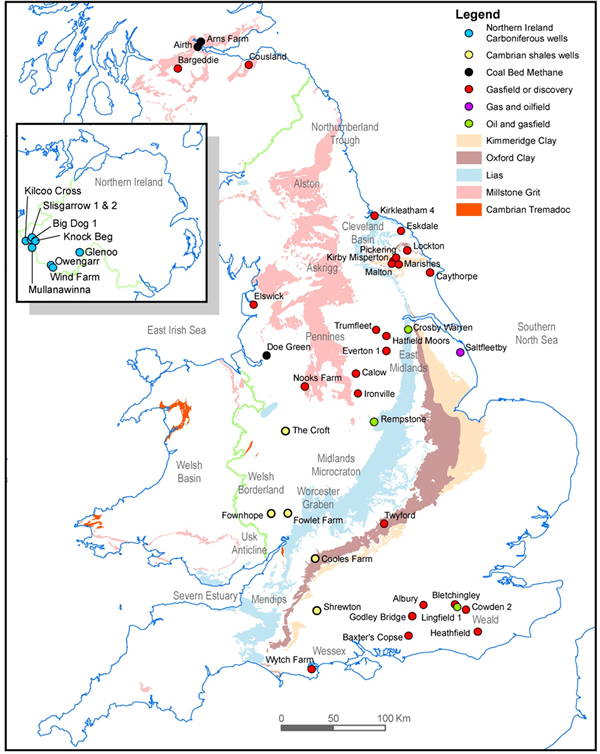
Areas where petroleum-rich shales occur at the surface in Britain. (credit: British Geological Survey)

Why would any commercial exploration company, such as Cuadrilla, go to the trouble of drilling wells, even of an ‘exploratory nature’, for such meager potential returns? Well, when there is sufficient hype, and the British Government has gushed in this context for a few years, bigger fish tend to bite and cash flows improve. For instance, Centrica the owner of British Gas forked out $160 million to Cuadrilla in June 2013 for a quarter share in the well-publicised licence area near Blackpool in Lancashire; the grub stake to allow Cuadrilla to continue exploration in exchange for 25% of any profit should commercial quantities of shale-gas be produced.

Sedimentary rock sequences further north in Britain whose geological evolution buried oil shales more deeply are potential gas producers through fracking; an example is the Carboniferous Bowland Shale beneath the Elswick gasfield in west Lancashire, targeted by Cuadrilla. Far greater potential may be present in a large tract of the Pennine hills and lowlands that flank them where the Bowland Shale occurs at depth.

Few people realize just how much detail is known about what lies beneath their homes apart from maps of surface geology. That is partly thanks to BGS being the world’s oldest geological survey (founded in 1835) and partly the sheer number of non-survey geologists who have prowled over Britain for 200 years or more and published their findings. Legally, any excavation, be it an underground mine, a borehole or even the footings for a building, must be reported to BGS along with whatever geological information came to light as a result. The sheer rarity of outcropping rock in Britain is obvious to everyone: a legacy of repeated glaciation that left a veneer of jumbled debris over much of the land below 500m that lies north of the northern outskirts of the London megalopolis. Only highland areas where glacial erosion shifted mullock to lower terrains have more than about 5% of the surface occupied by bare rock. Of all the data lodged with BGS by far the most important for rock type and structure at depth are surveys that used seismic waves generated by vibrating plates deployed on specialized trucks. These and the cables that connected hundreds of detectors were seen along major and minor roads in many parts of Britain during the 1980s during several rounds of licenced onshore exploration for conventional petroleum resources. That the strange vehicles carried signs saying Highway Maintenance lulled most people apart from professional geologists as regards their actual purpose. Over 75 thousand kilometers of seismic sections that penetrated thousands of metres into the Earth now reside in the UK Onshore Geophysical Library (an Interactive Map at UKOGL allows you to see details of these surveys, current areas licenced for exploration and the locations of various petroleum wells).

Seismic survey lines in northern England (green lines) from the interactive map at the UK Onshore Geophysical Library

Such is the detail of geological knowledge that estimates of any oil and gas, conventional or otherwise, residing beneath many areas of Britain are a lot more reliable than in other parts of the world which do not already have or once had a vibrant petroleum industry. So you can take it that when the BGS says there is such and such a potential for oil or gas beneath this or that stretch of rural Britain they are pretty close to the truth. Yet it is their raw estimates that are most often publicized; that is, the total possible volumes. Any caveats are often ignored in the publicity and hype that follows such an announcement. BGS recently announced that as much as 38 trillion cubic metres of gas may reside in British shales, much in the north of England. There followed a frenzy of optimism from Government sources that this 40 years’ worth of shale gas would remove at a stroke Britain’s exposure to the world market of natural gas, currently dominated by Russia, and herald a rosy economic future to follow the present austerity similar to the successes of shale-gas in North America. Equally, there has been fear of all kinds of catastrophe from fracking on our ‘tight little island’ especially amongst those lucky enough not to live in urban wastelands. What was ignored by both tendencies was reality. In the US, fracking experience shows that only 10% at most of the gas in a fractured shale can be got out; even the mighty Marcellus Shale of the NE US underlying an area as big as Britain can only supply 6 years of total US gas demand. Britain’s entire shale-gas endowment would serve only 4 years of British gas demand.

To tap just the gas in the upper part of the Bowland basin would require 33 thousand fracking wells in northern Britain. Between 1902 and 2013 only 19 onshore petroleum wells were drilled here in an average year. To make any significant contribution to British energy markets would require 100 per annum at a minimum. Yet, in the US, the flow rate from fracked wells drops to a mere zephyr within 3 years. Fracking on a large scale may well never happen in Britain, such are the largely unstated caveats. But the current hype is fruitful for speculation that it will, and that can make a lot of cash sucked in by the prospect – without any production whatsoever.

Enhanced by Zemanta