Impact debris in Neoproterozoic sediments of Scotland and biological evolution?

False-colour electron microscope image of a shocked grain of zircon recovered from the Stac Fada Member. The red and pink material is a high-pressure polymorph of zircon, arranged in shock lamellae. Zircon is rendered in cyan, some of which is in granulated form. Credit: Kirkland et al. 2025, Fig 2C

Judging by its content of shards and spherules made of murky green glass, one of the lowest units in the Torridonian continental sediments of NW Scotland had long been regarded as simply red sandstone that contained volcanic debris. This Stac Fada Member was thus celebrated as the only sign of a volcanic contribution to a vast thickness (up to 2.5 km) of Neoproterozoic lake and fluviatile sediments. Current flow indicators suggested that the Torridonian was laid down by large alluvial fans derived by erosion of much older crystalline basement far to what is today the west. That is, the Archaean core of the ancient continent of Laurentia, now the other side of the North Atlantic. In 2002 more sophisticated sedimentological and geochemical analysis of the Stac Fada Member revealed a surprise: it contains anomalously elevated platinum-group elements, quartz grains that show signs of shock and otherworldly chromium isotope concentrations. The 10 m thick bed is made from ejecta, perhaps from a nearby impact crater to the WNW concluded from brittle fractures that may have been produced by the impact. Some idea of its age was suggested by Ar-Ar dating of feldspar crystals (~1200 Ma) believed to have formed authigenically in the hot debris. Being the only decent impactite known in Britain, it continues to attract attention.

A group of geoscientists from Western Australia, NASA and the UK, independent of the original discoverers, have now added new insights ( Kirkland, C.L. and 12 others 2025. A one-billion-year old Scottish meteorite impact. Geology, v. 53, early online publication; DOI: 10.1130/G53121.1). They dated shocked zircon grains using U-Pb analyses at 990 ± 22 Ma; some 200 Ma younger than the previously dated, authigenic feldspars.  Detrital feldspar grains in the Stac Fada Member yield Rb-Sr radiometric ages of 1735 and 1675, that are compatible with Palaeoproterozoic granites in the underlying Lewisian Gneiss Complex.

Photomicrograph of Bicellum brazieiri: scale bar = 10μm; arrows point to dark spots that may be cell nuclei (credit: Charles Wellman, Sheffield University)

In a separate publication (Kirkland, C.L et al 2025. 1 billion years ago, a meteorite struck Scotland and influenced life on Earth. The Conversation, 29 April 2025) three of the authors take things a little further, as their title suggests. In this Conversation piece they ponder, perhaps unwarily, on the spatial and temporal association of the indubitable impact with remarkably well-preserved spherical fossils found in Torridonian lake-bed sediments (Bicellum brasieri, reported in Earth-logs in May 2021), which are the earliest-known holozoan animal ancestors. The Torridonian phosphatic concretions in which these important fossils were found at a different locality are roughly 40 Ma younger than the Stac Fada impactite. The authors of the Conversation article appeal to the residual thermal effect of the impact as a possible driver for the appearance of these holozoan organisms. Whether a residual thermal anomaly would last long enough for them to evolve to this biological status would depend on the magnitude of the impact, of which we know nothing.  Eukaryote fossils are known from at least  650 Ma older sedimentary rocks in northern China and perhaps as far back as 2.2 Ga in a soil that formed in the Palaeoproterozoic of South Africa. Both the Torridonian organism and impactite were found in a small area of fascinating geology that has been studied continuously in minute detail since Victorian times, and visited by most living British geologists during their undergraduate days. Ideas will change as curiosity draws geologists and palaeobiologists to less-well studied sites of Proterozoic antiquity, quite possibly in northern China.

A fully revised edition of Steve Drury’s book Stepping Stones: The Making of Our Home World can now be downloaded as a free eBook

A sign of life on another planet? Should we be excited?

Judging by the coverage in the media, there is huge excitement about a possible sign of life on a very distant planet. It emerged from a Letter to The Astrophysical Journal posted by a British-US team of astronomers led by Nikku Madhusudhan that was publicised by the Cambridge University Press Office (Madhusudhan, N.et al. 2025. New Constraints on DMS and DMDS in the Atmosphere of K2-18 b from JWST MIRI. The Astrophysical Journal, v. 983, article adc1c8; DOI: 10.3847/2041-8213/adc1c8). K2-18 b is a planet a bit smaller than Neptune that orbits a red dwarf star (K2-18) about 124 light years away. The planet was discovered by NASA’s now-defunct Kepler space telescope tasked with the search for planets orbiting other stars. An infrared spectrometer on the Hubble Space Telescope revealed in 2019 that the atmosphere of K2-18 b contained water vapour, making the planet a target for further study as it may possess oceans. The more sophisticated James Webb Space Telescope IR spectrometer was trained on it a year later to reveal methane and CO2: yet more reason to investigate more deeply, for water and carbon compounds imply both habitability and the potential for life forms being there.

The latest results suggest that that the atmosphere of K2-18 b may contain simple carbon-sulfur gases: dimethyl sulfide ((CH3)2S) and dimethyl disulfide (CH3SSCH3). Bingo! for exobiologists, because on Earth both DMS and DMDS are only produced by algae and bacteria. Indeed they are responsible for the odour of the seaside. They became prominent in 1987 when biogeochemist James Lovelock fitted them into his Gaia Hypothesis. He recognised that they encourage cloud formation and thus increase Earth’s reflectivity (albedo) and also yield sulfuric acid aerosols in the stratosphere when they oxidise: that too increases albedo. DMS generates a cooling feedback loop to counter the warming feedback of greenhouse emissions. That is an idea of planetary self-regulation not much mentioned nowadays. Such gases were proposed by Carl Sagan as unique molecular indicators that could be used to search for extraterrestrial life.

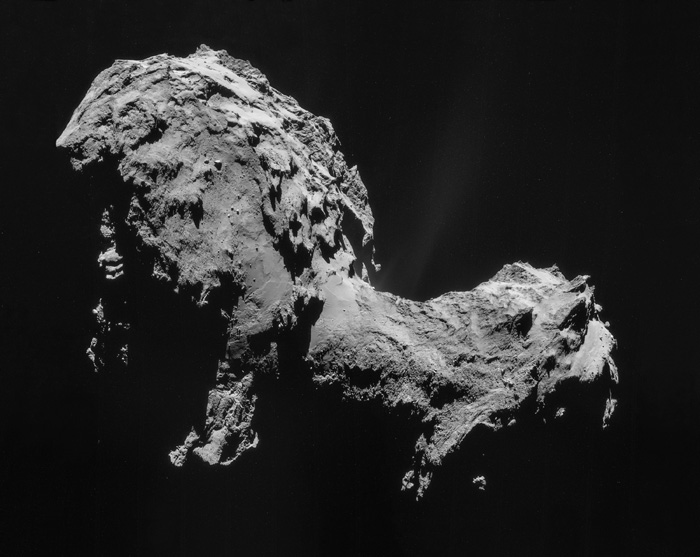
The coma of Comet Churyumov-Gerasimenko yielded both dimethyl sulfide and amino acids to the mass spectrometer carried by ESA’s Rosetta. Credit: ESA.

The discovery of possible DMS and DMDS in K2-18 b’s atmosphere is, of course, currently under intense scientific scrutiny. For a start, the statistics inherent in Madhusudhan et al.’s methodology (3σ or 99.7% probability) fall short of the ‘gold standard’ for discoveries in physics (5σ or 99.99999% probability). Moreover, there’s also a chance that exotic, inorganic chemical processes could also create the gases, such as lightning in an atmosphere containing C, H and S. But this is not the first time that DMS has been discovered in an extraterrestrial body. Comets, having formed in the infancy of the Solar System much further from the Sun than any planets, are unlikely to be ‘teeming with life’. The European Space Agency’s Rosetta spacecraft chased comet 67P/Churyumov-Gerasimenko for 2 years, directly sampling dust and gas that it shed while moving closer to the Sun. A single day’s data from Rosetta’s mass spectrometer showed up DMS, and also amino acids. Both could have formed in comets or interstellar dust clouds by chemistry driven by radiation, possibly to contaminate planetary atmospheres. Almost certainly, further remote sensing of K2-18 b will end up with five-sigma precision and some will say, ‘Yes, there is life beyond Earth!’ and celebrate wildly. But that does not constitute proof, even by the ‘weight of evidence’ criterion of some judiciaries. To me such a conclusion would be unseemly romanticism. Yet such is the vastness of the material universe and the sheer abundance of the elements C H O N and P that make up most living matter that life elsewhere, indeed everywhere, (but not life as we know it) is a near certainty. The issue of intelligent lifeforms ‘out there’ is, however, somewhat less likely to be resolved . . .

Middle Palaeolithic Neanderthals and Denisovans of East Asia

During the Middle Palaeolithic (250 to 30 ka) anatomically modern humans (AMH) and Neanderthals were engaged in new technological developments in Europe and Africa as well as in migration and social interaction. This is reflected in the tools that they left at occupation sites and the fact that most living non-Africans carry Neanderthal DNA. One of the major cultural developments was a novel means of manufacturing stone implements. It developed from the Levallois technique that involved knapping sharp-edged flakes of hard rock from larger blocks or cores. A type of tool first found at a Neanderthal site near La Quina in France is a thick flake of stone with a broad, sharp edge that shows evidence of having been resharpened many times. Most other flake tools seem to have been ‘one-offs’ that were discarded after brief usage. The Quina version was not only durable but seems to have been multipurpose. Analysis of wear patterns on the sharpened edges suggest that they were deployed in carving wood and bone, removing fat and hair from animal hides, and butchery. Such scrapers have been found over a wide area of Europe, the Middle East and NE Asia mostly at Neanderthal sites, including the famous Denisova Cave of southern Siberia that yielded the first Denisovan DNA as well as that of Neanderthals.

Making a typical Quina scraper and related tools. The toolmaker would flake pieces of stone off the core and then carefully shape the Quina scraper. (Image credit: Pei-Yuan Xiao)

Until now, the early humans of East Asia were thought not to have proceeded beyond more rudimentary tools during the Middle Palaeolithic: in fact that archaeological designation hasn’t been applied there. Recent excavations at Longtan Cave in south-west China have forced a complete revision of that view (Ruan, Q.-J., et al. 2025. Quina lithic technology indicates diverse Late Pleistocene human dynamics in East Asia. Proceedings of the National Academy of Sciences, v. 122, article e2418029122; DOI: 10.1073/pnas.2418029122). The Longtan site has yielded more than fifty scrapers and the cores from which they had been struck that clearly suggest the Quina technology had been used there. They occur in cave sediments dated at between 60 and 50 ka. As yet, no human remains have been found in the same level at Longtan, although deeper levels dated at 412 ka have yielded hominin crania, mandibular fragments, and teeth, that have been suggested to be Homo erectus.

Quina type tools in East Asia may previously have been overlooked at other hominin sites in China: re-examination of archived tool collections may show they are in fact widespread. The technology could have been brought in by migrating Neanderthals, or maybe it was invented independently by local East Asian hominins. Because most living people in China carry Denisovan DNA in the genomes so perhaps that group developed the technique before interbreeding with AMH immigrants from the west. Indeed there is no reason to discard the notion that  early AMH may have imported the Quina style. A lot of work lies ahead to understand this currently unique culture at Longtan Cave. However, interpretation of another discovery published shortly after that from Longtan has spectacularly ‘stolen the thunder’ of the Qina tools, and it was made in Taiwan …

Right (top) and downward (lower) views of the partial Penghu mandible. Credit: Yousuke Kaifu University of Tokyo, Japan and Chun-Hsiang Chang Tunghai University, Taichung, from Tsutaya et al. Fig. 1 (inset)Taiwan.

About 10 years ago, Taiwanese fishers trawling in the Penghu Channel between Taiwan and China were regularly finding bones in their nets. Between 70 to 10 ka and 190 to 130 ka ago much lower sea level due to continental ice cap formation exposed the Penghu seabed. Animals and humans were thus able to move between the East Asian mainland and what is now Taiwan. The bones brought to the surface included those of elephants, water buffaloes and tigers, but one was clearly a human lower jawbone (mandible). Its shape and large molar teeth are very different from modern human mandibles and molars. A multinational team from Japan, Denmark, Taiwan and Ireland has extracted proteins from the mandible to check its genetic affinities (Tsutaya, T. and 14 others 2025. A male Denisovan mandible from Pleistocene Taiwan. Science, v. 388, p. 176-180; DOI: 10.1126/science.ads3888). Where DNA has not been preserved in bones proteomics is a useful tool, especially if results are matched with other bones that have yielded both DNA and protein sequences. In the case of the Penghu mandible, proteins from its teeth matched those of Denisovans from the Denisova Cave in Siberia which famously yielded the genome of this elusive human group. They also matched proteins from a rib found in Tibet associated with Denisovan mitochondrial DNA in cave sediments that enclosed the bones.

The three sites (Denisova, Baishiya Cave in Tibet and Penghu Channel) that have produced plausible Denisovan specimens span a large range of latitudes and altitudes. This suggests that Denisovans were capable of successful subsistence across much of East Asia. The Penghu mandible and teeth are similar to several hominin specimens from elsewhere in China that hitherto have been attributed to H. erectus. Apart from the Denisovan type locality, most of the sites have yet to be accurately dated. Having been immersed in sea water for thousands of years isotopes used in dating have been contaminated in the Panghu specimen. It can only be guessed to have lived when the seabed from which it was recovered was dry land; i.e. between 70 to 10 ka and 190 to 130 ka. China was undoubtedly occupied by Homo erectus during the early Pleistocene, but much younger fossils have been attributed to that species by Chinese palaeoanthropologists. Could it be that they are in fact Denisovans? Maybe such people independently developed the Quina knapping technique

See also: Marwick, B. 2025.  Unknown human species in East Asia used sophisticated tools at the same time Neanderthals did in Europe. Live Science, 31 March 2025; Ashworth. J. 2025. Denisovan jawbone helps to reveal appearance of ancient human species. Natural History Museum News 11 April 2025.

A fully revised edition of Steve Drury’s book Stepping Stones: The Making of Our Home World can now be downloaded as a free eBook

More dinosaur trackways from the Jurassic of the Isle of Skye, Scotland

The Isle of Skye off the northwestern coast of Scotland is one of several areas in Britain that are world-class geological gems. Except for the Cuillin Hills that require advanced mountaineering skills it is easy to explore and has become a major destination for both beginners and expert geoscientists of all kinds. Together with the adjacent Isle of Raasay the area is covered by a superb, free geological guidebook (Bell, B. 2024. The Geology of the Isles of Skye and Raasay. Geological Society of Glasgow) together with 60 standalone excursion guides, and even an introduction to Gaelic place names and pronunciation. It is freely available from https://www.skyegeology.com/

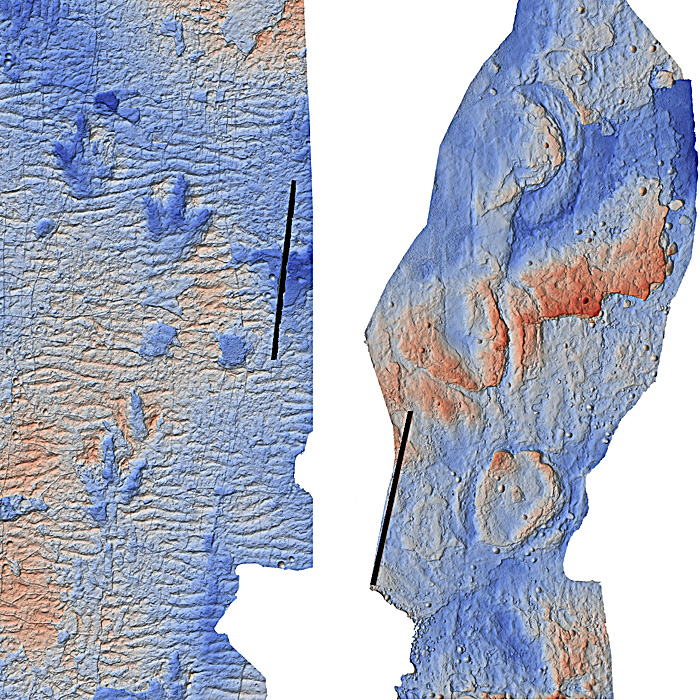
Fig Dinosaur trackways at Prince Charles’s Point on the Isle of Skye: Left carnivorous theropods; Right herbivorous sauropods. The black scales are 1 m long. The images are enhanced fine-scale elevation models of the exposed surfaces that were derived from vertical photographs. Credit: Blakesley et al., Figs 9 and 27.

Since 2018 Skye has also become a must-visit area for vertebrate palaeontologists. Beneath Palaeocene flood basalts is a sequence of Jurassic strata, both shallow marine and terrestrial. One formation, the Great Estuarine Group of Middle Jurassic (Bathonian, 174–164 Ma) age covers the time when meat-eating theropod- and herbivorous sauropod dinosaurs began to grow to colossal sizes from diminutive forebears. While other Jurassic sequences on Skye have notable marine faunas, its Bathonian strata have yielded a major surprise: some exposed bedding surfaces are liberally  dotted with trackways of the two best known groups of dinosaur. The first to be discovered were at Rubha Nam Brathairean (Brothers’ Point) suggesting a rich diversity of species that had wandered across a wide coastal plain, also including the somewhat bizarre Stegosaurus. The latest finds are from a rocky beach at Prince Charles’s Point where the Young Pretender to the British throne, Charles Edward Stuart, landed and hid during his flight from the disastrous Battle of Culloden (16 April 1746). It was only in the last year or so that palaeontologists from the universities of Edinburgh and Liverpool, and the Staffin Museum came across yet more footprints (131 tracks) left there by numerous dinosaurs in the rippled sands of a Bathonian lagoon (Blakesley, T. et al. 2025. A new Middle Jurassic lagoon margin assemblage of theropod and sauropod dinosaur trackways from the Isle of Skye, Scotland. PLOS One, v. 20, article e0319862; DOI: 10.1371/journal.pone.0319862.

The Prince Charles’s Point site is partly covered by large basalt boulders, which perhaps account for the excellent preservation of the bedding surfaces from wave action. Two kinds of footprint are preserved (see image): those made by three-toed feet and by elephant-like feet that ‘squidged-up’ sediment surrounding than. Respectively these are suggested to represent the hind limbs of bipedal carnivorous theropods and quadrupedal herbivorous sauropods. They show that individual dinosaurs moved in multiple directions, but there is no evidence for gregarious behaviour, such as parallel trackways of several animals. They occur on two adjacent bedding surfaces so represent a very short period of time, perhaps a few days. The authors suggest that several individual animals were milling around, with more sauropods than theropods. What such behaviour represents is unclear. The water in an estuarine lagoon would likely have been fresh or brackish. They may have been drinking or perhaps there was some plants or carcases worth eating ? That might explain both kinds of dinosaurs’ milling around. The sizes of both sauropod and theropod prints average about 0.5 m. The stride lengths of the theropods suggest that they were between 5 to 7 metres long with a hip height of around 1.85 m. Their footprints resemble those reconstructed from skeletal remains of Middle Jurassic Megalosaurus, the first dinosaur to be named (by William Buckland in 1827). The sauropods had estimated hip heights of around 2 m so they may have been similar in size (around 16 m) to the Middle Jurassic Cetiosaurus, the first sauropod to be named (by Richard Owen in 1842).

A fully revised edition of Steve Drury’s book Stepping Stones: The Making of Our Home World can now be downloaded as a free eBook