Curiosity rover hints at the carbon cycle on Mars

The Mars Science Laboratory carried by the Curiosity rover is still functioning 10 years after a jetpack lowered Curiosity onto the surface of Gale crater. It includes a system aimed at scooping and drilling samples of soil and rock from the sedimentary strata deposited in the lake that once filled the crater about 3.5 to 3.8 billion years ago. The system on the rover is also capable of analysing the samples in various ways. A central objective of the mission was to obtain data on oxygen and carbon isotopes in carbon dioxide and methane released by heating samples, which uses a miniature mass spectrometer. In early 2022 a paper on Martian carbon isotopes was published in the Proceedings of the National Academy of Sciences (PNAS) that I have only just found (House, C.H. et al. 2022. Depleted carbon isotope compositions observed at Gale crater, Mars. Proceedings of the National Academy of Sciences, v. 119, article e2115651119; DOI: 10.1073/pnas.2115651119). PNAS deemed it to be one of the 12 most important of its articles during 2022.

Oblique view of Curiosity’s landing site in Gale crater on Mars, from which the rover has traversed the lower slopes of Mount Sharp. Credit: NASA-Jet Propulsion Laboratory

Carbon isotopic analyses chart the type and degree of fractionation between carbon’s two stable isotopes 12C and 13C. This is expressed by their relative abundances to one another in a sample and in a reference standard, signified by δ13C. The measure is a natural tracer of both inorganic and biological chemical processes: hence the potential importance of the paper by Christopher House and colleagues from the University of California, San Diego. The thin atmosphere of Mars contains both CO2 and traces of CH4, so a carbon cycle is part and parcel of the planet’s geochemical functioning. The ‘big question’ is: Did that involve living processes at any stage in the distant past and even now? Carbon held in various forms within Mars’s ancient rocks and soils may provide at least a hint, one way of the other. At the very least it should say something about the Martian carbon cycle.

House et al. focus on methane released by heating 22 samples drilled from sandstones and mudstones traversed by Curiosity up a slope leading from the floor of Gale crater towards its central peak, Mount Sharp.  The sampled sedimentary rocks span a 0.5 km thick sequence. Carbon in the expelled methane has δ13C values that range from -137 to +22 ‰ (per mil). Samples from six possibly ancient exposed surfaces were below -70 ‰. This depletion in 13C is similar to the highly negative δ13C that characterises carbon-rich sediments on Earth that were deposited at the Palaeocene-Eocene boundary. That anomaly is suspected to have resulted from releases of methane from destabilised gas hydrate on the sea floor during the Palaeocene–Eocene Thermal Maximum. Organic photosynthesis takes up ‘light’ 12C in preference to 13C, thereby imparting low δ13C to organic matter. In the case of the Mars data that might seem to point to the lake that filled Gale crater 3.5 to 3.8 billion years ago has contained living organisms of some kind. Perhaps on exposed surfaces of wet sediment primitive organisms consumed methane and inherited its δ13C. Some Archaean sediments of about the same age on Earth show similar 13C depletion associated with evidence for microbial mats that are attributed to the activities of such methanotrophs.

Before exobiologists become too excited, no images of possible microbial mats in Gale crater sediments have been captured by Curiosity. Moreover, there are equally plausible scenarios with no recourse to once-living organisms that may account for the carbon-isotope data,. Extreme depletion in 13C is commonly found in the carbon within meteorites, almost certainly inherited from the interstellar dust from which they accreted. It is estimated that the solar system passes through giant molecular clouds every 100 Ma or so: the low δ13C may be inherited from interstellar dust. Alternatively, because Mars has an atmosphere almost entirely composed or CO2 – albeit thin at present – various non-biological chemical reactions driven by sunlight or electrically charged particles may have reduced that gas to form methane and other compounds based on C-H bonds. Carbon dioxide still in Mars’s atmosphere is highly enriched in 13C, suggesting that earlier abiotic reduction may have formed 13C-depleted methane that became locked in sediments. Yet such an abundant supply of inorganic methane may have encouraged the evolution of methanotrophs, had life emerged on early Mars. No one knows …

It’s becoming a cliché that, ‘We may have to await the return of samples from the currently active Perseverance rover, or a crewed mission at some unspecifiable time in the future. The Curiosity carbon-isotope data keep the lamp lit for those whose livelihoods have grown around humans going to the Red Planet.

End-Ordovician mass extinction, faunal diversification, glaciation and true polar wander

Enormous events occurred between 460 and 435 Ma around the mid-point of the Palaeozoic Era and spanning the Ordovician-Silurian (O-S) boundary. At around 443 Ma the second-most severe mass extinction in Earth’s history occurred, which eliminated 50 to 60% of all marine genera and almost 85% of species: not much less than the Great Dying at the end of the Permian Period. The event was accompanied by one of the greatest biological diversifications known to palaeontology, which largely replaced the global biota initiated by the Cambrian Explosion. Centred on the Saharan region of northern Africa, Late Ordovician glacial deposits also occur in western South America and North America. At that time all the current southern continents and India were assembled in the Gondwana supercontinent, with continental masses that became North America, the Baltic region, Siberia and South China not far off: all the components that eventually collided to form Pangaea from the Late Silurian to the Carboniferous.

The mass extinction has troubled geologists for quite a while. There are few signs of major volcanism having been involved, although some geochemists have suggested that very high mercury concentrations in some Late Ordovician marine sediments bear witness to large, albeit invisible, igneous events. No large impact crater is known from those times, although there is a curious superabundance of extraterrestrial debris, including high helium-3, chromium and iridium concentrations, preserved in earlier Ordovician sedimentary rocks, around the Baltic Sea. Another suggestion, poorly supported by evidence, is destruction of the atmospheric ozone layer by a gamma-ray burst from some distant but stupendous supernova. A better supported idea is that the oceans around the time of the event lacked oxygen. Such anoxia can encourage solution of toxic metals and hydrogen sulfide gas. Unlike other mass extinctions, this one was long-drawn out with several pulses.

The glacial epoch also seems implicated somehow in the mass die-off, being the only one known to coincide with a mass extinction. It included spells of frigidity that exceeded those of the last Pleistocene glacial maximum, with the main ice cap having a volume of from 50 to 250 million cubic kilometres. The greatest of these, around 445 Ma, involved a 5°C fall in global sea-surface temperatures and a large negative spike in δ13C in carbon-rich sediments, both of which lasted for about a million years. The complex events around that time coincided with the highest ever extinction and speciation rates, the number of marine species being halved in a short space of time: a possible explanation for the δ13 C anomaly. Yet estimates of atmospheric CO2 concentration in the Late Ordovician suggests it was perhaps 8–16 times higher than today; Earth should have been a warm planet then. One probable contributor to extreme glacial conditions has been suggested to be that the South Pole at that time was well within Gondwana and thus isolated from the warming effect of the ocean. So, severe glaciation and a paradoxical combination of mass extinction with considerable biological diversification present quite an enigma.

A group of scientists based in Beijing, China set out to check the palaeogeographic position of South China between 460 and 435 Ma and evaluate those in  O-S sediments at locations on 6 present continents (Jing, X., Yang, Z., Mitchell, R.N. et al. 2022. Ordovician–Silurian true polar wander as a mechanism for severe glaciation and mass extinction. Nature Communications, v. 13, article 7941; DOI: 10.1038/s41467-022-35609-3). Their key tool is determining the position of the magnetic poles present at various times in the past from core samples drilled at different levels in these sedimentary sequences. The team aimed to test a hypothesis that in O-S times not only the entire lithosphere but the entire mantle moved relative to the Earth’s axis of rotation, the ‘slippage’ probably being at the Core-mantle boundary [thanks to Steve Rozario for pointing this out]. Such a ‘true polar wander’ spanning 20° over a mere  2 Ma has been detected during the Cretaceous, another case of a 90° shift over 15 Ma may have occurred at the time when Snowball Earth conditions first appeared in the Neoproterozoic around the time when the Rodinia supercontinent broke up and a similar event was proposed in 1994 for C-O times albeit based on sparse and roughly dated palaeomagnetic pole positions.

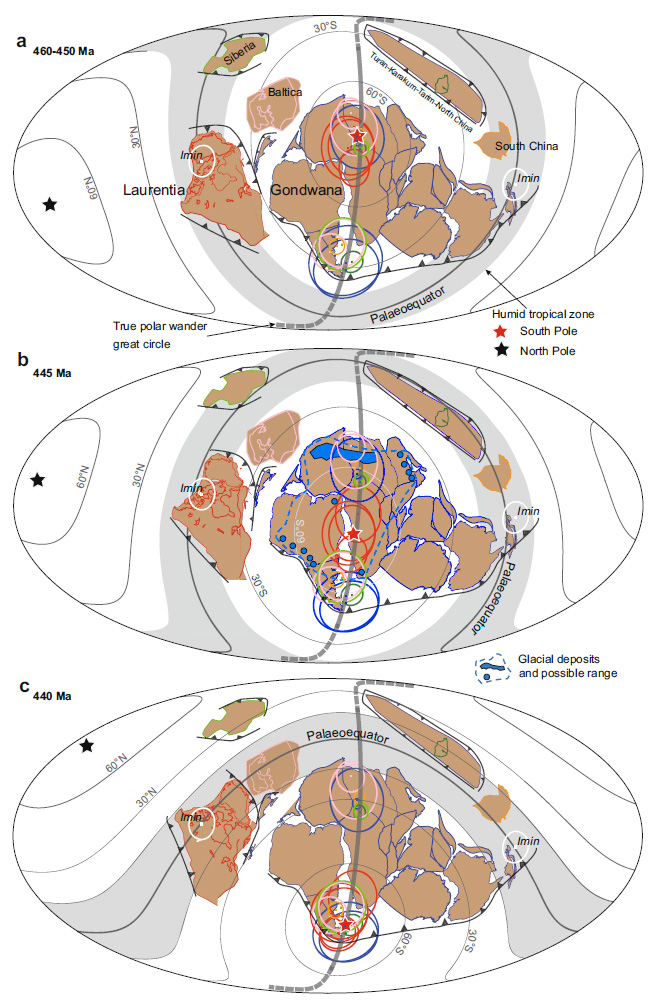
Xianqing Jing and colleagues report a wholesale 50° rotation of the lithosphere between 450 and 440 Ma that would have involved speeds of about 55 cm per year. It involved the Gondwana supercontinent and other continental masses still isolated from it moving synchronously in the same direction, as shown in the figure. From 460 to 450 Ma the geographic South Pole lay at the centre of the present Sahara. At 445 Ma its position had shifted to central Gondwana during the glacial period. By 440 Gondwana had moved further northwards so that the South Pole then lay at Gondwana’s southernmost extremity.

Palaeogeographic reconstructions charting true polar wander and the synchronised movement of all continental masses between 460 and 440 Ma. Note the changes in the trajectories of lines of latitude on the Mollweide projections. The grey band either side of the palaeo-Equator marks intense chemical weathering in the humid tropics. Credit Jing et al. Fig 5.

As well as a possible key to the brief but extreme glacial episode this astonishing journey by a vast area of lithosphere may help account for the mass extinction with rapid speciation and diversification associated with the O-S boundary. While the South Pole was traversing Gondwana as the supercontinent shifted the ‘satellite’ continental masses remained in or close to the humid tropics, exposed to silicate weathering and erosion. That is a means for extracting CO2 from the atmosphere and launching global cooling, eventually to result in glaciation over a huge tract of Gondwana around 445 Ma. Gondwana then moved rapidly into more clement climatic zones and was deglaciated a few million years later. The rapid movement of the most faunally diverse continental-shelf seas through different climate zones would have condemned earlier species to extinction simultaneous adaptation to changed conditions could have encouraged the appearance of new species and ecosystems. This does not require the catastrophic mechanisms largely established for the other mass extinction events. It seems that during the stupendous, en masse slippage of the Earth’s lithosphere plate tectonic processes still continued, yet it must have had a dynamic effect throughout the underlying mantle.

Yet the fascinating story does have a weak point. What if the position of the magnetic poles shifted during O-S times from their assumed rough coincidence with the geographic poles? In other words, did the self-exciting dynamo in the liquid outer core undergo a large and lengthy wobble? How the outer core’s circulation behaves depends on its depth to the solid core, yet the inner core seems only to have begun solidifying just before the onset of the Cambrian, about 100 Ma before the O-S events. It grew rapidly during the Palaeozoic, so the thickness of the outer core was continuously increasing. Fluid dynamic suggests that the form of its circulation may also have undergone changes, thereby affecting the shape and position of the geomagnetic field: perhaps even shifting its poles away from the geographic poles …

Annual logs for 2020 and 2021 added

For ease of access to annual developments within the general topics that Earth-logs covers I have now compiled all the Earth-logs posts from 2020 and 2021 into the categories: Geohazards; Geomorphology; Human Evolution; Magmatism; Palaeobiology; Palaeoclimatology; Physical Resources; Planetary Science; Remote Sensing; Sediments and Stratigraphy, and Tectonics. You can download them by ‘hovering’ over the Annual logs pull-down in the main menu and clicking on a category, whose index page will appear. Then scroll down to the 2020 or 2021 entry and click on the link to the PDF.

I hope that readers find this option useful in showing how each general topic has developed over the 21st century so far. Of course, it is based on my personal view of what constitute important developments published in international journals

Best wishes for 2023.

Steve Drury