Multiple impacts set back oxygen build-up in the Archaean

Earth’s present atmosphere contains oxygen because of one form of photosynthesis that processes water and carbon dioxide to make plant carbohydrates, leaving oxygen at a waste product. The photochemical trick that underpins oxygenic photosynthesis seems only to have evolved once. It was incorporated in a simple, single-celled organism or prokaryote, which lacks a cell nucleus but contains the necessary catalyst chlorophyll. Such an organism gave rise to cyanobacteria or blue-green bacteria, which still make a major contribution to replenishing atmospheric oxygen. Chloroplasts that perform the same function in plant cells are so like cyanobacteria that they were almost certainly co-opted during the evolution of a section of nucleus-bearing eukaryotes that became the ancestors of plants. A range of evidence suggests that oxygenic photosynthesis appeared during the Archaean Eon, the most tangible being the presence of stromatolites, which cyanobacteria mats or biofilms form today. These knobbly structures in carbonate sediments extend as far back as 3.5 billion years ago (see: Signs of life in some of the oldest rocks; September 2016). Yet it took a billion years before the first inklings of biogenic oxygen production culminated in the Great Oxygenation Event or GOE (see: Massive event in the Precambrian carbon cycle; January, 2012) at around 2400 Ma. Then, for the first time, oxidised iron in ancient soils turned them red. If oxygen was being produced, albeit in small amounts, in shallow, sunlit Archaean seas, why didn’t it build up in the atmosphere of those times? Geochemical analyses of Archaean sediments do point to trace amounts, with a few ‘whiffs’ of more substantial amounts. But they fall well below those of Meso- and Neoproterozoic and Phanerozoic times. One hypothesis is that Archaean oceans contained dissolved, ferrous iron (Fe2+) – a powerful reducing agent – with which available oxygen reacted to form insoluble ferric iron (Fe3+) oxides and hydroxides that formed banded iron formations (BIFS). The Fe2+ in this hypothesis is attributed to hydrothermal activity in basaltic oceanic crust. There is, however, another possibility for suppression of atmospheric oxygen accumulation in the Archaean and early-Palaeoproterozoic.
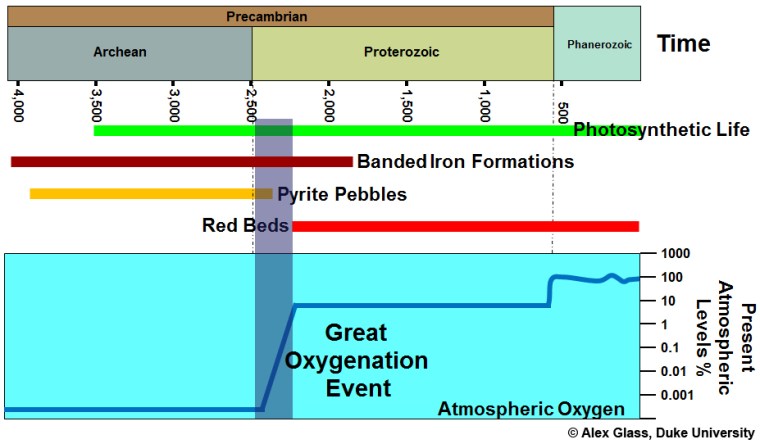
Summary of the evolution of atmospheric oxygen and related geological features. The percentage scale is logarithmic with the modern level being100%. Credit Alex Glass, Duke University

Simone Marchi of the Southwest Research Institute of Boulder, CO, USA and colleagues from the US, Austria and Germany suggest that planetary bombardment offers a plausible explanation (Marchi, S. et al 2021. Delayed and variable late Archaean atmospheric oxidation due to high collision rates on Earth. Nature Geoscience, v. 14 advance publication; DOI: 10.1038/s41561-021-00835-9). Over the last 20 years evidence of extraterrestrial impacts has emerged, in the form of thin spherule-bearing layers in Archaean sedimentary strata, probably formed by impacts of objects around 10 km across. So far 35 such layers have been identified from several locations in South Africa and Western Australia. They span the last billion years of the Archaean and the earliest Palaeoproterozoic, although they are not evenly spaced in time. The spherules represent droplets of mainly crustal but some meteoritic rocks that were vaporised by impacts and then condensed as liquid. Meteorites in particular contain reduced elements and compounds, including iron, whose oxidation by would remove free oxygen.

The evidence from spherule beds is supplemented by the team’s new calculations of the likely flux of impactors during the Archaean. These stem from re-evaluation of the lunar cratering record that is used to estimate the number and size of impacts on Earth up to 2.5 Ga ago. This flux amounts to the ‘leftovers’ of the catastrophic period around 4.1 Ga when the giant planets Jupiter and Saturn ran amok before they settled into their present orbits. Their perturbation of gravitational fields in the solar system injected a long-lived supply of potential impactors into the inner solar system, which is recorded by craters on the post-4.1 Ga lunar maria. The calculations suggest that the known spherule layers underestimate the true number of such collisions on Earth. Modelling by Marchi et al., based on the meteorite flux and the oxidation of vaporised materials produced by impacts, plausibly accounts for the delay in atmospheric oxygen build-up.

It is worth bearing in mind, however, that large impacts and their geochemical aftermath are, in a geological sense, instantaneous events widely spaced in time. They may have chemically ‘sucked’ oxygen out of the Archaean and early-Palaeoproterozoic atmosphere. Yet photosynthesising bacteria would have been generating oxygen continuously between such sudden events. The same goes for the supply of reduced ferrous iron and its circulation in the oceans of those times, capable of scavenging available oxygen through simple chemical reactions. In fact we can still observe that in action around ocean-floor hydrothermal vents where a host of reduced elements and compounds are oxidised by dissolved oxygen. The difference is that oxygen is now produced more efficiently on land and in the upper oceans and a less vigorous mantle is adding less iron-rich basalt magma to the crust: the balance has changed. Another issue is that the Great Oxygenation Event terminated the oxygen-starved conditions of the Archaean and Palaeoproterozoic in about 200 million years, despite the vast production of BIFs before and after it happened. The Wikipedia entry for the GOE provides a number of hypotheses for how that termination came about. Interestingly, one idea looks to a shortage of dissolved nickel that is vital for methane generating bacteria: a nickel ‘famine’. A geochemical setback for methanogens would have been a boost for oxygenic photosynthesisers and especially their waste product oxygen: methane quickly reacts with oxygen in the atmosphere to produce CO2 and water. Anomalously high nickel is a ‘signature element’ for meteorite bombardment, though it can be released by hydrothermal alteration of basalt. Had meteoritic nickel been fertilising methane-generating bacteria in the oceans prior to the GOE?

See also: A new Earth bombardment model. Science Daily, 21 October 2021.

Wide criticism of Sodom airburst hypothesis emerges

A follower of Earth-logs has brought to my attention a wide range of concerns regarding the veracity of the paper by Bunch et al in Nature Scientific Reports, which Earth-logs covered on 8 October 2021. The reactions are summarised by the Retraction Watch website (Criticism engulfs paper claiming an asteroid destroyed Biblical Sodom and Gomorrah Retraction Watch 1 October 2021). It seems that the Chief Editor of Scientific Reports is considering the issues that have been raised. Anyone who has downloaded and read the paper by Bunch et al will have noted the very large amount of data that it cites. It is alleged that there are flaws in the evidence, and that some of the figures may have been falsified. Some of the authors also contributed to the ‘airburst’ hypothesis for onset of the Younger Dryas, covered in Earth-pages several times, which uses similar data. More information can be accessed through Paul Braterman’s comments on the Sodom post 

A Bronze Age catastrophe: the destruction of Sodom and Gomorrah?

“…The sun was risen upon the earth when Lot entered into Zoar. Then the Lord rained upon Sodom and Gomorrah brimstone and fire from the Lord out of heaven. And overthrew those cities, and all the plain, and all the inhabitants of the cities, and that which grew upon the ground. But his wife looked back from behind him, and she became a pillar of salt …”

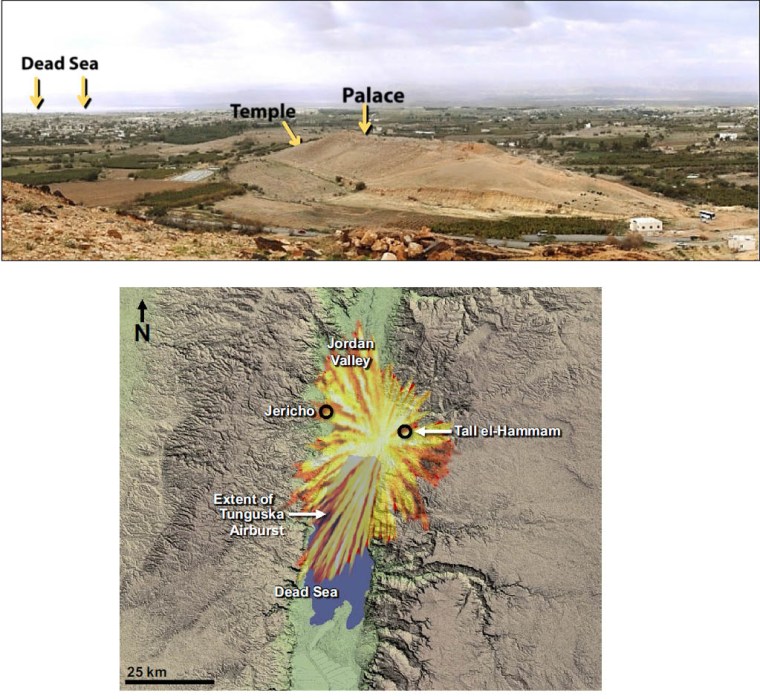
This is the second catastrophe recorded in the Old Testament of the King James Bible (Genesis 19:23-26), after the Noachian Flood (Genesis 7 and 8). The Flood is now regarded by many geoscientists to be a passed-down and mythologised account of the rapid filling of the Black Sea when the Bosporus was breached around 7600 years ago, as global see level rose in the early Neolithic. Eleven Chapters and a great many begotten people later comes the dramatic punishment of the ‘sinners’ of Sodom and Gomorrah. The two legendary settlements are now considered to have been in the Lower Jordan Valley near the Dead Sea. Being on the major strike-slip fault that defines the Jordan Rift, related to the long-active spreading of the Red Sea, the most obvious rationalisation of the myth is a major earthquake. The sedimentary sequence contains sulfide-rich clays and silts, as well as thick salt beds. Major seismicity would have liquidised saturated sediments full of supersaturated salt water and the release of large volumes of hydrogen sulfide gas. There are also remains of early settlements in the form of large mounds known locally as ‘talls’. The largest  and archaeologically  most productive of these is Tall el Hammam in Jordan, whose excavation has proceeded since 2005. It lies just to the north of the Dead Sea on the eastern flank of the Jordan valley, 15 km from Jericho on the occupied West Bank.

The Tall el Hammam mound is formed from layers of debris, mainly of mud bricks, dwellings being built again and again on the remains of earlier ones. It seems to have been continuously occupied for three millennia after 6650 ka ago (4700 BCE) at the core of a presumably grain-based city state with upwards of 10 thousand inhabitants. The site was destroyed around 3600 Ka (1650 BCE). The catastrophic earthquake hypothesis can be neither confirmed nor refuted, but the destruction toppled structures with walls up to 4 m thick.. Whatever the event, 15 years of excavation have revealed that it was one of extremely high energy. There is evidence for pulverisation of mud bricks and at some dwellings they were apparently blown off-site: a possibility in a large magnitude earthquake. Unusually, however, mud bricks and clay used in pottery and roofing had been partially melted during the final destruction. Various analyses suggest temperatures were as high as 2000 °C.

Top – oblique aerial view of the mound at Tal el Hammam looking to the south-west; Bottom – the Lower Jordan Valley and Bronze age talls superimposed by the extent of the area devastated by the 1908 Tunguska air-burst. (credit: Bunch et al. 2021, Figs 1b and 52)

A detailed summary of results from the Tall el Hammam site has just appeared (Bunch T.E., and 20 others 2021. A Tunguska sized airburst destroyed Tall el-Hammam a Middle Bronze Age city in the Jordan Valley near the Dead SeaNature Scientific Reports, v. 11, article 18632; DOI: 10.1038/s41598-021-97778-3). As the title indicates, it comes to an astonishing conclusion, which rests on a large range of archaeological and geochemical data that go well beyond the earlier discovery of the tall’s destruction at very high temperatures. Radiocarbon dates of 26 samples from the destruction layer reveal that it happened in 1661±21 BCE – the mid- to late Bronze Age, as also suggested by the styles of a variety of artefacts. The most revealing data have emerged from the debris that caps the archaeological section, particularly fine-grained materials in it. There are mineral grains indicating that sand-sized grains were melted, some to form spherules or droplets of glass. Even highly refractory minerals such as zircon and chromite were melted. Mixed in with the resulting glasses are tiny nuggets of metals, including platinum-group metals. As well as high temperatures the event involved intense mechanical shock that produced tell-tale lamellae in quartz grains, familiar from sites of known extraterrestrial impacts. One specimen shows a micro-crater produced by a grain of carbonaceous material, which is now made up of ~ 1 μm diamond-like carbon (diamondoids) crystals. There is abundant evidence of directionality in the form of linear distributions of ceramic shards and carbonised cereal grains that seem to have been consistently transported in a SW to NE direction: a kind of high-speed ‘blow-over’. In the debris are also fragments of pulverised bone, most too small to assign to species. But among them are two highly damaged human skulls and isolated and charred human limb- and pelvic bones. Forensic analysis suggests at least two individuals were decapitated, dismembered and incinerated during the catastrophe. Isolated scatters of recognisable human bones indicate at least 10 people who suffered a similar death. Finally the destruction layer is marked by an unusually high concentration of salt, some of which has been melted.

Such a range of evidence is difficult to reconcile by hypotheses citing warfare, accidental burning, tornadoes or earthquakes. However, the diversity of phenomena associated with the destruction of Tall el Hammam has been compared with data from nuclear explosion sites, suggesting the huge power of the event. The authors turned to evidence linked to the air-burst detonation of a cosmic body over Tunguska, Siberia in 1908 which had a power estimated at between 12- to 23 megatonnes of TNT equivalent. Such an event seems to fit the fate of Tall el Hammam. The Tunguska event devastated an area of 2200 km2. The tall and another at Jericho lies within such an area. Perhaps not coincidentally, the destruction of Jericho was also in the mid- to late Bronze Age sometime between 1686 and 1626 BCE: i.e. statistically coeval with that of Tall el Hammam.

Archaeologists working in the Lower Jordan Valley have examined 15 other talls and more than a hundred lesser inhabited sites and have concluded that all of them were abandoned at the end of the Middle Bronze Age. The whole area is devoid of evidence for agricultural settlements for the following three to six centuries, although there are traces of pastoralist activity. The high amount of salt in the Tall el Hammam debris, if spread over the whole area would have rendered its soils infertile until it was eventually flushed out by rainfall and runoff. If, indeed, the event matches the biblical account of Sodom and Gomorrah, then Lot and his remmaing companions would have found it difficult to survive without invading the lands of other people who had escaped, much as recorded later in Genesis. Of more concern is what will become of Ted Bunch and his 20 US colleagues? Will they be charged with blasphemy?

See also: Tunguska-Sized Impact Destroyed Jordan Valley City 3,670 Years Ago, SciNews, 29 September 2021; Did an impact affect hunter gatherers at the start of the Younger Dryas? Earth-logs, 3 July 2020.

Climate change reducing Earth’s albedo

According to a new study (Goode, P. R.et al. 2021. Earth’s albedo 1998–2017 as measured from earthshine. Geophysical Research Letters, v. 48, article e2021GL094888; DOI: 10.1029/2021GL094888) the ability of the Earth to reflect solar radiation back into space has been decreasing significantly over the last two decades. The conclusion has arisen from measurements of the brightness of the lunar surface. A new Moon is barely visible, apart from a thin sliver illuminated by the Sun. Its overall faint brightness is due to sunlight reflected from the Earth’s surface that faces the Moon: so-called ‘earthshine’. New Moons occurs when it is above the lit side of the Earth, so they appear during daylight hours. Earthshine depends on the ability of the Earth’s surface and cloud cover to reflect solar radiation, or its albedo. Albedo was high during the last ice age because of continental ice sheets and it can also occur when there is an unusually large percentage of cloud cover or a lot of dust and aerosols in the atmosphere, perhaps after a large volcanic eruption. High albedo leads to global cooling. Decreased albedo allows the atmosphere to heat up, and conspires with the greenhouse effect to produce global warming.

Philip Goode and his colleagues measured earthshine on the Moon between 1998 and 2017 to precisely determine daily, monthly, seasonal, yearly and decadal changes in terrestrial albedo. The Earth reflects roughly 30% of the solar energy that falls on it, although it varies with Earth’s rotation, depending on the proportion of land to ocean that is sunlit. Over the two decades earthshine decreased gradually by ~0.5 W m-2, indicating a 0.5% decrease in Earth’s albedo and a corresponding increase in the amount of solar energy received at the land and ocean surfaces. To put this in perspective the estimated warming from anthropogenic greenhouse emissions over the same period increased by just a little more (0.6 W m-2). Albedo decrease is reinforcing the greenhouse effect.

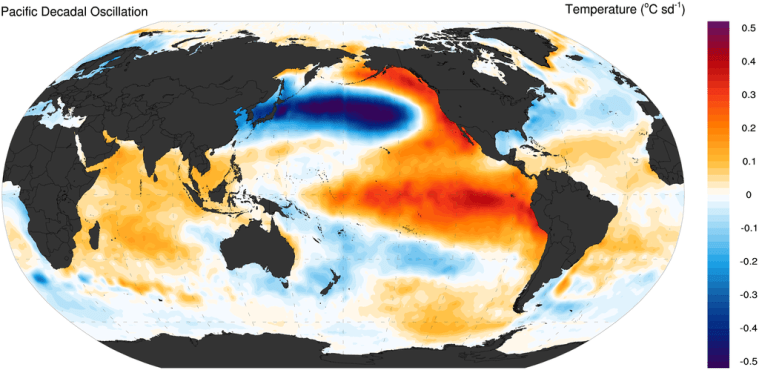
Sea-surface temperature anomalies over the Pacific Ocean during a ‘positive’ phase of the Pacific Decadal Oscillation – reversal to a ‘negative’ phase cools the eastern Pacific and warms the west (Credit: Wikipedia)

Although it might seem that increased seasonal melting of polar sea ice would have the main effect on albedo, this is not borne out by the earthshine data. What is strongly implicated is a decrease over the Eastern Pacific Ocean of highly reflective low-altitude clouds. That might seem counterintuitive, since warming of the sea surface increases evaporation, but the reduced low-cloud cover has been measured from satellites. Many scientists and most climate-change deniers have thought that an increase in cloud cover at low latitudes and thus albedo would moderate surface warming. The opposite seems to be happening. The key may lie in one of the Earth’s largest climate phenomena, the Pacific Decadal Oscillation (PDO). This has a major effect on global climate through long-distance connections (teleconnections) to other climatic processes. The satellite data hint at the changes in albedo of the Western Hemisphere having been related to a long-term reversal in the PDO. The Earth’s climate system increasingly reveals its enormous complexity.

See also: Earth is dimming due to climate change, Science Daily, 30 September 2021.