Opportunities for anatomically modern humans to have left Africa

Key ages of early H. sapiens, Neanderthals and Denisovans (credit: Delson, 2019; Fig. 1)

For almost 2 million years humans have migrated long distances, the earliest example of a move out of Africa being the Georgian Homo erectus specimens (see: First out of Africa? November 2003). As regards H. sapiens – anatomically modern humans (AMH) – the earliest fossils, found at Jebel Irhoud in Morocco, are about 300 ka old. By 260 ka they were present at several sites that span the African continent. The first sign of AMH having left Africa are fossils found at Mislaya in Israel and Apidima in Greece – dated to 177 and 210 to 170 ka respectively – and 125 ka-old tools tentatively attributed to AMH in the Arabian Peninsula (see: Arabia : staging post for human migrations?, September 2014). There is also genetically dated evidence of geneflow from Homo sapiens into Neanderthal DNA between 130 to 250 ka ago. The evidence for an early ‘Out of Africa’ migration by AMH is concrete but very sparse, a fuller story of our permanently colonising all habitable parts of the world only emerging for times after about 65 ka.

It is easy to appreciate that the main hindrance for palaeo-anthropological research into human migration centres on the issue of where to look for evidence, a great many discoveries owing more to luck than to a strategic approach. And, of course, once interesting sites are found researchers congregate there. There is a limited number of active palaeoanthropologists of whom only a proportion engage regularly in field exploration. And there is also an element of the old gold prospectors adage: ‘If you want to find elephants, go to elephant country’! But there are other issues connected with discoveries. When was it possible for AMH to make transcontinental journeys and what routes would have been feasible from time to time? Robert Beyer of the Cambridge University with scientists from New Zealand, Estonia and the UK have devised a rational approach to the questions of optimum times and routes for major migration (Beyer, R.M., et al. 2021. Climatic windows for human migration out of Africa in the past 300,000 yearsNature Communications, v.  12, article 4889; DOI: 10.1038/s41467-021-24779-1). Just two routes out of Africa have been considered feasible: by crossing the Strait of Bab el Mandab from Djibouti and southern Eritrea to the Yemen, and following the Nile northwards to access Eurasia via the Levant. The first depends to some extent on how wide the Strait was; depending on sea level fluctuations, it has varied from 4 to 20 km during the last 300 ka. Exit by way of both routes would also have depended on vegetation, game and drinking water supplies that varying amounts of rainfall would have supported.

Assessing the feasibility of crossing the southern Red Sea at different times is fairly easy. Sea level fluctuates according to the amount of water locked in the ice caps of Antarctica and Greenland and on the land glaciated during ice ages in northern North America and Scandinavia. Oxygen isotopes in Pleistocene sea-floor sediments and today’s ice caps reveal that variation. Being one of the world’s most important seaways the bathymetry of the Red Sea is known in considerable detail. At present the minimum sea distance needed to cross the Strait of Bab el Mandab is about 21 km. At the lowest sea levels during the Pleistocene the sea journey was reduced to slightly less than 5 km, which would not have required sophisticated boats or seafaring skills. There is evidence that AMH and earlier humans occupied the western shore of the Red Sea to use its rich marine resources, but none for boats or for habitation of the Yemeni coastline. However, calculations by Beyer et al. of sea level fluctuations during the last 300 ka show that for more than half that time the sea crossing was less than 7 km thanks to a shallow continental shelf and a very narrow stretch of deep water. Clearly the varying width of the Strait is not a useful guide to windows of opportunity for migration via that route. Except for warm interglacials and a few interstadials, people could have crossed at any time provided that the ecosystems on either side could sustain them.

Annual precipitation during each millennium of the Late Pleistocene for the two most likely out-of-Africa routes. The double green lines show the lower level of tolerance for hunter gatherers. The percentage of decades during which ANH could sustain themselves is colour-coded in blues. (Credit: Beyer et al. Fig 2)

Turning to climatic fluctuations, especially that of rainfall, Beyer et al. first estimated the lowest rainfall that hunter-gatherers can survive from the distribution of surviving groups according to annual precipitation and the biomass of grazing prey animals in their habitats. The lower limit is about 90 mm per year. Using the climate record for the Late-Pleistocene from proxies, such as oxygen isotopes, in global climate modelling produces a series of high-resolution ‘time-lapse snapshots’ of conditions in the geographic areas of interest – the Nile-Levant route and that from the Horn of Africa to Yemen. The results are expressed as the percentage of decades in each thousand-year interval that hunter-gatherers could sustain themselves under prevailing climatic conditions in the two regions. What seems clear from the figure (above) is that the southern, Bab el Mandab route had considerable potential for AMH migrants. The northern one looks as if it was more risky, as might be expected from today’s dominant aridity away from the Mediterranean and Gulf coasts. The northern route seems to have been just about feasible for these periods: 245-230; 220-210; 206-197; 132-94; 85-82; ~75 and ~72 ka. The climatic windows for possible migration via the southern route are: ~290; 275-240 (with optimums at ~273, ~269, ~246 and ~243); 230-210; 203-200; 182-145; 135-118; 112; 107; 70-30; 18-13 ka. The well documented beginning of major AMH migration into Eurasia was around 75 to 60 ka, which the southern route would most favour on climatic grounds. Yet before that there are many possibilities involving either route. Any AMH finds outside Africa before 250, and between 190-133 ka seem almost certain to have been via the southern route, based on arid conditions in the north. But, of course, there would have been other factors at play encouraging or deterring migration via either route. So perhaps not every climatic opportunity was exploited.

Beyer and colleagues have provided a basis for plenty of discussion and shifts in focus for future palaeo-anthropological work. One thing to bear in mind is that different humans may also have taken up the opportunities; for example, some Neanderthals are now suspected to have migrated back to Africa in the last 300 ka.

See also: Groucutt, H.S  and 22 others 2021. Multiple hominin dispersals into Southwest Asia over the past 400,000 years. Nature, ; DOI: 10.1038/s41586-021-03863-y

When Greenland was a warm place

On 14-15 August 2021 it rained for the first time since records began at the highest point on the Greenland ice cap. Summit Camp at 3.216 m is run by the US National Science Foundation, which set it up in 1989, and is famous for climate data gleaned from two deep ice cores there. This odd event came at a time when surface melting of the ice cap covered 870 thousand km2: over half of its total 1.7 million km2 extent: a sure sign of global warming. The average maximum temperature in August at Summit is -14°C, but since the mid 20th century the Arctic has been warming at about twice the global rate. Under naturally fluctuating climatic conditions during the Pleistocene, associated with glacial-interglacial cycles, Greenland may have been ice-free for extended periods, perhaps as long as a quarter of a million years around 1.1 Ma ago. If 75% of the up to 3 km thick ice on Greenland melted that would add 5 to 6 m to global sea level, perhaps as early as 2100 if current rates of climate warming persist.

The edge of the ice cap in NE Greenland (credit: Wikipedia)

The worst scenario is runaway warming on the scale of that which took place 56 Ma ago during the Palaeocene-Eocene Thermal Maximum (PETM) when global mean temperature rose by between 5 to 8°C at a rate comparable with what the planet is experiencing now as a result of growth in the world economy. In fact, the CO2 released during the PETM emerged at a rate that was only about tenth of modern anthropogenic emissions  Sediments that span the Palaeocene-Eocene boundary occur in NE Greenland, a study of which was recently published by scientists from Denmark, Greenland, the UK, Australia and Poland (Hovikoski, J. and 13 others 2021. Paleocene-Eocene volcanic segmentation of the Norwegian-Greenland seaway reorganized high-latitude ocean circulation. Communications Earth & Environment, v. 2, article 172; DOI: 10.1038/s43247-021-00249-w). The greenhouse world of NE Greenland that lay between 70 and 80°N then, as it still does, was an area alternating between shallow marine and terrestrial conditions, the latter characterised by coastal plain and floodplain sediments deposited in estuaries, deltas and lakes. They include coals derived from lush, wooded swamps, inhabited by hippo-like ungulates, primates and reptiles.

At that time the opening of the northern part of the North Atlantic had barely begun, with little chance for an equivalent of the Gulf Stream to have had a warming influence on the Arctic. Shortly after the PETM volcanism began in earnest, to form the flood basalts of the North Atlantic Igneous Province. Each lava flow is capped by red soil or bole: further evidence for a warm, humid climate and rapid chemical weathering. As well as lava build-up, tectonic forces resulted in uplift, effectively opening migration routes for animals and land plants to colonise the benign – for such high latitudes – conditions and perhaps escape the far hotter conditions further south.

The situation now is much different, with the potential for even more rapid melting of the Greenland ice cap to flood freshwater into the North Atlantic, as is currently beginning. Diluting surface seawater reduces its density and thus its tendency to sink, which is the main driving force that pulls warmer water towards high-latitudes in the form of the Gulf Stream. Slowing and even shutting down its influence may have an effect that contradicts the general tendency for global warming – a cooling trend at mid- to high latitudes with chaotic effects on atmospheric pressure systems, the jet stream and weather in general.

See also: Barham, M. et al. 2021. When Greenland was green: rapid global warming 55 million years ago shows us what the future may hold. The Conversation, 23 August 2021.

Geothermal heat from coalfields: a ‘green’ revolution?

Sooner rather than later all energy users will be forced to change their source of energy to ones that do not involve fossil fuels. On average, 84% of household energy consumption is for space heating and hot water. Reducing domestic greenhouse gas emissions must replace the current dominance of coal, natural gas and oil in keeping ourselves warm and clean. One widely suggested solution is the use of heat pumps to ‘concentrate’ the solar energy that is temporarily stored in air or in the soil and rock just beneath our homes and gardens: air- and ground-source heating systems. Heat pumps rely on overcoming the Second Law of Thermodynamics, as do refrigerators and air conditioners. The Law implies that hot things always cool down; that is, energy cannot move ‘of its own accord’ from a cooler source to a warmer destination. But reversing the natural flow of heat energy is possible. To achieve this involves work in some form. There are several kinds of heat pumps powered by electricity, the simplest using a vapour compression cycle, as in refrigeration, which ‘pumps’ heat out of a fridge interior or a room. So, warm air is emitted to the outside world. Reverse the flow and the pump becomes a device that captures heat from a cold source – either a gas or a fluid – and delivers it for a domestic or industrial use.

In the case of a ground-source heat pump, the energy delivered also includes geothermal heat flowing from deep in the Earth: ultimately from radioactive decay of unstable isotopes bound up in rocks and the minerals they contain. At the surface, this supply is far less than solar heating. Yet, because of the Second Law of Thermodynamics it flows from a much hotter source: the Earth’s mantle. The deeper down, the hotter it gets. Beneath most of the continental surface temperature increases at between 15 to 35°C per kilometre. Without surface air being circulated to the deepest parts of mines it would be impossible to work in them. I remember as a school student visiting the deepest level of Maltby Main coal mine in South Yorkshire. Because my school was co-educational, our guide shouted ahead to the miners that women were coming – these miners normally worked in just helmet, boots and a jock strap! Dozens of them rushed frantically to find their trousers. Maltby Main’s shafts reached almost a kilometre below the surface and without ventilation the air temperature would have been more than 50°C. As it was, it was well above 30 degrees

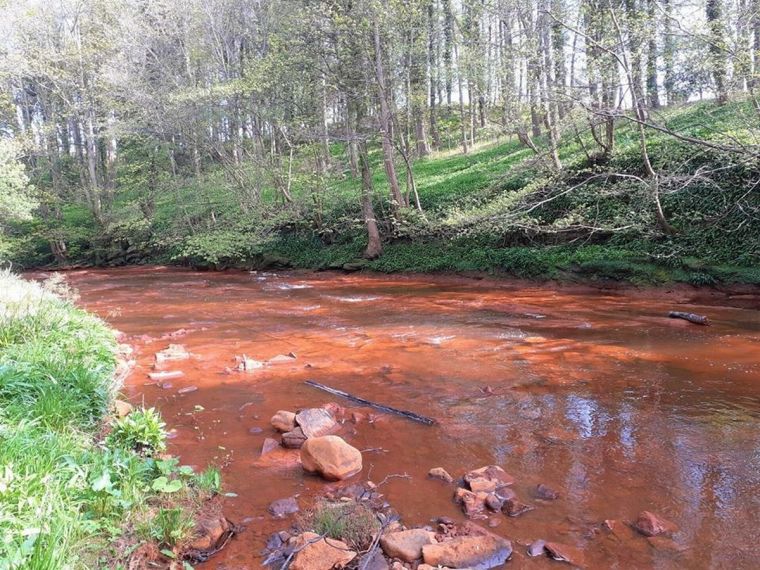
As well as methane (‘fire damp’), CO2 (‘choke damp’) and roof collapse, one of the main hazards of coal mining is flooding by groundwater. When operational, before the Conservative governments of the 1980s and early 90s set about destroying deep-coal mining in Britain, all mines had massive pumps to remove water from their deepest levels or ‘sumps’. It is hazardous stuff, being highly acidic and rich in dissolved metals – including arsenic in some areas – as well as being warm: a low-temperature hydrothermal fluid. In many cases such water seeps to the surface from the now flooded mine workings, and precipitates brightly coloured iron hydroxides. Most of the abandoned British coalfields are plagued by such minewater escaping to the surface. Untreated it contaminates surface water, soils and sediments, posing threats to vegetation, wild life and people. Yet, it has considerable potential as a heat source, especially for community heating systems based on large-scale heat pumps (Farr, G. et al. 2020. The temperature of Britain’s coalfields. Quarterly Journal of Engineering Geology and Hydrogeology, v. 54, article qjegh2020-109; DOI: 10.1144/qjegh2020-109).

Pollution of South Esk river near Edinburgh by water from old coal-mine workings (Credit: EdinburghLive, 11 June 2020)

For decades, geothermal energy has been touted as a near-ideal renewable, carbon-free resource, using natural hot-spring systems in volcanically active areas, such as Iceland and New Zealand, from areas of unusually high heat flow over highly radioactive granite intrusions or from very deep sedimentary aquifers as exploited in parts of the Paris Basin. But in Britain various optimistic projects have arisen and then faded away. All relied on pumping surface water down boreholes to depths that achieve high temperatures, returning it to the surface at around 60°C to the surface and then piping it to users: very expensive. About a quarter of the population live above the former coalfields of Britain. Around 2.2 million gigawatt hours of geothermal heat are currently stored in flooded mine workings, with the possibility of further expansion. The UK Coal Authority has about 40 minewater pumping stations aimed at reducing pollution, which remove 3,000 l s-1 at an average temperature of around 9-18°C. Expressed in terms of energy content this amounts to 63 MW if recovered. But this is just scratching the surface of the potential for large-scale district heating based on heat pumps, such as that planned at Seaham, County Durham to heat 1500 new homes. Community heating and wastewater treatment can be combined for all the former coal mining areas in Central Scotland, the North of England and Midlands and South Wales where population densities are still very high

See also: Lane, A.2021. How flooded coalmines could heat homes. BBC Future 7 July 2020. Taylor, M. 2021. Abandoned pits of former mining town fuel green revolution. The Guardian, 10 August 2021.

Apocalypse Soon: Will current global warming trigger a mass extinction?

Since the start of 2020 I doubt there has been much field research. But such a vast amount of data has been amassed over the years that there must be opportunities to keep the academic pot boiling. One way is to look for new correlations between different kinds of data. For instance matching the decades-old time series of extinctions with those of other parameters that have changed over geological time. At a time of growing concern about anthropogenic climate change a group based at the State Key Laboratory of Biogeology and Environmental Geology, at China University of Geosciences, Wuhan have checked the extinction rates of marine fossils over the last 450 Ma against variations in sea-surface temperature (Song, H. et al 2021. Thresholds of temperature change for mass extinctions. Nature Communications, v. 12, Article number 4694; DOI: 0.1038/s41467-021-25019-2).

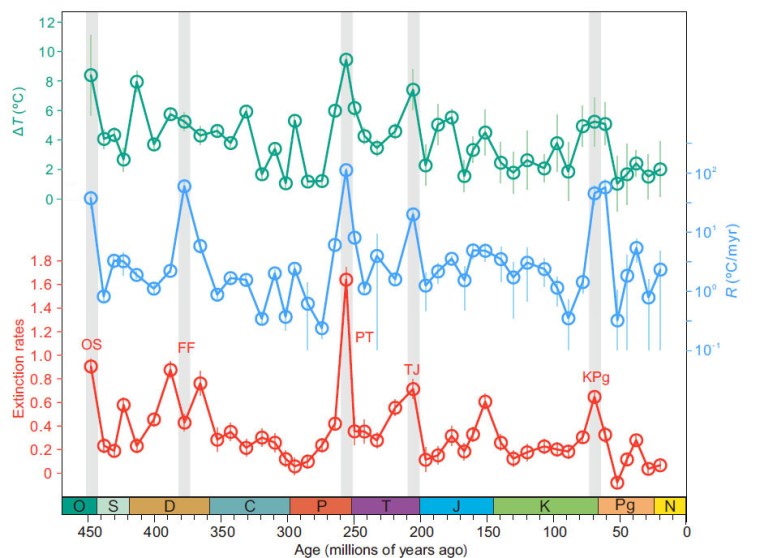
Extinction data are usually presented in time ‘bins’ based on the number of disappearances of fossil genera in one or a number of geological Stages – the finest divisions of the stratigraphic column. The growing data set for sea-surface temperatures derived using oxygen isotopes from marine fossil shells is more continuous, being derived from many different layers of suitable sedimentary rock within a Stage. Clearly, the two kinds of data have to be expressed in a similar way to check for correlations. Haijun Song and co-workers converted both the extinction and temperature time series to 45 time ‘bins’, each around 10 Ma long. They express the binned climatic data in two ways: as the largest temperature change (°C) and the highest rate of temperature change (°C Ma-1) within each bin. That is, they expressed to some extent the greater continuity of seawater temperature data as well as matching them to those for extinctions.

Changes since the end of the Ordovician: red = extinction rate in time bins; green = the greatest magnitude of change in temperature in each bin; blue- the greatest rate of temperature change in each bin. Grey bars show mass extinctions (Credit: Song et al., Fig 1)

There are good correlations between the climatic and extinction data, particularly for mass extinctions. Bearing in mind that mass extinctions take place far more rapidly than can be expressed with 10 Ma time bins, the authors were concerned that bias could creep into the binned extinction data. They were able to discount this by examining both data sets in finer detail at the times of the ‘Big 5’ extinctions. Earlier research had identified warming episodes around the times of each mass extinction, often implicating greenhouse-gas emissions from Large Igneous Provinces. Yet there are other factors that may have influenced the 7 ‘lesser’ mass extinctions in the fossil record. The authors are sufficiently confident in the correlations they have revealed to suggest thresholds that seem to have launched major mass extinctions: greater than 5.2 °C and 10 °C Ma-1 for magnitudes and rates of sea-surface temperature change, respectively.

In the context of the modern climate, the data analysis predicts that a rise of 5.2 °C above the preindustrial mean global temperature spells extinctions of ‘Big Five’ magnitude. The rate of temperature increase since 1880 – 0.08 ° per decade – is hugely faster than that expressed by the data that span the last 450 Ma. This is more alarming than the stark Sixth Report of the Intergovernmental Panel on Climate Change IPCC released on 9 August 2021.