Climate changes and the mass extinction at Permian-Triassic boundary

The greatest mass extinction in Earth’s history at around 252 Ma ago snuffed out 81% of marine animal species, 70% of vertebrates and many invertebrates that lived on land. It is not known how many land plants were removed, but the complete absence of coals from the first 10 Ma of the Early Triassic suggests that luxuriant forests that characterised low-lying humid area in the Permian disappeared. A clear sign of the sudden dearth of plant life is that Early Triassic river sediments were no longer deposited by meandering rivers but by braided channels. Meanders of large river channels typify land surfaces with abundant vegetation whose root systems bind alluvium. Where vegetation cover is sparse, there is little to constrain river flow and alluvial erosion, and wide braided river courses develop (see: End-Permian devastation of land plants; September 2000. You can follow 21st century developments regarding the P-Tr extinction using the Palaeobiology index).

The most likely culprit was the Siberian Trap flood basalts effusion whose lavas emitted huge amounts of CO2 and even more through underground burning of older coal deposits (see: Coal and the end-Permian mass extinction; March 2011) which triggered severe global warming. That, however, is a broad-brush approach to what was undoubtedly a very complex event. Of about 20 volcanism-driven global warming events during the Phanerozoic only a few coincide with mass extinctions. Of those none comes close the devastation of ‘The Great Dying’, which begs the question, ‘Were there other factors at play 252 Ma ago?’ That there must have been is highlighted by the terrestrial extinctions having begun significantly earlier than did those in marine ecosystems, and they preceded direct evidence for climatic warming. Also temperature records – obtained from shifts in oxygen isotopes held in fossils – for that episode are widely spaced in time and tell palaeoclimatologists next to nothing about the details of the variation of air- and sea-surface temperature (SST) variations.

Modelled sea-surface temperatures in the tropics in the early stages of Siberian Trap eruptions with atmospheric CO¬2 at 857 ppm – twice today’s level. (Credit: Sun et al., Fig. 1A)

Earth at the end of the Permian was very different from its current wide dispersal of continents and multiple oceans and seas. Then it was dominated by Pangaea, a single supercontinent that stretched almost from pole to pole, and a surrounding vast ocean known as Panthalassa. Geoscientists from China, Germany, Britain and Austria used this simple palaeogeography and the available Early Triassic greenhouse-gas and  palaeo-temperature data as input to a climate prediction model (HadCM3BL) (Yadong Sun and 7 others 2024. Mega El Niño instigated the end-Permian mass extinction. Science 385, p. 1189–1195; DOI: 10.1126/science.ado2030  – contact yadong.sun@cug.edu.cn for PDF).. The computer model was developed by the Hadley Centre of the UK Met Office to assess possible global outcomes of modern anthropogenic global warming. It assesses heat transport by atmospheric flow and ocean currents and their interactions. The researchers ran it for various levels of atmospheric CO2 concentrations over the estimate 100 ka duration of the P-Tr mass extinction.

The pole-to-pole continental configuration of Pangaea lends itself to equatorial El Niño and El Niña type climatic events that occur today along the Pacific coast of the Americas, known as the El Niño-Southern Oscillation. In the first, warm surface water builds-up in the eastern tropical Pacific Ocean. It then then drifts westwards to allow cold surface water to flow northwards along the Pacific shore of South America to result in El Niña. Today, this climatic ‘teleconnection’ not only affects the Americas but also winds, temperature and precipitation across the whole planet. The simpler topography at the end of the Permian seems likely to have made such global cycles even more dominant.

Sun et al’s simulations used stepwise increases in the atmospheric concentration of CO2 from an estimated  412 parts per million (ppm) before the eruption of the Siberian Traps (similar to those today) to a maximum of 4000 ppm during the late-stage magmatism that set buried coals ablaze. As levels reached 857 ppm SSTs peaked at 2 °C above the mean level during El Niño events and the cycles doubled in length. Further increase in emissions led to greater anomalies that lasted longer, rising to 4°C above the mean at 4000 ppm. The El Niña cooler parts of the cycle steadily became equally anomalous and long lasting. This amplification of the 252 Ma equivalent of the El Niño-Southern Oscillation would have added to the environmental stress of an ever increasing global mean surface temperature.  The severity is clear from an animation of mean surface temperature change during a Triassic ENSO event.
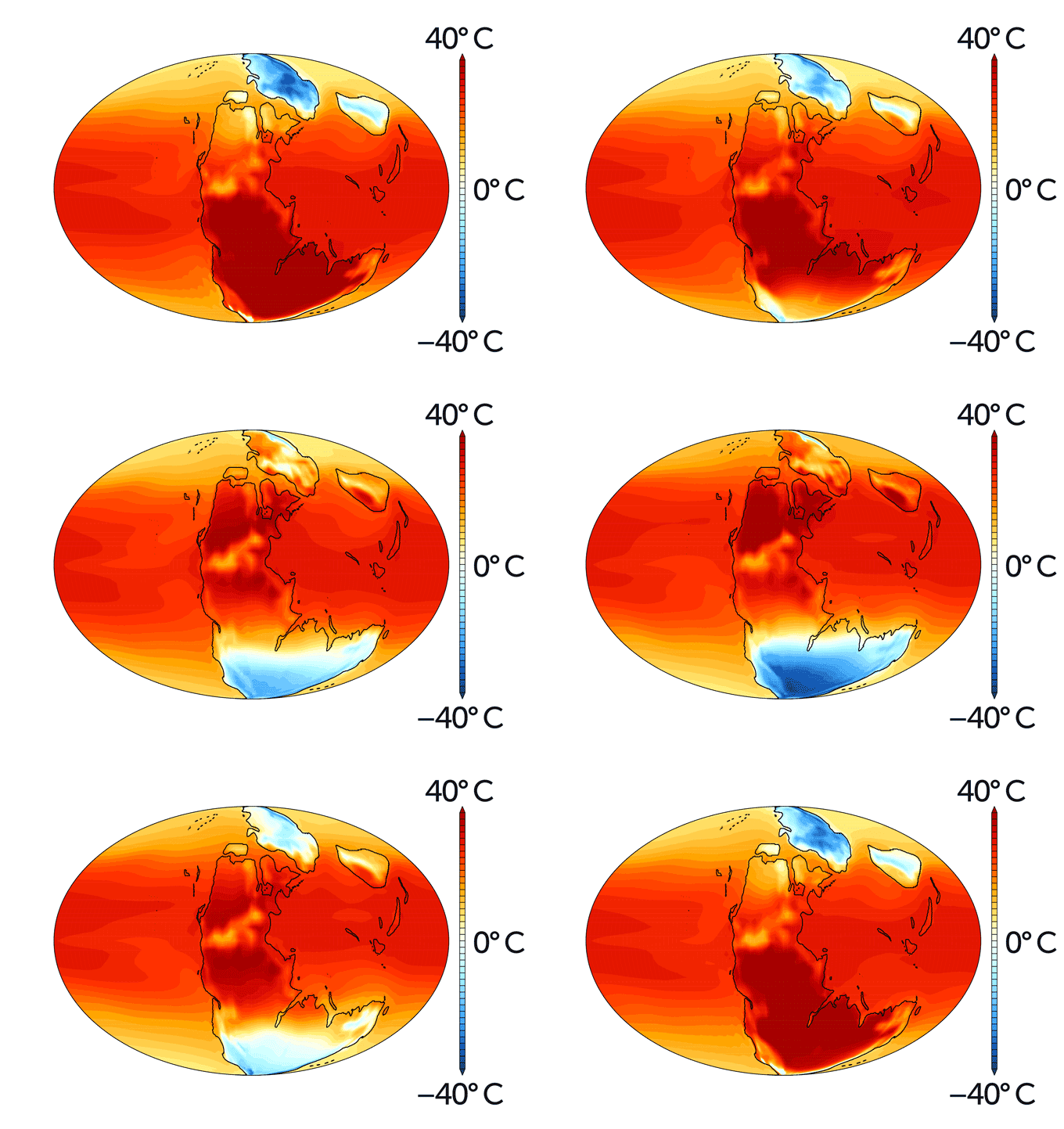
Animation of monthly average surface temperatures across the Earth during an ENSO event at the height of the P-Tr mass extinction. (Credit: Alex Farnsworth, University of Bristol, UK)

The results from the modelling suggest increasing weather chaos across the Triassic Earth, with the interior of Pangaea locked in permanent drought. Its high latitude parts would undergo extreme heating and then cooling from 40°C to -40°C during the El Niño- El Niña cycles. The authors suggest that conditions on the continents became inimical for terrestrial life, which would be unable to survive even if they migrated long distances. That can explain why terrestrial extinctions at the P-Tr boundary preceded those in the global ocean. The marine biota probably succumbed to anoxia (See: Chemical conditions for the end-Permian mass extinction; November 2008)

There is a timely warning here. The El Niño-Southern Oscillation is becoming stronger, although each El Niño is a mere 2 years long at most, compared with up to 8 years at the height of the P-Tr extinction event. But it lay behind the record 2023-2024 summer temperatures in both northern and southern hemispheres, the North American heatwave of June 2024 being 15°C higher than normal. Many areas are now experiencing unprecedentedly severe annual wildfires. There also finds a parallel with conditions on the fringes of Early Triassic Pangaea. During the early part of the warming charcoal is common in the relics of the coastal swamps of tropical Pangaea, suggesting extensive and repeated wildfires. Then charcoal suddenly vanishes from the sedimentary record: all that could burn had burnt to leave the supercontinent deforested.

See also: Voosen, P. 2024. Strong El Niños primed Earth for mass extinction. Science 385, p. 1151; DOI: 10.1126/science.z04mx5b; Buehler, J. 2024. Mega El Niños kicked off the world’s worst mass extinction. ScienceNews, 12 September 2024.

Fossil fuel, mercury and the end-Palaeozoic catastrophe

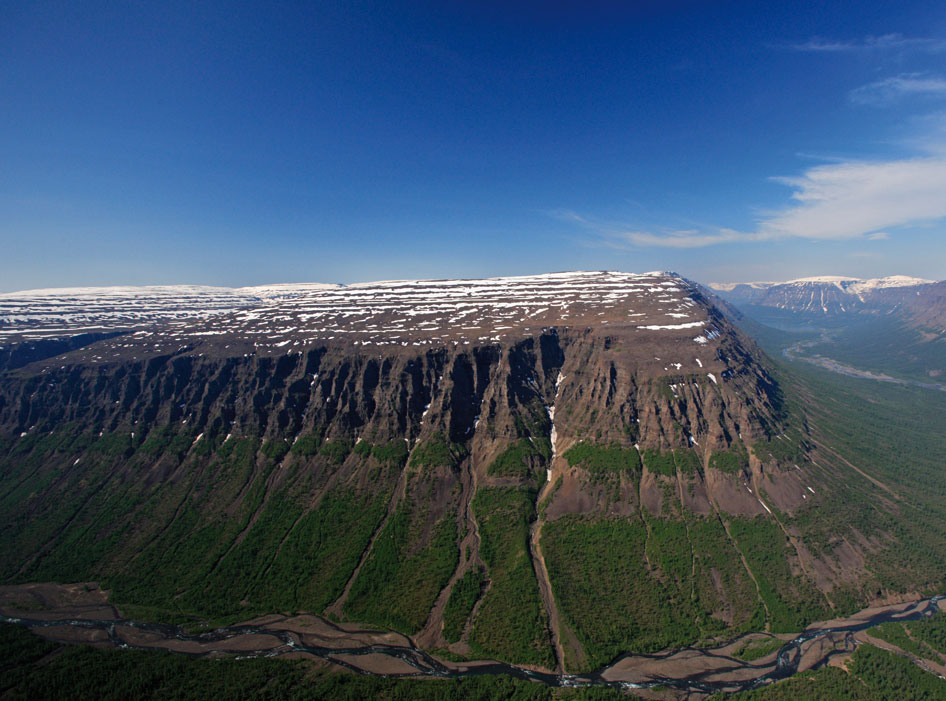
Siberian flood-basalt flows in the Putorana Plateau, Taymyr Peninsula, Russia. (Credit: Paul Wignall)

The end of the Permian Period (~252 Ma ago) saw the loss of 90% of marine fossil species and 70% of those known from terrestrial sediments: the greatest known extinction in Earth’s history. In their naming of newly discovered life forms, palaeontologists can become quite lyrical. Extinctions, however, really stretch their imagination. They call the Permo-Triassic boundary event ‘The Great Dying’. Why not ‘Permageddon’? Sadly, that was snaffled in the 1980s by an astonishingly short-haired heavy-metal tribute band. Enough bathos … The close of the Palaeozoic left a great many ecological niches to be filled by adaptive radiation during the Triassic and later Mesozoic times. Coinciding with the largest known flood-basalt outpouring – the three million cubic kilometres of Siberian Traps – the P-Tr event seemed to be ‘done and dusted’ after that possible connection was discovered in the mid 1990s. Notwithstanding, the quest for a gigantic, causative impact crater continues (see: Palaeobiology Earth-logs, May, September and October 2004), albeit among a dwindling circle of enthusiasts. The Siberian Traps are suitably vast to snuff the fossil record, for their eruption must have belched all manner of climate-changing gases and dusts into the atmosphere; CO2 to encourage global warming; SO2 and dusts as cooling agents. There is also evidence of a role for geochemical toxicity (see: Nickel, life and the end-Permian extinction, June 2014). The extinctions accompanied not only climate change but also a catastrophic fall in atmospheric oxygen content (see: Homing in on the great end-Permian extinction, April 2003; When rain kick-started evolution, December 2019). Recovery of the biosphere during the early Triassic was exceedingly slow.

Research focussed on the P-Tr boundary eventually uncovered an element of pure chance. Shales in Canada that span the boundary show major, negative δ13C excursions in the carbon-isotope record that coincide with fly ash in the analysed layers. This material is similar in all respects to that emitted from coal-fired power stations (see: Coal and the end-Permian mass extinction, March 2011). The part of Siberia onto which the flood basalts were erupted is rich in Permian coal measures and oil shales that lay close to the surface 252 Ma ago. The coal ash and massive emissions of CO2 may have resulted from their burning by the flood basalt event. Now evidence has emerged that this did indeed happen (Elkins-Tanton, L.T. et al. 2020. Field evidence for coal combustion links the 252 Ma Siberian Traps with global carbon disruption. Geology, v. 48, early publication; DOI: 10.1130/G47365.1).

The US, Canadian and Russian team found large quantities of burnt coal and woody material, and bituminous blobs in 600 m thick volcanic ashes at the base of the Siberian traps themselves. They concluded that the magma chamber from which the flood basalts emerged had incorporated sizeable volumes of the coal measures, leading to their combustion and distillation. This would have released CO2 enriched in light 12C due to isotopic fractionation by biological means, i.e. its δ13C would have been sufficiently negative to affect the carbon locked up in the Canadian P-Tr boundary-layer shales that show the sharp isotopic anomalies. The magnitude of the anomalies suggest that between six to ten thousand billion tons of carbon released as CO2 or methane by interaction of the Siberian Traps with sediments through which their magma passed could have created the global δ13C anomalies. That is about one tenth of the organic carbon originally locked in the Permian coal measures beneath the flood basalts

Another paper whose publication coincided with that by Elkins-Tanton et al. suggests that environmental mercury appears to have followed the same geochemical course as did carbon at the end of the Palaeozoic Era (Dal Corso, J. and 9 others 2020. Permo–Triassic boundary carbon and mercury cycling linked to terrestrial ecosystem collapse. Nature Communications, v. 11, paper 2962; DOI: 10.1038/s41467-020-16725-4). This group, based at Leeds and Oxford Universities, UK and the University of Geosciences in Wuhan, China, base their findings on biogeochemical modelling of the global carbon and mercury cycles at the end of the Permian. Their view is that the coincidence in marine sediments at the P-Tr boundary of a short-lived spike in mercury and an anomaly in its isotopic composition with the depletion in 13C, described earlier, shows an intimate link between mercury and the biological carbon cycle in the oceans at the time. They suggest that this synergy marks ecosystem collapse and derives ‘from a massive oxidation of terrestrial biomass’; i.e. burning of organic material on the land surface. Their modelling hints at huge wildfires in equatorial peatlands but also a role for the Siberian flood-basalt volcanism and the incorporation of coal measures into the Siberian Trap magma chamber.

Verneshots (huge volcanic gas blasts) ten years on

One of the most daring hypotheses of modern geosciences: is that of the ‘Verneshot’ reported by Earth Pages in 2004.  Jason Phipps Morgan and colleagues explored the possible consequences of a build-up of volatiles in plume-related magmas at the base of thick continental lithosphere beneath cratons, prior to the eruption of continental flood basalts. They suggested that pressure would eventually result in an explosive release at a lithospheric weak point, followed by collapse above the plume head that would propagate upwards, at hypersonic speeds. Modelling the forces involved, the authors of the novel idea considered that they would be sufficient to fling huge rock masses into orbit.  Verneshots might neatly explain the circumstances around mass extinctions, such as their coincidence with continental flood basalt events; large impact structures, most likely at the antipode of the event; global debris layers containing shocked rock, melt spherules; unusual element suites and compounds (including fullerenes); and enough toxic gas to cause biological devastation.

Ten years on, Verneshots are back, again in the prestigious journal Earth and Planetary Science Letters, and this time among the co-authors are Morgan père et fils (W. Jason a founder of plate tectonics, and Jason P. who launched the idea). This time the yet-to-be –accepted hypothesis comes with evidence of an extremely unusual and fortuitous kind (Vannucchi, P. et al. 2015. Direct evidence of ancient shock metamorphism at the site of the 1908 Tunguska event. Earth and Planetary Science Letters, v. 409, p. 168-174). The origin of the paper lies in an attempt to verify reports of shocked quartz in samples collected close to the centre of the 2000 km2 devastation that resulted from what is now accepted to have been a comet or asteroid air-burst explosion in June 1908 in the Tunguska region of Siberia. Apart from a disputed 300 m crater in the area, the Tunguska Event left no long-lived sign: it ‘merely’ knocked over millions of trees. However, its epicenter lay in a 10 km depression ringed by hills, that has been suggested to be a volcanic centre associated with the end-Permian Siberian Traps.

Trees knocked down and burned over hundreds of square km by the 1908Tunguska Event (credit: Leonid Alekseyevich Kulik deceased)
Trees knocked down and burned over hundreds of square km by the 1908 Tunguska Event (credit: Leonid Alekseyevich Kulik deceased)

The reported shocked quartz locality turned out to associated with an isolated occurrence of quartz-rich sand and rounded clasts of quartzite that contains sedimentary structures. The occurrence is surrounded by basalts of the Siberian Traps, yet is situated topographically above them. The quartzite is thought to be Permian terrestrial sandstone that commonly underlies much of the remaining extent of Siberian Traps.

Quartzite clasts do indeed contain shocked quartz, together with pseudotachylite glass veinlets, quartz and feldspar crystal growth on sedimentary grains and silica-rich glassy spherules. These features are not uniquely diagnostic of shock metamorphism, but are oddly absent from the surrounding Siberian Traps nearby, which suggests that whatever formed them predated the final eruptive stages of the end-Permian large igneous province. Indeed it would be unlikely that airburst of some extraterrestrial bolide in 1908 could produce the metamorphic features of the quartzites without setting ablaze the trees that it felled. A second possibility, that the Tunguska Depression is a Permo-Triassic impact crater and the quartzites being part of an associated central uplift runs into the unlikely coincidence of lying less than 5 km from the 1908 epicentre.

A third hypothesis is that the Tunguska Depression is a massive diatreme associated with a Verneshot. Another odd association lies 8 km to the south of the epicentre, a carbonatite that is one of many, along with smaller pipe-like structures all possibly linked to magmatic gas escape. The Tunguska Event, a mighty puzzle in its own right, may perhaps be eclipsed. Will silence return as it did after the original Verneshot hypothesis was published? Quite possibly, but another quirk about the Siberian Traps was reported by Earth Pages in mid-2014. In a contribution to a link between this massive end-Permian volcanic effusion and the Permian-Triassic mass extinction it was noted that in the Chinese sedimentary repository of evidence for the extinction there is an isolated spike in the abundance of nickel  that is almost certainly of volcanic origin, but only the one when repeated flood basalt events perhaps ought to have led to a series of nickel anomalies. One huge volcanic gas release as the Siberian Traps were building up?