Global Tectonics Centenary: Any Inspiring Papers?

Although Alfred Wegener first began to present his ideas on Continental Drift in 1912 his publication in 1915 of The Origin of Continents and Oceans (Die Entstehung der Kontinente und Ozeane) is generally taken as the global launch of his hypothesis. Apart from support from Alexander du Toit and Arthur Holmes, geoluminaries of the day panned it unmercifully because, in the absence of evidence for a driving mechanism, he speculated that his proposed ‘urkontinent’ (primal continent) Pangaea had been split apart by a centrifugal mechanism connected to the precession of Earth’s rotational axis. This ‘polflucht’ (flight from the poles) is in fact far too weak to have any such influence. Wegener’s masterly assembly of geological evidence for former links between the major continents was ignored by the critics, suggesting that their motive for excoriation of his suggested mechanism was as much spite against an ‘outsider’ as a full consideration of his hypothesis. It must have been hurtful in the extreme, yet Wegener defended himself with a series of revised editions that amassed yet more concrete evidence. What is often overlooked, even now that his ideas have become part of the geoscientific canon, is that in his initial Geologische Rundschau paper in 1912 he mused that the floor of the Atlantic is continuously spreading by tearing apart at the mid-Atlantic Ridge where ‘relatively fluid and hot sima’ rises. Strangely, he dropped that idea in later works. Anyhow, neither 2012 nor 2015 was celebrated in the manner of the centenary-and-a-half of Darwin’s On the Origin of Species: 2009 was marked by palaeobiologists and geneticists metaphorically dancing in the streets, if not foaming at the mouth. There have been a few paragraphs, and some minor symposia about Wegener’s dragging geology out of the 18th century and into the 20th, but that’s about it. The best centenary item I have seen is by Marco Romano and Richard Cifelli (Romano, M. & Cifelli, R.L. 2015. 100 years of continental drift. Science, v. 350, p. 916-916).

In the shape of plate tectonics the Earth sciences hosted what was truly a revolution in science, albeit 50 years on from its discoverer’s announcement. It was through the persistent agitation by his tiny band of supporters, that the upheaval was unleashed when the revelations from palaeomagnetism, seismology and many other lines of evidence were resolved as plate tectonics by the discovery of ocean-floor magnetic stripes by Vine, Matthews and Morley in 1963. Despite an explosion of papers that followed, elaborating onthe new theory and showing examples of its influence on ‘big’ geology , counter-revolutionary resistance lasted almost to the first years of the new century. By then so much evidence had emerged from every geological Eon that opponents looked truly stupid. Even so, the skepticism among those sub-disciplines that were ‘left out’ of geodynamic thought continued to blurt out with the emergence of other exciting aspects of the Earth’s history. I remember that, when three of us in the Open University’s Department of Earth Sciences proposed in 1994 that the influence of impacts by extraterrestrial objects ought to figure in a new course on the evolution of Earth and Life we were sneered at as ‘whizz-bang kids’ by those more earth-bound. Trying belatedly in 1996 to introduce students to another revolutionary development – the use of sedimentary and glacial oxygen isotopes in unraveling past climate change – became a huge struggle in the OU’s Faculty of Science. It went to the press eventually and for 2 years our students had the benefit. But the murmuration of dissent ended with a force-majeur re-edit of the course, by someone who had played no role in its development, expunged the lot and changed the ‘offending’ section back to the way it had been a decade before.  As they say: ho hum!

Oddly, in the last 15 years or so of trying to follow in Earth-Pages what I considered to be the most exciting developments in the geosciences, it has become increasing difficult to find papers in the top journals that are truly ground-breaking. Of course that may just be ageing and a certain cynicism that often companies it. From being spoiled for choice week after week it has become increasingly difficult from month to month to maintain the standards that I have set for new work. Has Earth science entered the fifth phase of a ‘paradigm shift’ predicted by philosopher Thomas Kuhn in his 1962 book The Structure of Scientific Revolutions? According to him once a science has entered a period when there is little consensus on the theories that might lie at the root of natural processes there is a drift in opinion to a few conceptual frameworks that seem to work, albeit leaving a lot to be desired. Weaknesses at the frontier between theory and empirical knowledge become increasingly burdensome as a result of the steady plod of ‘normal science’ until the science in question reaches a crisis. If existing paradigms fail repeatedly, science is ripe for the metaphorical equivalent of a ‘Big Bang’: maybe an entirely new discovery or hypothesis, or an idea that has been suppressed which new data fits better than any others that have been common currency. Plate Tectonics is the second kind. After the revolution much is reexamined and new lines of work emerge, until in Kuhn’s 5th phase scientists return to ‘normal science’. That looks like a pretty good story, on paper, but other forces are at work in science; external to scientific objectives. Most of these are a blend of economics, political ideologies and managerial ‘practicalities’. If the Earth sciences have entered the doldrums of novelty, I suspect it is these forces that are bearing some kind of glum fruit.

The old concept of academic freedom has gone by the board. Institutions demand that research is externally funded – the more the better as the institution, at least in the UK, demands a kind of tax (40% of that proposed) supposedly to cover corporate overheads including salaries of support staff. If an academic doesn’t pull in the dosh, she is not much favoured. If the individual doesn’t publish regularly either, there is a weasel sanction: Josephine Soap is declared ‘research inactive’. Consortia of researchers are more and more in vogue: managers and funders like ‘team players’, so individuals who are bright and confident enough to ‘stick their necks out’ cannot do that in a consortium publication and as often as not are ‘left on the bench’. Risk taking is more dangerous now and to stay ‘research active’, and in many cases of non-tenured posts getting a salary, an individual, even a few like-minded colleagues have to publish 2 or 3 papers a year.

It’s worth mentioning that open access publishing is not just all the rage, it has become more or less compulsory. Of course, it has some benefits for scientists in less well-heeled countries, but there is a downside. You have to raise the cash demanded by journals for the privilege or potentially universal access – at least US$1000 a pop, depending on a journals Impact Factor, and that of course is an odiously essential corporate consideration – and having done that woe betide those who do not publish and spend it. Academic publishing is the most profitable sector of the trade, the more so as print is supplanted by electronic delivery – the 50 free reprints is a thing of the past. So there are more and more journals and each of them strives to get out more issues per year, and of course those have to be filled. To me, this all adds up to more and more ‘pot-boiler’ articles and a tendency to maximise the flesh rendered from the body of research work and into the pot. Taken together with the stresses of commodification in higher education and the now vertical corporate structures from which it is constituted, it shouldn’t be a surprise that excitement and inspiration are at a premium in the weekly and monthly output of such a marginal science as that concerned with how the world works.

The core’s influence on geology: how does it do it?

Although no one can be sure about the details of processes in the Earth’s core what is accepted by all is that changes in core dynamics cause the geomagnetic field to change in strength and polarity, probably through some kind of physical interaction between core and deep mantle at the core-mantle boundary (CMB). Throughout the last 73 Ma and especially during the Cenozoic Era geomagnetism has been more fickle than at any time since a more or less continuous record began to be preserved in the Jurassic to Recent magnetic ‘stripes’ of the world ocean floor. Moreover, they came in bursts: 5 in a million years at around 72 Ma; 10 in 4 Ma centred on 54 Ma; 17 over 3 Ma around 42 Ma; 13 in 3 Ma at ~24 Ma; 51 over a period of 12 Ma centring on 15 Ma. During the Late Jurassic and Early Cretaceous the core was similarly ‘busy’, the two time spans of frequent reversals being preceded by quiet ‘superchrons’ dominated by the same normal polarity as we have today i.e. magnetic north being roughly around the north geographic pole.

The Cenozoic history of magnetic reversals - black periods were when geomagnetic field polarity was normal and white when reversed. (credit: Wikipedia)
The Cenozoic history of magnetic reversals – black periods were when geomagnetic field polarity was normal and white when reversed. (credit: Wikipedia)

Until recently geomagnetic ‘flips’ between the two superchrons were regarded as random , perhaps suggesting chaotic behaviour at the CMB. But such a view depends on the statistical method used. A novel approach to calculating reversal frequency through time, however, shows peak-trough pairs recurring 5 times through the Cenozoic Era, approximately 13 Ma apart: maybe the chaos is illusory (Chane, J. et al. 2015. The 13 million year Cenozoic pulse of the Earth. Earth and Planetary Science Letters, v. 431, p. 256-263). So, here is a kind of yardstick to see if there may be any connection between core processes and those at the surface, which Chen of the Fujian Normal University, Fushou China and Canadian and Chinese colleagues compared with the very detailed Cenozoic oxygen-isotope (δ18O) record preserved by foraminifera in ocean-floor sediments, which is a well established proxy for changes in climate. Removing the broad trend of cooling through the Cenozoic resulted in a plot of more intricate climatic shifts that matches the geomagnetism record in both shape and timing of peak-trough pairs. It also turns out, or so the authors claim, that both measures correlate with changes in the rate of Cenozoic subduction of oceanic lithosphere (a measure of plate tectonic activity), albeit negative – peaks in magnetism and climate connecting with slowing in the pace of tectonics.

The analyses involved some complicated maths, but taken at face value the correlations beg the questions why and how? Long-term climate change contains an astronomical signal, encapsulated in the Milankovich hypothesis which has been tested again and again with little room for refutation. So is this all to do with gravitational influences in the Solar System. More exotic still is the possibility of 13 Ma cyclicity linking the Milankovich mechanism with the vaster scale of the Sun’s orbit oscillating through the disc of the Milky Way galaxy and theoretical hints of a mysterious role for dark matter in or near the galaxy. Or, is it a relationship in which climate and the magnetic field are modulated by plate tectonics through varying volcanic emissions of greenhouse gases and the deep effect of subduction on processes at the CMB respectively? To me that seems more plausible, but it is still as exceedingly complex as the maths used to reveal the correlations.

Hotspots and plumes

One of the pioneers of plate tectonics, W. Jason Morgan, recognised in the 1970s that chains of volcanic islands and seamounts that rise from the ocean floor may have formed as the movement of lithospheric plates passed over sources of magma that lay in the mantle beneath the plates. He suggested that such hotspots were fixed relative to plate movements at the surface and likened the formation of chains such as that to the west of the volcanically active of the Hawaiian ‘Big Island’ to linear scorching of a sheet of paper moved over a candle flame. If true, it should be possible to use hotspots as a framework for the absolute motion of lithospheric plates rather than the velocities of individual plates relative to the others. But Morgan’s hypothesis has been debated ever since he formulated it. A test would be to see whether or not plumes of rising hot material in the deep part of the mantle can be detected. This became one of the first objectives of seismic tomography when it was devised in the last decade of the 20th century: a method that uses global earthquakes records to detect parts of the mantle where seismic waves traveled faster or slower than the norm: effectively patches of hot (probably rising) and cold rock. The first such evidence was equally hotly debated, one view being that the magma sources beneath oceanic islands such as Hawaii and Iceland were actually related to plate tectonics and that the hotspot hypothesis had become a kind of belief system.

English: global distribution of 45 identified ...
Global distribution of hotspots ( credit: Wikipedia)

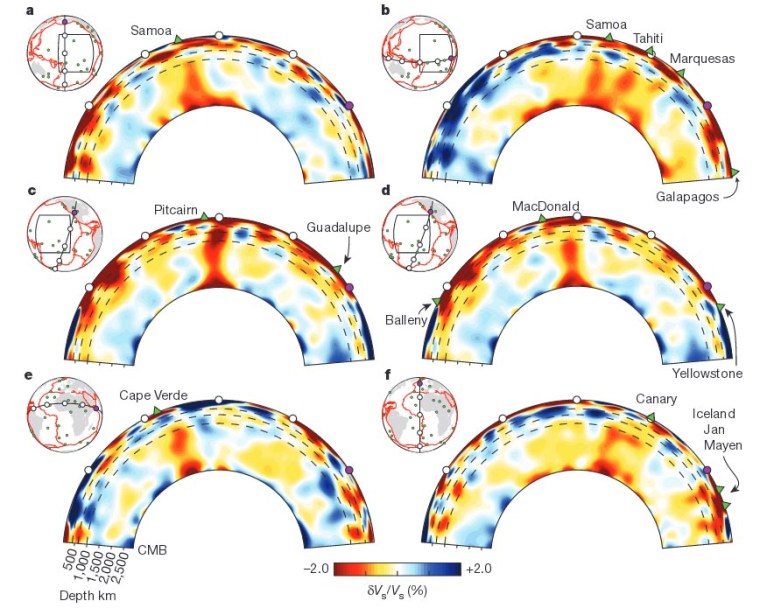
The problem was that mantle plumes supposedly linked to magmatic hotspots in the upper mantle would be so thin that they would be difficult to detect even with seismic tomography. Geophysicists have been trying to sharpen up seismic resolution partly by using supercomputers to analyse more and more seismic records and also by improving the theory about how seismic waves interact with 3-D mantle structure. This has culminated in more believable visualisation of mantle structure (French, S.W. & Romanowicz, B. 2015. Broad plumes rooted at the base of the Earth’s mantle beneath major hotspots). The two researchers from the University of California at Berkeley in fact showed something different, but still robust support for Morgan’s 40-year old ideas. Instead of thin plumes, they have been able to show much broader conduits beneath at least 5 and maybe more active ends of hotspot chains. The zones extend upwards from the core-mantle boundary to about 1000 km below the Earth’s surface, where some bend sideways towards hotspots, perhaps as a result of another kind of upper mantle circulation.

Whole-Earth seismic tomography cross sections beneath a variety of volcanic islands, (Credit French and Romanowicz; http://www.nature.com/doifinder/10.1038/nature14876)

The sources of these hot columns at the core-mantle boundary appear to be zones of very low shear-wave velocities; i.e. almost, but not quite molten blobs. French and Romanowicz suggest that the columns are extremely long-lived and may even have a chemical dimension – as in the hypothesis of mantle heterogeneity. Another interesting feature of their results is that the striking vertical linearity of the columns could indicate that the overall motion of the lower mantle is extremely sluggish and punctured by discrete convection.

New gravity and bathymetric maps of the oceans

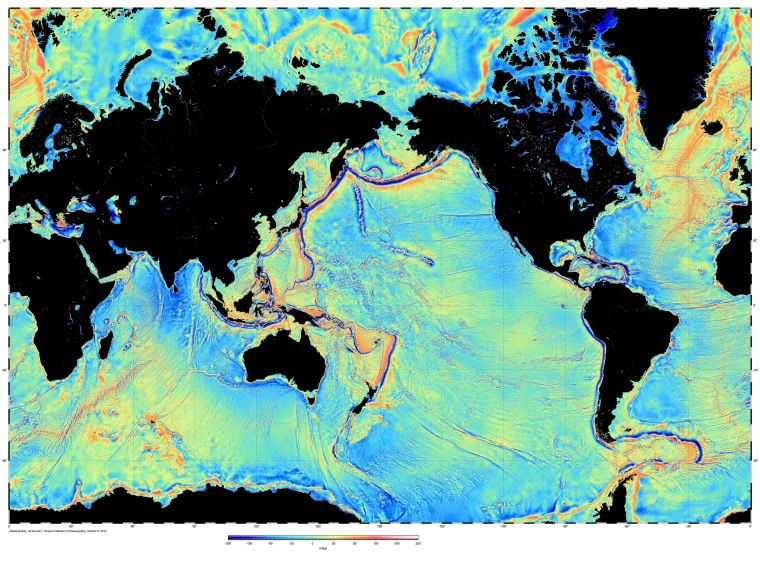
By far the least costly means of surveying the ocean floor on a global scale is the use of data remotely sensed from Earth orbit. That may sound absurd: how can it be possible to peer through thousands of metres of seawater? The answer comes from a practical application of lateral thinking. As well as being influenced by lunar and solar tidal attraction, sea level also depends on the Earth’s gravity field; that is, on the distribution of mass beneath the sea surface – how deep the water is and on varying density of rocks that lie beneath the sea floor. Water having a low density, the deeper it is the lower the overall gravitational attraction, and vice versa. Consequently, seawater is attracted towards shallower areas, standing high over, say, a seamount and low over the abyssal plains and trenches. Measuring sea-surface elevation defines the true shape that Earth would take if the entire surface was covered by water – the geoid – and is both a key to variations in gravity over the oceans and to bathymetry.

Radar altimeters can measure the average height of the sea surface to within a couple of centimetres: the roughness and tidal fluctuations are ‘ironed out’ by measurements every couple of weeks as the satellite passes on a regular orbital schedule. There is absolutely no way this systematic and highly accurate approach could be achieved by ship-borne bathymetric or gravity measurements, although such surveys help check the results from radar altimetry over widely spaced transects. Even after 40 years of accurate mapping with hundreds of ship-borne echo sounders 50% of the ocean floor is more than 10 km from such a depth measurement (80% lacks depth soundings)

This approach has been used since the first radar altimeter was placed in orbit on Seasat, launched in 1978, which revolutionised bathymetry and the details of plate tectonic features on the ocean floor. Since then, improvements in measurements of sea-surface elevation and the computer processing needed to extract the information from complex radar data have show more detail. The latest refinement stems from two satellites, NASA’s Jason-1(2001) and the European Space Agency’s Cryosat-2 (2010) (Sandwell, D.T. et al. 2014. New global marine gravity model from CryoSat-2 and Jason-1 reveals buried tectonic structure. Science, v. 346. p. 65-67; see also Hwang, C & Chang, E.T.Y. 2014. Seafloor secrets revealed. Science, v. 346. p. 32-33). If you have Google Earth you can view the marine gravity data by clicking here.  The maps throw light on previously unknown tectonic features beneath the China Sea (large faults buried by sediments), the Gulf of Mexico (an extinct spreading centre) and the South Atlantic (a major propagating rift) as well as thousands of seamounts.

Global gravity over the oceans derived from Jason-1 and Cryosat-2 radar altimetry (credit: Scripps Institution of Oceanography)

There are many ways of processing the data, and so years of fruitful interpretation lie ahead of oceanographers and tectonicians, with more data likely from other suitably equipped satellites: sea-surface height studies are also essential in mapping changing surface currents, variations in water density and salinity, sea-ice thickness, eddies, superswells and changes due to processes linked to El Niño.

Subduction and the water cycle

Note: Earth-Pages will be closing as of early July, but will continue in another form at Earth-logs

For many geoscientists and lay people the water cycle is considered to be part of the Earth’s surface system. That is, the cycle of evapotranspiration, precipitation and infiltration involving atmosphere, oceans, cryosphere, terrestrial hydrology and groundwater. Yet it links to the mantle through subduction of hydrated oceanic lithosphere and volcanism. The rate at which water vapour re-enters the surface part of the water cycle through volcanoes is reasonably well understood, but the same cannot be said about ‘recharge’ of the mantle through subduction.

Water cycle http://ga.water.usgs.gov/edu/water...
The water cycle as visualised by the US Geological Survey (credit: Wikipedia)

Subducted oceanic crust is old, cold and wet: fundamentals of plate theory. The slab-pull that largely drives plate tectonics results from phase transitions in oceanic crust that are part and parcel of low-temperature – high-pressure metamorphism. They involve the growth of the anhydrous minerals garnet and high-pressure pyroxene that constitute eclogite, the dense form taken by basalt that causes the density of subducted lithosphere to exceed that of mantle peridotite and so to sink. This transformation drives water out of subducted lithosphere into the mantle wedge overlying a subduction zone, where it encourages partial melting to produce volatile-rich andesitic basalt magma – the primary magma of island- and continental-arc igneous activity. Thus, most water that does reenter the mantle probably resides in the ultramafic lithospheric mantle in the form of hydrated olivine, i.e. the mineral serpentine, and that is hard to judge.

Water probably gets into the mantle lithosphere when the lithosphere bends to begin its descent. That is believed to involve faults – cold lithosphere is brittle – down which water can diffuse to hydrate ultramafic rocks. So the amount of water probably depends on the number of such bend-related faults. A way of assessing the degree of such faulting and thus the proportion of serpentinite is analysis of seismic records from subduction zones. This has been done from earthquake records from the West Pacific subduction zone descending beneath northern Japan (Garth, T. & Rietbrock, A. 2014. Order of magnitude increase in subducted H2O due to hydrated normal faults within the Wadati-Bennioff zone. Geology, on-line publication doi:10.1130/G34730.1). The results suggest that between 17 to 31% of the subducted mantle there has been serpentinised.

In a million years each kilometre along the length of this subduction zone would therefore transfer between 170 to 318 billion tonnes of water into the mantle; an estimate more than ten times previous estimates. The authors observe that at such a rate a subduction zone equivalent to the existing, 3400 km long Kuril and Izu-Bonin arcs that affect Japan would have transferred sufficient water to fill the present world oceans 3.5 times over the history of the Earth. Had the entire rate of modern subduction along a length of 55 thousand kilometres been maintained over 4.5 billion years, the world’s oceans would have been recycled through the mantle once every 80 million years. To put that in perspective, since the Cretaceous Chalk of southern England began to be deposited, the entire mass of ocean water has been renewed. Moreover, subduction has probably slowed considerably through time, so the transfer of water would have been at a greater pace in the more distant past.

Enhanced by Zemanta

Tectonics of the early Earth

Tectonics on any rocky planet is an expression of the way heat is transferred from its deep interior to the surface to be lost by radiation to outer space. Radiative heat loss is vastly more efficient than either conduction or convection since the power emitted by a body is proportion to the fourth power of its absolute temperature. Unless it is superheated from outside by its star, a planet cannot stay molten at its surface for long because cooling by radiation releases all of the heat that makes its way to the surface.  Any football supporter who has rushed to get a microwaved pie at half time will have learned this quickly: a cool crust can hide a damagingly hot centre.

Thermal power is delivered to a planet’s surface by convection deep down and conduction nearer the surface because rocks, both solid and molten, are almost opaque to radiation. The vigour of the outward flow of heat might seem to be related mainly to the amount of internal heat but it is also governed by limits imposed by temperature on the form of convection. Of the Inner Planets only Earth shows surface signs of deep convection in the form of plate tectonics driven mainly by the pull exerted by steep subduction of cool, dense slabs of old oceanic lithosphere. Only Jupiter’s moon Io shows comparable surface signs of inner dynamics, but in the form of immense volcanoes rather than lateral movements of slabs. Io has about 40 times the surface heat flow of Earth, thanks largely to huge tidal forces imposed by Jupiter. So it seems that a different mode of convection is needed to shift the tidal heat production; similar in many ways to Earth’s relatively puny and isolated hot spots and mantle plumes.

Most of the yellow and orange hues of Io are d...
An analogy for the early Earth, Jupiter’s moon Io is speckled with large active volcanoes; signs of vigorous internal heat transport but not of plate tectonics. Its colour is dominated by various forms of sulfur rather than mafic igneous rocks. (credit: Wikipedia)

Shortly after Earth’s accretion it would have contained far more heat than now: gravitational energy of accretion itself; greater tidal heating from a close Moon and up to five times more from internal radioactive decay. The time at which plate tectonics can be deduced from evidence in ancient rocks has been disputed since the 1970s, but now an approach inspired by Io’s behaviour approaches the issue from the opposite direction: what might have been the mode of Earth’s heat transport shortly after accretion (Moore, W.B. & Webb, A.A.G. 2013. Heat-pipe Earth. Nature, v.  501, p. 501-505). The two American geophysicists modelled Rayleigh-Bénard convection – multicelled convection akin to that of the ‘heat pipes’ inside Io – for a range of possible thermal conditions in the Hadean. The modelled planet, dominated by volcanic centres turned out to have some surprising properties.

The sheer efficiency of heat-pipe dominated heat transfer and radiative heat lost results in development of a thick cold lithosphere between the pipes, that advects surface material downwards. Decreasing the heat sources results in a ‘flip’ to convection very like plate tectonics. In itself, this notion of sudden shift from Rayleigh-Bénard convection to plate tectonics is not new – several Archaean specialists, including me, debated this in the late 1970s – but the convincing modelling is. The authors also assemble a plausible list of evidence for it from the Archaean geological record: the presence in pre- 3.2 Ga greenstone belts of abundant ultramafic lavas marking high fractions of mantle melting; the dome-trough structure of granite-greenstone terrains; granitic magmas formed by melting of wet mafic rocks at around 45 km depth, extending back to second-hand evidence from Hadean zircons preserved in much younger rocks. They dwell on the oldest sizeable terranes in West Greenland (the Itsaq gneiss complex), South Africa and Western Australia (Barberton and the Pilbara) as a plausible and tangible products of ‘heat-pipe’ tectonics. They suggest that the transition to plate-tectonic dominance was around 3.2 Ga, yet ‘heat pipes’ remain to the present in the form of plumes so nicely defined in the preceding item Mantle structures beneath the central Pacific.

Mantle structures beneath the central Pacific

Since it first figured in Earth Pages 13 years ago seismic tomography has advanced steadily as regards the detail that can be shown and the level of confidence in its accuracy: in the early days some geoscientists considered the results to be verging on the imaginary. There were indeed deficiencies, one being that a mantle plume which everyone believed to be present beneath Hawaii didn’t show up on the first tomographic section through the central Pacific. Plumes are one of the forms likely to be taken by mantle heat convection, and many now believe that some of them emerge from great depths in the mantle, perhaps at its interface with the outer core.

The improvements in imaging deep structure stem mainly from increasingly sophisticated software and faster computers, the data being fed in being historic seismograph records from around the globe. The approach seeks out deviations in the speed of seismic waves from the mean at different depths beneath the Earth’s surface. Decreases suggest lower strength and therefore hotter rocks while abnormally high speeds signify strong, cool parts of the mantle. The hotter mantle rock is the lower its density and the more likely it is to be rising, and vice versa.

Using state-of-the-art tomography to probe beneath the central Pacific is a natural strategy as the region contains a greater concentration of hot-spot related volcanic island chains than anywhere else and that is the focus of a US-French group of collaborators (French, S. et al. 2013. Waveform tomography reveals channeled flow at the base of the oceanic lithosphere. Science, v. 342, 227-230;  doi 10.1126/science.1241514). The authors first note the appearance on 2-D global maps for a depth of 250 km of elongate zones of low shear-strength mantle that approximately parallel the known directions of local absolute plate movement. The most clear of these occur beneath the Pacific hemisphere, strongly suggesting some kind of channelling of hot material by convection away from the East Pacific Rise.

Seismic tomograhic model of the mantle beneath the central Pacific. Yellow to red colours represent increasing low shear strength. (credit: Global Seismology Group / Berkeley Seismological Laboratory
Seismic tomographic model of the mantle beneath the central Pacific. Yellow to red colours represent increasingly low shear strength. (credit: Global Seismology Group / Berkeley Seismological Laboratory)

Visually it is the three-dimensional models of the Pacific hot-spot ‘swarm’ that grab attention. These show the low velocity zone of the asthenosphere at depths of around 50 to 100 km, as predicted but with odd convolutions. Down to 1000 km is a zone of complexity with limb-like lobes of warm, low-strength mantle concentrated beneath the main island chains. That beneath the Hawaiian hot spot definitely has a plume-like shape but one curiously bent at depth, turning to the NW as it emerges from even deeper mantle then taking a knee-like bend to the east . Those beneath the hot spots of the west Pacific are more irregular but almost vertical. Just what kind of process the peculiarities represent in detail is not known, but it is almost certainly a reflection of complex forms taken by convection in a highly viscous medium.

Afar: the field lab for continental break-up

The Afar Depression of Ethiopia and Eritrea is a feature of tectonic serendipity. It is unique in showing on land the extensional processes and related volcanism that presage sea-floor spreading. Indeed it hosts three rift systems and a triple junction between the existing Red Sea and Gulf of Aden spreading centres and the East African Rift System that shows signs of future spalling of Somalia from Africa. Afar has been a focus of geoscientific attention since the earliest days of plate theory but practical interest has grown rapidly over the last decade or so when the area has become significantly more secure and safe to visit. Two recent studies seem to have overturned one of the most enduring assumptions about what drives this epitome of continental break-up.

Perspective view of the Afar depression and en...
Simulated perspective view of the Afar depression from the south (credit: Wikipedia)

From the obvious thermal activity deep below Afar, linked with volcanism and high heat flow, a mantle host spot and rising plume of deep mantle has been central to ideas on the tectonics of the area. A means of testing this hypothesis is the use of seismic data to assess the ductility and temperature structure of deep mantle through a form of tomography. The closer the spacing of seismic recording stations and the more sensitive the seismometers are the better the resolution of mantle structure. Afar now boasts one of the densest seismometer networks, rivalling the Earthscope USArray. http://earth-pages.co.uk/2009/11/01/the-march-of-the-seismometers/ and it is paying dividends (Hammond, J.O.S. and 10 others 2013. Mantle upwelling and initiation of rift segmentation beneath the Afar Depression. Geology, v. 41, p. 635-638). The study  brought together geoscientists from Britain, the US, Ethiopia, Eritrea and Botswana, who used data from 244 seismic stations in the Horn of Africa to probe depths down to 400 km with a resolution of about 50 km.

The tomographic images show no clear sign of the kind of narrow plume generally aasociated with the notion of a ‘hot spot’. Instead they pick out shallow (~75 km depth) P- and S-wave  low-velocity features that follow the axes of the three active rift systems. The features coalesce at depth; in some respects the opposite of a classic plume that has a narrow ‘stem’ that swells upwards to form a broad ‘head’. If there ever was an Afar Plume it no longer functions. Instead, the rifts and associated lithospheric thinning are associated with a mantle upwelling that is being emplaced passively in the space made available by extensional tectonics. This is closely similar to what goes on beneath active and well-established mid-ocean spreading centres where de-pressuring of the rising mantle results in partial melting and basaltic magmatism along the rift system. Perhaps this is a sign that full sea-floor spreading in Afar is imminent, at least on geological timescales.

Simplified geologic map of the Afar Depression.
Simplified geologic map of the Afar Depression. (credit: Wikipedia after Beyene and Abdelsalam (2005))

For once, mantle geochemists and geophysicists have data that support a common hypothesis (Ferguson, D.J. and 8 others 2013. Melting during late-stage rifting in Afar is hot and deep. Nature, v. 499, p. 70-73). This US-British-Ethiopian team compares the trace element geochemistry of Recent basaltic lavas erupted along the axis of the Afar rift that links with the Red Sea spreading centre with equally young lavas from volcanoes some 20 km from the axis. Both sets of lavas are a great deal more enriched in incompatible trace elements that are generally enriched in melt compare with source than are ocean-floor basalts sampled from the mid-Red Sea rift.  Modelling rare-earth element patterns in particular suggests that partial melting is going on at depths where garnet is stable in the mantle instead of spinel. This suggests that a strong layer, about 85 km down in the upper mantle is beginning to melt – magmas formed by small degrees of partial melting generally contain higher amounts of incompatible trace elements than do the products of more extensive melting. Estimates of the temperature of melting from lavas extruded at the rift axis than off-axis are significantly higher than expected at this depth suggesting that deeper mantle is rising faster than it can lose heat.

The depth of melting tallies with the thermal feature picked out by seismic tomography. The two teams converge on passively induced upwelling of hot asthenosphere while the Afar lithosphere is slowly being extended. The degree of melting beneath Afar is low at present, so that to become like mid-ocean ridge basalts a surge in the fraction of melting is needed. That would happen if the strong mantle layer fails plastically so that more asthenosphere can rise higher by passive means. The geochemists persist in an appeal to an Afar Plume for the 30 Ma old flood basalts that plaster much of the continental crust outside Afar. Those plateau-forming lavas, however, are little different in their trace element geochemistry from off-axis Afar basalts. Yet they are not obviously associated with an earlier episode of lithospheric extension and passive mantle upwelling.  Most geologists who have studied the flood basalts would agree that they preceded the onset of rifting but have little idea of the actual processes that went on during that mid-Oligocene volcanic cataclysm.

Continental comfort blanket

Way back in the mists of time, say around 1970-71, an idea was doing the rounds that because the thermal conductivity of continental crust is lower than that of the ocean floor it should allow thermal energy to build up in the mantle beneath. In turn that might somehow encourage the formation of hot spots and a shallower depth to the asthenosphere: the outcome might be to encourage rifting of weakened lithosphere and ultimately a new round of sea-floor spreading. The case often cited was the Atlantic – North and South – since there are eight hotspots currently on the mid-Atlantic ridge. Africa was another popularised case with a great many broad domes associated with Cenozoic volcanism, and the link between formation of the East African Rift System, hot spots and doming had already been suggested. Africa has barely drifted for around 100 Ma and the domes were supposed to have formed by the build up of heat in the mantle beneath. Geoscience moved on to clearly demonstrate the coincidence of large igneous provinces and flood basalt volcanism with the initiation of Atlantic spreading in the form of the Central Atlantic and Brito-Arctic LIPs during initial opening of the South and North Atlantic at the end of the Triassic and during the Palaeocene respectively. But the role of continental insulation became a bit of backwater compared with notions of mantle plumes emanating at the core-mantle boundary. Well, it’s back.

Divergent plate boundary: Mid-Atlantic Ridge
The Mid-Atlantic Ridge (credit: Wikipedia)

There is now a vast repository of ocean-floor lavas that formed at mid-ocean ridges in the past, thanks to the international Deep Sea and Ocean Drilling Programmes begun in 1968 about when the heyday of plate tectonics really got underway. In the last 45 years there have also been great advances in igneous geochemistry and its interpretation, including relations with mantle melting temperatures. Geochemists at the Friedrich-Alexander-Universiteit in Erlangen, Germany have re-examined the major-element geochemistry of 184 glassy ocean-floor basalts from drill sites of different ages on the floor of the Atlantic Ocean and compared them with 157 from the Pacific. To avoid the possible influence of plume-related heating, the sites were chosen well away from the tracks of existing hot spots. Mantle temperature can be assessed from the sodium and iron content of basalts, Na decreasing with higher temperatures and Fe doing the reverse (Brandl, P.A. et al. 2013. High mantle temperatures following rifting cause by continental insulation. Nature Geoscience, v. 6, p. 391-394). Atlantic samples show increasing Na and decreasing Fe contents in progressively younger basalts, i.e. a trend with time of decreasing mantle temperature such that the oldest (~166 Ma) record 150°C higher mantle temperature than the youngest, with a similar result for the Indian Ocean floor. No such trend is present in samples from the same age range of the Pacific Ocean floor. At around 170 Ma the mid-Atlantic Ridge was close to the continental lithosphere of the Americas and Africa, whereas the East Pacific Rise was at least 2000 km from any continental margin. Younger Atlantic samples formed progressively further from its shores record cooling of the mantle source.
A prediction of the model is that the converse, continental accretion to form supercontinents such as Pangaea, should rapidly have caused considerable warming in the mantle beneath them. This suggests that the formation of supercontinents, or even less substantial continents, should carry the seeds of their re-fragmentation, as Africa is currently demonstrating by the separation of Arabia since the Red Sea began to open some 15 Ma ago, which Somalia and much of eastern Kenya and Tanzania seem destined to follow once the East African Rift System ‘gets steam up’.

  • Langmuir, C. 2013. Older and hotter. Nature Geoscience, v. 6, p. 332-333

The shuffling poles

The mechanical disconnection of the lithosphere from the Earth’s deep mantle by a more ductile zone in the upper mantle – the asthenosphere – suggests that the lithosphere might move independently. If that were the case then points on the surface would shift relative to the axis of rotation and the magnetic poles, irrespective of plate tectonics.  So it makes sense to speak of absolute and relative motions of tectonic plates. The second relates to plates’ motions relative to each other and to the ancient position of the magnetic poles, assumed to be reasonably close to that of the past pole of rotation, yet measurable from the direction of palaeomagnetism retained in rocks on this or that tectonic plate. Plotting palaeomagnetic pole positions through time for each tectonic plate gives the impression that the poles have wandered. Such apparent polar wandering has long been a key element in judging ancient plate motions.  Absolute plate motion judges the direction and speed of plates relative to supposedly fixed mantle plumes beneath volcanic hot spots, the classic case being Hawaii, over which the Pacific Plate has moved to leave a chain of extinct volcanoes that become progressively older to the west. But it turns out that between about 80 to 50 Ma there are some gross misfits using the hot-spot frame of reference. An example is the 60° bend of the Hawaiian chain to become the Emperor seamount chain that some have ascribed to hot spots shifting (see http://earth-pages.co.uk/2009/05/01/the-great-bend-of-the-pacific-ocean-floor/).

English: Age of ocean floor, with fracture zon...
Age of Pacific Ocean floor, showing the Hawaii-Emperor seamount chain in black. (credit: Wikipedia)

Ideas have shifted dramatically since it became clear that hot spots can shift, and there has been an attempt to estimate their actual motions (Doubrovine, P.V. et al. 2012. Absolute plate motions in a reference frame defined by moving hot spots in the Pacific, Atlantic, and Indian oceans. Journal of Geophysics Research: Solid Earth, v. 117, B09101, doi:10.1029/2011JB009072). It is early days for the revised view of absolute motion of the lithosphere and estimates go back only 120 Ma. However, one outcome has been a realistic examination of whether the positions of the poles have shifted through time; a possibility that is hidden in apparent polar wander paths. Since the mid-Cretaceous it seems that a slow and hesitant, but significant polar shuffle has taken place, varying between 0.1 and 1.0° Ma-1, starting in one direction and then the movement retraced its steps to achieve the current proximity of magnetic poles to the poles of rotation.