The end-Triassic mass extinction and ocean acidification

Triassic reef limestones in the Dolomites of northern Italy. Credit: © Matteo Volpone

Four out of six mass extinctions that ravaged life on Earth during the last 300 Ma coincided with large igneous events marked by basaltic flood volcanism. But not all such bursts of igneous activity match significant mass extinctions. Moreover, some rapid rises in the rate of extinction are not clearly linked to peaks in igneous activity. Another issue in this context is that ‘kill mechanisms’ are generally speculative rather than based on hard data. Large igneous events inevitably emit very large amounts of gases and dust-sized particulates into the atmosphere. Carbon dioxide, being a greenhouse gas, tends to heat up the global climate, but also dissolves in seawater to lower its pH. Both global warming and more acidic oceans are possible ‘kill mechanisms’. Volcanic emission of sulfur dioxide results in acid rain and thus a decrease in the pH of seawater. But if it is blasted into the stratosphere it combines with oxygen and water vapour to form minute droplets of sulfuric acid. These form long-lived haze, which reflects solar energy beck into space. Such an increased albedo therefore tends to cool the planet and create a so-called ‘volcanic winter’. Dust that reaches the stratosphere reduces penetration of visible light to the surface, again resulting in cooling. But since photosynthetic organisms rely on blue and red light to power their conversion of CO­2­ and water vapour to carbohydrates and oxygen, these primary producers at the base of the marine and terrestrial food webs decline. That presents a fourth kill mechanism that may trigger mass extinction on land and in the oceans: starvation.

Palaeontologists have steadily built up a powerful case for occasional mass extinctions since fossils first appear in the stratigraphic record of the Phanerozoic Eon. Their data are simply the numbers of species, genera and families of organisms preserved as fossils in packages of sedimentary strata that represent roughly equal ‘parcels’ of time (~10 Ma). Mass extinctions are now unchallengeable parts of life’s history and evolution. Yet, assigning specific kill mechanisms involved in the damage that they create remains very difficult. There are hypotheses for the cause of each mass extinction, but a dearth of data that can test why they happened. The only global die-off near hard scientific resolution is that at the end of the Cretaceous. The K-Pg (formerly K-T) event has been extensively covered in Earth-logs since 2000. It involved a mixture of global ecological stress from the Deccan large igneous event spread over a few million years of the Late Cretaceous, with the near-instantaneous catastrophe induced by the Chicxulub impact, with a few remaining dots and ticks needed on ‘i’s and ‘t’s. Other possibilities have been raised: gamma-ray bursts from distant supernovae; belches of methane from the sea floor; emissions of hydrogen sulfide gas from seawater itself during ocean anoxia events; sea-level changes etc.

The mass extinction that ended the Triassic (~201 Ma) coincides with evidence for intense volcanism in South and North America, Africa and southern Europe, then at the core of the Pangaea supercontinent. Flood basalts and large igneous intrusions – the Central Atlantic Magmatic Province (CAMP) – began the final break-up of Pangaea. The end-Triassic extinction deleted 34% of marine genera. Marine sediments aged around 201 Ma reveal a massive shift in sulfur and carbon isotopes in the ocean that has been interpreted as a sign of acute anoxia in the world’s oceans, which may have resulted in massive burial of oxygen-starved marine animal life. However, there is no sign of Triassic, carbon-rich deep-water sediments that characterise ocean anoxia events in later times. But it is possible that bacteria that use the reduction of sulfate (SO42-) to sulfide (S2-) ions as an energy source for them to decay dead organisms, could have produced the sulfur isotope ‘excursion’. That would also have produced massive amounts of highly toxic hydrogen sulfide gas, which would have overwhelmed terrestrial animal life at continental margins. The solution ofH2S in water would also have acidified the world’s oceans.

Molly Trudgill of the University of St Andrews, Scotland and colleagues from the UK, France, the Netherlands, the US, Norway, Sweden and Ireland set out to test the hypothesis of end-Triassic oceanic acidification (Trudgill, M. and 24 others 2025. Pulses of ocean acidification at the Triassic–Jurassic boundary. Nature Communications, v. 16, article 6471; DOI: 10.1038/s41467-025-61344-6). The team used Triassic fossil oysters from before the extinction time interval. Boron-isotope data from the shells are a means of estimating variations in the pH of seawater. Before the extinction event the average pH in Triassic seawater was about the same as today, at 8.2 or slightly alkaline. By 201 Ma the pH had shifted towards acidic conditions by at least 0.3: the biggest detected in the Phanerozoic record. One of the most dramatic changes in Triassic marine fauna was the disappearance of reef limestones made by the recently evolved modern corals on a vast scale in the earlier Triassic; a so-called ‘reef gap’ in the geological record. That suggests a possible analogue to the waning of today’s coral reefs that is thought to be a result of increased dissolution of CO2 in seawater and acidification, related to global greenhouse warming. Using the fossil oysters, Trudgill et al. also sought a carbon-isotope ‘fingerprint’ for the source of elevated CO2, finding that it mainly derived from the mantle, and was probably emitted by CAMP volcanism. So their discussion centres mainly on end-Triassic ocean acidification as an analogy for current climate change driven by CO2 largely emitted by anthropogenic burning of fossil fuels. Nowhere in their paper do they mention any role for acidification by hydrogen sulfide emitted by massive anoxia on the Triassic ocean floor, which hit the scientific headlines in 2020 (see earlier link).

The end of the Carboniferous ‘icehouse’ world

From about 340 to 290 Ma the Earth experienced the longest episode of repeated ice ages of the Phanerozoic. The climate then was similar in many ways to that of the Pleistocene. The South Polar region was then within the Pangaea supercontinent and thus isolated from any warming effect from the surrounding ocean: much the same as modern Antarctica but on a much larger scale. Glaciation extended as far across what became the southern continents and India as did the continental ice sheets of the Northern Hemisphere during Pleistocene glacial maxima. Tropical sedimentary rocks of the time, display evidence for repeated alternations of high and low sea levels that mark cycles of glacial maxima and interglacial episodes akin to those of the Pleistocene. In fact they probably reflect the influence of changes in the Earth’s orbit and geometry of its axis of rotation very similar to those predicted by Milankovich from astronomical factors to explain Pleistocene climatic cycles. At the end of the Carboniferous what was an ‘ice-house’ world changed suddenly to its opposite – ‘greenhouse’ conditions – that persisted through the Mesozoic Era until the later part of the Cenozoic, when Antarctica developed is ice cap and global climate slowly cooled to become extremely cyclical once again.

Sedimentary evidence for global climates 320 Ma ago. As well as the large tracts of glaciogenic sediments, smaller occurrences and examples of polished rock surfaces over which ice had passed show the probable full extent (blue line) of ice sheets across the southern, Gondwana sector of Pangaea (Credit: after Fig 7.3, S104, Earth and Space, ©Open University 2007)

The end of the Carboniferous witnessed the collapse of the vast Equatorial rainforests, which formed the coal deposits that put ‘Carbon’ into the name of the Period. By its end this ecosystem had vanished to result in a minor mass extinction of both flora and fauna. Temperatures rose and aridity set in, to the extent that the latest Carboniferous in the British coalfields is marked by redbeds that presage the spread of desert conditions across the Equatorial parts of Pangaea during the succeeding Permian. A team of researchers based at the University of California at Davis have been studying data pertaining to this sudden change have now published their findings (Chan J. and 17 others 2022. Marine anoxia linked to abrupt global warming during Earth’s penultimate icehouse. Proceedings of the National Academy of Sciences, v. 119, article e2115231119; DOI: 10.1073/pnas.2115231119). They used carbon-, oxygen- and uranium isotopes, together with proxies for changes in atmospheric CO2 concentrations, to model changes in the carbon cycle in the Late Carboniferous of China.

Changes in uranium isotopes within marine carbonates are useful indicators of the amount of oxygen available in ocean water at the sea floor. Between 304 and 303.5 Ma ago oxygen content declined by around 30%, the peak of this anoxia being at 303.7 Ma. This occurred about 100 ka after atmospheric CO2 had risen to ~700 parts per million (ppm) from around 350 ppm in the preceding 300 ka, as marked by several proxies.  The authors suggest that the lower ‘baseline’ for the main greenhouse gas marked an extreme glacial maximum. Changes in the proportions of 18O relative to ‘lighter’ 16O in fossil shells suggest that sea-surface temperatures increased in step with the doubling of the greenhouse effect. At the same time there was a major marine transgression as sea level rose. This would have been accompanied by a massive increase in low density freshwater in surface ocean water derived from melting of Pangaea’s ice cap. The team suggests that the freshened surface layer could not sink to carry oxygen to deeper levels, thereby creating anoxic conditions across an estimated 23% of the global seafloor, and thus toxic ‘death zones’ for marine organisms.

One possibility for this sudden rise of atmospheric CO2 is a massive episode of volcanism, perhaps a large igneous province, but there is scanty evidence for that at the end of the Carboniferous. A coinciding sharp decrease in δ13C  in carbonate shells suggests that the excess carbon dioxide probably had an organic origin. So a more plausible hypothesis is massive burning on the continental surface. In the tropics, the huge coals swamps would have contained vast amounts of peat-like decayed vegetable matter as well as living green vegetation. How might that have caught fire? The peat precursor to Carboniferous coal deposits derived from photosynthesis on an unprecedented, and never repeated, scale during tens of million years of thriving tropical rain forest during that Period. This built up atmospheric oxygen levels to about 35%, compared with about 21% today. Insects, whose maximum size is governed by their ability to take in oxygen through spiracles in their bodies, and by the atmospheric concentration of oxygen, became truly huge during the earlier Carboniferous. The more oxygen in the air, the greater the chance that organic matter will catch fire. In fact wet vegetation can burn if oxygen levels rise above 25%. At the levels reached in the Carboniferous huge wildfires in forests and peatlands would have been inevitable. Evidence that huge fires did occur comes from the amount of charcoal found in Carboniferous coal seams, which reach 70% compared with the 4 to 8 % in more recent coals. They may have been ignited by lightning strikes or even spontaneous combustion if decay of vegetation generated sufficient heat, as sometimes happens today in wet haystacks or garden compost heaps.  But how in a short period around 304 Ma could 9 trillion tons of carbon dioxide be released in this way. The preceding  glacial super-maximum, like glacial maxima of the Pleistocene, may have been accompanied by decreased atmospheric humidity: this would dry out the vast surface peat deposits.

The succeeding Permian is famous for its extensive continental redbeds, and so too those of the Triassic. They are red because sediment grains are coated in the iron oxide hematite (Fe2O3). As on Mars, the redbeds are a vast repository for oxygen sequestered from the atmosphere by the oxidation of dissolved Fe2+ to insoluble Fe3+. This had been going on throughout the Permian, the nett result being that by 250 Ma atmospheric oxygen content has slumped to 16% and remained so low for another 50 million years. Photosynthesis failed to resupply oxygen against this inorganic depletion, and there are few coal deposits of Permian or Triassic age: for about 100 Ma Earth ceased to have green continents.

See also: Carbon, climate change and ocean anoxia in an ancient icehouse world. Science Daily, 2 May 2022. 

End-Triassic mass extinction: evidence for oxygen depletion on the ocean floor

For British geologists of my generation the Triassic didn’t raise our spirits to any great extent. There’s quite a lot of it on the British Geological Survey 10-miles-to-the-inch geological map (South Sheet) but it is mainly muds, sandstones or pebble beds, generally red and largely bereft of fossils. For the Triassic’s 50 Ma duration following the end-Permian extinction at 252 Ma Britain was pretty much a desert in the middle of the Pangaea supercontinent. Far beyond our travel grants’ reach, the Triassic is a riot, as in the Dolomites of Northern Italy. Apart from a day trip to look at the Bunter Pebble Beds in a quarry near Birmingham and several weeks testing the load-bearing strength of the Keuper mudstones in the West Midlands (not far off zero) in a soil-mechanics lab, we did glimpse the then evocatively named Tea Green Marl (all these stratigraphic names have vanished). Conveniently they outcrop by the River Severn estuary, below its once-famous suspension bridge and close-by the M5 motorway. Despite the Tea Green Marl containing a bone bed with marine reptiles, time didn’t permit us to fossick, and, anyway, there was a nearby pub … The formation was said to mark a marine transgression leading on to the ‘far more interesting Jurassic’ – the reason we were in the area. We were never given even a hint that the end of the Triassic was marked by one of the ‘Big Five’ mass extinctions: such whopping events were not part of the geoscientific canon in the 1960s.

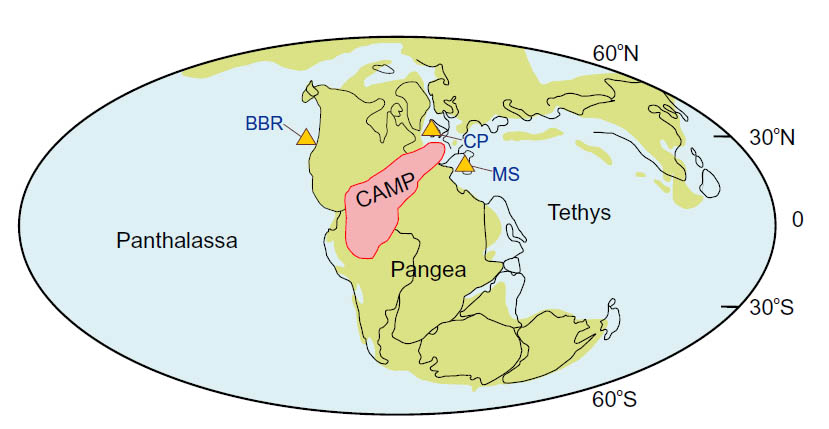
Pangaea just before the start of Atlantic opening at the end of the Triassic, showing the estimated extend of the CAMP large igneous province. The pink triangles show the sites investigated by He and colleagues.

At 201.3 Ma ago around 34 % of marine genera disappeared, comparable with the effect of the K-Pg extinction that ended the Mesozoic Era. Extinction of Triassic terrestrial animals is less quantifiable. Early dinosaurs made it through to diversify hugely during the succeeding Jurassic and Cretaceous Periods. Probably because nothing famous ceased to be or made its first appearance, the Tr-J mass extinction hasn’t captured public attention in the same way as those with the K-Pg or the P-Tr acronyms.  But it did dramatically alter the course of biological evolution. The extinctions coincided with a major eruption of flood basalts known as the Central Atlantic Magmatic Province (CAMP), whose relics occur on either side of the eponymous ocean, which began to open definitively at about the same time. So, chances are, volcanic emissions are implicated in the extinction event, somehow (see: Is end-Triassic mass extinction linked to CAMP flood basalts? June 2013). Tianchen He  of Leeds University, UK and the China University of Geosciences and British and Italian colleagues have studied three Tr-J marine sections on either side of Pangaea: in Sicily, Northern Ireland and British Columbia (He, T. and 12 others 2020. An enormous sulfur isotope excursion indicates marine anoxia during the end-Triassic mass extinction. Science Advances, v. 6, article eabb6704; DOI: 10.1126/sciadv.abb6704). Their objective was to test the hypothesis that CAMP resulted in an episode of oceanic anoxia that caused the many submarine organisms to become extinct. Since eukaryote life depends on oxygen, a deficit would put marine animals of the time under great stress. Such events in the later Mesozoic account for global occurrences of hydrocarbon-rich, black marine shales – petroleum source rocks – in which hypoxia thwarted complete decay of dead organisms over long periods. However there is scant evidence for such rocks having formed ~201 Ma ago. Such as there is dates to about 150 ka younger than the Tr-J boundary in an Italian shallow marine basin. The issue of evidence is compounded by the fact that there are no ocean-floor sediments as old as that, thanks to their complete subduction as Pangaea broke apart in later times and its continental fragments drifted to their present configuration.

But there is an indirect way of detecting deep-ocean anoxia, in the inevitable absence of any Triassic and early Jurassic oceanic crust. It emerges from what happens to the stable isotopes of sulfur when there are abundant bacteria that use the reduction of sulfate (SO42-) to sulfide (S2-) ions. Such microorganisms thrive in anoxic conditions and produce abundant hydrogen sulfide, which in turn leads to the precipitation of dissolved iron as minute grains of pyrite (FeS2). This biogenic process selectively excludes 34S from the precipitated pyrite. As a result, at times of widespread marine reducing conditions seawater as a whole becomes enriched in 34S relative to sulfur’s other isotopes. The enrichment is actually expressed in the unreacted sulfate ions, and they may be precipitated as calcium sulfate or gypsum (CaSO4) in marine sediments deposited anywhere: He et al. focussed on such fractionation. They discovered large ‘spikes’ in the relative enrichment of 34S at the Tr-J boundary in shallow-marine sedimentary sequences exposed at the three sites. Moreover, they were able to estimate that the conditions on the now vanished bed of the Triassic ocean that gave rise to the spikes lasted for about 50 thousand years. The lack of dissolved oxygen resulted in a five-fold increase in pyrite burial in the now subducted ocean-floor sediments of that time. The authors suggest that the oxygen depletion stemmed from extreme global warming, which, in turn, encouraged methane production by other ocean-floor bacteria and, in a roundabout way, other chemical reactions that consumed free dissolved oxygen. Quite a saga of a network of interactions in the whole Earth system that may hold a dreadful warning for the modern Earth and ourselves.