How the earliest continental crust may have formed

Detrital zircon grains extracted from sandstones deposited ~3 billion year (Ga) ago in Western Australia yield the ages at which these grains crystallised. The oldest formed at about 4.4 Ga; only 150 Ma after the origin of the Earth (4.55 Ga). Various lines of evidence suggest that they originally crystallized from magmas with roughly andesitic compositions, which some geochemists suggest to have formed the first continental crust (see: Zircons and early continents no longer to be sneezed at; February 2006). So far, no actual rocks of that age and composition have come to light. The oldest of these zircon grains also contain anomalously high levels of 18O, a sign that water played a role in the formation of these silicic magmas. Modern andesitic magmas – ultimately the source of most continental crust – typically form above steeply-dipping subduction zones where fluids expelled from descending oceanic crust encourage partial melting of the overriding lithospheric mantle. Higher radiogenic heat production in the Hadean and the early Archaean would probably have ensured that the increased density of later oceanic lithosphere needed for steep subduction could not have been achieved. If subduction occurred at all, it would have been at a shallow angle and unable to exert the slab-pull force that perpetuated plate tectonics in later times (see: Formation of continents without subduction, March, 2017).

Landsat image mosaic of the Palaeoarchaean granite-greenstone terrain of the Pilbara Craton, Western Australia. Granite bodies show as pale blobs, the volcanic and sedimentary greenstone belts in shades of grey.

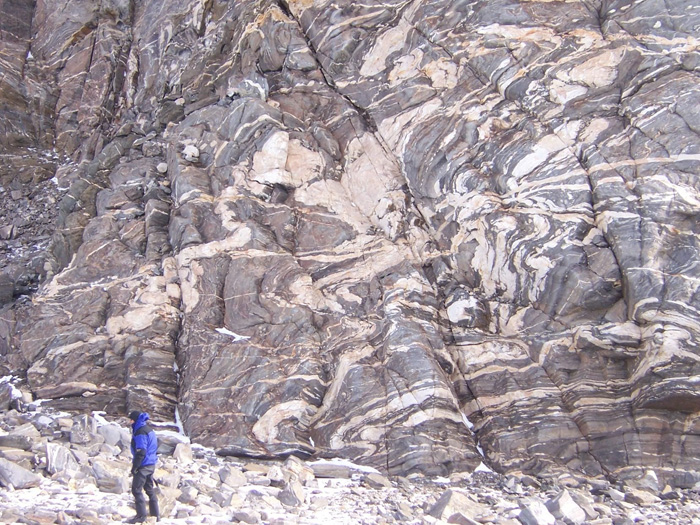
Geoscientists have been trying to resolve this paradox for quite a while. Now a group from Australia, Germany and Austria have made what seems to be an important advance (Hartnady, M. I. H and 8 others 2025. Incipient continent formation by shallow melting of an altered mafic protocrust. Nature Communications, v. 16, article 4557; DOI: 10.1038/s41467-025-59075-9). It emerged from their geochemical studies of rocks in the Pilbara Craton of Western Australia that are about a billion years younger than the aforementioned ancient zircon grains. These are high-grade Palaeoarchaean metamorphic rocks known as migmatites that lie beneath lower-grade ‘granite-greenstone’ terrains that dominate the Craton, which Proterozoic deformation has forced to the surface. Their bulk composition is that of basalt which has been converted to amphibolite by high temperature, low pressure metamorphism (680 to 730°C at a depth of about 30 km). These metabasic rocks are laced with irregular streaks and patches of pale coloured rock made up mainly of sodium-rich feldspar and quartz, some of which cut across the foliation of the amphibolites. The authors interpret these as products of partial melting during metamorphism, and they show signs of having crystallised from a water-rich magma; i.e. their parental basaltic crust had been hydrothermally altered, probably by seawater soon after it formed. The composition of the melt rocks is that of trondhjemite, one of the most common types of granite found in Archaean continental crust. Interestingly, small amounts of trondhjemite are found in modern oceanic crust and ophiolites.

A typical migmatite from Antarctica showing dark amphibolites laced with quartzofeldspathic products of partial melting. Credit: Lunar and Planetary Laboratory, University of Arizona

The authors radiometrically dated zircon and titanite (CaTiSiO₅) – otherwise known as sphene – in the trondhjemites, to give an age of 3565 Ma. The metamorphism and partial melting took place around 30 Ma before the overlying granite-greenstone assemblages formed. They regard the amphibolites as the Palaeoarchaean equivalent of basaltic oceanic crust. Under the higher heat production of the time such primary crust would probably have approached the thickness of that at modern oceanic plateaux, such as Iceland and Ontong-Java, that formed above large mantle plumes. Michael Hartnady and colleagues surmise that this intracrustal partial melting formed a nucleus on which the Pilbara granite-greenstone terrain formed as the oldest substantial component of the Australian continent. The same nucleation may have occurred during the formation of similar early Archaean terrains that form the cores of most cratons that occur in all modern continents.

The origin of life on Earth: new developments

Debates around the origin of Earth’s life and what the first organism was like resemble the mythical search for the Holy Grail. Chivalric romanticists of the late 12th and early 13th centuries were pretty clear about the Grail – some kind of receptacle connected either with the Last Supper or Christ’s crucifixion – but never found it. Two big quests that engage modern science centre on how the chemical building blocks of the earliest cells arose and the last universal common ancestor (LUCA) of all living things. Like the Grail’s location, neither is likely to be fully resolved because they can only be sought in a very roundabout way: both verge on the imaginary. The fossil record is limited to organisms that left skeletal remains, traces of their former presence, and a few degraded organic molecules. The further back in geological time the more sedimentary rock has either been removed by erosion or fundamentally changed at high temperatures and pressures. Both great conundrums can only be addressed by trying to reconstruct processes and organisms that occurred or existed more than 4 billion years ago.

Artistic impression of the early Earth dominated by oceans (Credit: Sci-news.com)

In the 1950s Harold Urey of the University of Chicago and his student Stanley Miller mixed water, methane, ammonia and hydrogen sulfide in lab glassware, heated it up and passed electrical discharges through it. They believed the simple set-up crudely mimicked Hadean conditions at the Earth surface. They were successful in generating more complex organic chemicals than their starting materials, though the early atmosphere and oceans are now considered to have been chemically quite different. Such a ‘Frankenstein’ approach has been repeated since with more success (see Earth-logs April 2024), creating 10 of the 20 amino acids plus the peptide bonds that link them up to make all known proteins, and even amphiphiles, the likely founders of cell walls. The latest attempt has been made by Spanish scientists at the Andalusian Earth Sciences Institute, the Universities of Valladolid and Cadiz, and the International Physics Centre in San Sebastian (Jenewein, C. et al 2024. Concomitant formation of protocells and prebiotic compounds under a plausible early Earth atmosphere. Proceedings of the National Academy of Sciences, v. 122, article 413816122; DOI: 10.1073/pnas.241381612).

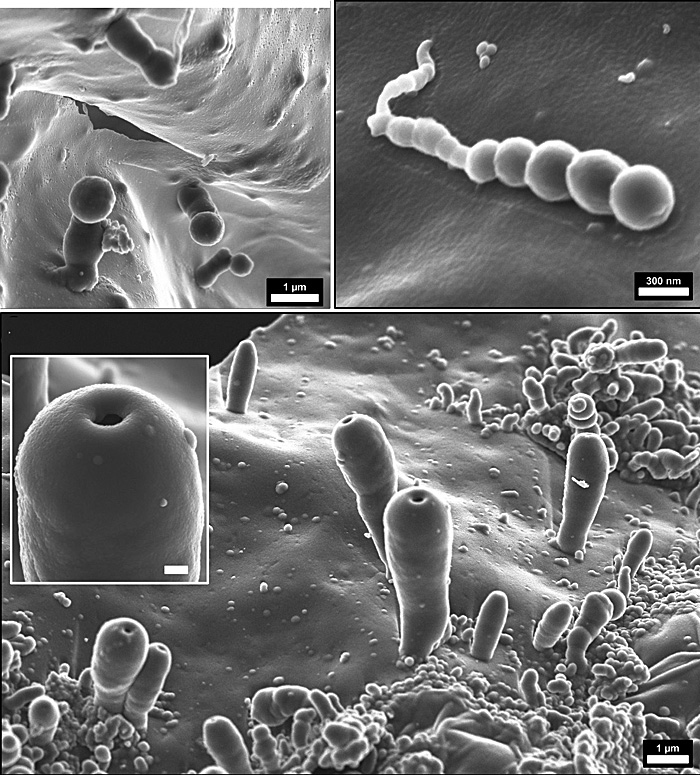
Biomorphs formed by polymerisation of HCN (Credit: Jenewein, C. et al 2024, Figure 2)

Jenewein and colleagues claim to have created cell-like structures, or ‘biomorphs’ at nanometre- and micrometre scale – spheres and polyp-like bodies – from a more plausible atmosphere of CO2 , H2O, and N2. These ‘protocells’ seem to have formed from minutely thin (150 to 3000 nanometres) polymer films built from hydrogen cyanide that grew  on the surface of the reaction chamber as electric discharges and UV light generated HCN and more complex ‘prebiotic’ chemicals. Apparently, these films were catalysed by SiO2 (silica) molecules from the glass reactor. Note:  In the Hadean breakdown of olivine to serpentinite as sea water reacted with ultramafic lavas would have released abundant silica. Serpentinisation also generates hydrogen. Intimate release of gas formed bubbles to create the spherical and polyp-like ‘protocells’. The authors imagine the Hadean global ocean permanently teeming with such microscopic receptacles. Such a veritable ‘primordial soup’ would be able to isolate other small molecules, such as amino acids, oligopeptides, nucleobases, and fatty acids, to generate more complex organic molecules in micro-reactors en route  to the kind of complex, self-sustaining systems we know as life.

So, is it possible to make a reasonable stab at what that first kind of life may have been? It was without doubt single celled. To reproduce it must have carried a genetic code enshrined in DNA, which is unique not only to all species, but to individuals. The key to tracking down LUCA is that it represents the point at which the evolutionary trees of the fundamental domains of modern life life – eukarya (including animals, plants and fungi), bacteria, and archaea – converge to a single evolutionary stem. There is little point in using fossils to resolve this issue because only multicelled life leaves tangible traces, and the first of those was found in 2,100 Ma old sediments in Gabon (see: The earliest multicelled life; July 2010). The key is using AI to compare the genetic sequences of the hugely diverse modern biosphere. Modern molecular phylogenetics and computing power can discern from their similarities and differences the relative order in which various species and broader groups split from others. It can also trace the origins of specific genes that provides clues about earlier genetic associations. Given a rate of mutation the modern differences provide estimates of when each branching occurred. The most recent genetic delving has been achieved by a consortium based at various institutions in Britain, the Netherlands, Hungary and Japan  (Moody, E.R.R. and 18 others 2024. The nature of the last universal common ancestor and its impact on the early Earth system. Nature Ecology & Evolution, v.8, pages 1654–1666; DOI: 10.1038/s41559-024-02461-1).

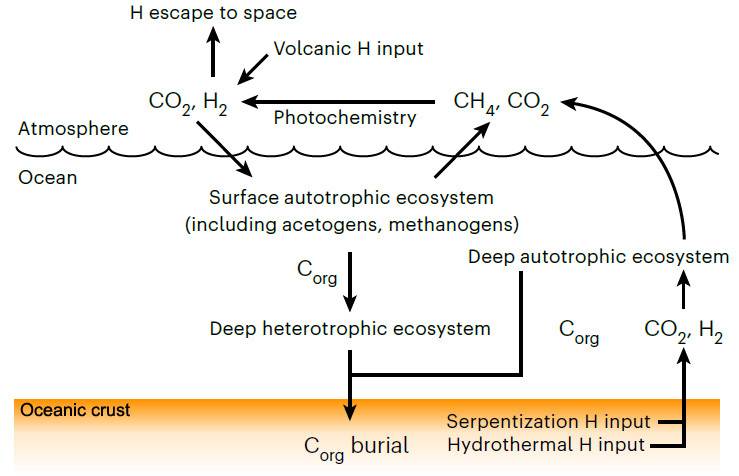
Moody et al have pushed back the estimated age of LUCA to halfway through the Hadean, between 4.09 to 4.33 billion years (Ga), well beyond the geologically known age of the earliest traces of life (3.5 Ga). That age for LUCA in itself is quite astonishing: it could have been only a couple of hundred million years after the Moon-forming interplanetary collision. Moreover, they have estimated that Darwin’s Ur-organism had a genome of around 2 million base pairs that encoded about 2600 proteins: roughly comparable to living species of bacteria and archaea, and thus probably quite advanced in evolutionary terms. The gene types probably carried by LUCA suggest that it may have been an anaerobic acetogen; i.e. an organism whose metabolism generated acetate (CH3COO) ions. Acetogens may produce their own food as autotrophs, or metabolise other organisms (heterotrophs). If LUCA was a heterotroph, then it must have subsisted in an ecosystem together with autotrophs which it consumed, possibly by fermentation. To function it also required hydrogen that can be supplied by the breakdown of ultramafic rocks to serpentinites, which tallies with the likely ocean-world with ultramafic igneous crust of the Hadean (see the earlier paragraphs about protocells). If an autotroph, LUCA would have had an abundance of CO2 and H2 to sustain it, and may have provided food for heterotrophs in the early ecosystem. The most remarkable possibility discerned by Moody et al is that LUCA may have had a kind of immune system to stave off viral infection.

The carbon cycle on the Hadean Earth (Credit: Moody et al. 2024; Figure 3e)

The Hadean environment was vastly different to that of modern times: a waterworld seething with volcanism; no continents; a target for errant asteroids and comets; more rapidly spinning with a 12 hour day; a much closer Moon and thus far bigger tides. The genetic template for the biosphere of the following four billion years was laid down then. LUCA and its companions may well have been unique to the Earth, as are their descendants. It is hard to believe that other worlds with the potential for life, even those in the solar system, could have followed a similar biogeochemical course. They may have life, but probably not as we know it  . . .

See also: Ball, P. 2025. Luca is the progenitor of all life on Earth. But its genesis has implications far beyond our planet. The Observer, 19 January 2025.

A fully revised edition of Steve Drury’s book Stepping Stones: The Making of Our Home World can now be downloaded as a free eBook

News about when subduction began

Tangible signs of past subduction take the form of rocks whose mineralogy shows that they have been metamorphosed under conditions of high pressure and low temperature, and then returned to the surface somehow. Ocean-crust basaltic rocks become blueschist and eclogite. The latter is denser than mantle peridotite so that oceanic lithosphere can sink and be recycled. That provides the slab-pull force, which is the major driver of plate tectonics. Unfortunately, neither blueschists nor eclogites are found in metamorphic complexes older than about 800 Ma. This absence of direct proof of subduction and thus modern style plate tectonics has resulted in lively discussion and research seeking indirect evidence for when it did begin, the progress of which since 2000 you can follow through the index for annual logs about tectonics. An interesting new approach emerged in 2017 that sought a general theory for the evolution of silicate planets, which involves the concept of ‘lid tectonics’. A planet in a stagnant-lid phase has a lithosphere that is weak as a result of high temperatures: indeed so weak and warm that subduction was impossible. Stagnant-lid tectonics does not recycle crustal material back to its source in the mantle and it simply builds up the lithosphere. Once planetary heat production wanes below a threshold level that permits a rigid lithosphere, parts of the lid can be driven into the mantle. The beginnings of this mobile-lid phase and thus plate tectonics of some kind involves surface materials in mantle convection: the may be recycled.

Cartoon of possible Hadean stagnant lid tectonics, dominated by mantle plumes. (Credit: Bédard, J.H. 2018, Fig 3B, DOI: 10.1016/j.gsf.2017.01.005)

A group of geochemists from China, Canada and Australia have sought evidence for recycled crustal rocks from silicon and oxygen isotopes in the oldest large Archaean terrane, the  4.0 Ga old Acasta Gneiss Complex in northern Canada (Zhang, Q. and 10 others 2023. No evidence of supracrustal recycling in Si-O isotopes of Earth’s oldest rocks 4 Ga ago. Science Advances, v.9, article eadf0693; DOI: 10.1126/sciadv.adf0693). Silicon has three stable isotopes 28Si, 29Si, and 30Si. As happens with a number of elements, various geochemical processes are able to selectively change the relative proportions of such isotopes: a process known as isotope fractionation. As regards silicon isotopes used to chart lithosphere recycling, the basic steps are as follows: Organisms that now remove silicon from solution in seawater to form their hard parts and accumulate in death as fine sediments like flint had not evolved in the Archaean. Because of that reasonable supposition it has been suggested that seawater during the Archaean contained far more dissolved silicon than it does now. Such a rich source of Si would have entered Archaean oceanic crust and ocean-floor sediments to precipitate silica ‘cement’. The heaviest isotope 30Si would have left solution more easily than the lighter two. Should such silicified lithosphere have descended to depths in the mantle where it could partially melt the anomalously high 30Si would be transferred to the resulting magmas.

Proportions of 30Si in zircons, quartz and whole rock for Acasta gneisses (coloured), other Archaean areas (grey) and Jack Hills zircons (open circles. Vertical lines are error bars. (Credit: simplified from Zhang et al. Fig 1)

Stable-isotope analyses by Zhang et al. revealed that zircon and quartz grains and bulk rock samples from the Acasta gneisses, with undisturbed U-Pb ages, contain 30Si in about the same proportions relative to silicon’s other stable isotopes as do samples of the mantle. So it seems that the dominant trondhjemite-tonalite-granodiorite (TTG) rocks that make up the oldest Acasta gneisses were formed by partial melting of a source that did not contain rocks from the ocean crust. Yet the Acasta Gneiss Complex also contains younger granitic rocks (3.75 to 3.50 Ga) and they are significantly more enriched in 30Si, as expected from a deep source that contained formerly oceanic rocks. A similar ‘heavy’ silicon-isotope signature is also found in samples from other Archaean terranes that are less than 3.8 Ga old. Thus a major shift from stagnant-lid tectonics to the mobile-lid form may have occurred at the end of the Hadean. But apart from the Acasta Gneiss Complex only one other, much smaller Hadean terrane has been discovered, the 4.2 Ga Nuvvuagittuq Greenstone Belt. It occupies a mere 20 km2 on the eastern shore of Hudson Bay in Canada, and appears to be a sample of Hadean oceanic crust. It does include TTG gneisses, but they are about 3.8 Ga old and contain isotopically heavy silicon. So it seems unlikely that testing this hypothesis with silicon-isotope data from other Hadean gneissic terranes will be possible for quite a while, if at all.

Evidence for an early Archaean transition to subduction

Modern plate tectonics is largely driven by slab-pull: a consequence of high-pressure, low-temperature metamorphism of the oceanic crust far from its origin at an oceanic ridge. As it ages, basaltic crust cools, become increasingly hydrated by hydrothermal circulation of seawater through it and its density increases. That is why the abyssal plains of the ocean floor are so deep relative to the shallower oceanic ridges where it formed. Due to the decrease in the Earth’s internal heat production by decay of radioactive isotopes, once oceanic lithosphere breaks and begins to descend high-P low-T metamorphism transforms the basaltic crust to a denser form: eclogite, in which the dense, anhydrous minerals garnet and sodium-rich pyroxene (omphacite) form. Depending on local heat flow, the entire oceanic slab may then exceed the density of the upper mantle to drag the plate downwards under gravity. Metamorphic reactions of any P-T regime creates minerals less capable of holding water and drive H2O-rich fluids upwards into the overriding lithosphere, thus inducing it to partially melt. Magmas produced by this create volcanism at the surface, either at oceanic island arcs or near to continental margins, depending on the initial position of the plate subduction.

A direct proof of active subduction in the geological record is the presence of eclogite and related blueschists. Such rocks are unknown before 2100 Ma ago (mid-Palaeoproterozoic of the Democratic Republic of Congo) but there are geochemical means of ‘sensing’ plate tectonic control over arc magmatism (See: So, when did plate tectonics start up? February 2016).  The relative proportions of rare-earth elements in ancient magmatic rocks that make up the bulk of continental crust once seemed to suggest that plate tectonics started at the end of the Archaean Eon (~2500 Ma). That method, however, was quite crude and has been superseded by looking in great detail at the geochemistry of the Earth’s most durable mineral: zircon (ZrSiO4), which began more than two decades ago. Minute grains of that mineral most famously have pushed back the geological record into what was long believed to be half a billion years with no suggestion of a history: the Hadean. Zircon grains extracted from a variety of ancient sediments have yielded U-Pb ages of their crystallisation from igneous magma that extend back 4.4 billion years (Ga) (see: Pushing back the “vestige of a beginning”;January 2001).  

Though simple in their basic chemical formula, zircons sponge-up a large range of other trace elements from their parent magma. So, in a sense, each tiny grain is a capsule of their geochemical environment at the time they crystallised. In 2020 Australian geochemists presented the trace-element geochemistry of 32 zircons extracted from a 3.3 Ga old sedimentary conglomerate in the Jack Hills of Western Australia, which lie within an ancient continental nucleus or craton. They concluded that those zircons mainly reveal that they formed in andesitic magmas, little different from the volcanic rocks that are erupted today above subduction zones. From those data it might seem that some form of plate tectonics has been present since shortly after the Earth’s formation. Oxygen-isotope data from zircons are useful in checking whether zircons had formed in magmas derived directly from partial melting of mantle rocks or by recycling of crustal magmatic rocks through subduction. Such a study in 2012 (see: Charting the growth of continental crust; March 2012) that used a very much larger number of detrital zircon grains from Australia, Eurasia, North America, and South America seemed, in retrospect, to contradict a subduction-since-the-start view of Earth dynamics and crust formation. Instead it suggested that recycling of crust, and thus plate-tectonic subduction, first showed itself in zircon geochemistry at about 3 Ga ago.

Detailed chemical and isotopic analysis of zircons using a variety of instruments has steadily become faster and cheaper. Actually finding the grains is much easier than doing interesting things with them. It is a matter of crushing the host rock to ‘liberate’ the grains. Sedimentary hosts that have not been strongly metamorphosed are much more tractable than igneous rocks. Being denser than quartz, the dominant sedimentary mineral, zircon can be separated from it along with other dense, trace minerals, and from them in turn by various methods based on magnetic and electrical properties. Zircons can then be picked out manually because of their distinctive colours and shapes. A tedious process, but there are now several thousand fully analysed zircons aged between 3.0 to 4.4 Ga, from eleven cratons that underpin Australia, North America, India, Greenland and southern Africa. The latest come from a sandstone bed laid down about 3.31 Ga ago in the Barberton area of South Africa (Drabon, N. et al. 2022. Destabilization of Long‐Lived Hadean Protocrust and the Onset of Pervasive Hydrous Melting at 3.8 GaAGU Advances, v. 3, article e2021AV000520; DOI: 10.1029/2021AV000520). The authors measured lutetium (Lu), hafnium (Hf) and oxygen isotopes, and concentrations of a suite of trace element in 329 zircons from Barberton dated between 3.3 to 4.15 Ga.

A schematic model of transition from Hadean-Eoarchaean lid tectonics to a type of plate tectonics that subsequently evolved to its current form, based on hafnium isotope data in ancient zircons (credit: Bauer et al. 2020; Fig 3)

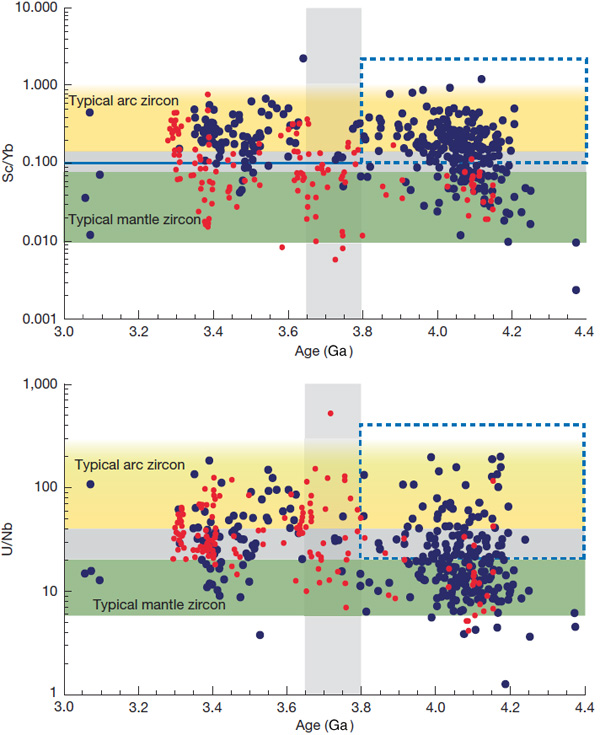
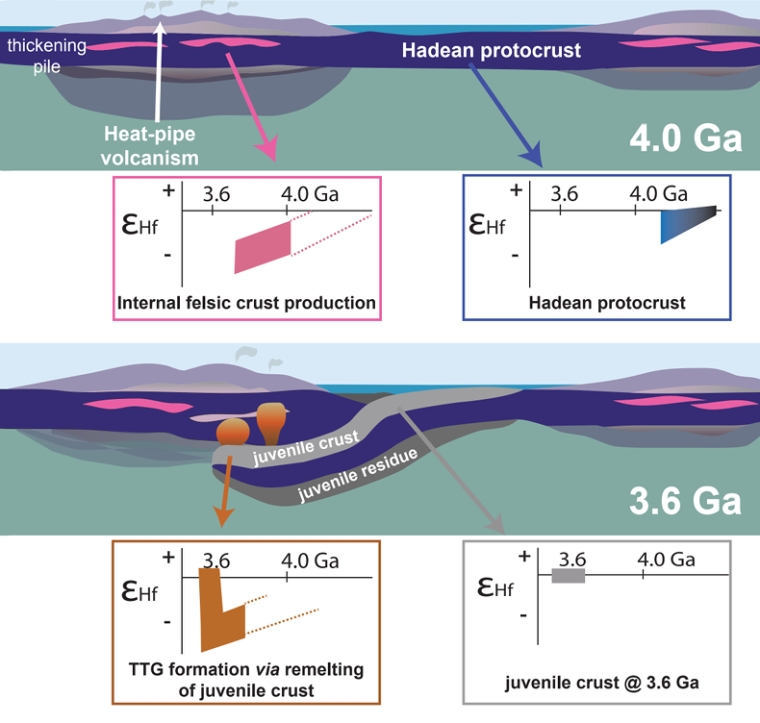
The Hf isotopes show two main groups relative to the values for chondritic meteorites (assumed to reflect the composition of the bulk Earth). Zircons dated between 3.8 and 4.15 Ga all show values below that expected for the whole Earth. Those between 3.3 and 3.8 Ga show a broader range of values that extend above chondritic levels. The transition in data at around 3.8 Ga is also present in age plots of uranium relative to niobium and scandium relative to ytterbium, and to a lesser extent in the oxygen isotope data. On the basis of these data, something fundamentally changed in the way the Earth worked at around 3.8 Ga. Nadja Drabon and colleagues ascribe the chemical features of Hadean and Eoarchaean zircons to an early protocrust formed by melting of chemically undepleted mantle. This gradually built up and remained more or less stable for more than 600 Ma, without being substantially remelted through recycling back to mantle depths. After 3.8 billion years ago, geochemical signatures of the zircons start showing similarities to those of zircons derived from modern subduction zones. Hf isotopes and trace-element geochemistry in 3.6 to 3.8 Ga-old  detrital zircons from other cratons are consistent with a 200 Ma transition from ‘lid’ tectonics (see: Lid tectonics on Earth; December 2017) to the familiar tectonics of rigid plates whose basalt-capped lithosphere ultimately returns to the mantle to be involved in formation of new magmas from which continental crust stems. Parts of plates bolstered by this new, low density crust largely remain at the surface.

While Drabon et al. do provide new data from South Africa’s Kaapvaal craton, their conclusions are similar to earlier work by other geochemists based on data from other area (e.g. Bauer, A.M. et al. 2020. Hafnium isotopes in zircons document the gradual onset of mobile-lid tectonicsGeochemical Perspectives Letters, v. 14; DOI: 10.7185/geochemlet.2015), which the accompanying figure illustrates.

See also: Earliest geochemical evidence of plate tectonics found in 3.8-billion-year-old crystal. Science Daily, 21 April 2022. 3.8-Billion-Year-Old Zircons Offer Clues to When Earth’s Plate Tectonics Began. SciNews, 26 April 2022

Evidence for oldest microbes from Arctic Canada

Among the oldest known rocks are metamorphosed pillow basalts on Nuvvuagittuk Island in Quebec on the east side of Hudson Bay, Canada. They contain red and orange, iron-rich sediments probably formed by hydrothermal activity associated with sea water passing through hot basalts. The ironstones are made of silica in the form of jasper (SiO2) and carbonates that are coloured by hematite (Fe2O3). This rock sequence is cut by silica-rich intrusive igneous rocks dated between 3750 and 3775 Ma: a minimum, Eoarchaean age for the sequence. This is roughly the same as the age of the famous Isua supracrustal rocks of West Greenland, but dating of the basalts using the samarium–neodymium method suggested that they formed in the Hadean about 4300 Ma ago, which would make them by far the oldest known rocks. However, that date clashes with a zircon U-Pb age of 3780 Ma for associated metasedimentary mica schists: a still ‘live’ controversy. The ironstones have been suggested to contain signs of life, in the form of minute tubes and filaments similar to those formed in modern hydrothermal vents by iron-oxidising bacteria (see: Earliest hydrothermal vent and evidence for life, March 2017). If that can be proven this would push back the age of the earliest known life by at least 300 Ma and maybe far more if the Hadean Sm-Nd age is confirmed

The Nuvvuagittuk material has recently been re-examined by its original discoverers using a variety of advanced microscope techniques (Papineau, D. et al 2022. Metabolically diverse primordial microbial communities in Earth’s oldest seafloor-hydrothermal jasper. Science Advances, v. 8, article 2296; DOI: 10.1126/sciadv.abm2296.). The most revealing of these involve two very-high resolution imaging systems: X-ray micro-tomography and electron microscopy armed with a focused ion beam that repeatedly shaves away 200 nm of rock from a sample. Both build up highly detailed 3-D images of any minute structures within a sample. The techniques revealed details of twisted filaments, tubes, knob-like and branching structures up to a centimetre long. While the first three could possibly have some inorganic origin, a ‘comb-like’ branch, likened to a moth’s antenna, has never been known to have formed by chemical reactions alone.

An image of hematite tubes from microfossils discovered in hydrothermal vent precipitates in the Nuvvuagittuk ironstones, reconstructed from X-ray and ion-beam micro-tomography (credit: Matthew Dodd, UCL)

All the structures are formed from hematite within a silica or carbonate (mainly calcite CaCO3 and ankerite Ca(Fe,Mg,Mn)(CO3)2) matrix. Some of the hematite (dominated by Fe3+) contains significant amounts of reduced Fe2+. The structures also contain tiny grains of graphite (C), phosphate (apatite Ca5(PO4)3(F,Cl,OH)) and various metal (Mn, Co, Cu, Zn, Ni, Cd) sulfides. The presence of graphite obviously suggests – but does not prove – a biological origin. However, all Phanerozoic jaspers formed from hydrothermal fluids contain undisputed organic material and appear little different from these ancient examples. Filaments, tubes and comb-like structures are displayed by various iron-oxidising bacteria found living in modern sea-floor hydrothermal vent systems. The sulfur isotopes in metal sulfides suggest their formation in an environment with vanishingly low oxygen content. Carbon isotopes in graphite are more enriched in light 12C relative to 13C than those in associated carbonates, a feature produced by living organic processes today. Patterns in plots of rare-earth elements (REE) from the Nuvvuagittuk jaspers are similar to those from modern examples and suggest high-temperature interactions between sea water and basaltic igneous rocks.

It is clear from the paper just how comprehensively the team of authors have considered and tested various biotic and abiotic options for the origin of the features found in the Nuvvuagittuk jasper samples. They conclude that they probably do represent an ancient microbial ecosystem associated with sea-floor hydrothermal vents; a now widely supported scenario for the origin of life on Earth. But what metabolic processes did the Nuvvuagittuk microbes use? Their intimate association with Fe3+ oxides that contain some reduced Fe2+ suggests that they exploited chemical ‘energy’ from oxidation reactions that acted on Fe2+ dissolved in hydrothermal fluids. This would have been impossible by inorganic means because of the very low oxygen content of seawater shown by the sulfur isotopes in associated sulfide minerals. Iron oxidation and precipitation of iron oxide by organic processes must have involved dissociation of water to yield the necessary oxygen and loss of electrons from available Fe2+, a process used by modern deep-water bacteria that depends on the presence of nitrates. That can power the metabolism of inorganic carbon dissolved in water as, for instance, bicarbonate ions and water to yield cell-building carbohydrates: a form of autotrophy. There may have been other metabolic routes, such as reducing dissolved sulfate ions to sulfur, as suggested by the association of metal sulfides. If the sea floor was shallow enough to be lit CO2 and water may have been converted to carbohydrates by a form of photosynthesis that does not release oxygen, analogous to modern purple bacteria.

There may have been considerable biodiversity in the Nuvvuagittuk ecosystem. So despite its vast age – it may have been active only 300 Ma after the Earth formed, if the oldest date is verified – it has to be remembered that a great many earlier evolutionary steps, both inorganic and organic, must have been accomplished to have allowed these organisms to exist. The materials do not signify the origin of life, but life that was chemically extremely sophisticated: far more so than anything attempted so far in laboratories to figure out the tricks performed by natural inorganic systems. DNA and RNA alone are quite a challenge!

See also: Video by authors of the paper (YouTube) Diverse life forms may have evolved earlier than previously thought. ScienceDaily, 13

Earliest plate tectonics tied down?

Papers that ponder the question of when plate tectonics first powered the engine of internal geological processes are sure to get read: tectonics lies at the heart of Earth science. Opinion has swung back and forth from ‘sometime in the Proterozoic’ to ‘since the very birth of the Earth’, which is no surprise. There are simply no rocks that formed during the Hadean Eon of any greater extent than 20 km2. Those occur in the 4.2 billion year (Ga) old Nuvvuagittuq greenstone belt on Hudson Bay, which have been grossly mangled by later events. But there are grains of the sturdy mineral zircon ZrSiO4)  that occur in much younger sedimentary rocks, famously from the Jack Hills of Western Australia, whose ages range back to 4.4 Ga, based on uranium-lead radiometric dating. You can buy zircons from Jack Hills on eBay as a result of a cottage industry that sprang up following news of their great antiquity: that is, if you do a lot of mineral separation from the dust and rock chips that are on offer, and they are very small. Given a laser-fuelled SHRIMP mass spectrometer and a lot of other preparation kit, you could date them. Having gone to that expense, you might as well analyse them chemically using laser ablation inductively coupled plasma mass spectrometry (LA-ICP-MS) to check out their trace-element contents. Geochemist Simon Turner of Macquarie University in Sydney, Australia, and colleagues from Curtin University in Western Australia and Geowissenschaftliches Zentrum Göttingen in Germany, have done all this for 32 newly extracted Jack Hills zircons, whose ages range from 4.3 to 3.3 Ga (Turner, S. et al. 2020. An andesitic source for Jack Hills zircon supports onset of plate tectonics in the HadeanNature Communications, v. 11, article 1241; DOI: 10.1038/s41467-020-14857-1). Then they applied sophisticated geochemical modelling to tease out what kinds of Hadean rock once hosted these grains that were eventually eroded out and transported to come to rest in a much younger sedimentary rock.

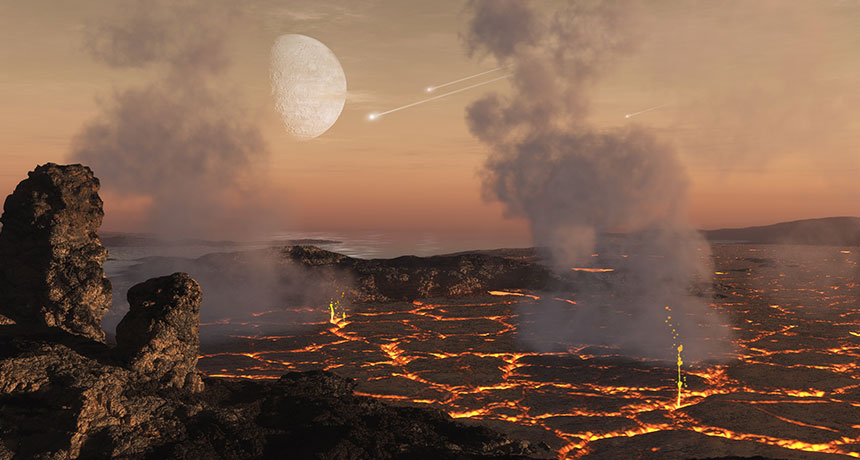
Artist’s impression of the old-style hellish Hadean (Credit : Dan Durday, Southwest Research Institute)

Zircons only form duuring the crystallisation of igneous magmas, at around 700°C, the original magma having formed under somewhat hotter conditions – up to 1200°C for mafic compositions. In the course of their crystallising, minerals take in not only the elements of which they are mainly composed, zirconium, silicon and oxygen in the case of zircon , but many other elements that the magma contains in low concentrations. The relative proportions of these trace elements that are partitioned from the magma into the growing mineral grains are more or less constant and unique to that mineral, depending on the particular composition of the magma itself. Using the proportions of these trace elements in the mineral gives a clue to the original bulk composition of the parent magma. The Jack Hills zircons  mainly  reflect an origin in magmas of andesitic composition, intermediate in composition between high-silica granites and basalts that have lower silica contents. Andesitic magmas only form today by partial melting of more mafic rocks under the influence of water-rich fluid driven upwards from subducting oceanic lithosphere. The proportions of trace elements in the zircons could only have formed in this way, according to the authors.

Interestingly, the 4.2 Ga Nuvvuagittuq greenstone belt contains metamorphosed mafic andesites, though any zircons in them have yet to be analysed in the manner used by Turner et al., although they were used to date those late-Hadean rocks. The deep post-Archaean continental crust, broadly speaking, has an andesitic composition, strongly suggesting its generation above subduction zones. Yet that portion of Archaean age is not andesitic on average, but a mixture of three geochemically different rocks. It is referred to as TTG crust from those three rock types (trondhjemite, tonalite and granodiorite). That TTG nature of the most ancient continental crust has encouraged most geochemists to reject the idea of magmatic activity controlled by plate tectonics during the Archaean and, by extension, during the preceding Hadean. What is truly remarkable is that if mafic andesites – such as those implied by the Jack Hills zircons and found in the Nuvvuagittuq greenstone belt – partially melted under high pressures that formed garnet in them, they would have yielded magmas of TTG composition. This, it seems, puts plate tectonics in the frame for the whole of Earth’s evolution since it stabilised several million years after the catastrophic collision that flung off the Moon and completely melted the outer layers of our planet. Up to now, controversy about what kind of planet-wide processes operated then have swung this way and that, often into quite strange scenarios. Turner and colleagues may have opened a new, hopefully more unified, episode of geochemical studies that revisit the early Earth . It could complement the work described in An Early Archaean Waterworld published on Earth-logs earlier in March 2020.

A unifying idea for the origin of life

The nickel in stainless steel, the platinum in catalytic converters and the gold in jewellery, electronic circuits and Fort Knox should all be much harder to find in the Earth’s crust. Had the early Earth formed only by accretion and then the massive chemical resetting mechanism of the collision that produced the Moon all three would lie far beyond reach. Both formation events would have led to an extremely hot young Earth; indeed the second is believed to have left the outer Earth and Moon completely molten. All three are siderophile metals and have such a strong affinity for metallic iron that they would mostly have been dragged down to each body’s core as it formed in the early few hundred million years of the Earth-Moon system, leaving very much less in the mantle than rock analyses show. This emerged as a central theme at the Origin of Life Conference held in Atlanta GA, USA in October 2018. The idea stemmed from two papers published in 2015 that reported excessive amounts in basaltic material from both Earth and Moon of a tungsten isotope (182W) that forms when a radioactive isotope of hafnium (182Hf), another strongly siderophile metal, decays. Hafnium too must have been strongly depleted in the outer parts of both bodies when their cores formed. The excesses are explained by substantial accretion of material rich in metallic iron to their outer layers shortly after Moon-formation, some being in large metallic asteroids able to penetrate to hundreds of kilometres. Hot iron is capable of removing oxygen from water vapour and other gases containing oxygen, thereby being oxidised. The counterpart would have been the release of massive amounts of hydrogen, carbon and other elements that form gases when combined with oxygen. The Earth’s atmosphere would have become highly reducing.

Had the atmosphere started out as an oxidising environment, as thought for many decades, it would have posed considerable difficulties for the generation at the surface of hydrocarbon compounds that are the sine qua non for the origin of life. That is why theories about abiogenesis (life formed from inorganic matter) hitherto have focussed on highly reducing environments such as deep-sea hydrothermal vents where hydrogen is produced by alteration of mantle minerals. The new idea revitalises Darwin’s original idea of life having originated in ‘a warm little pond’. How it has changed the game as regards the first step in life, the so-called ‘RNA World’ can be found in a detailed summary of the seemingly almost frenzied Origin of Life Conference (Service, R.F. 2019. Seeing the dawn. Science, v. 363, p. 116-119; DOI: 10.1126/science.363.6423.116).

Isotope geochemistry has also entered the mix in other regards, particularly that gleaned from tiny grains of the mineral zircon that survived intact from as little as 70 Ma after the Moon-forming and late-accretion events to end up (3 billion years ago) in the now famous Mount Narryer Quartzite of Western Australia. The oldest of these zircons (4.4 Ga) suggest that granitic rocks had formed the earliest vestiges of continental crust far back in the Hadean Eon: Only silica-rich magmas contain enough zirconium for zircon (ZrSiO4) to crystallise. Oxygen isotope studies of them suggest that at that very early date they had come into contact with liquid water, presumably at the Earth’s surface. That suggests that perhaps there were isolated islands of early continental materials; now vanished from the geological record. A 4.1 Ga zircon population revealed something more surprising: graphite flakes with carbon isotopes enriched in 12C that suggests the zircons may have incorporated carbon from living organisms.

407458aa.2
A possible timeline for the origin of life during the Hadean Eon (Credit: Service, R.F. 2019, Science)

Such a suite of evidence has given organic chemists more environmental leeway to suggest a wealth of complex reactions at the Hadean surface that may have generated the early organic compounds needed as building blocks for RNA, such as aldehydes and sugars (specifically ribose that is part of both RNA and DNA), and the amino acids forming the A-C-G-U ‘letters’ of RNA, some catalysed by the now abundant siderophile metal nickel. One author seems gleefully to have resurrected Darwin’s ‘warm little pond’ by suggesting periodic exposure above sea level of abiogenic precursors to volcanic sulfur dioxide that could hasten some key reactions and create large masses of such precursors which rain would have channelled into ‘puddles and lakes’. The upshot is that the RNA World precursor to the self-replication conferred on subsequent life by DNA is speculated to have been around 4.35 Ga, 50 Ma after the Earth had cooled sufficiently to have surface water dotted with specks of continental material.

There are caveats in Robert Services summary, but the Atlanta conferences seems set to form a turning point in experimental palaeobiology studies.

Read more on Palaeobiology and Planetary science

Hadean potentially fertile for life

The earliest incontrovertible signs of life on Earth are in the 3.48 billion-year-old Dresser Formation in the Pilbara craton of Western Australia, which take the form of carbon-coated, bubble-like structures in fine-grained silica sediments ascribed to a terrestrial hot-spring environment. In the same Formation are stromatolites that are knobbly, finely banded structures made of carbonates. By analogy with similar structures being produced today by bacterial mats in a variety of chemically stressed environments that are inhospitable for multicelled organisms that might know them away, stromatolites are taken to signify thriving, carbonate secreting bacteria. There are also streaks of carbon associated with wave ripples that may have been other types of biofilm. A less certain record of the presence of life are stromatolite-like features in metasediments from the Isua supracrustal belt of West Greenland, dated at around 3.8 Ga, which also contain graphite with carbon-isotopic signs that it formed from biogenic carbon. Purely geochemical evidence that carbonaceous compounds may have formed in living systems are ambiguous since quite complex hydrocarbons can be synthesised abiogenically by Fischer-Tropsch reactions between carbon monoxide and hydrogen.

At present there is little chance of extending life’s record further back in time than four billion years because the Hadean is mainly represented by pre 4 Ga ages of zircon grains found in much younger sedimentary rocks – resistant relics of Hadean crustal erosion. The eastern shore of Hudson Bay does preserve a tiny (20 km2) patch of metamorphosed basaltic igneous rocks, known as the Nuvvuagittuq Greenstone Belt. Dated at 3.77 Ga by one method but 4.28 Ga by another, this could be Hadean. Like the Isua sequence that in Quebec also contains metasediments, including banded ironstones with associated iron-rich hydrothermal deposits. Silica from the vent system shows dramatically lifelike tubules. Yet the ambiguity in dating upsets any claims to genuine Hadean life. There has also been a physical stumbling block to the notion that life may have originated and thrived during the Hadean: the bombardment record.

English: An outcrop of metamorphosed volcanose...
Metamorphosed volcanosedimentary rocks from the Nuvvuagittuq supracrustal belt, Canada. Some of these rocks contain quite convincing examples of fossil cells. (credit: Wikipedia)

While oxygen-isotope data from 4.4 Ga zircons hints strongly at subsurface and perhaps surface water on Earth at that time, continued accretion of large planetesimals would have created the hellish conditions associated with the name of the first Eon in Earth’s history. Liquid water is essential for life to have formed, on top of a supply of the essential biological elements C, H, O, N, P and S. The sheer amount of interstellar dust that accompanied the Hadean impact record would have ensured fertile chemical conditions, but would the surface and near-surface of the early Earth have remained continually wet? Judging by the lunar surface and that of other bodies in the solar system, after the cataclysmic events that formed the Moon, many Hadean impacts on Earth were in the range of 100 to 1000 km across, with a Late Heavy Bombardment (LHB)that not only increased the intensity of projectile delivery but witnessed the most energetic single events such as those that created the lunar maria and probably far larger structures on Earth. The thermal energy, accompanied, by incandescent silicate vapour ejected from craters, may have evaporated oceans and even subsurface water with calamitous consequences for early life or prebiotic chemistry. Until 2017 no researchers had been able to model the energetic of the Hadean convincingly.

After assessing the projectile flux up to and through the LHB, and the consequent impact heating Bob Grimm and Simone Marchi of the Southwest Research Institute in Boulder, Colorado modelled the likely thermal evolution of the outer Earth through the Hadean. This allowed them to calculate the likely thermal gradients in the near-surface, the volumes of rock each event would have affected and the times taken for cooling after impacts (Grimm, R.E. & Marchi, S. 2018. Direct thermal effects of the Hadean bombardment did not limit early subsurface habitability. Earth and Planetary Science Letters, v. 485, p. 1-9; doi:10.1016/j.epsl.2017.12.043). They found that subsurface ‘habitability’ would have grown continuously throughout the Hadean, even during the worst events of the LHB. Sterilizing Earth and thus destroying and interrupting any life processes could only have been achieved by ten times more projectiles arriving ten times more frequently over the 600 Ma history of the Hadean and LHB. Although surface water may have been evaporated by impact-flash heating and vaporized silicate ejecta, the subsurface would have been wet at least somewhere on the early Earth. Provided it either originated in or colonised surface sedimentary cover it would have been feasible for life to have survived the Hadean. However, nobody knows how long it would have taken for the necessary accumulation of prebiotic chemicals and to achieve the complex sequence of processes that lead to nucleic acids encapsulated in cells and thus self-replication and life itself.

Steam-bath Earth

The Earth’s mantle probably contained a significant amount of water from the start. Its earliest history was one of intense bombardment, including the impact that formed the Moon. Together with the conversion of gravitational potential energy to heat while the core was settling out from the mantle, impacts would have kept its overall temperature high enough to prevent water vapour from condensing on the surface until such heat input ceased and heat loss by radiation allowed the surface rapidly to cool. The atmosphere would have been rich in water vapour. Evidence from zircons that are the earliest tangible materials yet recovered hint at the formation of Zr-rich magmas – probably granitic in the broad sense – about 100 Ma after the Moon-forming event (see EPN July 2001: Zircons’ window on the Hadean). Yet no trace of substantial granitic rocks that old have ever been found.

Don Baker and Kassandra Sofonio of McGill University in Montreal, Canada have considered processes other than partial melting or fractional crystallisation that may have been possible during the earliest Hadean. In particular they have looked at one thought once to be a contender in the genesis of granite and latterly sidelined (Baker, D.R. & Sofonio, K. 2017. A metasomatic mechanism for the formation of Earth’s earliest evolved crust. Earth and Planetary Science Letters, v. 463, p. 48-55; http://dx.doi.org/10.1016/j.epsl.2017.01.022 ). They heated powdered artificial samples that chemically resembled the Earth’s original silicate mantle in sealed double capsules – an inner part containing the silicate powder and an outer one containing water. The capsules were held at around 727°C for a time and then quenched. The outer part of each capsule was found to be a glass of roughly granite composition. The experimental design ensured that superheated water diffused across the inner-outer capsule wall. So the ‘granite’ must have formed by a metasomatic process – essentially preferential solution of its component elements in supercritical water – the experimental temperature being insufficient to partially melt the ultramafic charge in the inner capsule.

Baker and Sofonio conclude that degassing of this metasomatic fluid – silicate-rich ‘steam’ – may have produced substantial masses of sialic crust on the Earth’s surface. Removal of material produced in such a manner would also have extracted trace elements with an affinity for granite from the early mantle – so-called incompatible elements. The subsequent recycling of such granitic blobs back into the mantle may explain geochemical signs in >500 Ma younger Archaean crust – produced by ‘normal’ igneous processes – of incompatible-element enriched reservoirs in the Early mantle.

Archaean continents derived from Hadean oceanic crust

As DNA is to tracing  human evolution and migration, so various isotope systems are to the evolution of the Earth. One of the most fruitful is the samarium-neodymium (Sm-Nd) system. The decay of 147Sm to 143Nd is used in dating rocks across the full range of Earth history, given coeval rocks with a suitable range of Sm/Nd ratios, because the decay has a long half life (1.06 x 10¹¹ years). However, samarium has another radioactive isotope 147Sm with a half life that is a thousand times shorter (1.06 x 10⁸ years). So it remains only as a minute proportion of the total Sm in rocks, most having decayed since it was formed in a pre-Solar System supernova. But its daughter isotope 142Nd is present in easily measurable quantities, having accumulated from 147Sm decay over the first few hundred million years of Earth’s history; i.e. during the Hadean and earliest Archaean Eons. It is this fact that allows geochemists to get an indirect ‘handle’ on events that took place in the Earth’s earliest, largely vanished history. The principle behind this approach is that when an ancient rock undergoes partial melting to produce a younger magma the rock that crystallizes from it inherits the relative proportions of Nd isotopes of its source and thereby carries a record of the earlier history.

English: An outcrop of metamorphosed volcanose...
Metamorphosed volcanosedimentary rocks from the Porpoise Cove locality, Nuvvuagittuq supracrustal belt, Canada. Possibly the oldest rocks on Earth. (credit: Wikipedia)

The eastern shore of Hudson Bay in Canada hosts the oldest tangible geology known, in form of some metamorphosed basaltic rocks dated at 4200 Ma old known as the Nuvvuagittuq Greenstone Belt – the only known Hadean rocks. They occur in a tiny (20 km2) patch associated with gneisses of tonalite-trondjhemits-granodiorite composition that are dated between 3760 and 3350 Ma. Engulfing both are younger (2800 to 2500 Ma) Archaean plutonic igneous rocks of felsic composition. Jonathan O’Neil and Richard Carlson of the University of Ottawa, Canada and the Carnegie Institution for Science, Washington DC, USA respectively, measured proportions of Nd isotopes in both sets of felsic igneous rocks (O’Neil, J. & Carlson, R.W. 2017. Building Archean cratons from Hadean mafic crust. Science, v. 355, p. 1199-1202; doi:10.1126/science.aah3823).

The oldest gneisses contained relative proportions of 142Nd commensurate with them having been formed by partial melting of the Hadean mafic rocks about a few hundred million years after they had been erupted to form the oldest known crust; no surprise there. However, the dominant components of the local continental crust that are about a billion years younger also contain about the same relative proportions of 142Nd. A reasonable conclusion is that the Archaean continental crust of NE Canada formed by repeated melting of mafic crust of Hadean age over a period of 1.5 billion years. The modern Earth continually replenishes its oceanic crust over about 200 Ma due to plate tectonics. During the Archaean mantle dynamics would have been driven faster by much higher internal heat production. Had this involved simply faster plate tectonics the outermost skin of mafic crust would have been resorbed into the mantle even faster. By the end of the Archaean (2500 Ma) barely any Hadean crust should have been available to produce felsic magmas. But clearly at least some did linger, adding more weight to the idea that plate tectonics did not operate during the Hadean and Archaean Eons. See Formation of continents without subduction below.