Evolution of pigmentation in anatomically modern humans of Europe: a new paradigm?

The colours of human skin, eyes and hair in living people across the world are determined by variants of genes (alleles) found at the same place on a chromosome. Since chromosomes are inherited from both mother and father, an individual may have the same two alleles (homozygous), or one of each (heterozygous). A dominant allele is always expressed, even if a single copy is present. A recessive allele is only expressed if the individual inherits two copies of it. Most characteristics of individuals result from the interaction of multiple genes, rather than a single gene. A commonly cited example is the coloration of eyes. If we had a single gene for eye colour – that of the iris – that had alleles just for blue (recessive or ‘b’) and one for brown (dominant or ‘B) pigmentation, brown-eyed individuals would have one or two ‘B’ alleles (bB or BB), whereas those with blue eyes would have to have two ‘blue’ alleles (bb). But inheritance is more complicated than that: there are people with green, hazel or grey eyes and even left- and right eyes of different colour. Such examples suggest that there are more than two genes affecting human eye colour, and each must have evolved as a result of mutations. Much the same goes for hair and skin coloration.

A group of scientists from the University of Ferrara in Italy have analysed highly detailed ancient DNA in anatomically modern human remains from Russia (Palaeolithic), Sweden (Mesolithic) and Croatia (Neolithic) to tease out the complexities of pigmentation inheritance. Then they applied a statistical approach learned from that study to predict the likely skin-, eye- and hair pigmentation in 348 less detailed genomes of ancient individuals whose remains date back to 45 Ma ( Silvia Perretti et al, 2025. Inference of human pigmentation from ancient DNA by genotype likelihood. Proceedings of the National Academy of Science, v. 122, article e2502158122; DOI: 10.1073/pnas.2502158122).

An artist’s impression of a Mesolithic woman from southern Denmark (credit: Tom Bjorklund)

All the hunter-gatherer Palaeolithic individuals (12 samples between 45 and 13 ka old) bar one, showed clear signs of dark pigmentation in skin, eyes and hair – the outlier from Russia was probably lighter. Those from the Mesolithic (14 to 4 ka) showed that 11 out of 35 had a light eye colour (Northern Europe, France, and Serbia), but most retained the dark skin and hair expected in descendants of migrants from Africa. Only one 12 ka hunter-gatherer from Sweden had inferred blue eyes, blonde hair, and light skin.  The retention of dark pigmentation by European hunter-gatherers who migrated there from Africa has been noted before, using DNA from Mesolithic human remains and in one case from birch resin chewed by a Mesolithic woman. This called into question the hypothesis that high levels of melatonin in skin, which protects indigenous people in Africa from cancers, would result in their producing insufficient vitamin D for good health. That notion supposed that out-of-Africa migrants would quickly evolve paler skin coloration at higher latitudes. It is now known that diets rich in meat, nuts and fungi – staple for hunter-gatherers – provide sufficient vitamin-D for health at high latitudes. A more recent hypothesis is that pale skins may have evolved only after the widespread Neolithic adoption of farming when people came to rely on a diet dominated by cereals that are a poor source of vitamin-D.

However, 132 Neolithic farmers (10 to 4 ka ago) individuals studied by Perretti et al. showed increased diversity in pigmentation, with more frequent light skin tones, yet dark individuals persisted, particularly in southern and eastern Europe. Hair and eye colour showed considerable variability, the earliest sign of red hair showing up in Turkey. Even Copper- and Bronze Age samples ( 113 from 7 to 3 ka) and those from Iron Age Europeans (25 from 3 to 1.7 ka ago) still indicate common retention of dark skin, eyes and hair, although the proportion of lighter pigmentation increased in some regions of Europe. Other analyses of ancient DNA have shown that the Palaeo- and Mesolithic populations of Europe were quickly outnumbered by influx of early farmers, probably from the Anatolian region of modern Turkey, during the Neolithic. The farming lifestyle seems likely to have allowed the numbers of those who practised it to rise beyond the natural environment’s ‘carrying capacity’ for hunter-gatherers. The former inhabitants of Europe may simply have been genetically absorbed within the growing population of farmers. Much the same absorption of earlier groups seems to have happened with the westward migration from the Ukrainian and Russia steppes of the Yamnaya people and culture, culminating in the start of the European Bronze Age that reached western Europe around 2.1 ka, The Yamnaya introduced metal culture, horse-drawn wheeled vehicles and possibly Indo-European language.

So the novel probabilistic approach to ancient DNA by Perretti et al. also casts doubt on the diet-based evolution of light pigmentation at high latitudes. Instead, pulses of large population movements and thus changes in European population genetics probably account for the persistence of abundant evidence for dark pigmentation throughout Europe until historic times. The ‘lightening’ of Europeans’ physiognomy seems to have been vastly more complex than previously believed. Early Europe seems to have been almost bewilderingly diverse, which make a complete mockery of modern chauvinism and racism. The present European genetic ‘melting pot’ is surprisingly similar to that of Europe’s ancient past.

The earliest known human-Neanderthal relations

The first anatomically modern humans (AMH) known to have left their remains outside of Africa lived about 200 ka ago in Greece and the Middle East. They were followed by several short-lived migrations that got as far as Europe, leaving very few fossils or artefacts. Over that time Neanderthals were continually present. Migration probably depended on windows of opportunity controlled by pressures from climatic changes in Africa and sea level being low enough to leave their heartland: perhaps as many as 8 or 9 before 70 ka, when continuous migration out of Africa began. The first long-enduring AMH presence in Europe began around 47 ka ago.

For about 7 thousand years thereafter – about 350 generations – AMH and Neanderthals co-occupied Europe. Evidence is growing that the two groups shared technology. After 40 ka there are no tangible signs of Neanderthals other than segments of their DNA that constitute a proportion of the genomes of modern non-African people. They and AMH must have interbred at some time in the last 200 ka until Neanderthals disappeared. In the same week in late 2024 two papers that shed much light on that issue were published in the leading scientific journals, Nature and Science, picked up by the world’s news media. Both stem from research led by researchers at the Max Planck Institute for Evolutionary Anthropology in Leipzig, Germany. They focus on new DNA results from the genomes of ancient and living Homo sapiens. One centred on 59 AMH fossils dated between 45 and 2.2 ka and 275 living humans (Iasi, L. M. N. and 6 others 2024. Neanderthal ancestry through time: Insights from genomes of ancient and present-day humans Science, v. 386, p. 1239-1246: DOI: 10.1126/science.adq3010. PDF available by request to leonardo_iasi@eva.mpg.de). The other concerns genomes recovered from seven AMH individuals from the oldest sites in Germany and Czechia. (Sümer, A. P. and 44 others 2024. Earliest modern human genomes constrain timing of Neanderthal admixture. Nature, online article; DOI: 10.1038/s41586-024-08420-x. PDF available by request to arev_suemer@eva.mpg.de ).

Leonardo Iasi and colleagues from the US and UK examined Neanderthal DNA segments found in more than 300 AMH  genomes, both ancient and in living people, by many other researchers. Their critical focus was on lengths of such segments. Repeated genetic recombination in the descendants of those individuals who had both AMH and Neanderthal parents results in shortening of the lengths of their inherited Neanderthal DNA segments. That provides insights into the timing and duration of interbreeding. The approach used by Iasi ­et al­. used sophisticated statistics to enrich their analysis of Neanderthal-human gene flow. They were able to show that the vast majority of Neanderthal inheritance stems from a single period of such gene flow into the common ancestors of all living people who originated outside Africa. This genetic interchange seems to have lasted for about 7 thousand years after 50 ka. This tallies quite closely with the period when fossil and cultural evidence supports AMH and Neanderthals having co-occupied Europe.

Reconstruction of the woman whose skull was found at Zlatý kůň, Czechia. Credit: Tom Björklund / Max Planck Institute for Evolutionary Anthropology.

The other study, led by Arev Sümer,  has an author list of 44 researchers from Germany, the US,  Spain, Australia, Israel, the UK, France, Sweden, Denmark and Czechia. The authors took on a difficult task: extracting full genomes from seven of the oldest AMH fossils found in Europe, six from a cave Ranis in Germany and one from about 230 km away at Zlatý kůň in Czechia. Human bones, dated between 42.2 and 49.5 ka, from the Ranis site had earlier provided mitochondrial DNA that proved them to be AMH. A complete female skull excavated from Czechia site, dated at 45 ka had previously yielded a high quality AMH genome. Interestingly that carried variants associated with dark skin and hair, which perhaps reflect African origins. Neanderthals probably had pale skins and may have passed on to the incomers genes associated with more efficient production of vitamin D in the lower light levels of high latitudes and maybe immunity to some diseases. Both sites contain a distinct range of artefacts known as the Lincombian-Ranisian-Jerzmanowician technocomplex. This culture was once regarded as having been made by Neanderthals, but is now linked by the mtDNA results to early AMH. Such artefacts occur across central and north-western Europe. The bones from both sites are clearly important in addressing the issue of Neanderthal-AMH cultural and familial relationships.

The new, distinct genetic data from the Ranis and Zlatý kůň individuals reveals a mother and her child at Ranis. The female found at Zlatý kůň had a fifth- to sixth-degree genetic relationship with Ranis individuals: she may have been their half first cousin once removed. This suggests a wider range of communications than most people in medieval Europe would have had. The data from both sites suggests that the small Ranis-Zlatý kůň population – estimated at around 200 individuals – diverged late from the main body of AMH who began to populate Asia and Australasia at least 65 ka ago. Their complement of Neanderthal genetic segments seems to have originated during their seven thousand-year presence in Europe. Though they survived through 350 generations it seems that their genetic line was not passed on within and outside of Europe. They died out, perhaps during a sudden cold episode during the climatic decline towards the Last Glacial Maximum. We know that because their particular share of the Neanderthal genome does not crop up in the wider data set used by Iasi et al., neither in Europe and West Asia nor in East Asia. That they survived for so long may well have been due to their genetic inheritance from Neanderthals that made them more resilient to what, for them, was initially an alien environment. It is not over-imaginative to suggest that both populations may have collaborated over this period. But neither survived beyond about 40 ka..

Widely publicised as they have been, the two papers leave much more unanswered than they reveal. Both the AMH-Neanderthal relationship and the general migration out of Africa are shown to be more complex than previously thought by palaeoanthropologists. For a start, the descendants today of migrants who headed east carry more Neanderthal DNA that do living Europeans, and it is different. Where did they interbreed? Possibly in western Asia, but that may never be resolved because warmer conditions tend to degrade genetic material beyond the levels that can be recovered from ancient bones. Also, some living people in the east carry both Neanderthal and Denisovan DNA segments. Research Centres like the Max Planck Institute for Evolutionary Anthropology will clearly offer secure employment for some time yet!

Wider traces of the elusive Denisovans

We know that when anatomically modern humans (AMH) arrived in Asia they shared the landscape with ‘archaic’ humans that had a much longer pedigree. In 2010 an individual’s little-finger bone dated to around 30 to 49 ka old was found in the Denisova Cave in central Siberia (at 50°N). It yielded a full genome that was distinctly different from those of AMH and Neanderthals (see: Other rich hominin pickings; May 2010). Four other fossils found subsequently in the Denisova Cave contained similar DNA. Checking the DNA of living humans and fossil Neanderthal remains revealed that the newly discovered human group had interbred with both. In the case of AMH, segments of Denisovan DNA are found in the genomes of indigenous people living in East and South Asia, Australia, the Pacific Islands and the Americas, at levels of 0.2%, rising to 6% in Melanesian people of Papua-New Guinea. But such introgressions have not been found in Europeans (but see below), suggesting that the Denisovans were restricted to Asia.

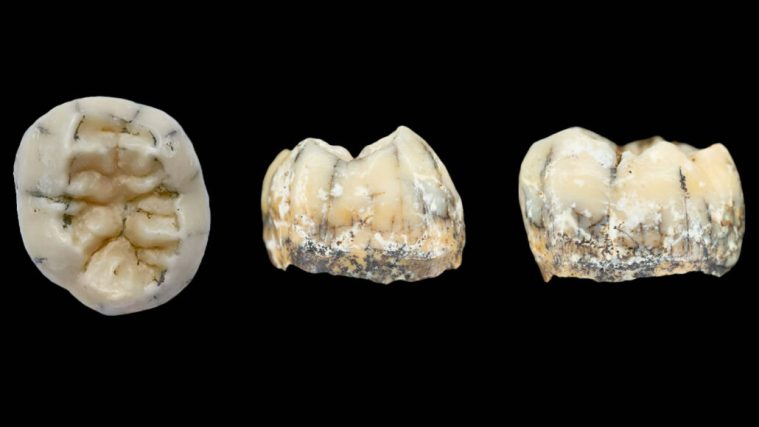
There have been suggestions that at least some of the ‘archaic’ human remains found widely and abundantly in China may have been Denisovans; although they might equally be of Homo erectus. But none of the Chinese fossils have been subjected to gene sequencing – those found in caves outside tropical and sub-tropical climates might retain DNA just as well as Neanderthal and even older remains in temperate Europe. Yet a partial lower jaw discovered in a cave on the Tibetan Plateau (at 35°N) did yield proteins that had close affinities to those recovered from Siberian Denisovans. Now similar analyses have been performed on an abnormally large molar found in a cave in Northern Laos, showing that it too is most likely to be from a young (as suggested by its being little worn), possibly female (it lacks male-specific peptides), Denisovan. The locality lies at about 20°N, far to the south of the other two Denisovan sites (Demeter, F. et al. A Middle Pleistocene Denisovan molar from the Annamite Chain of northern Laos. Nature Communications, v. 13, article 2557; DOI: 10.1038/s41467-022-29923-z). Sparse as the evidence is, Denisovans were able to tolerate climate differences across 30 degrees of latitude.

A probable Denisovan molar from 164 to 131 ka old cave sediments in northern Laos. (credit: Demeter, et al.; Fig. 2)

The Wikipedia entry for Denisovans is a mine of additional information. For instance, detailed analysis of the roughly 5% of their genome that indigenous people of New Guinea carry suggests that the two groups may have interbred there as late as 30 ka. Since Both New Guinea and Australia were until 8 thousand years ago part of the Sahul landmass when sea level was low during the last ice age, these inferences add tropical occupancy to the Denisovan range. Does this suggest that Papuans and indigenous Australians migrated with Denisovans, or had the latter crossed the sea from Timor earlier and independently, after moving from Asia by ‘hopping’ from island to island through eastern Indonesia? There is a possibility that Denisovans could even have survived in Sahul until as late as 14.5 ka. Even more odd, modern Icelandic people are unique among Europeans in having detectable traces of Denisovan DNA. However, rather than having been directly shared between Denisovans and ancestral Scandinavians – a possibility – it may have been carried by Neanderthal-Denisovan hybrids migrating westwards from Siberia with whom the Icelanders’ ancestors interbred. There are other interesting points in the Wikipedia entry. One is that the consistently lower Denisovan ancestry in living East Asians compared with people of Oceania, may indicate two separate waves of eastward migration by AMH. The latter may have arrived first, had greater contact with Denisovans and then moved on across seaways to remain isolated from the later migrants.

Finally, something that puzzles me as a non-geneticist. If both Denisovans and Neanderthals died out as genetically distinct groups tens of millennia ago how could the genetic traces of interbreeding with AMH have been retained at such high levels until the present; i.e. through thousands of generations? Each of us carries a 50% deal of genes from our parents. Then with each subsequent generation the proportion is diluted, so that we inherit 25% from grandparents, 12.5 % from great-grandparents and so on. Yet Papuans still have 5 to 6 percent of Denisovan DNA: much the same holds for Europeans’ Neanderthal heritage. Does such a high level of retention of this ancestry suggest that a large proportion of the earliest migrating AMH individuals stemmed from generation to generation interbreeding on a massive scale? Did the ‘newcomers’ and ‘locals’ band eventually together almost completely to merge genetically, or am I missing something … ? Probably

A challenge to the concept of species

Comparison of DNA from ancient hominin fossils with that obtained from a broad spectrum of living people showed that on the road out of Africa in the last 130 thousand years some anatomically modern humans successfully interbred with Neanderthals and Denisovans to produce fertile offspring. All non-African people contain a trace of those liaisons and include fertile hybrids in their ancestry, whereas Africans do not. Using quick, low-cost and sensitive genomic analyses these discoveries made similar searches for hybridisation among other supposedly distinct species a popular and fruitful line of research (Pennisi, E. 2016. Shaking up the tree of life. Science, v. 354, p. 817-820; doi: 10.1126/science.354.6314.817). They also challenge the long-held view that individual species are incapable of fertile interbreeding with others. Yet fertile hybrids have long been known among plants and butterflies without recourse to genomics. Now that it is a basic tool, it has been shown that up to 10% of known plant species have arisen from hybrids and examples are quickly being found among birds, insects, fish and mammals, including the famous Galapagos finches. Hybridisation introduces genetic variation more quickly than does mutation, potentially a major advantage in adaptive radiation.

Page from Darwin's notebooks around July 1837 ...
Page from Darwin’s notebooks around July 1837 showing his first sketch of an evolutionary tree. (credit: Wikipedia)

Of course, the concept of ‘species’ is arbitrarily based on biological ‘form and function’, and in the same fashion as discoveries about epigenetics have shown genetic determinism to have an air of dogma, so hybridisation suggests that a ‘web’ is more apt as shorthand for the progress of evolution than is Darwin’s ‘tree’ or even a tangled ‘bush’. Another welcome outcome spurred by the pioneers of hominin comparative genetics is a powerful challenge to the dominant philosophies of reductionism and dualism among scientists; legacies of René Descartes bound up with the ‘scientific method’ – especially among physical scientists – and ideas such as ‘nature versus nurture’. A major revolution is in progress, from which the seekers for a Theory of Everything, from quantum mechanists through particle physicists to cosmologists need to draw some sharp and perhaps embarrassing lessons.

It is appropriate that the driving agency lies within anthropology, and thrilling too, for everyone can quickly learn a new way of approaching the world by contemplating their own origins. They would be hard-pressed to do that by pondering on the early nanoseconds of the cosmos …