A possible Chinese ancestor for Denisovans, Neanderthals and modern humans

Assigning human fossils older than around 250 ka to different groups of the genus Homo depends entirely on their physical features. That is because ancient DNA has yet to be found and analysed from specimens older than that. The phylogeny of older human remains is also generally restricted to the bones that make up their heads; 21 that are fixed together in the skull and face, plus the moveable lower jaw or mandible. Far more teeth than crania have been discovered and considerable weight is given to differences in human dentition. Teeth are not bones, but they are much more durable, having no fibrous structure and vary a great deal. The main problem for palaeoanthropologists is that living humans are very diverse in their cranial characteristics, and so it is reasonable to infer that all ancient human groups were characterised by such polymorphism, and may have overlapped in their physical appearance. A measure of this is that assigning fossils to anatomically modern humans, i.e. Homo sapiens, relies to a large extent on whether or not their lower mandible juts out to define a chin. All earlier hominins and indeed all other living apes might be regarded as ‘chinless wonders’! This pejorative term suggests dim-wittedness to most people, and anthropologists have had to inure themselves to such crude cultural conjecture.

The extraction, sequencing and comparison of ancient DNA from human fossils since 2010 has revealed that three distinct human species coexisted and interbred in Eurasia. Several well preserved examples of ancient Neanderthals and anatomically modern humans (AMH) have had their DNA sequenced, but a Denisovan genome has only emerged from a few bone fragments from the Denisova Cave in western Siberia. Whereas Neanderthals have well-known robust physical characters, until 2025 palaeoanthropologists had little idea of what Denisovans may have looked like. Then proteins and, most importantly, mitochondrial DNA (mtDNA) were extracted from a very robust skull found around 1931 in Harbin, China, dated at 146 ka. Analysis of the mtDNA and proteins, from dental plaque and bone respectively, reveal that the Harbin skull is likely to be that of a Denisovan. Previously it had been referred to as Homo longi, or ‘Dragon Man’, along with several other very robust Chinese skulls of a variety of ages.

The distorted Yunxian cranium (right) and its reconstruction (middle) [Credit: Guanghui Zhao] compared with the Harbin Denisovan cranium (left) [Hebei Geo University]

The sparse genetic data have been used to suggest the times when the three different coexisting groups diverged. DNA in Y chromosomes from Denisovans and Neanderthals suggest that the two lineages split from a common ancestor around 700 ka ago, whereas Neanderthals and modern humans diverged genetically at about 370 ka. Yet the presence of sections of DNA from both archaic groups in living humans and the discovery that a female Neanderthal from Denisova cave had a Neanderthal mother and a Denisovan father reveals that all three were interfertile when they met and interacted. Such admixture events clearly have implications for earlier humans. There are signs of at least 6 coexisting groups as far back as the Middle Pleistocene (781 to 126 ka), referred to by some as the ‘muddle in the middle’ because such an association has increasingly mystified palaeoanthropologists. A million-year-old, cranium found near Yunxian in Hubei Province, China, distorted by the pressure of sediments in which it was buried, has been digitally reconstructed.

This reconstruction encouraged a team of Chinese scientists, together with Chris Stringer of the UK Museum of Natural History, to undertake a complex statistical study of the Yunxian cranium. Their method compares it with anatomical data for all members of the genus Homo from Eurasia and Africa, i.e. as far back as the 2.4 Ma old H. habilis (Xiabo Feng and 12 others 2025. The phylogenetic position of the Yunxian cranium elucidates the origin of Homo longi and the Denisovans. Science, v. 389, p. 1320-1324; DOI: 10.1126/science.ado9202). The study has produced a plausible framework that suggests that the five large-brained humans known from 800 ka ago – Homo erectus (Asian), H. heidelbergensis, H. longi (Denisovans), H. sapiens, and H. neanderthalensis – began diverging from one another more than a million years ago. The authors regard the Yuxian specimen as an early participant in that evolutionary process. The fact that at least some remained interfertile long after the divergence began suggests that it was part of the earlier human evolutionary process. It is also possible that the repeated morphological divergence may stem from genetic drift. That process involves small populations with limited genetic diversity that are separated from other groups, perhaps by near-extinction in a population bottleneck or as a result of the founder effect when a small group splits from a larger population during migration. The global population of early humans was inevitably very low, and migrations would dilute and fragment each group’s gene pool.

The earliest evidence for migration of humans out of Africa emerged from the discovery of five 1.8 Ma old crania of H. erectus at Dmanisi to the east of the Black Sea in Georgia. similar archaic crania have been found in eastern Eurasia, especially China, at various localities with Early- to Middle Pleistocene dates. The earliest European large-brained humans – 1.2 to 0.8 Ma old H. antecessor from northern Spain – must have migrated a huge distance from either Africa or from eastern Eurasia and may have been a product of the divergence-convergence evolutionary framework suggested by Xiabo Feng and colleagues. Such a framework implies that even earlier members of what became the longi, heidelbergensis, neanderthalensis, and sapiens lineages may await either recognition or discovery elsewhere. But the whole issue raises questions about the widely held view that Homo sapiens first appeared 300 ka ago in North Africa and then populated the rest of that continent. Was that specimen a migrant from Eurasia or from elsewhere in Africa? The model suggested by Xiabo Feng and colleagues is already attracting controversy, but that is nothing new among palaeoanthropologists. Yet it is based on cutting edge phylogeny derived from physical characteristics of hominin fossils: the traditional approach by all palaeobiologists. Such disputes cannot be resolved without ancient DNA or protein assemblages. But neither is a completely hopeless task, for Siberian mammoth teeth have yielded DNA as old as 1.2 Ma and the record is held by genetic material recovered from sediments in Greenland that are up to 2.1 Ma old. The chances of pushing ancient human DNA studies back to the ‘muddle’ in the Middle Pleistocene depend on finding human fossils at high latitudes in sediments of past glacial maxima or very old permafrost, for DNA degrades more rapidly as environmental temperature rises.

See also: Natural History Museum press release. Analysis of reconstructed ancient skull pushes back our origins by 400,000 years to more than one million years ago. 25 September 2025; Bower, B. 2025. An ancient Chinese skull might change how we see our human roots. ScienceNews, 25 September 2025; Ghosh, P. 2025. Million-year-old skull rewrites human evolution, scientists claim. The Guardian, 25 September 2025

Did earliest modern humans in Europe share a cave with Neanderthals?

The cave of Grotte Mandrin in the Rhône Valley, France. (Credit: Slimak et al Fig 1c)

Since 1999 a cave (Grotte Mandrin) on the west flank of the lower Rhône valley in sothern France has been revealing archaeological remains from 3 metres of sediment that can be divided into 12 distinct layers (Slimak, L. and 22 others 2022. Modern human incursion into Neanderthal territories 54,000 years ago at Mandrin, France. Science Advances, v. 8, article eabj9496; DOI: 10.1126/sciadv.abj9496). Tens of thousands of objects have been recovered, mostly from a layer just below midway in the sequence, which is dominated by small (<1 cm), ‘standardised’ stone points that are also found at other sites in the local area. This veritable industry – dubbed the ‘Neronian’ from the nearby Grotte de Néron – seems to have been focussed hereabouts. Older artefacts in layers F and G are considered to be Mousterian, that is generally ascribed to late Neanderthals. Horse, bison and deer bones suggest that these were the main source of animal protein for the cave’s occupants. The site also contained a few objects that show simple decoration. The way in which the Neronian points were produced resembles the working of similar artefacts in Lebanon by anatomically modern humans (AMH) about 45 ka ago; so it is possible that the technology had spread westward with the earliest AMH migrants into Europe. Yet precise radiocarbon and optically stimulated luminescence dating of the Grotte Mandrin site suggests that the sediment accumulated between 84 to 44 thousand years ago. The Mousterian/Neanderthal objects occur in layers F and G between 79 and 57 ka, whereas the Neronian layer E spans 56.8 to 51.7.

Grotte Mandrin has yielded very few hominin remains, except for 9 teeth in layers C to G. Those from C, D, F and G showed clear Neanderthal dental features. However, shape analysis of one damaged, deciduous (infant) molar from Layer E suggests that it matches Upper Pleistocene AMH dental morphology. That seems to place Grotte Mandrin as by far the oldest AMH occupation site in Europe, up 11 thousand years earlier than the 45 to 43 ka AMH site at Bacho Kiro in Bulgaria. To some extent that tallies with the tiny tooth’s association with a prolific, standardised and delicate industry new to the area: probably points for small projectiles. Neanderthals re-occupied the site in Layers D to B, yet in the upper part of layer B, from 44.1 to 41.5, there is a return of Neronian-like points, probably made by AMH.

A curious detail from layer E (not reported in this paper) is the occurrence of soot trapped in thin, annually deposited layers of carbonate on the cave walls. Fragments of the sooty speleothem continually fell onto the cave floor to be incorporated into the sediments. The base of layer E that contains Neronian, possibly AMH artefacts and the top of layer F that shows preceding Neanderthal occupation, contain such sooty speleothem fragments. Precise dating of them is claimed to suggest a very short period of transition between the two kinds of occupants: perhaps only a few years. Neanderthals and AMH may not have met in the cave, but may well have been co-occupants of the surrounding area at the same time.

A great deal of effort over more than two decades has gone into this publication, and several of its findings have caused quite a stir. Because permanent AMH occupation of the Levant began at least 55 ka ago, there is no reason to suppose that AMH migrating along the northern shores of the Mediterranean could not have arrived a little earlier in what is now southern France. What has been emphasised in the broad media is the exchange of a Neanderthal to an AMH population in the Grotte Mandrin, as if it was done in a friendly, indeed neighbourly spirit (!). That hinges on the ultra-precise dating of the sooty speleothem fragments to reveal just a few years between the Neanderthals doing a ‘flit’ and the AMH starting a ‘squat’ in the vacant premises to set up a cottage industry. The time of the replacement before present is, in fact, very close to the limit at which radiocarbon dating is feasible, almost all 14C formed at that time having decayed away since then. There can be no doubt that layer E did mark a major change in sophistication of stone technology, but was it really an AMH development? The only definite evidence is the single deciduous molar, and that is damaged to such an extent that an independent dental paleoanthropologist who has specialised in distinguishing AMH from Neanderthal dentition isn’t convinced. But,surely, DNA from the tooth would resolve the issue. The paper notes that trial extraction and sequencing of 6 horse teeth from layer E failed to yield results, which suggests degradation of genetic teril. So the team did not commit the tooth to sequencing, which would have further damaged it. Finally, four separate groups occupying what certainly looks like a nice little cave over the course of about 40 thousand years is hardly a surprise. Many caves throughout Europe and southern Africa show evidence of multiple occupancy. After all, before 11 ka all humans and their forebears were of necessity foragers and migrants; just think of how many times your neighbours have changed since you moved in …

See also: Price, M. 2022. Did Neanderthals and modern humans take turns living in a French cave? Science, v, 375, p. 598-599; DOI: 10.1126/science.ada1114

Relationships between modern humans and Neanderthals

Before 40 thousand years (ka) ago Europe was co-occupied by Neanderthals and anatomically modern humans (AMH) for between five to seven thousand years; about 350 generations – as long as the time since farming began in Neolithic Britain to the present day. Populations of both groups were probably low given their dependence on hunting and foraging during a period significantly colder than it is now. Crude estimates suggest between 3,000 to 12,000 individuals in each group; equivalent to the attendance at a single English Football League 2 match on a Covid-free winter Saturday afternoon. Moving around Europe south of say 55°N, their potential range would have been around 5 million square kilometres, which very roughly suggests that population density would be one person for every 200 km2. That they would have moved around in bands of, say, 10 to 25 might seem to suggest that encounters were very infrequent. Yet a hybrid Neanderthal-Denisovan female found in Siberia yielded DNA that suggested a family connection with Croatia, 5,000 km away (see: Neanderthal Mum meets Denisovan Dad, August 2018); early humans moved far and wide.

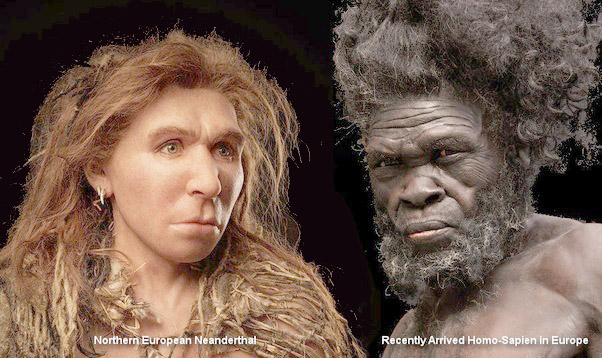
The likely appearances of Neanderthals and anatomically modern humans when they first met between 50 and 40 thousand years ago. (Credit: Jason Ford, New York University)

A sparsely populated land can be wandered through with little fear other than those of predators, sparse resources or harsh climate and lack of shelter. But it still seems incredible for there to have been regular meetings with other bands. But that view leaves out knowledge of good places to camp, hunt and forage that assure shelter, water, game and so forth, and how to get to them – a central part of hunter-gatherers’ livelihoods. There would have been a limited number of such refuges, considerably increasing chances of meeting. Whatever the physiognomic differences between AMH and Neaderthals, and they weren’t very striking, meeting up of bands of both human groups at a comfortable campsite would be cause for relief, celebration, exchanges of knowledge and perhaps individuals of one group to partner members of the other.

As well as that from Neanderthals, ancient DNA from very early European AMH remains has increasingly been teased out. The latest comes from three individuals from Bacho Kiro Cave in Bulgaria dated to between 45.9 to 42.6 ka; among the earliest known, fully modern Europeans. One had a Neanderthal ancestor less than six generations removed (perhaps even a great-great grandparent 60 years beforehand). Because of the slight elapsed time, the liaison was probably in Europe, rather than in the Middle East as previously suggested for insertion of Neanderthal genes into European ancestry. The genetic roots of the other two families stemmed back seven to ten generations – roughly 100 to 150 years (Hajdinjak, M. and 31 others 2021. Initial Upper Palaeolithic humans in Europe had recent Neanderthal ancestryNature, v. 592, p. 253–257; DOI: 10.1038/s41586-021-03335-3). The interpretation of these close relationships stems from the high proportion of Neanderthal DNA (3 to 4 %) in the three genomes. The segments are unusually lengthy, which is a major clue to the short time since the original coupling; inherited segments tend to shorten in successive generations. The groups to which these AMH individuals belonged did not contribute to later Eurasian populations, but link to living East Asians and Native Americans. They seem to have vanished from Europe long before modern times. The same day saw publication of a fourth instance of high Neanderthal genetic content (~3 %) in an early European’s genome, extracted from a ~45 ka female AMH from Zlatý kůň (Golden Horse) Cave in Czechia (Prüfer, K. and 11 others 2021. A genome sequence from a modern human skull over 45,000 years old from Zlatý kůň in Czechia. Nature Ecology & Evolution  DOI: 10.1038/s41559-021-01443-x). In her case, too, the Neanderthal DNA segments are unusually lengthy, but indicate 70 to 80 generations (~2,000 to 3,000 years) had elapsed. Her DNA also suggests that she was dark-skinned and had brown hair and brown eyes. Overall her genetics, too, do not have counterparts in later European AMH. The population to which she belonged may have migrated westwards from the Middle East, where one of her ancestors had mated with a Neanderthal, perhaps as long as 50 ka ago. But that does not rule out her group having been in Europe at that time. A later modern human, dated at 42 to 37 ka, is a young man from the Petştera cu Oase cave in Romania, whose forbears mixed with Neanderthals. His genome contains 6.4% of Neanderthal DNA, suggesting that his Neanderthal ancestor lived a mere 4 to 6 generations earlier, most likely in Europe, and was perhaps one of the last of that group.

The data suggest that once modern humans came into contact with their predecessors in the Middle East and Europe, mixture with Neanderthals was ‘the rule rather than the exception’. Yet their lack of direct relationship to later Europeans implies that AMH colonisation of Europe occurred in successive waves of people, not all of whom survived. As Palaeolithic specialist Chris Stringer of the Natural History Museum in London cautions, of these multiple waves of incomers ‘Some groups mixed with Neanderthals, and some didn’t. Some are related to later humans and some are not’. Even five thousand years after ‘first contact’, relations of modern humans with Neanderthals remained ‘cordial’, to say the least, including with the last few before their extinction.

See also: Gibbons, A. 2021. More than 45,000 years ago, modern humans ventured into Neanderthal territory. Here’s what happened next. Science, v. 372, News article; DOI: 10.1126/science.abi8830. Callaway, E. 2021. Oldest DNA from a Homo sapiens reveals surprisingly recent Neanderthal ancestry. Nature, v. 592, News article; DOI: 10.1038/d41586-021-00916-0. Genomes of the earliest Europeans (Science Daily, 7 April 2021). Bower, B. 2021 Europe’s oldest known humans mated with Neandertals surprisingly often (ScienceNews, 7 April 2021)

Neanderthal news

Note: Earth-Pages will be closing as of early July, but will continue in another form at Earth-logs

Increasingly sophisticated analysis of existing genomes from Neanderthal and Denisovan fossil bone, together with new data on single-chromosome DNA extracted from Croatian and Spanish Neanderthals continues to break new ground.

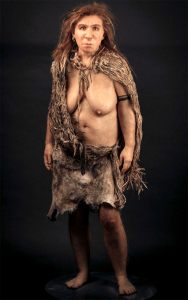
Artistic reconstruction of Neanderthal woman (credit: Natural History Museum, http://www.nhm.ac.uk/natureplus/blogs/tags/human_evolution)

According to genome comparison between a Siberian specimen and modern humans, a population from which Neanderthals emerged separated from that which led to anatomically modern humans (AMH) sometime between 550 and 765 ka, although the fossil record can only confirm that divergence was before 430 ka. The comparison famously showed that Neanderthals contributed to modern, non-African humans between 47 and 75 ka, that is after the exodus of AMH from Africa that spread our species throughout all continents except Antarctica. This genetic exchange is thought to have taken place somewhere in the Middle East, which seems to have been a major staging post for our spread further east and also westward to Europe. A similar indication of liaison between Denisovans and AMH migrants is restricted to modern Melanesians, and probably took place in eastern Asia before 45 ka, when modern people began crossing from Eurasia to New Guinea and Australia. Neanderthal-Denisovan comparison suggests that those distinct groups separated between 380 and 470 ka ago (recently revised from an earlier estimate).

In both cases the gene flow was from the older groups to humans. Further examination of Siberian Neanderthal genomes now indicates that a reverse exchange occurred more than 100 ka ago (Kuhlwilm, M. and 21 others 2016. Ancient gene flow from early modern humans into Eastern Neanderthals. Nature, v. 530, p. 429-433). But the single-chromosome DNA from Croatian and Spanish Neanderthals shows no such sign This instance of two-way exchange is significant in another way: it took place before direct evidence of the generally accepted departure of African migrants to populate the rest of the world. At about 100 ka there is fossil evidence of possible AMH-Neanderthal cohabitation of the Levant, followed by a period with fossil evidence for Neanderthal presence there but not modern humans. Because stone tools from northern Arabia are dated as far back as 125 ka and closely resemble those associated with archaic modern humans, there is a possibility that AMH migration was far earlier than previously thought and passed through the Levant en route to points east.

Another tantalizing aspect of Neanderthal-modern human genetics is the tangible legacy of interbreeding with non-African humans. The first sign was that the gene (mc1r) that confers red hair on those of us blessed, or otherwise, with it may have Neanderthal origins, thus making us extremely proud of that heritage. The same gene is implicated in northern modern humans having developed pale skin, which might embarrass ‘white supremacists’! Similar studies in Svante Paabo’s lab at the Max Planck Institute for Evolutionary Anthropology in Leipzig also suggested 15 genome regions that include those involved in energy metabolism, possibly associated with type 2 diabetes; cranial shape and cognitive abilities, perhaps linked to Down’s syndrome, autism and schizophrenia; wound healing; skin, sweat glands, hair follicles and skin pigmentation; and barrel chests. There is more…

Joshua Akey of the University of Washington, Seattle, and evolutionary genomicist Tony Capra of Vanderbilt University in Nashville hit on the idea of ‘mining’ archived genetic information from more than 28 thousand living people for traces of 6000 Neanderthal DNA variants and comparing the results with physical traits and diseases logged in the human database (reported by Gibbons, A. 2016. Neanderthal genes linked to modern diseases. Science, v. 351, p. 648-9). On the plus side, Neanderthal ancestry may help boost immune responses to fungi, parasites and bacteria. Inheritance of enhanced blood coagulation, although greatly assisting recovery from wounds and hemorrhage when giving birth, confers a proclivity to heart attacks and strokes. Neanderthals also passed on ‘weak bladders’, solar keratoses that confer skin cancer risk, a tendency to malnutrition from modern diets low on meat and nuts, depression triggered by jet lag(!) and even a tendency to nicotine addiction. But a ‘pure’ line of modern human descent, shared by most Africans, also has its positive and negative heritable traits.

More on Neanderthals, Denisovans and anatomically modern humans

Surprising modern-human migrations into China and Africa

Caves figure highly in discoveries of hominin remains, fossil riches from those near Johannesburg in South Africa and at Atapuerca in northern Spain having set the world of palaeoanthropology reeling in the last few months. As often as not the caves chosen by hominins for day-to-day living, refuge or ritual, places where carnivores dragged some of our early relatives, or into which they fell accidentally, formed in limestones. There are few places so well endowed with karst features than southern China, a fair number of caves in them having rich deposits of bat guano to which farmers have beaten well-trodden paths to dig it out for fertiliser. One such is Fuyan Cave in Daoxian County, Hunan. Manure mining there had done a great deal of the heavy work faced by archaeologists, having stopped when it reached a hard layer of calcite speleothem or flowstone that underpaves more or less the entire cave floor. Initial trial investigations found three clearly human teeth at the surface, encouraging further work. Digging through the flowstone revealed sediments rich in fossils, mainly teeth which preserve better than other remains in humid conditions. As well as teeth from a variety of mammals, large and small, 47 human teeth emerged. Close study revealed dental features that are irrefutably those of anatomically modern humans (Liu, W. and 13 others 2015. The earliest unequivocally modern humans in southern China. Nature, doi:10.1038/nature15696). Remarkably, many of the teeth are in far better condition than my own, and those of many living people with access to dental expertise.

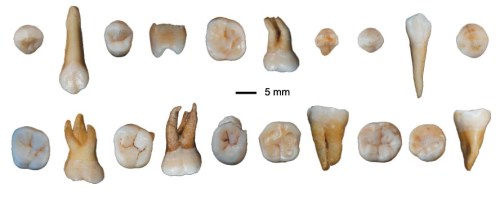
Some of the Daoxian human teeth. (Credit: Song Xing and Xiu-jie Wu of the 1Key Laboratory of Vertebrate Evolution and Human Origins at the Chinese Academy of Sciences
Some of the Daoxian human teeth. (Credit: Song Xing and Xiu-jie Wu of the 1Key Laboratory of Vertebrate Evolution and Human Origins at the Chinese Academy of Sciences)

The true significance of the excavation emerged only when 230Th dating revealed the age of the flowstone cap to the old cave sediments. A small stalagmite protruding from its surface yielded a minimum age of ~80 ka: by far the oldest date for anatomically modern human remains outside of Africa and the eastern Mediterranean. The dating produced older ages around 120 ka with equally good precision. Before this discovery the date of migration of Africans to populate Eurasia was thought to be about 60 ka from imprecise dating based on genetics of a range of living Eurasians and Africans – a ‘molecular clock’ – and the earliest sign of humans found in Australia. Consequently, finds in South India of artefacts beneath 74 ka ash from the super-eruption of the Mount Toba caldera have been regarded by many, other than the finders, as having been made by Homo erectus. Dates of 100 ka for modern human occupation of the Levant were thought to represent a failed attempt at migration out of Africa by a northern route. Both these important findings now take on renewed significance. Yet a 30 to 40 ka time gap between the Fuyan people and the previous dates for the earliest signs of migration into China, Borneo and Australia (40-50 ka) begs the question, ‘Did this early group of far-travelled migrants survive to become ancestors of modern Chinese people?’ There are many possible scenarios that only future discoveries might validate: simply goiung extinct; failure to survive the encounter with earlier migrants, such as H. erectus or the Denisovans; assimilation into those older populations.

Mitochondrial DNA-based chart of large human m...
Mitochondrial DNA-based chart of large human migrations: the consensus before these new data. Numbers are millennia before present. ( credit: Wikipedia)

As if to counter this, a multinational group of collaborators have sequenced and analysed the genome from a 4500 year-old male skeleton discovered in the Mota Cave of the Gamo highlands of southern Ethiopia (Llorente, M.G. and 18 others 2015. Ancient Ethiopian genome reveals extensive Eurasian admixture throughout the African continent. Science, DOI: 10.1126/science.aad2879). Comparison with what is now a virtual library of living human genomes showed that this man’s genetic make-up most closely matched that of the Ari, a tribe living in the area today. What was most interesting is that part of the modern Ari genome – between 4 to 7% – is not present in the 4500 year-old sequence. Instead, it matches those of modern Sardinians and a prehistoric German farmer. Yet it occurs in people living not only in Ethiopia, but also in central, western and southern Africa to varying degrees. There seems to have been a ‘backflow’ of people into the whole of Africa from Eurasia, estimated to have occurred some 3500-4000 years ago and probably involving a large influx. By that time farming was already established in Africa, so the migrants may have had some advantage, either culturally or physically, to encourage their wide spread through the continent.

In tropical climates, DNA is likely to break down quickly and little if any fossil DNA has been recovered from prehistoric Africans. In this case, burial in a cave at high elevation may have helped preserve it, but also the target for extraction was the petrous bone from the inner ear whose density seems to allow DNA a better change of long-term survival. With continually improving DNA analysis and sequencing techniques more news is surely going to emerge from past African populations.

More on human migrations

Related articles

Gibbons, A. 2015. Prehistoric Eurasians streamed into Africa, genome shows. Science, v. 350 (9 October 2015), p. 149.

Human-Neanderthal cohabitation of the Levant

The earliest known remains of anatomically modern humans outside of Africa were found unearthed from the Skhul and Qafzeh caves in what is now northern Israel. Their context was that of deliberate burial at a time when climate was cooling from the last interglacial, between 90 to 120 ka. The Levant was also the repository for a number of well-preserved Neanderthal skeletons, most dating to between 35-65 ka, including ten individuals at Shanidar in today’s northern Iraq, some of whom were also deliberately buried including one whose grave reputedly contained evidence for a floral tribute. The 25 ka gap between the two populations has previous been regarded as evidence for lack of contact between them. However, the Tabun Cave in modern Israel has yielded tools attributed to Neanderthal Mousterian culture that may indicate their intermittent presence from 200 to 45 ka, and fossils of two individuals dated at ~122 and ~90 ka. The remains at Skhul and Qafzeh are significantly more rugged or robust than African contemporaries and have been considered possible candidates for Neanderthal-modern human hybrids. But whatever their parentage, it seems they became extinct as the climate of the Levant dried to desert conditions around 80 ka.

View of the exterior of Shanidar Cave, taken d...
Entrance to the Shanidar Cave, northern Iraq, occupied by Neanderthals between 35-65 ka (credit: Wikipedia)

A more promising overlap between modern human and Neanderthal occupation comes with the discovery by a group of Israeli, US, Canadian, German and Austrian scientists of a much younger anatomically modern human cranium from the Manot Cave, also in northern Israel (Herschkovitz, I. and 23 others 2015. Levantine cranium from Manot Cave (Israel) foreshadows the first European modern humans. Nature (online) doi:10.1038/nature14134). The cranium has a U-Th radiometric age of ~55 ka, well within the time span of Neanderthal occupation. Moreover, Manot Cave is one of a cluster of occupied sites in northern Israel, with separations of only a few tens of kilometres: undoubtedly, this individual and companions more than likely met Neanderthals. The big question, of course, is did the neighbours interbreed? If so the Levant would be the confirmed as the probable source of hybridisation to which the DNA of non-African living humans points. There may be a insuperable difficulty in taking this further: it is thought that the high temperatures of the region, despite its dryness, may have destroyed any chance of reconstructing ancient genomes. Yet one of the first Neanderthal bones to yield useful genetic material was from Croatia, which is not a great deal cooler in summer.

Are modern humans ‘domesticated’?

While animals, especially dogs, underwent domestication the deliberate or unconscious human choice of favoured physiological and behavioural traits produced distinct differences between the ancestral species and the ‘breeds’ with which we are now familiar. In general domestication has resulted in dogs with reduced jaws and flatter faces, lower aggression, especially in the case of males, and reduced stressfulness in the company of humans and other tame dogs compared with their wolf ancestors. It is widely accepted that cats have ‘tamed themselves’ through the adoption of lifestyles associated with the benefits of close association with human communities, which have resulted in similar adaptations to those in more deliberately domesticated dogs. It is beginning to dawn on anthropologists that human social evolution may unwittingly have affected the course of our own evolution. Tighter social bonding among growing sizes of communities as brain capacity increased and the behavioural and cognitive attributes needed for that have been summarised recently by a group associated with the Social Brain hypothesis of Robin Dunbar of Oxford University, UK (Gamble, C., Gowlett, J. & Dunbar, R.I.M. 2014. Thinking Big: How the Evolution of Social Life Shaped the Human Mind. ISBN-13: 978-0500051801;Thames and Hudson: London).

It was Charles Darwin who first speculated that ‘Man in many respects may be compared with those animals which have long been domesticated’. But to what extent does the hominin fossil record support such a view? Collaborators from Duke University and the University of Iowa, USA, have set out to analyse physiological changes over the last 200 ka that may be explained in this way (Cieri, R.L. et al. 2014. Craniofacial feminization,social tolerance and the origins of behavioural modernity. Current Anthropology, v. 55, p. 419-443. Includes discussion and responses). They used the degree of projection of brow ridges, facial shape and cranial volume from 3 groups of Homo sapiens remains: skulls older than 80 ka (13 specimens); spanning 38 to 80 ka (41) and from recent humans (1367). They found that brow ridges shrank significantly over the last 80 thousand years, faces shortened and cranial capacity decreased, especially among males. This resulted in a convergence in appearance between males and females, which the authors attributed to general lowering of testosterone and stress hormone levels through selection for greater social tolerance: akin to similar physiognomic changes in domesticated dogs which DNA analyses have shown to be been linked with modification of genes associated with aggression regulation. The finding among dogs suggests that their domestication is accomplished by slower development; i.e. young animals are naturally less fearful and have a greater tendency to taming. This delayed development from foetus to adulthood, with retention in mature individuals of juvenile characteristics, is known as neoteny, and affects all manner of adult characteristics, including coloration, snout length and the adrenal glands: as adult dogs now more resemble wolf pups, so human adults are more like young chimps than elders. At a conference where Cieri et al.’s results were presented, it was observed that hunter gatherer bands are intolerant, to the point of capital punishment, of wife stealers, murderers and seriously dishonest men, whereas such reactions fall off significantly among members of larger social groups involved in agriculture and urban life. Such modern behavioural patterns tally with brow ridge, face length and cranial capacity, perhaps linked with selection for personalities more attuned to cooperation.

English: comparison of Neanderthal and Modern ...
Comparison of Neanderthal and Modern human skulls from the Cleveland Museum of Natural History (credit: Wikipedia)

Although earlier human species, such as H. neanderthalensis, heidelbergensis and erectus had significantly different skull anatomy, each had prominent brow ridges that, on this account, may signify both greater exposure to testosterone and less social tolerance, and smaller group sizes. But, so far, analysis of the Neanderthal genome has not led to publication of any comments about testosterone or stress-hormone related genes. However, a clear strand of discussion is developing around evidence rather than mere speculation about psychological/cognitive aspects of human evolution that challenges the old-style ‘what-you-see-is-what-there-was’ (WYSWTW) archaeological dogma: a dialectic of social and biological relationships.

Human evolution news

Since discovery of its fossilised remains in Liang Bua cave on the Indonesian island of Flores was discovered in 2004 the diminutive Homo floresienesis, dubbed the ‘hobbit’ by the media, has remained a popular news item each time controversies surrounding it have flared. To mark the tenth anniversary  of its publication of a paper describing the remains Nature has summarised the recollections of many of those involved in trying to understand the significance of H. floresiensis (Callaway, E. 2014. Tales of the hobbit. Nature, v. 514, p. 422-426). Two main schools of thought continue in dispute, one holding that it is anatomically so different from anatomically modern humans and earlier members of the genus Homo that it constitutes a new species, despite its youngest member dating back only 18 ka, the other that it is H. sapiens, its tiny size having resulted from some kind of genetic disorder, such as microcephaly or Down’s syndrome. There have been so many attempts to expunge the idea of such an odd fossil cohabiting an island with fully modern humans yet being a different and perhaps extremely archaic species that such an outlook itself seems somewhat pathological.

English: Homo floresiensis, replica Deutsch: H...
Replica of the Homo floresiensis skull from Liang Bua cave, Flores, Indonesia (credit: Wikipedia)

The evidence presented to force H. floresiensis into a deformed human mould has never been convincing, and the best way of combating that view is to document from a ‘non-combatant ‘standpoint the many ways in which its anatomy differs from ours and how it might have arisen; a job to which Chris Stringer of the Museum of Natural History in London is amply qualified (Stringer, S. 2014. Small remains still pose big problems. Nature, v. 514, p. 427-429). He, like the original discoverers, feels this is a case of evolution of small stature due to a limited population being isolated for a long time on a relatively small island, which is just what happened to elephants that colonised Flores to become the pigmy Stegodon that H. floresiensis seemingly hunted. These tiny Flores dwellers (adults were about 1 m tall) used fire and made tools, similar ones dating as far back as ~1 Ma. Stringer mentions the possibility of first human colonisation about that time by Asian H. erectus but also the view that if it happened once there may have been several waves of immigration to Flores. The unusual ‘hobbit’ anatomy is not restricted to tiny size and a small skull and brain cavity (400 cm3), but includes odd hips, wrist bones, shoulder joint and collar bone. In fact the remains bear as much or more resemblance to australopithecines like ‘Lucy’ (3.2 Ma) than to other members of our genus, even H. erectus that has been proposed as its possible ancestor. Could they be far-travelled descendants of the 1.8 Ma old H. georgicus from Dmanisi in Georgia? More fossils clearly need to be found, and Stringer raises the possibility of the search being widened to other islands east of Java, such as Sulawesi, the Philippines and Timor. He hints that in such a tectonically active region tsunamis may have led to animals and humans saving themselves and then being current dispersed on rafts of broken vegetation, rather like some survivors of the 2004 Indian Ocean tsunami who ended up 150 miles from their homes by such a means.

Another story that is set to ‘run and run’ is that of ‘alien’ DNA in the human genome and productive relations between early out-of-Africa migrants with Neanderthals, Denisovans and perhaps yet a mysterious, earlier human species. The oldest (45 ka) anatomically modern human genome sequence so far charted is from a leg bone found by a mammoth-ivory prospector in Siberian permafrost (Fu, Q. and 27 others 2014. Genome sequence of a 45,000-year-old modern human from western Siberia. Nature, v. 514, p. 445-449). Like a great many living non-Africans this individual carried about 2 % Neanderthal DNA, but unlike living people the 45 ka genome has it in significantly longer segments. That allowed the authors to re-estimate the timing of the genetic flow from Neanderthals into the individual’s ancestors. Previous estimates from living DNA geve the possibility of that being between 37-86 ka, but this closer data suggests that it happened between 7 to 13 ka before the date of the fossil femur, i.e. narrowing it down to between 52 and 58 ka closer to the widely suggested time of African exodus around 60 ka (but see an Earth Pages item from September 2014)

More on human evolution here and here

Did Out of Africa begin earlier?

It is widely thought that anatomically modern humans (AMH) began to diffuse out of Africa during the climatic cooling that followed the last interglacial episode. Periods of build-up of ice sheets, or stadials, also saw falls in sea level, which would have left shallow seas dry and easily crossed. The weight of evidence seems to point towards the narrowing of the Red Sea at the Straits of Bab el Mandab between modern Eritrea and the Yemen. Because the Red Sea spreading axis goes onshore through the Afar region of Ethiopia further north, the Straits today are shallow. Between about 70 and 60 ka, during a major stadial, much of the Bab el Mandab would have been dry. Dating of the earliest AMH remains in Asia and Australasia seems to suggest that the move out of Africa probably began around that time. But, of course, that presupposes the AMH fossils being the oldest in existence, although some would claim that genetic evidence also supports a 70-60 ka migration. Yet, AMH human remains dated at around 100 ka have been found in the Middle East on a route that would also lead out of Africa, but for the major problem of crossing deserts of modern Syria and Iraq. The supposed desert barrier has led many to suggest that the earlier venture into the Levant met a dead end. Should AMH fossils older than 70 ka turn up in Eurasia or Australasia then a single migration becomes open to doubt.

Mitochondrial DNA-based chart of large human m...
Chart of large human migrations based on variations in mitochondrial DNA in living humans(Numbers are millennia before present.) (credit: Wikipedia)

It appears that challenge to what has become palaeoanthropological orthodoxy has emerged (Bae, C.J. et al. 2014. Modern human teeth from Late Pleistocene Luna Cave (Guangxi, China). Quaternary International, In Press). Scientists from the US, China and Australia found two molar teeth within calcite flowstone in Lunadong (‘dong’ means ‘cave’). That speleothem is amenable to uranium-series dating, and has yielded ages between 70 and 127 ka. That antiquity does open up the possibility of earlier migration, perhaps during the interglacial that ended at about 115 ka when sea levels would have stood about as high as it does nowadays (in fact it was only after about 80 ka that it stood low enough to make a move across the Bab el Mandab plausible). If that were the case, the migration route would have more likely been through the Middle East, perhaps along the Jordan valley and thence to the east. Had there been greater rainfall over what is now desert then there would have been no insurmountable barrier to colonisation of Asia.

These teeth are not the only evidence for earlier entry of AMH into east Asia; a date of 66 ka for a modern human toe bone was recently reported from the Philippines. Yet many experts remain unconvinced by teeth alone, especially from east Asia where earlier humans had evolved since first colonisation as early as 1.8 Ma ago. There are other pre-70 ka east Asian bones with more convincing AMH provenance, however.

There is another approach to the issue of earlier Out of Africa migration; one resting on theoretical modelling of the observed genetic and morphological variation among living Eurasians, especially the decreasing diversity proceeding eastwards (Reyes-Centeno, H. et al. 2014. Genomic and cranial phenotype data support multiple modern human dispersals from Africa and a southern route into Asia. Proceedings of the National Academy of Sciences, v. 111, p. 7248-7253. doi: 10.1073/pnas.1323666111). The authors, from Germany, Italy and France, challenge the single-exit hypothesis based on genetic data, suggesting that those data are also commensurate with several Out of Africa dispersals beginning as early as 130 ka. They favour the Bab el Mandab exit point and migration around Eurasia at that time when sea-level was extremely low during a glacial maximum. They hint at the ancestors of living native Australians and Melanesians being among those first to leave Africa, other Asian and European populations having dispersed from a later wave.

Breakthrough in human tools: the scene shifts to Africa

A means of assessing the cognitive abilities of hominins is through the objects that they created, whether tools or artefacts with apparent symbolic significance. The latter include pigments, coloured shells, beads, artwork or even deliberately parallel and crossing lines gouged on otherwise innocuous rock. Undoubtedly valuable to their creators, possibly treasured and passed on until lost or broken – most are fragile – symbolic artefacts are rare. So although they shout ‘thoughtful’, their age tells us little about when such a capacity first arose. Many archaeologists and palaeoanthropologists assert that creating and/or manipulating symbols may signify a link with being able to speak. Tools are a lot easier to find, probably as discards and lost items, and a well-described and understood sequence of forms and sometimes uses has been established, which extends as far back as perhaps 3 Ma – before the genus Homo appeared.

In terms of their meaning in terms of the consciousness of their makers and users, there are possibly four major recognisable steps. Chimpanzees and some birds can learn to pick up natural objects, such as stones and twigs, and use them: some bands of chimps even retain the knowledge. A step beyond that is preparing a natural object for use, as with breaking a pebble to create a cutting edge: something not exclusively human because it is possible that pre-human hominins created the earliest such Oldowan tools. Being able to visualise hidden potential inside something natural is altogether more advanced, and is represented by the iconic bi-face or Acheulean ‘hand-axe’. Its earliest makers, H. ergaster and erectus, literally brought such objects to light by skilfully knapping away the outer parts of substantial lumps of suitable rock. The knowledge endured for more than a million years but was eventually added to and superseded by a range of more delicate and specific stone tools, but more sophisticated tools represented the same ‘liberation’ of a simple idea held in rock. The fourth general cognitive leap was to add several resources together as composite tools, and arguably we have not long emerged from that phase with the creation of composite tools that help us design and make other tools: a machine-tool culture.

English: Backed edge bladelet Español: Hojita ...
Example of a microlith (credit: Wikipedia)

It is that penultimate step-up in consciousness that has been engaging archaeologists since they first realised that some small, sharp chips of stone were not waste but deliberately crafted for combination with wood or bone. Such ‘microliths’ have been found in intact arrows and sickles of the Meso- and Neolithic, but their range steadily goes back in time with more research. Unmistakeable microliths have now been discovered at the South African coastal site at Pinnacle Point, in an occupation layer that is 71 ka old (Brown, K.S. and 8 others 2012. An early and enduring advanced technology originating 71, 000 years ago in South Africa. Nature, v. 491, p. 590-593).

The Pinnacle Point technology was indeed sophisticated, microlith manufacture requiring fire treatment as well as choice of rock and careful shaping and sharpening. As well as extending the microlith culture back so far the team of South African, US, Australian and Greek archaeologists compared them with 28 later African tool kits. The designs have barely changed from 71 ka to those of the last few hundred years. Kyle Brown and colleagues show that the industrial method endured, thereby laying to rest the somewhat reactionary notion that the methods were lost again and again in Africa after separate inventions and were only taken up decisively by the supposed ‘advanced’ anatomically modern humans who colonised Europe…

It is difficult to see how the Pinnacle Point microliths could have been useful, unless hafted in arrows or throwing sticks – maybe even saws and sickles? Crucially, they predate larger blade-tools that could have been hafted to form spears. The focus must now shift to the Zambian scene where possible microliths are reported at two 250 ka sites. If confirmed, they would link the decisive fourth cognitive step towards humanity with the very origin of fully modern humans, rather than a much later, non-African dawning of ‘smarts’ along with language, advanced art and much else in the chilly caves of southern Europe.

Of all human-colonised continents Africa lags far behind the rest as regards spread and density of archaeological digs. Only the ‘famous’ sites attract resources for investigation. Imagine what might emerge once there are more local people with research skills, equipment and transport; and, dare I say it, more independence of action and the attendant confidence in their ability.