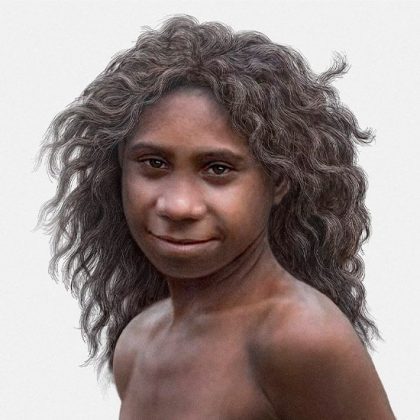
Denisovans may have been much  bigger than modern humans

All that there is – a little-finger bone – of the first Denisovan to be discovered using its DNA analysis in 2008

From Europe to Siberia, Neanderthal remains have gradually accumulated since the first 1856 find in Germany’s Neander Valley. Not only are there plenty of them, there are many near-complete skeletons. So we know a great deal about them, including their intimate relations with anatomically modern humans when the two met outside of Africa. Modern people throughout Eurasia are hybrid as a result. The Denisovans, on the other hand, were only discovered through genetic analysis in 2008 of a finger bone and a few teeth from the eponymous cave in western Siberia. Significant traces of AMH-Neanderthal interbreeding emerged in 2010 from segments of their DNA (between 1 to 4 %)  being found in living people whose ancestry lies beyond sub-Saharan Africa. Within a few months the same kind of genetic exploration revealed that AMH and Denisovans also interbred. It is now known that the DNA of indigenous people living on Pacific islands and in Australia, South, Central and East Asia and the Americas contains Denisovan segments (up to 5% in the Philippines)

Until 2019 the only tangible remains of Denisovans amounted to a finger bone, a toe bone and three molars. They were then joined by a partial lower jaw from a Tibetan cave, containing one tooth that yielded protein data that roughly matched those from Denisova Cave: not as convincing as DNA, but sufficient. About a decade ago Taiwanese fishers of the Penghu Channel between Taiwan and China began to collect ancient bones from their trawl nets, including those of hominins. In 2025 proteomic data from a Penghu hominin mandible again showed plausible Denisovan characteristics. For years Chinese palaeoanthropologists had been pondering on ancient, very robust skulls that had been discovered then hidden in the 1930s, and only recently re-emerged. One from Harbin, dubbed Homo longi or ‘Dragon Man’ had been dated at 146 ka. It had abundant dental calculus (plaque), which yielded mitochondrial DNA that matched that of Siberian Denisovan remains. At last the Denisovans had a face! There are many similar skulls in China, which had previously been assigned to H. erectus or a range of local ‘species’ but are yet to be subject to genetic and proteomic analysis. So it is possible that Denisovans may be ‘hiding’ in plain sight!

Rear and frontal views of Denisovan partial thigh bones trawled from the Penghu Channel. Left tibia, right femur. The pilaster ridge shows on the right-most image. Credit: Kaifu et al. Fig 2.

Now, once again thanks to Taiwanese trawling (and research by joint Japanese and Taiwanese consortia) two hominin upper-leg bones –a femur and a tibia – have entered the Denisovan collection from the seafloor off Penghu.  They are about 45 ka old, and assigned to two separate Denisovan individuals using the proteins of bone collagen. This is a particularly interesting development because upper leg bones are a guide to stature (Yousuke Kaifu and 11 others 2026. Denisovan leg bones from Taiwan reveal large body size. bioRxiv, preprint; DOI: 10.64898/2026.08.07.743438). The leg bones are the largest known from East Asian Pleistocene hominins: i.e. H. erectus and H. sapiens. The femur suggests an individual ~1.8 m tall, weighing around 83 kg, the tibia someone larger (1.9 m and 91 kg). Other commentators have suggested a stature of up to 2.3 m. A ridge of the femur known as its pilaster, to which major muscles are attached, is especially pronounced. This suggests enhanced mobility akin to that in modern hunter-gatherers. A separate preprint about the Penghu leg bones (Minoru Yoneda et al. 2026. Habitat and feeding ecology of a Denisovan from Late Pleistocene Taiwan. bioRxiv, preprint; DOI: 10.64898/2026.08.07.743455) uses carbon and nitrogen isotopes in the tibia to assess the individual’s diet. He/she ate a lot of terrestrial animal protein, but little in the way of aquatic resources. The late Pleistocene ages of the leg bones strongly suggests that the individuals may have encountered modern humans, and the two papers speculate on possible gene flow between Denisovans and AMH.

Let’s hope that this work encourages a flurry of research into other Pleistocene hominin bones from China. Proteomics are not as revealing as ancient DNA, but proteins are sufficiently robust to remain undecayed for hundreds of ka in climates that DNA does not survive for long

See also: Hawks, J. 2026. Legs of the last Denisovans. Personal substack, 8 August 2026.

Advances in hominin evolution

For decades, most of the news concerning our deep ancestry emerged from discoveries in sub-Saharan Africa at sites in Zambia, Tanzania, Kenya, South Africa, Ethiopia. The first week of 2026 decisively shifted that focus northwards to Chad and Morocco in two separate publications.

In 2002 ago the world of palaeoanthropology was in turmoil following the first discovery of fragments of what was then thought to be a hominid, or great-ape, cranium in Chad dated at around 7 Ma ago (Brunet, M. and 37 others 2002. A new hominid from the Upper Miocene of Chad, central Africa. Nature, v. 4418, p. 145-151;DOI:10.1038/nature00879). When pieced together the cranium looked like a cross between that of a chimpanzee and an australopithecine. Some suggested that the creature may have been a ‘missing link’ between the hominids and hominins; perhaps the ultimate ancestor of humans. Sahelanthropus tchadensis (nicknamedToumaï­ or ‘hope of life’ in the local Goran language) was undoubtedly enigmatic. The ‘molecular-clock’ age estimate for the branching of hominins from a common ancestor with chimpanzees was, in 2002, judged to be two million years later the dating of Sahelanthropus, so controversy was inevitable. Another point of contention was the size of Sahelanthropus’s canine teeth: too large for australopithecines and humans, but more appropriate for a gorilla or chimp. Moreover, Toumaï­ showed no indisputable evidence for having been bipedal. The Chadian site subsequently yielded three lower jaw bones and a collection of teeth, a partial femur (leg bone) and three fragmentary ulnae (forearm bones). The finds suggested that as many as five individuals had been fossilised. The femur gave an unresolved hint of an upright gait, yet the ulnas suggested Toumaï­ might equally have been arboreal; as could also be said for the australopithecines.

Reconstructed skull of Sahelanthropus tchadensis. (Credit: Didier Descouens, University of Toulouse)

All the limb bones of Toumaï­have now been anatomically compared with those of hominins and apes (Williams S.A. et al. 2026. Earliest evidence of hominin bipedalism in Sahelanthropus tchadensis. Science Advances, v. 12, article eadv0130; DOI: 10.1126/sciadv.adv0130). Scott Williams of New York University and co-workers from other US institutions show that although the leg bones are much the same size as those of chimpanzees, their proportions were more like those of hominins. They also showed features around the knees and hips needed for bipedalism and an insertion point for a tendon for the gluteus maximus muscle (buttock) vital for sustained upright locomotion, similar to the femurs of Orrorin tugenensis (see: Orrorin walked the walk; May 2008) and Ardipithecus ramidus. Unfortunately, an intact Sahelanthropus cranium showing a foramen magnum – where the skull attaches to the spine – continues to elude field workers. Its position distinguishes upright gait definitively.

See also: This ancient fossil could rewrite the story of human originsScience Daily, January 3, 2026)

The second new advance concerns the joint ancestry of Neanderthals, Denisovans and anatomically modern humans (AMH), whose ancient genetics crudely suggest a last common ancestor living between 765 to 550 ka. This had previously been attributed to Homo antecessor found in the Gran Dolina cave at Atapuerca in northern Spain, roughly dated between 950 ka and 770 ka. (Incidentally, Gran Dolina has yielded plausible evidence of cannibalism). A novel possibility stems from hominin fossils excavated from a cave in raised-beach sediments near Casablanca in Morocco (Hublin, JJ. and 28 others, 2026  Early hominins from Morocco basal to the Homo sapiens lineageNature, v. 649 ; DOI: 10.1038/s41586-025-09914-y). The fossil-bearing sediments contain evidence for a shift in the Earth’s magnetic field (the Brunhes–Matuyama reversal) dated at 773 ka, much more precisely than the Atapuerca age span for H. antecessor. Jean-Jacques Hublin of CNRS in Paris and his multinational colleagues report that the fossils are similar in age to H. antecessor, yet are morphologically distinct, displaying a combination of primitive traits and of ‘derived features reminiscent of’ later Neanderthal, Denisovan and AMH fossils. The differences and shared features suggest that there may have been genetic exchanges between the Moroccan and Iberian population over a considerable period. The most obvious route would have been across the Straits of Gibraltar, but would have required some kind of water craft.  An important question is ‘which population gave rise to the other?’

Artistic reconstruction of a juvenile Homo antecessor, Based on skeletal remains from Gran Dolina Cave

Larger and more robust hominin remains in Algeria dated at 1,000 ka – H. heidelbergensis? – resemble those found near Casablanca. They may have evolved to the latter. Similar possible progenitors to Iberian Homo antecessor have yet to be found in Western Europe. Homo erectus appeared in Georgia and Romania between 2.0 and 1.9 Ma, but the intervening million years or more have yielded no credible European forebears of H. antecessor. For the moment, incursion of a North African population into Europe followed by sustained contact is Hublin et al’s favoured hypothesis, rather than a European origin for Homo antecessor. For Neanderthals and Denisovans to have originated from such an African group, as has been suggested, requires finds of African fossils with plausible resemblance to what are predominantly Eurasian groups. The Iberian population migrated far and wide in Western Europe, as witnessed by stone tools and footprints dating to between 950 to 850 ka in eastern England. So it is equally possible that the Iberian group were progenitors of Neanderthals and Denisovans in Eurasia itself. At least for the moment, ancient genomes of the two H. antecessor groups are unlikely to be found in either Iberian or African fossils of the same antiquity. But, as usual, that will not stifle debate: a resort to the adage ‘absence of evidence is not evidence of absence’ seems appropriate to several research teams!

The oldest anatomically modern human fossils dated at ~300 ka, were also discovered in Morocco (see: Origin of anatomically modern humans, June 2017). Their isolation in the NW corner of the African continent poses a similar conundrum, as since then such beings went on to occupy wide areas of sub-Saharan Africa and then the world.