Out of Africa: a little less blurred?

DNA from the mitochondria of humans who live on all the habitable continents shows such a small variability that all of us must have had a common maternal ancestor, and she lived in Africa about 160 ka ago. Since this was first suggested by Rebecca Cann, Mark Stoneking and Allan Wilson of the University of California, Berkeley in 1987 there has been a stream of data and publications – subsequently using Y-chromosome DNA and even whole genomes – that both confirm an African origin for Homo sapiens and illuminate it. Analyses of the small differences in global human genetics also chart the routes and – using a ‘molecular clock’ technique – the timings of geographic and population branchings during migration out of Africa. As more and better quality data emerges so the patterns change and become more intricate: an illustration of the view that ‘the past is always a work in progress’. The journal Nature published four papers online in the week ending 25 September 2016 that demonstrate the ‘state of the art’.

Three of these papers add almost 800 new, high-quality genomes to the 1000 Genomes Project that saw completion in 2015. The new data cover 270 populations from around the world including those of regions that have previously been understudied for a variety of reasons: Africa, Australia and Papua-New Guinea. All three genomic contributions are critically summarized by a Nature News and Views article (Tucci, S & Akey, J.L. 2016. A map of human wanderlust. http://dx.doi.org/10.1038/nature19472). The fourth paper pieces together accurately dated fossil and archaeological findings with data on climate and sea-level changes derived mainly from isotopic analyses of marine sediments and samples from polar ice sheets (Timmermann, A & Friedrich, T. 2016. Late Pleistocene climate drivers of early human migration. Nature, doi:10.1038/nature19365). Axel Timmermann and Tobias Friedrich of the University of Hawaii have attempted to simulate the overall dispersal of humans during the last 125 ka according to how they adapted to environmental conditions; mainly the changing vegetation cover as aridity varied geographically, together with the opening of potential routes out of Africa via the Straits of Bab el Mandab and through what is now termed the Middle East or Levant. They present their results as a remarkable series of global maps that suggest both the geographic spread of human migrants and how population density may have changed geographically through the last glacial cycle. Added to this are maps of the times of arrival of human populations across the world, according to a variety of migration scenarios. Note: the figure below estimates when AMH may have arrived in different areas and the population densities that environmental conditions at different times could have supported had they done so. Europe is shown as being possibly settled at around 70-75 ka, and perhaps having moderately high densities for AMH populations. Yet no physical evidence of European AMH is known before about 40 ka. Anatomically modern humans could have been in Europe before that time but failed to diffuse towards it, or were either repelled by or assimilated completely into its earlier Neanderthal population: perhaps the most controversial aspect of the paper.

timmermann
Estimated arrival time since the last continuous settlement of anatomically modern human migrants from Africa (top); estimated population densities around 60 thousand years ago. (Credit: Axel Timmermann University of Hawaii)

The role of climate change and even major volcanic activity – the 74 ka explosion of Toba in Indonesia – in both allowing or forcing an exodus from African homelands and channelling the human ‘line of march’ across Eurasia has been speculated on repeatedly. Now Timmermann and Friedrich have added a sophisticated case for episodic waves of migration across Arabia and the Levant at 106-94, 89-73, 59-47 and 45-29 ka. These implicate the role of Milankovich’s 21 ka cycle of Earth’s axial precession in opening windows of opportunity for both the exodus and movement through Eurasia; effectively like opening and closing valves for the flow of human movement. The paper is critically summarised by a Nature News and Views article (de Menocal, P.B. & Stringer, C. 2016. Climate and peopling of the world. Nature, doi:10.1038/nature19471.

This multiple-dispersal model for the spread of anatomically modern humans (AMH) finds some support from one of the genome papers (Pangani, L. and 98 others 2016. Genomic analyses inform on migration events during the peopling of Eurasia. Nature (online). http://dx.doi.org/10.1038/nature19792). A genetic signature in present-day Papuans suggests that at least 2% of their genome originates from an early and largely extinct expansion of AMH from Africa about 120 ka ago, compared with a split of all mainland Eurasians from African at around 75 ka. It appears from Pangani and co-workers’ analyses that later dispersals out of Africa contributed only a small amount of ancestry to Papuan individuals. The other two genome analyses (Mallick, S. and 79 others 2016. The Simons Genome Diversity Project: 300 genomes from 142 diverse populations. Nature (online) http://dx.doi.org/10.1038/nature18964; Malaspinas, A.-S. and 74 others 2016. A genomic history of Aboriginal Australia. Nature (online). http://dx.doi.org/10.1038/nature18299) suggest a slightly different scenario, that all present-day non-Africans branched from a single ancestral population. In the case of Malaspinas et al. an immediate separation of two waves of AMH migrants led to settlement of Australasia in one case and to the rest of Mainland Eurasia. Yet their data suggest that Australasians diverged into Papuan and Australian population between 25-40 ka ago. Now that is a surprise, because during the lead-up to the last glacial maximum at around 20 ka, sea level dropped to levels that unified the exposed surfaces of Papua and Australia, making it possible to walk from one to the other. These authors appeal to a vast hypersaline lake in the emergent plains, which may have deterred crossing the land bridge. Mallick et al. see an early separation between migrants from Africa who separately populated the west and east of Eurasia, with possible separation of Papuans and Australians from the second group.  These authors also show that the rate at which Eurasians accumulated mutations was about 5% faster than happened among Africans. Interestingly, Mallick et al. addressed the vexed issue of the origin of the spurt in cultural, particularly artistic, creativity after 50 ka that characterizes Eurasian archaeology. Although their results do not rule out genetic changes outside Africa linked to cultural change, they commented as follows:

‘… however, genetics is not a creative force, and instead responds to selection pressures imposed by novel environmental conditions or lifestyles. Thus, our results provide evidence against a model in which one or a few mutations were responsible for the rapid developments in human behaviour in the last 50,000 years. Instead, changes in lifestyles due to cultural innovation or exposure to new environments are likely to have been driving forces behind the rapid transformations in human behaviour …’.

Variations in interpretation among the four papers undoubtedly stem from the very different analytical approaches to climate and genomic data sets, and variations within the individual sets of DNA samples. So it will probably be some time before theoretical studies of the drivers of migration and work on global human genomics and cultural development find themselves unified. And we await with interest the pooling of results from all the different genetics labs and agreement on a common data-mining approach.

Lucy: the australopithecine who fell to Earth?

The specimen of Australopithecus afarensis known far beyond the confines of palaeoanthropology as Lucy remains the iconic figure of hominin evolution, 42 years after her discovery by Donald Johanson and Tom Gray near Hadar in the Awash valley of the Afar Depression, Ethiopia. Her skeletal remains were not complete, but sufficient to recognize that they were from the oldest known upright hominin and that they were female, the pelvis having affinities to that of human women rather than other extant apes. Yet her skull was more akin to apes with a brain volume about the same as a modern chimpanzee’s. Part of the reason for her fame stems from being named after a character in a somewhat mystical song by the British pop group, the Beatles, which was played over and over in the palaeontologist’s camp – good job the find wasn’t during the 1990’s acme of gangsta rapper Apache.

Subsequently, the entombing strata were radiometrically dated at around 3.2 Ma. Lucy, in common with most fossils roughly in the human line of descent, has from the outset been the subject of controversy, even at one time being said to be misnamed because of alleged male characteristics; a view swiftly discarded. Like the treasures of Tutankhamun, Lucy’s actual remains have been exhibited far and wide, including a 6-year stay in the US. Fears of damage in transit led the Ethiopian authorities to produce casts for distribution, and Lucy is now restricted to the National Museum in Addis Ababa. As a further precaution, all the actual bones were rendered in digital 3-dimensions using a high-resolution CT scanner during her US sojourn. It is these scans that have led to a surprising development as regards her original fate. Apart from signs of a single carnivore tooth mark, her remains were not devoured by scavengers, nor did early anatomical examinations suggest any sign of disease and she was estimated to have been a young mature female when she died – the cause of death was unknown.

Model of the australopithecus Lucy in the muse...
Model of the Lucy (Australopithecus afarensis) in the museum of Barcelona (credit: Wikipedia)

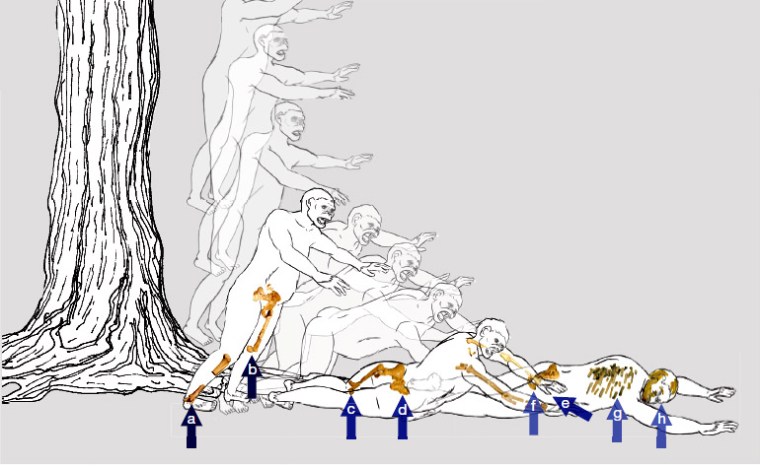
Detailed forensic analysis of the CT scans (Kappelman, J. and 8 others 2016. Perimortem fractures in Lucy suggest mortality from fall out of tall tree. Nature, v. 537, published online 29 August 2016, doi:10.1038/nature19332) revealed far more than did the original bones, including evidence for numerous fractures in Lucy’s limbs, ribs and cranium, many of which are of the compressive or ‘greenstick’ kind. Those in the left ankle and leg bones (talus, tibia, fibula and femur) are compressive and suggest a severe vertical impact of the heel with enough force to smash the strongest bones in the body, driving the hip into the pelvis. Damage to the ribs, pelvis and lower spine (sacrum) is commensurate with a further horizontal, frontal impact of the torso. Arm (humerus), wrist (radius)  shoulder blade (scapula) and collar (clavical) bone fractures are typical of injuries sustained when a falling person tries to break a fall by stretching out the arms. Damage to the cranium and lower jaw (mandible) suggest this instinctive defence posture was futile. None of the fractures show signs of healing, so the multiple traumas were immediately fatal.

Forensic reconstruction of how Lucy fell to meet her end. (credit: John Kappelman et al, doi: 10.1038/nature19332)

The traumatic pattern is reminiscent of someone falling onto hard ground from great height; perhaps equivalent to a four- or five-storey building (see animated reconstruction here). In Lucy’s case, the most likely scenario is from a large tree, perhaps while foraging or sleeping in a safe refuge from ground predators. Forensic analysis of newly dead victims of severe falls generally show massive soft tissue damage by penetration of bone fragments or a ‘hydraulic ram effect’ in which abdominal organs are thrust upwards to produce cardiac damage. That Lucy was found almost intact rules out dismemberment by scavengers or transport by flood water. Indeed, the preservation of even tiny slivers of fractured bone seems to suggest her burial in flood plain sediments before decomposition had set in. A question that the authors do not address is whether or not she may have been deliberately interred, which to me seems a possibility that could be drawn from the detailed evidence. I wonder what a modern coroner might conclude: probably misadventure.

More on hominin evolution can be found here.

Climatic conditions for early hominin evolution

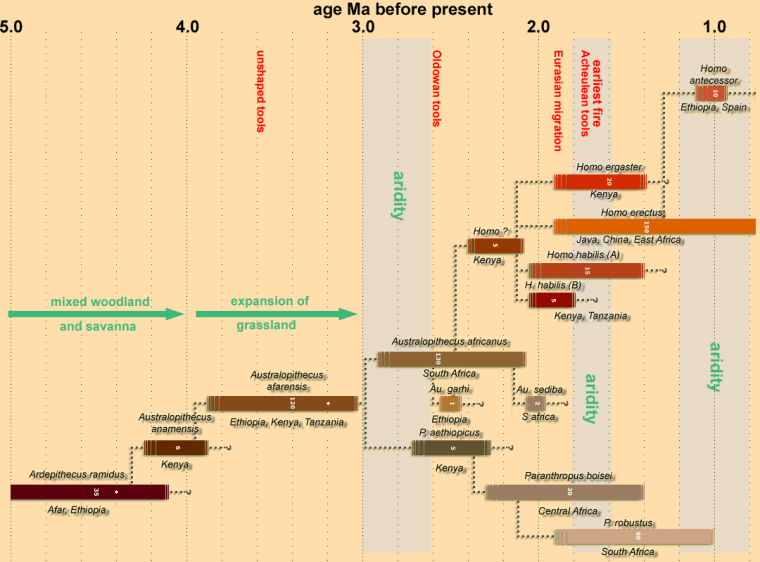
Until about 1.8 Ma ago, when early Homo erectus and perhaps other archaic hominins strode into Eurasia, our forerunners lived and evolved on only one continent – Africa. The physical and environmental conditions underlying the steps from a common ancestor with modern chimpanzees through a growing number of upright species are not well charted by the Pliocene and early Pleistocene terrestrial evidence. All that is know of this formative period is that global climate cooled in an oscillating fashion that culminated in the onset of Northern Hemisphere glaciations in the late Pliocene (~3 Ma) and a shift to drier conditions in East Africa around 2.8 Ma suggested by pollen records off the east coast. Marine sediments of the Indian Ocean, Red Sea and Gulf of Aden still offer the most convenient means of charting environmental change in detail for this crucial episode in human history. As well as oxygen-isotope and pollen-type variations, modern core analysis offers a growing number of wind-blown proxies for onshore vegetation. These include organic geochemistry plus carbon and hydrogen isotopes from trace amounts of leaf waxes. During the May to September East African Monsoon, high speed winds in the upper atmosphere drag dusty continental air from the East African Rift System over the Gulf of Aden, making sea-floor sediment an important target for tracking variations in the proxies (Liddy, H.M. et al. 2016.  Cooling and drying in northeast Africa across the Pliocene.  Earth and Planetary Science Letters, v. 449, p. 430-438. doi:10.1016/j.epsl.2016.05.005). Hannah Liddy and colleagues from the Universities of Southern California and Arizona, USA, applied these techniques to a Gulf of Aden core from offshore Somaliland to open a window on this crucial period.

Early history of hominin evolution and evidence for climate change in East Africa. Based on a diagram at the handprint.com website
Early history of hominin evolution and evidence for climate change in East Africa. Based on a diagram at the handprint.com website and in Stepping Stones Chapter 22

Early Pliocene East Africa (5.3 to 4.3 Ma), the time of Ardepithecus ramidus, was characterized by evidence for a climate wet enough to sustain grasses and riverine woodlands. Yet around 4.3 Ma conditions had shifted to ecosystems more dominated by shrubby plants able to thrive in more arid conditions. At about that time the earliest australopithecines appear in the fossil record, with A. anamensis. Yet the later Pliocene was not devoid of grasses or herbivores. There is ample carbon-isotope evidence from the teeth of hominins that shows that after 3.4 Ma the diet of A. afarensis and A. africanus included increasing amounts whose carbon derived from grasses, when. This apparent paradox can be explained by a major turn to eating meat from herbivores as vegetable foods declined with increasing aridity. This is all very interesting, especially the detailed record of δ13C in plant waxes, but there is little to indicate that steps in hominin speciation or extinction had much direct connection with fluctuations in climatic conditions. Environmental change may have formed a background to other influences that may have been wholly down to early hominin’s social and technological behaviour.

Hobbit time

A few months after the diminutive hominin fossil Homo floresiensis, which because of its relatively large feet was quickly dubbed the ‘Hobbit’, turned out to be considerably older than previously thought it hit has the headlines again because its ancestors may have colonized the Indonesian island of Flores far earlier still. A pair of articles in the 9 June 2016 issue of Nature consider evidence from another site on the island where fluvial sediments offer more easily interpreted stratigraphy than the complex Liang Bua cave assemblage where the original skeletal remains were unearthed. The site in the So’a Basin became an important target for excavation following the discovery there in the 1950’s of stone artefacts, east of Wallace’s Line – a fundamental faunal and floral divide once thought to be due to the difficulty of crossing a deep, current-plagued channel in the Indonesian archipelago. The unexpected presence of artefacts drew palaeoanthropologists from far afield, but it was almost 50 years later before their exploration yielded hominin remains.

English: homo from flores
Homo floresiensis (credit: Wikipedia)

One of the papers reports sparse new finds of hominin material from the So’a Basin, a fragment of mandible and 6 isolated teeth thought to be from at least three individuals (van den Bergh, G.D. et al., 2016. Homo floresiensis-like fossils from the early Middle Pleistocene of Flores. Nature, v.  534, p. 245-248). The other covers newly discovered artefacts, the stratigraphic and palaeoecological setting, and radiometric dates of the finds (Brumm, A. and 22 others, 2016. Age and context of the oldest known hominin fossils from Flores. Nature, v.  534, p. 249-253). The jaw fragment shows signs of having once held a wisdom tooth, showing that it belonged to an adult. Yet although it resembles the dentition of the younger Liang Bua specimens, it seems more primitive and is even smaller. The other dental finds are most likely to be deciduous teeth of juveniles. Fission-track, uranium-series and 40Ar/39Ar dating indicates that the fossils entered the sediments about 700 ka ago. But tools and remains of prey animals in deeper sedimentary layers here and at other Flores sites indicate the presence of hominins back as far as about 1 Ma, before which there are no such signs.

So, at least a million years ago Flores was colonised by hominins. Either the original immigrants were uniquely small compared with other hominins of that vintage in Asia and Africa, or within 300 ka they had decreased in size through the evolutionary influence of limited resources on Flores and the process of island dwarfism. The second may also have been influenced by an initially small population of migrants or a later population ‘bottleneck’ that added a loss of genetic variability – a founder effect.   These two alternatives may point respectively to either the even earlier migration out of Africa and across most of Asia of perhaps H. habilis, or the dwarfing of a limited population of H. erectus who made their way there from their known occupation of Java. The authors painstaking analysis of the meagre remains suggest a closer dental resemblance to Asian Homo erectus than to earlier African hominins, so the second alternative seems more likely. However, even that scenario poses palaeoanthropology with a major problem; yet another evolutionary process that helps cryptify the links among our earlier relatives. (See also: Gomez-Robles, A., 2016. The dawn of Homo floresiensis. Nature, v.  534, p. 188-189.)

Breaking news: Cave structures made by Neanderthals

Neanderthals were well equipped and undoubtedly wore clothing, made shelters, hunted, used fire and famously lived in caves. Deliberate burial of their dead, in some cases arguably with remains of flowers, indicates some form of ritual and belief system. Those in Spain wore necklaces and pendants of bivalve shells, some of which retain evidence of having been painted. Excavators there even found a paint container and painting tools made of small bones from a horse’s foot. The container and tools retain traces of the common iron colorants goethite, jarosite and hematite. One large, perforated scallop shell, perhaps used as a pectoral pendant, shows that its white interior was painted to match its reddish exterior. Given the evidence for adornment by earlier hominins, to find that Neanderthals created art should not be surprising. In May 2016 it emerged that about 177 thousand years ago and earlier, they had broken stalagmites off the cave roof to create curious semi-circular structures in Bruniquel Cave near Montauban in southern France (Jaubert, J. and 19 others, 2016. Early Neanderthal constructions deep in Bruniquel Cave in southwestern France. Nature, v. 533,  online publication, doi:10.1038/nature18291). Each of the structures contains incontrovertible evidence that fires were made within them. Rather than being near the well-lit cave entrance the structures are more than 300 m deep within the cave system surrounded by spectacular stalagmites and stalactites that are still in place. Were the structures younger than 42 ka they would probably have been attributed to the earliest anatomically modern Europeans and to some ritual function. Instead they were made during the climatic decline to the last but one glacial maximum.

Related article

Neanderthals built mystery underground circles 175,000 years ago


Homo floresiensis, aka the ‘Hobbit’, is somewhat older

In 2004 a newly discovered hominin fossil from the Indonesian island of Flores made headlines worldwide. Although an adult, it was tiny – about a metre tall, had a commensurately small brain (the size of a grapefruit), had made tools and hunted small elephants and giant rats. Dates from the cave floor sediments that had entombed it gave ages as young as 13 to 11 thousand years and as far back as 850 ka. So H. floresiensis was regarded as being the last human to share the Earth with us; that is, if it was a different species rather than a product of evolutionary shrinkage of anatomically modern humans stranded and isolated on the island for a very long time. Then there was talk among locals of the legendary Ebo Go-Go, with whom their ancestors had shared the island – they had arrived between 35 to 55 thousand years ago.

Homo floresiensis (the "Hobbit")
Homo floresiensis (the “Hobbit”) ( credit: Wikipedia)

Unsurprisingly, a major controversy raged in palaeoanthropology circles, between those who demanded either island dwarfism or congenital deformity of modern humans, and the other camp focused on many anatomical differences that pointed to a bona fide companion to later immigrants who perhaps survived into modern times. The ‘Hobbit’ became a cause celebre, but many of the original protagonists are now left with the proverbial egg on their faces. The cave sediments turn out to have a much more complex stratigraphy than previously thought, following further excavations led by the original discoverer Thomas Sutikna of the Pusat Penelitian Arkeologi Nasional in Jakarta Indonesia (Sutikna, T. and 19 others 2016. Revised stratigraphy and chronology for Homo floresiensis at Liang Bua in Indonesia. Nature, v. 532, p. 366-369.

English: Cave where the remainings of ' where ...
Liang Bua cave on Flores island, Indonesia, where the remains of Homo floresiensis were discovered in 2003. (credit: Wikipedia)

The delayed appearance of the revision is hardly surprising, given the lengthy political squabbles surrounding access to the site. And neither are the outcomes, for cave sediments are notoriously tricky because of their episodic reworking by cave floods and roof falls, together with the difficulty in finding materials suited to dating in tropical settings. The original charcoal used in radiocarbon dating and sand grains subject to the thermoluminescence method were in fact from a  unit that lies unconformably against the stratum that hosted the fossils. More sophisticated luminescence dating of the actual fossil-hosting sediments yield ages between 100 to 60 ka, tool-bearing units range from 190 to 50 ka. The origins of H. floresiensis are thus pushed back beyond the date of supposed colonisation by H. sapiens, and remain an open question.

Neanderthals and Denisovans at it more often

Palaeogeneticists certainly have the bit between their teeth as DNA sequencing methods become faster and more productive and statistical methods of sequence analysis and comparison are made more powerful. Only last month I reported on the two-way breeding unearthed from the data on single-chromosome DNA extracted from Croatian and Spanish Neanderthals, as well as some of the tangible inheritance from Neanderthals found in living non-African people. Now a team of statisticians, anthropologists and genetic sequencers have applied the new approaches to the genomes of over 1500 non-Africans, including 35 living Melanesian people from Papua-New Guinea (Vernot, B. and 16 others 2016.  Excavating Neandertal and Denisovan DNA from the genomes of Melanesian individuals. Science, v. 351 doi:10.1126/science.aad9416).  Melanesians had previously shown evidence of hybridization with both Neanderthals and Denisovans. The most interesting outcome is that the analyses pointed towards yet more instances of interbreeding between ancestors of modern non-Africans and Neanderthals. Many East Asians have 3 Neanderthals in their family trees, for Europeans and South Asians the score is 2, while Melanesians show descent from one Neanderthal and one Denisovan. Moreover, it emerges that interbreeding episodes were at different times among different populations since anatomically modern humans migrated from Africa, beginning perhaps as long ago as 130 ka and recurring later, after different regional groups of AMH had proceeded on their separate ways.

English: Melanesia, a cultural and geographica...
Melanesia, a cultural and geographical area in the Pacific. (credit: Wikipedia)

A second study (Sankararaman, S. et al. 2016. The combined landscape of Denisovan and Neanderthal ancestry in modern humans. Current Biology, v. 26, p. 1-7) has teased out evidence for Denisovan ancestry among South Asians, their admixture with Melanesians after that group acquired Neanderthal forebears, and significant signs  of dwindling fertility among hybrid males.

Early 2016 has been very fertile as regards palaeoanthropology. Katherine Zink and Daniel Lieberman of Harvard University focus on the small teeth of Homo erectus and later humans, wondering if they arose following a major shift in culinary practices (Zink, K.D. & Lieberman, D.E. 2016. Impact of meat and lower Palaeolithic food processing techniques on chewing in humans. Nature, v. 531, p. 500-503). Their work is based  on experiments to discover how much chewing is needed to make it possible to swallow different uncooked foodstuffs (assuming that cooking did not arise until after 500 ka). It seems that simply introducing meat to the diet would have reduced mastication by around 13% (2 million chews) per year, with a 15% reduction in applied chewing force. Simply slicing and pounding takes out another 750 thousand annual chews and gives a 12% fall in average biting force. So, here’s a link between tools and human gnashers as well as with development of the hand. Fascinating, perhaps, but every hominin species since 7 Ma old Sahelanthropus tchadensis had far smaller canine teeth than are the norm among non-hominin living and fossil apes. Something else was going on with dentition during our evolution, which may have been a loss of the need for threatening teeth. From ‘Do that again and I’ll bite you’, to ‘Let’s chew this over’…

More on Neanderthals, Denisovans and anatomically modern humans

Neanderthal news

Note: Earth-Pages will be closing as of early July, but will continue in another form at Earth-logs

Increasingly sophisticated analysis of existing genomes from Neanderthal and Denisovan fossil bone, together with new data on single-chromosome DNA extracted from Croatian and Spanish Neanderthals continues to break new ground.

Artistic reconstruction of Neanderthal woman (credit: Natural History Museum, http://www.nhm.ac.uk/natureplus/blogs/tags/human_evolution)

According to genome comparison between a Siberian specimen and modern humans, a population from which Neanderthals emerged separated from that which led to anatomically modern humans (AMH) sometime between 550 and 765 ka, although the fossil record can only confirm that divergence was before 430 ka. The comparison famously showed that Neanderthals contributed to modern, non-African humans between 47 and 75 ka, that is after the exodus of AMH from Africa that spread our species throughout all continents except Antarctica. This genetic exchange is thought to have taken place somewhere in the Middle East, which seems to have been a major staging post for our spread further east and also westward to Europe. A similar indication of liaison between Denisovans and AMH migrants is restricted to modern Melanesians, and probably took place in eastern Asia before 45 ka, when modern people began crossing from Eurasia to New Guinea and Australia. Neanderthal-Denisovan comparison suggests that those distinct groups separated between 380 and 470 ka ago (recently revised from an earlier estimate).

In both cases the gene flow was from the older groups to humans. Further examination of Siberian Neanderthal genomes now indicates that a reverse exchange occurred more than 100 ka ago (Kuhlwilm, M. and 21 others 2016. Ancient gene flow from early modern humans into Eastern Neanderthals. Nature, v. 530, p. 429-433). But the single-chromosome DNA from Croatian and Spanish Neanderthals shows no such sign This instance of two-way exchange is significant in another way: it took place before direct evidence of the generally accepted departure of African migrants to populate the rest of the world. At about 100 ka there is fossil evidence of possible AMH-Neanderthal cohabitation of the Levant, followed by a period with fossil evidence for Neanderthal presence there but not modern humans. Because stone tools from northern Arabia are dated as far back as 125 ka and closely resemble those associated with archaic modern humans, there is a possibility that AMH migration was far earlier than previously thought and passed through the Levant en route to points east.

Another tantalizing aspect of Neanderthal-modern human genetics is the tangible legacy of interbreeding with non-African humans. The first sign was that the gene (mc1r) that confers red hair on those of us blessed, or otherwise, with it may have Neanderthal origins, thus making us extremely proud of that heritage. The same gene is implicated in northern modern humans having developed pale skin, which might embarrass ‘white supremacists’! Similar studies in Svante Paabo’s lab at the Max Planck Institute for Evolutionary Anthropology in Leipzig also suggested 15 genome regions that include those involved in energy metabolism, possibly associated with type 2 diabetes; cranial shape and cognitive abilities, perhaps linked to Down’s syndrome, autism and schizophrenia; wound healing; skin, sweat glands, hair follicles and skin pigmentation; and barrel chests. There is more…

Joshua Akey of the University of Washington, Seattle, and evolutionary genomicist Tony Capra of Vanderbilt University in Nashville hit on the idea of ‘mining’ archived genetic information from more than 28 thousand living people for traces of 6000 Neanderthal DNA variants and comparing the results with physical traits and diseases logged in the human database (reported by Gibbons, A. 2016. Neanderthal genes linked to modern diseases. Science, v. 351, p. 648-9). On the plus side, Neanderthal ancestry may help boost immune responses to fungi, parasites and bacteria. Inheritance of enhanced blood coagulation, although greatly assisting recovery from wounds and hemorrhage when giving birth, confers a proclivity to heart attacks and strokes. Neanderthals also passed on ‘weak bladders’, solar keratoses that confer skin cancer risk, a tendency to malnutrition from modern diets low on meat and nuts, depression triggered by jet lag(!) and even a tendency to nicotine addiction. But a ‘pure’ line of modern human descent, shared by most Africans, also has its positive and negative heritable traits.

More on Neanderthals, Denisovans and anatomically modern humans

A rational view of the start of human influences on Life and Geology

Regular readers will know that I have strong views on attempts to burden stratigraphy with a new Epoch: the Anthropocene. The central one is that the lead-in to a putsch has as much to do with the creation of a bandwagon, to whose wheels all future geologists will be shackled, as it does to any scientific need for such a novelty. Bound up as it is with the fear that Earth may be experiencing its sixth mass extinction, the mooted Anthropocene will likely become a mere boundary marked by future stratigraphers as a Global Boundary Stratotype Section and Point or GSSP between the existing Holocene Epoch and that sequence of sedimentary strata and their fossil record that will be laid down on top of it. Or not, if humanity becomes extinct should the economically induced, dangerous modifications of our homeworld of the last few decades or centuries not be halted. Either way, it defies the stratigraphic ‘rule book’.

No one can deny that humanity’s activities are now immensely disruptive to surface geological processes. Nor is it possible to rule out such disruptive change to the biosphere in the near-future that a latter-day equivalent of the K/Pg or end-Permian events is on the cards: such confidence does not spring from the interminable succession of grand words and global inaction reiterated in December 2015 by the UN Paris Agreement on economically-induced climate change. Still, it was a bit of a relief to find that palaeontological evidence, or rather statistics derived from the fossil record in North American sedimentary rocks since the Carboniferous, emphasises that there is no need for the adoption of Anthropocene as an acceptable geological adjective.

To ecologists, extinctions are not the be all and end all of disruption of the biosphere. Major shifts in life’s richness are also recorded by the way entire ecosystems become disrupted. A classic, if small-scale, example is that way in which the ecosystem of the US Yellowstone National Park changed since the eradication by 1926 of the few hundred grey wolves that formerly preyed mainly on elk. In the 20 years since wolf reintroduction to the Park in 1995 the hugely complex but fragile Yellowstone ecosystem has showed clear signs of recovery of its pre-extirpation structure and diversity.

A consortium of mainly US ecologists, led by Kathleen Lyons of the National Museum of Natural History at the Smithsonian Institution in Washington DC, has assessed linkages between species of fossil animal and plants since the Carboniferous (S.K. Lyons and 28 others, 2015. Holocene shifts in the assembly of plant and animal communities implicate human impacts. Nature, published on-line 16 December 2015 doi:10.1038/nature16447). They found that of the 350 thousand pairs of species that occurred together at different times throughout the late Palaeozoic to the last Epoch of the Cenozoic, the Holocene, some pairs appeared or clustered together more often than might be expected from random chance. Such non-random association suggests to ecologists that the two members of such a pair somehow shared ecological resources persistently, hinting at relationships that helped stabilise their shared ecosystem. For most of post-300 Ma time an average of 64% of non-random pairs prevailed, but after 11.7 ka ago – the start of the Holocene – that dropped to 37%, suggesting a general destabilisation of many of the ecosystems being considered. This closely correlates with the first human colonisation of the Americas, the last of the habitable continents to which humans migrated. This matches the empirical evidence of early Holocene extinctions of large mammals in the Americas, which itself is analogous to the decimation of large fauna in Australasia during the late Pleistocene following human arrival from about 50 to 60 ka ago. Significant human-induced ecological impact seems to have accompanied their initial appearance everywhere. The ecological effects of animal domestication and agriculture in Eurasia and the Americas mark the Holocene particularly. In fact, in Europe the presence of Mesolithic hunter gatherers is generally inferred, in the face of very rare finds of artefacts and dwellings, from changes in pollen records from Holocene lake and wetland sediments, which show periods of tree clearance that can not be accounted for by climate change.

There is no need for Anthropocene, other than as a political device.

Surprising modern-human migrations into China and Africa

Caves figure highly in discoveries of hominin remains, fossil riches from those near Johannesburg in South Africa and at Atapuerca in northern Spain having set the world of palaeoanthropology reeling in the last few months. As often as not the caves chosen by hominins for day-to-day living, refuge or ritual, places where carnivores dragged some of our early relatives, or into which they fell accidentally, formed in limestones. There are few places so well endowed with karst features than southern China, a fair number of caves in them having rich deposits of bat guano to which farmers have beaten well-trodden paths to dig it out for fertiliser. One such is Fuyan Cave in Daoxian County, Hunan. Manure mining there had done a great deal of the heavy work faced by archaeologists, having stopped when it reached a hard layer of calcite speleothem or flowstone that underpaves more or less the entire cave floor. Initial trial investigations found three clearly human teeth at the surface, encouraging further work. Digging through the flowstone revealed sediments rich in fossils, mainly teeth which preserve better than other remains in humid conditions. As well as teeth from a variety of mammals, large and small, 47 human teeth emerged. Close study revealed dental features that are irrefutably those of anatomically modern humans (Liu, W. and 13 others 2015. The earliest unequivocally modern humans in southern China. Nature, doi:10.1038/nature15696). Remarkably, many of the teeth are in far better condition than my own, and those of many living people with access to dental expertise.

Some of the Daoxian human teeth. (Credit: Song Xing and Xiu-jie Wu of the 1Key Laboratory of Vertebrate Evolution and Human Origins at the Chinese Academy of Sciences
Some of the Daoxian human teeth. (Credit: Song Xing and Xiu-jie Wu of the 1Key Laboratory of Vertebrate Evolution and Human Origins at the Chinese Academy of Sciences)

The true significance of the excavation emerged only when 230Th dating revealed the age of the flowstone cap to the old cave sediments. A small stalagmite protruding from its surface yielded a minimum age of ~80 ka: by far the oldest date for anatomically modern human remains outside of Africa and the eastern Mediterranean. The dating produced older ages around 120 ka with equally good precision. Before this discovery the date of migration of Africans to populate Eurasia was thought to be about 60 ka from imprecise dating based on genetics of a range of living Eurasians and Africans – a ‘molecular clock’ – and the earliest sign of humans found in Australia. Consequently, finds in South India of artefacts beneath 74 ka ash from the super-eruption of the Mount Toba caldera have been regarded by many, other than the finders, as having been made by Homo erectus. Dates of 100 ka for modern human occupation of the Levant were thought to represent a failed attempt at migration out of Africa by a northern route. Both these important findings now take on renewed significance. Yet a 30 to 40 ka time gap between the Fuyan people and the previous dates for the earliest signs of migration into China, Borneo and Australia (40-50 ka) begs the question, ‘Did this early group of far-travelled migrants survive to become ancestors of modern Chinese people?’ There are many possible scenarios that only future discoveries might validate: simply goiung extinct; failure to survive the encounter with earlier migrants, such as H. erectus or the Denisovans; assimilation into those older populations.

Mitochondrial DNA-based chart of large human m...
Mitochondrial DNA-based chart of large human migrations: the consensus before these new data. Numbers are millennia before present. ( credit: Wikipedia)

As if to counter this, a multinational group of collaborators have sequenced and analysed the genome from a 4500 year-old male skeleton discovered in the Mota Cave of the Gamo highlands of southern Ethiopia (Llorente, M.G. and 18 others 2015. Ancient Ethiopian genome reveals extensive Eurasian admixture throughout the African continent. Science, DOI: 10.1126/science.aad2879). Comparison with what is now a virtual library of living human genomes showed that this man’s genetic make-up most closely matched that of the Ari, a tribe living in the area today. What was most interesting is that part of the modern Ari genome – between 4 to 7% – is not present in the 4500 year-old sequence. Instead, it matches those of modern Sardinians and a prehistoric German farmer. Yet it occurs in people living not only in Ethiopia, but also in central, western and southern Africa to varying degrees. There seems to have been a ‘backflow’ of people into the whole of Africa from Eurasia, estimated to have occurred some 3500-4000 years ago and probably involving a large influx. By that time farming was already established in Africa, so the migrants may have had some advantage, either culturally or physically, to encourage their wide spread through the continent.

In tropical climates, DNA is likely to break down quickly and little if any fossil DNA has been recovered from prehistoric Africans. In this case, burial in a cave at high elevation may have helped preserve it, but also the target for extraction was the petrous bone from the inner ear whose density seems to allow DNA a better change of long-term survival. With continually improving DNA analysis and sequencing techniques more news is surely going to emerge from past African populations.

More on human migrations

Related articles

Gibbons, A. 2015. Prehistoric Eurasians streamed into Africa, genome shows. Science, v. 350 (9 October 2015), p. 149.