Former Senior Lecturer at British Open University, research in remote sensing of arid lands, groundwater exploration, Precambrian tectonics and geochemistry
One of the oddities of using human genetic material passed down the male (from Y chromosomes) and female lines (from mitochondria) to assess when fully modern humans originated is that they have hitherto given widely different dates: 50 to 115 ka and 150 to 240 ka respectively. Twice to three-times the age for a putative ancestral ‘mother’ compared with such a ‘father’ for humanity raised all kinds of problematic issues for palaeoanthropology, such as a possibly greater ‘turnover’ of lines of descent among males perhaps due to riskier lifestyles. Y-chromosome data limited speculation on the timing of human colonisation outside of Africa to a maximum of 60 ka, even though there is fossil and archaeological evidence for a much earlier presence in the Levant and India. The difference also questions the validity of molecular-clock approaches to evolutionary matters. Two new studies have lessened the phylogenetic strains.
One examines Y chromosomes in 69 males from nine diverse populations from Africa, Eurasia and Central America (Poznik, G.D. and 10 others 2013. Sequencing Y chromosomes resolves discrepancy in time to common ancestors of males versus females. Science, v. 341, p. 562-565). The US-French team applied sophisticated statistics as well as the elements of a molecular clock approach to both Y-chromosome and mitochondrial DNA, discovering in the process a hitherto unresolved feature in the African part of the male ‘tree’. The outcome is a significant revision of both male and female paths of descent: 120 to 156 ka and 99 to 148 ka to the last common ancestor in both lines. The upper limit is somewhat lower than the age of fossil evidence for the earliest anatomically modern humans.
The second study zeros-in on the European story, by examining the Y-chromosome data of 1200 men from Sardinia (Francalacci, P. and 38 others. Low-pass DNA sequencing of 1200 Sardinians reconstructs European Y-chromosome phylogeny. Science, v. 341, p. 565-569) calibrated to some extent by the date when Sardinia was first colonised (7.7 ka). It too revealed new detail that enabled the Italian-US-Spanish team to refine the time when features of Sardinian Y-chromosome DNA would coalesce with those from the rest of the world. In this case the date for a last common paternal ancestor goes back to between 180 to 200 ka, more similar to the old dates for ‘African Eve’ and the earliest modern human fossils than to either that for male or female lines arrived at by Posnik et al. (2013), which are significantly younger.
Map of early migrations of modern humans based on Y chromsome data (credit: Wikipedia)
Equally interesting are the comments on both papers in the Perspectives section of the issue of science in which they appear (Cann, R.L. 2013. Y weigh in again on modern humans. Science, v. 341, p. 465-7).Rebecca Cann of the University of Hawaii Manoa considers the two sets of results from Y-chromosomes potentially capable of refining models for the migration times of modern humans out of Africa and their interactions with the archaic populations that they eventually displaced from Europe and central and southern Asia (Neanderthals, Denisovans and Homo erectusrespectively). She believes that will include signs of earlier excursions that the generally accepted diaspora between roughly 60 and 50 ka seemingly constrained by the previous 50 to 115 ka estimate for the last common paternal ancestor. That would help explain the presence of modern humans in India at the time of the Toba eruption (71 ka).
Geologists who study turbidites assume that the distinctive graded beds from which they are constructed and a range of other textures represent flows of slurry down unstable steep slopes when submarine sediment deposits are displaced. Such turbidity currents were famously recorded by the severing of 12 transatlantic telecommunication cables off Newfoundland in 1929. This happened soon after an earthquake triggered 100 km hr-1 flows down the continental slope, which swept some 600 km eastwards.
Typical structures in Upper Carboniferous turbidites near Bude, Cornwall, UK (credit: Flickr, Earthwatcher)
Sea beds at destructive margins provide the right conditions for repeated turbidity currents and it is reasonable to suppose that patterns should emerge from the resulting turbidite beds that in some way record the seismic history of the area. British and Indonesian geoscientists set out to test that hypothesis at the now infamous plate margin off Sumatra that hosted the great Acheh Earthquake and tsunamis of 26 December 2004 to kill 250 thousand people around the rim of the Indian Ocean (Sumner, E.J. et al. 2013. Can turbidites be used to reconstruct a paleoearthquake record for the central Sumatra margin? Geology, v. 41, p.763-766).
Animation of Indonesian tsunami of 26 December 2004 (credit: Wikipedia)
Cores through turbidite sequences along a 500 km stretch of the margin formed the basis for this important attempt to test the possibility of recording long-term seismic statistics. To avoid false signals from turbidity currents stirred up by storms, floods and slope failure from rapid sediment build-up 17 sites were cored in deep water away from major terrestrial sediment supplies, which only flows triggered by major earthquakes would be likely to reach. To calibrate core depth to time involved a variety of radiometric and stratigraphic methods
Disappointingly, few of the sites on the submarine slopes recorded turbidites that match events during the 150-year period of seismic records in the area, none being correlatable with the 2004 and 2005 great earthquakes. Indeed very little correlation of distinctive textures from site to site emerged from the study. Some sites on slopes revealed no turbidites at all from the last 150 years, whereas turbidites in others that could be accurately dated occurred when there were no large earthquakes. Only cores from the deep submarine trench consistently preserved near-surface turbidites that might record the 2004 and 2005 great earthquakes.
These are surprising as well as depressing results, but perhaps further coring will discover what kind of bathymetric features might yield useful and consistent seismic records from sediments.
In its 125th year the Geological Society of America is publishing invited reviews of central geoscience topics in its Bulletin. They seem potentially useful for both undergraduate students and researchers as accounts of the ‘state-of-the-art’ and compendia of references. The latest focuses on major controls on past sea-level changes by processes that operate in the solid Earth (Conrad, C.P. 2013. The solid Earth’s influence on sea level. Geological Society of America Bulletin, v. 125, p. 1027-1052), a retrospective look at how geoscientists have understood large igneous provinces (Bryan, S. E. & Ferrari, L. 2013. Large igneous provinces and silicic large igneous provinces: Progress in our understanding over the last 25 years. Geological Society of America Bulletin, v. 125, p. 1053-1078) and the perennial topic of how granites form and end up in intrusions (Brown, M. 2013. Granite: From genesis to emplacement Geological Society of America Bulletin, v. 125, p. 1079-1113).
Sea level change
Conrad covers sea-level changes on the short- (1 to 100 years), medium- (1 to 100 ka) and long term (1 to 100 Ma). The first two mainly result from local deformation of different kinds associated with glacial loading and unloading. These result in changes in the land surface, the sea surface nearby and on thousand year to 100 ka timescales to ups and downs of the sea-bed. Global sea-level changes due to melting of continental glaciers at the present day amount to about half the estimated 2 to 3 mm of rise each year. But increasingly sensitive measures show it is more complex as the rapid shifts of mass involved in melting ice also result in effects on the solid Earth. At present solid mass is being transferred polewards, but at rates that differ in Northern and Southern hemispheres and which are changing with anthropogenic influences on glacial melting. Viscous movement of the solid Earth is so slow that effects from previous glacial-interglacial episodes continue today. As a result rapid elastic movements are tending to produce relative sea-level falls in polar regions of up to 20 mm per year with rising sea level focusing on areas between 30°N and 30°S. The influence of the slower viscous mass transfer has an opposite sense: sea-level rise at high latitudes. Understanding the short- and medium-term controls is vital in predicting issues arising in the near future from natural and anthropogenic change.
Comparison of two sea level reconstructions during the last 500 Ma. (credit: Wikipedia)
Most geologists are concerned in practice with explanations for major sea-level changes in the distant past, which have a great deal to do with changes in the volumes of the ocean basins. If the global sea-floor rises on average water is displaced onto former land to produce transgressions, and subsidence of the sea floor draws water down from the land. Conrad gives a detailed account of what has been going on since the start of the Cretaceous Period, based on the rate of sea-floor spreading, marine volcanism and sedimentation, changes in the area of the ocean basins and the effects of thermally-induced uplift and subsidence of the continents, showing how each contribution acted cumulatively to give the vast transgressions and regressions that affected the late Phanerozoic. On the even longer timescale of opening and closing of oceans and the building and disintegration of supercontinents the entire mantle becomes involved in controls on sea level and a significant amount of water is chemically exchanged with the mantle.
Large igneous provinces
The Web of Science database marks the first appearance in print of “large igneous province” in 1993, so here is a topic that is indeed new, although the single-most important attribute of LIPs, ‘flood basalt’ pops up three decades earlier and the term ‘trap’ that describes their stepped topography is more than a century old. Bryan and Ferrari are therefore charting progress in an exciting new field, yet one that no human – or hominin for that matter – has ever witnessed in action. One develops, on average, every 20 Ma and since they are of geologically short duration long periods pass with little sign of one of the worst things that our planet can do to the biosphere. In the last quarter century it has emerged that they blurt out the products of energy and matter transported as rising plumes from the depths of the mantle; they, but not all, have played roles in mass extinctions; unsuspected reserves of precious metals occur in them; they play some role in the formation of sedimentary basins and maturation of petroleum and it seems other planets have them – a recipe for attention in the early 21st century. Whatever, Bryan and Ferrari provide a mine of geological entertainment.
In comparison, granites have always been part of the geologist’s canon, a perennial source of controversy and celebrated by major works every decade, or so it seems, with twenty thousand ‘hits’ on Web of Science since 1900 (WoS only goes back that far). Since the resolution of the plutonist-neptunist wrangling over granite’s origin one topic that has been returned to again and again is how and where did the melting to form granitic magma take place? If indeed granites did form by melting and not as a result of ‘granitisation. Lions of the science worried at these issues up to the mid 20th century: Bowen, Tuttle, Read, Buddington, Barth and many others are largely forgotten actors, except for the credit in such works as that of Michael Brown. Experimental melting under changing pressure and temperature, partial pressures of water, CO2 and oxygen still go on, using different parent rocks. One long-considered possibility has more or less disappeared: fractional crystallisation from more mafic magma might apply to other silicic plutonic rocks helpfully described as ‘granitic’ or called ‘granitoids’, but granite (sensu stricto) has a specific geochemical and mineralogical niche to which Brown largely adheres. For a while in the last 40 years classification got somewhat out of hand, moving from a mineralogical base to one oriented geochemically: what Brown refers to as the period of ‘Alphabet Granites’ with I-, S- A- and other-type granites. Evidence for the dominance of partial melting of pre-existing continental crust has won-out, and branched into the style, conditions and heat-source of melting.
Typical granite tor near Kisumu, Kenya (credit: Wikipedia)
All agree that magmas of granitic composition are extremely sticky. The chemical underpinnings for that and basalt magma’s relatively high fluidity were established by physical chemist Bernhardt Patrick John O’Mara Bockris (1923-2013) but barely referred to, even by Michael Brown. Yet that high viscosity has always posed a problem for the coalescence of small percentages of melt into the vast blobs of low density liquid able to rise from the deep crust to the upper crust. Here are four revealing pages and ten more on how substantial granite bodies are able to ascend, signs that the puzzle is steadily being resolved. Partial melting implies changes in the ability of the continental crust to deform when stressed, and this is one of the topics on which Brown closes his discussion, ending, of course, on a ‘work in progress’ note that has been there since the days of Hutton and Playfair.
Sediments built up on lake beds are a fruitful source of proxy data for all kinds of time series – mainly climatic and ecological. Pollen, other organic remains, various stable isotopes, and a range of organic geochemical data calibrated to time using magnetostratigraphy, C-14 dating and astronomical ‘pacemakers’. Suddenly there is another proxy: cannabinol, the metabolite of tetrahydrocannibinol the principal psychoactive component of marijuana (Lavrieux, M. et al. 2013. Sedimentary cannabinol tracks the history of hemp retting. Geology, v. 41, p. 751-754). The compound is detectable at the parts per billion level thanks to advances in monitoring the use of drugs, particularly in sports persons – it ends up in the urine of users. So the paper by a team of French Earth scientists has a somewhat irresistible draw, the more so from the opening sentence of its abstract, ‘Hemp (Cannabis sp.) has been a fundamental plant for the development of human societies’. Indeed it has, for the earliest records date back to the Neolithic in China, perhaps back to 12 ka ago.
Cultivation of hemp for fibre and grain in France. (credit: Wikipedia)
But then all becomes clear: they speak of hemp fibres used in rope and some textiles, and the climatic adaptability of the plant that has ensured its spread from Equator to north of the Arctic Circle and lesser southern latitudes. But there is an element of tongue-in-cheek, or at least so it seemed to me, as the objective of their research is to chart to emergence and rise of rope making in Central France. Freeing the useful fibres from Cannabis stems requires the plant to be soaked and subject to microbial action that breaks down soft tissue, know as retting that is also used in flax and coir production. The resin breaks down to cannabinol, which is therefore a perfect proxy for Hemp retting.
Lac d’Aydat is geologically famous as it formed when a lava flow from one of the puys of the Massif Central blocked a valley and became a dam. It figured in the pioneering volcanological research of English geologist George Julius Poulett Scrope. Its new place in science rests on Lavrieux et al.’s chronologically calibrated time series for retting from the lake’s muds. Hemp pollen in the section betrays the start of Cannabis cultivation in the Auvergne between 500-650 AD, but hemp retting in the lake is marked by a cannabinol spike in the 13th century and increases in pollen. It fell-off sharply in the late 19th century, probably as a result of being outcompeted by more easily processed cotton.
Almost 7 centuries of Cannabis processing in central France actually took a toll as cannabinol is toxic to fish and cattle. Despite a 1669 Royal Ordinance against hemp retting in French rivers it continued unchecked in Lac d’Aydat, but more likely than secret retting tucked away in a remote corner of France it stemmed from the ordinance being widely flouted. That it ended with the rise of cotton is not so convincing as hemp is still a staple in rope manufacture, and when the US entered World War II large tracts of land were placed under Cannabis to produce naval cordage; the reason why it still grows wild in abundance across many States. There is plenty of evidence, including this, that use of Cannabis for cordage came rather late, and plenty in support of its cultivation and wide spread before the Iron Age for ‘relaxation’.
Review of Fracking Issues posted on 31 May 2013 briefly commented on a major academic study of the impact of shale gas exploitation on groundwater. The 12 July 2013 issue of Science follows this up with a similar online, extensive treatment of how underground disposal of fracking fluids might influence seismicity in new gas fields (Ellsworth, W.J. 2013. Injection-induced earthquakes. Science, v. 341, p. 142 and doi: 10.1126/science.1225942) plus a separate paper on the same topic (van der Elst, N.J. et al. 2013. Enhanced remote earthquake triggering at fluid-injection sites in the Midwestern United States. Science, v. 341, p.164-167).
Major shale gas basins (credit: Wikipedia)
It was alarm caused by two minor earthquakes (<3 local magnitude) that alerted communities on the Fylde peninsula and in the seaside town of Blackpool to worrisome issues connected to Cuadrilla Resources’ drilling of exploratory fracking wells. These events were put down to the actual hydraulic fracturing taking place at depth. Such low-magnitude seismic events pose little hazard but nuisance. The two reports in Science look at longer-term implications associated with regional shale-gas development. All acknowledge that the fluids used for hydraulic fracturing need careful disposal because of their toxic hazards. The common practice in the ‘mature’ shale-gas fields in the US is eventually to dispose of the fluids by injecting them into deep aquifers, which Vidic et al. suggested that ‘due diligence’ in such injection of waste water should ensure limited leakage into shallow domestic groundwater.
The studies, such as that by William Ellsworth, of connection between deep waste-water injection and seismicity are somewhat less reassuring. From 1967 to 2001 the central US experienced a steady rate of earthquakes with magnitudes greater than 3.0, which can be put down to the natural background of seismicity in the stable lithosphere of mid North America. In the last 12 years activity at this energy level increased significantly, notably in areas underlain by targets for shale-gas fracking such as the Marcellus Shale of the north-eastern US. The increase coincides closely with the history of shale-gas development in the US. The largest such event (5.6 local magnitude) destroyed 14 homes in Oklahoma near to such a waste-injection site. Raising the fluid pressure weakens faults in the vicinity thereby triggering them to fail, even if their tectonic activity ceased millions of years ago: many retain large elastic strains dependent on rock strength.
Apart from the mid-continent New Madrid seismic zone associated with a major fault system parallel to the Mississippi, much of the central US is geologically simple with vast areas of flat-bedded sediments with few large faults. The same cannot be said for British geology which is riven with major faults formed during the Caledonian and Variscan orogenies, some of which in southern Britain were re-activated by tectonics associated with the Alpine events far off in southern Europe. Detailed geological maps show surface-breaking faults everywhere, whereas deep coal mining records and onshore seismic reflection surveys reveal many more at depth. A greater population density living on more ‘fragile’ geology may expect considerably more risk from industrially induced earthquakes, should Britain’s recently announced ‘dash’ for shale gas materialise to the extent that its sponsors hope for.
Nicholas van der Elst and colleagues’ paper indicates further cause for alarm. They demonstrate that large remote earthquakes. In the 10 days following the 11 March 2011 Magnitude 9.0 Sendai earthquake a swarm of low-energy events took place around waste injection wells in central Texas, to be followed 6 months later by a larger one (4.5 local magnitude). Similar patterns of injection-related seismicity followed other distant great earthquakes between 2010 and 2012. Other major events seem not to have triggered local responses. The authors claim that the pattern of earth movements produced by such global triggering might be an indicator of whether or not fluid injection has brought affected fault systems to a critical state. That may be so, but it seems little comfort to know that one’s home, business or community is potentially to be shattered by intrinsically avoidable seismic risk.
The extremely hazardous seaway through the Straits of Gibraltar and the waterless deserts of the Levant presented considerable barriers to natural exchange of animal groups between Africa and Eurasia throughout the period of hominin evolution known from the African Pliocene and Pleistocene record. These barriers were breached by hominins only occasionally. Through most of the Miocene and back to the Mesozoic Era Iberia and what is now Morocco were separated by a wide seaway preventing faunal exchange. That Betic Seaway eventually closed with the tectonic collision of the two sides to form the modern Betic Cordillera in southern Spain towards the end of the Miocene. This left parts of the Mediterranean to evaporate during what is known as the Messinian Salinity Crisis, which reached completion at 5.59 Ma. Yet this Europe-Africa connection was short-lived, being breached by what is regarded as one of the most dramatic events in Cenozoic history: the Zanclean Flood. At 5.33 Ma the Atlantic burst through what is now the Straits of Gibraltar to refill the Mediterranean Basin within a period between a few months and two years. The flooding began as a vast system of rapids some 1 km high with an estimated flow a thousand times that of the modern Amazon.
Strait of Gibraltar from space, with Spain on the left and Morocco on the right.) (credit: Wikipedia)
During the existence of the Europe-Africa land bridge it was possible for animals to move between north-west Africa and western Europe. Evidence that such an exchange did take place comes from a number of Late Miocene localities in southern Spain and North Africa. The first recorded migrants into Spain were African gerbils, then evidence mounted for larger animals, including hippos and early camels moving into Europe and a reverse migration of rabbits and mice. One of the Spanish sites (Gibert, L. et al. 2013. Evidence for an African-Iberian mammal dispersal during the pre-evaporitic Messinian. Geology, v. 41, p. 691-694) has allowed precise magnetostratigraphic dates to be put on the migrations. The Spanish-US team suggests conditions ripe for migration were in three distinct phases: around 6.3 Ma when hippos managed to swim to Europe; around 6.2 Ma which saw European small mammals making the journey south and camels moving to Europe; in a 300 ka window of opportunity from 5.6 to 5.3 Ma for African mice to make the journey into Europe. Several distinct episodes probably reflect some ups and downs of sea level related to glacial retreats and advances in Antarctica.
One implication of the short-lived Messinian land bridge is that it may have been followed by primates, though evidence has yet to be found. A particularly interesting genus, suggested by some as a possible common ancestor for hominins and chimpanzees, is Oreopithecus a bipedal ape recorded from the Miocene of Italy
The Afar Depression of Ethiopia and Eritrea is a feature of tectonic serendipity. It is unique in showing on land the extensional processes and related volcanism that presage sea-floor spreading. Indeed it hosts three rift systems and a triple junction between the existing Red Sea and Gulf of Aden spreading centres and the East African Rift System that shows signs of future spalling of Somalia from Africa. Afar has been a focus of geoscientific attention since the earliest days of plate theory but practical interest has grown rapidly over the last decade or so when the area has become significantly more secure and safe to visit. Two recent studies seem to have overturned one of the most enduring assumptions about what drives this epitome of continental break-up.
Simulated perspective view of the Afar depression from the south (credit: Wikipedia)
From the obvious thermal activity deep below Afar, linked with volcanism and high heat flow, a mantle host spot and rising plume of deep mantle has been central to ideas on the tectonics of the area. A means of testing this hypothesis is the use of seismic data to assess the ductility and temperature structure of deep mantle through a form of tomography. The closer the spacing of seismic recording stations and the more sensitive the seismometers are the better the resolution of mantle structure. Afar now boasts one of the densest seismometer networks, rivalling the Earthscope USArray. http://earth-pages.co.uk/2009/11/01/the-march-of-the-seismometers/ and it is paying dividends (Hammond, J.O.S. and 10 others 2013. Mantle upwelling and initiation of rift segmentation beneath the Afar Depression. Geology, v. 41, p.635-638). The study brought together geoscientists from Britain, the US, Ethiopia, Eritrea and Botswana, who used data from 244 seismic stations in the Horn of Africa to probe depths down to 400 km with a resolution of about 50 km.
The tomographic images show no clear sign of the kind of narrow plume generally aasociated with the notion of a ‘hot spot’. Instead they pick out shallow (~75 km depth) P- and S-wave low-velocity features that follow the axes of the three active rift systems. The features coalesce at depth; in some respects the opposite of a classic plume that has a narrow ‘stem’ that swells upwards to form a broad ‘head’. If there ever was an Afar Plume it no longer functions. Instead, the rifts and associated lithospheric thinning are associated with a mantle upwelling that is being emplaced passively in the space made available by extensional tectonics. This is closely similar to what goes on beneath active and well-established mid-ocean spreading centres where de-pressuring of the rising mantle results in partial melting and basaltic magmatism along the rift system. Perhaps this is a sign that full sea-floor spreading in Afar is imminent, at least on geological timescales.
Simplified geologic map of the Afar Depression. (credit: Wikipedia after Beyene and Abdelsalam (2005))
For once, mantle geochemists and geophysicists have data that support a common hypothesis (Ferguson, D.J. and 8 others 2013. Melting during late-stage rifting in Afar is hot and deep. Nature, v. 499, p. 70-73). This US-British-Ethiopian team compares the trace element geochemistry of Recent basaltic lavas erupted along the axis of the Afar rift that links with the Red Sea spreading centre with equally young lavas from volcanoes some 20 km from the axis. Both sets of lavas are a great deal more enriched in incompatible trace elements that are generally enriched in melt compare with source than are ocean-floor basalts sampled from the mid-Red Sea rift. Modelling rare-earth element patterns in particular suggests that partial melting is going on at depths where garnet is stable in the mantle instead of spinel. This suggests that a strong layer, about 85 km down in the upper mantle is beginning to melt – magmas formed by small degrees of partial melting generally contain higher amounts of incompatible trace elements than do the products of more extensive melting. Estimates of the temperature of melting from lavas extruded at the rift axis than off-axis are significantly higher than expected at this depth suggesting that deeper mantle is rising faster than it can lose heat.
The depth of melting tallies with the thermal feature picked out by seismic tomography. The two teams converge on passively induced upwelling of hot asthenosphere while the Afar lithosphere is slowly being extended. The degree of melting beneath Afar is low at present, so that to become like mid-ocean ridge basalts a surge in the fraction of melting is needed. That would happen if the strong mantle layer fails plastically so that more asthenosphere can rise higher by passive means. The geochemists persist in an appeal to an Afar Plume for the 30 Ma old flood basalts that plaster much of the continental crust outside Afar. Those plateau-forming lavas, however, are little different in their trace element geochemistry from off-axis Afar basalts. Yet they are not obviously associated with an earlier episode of lithospheric extension and passive mantle upwelling. Most geologists who have studied the flood basalts would agree that they preceded the onset of rifting but have little idea of the actual processes that went on during that mid-Oligocene volcanic cataclysm.
It is always refreshing when physical anthropologists perform experiments as well as pondering on bones. It turns out that examining the bio-mechanics of college baseball players can provide useful clues about where in fossil anatomy to look for signs of potential big-game hunters. Anyone who can hurl a baseball, or one of the smaller but much harder red ones preferred by non-Americans, at speeds exceeding 100 kph could in all likelihood bring down a substantial prey animal with a rock and even more so with a spear. At the heart of an important examination of what our forebears might have done to get a meaty meal (Roach, N.T. et al. 2013. Elastic energy storage in the shoulder and the evolution of high-speed throwing in Homo. Nature, v. 498, p. 483-486) is a US-Indian team’s sophisticated study of college baseball players’ throwing action using high-speed video, radar and precise timing techniques.
Matt Kata throwing for the Houston Astros (Photo credit: Wikipedia)
It seems that there are several physiological phases in demon ball throwing: rotation of the torso; rotation flexion and extension of the shoulder; flexion and extension of the elbow; and wrist extension. All of these contribute to acceleration of the ball before release. While the thrower steps forward the arm is cocked so that ligaments, tendons and muscles crossing the shoulder become stretched, thereby storing energy. During the acceleration phase the bend in the elbow is snapped straight adding yet more power. Readers should note the difference between this action and that of a bowler in cricket, where the elbow snap is banned on pain of severe penalty and public humiliation of the bowler who ‘chucks’. Since a fast bowler also adds energy by running into the crease, this is a humanitarian aspect of the Rules of cricket, although several legal West Indian bowlers of the past 40 years are still remembered with terror by their batsmen contemporaries. No such stricture is placed on the baseball pitcher who has no run-up.
These observations focus attention on the structure of shoulder and elbow, yielding a robust means of predicting how fast throwers with different configurations may have thrown objects. Chimpanzees make poor players of ball games, although they will throw the odd stick, but just for aggressive show. The same goes for the earliest hominins for which we have suitable fossil material: australopithecines may occasionally have eaten carrion but they couldn’t throw rocks or spears with enough force to bring down anything and their throwing range would have been pathetic. Not so Homo erectus! They were well equipped in the hurling department and could, were they so inclined, have hunted equally as well as modern humans. Interestingly, earlier hominins had some of the physiological necessities of decent throwing, but not all of them. So it seems that the full combination emerged in the evolution of our own genus around 2 Ma ago,
This is in contrast to a view held by some anthropologists, such as Christopher Boehm of the University of Southern California, that big game hunting using projectile weapons emerged only with anatomically modern humans after 250 ka, and most likely only reached its acme 45 ka ago. That assumption, at least by Boehm, is central to notions of how social activities centred on meat sharing may have helped evolve morals, such as altruism and shame (see Boehm, C. 2012. Moral Origins: The Evolution of Virtue, Altruism and Shame. Basic Books, New York). That H.erectus would have been able to harness sufficient energy to kill at a distance casts doubt on such assertions. Mere foraging does not require throwing-capable physiology, so how it evolved in early humans with neither the inclination nor bodies to at least begin throwing projectiles at potential prey is something that school might consider.
Around 3.6 Ma ago a large extraterrestrial projectile slammed into the far north-east of Siberia forming crater 16 km across. The depression soon filled with water to form Lake El’gygytgyn, on whose bed sediments have accumulated up to the present. A major impact close to the supposed start of Northern Hemisphere glacial conditions was a tempting target for coring: possibly two birds with one stone as the lowest sediments would probably be impact debris and boreal lake sediments of this age are as rare as hens’ teeth. The sedimentary record of Lake El’gygytgyn has proved to be a climate-change treasure trove (Brigham-Grette, J and 15 others 2013. Pliocene warmth, polar amplification, and stepped Pleistocene cooling recorded in NE Arctic Russia. Science, v. 340, p. 1421-1426).
Lake El’gygytgyn impact crater. (credit: Wikipedia)
The team of US, Russian, German and Swedish scientists discovered that the sedimentary record was complete over a depth of 318 m and so promised a high resolution climate record. The striking feature of the sediments is that they show cyclical variation between five different facies, four of which are laminated and so preserve intricate records of varying weathering and sediment delivery to the lake. The sediments also contain pollens and diatom fossils, and yield good magnetic polarity data. The last show up periods of reversed geomagnetic polarity, which provide age calibration independent of relative correlation with marine isotope records.
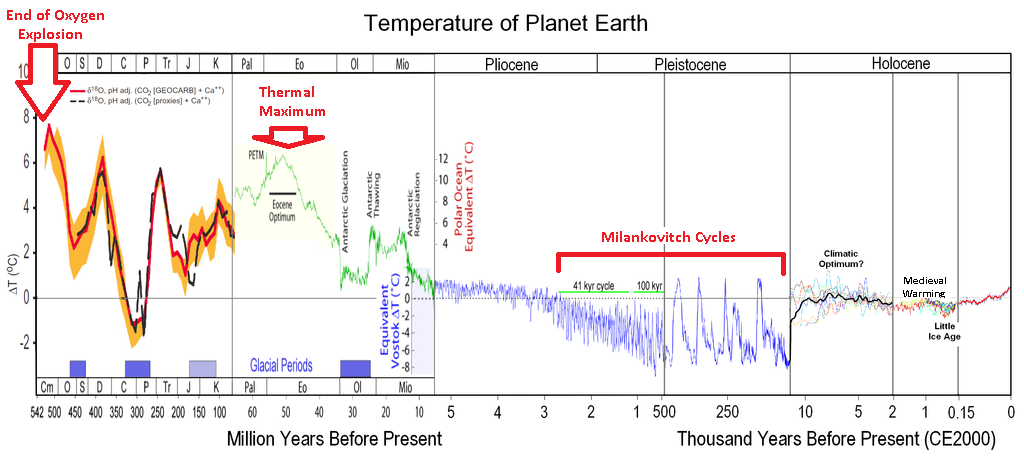
A host of climate-related proxies, including pollen from diverse tree and shrub genera, variations in silica due to changes in diatom populations and organic carbon content in the cyclically changing sedimentary facies are correlated with global climate records based on marine-sediment stable isotope. These records reveal intricate oscillations between cool mixed forest, cool coniferous forest, taiga and cold deciduous forest, with occasional frigid tundra conditions through the mid- to late Pliocene. Compared with modern conditions NE Siberia was much warmer and wetter at the start of the record. Around the start of the Pleistocene sudden declines to cooler and drier conditions appear, although until 2.2 Ma ago average summer conditions seem to have been higher that at present, despite evidence from marine proxies of the onset of glacial-interglacial cycles in the Northern Hemisphere.
In detail, Lake El’gygytgyn revealed some surprises including rapid onset of a lengthy cold-dry spell of tundra conditions between 3.31 to 3.28 Ma. The first signs that the lake was perennially frozen appear around 2.6 Ma, well before evidence for the first continental glaciation in North America, presaged by signs around 2.7 Ma that winters consistently became colder than present ones. Overall the lake record presents a picture of a stepped shift in climate in the run-up to the Great Ice Age. Lake El’gygytgyn seems set to become the standard against which other, more patchy records around the Arctic Ocean are matched and correlated. Indeed it is the longest and most detailed record of climate for the Earth’s land surface, compared with 120 and 800 ka for the Greenland and Antarctic ice-caps.
Modelling their findings against likely atmospheric CO2 levels the authors provide grist to the media mill which focuses on how the late Pliocene may be a model for a future warm Earth if emissions are not curtailed, with visions of dense polar forests
For half a century the Earth’s planetary dynamism – plate movements, mantle convection and so on – has been ascribed to its abundance of water. Experiments on the ductility of quartz seemed to show that it became much weaker under hydrous conditions, and that was assumed to hold for all common silicates, a view backed up by experiments that deformed minerals under varying conditions. It was widely believed that even a few parts per million in a rock at depth would weaken it by orders of magnitude, a view that increasingly dominated theoretical tectonics on scales up to the whole lithosphere and at different mantle depths. Strangely, the founding assertion was not followed up with more detailed and sophisticated work until the last year or so. Though rarely seen in bulk, the dominant mineral in the mantle is olivine and that is likely to be a major control over ductility at depth, in plumes and other kinds of convection.
Peridotite xenoliths —olivines are light green crystals, pyroxenes are darker. (credit: Wikipedia)
Experimental work at the temperatures and pressures of the mantle has never been easy, and that becomes worse the more realistic the mineral composition of the materials being investigated. High-T, high-P research tends to focus on as few variables as possible: one mineral and one variable other than P and T is the norm. This applies to the latest research (Fei, H. et al. 2013. Small effect of water on upper mantle rheology based on silicon self-diffusion coefficients. Nature, v. 498, p. 213-215) but the measurements are of the rate at which silicon atoms diffuse through olivine molecules rather than direct measurements of strain. The justification for this approach is that one of the dominant processes involved in plastic deformation is a form of structural creep in which atoms diffuse through molecules in response to stress – the other is ‘dislocation creep’ achieved by the migration of structural defects in the atomic lattice.
Contrary to all expectations, changing the availability of water by 4 to 5 orders of magnitude changed silicon diffusion by no more than one order. If confirmed this presents major puzzles concerning Earth’s mantle and lithosphere dynamics. For instance, the weak zone of the asthenosphere cannot be a response to water and nor can the relative immobility of hotspots. Confirmation is absolutely central, in the sense of repeating Fei et al.’s experiments and also extending the methods to other olivine compositions – magnesium-rich forsterite was used, whereas natural olivines are solid solutions of Mg- and Fe-rich end members – and to materials more representative of the mantle, e.g. olivine plus pyroxene as a minimum (Brodholt, J. 2013. Water may be a damp squib. Nature, v. 498, p. 18-182)