The launch of modern life on Earth

To set against five brief episodes of mass extinction – some would count the present as being the beginning of a sixth – is one short period when animals with hard parts appeared for the first time roughly simultaneously across the Earth. Not only was the Cambrian Explosion sudden and pervasive but almost all phyla, the basic morphological divisions of multicellular life, adopted inner or outer skeletons that could survive as fossils. Such an all-pervading evolutionary step has never been repeated, although there have been many bursts in living diversity. Apart from the origin of life and the emergence of its sexual model, the eukaryotes, nothing could be more important in palaeobiology than the events across the Cambrian-Precambrian boundary.

English: Opabinia regalis, from the Cambrian B...
One of the evolutionary experiments during the Cambrian, Opabinia regalis, from the Burgess Shale. (credit: Wikipedia)

This eminent event has been marked by most of the latest issue of the journal Gondwana Research (volume 25, Issue 3 for April 2014)in a 20-paper series called Beyond the Cambrian Explosion: from galaxy to genome (summarized  by Isozaki, Y., Degan, S.., aruyama,, S.. & Santosh, M. 2014. Beyond the Cambrian Explosion: from galaxy to genome.  Gondwana Research, v. 25, p. 881-883). Of course, these phenomenal events have been at issue since the 19th century when the division of geological time began to be based on the appearance and vanishing of well preserved and easily distinguished fossils in the stratigraphic column. On this basis roughly the last ninth of the Earth’s history was split on palaeontological grounds into the 3 Eras, 11 Periods, and a great many of the briefer Epochs and Ages that constitute the Phanerozoic. Time that preceded the Cambrian explosion was for a long while somewhat murky mainly because of a lack of means of subdivision and the greater structural and metamorphic damage that had been done to the rocks that had accumulated over 4 billion years since the planet accreted. Detail emerged slowly by increasingly concerted study of the Precambrian, helped since the 1930s by the ability to assign numerical ages to rocks. Signs of life in sediments that had originally been termed the Azoic (Greek for ‘without life’) gradually turned up as far back as 3.5 Ga, but much attention focused on the 400 Ma immediately preceding the start of the Cambrian period once abundant trace fossils had been found in the Ediacaran Hills of South Australia that had been preceded by repeated worldwide glacial epochs. The Ediacaran and Cryogenian Periods (635-541 and 850-635 Ma respectively) of the Neoproterozoic figure prominently in 9 of the papers to investigate or review the ‘back story’ from which the crucial event in the history of life emerged. Six have a mainly Cambrian focus on newly discovered fossils, especially from a sedimentary sequence in southern China that preserves delicate fossils in great detail: the Chengjian Lagerstätte. Others cover geochemical evidence for changes in marine conditions from the Cryogenian to Cambrian and reviews of theories for what triggered the great faunal change.

Since the hard parts that allow fossils to linger are based on calcium-rich compounds, mainly carbonates and phosphates that bind the organic materials in bones and shells, it is important to check for some change in the Ca content of ocean water over the time covered by the discourse. In fact there are signs from Ca-isotopes in carbonates that this did change. A team of Japanese and Chinese geochemists drilled through an almost unbroken sequence of Ediacaran to Lower Cambrian sediments near the Three Gorges Dam across the Yangtse River and analysed for 44Ca and 42Ca (Sawaki, Y. et al. 2014. The anomalous Ca cycle in the Ediacaran ocean: Evidence from Ca isotopes preserved in carbonates in the Three Gorges area, South China. Gondwana Research, v. 25, p. 1070-1089) calibrated to time by U-Pb dating of volcanic ash layers in the sequence (Okada, Y. et al. 2014. New chronological constraints for Cryogenian to Cambrian rocks in the Three Gorges, Weng’an and Chengjiang areas, South China. Gondwana Research, v. 25, p. 1027-1044). They found that there were significant changes in the ratio between the two isotopes. The isotopic ratio underwent a rapid decrease, an equally abrupt increase then a decrease around the start of the Cambrian, which coincided with a major upward ‘spike’ and then a broad increase in the 87Sr/86Sr isotope ratio in the Lower Cambrian. The authors ascribe this to an increasing Ca ion concentration in sea water through the Ediacaran and a major perturbation just before the Cambrian Explosion, which happens to coincide with Sr-isotope evidence for a major influx of isotopically old material derived from erosion of the continental crust. As discussed in Origin of the arms race (May 2012) perhaps the appearance of animals’ hard parts did indeed result from initial secretions of calcium compounds outside cells to protect them from excess calcium’s toxic effects and were then commandeered for protective armour or offensive tools of predation.

"SNOWBALL EARTH" - 640 million years ago
Artists impression of a Snowball Earth event 640 Ma ago (credit: guano via Flickr)

Is there is a link between the Cambrian Explosion and the preceding Snowball Earth episodes of the Cryogenian with their associated roller coaster excursions in carbon isotopes? Xingliang Zhang and colleagues at Northwest University in Xian, China (Zhang, X. et al. 2014. Triggers for the Cambrian explosion: Hypotheses and problems.  Gondwana Research, v. 25, p. 896-909) propose that fluctuating Cryogenian environmental conditions conspiring with massive nutrient influxes to the oceans and boosts in oxygenation of sea water through the Ediacaran set the scene for early Cambrian biological events. The nutrient boost may have been through increased transfer o f water from mantle to the surface linked to the start of subduction of wet lithosphere and expulsion of fluids from it as a result of the geotherm cooling through a threshold around 600 Ma (Maruyama, S. et al. 2014. Initiation of leaking Earth: An ultimate trigger of the Cambrian explosion. Gondwana Research, v. 25, p. 910-944). Alternatively the nutrient flux may have arisen by increased erosion as a result of plume-driven uplift (Santosh, M. et al. 2014. The Cambrian Explosion: Plume-driven birth of the second ecosystem on Earth. Gondwana Research, v. 25, p. 945-965).

A bolder approach, reflected in the title of the Special Issue, seeks an interstellar trigger (Kataoka, R. et al. 2014. The Nebula Winter: The united view of the snowball Earth, mass extinctions, and explosive evolution in the late Neoproterozoic and Cambrian periods. Gondwana Research, v. 25, p. 1153-1163). This looks to encounters between the Solar System and dust clouds or supernova remnants as it orbited the galactic centre: a view that surfaces occasionally in several other contexts. Such chance events may have been climatically and biologically catastrophic: a sort of nebular winter, far more pervasive than the once postulated nuclear winter of a 3rd World War. That is perhaps going a little too far beyond the constraints of evidence, for there should be isotopic and other geochemical signs that such an event took place. It also raises yet the issue that life on Earth is and always has been unique in the galaxy and perhaps the known universe due to a concatenation of diverse chance events, without structure in time or order, which pushed living processes to outcomes whose probabilities of repetition are infinitesimally small.

Enhanced by Zemanta

Traces of the most ancient Britons

Perhaps the most evocative traces of our ancestors are their footprints preserved in once soft muds or silts, none more so than the 3.6 Ma old hominin trackway at Laetoli in Tanzania, discovered by Mary Leakey and colleagues in 1978. Such records of living beings’ activities are by no means vanishingly rare. In 2003 footprints of Neanderthal children emerged in volcanic ash that had formed on the slopes of an Italian volcano. The fact that the tracks zig-zagged and included handprints seemed to suggest that the children were playing on a tempting slope of soft sediment, much as they do today (see The first volcanologists?   and Walking with the ancestors). The muddy sediments of the Severn and Mersey estuaries in England yield younger footprints of anatomically modern humans of all sizes every time tidal flows rip up the sedimentary layers. Now similar examples have been unearthed from 1.0 to 0.78 Ma old Pleistocene interglacial sediments at a coastal site in Norfolk, England, in which stone tools had been found in 2010 .

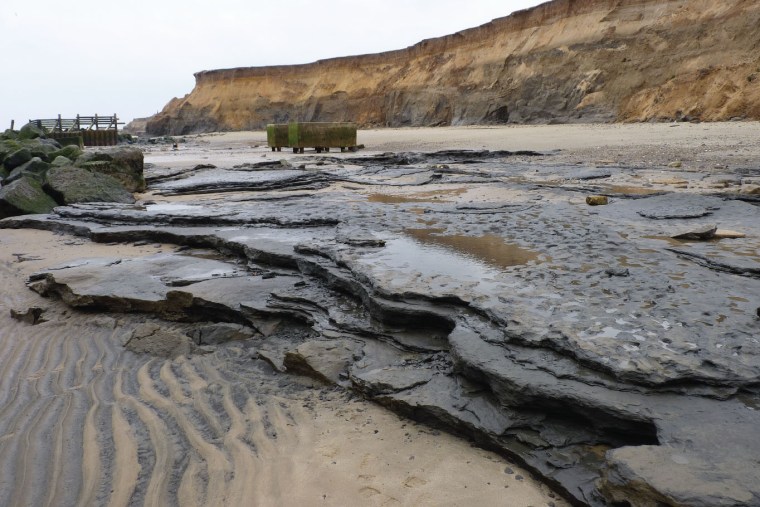
Coastal exposure of Pleistocene laminated sediments at Happisburgh (credit: Ashton et a. 2014 PLOS1)
Coastal exposure of Pleistocene laminated sediments at Happisburgh; the top surface exposes the hominin trackway  (credit: Ashton et al. 2014 PLOS1)

A team funded by the Pathways to Ancient Britain Project, involving scientists from a consortium of British museums and universities, rapidly conserved a 12 m2 surface of laminated sediments fortuitously exposed on the foreshore at Happisburgh (pronounced ‘Haze-burra’) by winter storms. It was covered in footprints (Ashton, N. and 11 others 2014. Hominin Footprints from Early Pleistocene Deposits at Happisburgh, UK. PLoS ONE v. 9: e88329. doi:10.1371/journal.pone.0088329). Analysis of the prints suggested a band of individuals who had tramped southwards across mudflats at the edge of an estuary. They were possibly members of an early human species, known as Homo antecessor, skeletal remains of whom are known from northern Spain. The Happisburgh individuals were of mixed size, probably including adults and juveniles: three footprint sets suggested 1.6 to 1.73 m stature; nine less than 1.4 m.

View from above of the well-trodden trackway at Happisburgh, with an enlarged example of one of the foot prints (credit: Ashton et al 2014 PLoS1)
View from above of the well-trodden trackway at Happisburgh, with an enlarged example of one of the foot prints (credit: Ashton et al. 2014 PLoS1)

From pollen samples, East Anglia during the interglacial had a cool climate with pine, spruce, birch and alder tree cover with patches of heath and grassland. That it had attracted early humans to travel so far north from the Mediterranean climate where skeletal remains are found, suggests that food resources were at least adequate. It is hard to imagine the band having been seasonal visitors from warmer climes further south. They must have been hardy, and from the stone tools we know they were well equipped and capable of killing sizeable prey animals, bones of which marked by clear cut marks being good evidence for their hunting skills.

Enhanced by Zemanta

Subduction and the water cycle

Note: Earth-Pages will be closing as of early July, but will continue in another form at Earth-logs

For many geoscientists and lay people the water cycle is considered to be part of the Earth’s surface system. That is, the cycle of evapotranspiration, precipitation and infiltration involving atmosphere, oceans, cryosphere, terrestrial hydrology and groundwater. Yet it links to the mantle through subduction of hydrated oceanic lithosphere and volcanism. The rate at which water vapour re-enters the surface part of the water cycle through volcanoes is reasonably well understood, but the same cannot be said about ‘recharge’ of the mantle through subduction.

Water cycle http://ga.water.usgs.gov/edu/water...
The water cycle as visualised by the US Geological Survey (credit: Wikipedia)

Subducted oceanic crust is old, cold and wet: fundamentals of plate theory. The slab-pull that largely drives plate tectonics results from phase transitions in oceanic crust that are part and parcel of low-temperature – high-pressure metamorphism. They involve the growth of the anhydrous minerals garnet and high-pressure pyroxene that constitute eclogite, the dense form taken by basalt that causes the density of subducted lithosphere to exceed that of mantle peridotite and so to sink. This transformation drives water out of subducted lithosphere into the mantle wedge overlying a subduction zone, where it encourages partial melting to produce volatile-rich andesitic basalt magma – the primary magma of island- and continental-arc igneous activity. Thus, most water that does reenter the mantle probably resides in the ultramafic lithospheric mantle in the form of hydrated olivine, i.e. the mineral serpentine, and that is hard to judge.

Water probably gets into the mantle lithosphere when the lithosphere bends to begin its descent. That is believed to involve faults – cold lithosphere is brittle – down which water can diffuse to hydrate ultramafic rocks. So the amount of water probably depends on the number of such bend-related faults. A way of assessing the degree of such faulting and thus the proportion of serpentinite is analysis of seismic records from subduction zones. This has been done from earthquake records from the West Pacific subduction zone descending beneath northern Japan (Garth, T. & Rietbrock, A. 2014. Order of magnitude increase in subducted H2O due to hydrated normal faults within the Wadati-Bennioff zone. Geology, on-line publication doi:10.1130/G34730.1). The results suggest that between 17 to 31% of the subducted mantle there has been serpentinised.

In a million years each kilometre along the length of this subduction zone would therefore transfer between 170 to 318 billion tonnes of water into the mantle; an estimate more than ten times previous estimates. The authors observe that at such a rate a subduction zone equivalent to the existing, 3400 km long Kuril and Izu-Bonin arcs that affect Japan would have transferred sufficient water to fill the present world oceans 3.5 times over the history of the Earth. Had the entire rate of modern subduction along a length of 55 thousand kilometres been maintained over 4.5 billion years, the world’s oceans would have been recycled through the mantle once every 80 million years. To put that in perspective, since the Cretaceous Chalk of southern England began to be deposited, the entire mass of ocean water has been renewed. Moreover, subduction has probably slowed considerably through time, so the transfer of water would have been at a greater pace in the more distant past.

Enhanced by Zemanta

A first for geochronology: ages from Mars

Remote sensing, including mapping of topographic elevation, and the recent exploits of three surface vehicles – the Spirit, Opportunity and Curiosity Rovers – have provided lots of data for a host of geological interpreters. Producing a time frame for Martian geological and geomorphological events has, understandably, been limited mainly to the use of stratigraphic principles. Various rock units and surface features can be placed in relative time order through simple stratigraphic principles, such as what sits on top of what and which features cut through pre-existing rock units or are masked by them. The most important guide up to now has been interpretation of the relations between impact craters and both rock units and other geomorphological features. The Inner Planets are assumed to have recorded the same variation through time of the frequency and energies of bombardment, and that has been calibrated to some extent by radiometric dating of impact-related rocks returned from the Moon by the crewed Apollo missions. Some detail of relative timings also emerge from some craters cutting earlier ones. The only other source of Martian ages has been from rare meteorites (there are only 114 of them) whose stable isotope compositions are different from those of terrestrial rocks and more common meteorites. By a process of elimination it is surmised that they were flung from Mars as a result of large impacts in the past to land eventually on Earth. The oldest of them date back to 4.5 Ga, much the same as the estimated age of the earliest crystallisation of magmas on Earth.

MOLA colorized relief map of the western hemis...
Colorised relief map of the western hemisphere of Mars, showing Valles Marineris at centre and the four largest volcanoes on the planet (credit: Wikipedia)

But all Martian stratigraphy is still pretty vague by comparison with that here, with only 4 time divisions based on reference to the lunar crater chronology and 3 based on evidence from detailed orbital spectroscopy and Rover data about the alteration of minerals on the Martian surface. Apart from meteorite dates there is very little knowledge of the earliest events, other than Mars must have had a solid, probably crystalline crust made of mainly anhydrous igneous minerals. This was the ‘target’ on which much of the impact record was impressed: by analogy with the Moon it probably spanned the period of the Late Heavy Bombardment from about 4.1 to 3.7 Ga, equivalent to the Eoarchaean on Earth. That period takes its name – Noachian – from Noachis Terra (‘land of Noah’), an intensely cratered, topographically high region of Mars’s southern hemisphere, whose name was given to this large area of high albedo by classical astronomers. Perhaps coincidentally, the Noachian provides the clearest evidence for the former presence of huge amounts of water on the surface of Mars and its erosional power that formed the gigantic Valles Marineris canyon system. The rocky surface that the craters punctured is imaginatively referred to as the pre-Noachian. A major episode of volcanic activity that formed Olympus Mons and other lava domes is named the Hesperian (another legacy of early astronomical nomenclature). It is vaguely ascribed to the period between 3.7 and 3.0 Ga, and followed by three billion years during which erosion and deposition under hyper-arid conditions formed smooth  surfaces with very few craters and rare evidence for the influence of surface water and ice. It is named, inappropriately as it turns out, the Amazonian.

Remote sensing has provided evidence of  episodes of mineral alteration. Clay minerals have been mapped on the pre-Noachian surface, suggesting that aqueous weathering occurred during the earliest times. Sulfates occur in exposed rocks of early Hesperian age, suggesting abundant atmospheric SO2 during this period of massive volcanicity. The last 3.5 billion years saw only the development of the surface iron oxides whose dominance led to Mars being nickname the ‘Red Planet’.

Curiosity Rover's Self Portrait at 'John Klein...
A ‘selfie’ of Curiosity Rover drilling in Gale Crater (credit: Euclid vanderKroew)

A recent paper (Farley, K.A. and 33 others plus the entire Mars Science Laboratory 2014. In Situ Radiometric and Exposure Age Dating of the Martian Surface. Science, v. 343, online publication DOI: 10.1126/science.1247166) suggests that radiometric ages can be measured ‘in the field’, as it were, by instruments carried by the Curiosity rover. How is that done? Curiosity carries a miniature mass spectrometer and other analytical devices. Drilling a rock surface produces a powder which is then heated to almost 900°C for half an hour to drive off all the gases present in the sample. The mass spectrometer can measure isotopes of noble gases, notably 40Ar, 36Ar, 21Ne and 3He. Together with potassium measured by an instrument akin to and XRF, the 40Ar yields a K-Ar age for the rock. A sample drilled from a fine-grained sedimentary in Gale Crater gave an age of 4.2 Ga, most likely that of the detrital feldspars derived from the ancient rocks that form the crater’s wall, rather than an age of sedimentation. The values for 36Ar, 21Ne and 3He provide a means for establishing how long the rock has been exposed at the surface: all three isotopes can be generated by cosmic-ray bombardment. The sample from Gale Crater gave an age of about 78 Ma that probably dates the eventual exposure of the rock by protracted wind erosion.

By themselves, these ages do not tell geologists a great deal about the history of Mars, but if Curiosity makes it through the higher levels of the sediments that once filled Gale Crater – and there is enough power to repeat the mass spectrometry at other levels – it could provide a benchmark for Noachian events. The exposure age, interesting in its own right, also suggests that sediments in the crater have not been exposed to cosmic-ray bombardment for long enough to have destroyed any organic materials that the science community longs for.

Enhanced by Zemanta

Plate tectonics and the Cambrian Explosion

A rough-and-ready way of assessing the rate at which silicic magmatic activity has varied through time is to separate out grains of zircon that have accumulated in sedimentary rocks of different ages. Zircon is readily datable using the U-Pb method, if you have access to mass spectrometry. While some of the zircons will date from much older continental crust that was exposed while the sediments originated, sometimes there are grains that formed only a few million years before the sediments accumulated. Those are likely to have crystallized from silica-rich volcanic rocks above subduction zones where ocean-floor has been driven beneath continental crust; i.e. at continental volcanic arcs. Such young zircons therefore help assess the tectonic conditions close to sedimentary basins. The potential of detrital zircon geochronology was first suggested to me by Dr M.V.N. Murthy of the Geological Survey of India in 1978, long before anyone could aspire to mass zircon dating. M.V.N. had by then amassed kilograms of zircon grains from every imaginable source in India, and may have been the first geologist to realise their potential. It has become a lot quicker and cheaper in the last two decades, thanks to methods of dating single zircon grains both precisely and accurately and M.V.N.’s prescient suggestion has been borne out globally.

Optical microscope photograph; the length of t...
A detrital zircon grain about 0.25 mm long. (Photo credit: Wikipedia)

Results for the late Precambrian to early Palaeozoic have recently been compiled (McKenzie, N.R. et al. 2014. Plate tectonic influences on Neoproterozoic-early Paleozoic climate and animal evolution. Geology, online publication doi:10.1130/G34962.1). One of the striking correlations is between the abundance of ‘young’ zircons relative to Cambrian sedimentary deposition and the pace of diversification of animal faunas during the Cambrian.  During the Cambrian Period there may have been far more continental-margin arc volcanism than in the preceding late Neoproterozoic or later in the early Palaeozoic. That would match with evidence for the Cambrian atmosphere having reached the greatest CO2 concentration of Phanerozoic times and the fact that the Gondwana supercontinent (comprising the present southern continents plus India) was assembled at that time by collision of several Precambrian continental masses. Global temperatures must have been rising.

Reconstruction of Earth 550 Ma ago showing the...
Earth at abround the start of the Cambrian showing the cratons that collided to form Gondwana (Photo credit: Wikipedia)

The rapid emergence of all the major animal groups by the middle Cambrian – the Cambrian Explosion – took place during and despite climatic warming. Environmental stress, perhaps increased calcium and bicarbonate ions in sea water as a result of acid conditions, may have forced animals to develop means of getting both ions out of their cells to form carbonate skeletons: the Cambrian Explosion really marks the first appearance of shelly faunas and a good chance of fossilisation. Yet at the peak of volcanically-induced warming faunal diversity, especially of reef-building animals, fell-off dramatically to create what some palaeobiologsts have termed the Cambrian ‘dead interval’. Marine life really took-off in a big way during the Ordovician while temperatures were falling globally; so much so that the close of the Ordovician was marked by the first major glaciation focused on Gondwana. The zircon record indicates that continental-arc volcanism also declined during the Ordovician, and maybe the Cambrian silicic volcanics were chemically weathered during that Period to remove carbon-dioxide from the atmosphere, along with renewed reef building to bury carbonate fossils.

Enhanced by Zemanta

Did ice-age climate changes across Europe happen at the same time?

Although the frigid conditions at the last glacial maximum, around 19 to 20 thousand years ago, gradually relinquished their grip through slow global warming, this amelioration came to sudden stop around 12 800 years before the present. Northern hemisphere ice-core and other climate records show that there was a return to glacial conditions over a period of a few decades at most, to launch what is known as the Younger Dryas stadial that lasted over a thousand years until about 11 500 years ago, with the onset of the warm, climatically more stable Holocene that launched the transformation of the human way of life. The start of the Younger Dryas had dramatic effects throughout the northern hemisphere, the cold conditions emerging suddenly from an immense oceanographic change; a weakening or the halt of the North Atlantic thermohaline circulation in which cold, very salty surface waters at the fringe of the Arctic Ocean sink to drag warmer water to high latitudes. In short, the Gulf Stream slowed or stopped its warming influence at high northern latitudes.  Current thoughts centre on a freshening of surface sea water following the collapse of the North American ice sheet to gush meltwater and icebergs into the North Atlantic to buoy-up surface waters.

Iceage time 18kyr
Major climate shifts in Europe since 18 ka (credit: Wikipedia)

Most of the data about this climatic shock can only be dated accurately to within a few centuries: it is clear that the initial cooling was very rapid, on the scale of a few years, as was the warming that closed the Younger Dryas and marked the start of the Holocene, but the ‘when’ is known only to within a few hundred years. To resolve the start and stop ages needs records that include several indicators: clear signs of the beginning and end of the episode, an accurate means of dating them and confirmation from other sites, which presupposes a cast-iron means of correlating the records over large distances. The most reliable markers for correlation are volcanic ashes that can be dated radiometrically and which drift on the wind to be deposited over very large areas. If sedimentary sequences that accumulated continuously preserve such ashes, contain clear signs of climatic change and clearly record the passage of time in great detail, there is a chance of resolving climatic events very accurately; but they are no common.  A British-German team have located and analysed two such promising sites (Land, C.S. et al. 2013. Volcanic ash reveals time transgressive abrupt climate change during the Younger Dryas. Geology, v. 41, p. 1251-1254). One of them is from the bed of a lake that formed by a single volcanic eruption (Meerfelder Maar) in the Eifel region of western Germany. Quiet sediment accumulation has occurred there continuously to form very narrow, alternating dark and light layers, the variegation being due to sedimentation under ice in winter and open water in summer respectively. Twelve thousand of these annual varves provide a means of dating potentially with a precision of ± 1 year, but calibration to absolute time is necessary. The maar sediments contain three ash layers, two of which are from small local eruptions; the older having an age of 12 900 years before 2000 AD, the other being 11 000 years old, showing that the entire Younger Dryas is spanned by the Meerfelder Maar sediments. The third was dated by varve counting, showing the eruption had taken place 12 140 years ago. That age coincides closely with that of major eruption in Iceland.

Panorama Weinfelder Maar oder Totenmaar, Eifel
A typical volcanic maar in Eifel Region of Germany (credit: Wikipedia)

One prominent climatic feature of the Younger Dryas of Europe is a shift around halfway through: it started with the fiercest cold and then ameliorated. This change shows up in the Meerfelder Maar record as a reduction in mean varve thickness and an increase in the titanium content of the clays, the latter taking place in about a year (12 250 years ago) some 100 years before the Icelandic ash was deposited. The same kind of change occurs in records from lakes as far north as the Arctic Circle. One of the core records from Kråkenes in Northern Norway also contains the tell-tale Icelandic ash (as do ice cores from Greenland), but in its case it occurs 20 years before the abrupt climate shift. This clearly shows that major climate changes at the end of the last ice age occur at different times from place to place. The authors ascribe the 120 year difference between the two records to the times when prevailing, warm westerly winds began to affect central and northern Europe, linked to a gradual northward migration of the polar front. The data from both lakes also suggest that the Younger Dryas ended about 20 years earlier in Norway than in Germany, although Lane et al. do not comment..

Hitherto, correlation between climate records has been based on an assumption that major climate changes were at the same time, so that climate proxies such those discussed here have been ‘wiggle-matched’. Quite probably a lot of subtleties have thereby been missed.

Enhanced by Zemanta

Land almost colonized during the Cambrian Explosion

One of the major shale-gas source strata in the eastern USA, the Middle Cambrian Conasauga Shale, formed in a shallow inland sea. Consequently the sedimentology of the lowest Palaeozoic Era of the region and the strange structures affecting it during deformation that formed the Appalachian Mountains have become a focus of intense tectonic and stratigraphic interest – economic potential generally helps fund academic research at a time when money for pure science is short. This has extended into the deepest part of the Cambrian lying unconformably just above the crystalline Precambrian basement. The Lower Cambrian of the Appalachians marks the earliest stage of rifting that flooded former dry land and comprises the multicoloured mudstones, siltstones and sandstones of the Rome Formation. Though only sparsely fossiliferous, the Rome formation contains archetypical trilobites of the genus Olenellus, typical of the Lower Cambrian and used to correlate sedimentary rocks of this age far and wide. They occur far across the North Atlantic in coeval rocks of the Northwest Highlands of Scotland, but not in those a mere couple of hundred kilometres to the south in Wales. This faunal disparity forms a major line of evidence that the olenelid fauna occupied one side of a once major ocean – Iapetus – another different bunch of early trilobites being characteristic of its opposite flank. The almost hemispherical extent of similar faunas was long regarded as an indication that they inhabited open ocean water. In fact, their wide distribution is as much due to juvenile arthropods being planktonic, while adults may have occupied all sorts of marine environments. It now turns out that Olenellus lived in very shallow water (Mángano, M.G. et al. 2014. Trilobites in early Cambrian tidal flats and the landward expansion of the Cambrian explosion. Geology, online pre-publication doi:10.1130/G34980.1).

Illustration of Olenellus thompsoni.png

Gabriela Mángano of the University of Saskatchewan and colleagues from Argentina and the US found that the Rome Formation is full of sedimentary structures typical of modern intertidal zones. Tidal-flat strata are full of suncracks but are also criss-crossed by tracks made by substantial arthropods, only fossil olenellid trilobites being big enough to have made them while feeding , maybe on microbial mats formed on the mudflats or on worms that burrowed the muds. Clearly these animals were literally only a few steps away from colonising the land very shortly after abundant, sturdy animal life appeared in the Cambrian Explosion. Currently the dominant hypothesis for permanent entry of animals onto land is that the colonizers first adapted to fresh- or brackish water habitats. Yet, apparently, there was little to stop a direct invasion from the sea.

Enhanced by Zemanta

Human evolution: bush or basketwork?

Analysis of DNA from ancient humans has revealed its power decisively in the last few years, and especially at the beginning of 2014 with publication of the sixth full genome of an individual who was not an anatomically modern human (Prüfer, K. and 44 others 2014. The complete genome sequence of a Neanderthal from the Altai Mountains. Nature, v. 505, p. 43-49). The newly sequenced material came from a toe bone found in the Denisova Cave in the Altai Mountains of southern Siberia; the same location made famous in 2010 by genetic evidence for unknown late hominins, the Denisovans . The bone occurred in the same layer of cave sediment, dated at 50.3 ka, which yielded the Denisovan finger bone, but from a lower sublayer. So there is no firm evidence that both groups cohabited the cave.

The genome reveals that the individual was female and related to the three Neanderthals from Croatia and another infant Neanderthal from the Caucasus, also analysed previously by Svante Pääbo’s team at the Max Planck Institute for Evolutionary Anthropology in Leipzig, Germany (Note that the toe-bone team also includes co-workers from US, Chinese, Austrian, French and Russian institutions). The closest statistical link is to the Caucasian infant Neanderthal’s DNA. Interestingly, it proved possible to demonstrate that the Siberian Neanderthal woman was from a population that was clearly inbred, her parents having been related at the level of half siblings. Her mtDNA shows that she shared a common ancestor with all 6 Neanderthals from whom mtDNA has been analysed.

Comparing genomes from the single Denisovan, the 5 Neanderthals and living humans from sub-Saharan Africans gives an estimated 550 to 765 ka time of divergence of a population leading to anatomically modern humans from the progenitors of Neanderthals and the Denisovan. The Neanderthal-Denisovan split was roughly 380 ka ago. It was already known that non-African living humans contain genetic evidence for past interbreeding with Neanderthals and that some people in Asia, Australia, Melanesia and the Philippines had acquired genes from Denisovans. More refined comparisons now show Oceanians to have 3 to 6% Denisovan make-up with Asians in general sharing 0.2%. Neanderthal to modern non-African gene flow is now estimated at between 1.5 and 2.1%, with Asians and Native Americans being at the high end.  Neanderthals and Denisovans also interbred, but only at the level of about 0.5% inheritance. However, that genetic sharing involved DNA regions known to confer aspects of immunity and sperm function, that also made their way into living non-African humans.

Since the common ancestor of Neanderthals and Denisovans left Africa long before modern humans appeared on the scene it would be expected that living Africans’ genomes would show the same level of similarity with both the now extinct groups, if all three originally shared a common ancestor. A surprising outcome from comparison of Neanderthal and Denisovan genomes with those of living sub-Saharan Africans is that there is a significant bias towards Neanderthal rather than Denisovan comparability.  There are three possibilities for this bias. After the Neanderthal-Denisovan split the former group may have continued to interbreed with the group leading to modern Africans (and indeed to modern non-Africans): that would require Neanderthal genetics to have originated in Africa before they migrated to Eurasia. Secondly, the gene flow could have been from the ancestors of modern humans to Neanderthal progenitors, making descendant Neanderthals more like modern humans. Prüfer et al. suggest that the evidence is less supportive of both and weighs towards a third possibility; that the Denisovans interbred with an unknown contemporary hominin, whose genetic make-up was yet more different from that of all three known groups of the late Pleistocene and therefore their common ancestor . This may have been Homo antecessor or possibly H. erectus who survived until as late as 20 ka in SE Asia.

Family tree of the four groups of early humans living in Eurasia 50,000 years ago and the gene flow between the groups due to interbreeding. Image credit: Kay Prüfer et al.

As other commentators  on the paper (Birney, E. & Pritchard J.K. 20113. Four makes a party. Nature, v. 505, p. 32-34)  have observed, ‘…Eurasia during the late Pleistocene was an interesting place to be a hominin, with individuals of at least four quite diverged groups living, meeting and occasionally having sex.’ All this arises quite convincingly from the genetics of only 7 ancient individuals, to show that it may no longer be appropriate to consider human evolution as a tree or a bush linking permanently separated species. Either it is the history of a single, polymorphic species – remains of 1.7 Ma old Homo georgicus show clear evidence of such polymorphism – or a better metaphor for human development is an interwoven basket or twine. Rumour has it that attempts are being made to sequence an H. antecessor dated at 900 ka from Gran Dolina Cave in the Atapuerca Mountains in Northern Spain: as they say, ‘Watch this space’!

Enhanced by Zemanta

How the great Tohoku-Sendai earthquake and tsunami happened

The great Tohoku earthquake (moment magnitude 9.0) of 11 March 2011 beneath the Pacific Ocean off the largest Japanese island of Honshu resulted in the devastating tsunami that tore many kilometres inland along its northern coast line and affected the entire Pacific Basin (see NOAA animation of the tsunami’s propagation) .

English: Sendai Rinkai Railway locomotive(SD55...
Railway locomotive thrown aside by the 11 March 2011 Tsunami in Japan. (credit: Wikipedia)

This article can now be read in full at Earth-logs in the Geohazards archive for 2017

An early magma ocean on Mars?

The division of the lunar surface into two petrological domains – ancient anorthositic highlands and younger basaltic maria – spurred the idea, as long ago as the early 1970s, that the early Moon had a deep ocean of magma at the surface, whose cooling caused fractional crystallization. Low density plagioclase feldspar, dominated by high-calcium anorthite and bytownite, floated to the surface to form the lunar anorthosites leaving a more mafic mantle from which the mare basalts formed by partial melting. The key evidence in support of this hypothesis lies in the rare-earth elements of the two terrains. Because plagioclase feldspar has a much stronger affinity to incorporate the element europium (Eu) than the other REEs, the lunar anorthosites are enriched in Eu compared with its related elements. If the highland anorthosites did form by fractional crystallisation the remaining magma that formed the lunar mantle would be depleted in Eu yet enriched in the remaining REE. Although there are no samples of the Moon’s mantle there are plenty of the mare basalts that formed when it partially melted, probably as a result of huge impacts around 3.8 billion years ago. They should have inherited dominant features of mantle geochemistry, and indeed they do show characteristic depletion of Eu.

Lunar Highlands, near Descartes Crater. Collec...
Lunar Highland anorthosite, collected by the crew of Apollo 16. (credit: Wikipedia)

The giant-impact hypothesis for the Earth-Moon system presupposes that such a cataclysm would have left much of the outer Earth in much the same molten condition and destined to fractionate in the same manner. There are geochemical hints from terrestrial rocks that do support such an idea. An important target for exploration of Mars has been to check if a magma ocean also existed early in its history. Of the various missions in recent years only two have the capacity to shed useful light on the issue: the US Mars Reconnaissance Orbiter and Mars Odyssey. Both orbiters carry more sophisticated remote sensing instruments than any circling the Earth. The first has the hyperspectral Compact Reconnaissance Imaging Spectrometer for Mars (CRISM) that senses visible to short-wave infrared (VNIR) radiation, the other deploys  the Thermal Emission Imaging System (THEMIS) that captures different parts of the longer wavelength thermal infrared (TIR) spectrum emitted by surface materials. Both allow spectra of surface materials to be reconstructed and compared with the features of known minerals from the Earth and Moon.

Feldspars are highly reflective for the most part of  the VNIR range but show a shallow, broad absorption feature centred on a wavelength of 1.26 micrometres. Such spectra have been detected using CRISM from parts of the Martian surface in the highlands of its southern hemisphere (Carter, J. & Poulet, F. 2013. Ancient plutonic processes on Mars inferred from the detection of possible anorthositic terrains. Nature Geoscience, v. 6, p. 1008-1012). The authors, from Chile and France, acknowledge that the plagioclase-rich rocks occur only in small patches, unlike the vast tracts on the Moon, and also that on Earth anorthosites are known to have formed by a variety of processes from far smaller magma systems than a veritable ocean of molten rock. Feldspars also show spectral features in the TIR, though not so distinctive, both plagioclase and alkali feldspars being very similar. Moreover, THEMIS deploys sensor for only 10 thermal wavebands, compared with 544 on CRISM.  A team of US remote sensers (Wray, J.J. and 8 others 2013. Prolonged magmatic activity on Mars inferred from the detection of felsic rocks. Nature Geoscience, v. 6, p. 1013-1017) used both CRISM and THEMIS data. While noting resemblances to lunar anorthosites, they adopt a more cautious approach to the spectra and prefer the broad, ‘sack’ term ‘felsic rocks’. It seemed possible from their work that feldspar-rich magmas may have formed by partial melting of common andesitic crust noted from the Martian surface: high spatial resolution images of the occurrences bear some resemblance to outcrops of granitic rocks in arid environments on Earth. That is, there may be highly evolved rocks akin to terrestrial continental crust.

The interesting spectral observations on Mars can only be validated by actual rock samples. While rovers still operating on the Martian surface are well able to produce geochemical data that would petrologically characterise most rocks that they encounter, none of them is in a terrain suitable for resolving this particular issue. Yet, coincidentally, a meteorite found in West Africa shows hallmarks of having been blasted from the surface of Mars and sheds useful light on various hypotheses about the Martian crust http://earth-pages.co.uk/2013/11/21/a-glimpse-of-early-martian-crust/. It is a breccia that may represent the soil or regolith that accumulated from early impacts that shattered and melted surface materials, and it is extremely old: zircons yielded an age of 4428 Ma. The clasts set in a fine matrix consist of a variety of igneous rocks, none of which are anorthosites. Some are coarse grained, plutonic rocks containing both alkali feldspars and plagioclase, which match terrestrial monzonites; broadly speaking members of the granite family. Having formed from the ejecta of large impacts, such regolith materials represent the breadth of compositions across the planet and extending deep into its crust. This one suggests that anorthosites may have been rare on early Mars.