Magnetic reversal and demise of the Neanderthals?

A rumour emerged last week that the Neanderthals met their end as one consequence of an extraterrestrial, possibly even extragalactic influence. Curiously, it stems from a recent discovery in New Zealand, where of course Neanderthals never set foot and nor did anatomically modern humans, the ancestors of Maori people, until a mere 800 years ago. It started with an ancient log from a kauri tree (Agathis australis), a species that Maoris revere. Found in excavations of boggy ground, the log weighed about 60 tons, so it was a valuable commodity, especially as it is illegal to fell living kauri trees. The wood is unaffected by burial and insect attack, has a regular grain and colour throughout, so is ideal for monumental Maori sculpture. Such swamp kauri also preserves their own life history in annual growth rings, and the log in question has 1700 of them. Using growth rings to chart climate variation gives the most detailed records of the recent past, provided the wood can be dated. Matching growth ring records from several trees of different ages is key to charting local climate with annual precision over several millennia.
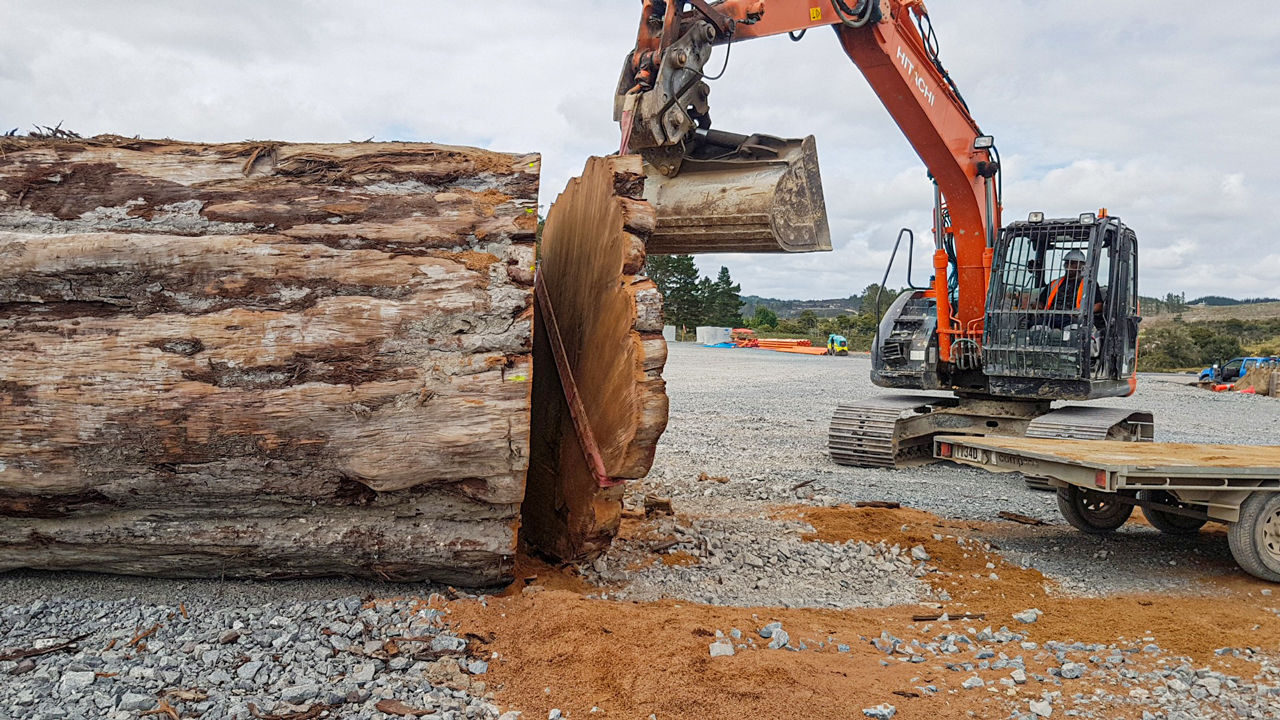
An ancient kauri tree log recovered by swampland excavations in New Zealand. (Credit: Jonathan Palmer, in Voosen 2021)

Radiocarbon dating indicates that this particular kauri tree was growing around 42 thousand years ago. That is close to the upper limit for using 14C concentration in organic matter to determine age because the isotope has a short half-life (5730 years). In this case samples of the log would contain only about 0.7 % of its original complement of radioactive carbon. Cosmic rays generate 14C when they hit nitrogen atoms in the atmosphere and it enters COand thus the carbon cycle. Carbon dioxide taken up by photosynthesis to contribute carbon to plants contains only about one part per trillion of 14C. Consequently wood as ancient as that in the kauri log contains almost vanishingly small amounts, yet it can still be measured using mass spectrometry to yield an accurate radiometric age.

The particularly interesting thing about the 42 ka date is that it coincides with the timing of the last reversal of the Earth’s magnetic field, known as the Laschamps event. The kauri tree bears detailed witness through its growth rings to the environmental effects of a decrease in that field to almost zero as the poles flipped. The bulk of cosmic rays are normally deflected away from the Earth by the geomagnetic field, but during a reversal a great many more pass through the atmosphere, the most energetic reaching the surface and the biosphere. The kauri growth rings record fluctuations in the generation of 14C by their passage and thereby the geomagnetic field strength, which was only 6% of normal levels from 42.3 to 41.6 ka (Cooper, A. and 32 others  2021. A global environmental crisis 42,000 years ago. Science, v. 371, p. 811-818; DOI: 10.1126/science.abb8677). This coincided with an unrelated succession of periods of low solar activity and a reduced solar ‘wind’, which also provides some cosmic-rayprotection when activity is at normal levels; a ‘double whammy’. One consequence would have been destruction of stratospheric ozone by cosmic rays and thus increased ultraviolet exposure at ground level.

Combined with the highly precise growth-ring dating, the climatic changes over the 1700 year lifetime of the kauri tree can be linked to other records of environmental change. These include glacial ice- and lake-bed cores together with stalactite layers. Apparently, the Laschamps geomagnetic reversal coincided with abrupt shifts in wind belts and precipitation, perhaps triggering major droughts in the southern continents. Highly plausible, but some of the other speculations are less certain. For instance, some time around 42 ka, but far from well-established, Australia’s marsupial megafauna experienced major extinctions, the Neanderthals disappear from the fossil record and modern humans started decorating caves in Europe (20 ka after they did in Indonesia). In fact, speculation becomes somewhat silly, with suggestions that early Europeans went to live in caves because of increased exposure to UV (they knew, did they, while Neanderthals didn’t?), their painting and, by implication, their entire culture shifting through the shock and awe of mighty displays of the aurora borealis. Just because the number 42 is (or was), according to the late Douglas Adams’s Hitchhiker’s Guide to the Galaxy, ‘the answer to life, the universe and everything’, the authors tag the episode as the ‘Adams Event’. In their summary for The Conversation they include an animation with a quintessential Stephen Fry narrative, which Earth-logs readers can judge for themselves. Perhaps ‘Lockdown Trauma’ has a lot more to answer for, other than upsurges in Zoom conferences, knitting and gourmet experimentation …

See also: Voosen, P. 2021. Kauri trees mark magnetic flip 42,000 years ago. Science, v. 371, p. 766; DOI: 10.1126/science.371.6531.766

When the Arctic Ocean was filled with fresh water

The salinity of surface water at high latitudes in the North Atlantic is a critical factor in its sinking to draw warm, low-latitude water northwards in the Gulf Stream while contributing to the southwards flow of North Atlantic Deep Water along the ocean floor. One widely supported hypothesis for rapid cooling events, such as the Younger Dryas, is the shutdown of this thermohaline circulation (Review of thermohaline circulation, February 2002). That may happen when surface seawater at high latitudes is freshened and made less dense by rapid melting or break-up of continental ice sheets, or through the release of vast amounts of fresh water from glacially dammed lakes. The climatic decline leading to the last glacial maximum at around 20 ka was punctuated by irregular episodes known as Dansgaard-Oeschger and Heinrich Events that have been attributed to such hiccups in thermohaline processes. In this context, a whole new barrel of fish has been opened up by a geochemical study of the top few metres of sediments on the Arctic Ocean floor (Geibert, W. et al. 2021. Glacial episodes of a freshwater Arctic Ocean covered by a thick ice shelfNature, v. 590, p. 97–102; DOI: 10.1038/s41586-021-03186-y), particularly their content of an isotope of thorium (230Th).

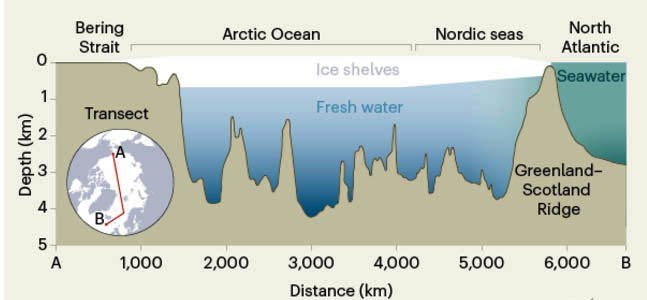
Being radioactive (half-life ~75 ka), 230Th is useful in working out sediment deposition rates, especially as it is insoluble and adheres to dust grains. The isotope is a decay product of uranium, yet it not only forms on land from uranium in hard rocks, eventually to be transported into marine sediments, but from uranium dissolved in seawater too. Interestingly, the amount of uranium that can enter seawater in solution depends on water salinity. Fresh water, especially that locked up in glacial ice, has very low concentrations of uranium. Consequently, ordinary seawater adds additional 230Th to sediments whereas fresh water does not. An excess of the isotope in marine sediments signifies their deposition from salty water, but those deposited in fresh water carry no excess. In the course of analysing deep-sea cores from the floors of the Arctic Ocean and the northernmost part of the North Atlantic, Walter Geibert and colleagues at the Alfred Wegener Institute in Bremerhaven, and the University of Bremen, Germany revealed a series of sediment layers that were devoid of excess 230Th. This suggests that twice, probably in periods between 150 to 131 and 70 to 62 ka, water in the Arctic Ocean and the connected Nordic Sea was entirely fresh. In two cores the evidence suggests a third, restricted occurrence of fresh water fill at about 15 ka.

The most likely explanation is that the fresh-water episodes marked the development of major ice shelves, similar to those still present around Antarctic; i.e. floating or grounded ice of glacial origin (not sea ice). That had been anticipated, but not previously proved for the northern polar region. The outlets from the Arctic Ocean basin to the Pacific and North Atlantic Oceans are marked by barriers of shallow seabed. One is the Bering Straits, which became the Beringia land bridge that facilitated animal and human migrations from Siberia to North America when sea level fell as continental ice sheets grew. The other is the Greenland-Scotland Ridge formed by volcanism connected to the Icelandic hot spot as the North Atlantic opened. It is possible that the suggested ice shelves grounded on these ridges, to effectively dam and isolate the Arctic Ocean. Fresh water from melting land ice would ‘pond’ beneath the ice shelves, floating on denser salt water and eventually expelling it from much of the polar marine basin. A side effect of this would have been partially to accumulate and isolate the oxygen-isotope proportions that characterise snow and glacial ice. Remember that the light 16O isotope is preferentially extracted from sea water during evaporation, to become stored in glacial ice sheets so that the proportion of the heavier 18O increases in ocean water; δ18O is therefore an important proxy for glacial waxing and waning and thus the fluctuations of global sea level. Trapping a proportion of water of glacial origin in isolated Arctic Ocean water and ice shelves would explain discrepancies in the oxygen-isotope records of successive ice ages. Also, if the ice shelves periodically broke up, fresh water derived from them and ponded in the deepest Arctic Ocean basin could change the salinity of surface ocean water elsewhere – being lower density that fresh water would ‘float’.

The work of Geibert and colleagues may well result in a great deal of head scratching among palaeoclimatologists and perhaps new ideas on the dynamics of ice age climates.

See also: Hoffmann, S. 2021. The Arctic Ocean might have been filled with freshwater during ice ages. Nature, v. 590, p. 37-38; DOI: 10.1038/d41586-021-00208-7

And here’s another snippet: Neanderthal link to our brain

Elizabeth Pennisi reports on a ‘Petri-dish’ experiment that substitutes a Neanderthal gene for a modern human one in a culture of human brain tissue. It gives some idea of how our very close relative may have thought differently from us. Pennisi, E. 2021. Neanderthal-inspired ‘minibrains’ hint at what makes modern humans specialScience, online news item; DOI:10.1126/science.abh0331

Worth a read: Genes that prepared fish to invade the land

Elizabeth Pennisi comments on three comparative studies of the genetics of modern fish and terrestrial tetrapods in the latest online issue of Science News. Apparently some fish genes were, perhaps fortuitously, ‘multipurpose’. They may have been exploited during the Devonian colonisation of land to help evolution of limbs, lungs and aspects of the nervous system to adapt shallow-water fishes to climb out onto dry land. (Pennisi, E. 2021. Fish had the genes to adapt to life on land—while they were still swimming the seas. Science, News 10 February 2021; DOI: 10.1126/science.abg9265).

The ancestry of our opposable thumbs

Since the appearance of smart phones and the explosion of social media our thumbs have found a new niche; typing while holding a mobile. At a desktop keyboard, most of us don’t use thumbs very much, unless we have mastered fast touch typing, but for a huge variety of manual tasks thumbs are essential. The first makers of sophisticated stone tools must have been able to grip between fingers and thumb to manipulate the materials from which they were made and to perform the various stages in creating a razor sharp edge. To do that, as most of us are aware, the tip of the thumb must be capable of touching the tips of all four fingers; an opposable thumb is essential for the ‘precision grip’. Being able to tell when opposable thumbs evolve depends, of course, on finding hand-bone fossils. Being made of many bones disarticulated hands are a lot more fragile than long bones or those of the skull. Complete fossil hands are rare, as are feet, but a number have been found more or less complete. Whichever hominin had evolved opposable thumbs, their potential would have given them a considerable advantage over those that hadn’t.

The main muscles that control the movements of modern human fingers and thumb (Credit: Wikipedia)

Simply comparing the shapes of fossilised bones of fingers and thumbs with those of modern humans and other living primates has, so far, not proved capable of resolving with certainty which hominin groups either did or did not have opposable thumbs. The key lies in the muscles that operate them. It has become commonplace to reconstruct faces and even whole bodies from fairly complete skeletal remains by modelling musculature from the positioning and shape of the points of attachment of muscles to bone. But that become increasingly difficult for the small-scale and intricate attachments in hands. The critical muscle for opposable thumbs is known as the Opponens pollicis (the Latin for thumb is Digitus pollex); a small triangular muscle that operates in conjunction with three others (with pollicis in their Latin names).

Fotios Karakostis and six colleagues from German, Swiss and Greek universities have devised software that can model muscles in 3-D (F.A. Karakostis et al. 2021. Biomechanics of the human thumb and the evolution of dexterityCurrent Biology, v.31,  online; DOI: 10.1016/j.cub.2020.12.041). Based on the anatomy of human and chimpanzee hand muscles and the positions of their attachment to individual bones, they have been able to establish a series of parameters that clearly distinguish the morphological and probably functional characteristics of the thumbs of these living primates. Complete sets of thumb bones from four Neanderthal skeletons show that they were significantly, but only slightly, different from anatomically modern humans. Those from three species of Australopithecus (africanus, sediba and afarensis) lie between ours and chimps’, with significantly closer affinity to chimpanzees. It seems that australopithecines of whatever age were not equipped with opposable thumbs and were possible tool producers and users with the very limited capabilities of modern chimps; holding, pounding and poking. A single set of hominin thumb bones from about two million years ago that were found in the famous Swartkrans Cave in South Africa show just as close affinity in thumb opposability to humans as do Neanderthals. So at 2 Ma there was a hominin species sufficiently dextrous to make and use sophisticated tools. The problem is, the bones are not directly associated with others and have been ascribed by different authors either to H. habilis or Paranthropus robustus. Interestingly, this paranthropoid has also been suggested (controversially) to have been the first known hominin to use fire, and it also used digging sticks. No one has ever suggested that the genus Homo descended from a paranthropoid ancestor or vice versa; these massively jawed beings did coexist with early humans in East Africa for over a million years. The other hominin who left hands in the geological record was Homo naledi; a controversial species because it was found in a barely accessible cave chamber, and took a while to date. This context gave rise to the notions that it was the direct ancestor of humans and that it buried its dead in a special place. However, it turned out to be relative recent, at about 280 ka (see: Homo naledi: an anti-climax; May 2017). Homo naledi does seem to have had opposable thumbs, but there is no associated evidence to suggest either tool making or use.

Fascinating as the methodology outlined by Karakostis et al. is, their findings do not take early human capabilities very much further than what is already known. Tools were made and used as far back as 3.3 Ma ago, and we know that H. habilis was doing this by about 2.6 Ma; i.e. long before the first evidence for opposable thumbs, and who had them first is uncertain. What is clear is that sophisticated tools, such as the bifacial Acheulian artifacts whose manufacture demands great dexterity, only appeared after the potential for nimble dexterity (about 1.8 Ma). The same goes for the first migration out of Africa, at about the same time, which demanded resourcefulness that may have sprung from the ability to manipulate natural materials effectively and carefully

See also: Handwerk B. 2012. How dexterous thumbs may have helped shape evolution two million years ago. (Smithsonian Magazine, 28 January 2021); Bower, B. 2021. Humanlike thumb dexterity may date back as far as 2 million years ago. (Science News, 28 January 2021)

Global warming: an important revision

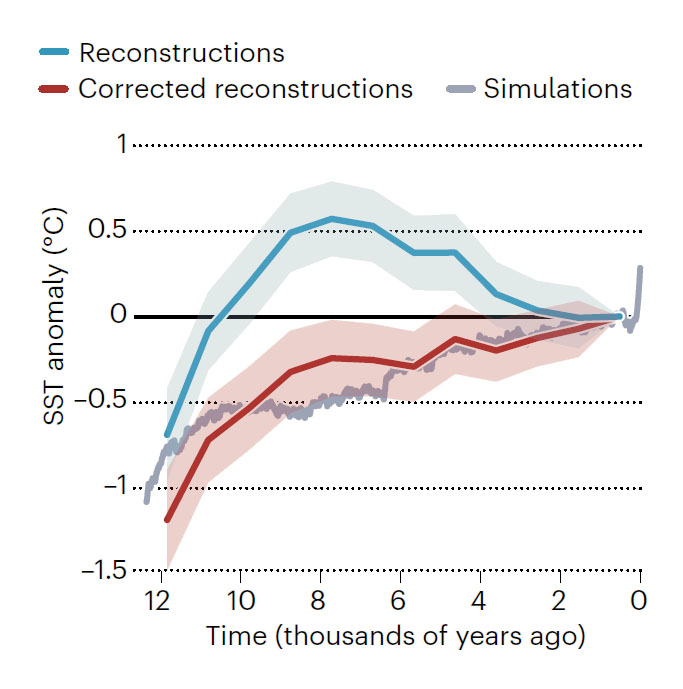
Part of the turmoil surrounding the issue of anthropogenic global warming hinges on whether or not observed changes in annual mean global temperature since the Industrial Revolution may be due to natural climatic cycles similar to those that operated previously during the Holocene Epoch. Actual measurements of temperatures of the air, sea surface and so on date only as far back at the early 18th century when thermometers were invented. Getting an idea of natural climate change through the 11.65 thousand years since the end of the last period of extensive glaciation depends on a variety of indirect measurements or proxies for temperature. For sea-surface temperature (SST) the proxy of choice is based on the way that surface-dwelling organisms, specifically planktic foraminifera, extract magnesium and calcium from sea water to construct their tests (shells). The warmer the sea surface the more magnesium is incorporated as a trace element into the calcium carbonate that forms their tests. The Mg/Ca ratio in planktic foram tests recovered from sea-floor sediment layers changes in a reliably precise fashion with warming and cooling. Following the Younger Dryas frigid millennium this proxy suggests that the average sea-surface temperature at mid-latitudes in the North Atlantic rose to a maximum of 0.5°C above the present value between 10 to 6 thousand years ago. After this Holocene Climate Optimum the sea surface seems to have cooled until very recently. Much the same pattern has been recorded in sediment cores from many parts of the world. Another approach is based on the varying amount of solar heating modelled by the Milankovich theory of astronomical climatic forcing and a variety of other forcing factors, such as albedo changes and the greenhouse effect. The two sets of data, one measured the other based on well-accepted simulations, do not agree; the modelling suggests a steady rise in SST throughout the Holocene and no climatic optimum. This conundrum either casts doubt on computer modelling of climate forcing, otherwise reliable on the broader time scale, or on some unsuspected aspect of the Mg/Ca palaeothermometer. The second could involve some kind of bias.

Plots of global mean sea-surface temperature estimates during the Holocene: blue – based on the Mg/Ca ratios in the tests of planktic foraminifera; red – the Mg/Ca data corrected for seasonal bias (the pale blue and pink areas encompass the full range of mid-latitude marine records); grey – modelling based on all potential forcing factors, including anthropogenic greenhouse emissions. (credit: Jennifer Hertzberg, 2021; Fig 1)

Samatha Bova of Rutgers University, USA, and colleagues from the US and China have examined the possibility of seasonal bias in estimates of SSTs from West Pacific ocean floor sediment cores off New Guinea  (Bova, S. et al. 2021. Seasonal origin of the thermal maxima at the Holocene and the last interglacialNature, v. 589, p. 548–553; DOI: 10.1038/s41586-020-03155-x). First they examined the Mg/Ca proxy record from the last, Eemian interglacial episode (128-115 ka), on the grounds that astronomical modelling indicated much stronger seasonal contrasts in solar warming during that period, whereas other forcing factors were comparatively weak. By calculating the varying sensitivity of the older Mg/Ca record to seasonal factors they were able to devise a method of correcting such records for seasonal bias and apply it to the Holocene data from northeast New Guinea. The corrected Holocene SST record lacks the previously suspected climate optimum and its peak at ~8000 years ago. Instead, it reveals a continuous warming trend throughout the Holocene. The early part is far cooler than previously indicated by uncorrected SST thermometry. That may have resulted from the increased reflection of solar radiation – albedo forcing – from a larger area of remnant ice sheets on high-latitude parts of continents than was present during the warmer early-Eemian interglacial. Final melting of the great ice sheets of the Northern Hemisphere took until about 6500 years ago, when albedo effects would be roughly the same as at present. Thereafter, rising levels of atmospheric greenhouse gases warmed the planet towards modern levels.

Bova et al’s findings fundamentally change the context for modelling future climate change, and also for the interpretation of all previous interglacials, palaeotemperature records from which remain uncorrected. It seems likely that none of them had an early warm episode. As regards the future; climate modelling will have to change its parameters. For climate-change sceptics; two of their favourite arguments have been questioned. There are no longer signs of major, natural  ups and downs in the early Holocene that might suggest that current warming is simply repeating such fluctuations. The other aspect of the Holocene climate conundrum, that greenhouse gases increased naturally since 6000 years ago while global mean SSTs declined, has been removed from the sceptics’ arguments

See also: Hertzberg, J. 2021. Palaeoclimate puzzle explained by seasonal variation. Nature, v. 589, p. 521-522; DOI: 10.1038/d41586-021-00115-x. Kiefer, P. 2021. Earth used to be cooler than we thought, which changes our math on global warming, Popular Science, 28 January 2021