Fossil fuel, mercury and the end-Palaeozoic catastrophe

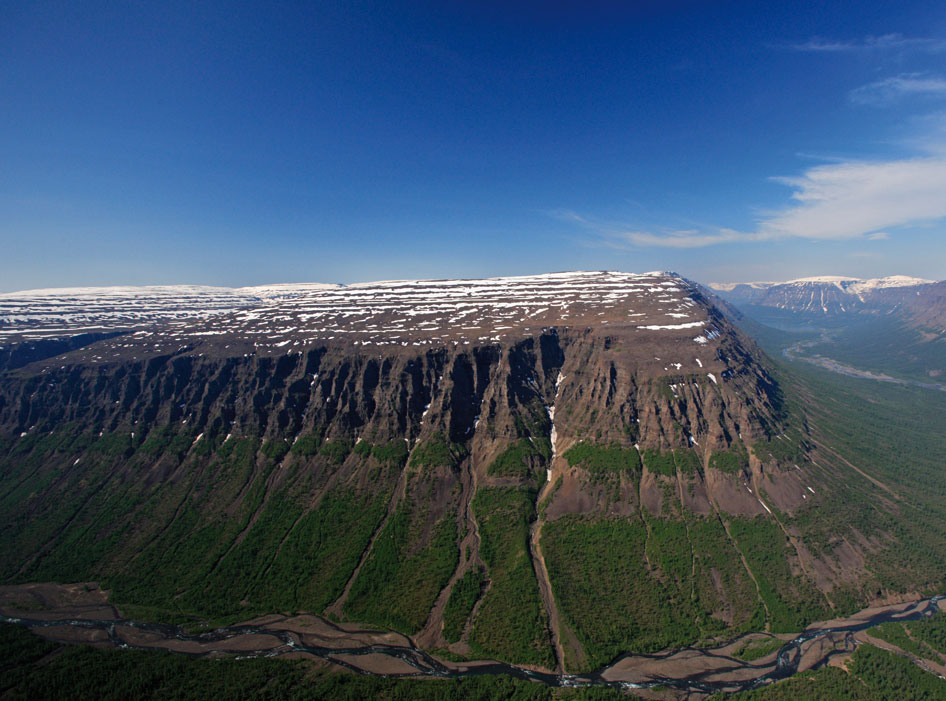
Siberian flood-basalt flows in the Putorana Plateau, Taymyr Peninsula, Russia. (Credit: Paul Wignall)

The end of the Permian Period (~252 Ma ago) saw the loss of 90% of marine fossil species and 70% of those known from terrestrial sediments: the greatest known extinction in Earth’s history. In their naming of newly discovered life forms, palaeontologists can become quite lyrical. Extinctions, however, really stretch their imagination. They call the Permo-Triassic boundary event ‘The Great Dying’. Why not ‘Permageddon’? Sadly, that was snaffled in the 1980s by an astonishingly short-haired heavy-metal tribute band. Enough bathos … The close of the Palaeozoic left a great many ecological niches to be filled by adaptive radiation during the Triassic and later Mesozoic times. Coinciding with the largest known flood-basalt outpouring – the three million cubic kilometres of Siberian Traps – the P-Tr event seemed to be ‘done and dusted’ after that possible connection was discovered in the mid 1990s. Notwithstanding, the quest for a gigantic, causative impact crater continues (see: Palaeobiology Earth-logs, May, September and October 2004), albeit among a dwindling circle of enthusiasts. The Siberian Traps are suitably vast to snuff the fossil record, for their eruption must have belched all manner of climate-changing gases and dusts into the atmosphere; CO2 to encourage global warming; SO2 and dusts as cooling agents. There is also evidence of a role for geochemical toxicity (see: Nickel, life and the end-Permian extinction, June 2014). The extinctions accompanied not only climate change but also a catastrophic fall in atmospheric oxygen content (see: Homing in on the great end-Permian extinction, April 2003; When rain kick-started evolution, December 2019). Recovery of the biosphere during the early Triassic was exceedingly slow.

Research focussed on the P-Tr boundary eventually uncovered an element of pure chance. Shales in Canada that span the boundary show major, negative δ13C excursions in the carbon-isotope record that coincide with fly ash in the analysed layers. This material is similar in all respects to that emitted from coal-fired power stations (see: Coal and the end-Permian mass extinction, March 2011). The part of Siberia onto which the flood basalts were erupted is rich in Permian coal measures and oil shales that lay close to the surface 252 Ma ago. The coal ash and massive emissions of CO2 may have resulted from their burning by the flood basalt event. Now evidence has emerged that this did indeed happen (Elkins-Tanton, L.T. et al. 2020. Field evidence for coal combustion links the 252 Ma Siberian Traps with global carbon disruption. Geology, v. 48, early publication; DOI: 10.1130/G47365.1).

The US, Canadian and Russian team found large quantities of burnt coal and woody material, and bituminous blobs in 600 m thick volcanic ashes at the base of the Siberian traps themselves. They concluded that the magma chamber from which the flood basalts emerged had incorporated sizeable volumes of the coal measures, leading to their combustion and distillation. This would have released CO2 enriched in light 12C due to isotopic fractionation by biological means, i.e. its δ13C would have been sufficiently negative to affect the carbon locked up in the Canadian P-Tr boundary-layer shales that show the sharp isotopic anomalies. The magnitude of the anomalies suggest that between six to ten thousand billion tons of carbon released as CO2 or methane by interaction of the Siberian Traps with sediments through which their magma passed could have created the global δ13C anomalies. That is about one tenth of the organic carbon originally locked in the Permian coal measures beneath the flood basalts

Another paper whose publication coincided with that by Elkins-Tanton et al. suggests that environmental mercury appears to have followed the same geochemical course as did carbon at the end of the Palaeozoic Era (Dal Corso, J. and 9 others 2020. Permo–Triassic boundary carbon and mercury cycling linked to terrestrial ecosystem collapse. Nature Communications, v. 11, paper 2962; DOI: 10.1038/s41467-020-16725-4). This group, based at Leeds and Oxford Universities, UK and the University of Geosciences in Wuhan, China, base their findings on biogeochemical modelling of the global carbon and mercury cycles at the end of the Permian. Their view is that the coincidence in marine sediments at the P-Tr boundary of a short-lived spike in mercury and an anomaly in its isotopic composition with the depletion in 13C, described earlier, shows an intimate link between mercury and the biological carbon cycle in the oceans at the time. They suggest that this synergy marks ecosystem collapse and derives ‘from a massive oxidation of terrestrial biomass’; i.e. burning of organic material on the land surface. Their modelling hints at huge wildfires in equatorial peatlands but also a role for the Siberian flood-basalt volcanism and the incorporation of coal measures into the Siberian Trap magma chamber.

A protein clue to H. antecessor’s role in human evolution

Homo_antecessor child
Forensic reconstruction of the remains of a Homo antecessor child from Gran Dolina Cave in northern Spain (credit Élisabeth Daynès, Museo de la Evolución, Burgos, Spain)

The older a fossil, no matter how well preserved it is, the less chance it has to contain enough undegraded DNA for it to be extracted and sequenced using the most advanced techniques. At present the oldest fossil DNA not to have passed its ‘sell-by’date is that of a 560 to 780 thousand year-old horse’s legbone found in Canadian permafrost. For human remains the oldest mtDNA is that of a ~430 ka individual from the Sima de los Huesos in northern Spain (see: Mitochondrial DNA from 400 thousand year old humans; Earth-logs December 2013). But there is another route to establishing genetic relatedness from the amino-acid sequences of proteins recovered from ancient individuals (see: Ancient proteins: keys to early human evolution?). Fossil teeth have proved to be good repositories of ancient protein and are the most commonly found hominin fossils.

A key species for unravelling the origins of the three most recent human groups (ourselves, Neanderthals and Denisovans) is thought to be Homo antecessor who inhabited the Gran Dolina Cave in the Atapuerca Mountains in northern Spain between about 1.2 Ma and 800 ka ago (see: Human evolution: bush or basketwork? Earth-logs, January 2014). Palaeoanthropologists excavated 170 skeletal fragments from six individuals in the most productive layer at Gran Dolina. Incomplete facial bones suggest a ‘modern-like’ face, although the remains as a whole are insufficient to reconstruct the oldest Europeans with sufficient detail to place them in anatomical relation to the younger groups. But there are several teeth. One of them, a permanent molar, has yielded informative proteins (Welker, F. and 26 others 2020. The dental proteome of Homo antecessor. Nature, v. 580, p. 235-238; DOI: 10.1038/s41586-020-2153-8) and has been dated to between 772 to 949 ka.

Amino acids in the dental proteins, sequenced using mass spectrometry, were compared with those of other hominins. Because protein sequences are coded by an animal’s genome they are a ‘proxy’ for DNA. The outcome is that the Gran Dolina proteins are roughly equally related to Denisovans, Neanderthals and ourselves, suggesting that, although the younger three groups are closely related, H. antecessor is an ‘outlier’. Being significantly older, it is likely to be the common ancestor of all three. Another species with close anatomical affinities is H. heidelbergensis (700 to 300 ka) found in Africa as well as in Europe. Its mtDNA (see: Mitochondrial DNA from 400 thousand year old humans; Earth-logs December 2013) matches that of Denisovans better than it does Neanderthals, yet without protein and full-genome analysis all that can be concluded is that it may be an intermediary between H. antecessor and the well known interbreeding triad of more recent times.

We are getting closer to a documented web of interrelationships between humans in general whose time span from 2 Ma ago is now well established. The remaining genetic link to be documented is that to H. erectus, the longest lived and most travelled of all ancient humans. Frido Welker and co-workers also had a shot at the proteomics of one of the first humans known to have migrated from Africa, using an isolated, presumably H. erectus, molar found at the 1.77 Ma site at Dmanisi in the Caucasus foothills of Georgia. Although inconclusive in placing that precociously intrepid group firmly in the human story, the fact that dental proteins were discovered is cause for optimism.

See also: Campbell, M. 2020. Protein analysis of 800,000-year-old human fossil clarifies dispute over ancestors (Technology Networks, 1 April 2020)

What controls the height of mountains?

‘Everybody knows’ that mountains grow: the question is, ‘How?’ There is a tale that farmers once believed that they grew from pebbles: ‘every year I try to rid my field of stones, but more are back the following year, so they must grow’… Geoscientists know better – or so they think[!] – and for 130 years have referred to ‘orogeny’, a classically-inspired term (from the Ancient Greek óros and geneia – high-ground creation’) adopted by the US geologist Grove Gilbert. It incorporates the concept of crustal thickening that results from lateral forces and horizontal compression. Another term, now rarely used, is ‘epeirogeny’ (coined too by G.K. Gilbert), wherein the continental surface rises or falls in response to underlying gravitational forces. That could include: changing mantle density over a hot, rising plume; detachment or delamination into the mantle of dense lower lithosphere; loading or unloading by ice during glacial cycles. Epeirogeny is bound up with isostasy, the maintenance of gravitational balance of mass in the outermost Earth.

A small part of the High Himalaya (credit: Access-Himalaya)

In 1990, Peter Molnar and Philip England pointed out that the incision of deep valleys into mountain ranges results in stupendous and rapid removal of mass from orogenic belts, which adds a major isostatic force to mountain building (Molnar, P. & England, P. 1990. Late Cenozoic uplift of mountain ranges and global climate change: chicken or egg? Nature, v. 346, p. 29–34; DOI: 10.1038/346029a0). In their model, the remaining peaks are driven higher by isostasy. They, and others, coupled climate change with compressional tectonics in a positive feedback that drives peaks to elevations that they would otherwise never achieve. Molnar and England’s review saw complex interplays contributing to mountain building, accompanying chemical weathering even changing global climate by sequestering atmospheric CO2 into the minerals that it produces. As well as the height of peaks in active zones of crustal shortening and thickening, such as the Himalaya, Molnar and England’s theory explained the aberrant high peaks at the edge of high plateaus that are passively subject to erosion. Examples of the latter are the isolated peaks beyond the eastern edge of the Ethiopian Plateau that locally have the greatest elevation than the flood basalts that form the plateau: unloading around these peaks has caused them to rise isostatically.

Thirty years on, this paradigm is being questioned, at least as regards active orogens (Dielforder, A. et al. 2020. Megathrust shear force controls mountain height at convergent plate margins. Nature, v. 582, p. 225–229; DOI: 10.1038/s41586-020-2340-7). Armin Dielforder and colleagues at the German Research Centre for Geosciences in Potsdam and The University of Münster consider that overall mountain height is sustained by interactions between three forces. 1. They are prevented from falling apart under their own weight or being pushed up further against gravity by lateral tectonic force. 2. Climate controlled erosion limits mountain height by removing material from the highest elevations. 3. Isostasy keeps the mountains ‘afloat’ above the asthenosphere. The authors have attempted to assess and balance all three major forces that determine the overall elevation of mountain belts.

At a convergent plate margin where one plate is shoved beneath another, the megathrust above the subduction zone behaves in a brittle fashion, with associated friction, towards the surface. At depth this transitions to a zone of ductile deformation dominated by viscosity. A major assumption in this work is that stress in the crust below a mountain belt is neutral; i.e. horizontal, tectonic compression is equal to the weight of the mountains themselves and thus to their height. So, the greater the tectonic compressive force the higher the mountain range that it can support. The test is to compare the actual elevation with that predicted from plate-tectonic considerations. For 10 active orogenic belts there is a remarkable correspondence between the model and actuality. the authors conclude that variation over time of mountain height reflects log-term variations in the force balance, in which they find little sign of a climatic/erosional control. But that doesn’t resolve the issue satisfactorily, at least for me.

The study focuses on the mean elevation, and this leaves out the largest mountains; for instance, their maximum mean elevation for the Himalaya is about 5.46 km (in fact for a narrow  NE-SW swath that may not be representative of the whole range). Yet the Himalaya contains 10 of the world’s highest mountains, all over 8 km high and 50 peaks that top 7 km, adjacent to the Tibetan Plateau. The mean elevation of the whole Himalayan range is 6.1 km. Consequently, it seems to me, the range’s maximum mean elevation must be somewhat higher than that reported by Dielforder et al.  The difference suggests that non-tectonic forces do contribute significantly to Himalayan terrain

See also:  Wang, K. 2020. Mountain height may be controlled by tectonic force, rather than erosion. Nature, v. 582, p. 189-190; DOI: 10.1038/d41586-020-01601-4

Geochemistry and the Ediacaran animals

Hopefully, readers will be fairly familiar with the sudden appearance of the Ediacaran fauna – the earliest abundant, large animals – at the start of the eponymous Period of the Neoproterozoic around 635 Ma. If not, use the Search Earth-logs box in the side bar to find extensive coverage since the start of the 21st century. A June 2019 Earth-logs review of the general geochemical background to the Ediacaran Period can be found here. Ten years ago I covered the possible role of the element phosphorus (P) – the main topic here – in the appearance of metazoans (see: Phosphorus, Snowball Earth and origin of metazoans – November 2010).

One of the major changes in marine sedimentation seen during the Ediacaran was a rapid increase in the deposition on the ocean floor of large bodies of P-rich rock (phosphorite), on which a recent paper focuses (Laakso, T.A. et al. 2020. Ediacaran reorganization of the marine phosphorus cycle. Proceedings of the National Academy of Sciences, v. 117, p. 11961-11967; DOI: 10.1073/pnas.1916738117). It has been estimated that on million-year time scales phosphorites remove only a tiny amount of the phosphorus carried into the oceans by rivers. So, conversely, an increase in deposition of marine P-rich sediment would have little effect on the overall availability of this essential nutrient from the oceans. The Ediacaran boost in phosphorites suggests a connection between them and the arrival of totally new ecosystems: the global P-cycle must somehow have changed. This isn’t the only change in Neoproterozoic biogeochemistry. Thomas Laakso and colleagues note signs of slightly increased ocean oxygenation from changes in sediment trace-element concentrations, a major increase in shallow-water evaporites dominated by calcium sulfate (gypsum) and changes in the relative proportions of different isotopes of sulfur.

Because all marine cycles, both geochemical and those involving life, are interwoven, the authors suggest that changes in the fate of dead organic matter may have created the phosphorus paradox. Phosphorus is the fifth most abundant element in all organisms after carbon, hydrogen, nitrogen and oxygen, followed by sulfur (CHNOPS), P being a major nutrient that limits the sheer bulk of marine life. Perhaps changes to dead organic matter beneath the ocean floor released its phosphorus content, roughly in the manner that composting garden waste releases nutrients back to the soil. Two chemical mechanisms can do this in the deep ocean: a greater supply of sinking organic matter – essentially electron donors – and of oxidants that are electron acceptors. In ocean-floor sediments organic matter can be altered to release phosphorus bonded in organic molecules into pore water and then to the body of the oceans to rise in upwellings to the near surface where photosynthesis operates to create the base of the ecological food chain.

Caption The Gondwana supercontinent that accumulated during the Neoproterozoic to dominate the Earth at the time of the Ediacaran (credit: Fama Clamosa, at Wikimedia Commons)

There is little sign of much increase in deep-ocean oxygen until hundreds of million years after the Ediacaran. It is likely, therefore, that increased availability of oxidant sulfate ions (SO42-) in ocean water and their reduction to sulfides in deep sediment chemically reconstituted the accumulating dead organic matter to release P far more rapidly than before. This is supported by the increase in CaSO4 evaporites in the Ediacaran shallows. So, where did the sulfate come from? Compressional tectonics during the Neoproterozoic Era were at a maximum, particularly in Africa, South America, Australia and Antarctica, as drifting continental fragments derived from the break-up of the earlier Rodinia supercontinent began to collide. This culminated during the Ediacaran around 550 Ma ago with assembly of the Gondwana supercontinent. Huge tracts of it were new mountain belts whose rapid erosion and chemical weathering would have released plenty of sulfate from the breakdown of common sulfide minerals.

So the biological revolution and a more productive biosphere that are reflected in the Ediacaran fauna ultimately may have stemmed from inorganic tectonic changes on a global scale

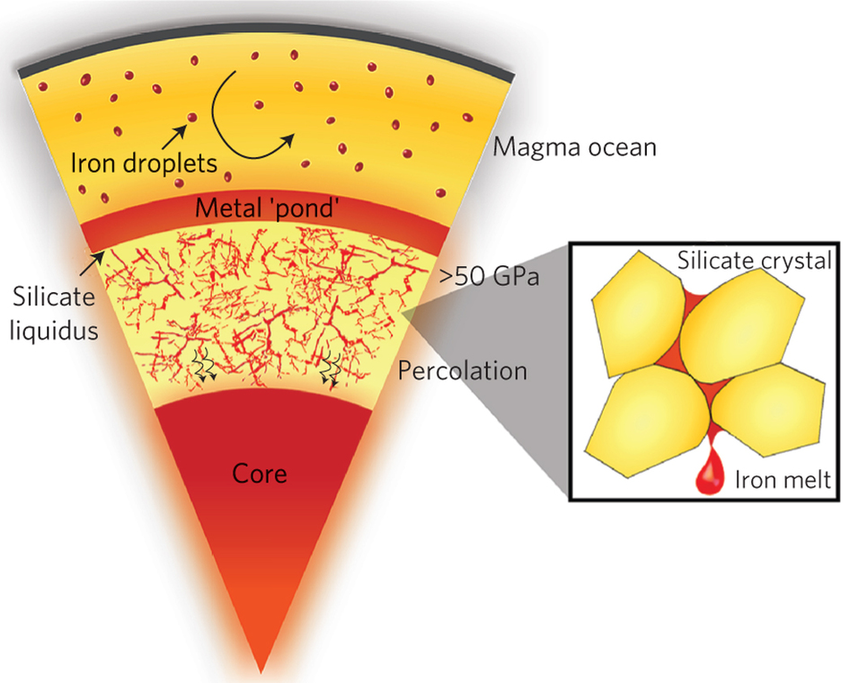
Is there water in the Earth’s core?

Understandably, the nature of what lies at the centre of the Earth is as much the subject of speculation as tangible evidence. That there must be something very dense within the planet emerged once the Earth’s bulk density was calculated. Because a high proportion of meteorites are dominated by an alloy of the metals iron and nickel, geoscientists adopted that combination as plausible core material. Study of the arrival times around the globe of seismic waves from earthquakes then revealed the actual size of the Earth’s core. Iron-nickel alloy fitted the bill quite nicely. It also fits geochemical evidence, such as the crust and mantle’s depletion in some trace elements that theoretically have an affinity for iron. The fact that seismology showed also that the outer core was molten and able to flow, together with metals’ high electrical conductivity, gave rise to the current concept of the geomagnetic field being generated by a dynamo effect in the core. However the density of Fe-Ni is not ‘quite right’ because the core is somewhat lighter than predicted for the pure alloy under stupendous pressure: it must contain a substantial amount – up to 13% – of lower density materials.  Silicon, sulfur and oxygen have been suggested as candidates, with evidence from a variety of minor minerals in metallic meteorites.

A recent model for core formation (credit Crystal Y. Shi et al 2013; DOI: 10.1038/NGEO1956 Fig. 5)

The world is currently awash with models that attempt to throw light on the course of the Covid-19 pandemic. Many are based on highly uncertain data, leading to suggestions by some people that they have become tools for political elites and a means of helping ambitious scientists into the limelight: a sort of fuel for hubris. In the midst of this unprecedented turmoil there has appeared a suggestion (from modelling) that the core also contains abundant hydrogen (Li, Y. et al. 2020. The Earth’s core as a reservoir of water. Nature Geoscience, v. 13, published online; DOI: 10.1038/s41561-020-0578-1). Yunguo Li and colleagues, from University College London, the Chinese Academy of Science and the University of Oslo, explore the idea that the dominant hydrogen of the pre-planetary Solar nebula, which accreted to form the Earth, may have joined iron during core formation. This had been predicted from the thermodynamics of chemical reactions between water and iron. The team takes this further through the geochemical theory that elements and compounds tend to enter other materials preferentially. For example, during partial melting of the crust alkali metals (Na, K etc) are more likely to enter the granitic melt than to remain in the solid residue. Li et al. have used thermodynamics to predict the partitioning of hydrogen between iron and silicate melts under the very high temperature and pressure conditions at the boundary between the core and mantle.

Their calculations suggest that hydrogen then behaves in much the same manner as, say gold and platinum: it becomes ‘iron-loving’ or siderophile and prefers the molten core, as would H2O. The amount that gets in depends on the water content of the molten silicate that eventually becomes the mantle. If the water now making up Earth’s ocean was ‘degassed’ from the mantle during core formation then the original silicate melt would have been ‘wetter’ than it is now. The implication of such early degassing is that the core may contain 5 ‘oceans worth’ of water! The alternative scenario for Earth’s becoming a watery world is the later accretion of, for instance, cometary material. In that case, the early core would have been drier. Yet, the continual subduction of hydrated oceanic lithosphere into the deep mantle during billions of years of plate tectonics would steadily have added water to the core, in the form of iron oxides and hydrogen. So, the core might, in either case, contain several ‘oceans’ of the components of water. One line of indirect evidence is the deficiency in Earth’s actual water of the heavier isotope of hydrogen (deuterium) relative to the D/H ratio of chondritic meteorites. Theory suggests that D has slightly more affinity for joining iron than does H. Substantial water in the core does help explain the core’s apparent low density, but that notion requires as much faith as politicians seem to have in ‘following the Science’ during the current pandemic …