A lowly worm from the Ediacaran?

Humans are more or less symmetrical, our left and right sides closely resembling each other. That is not so comprehensive for our innards, except for testes and ovaries, kidneys, lungs, arteries and veins, lymph and nervous systems. We have front- and rear ends, top and bottom, input and output orifices. All that we share with almost all other animals from mammals to worms, particularly at the earliest, embryonic stage of development. We are bilaterians, whereas sponges, ctenophores, placozoans and cnidarians are not – having either no symmetry at all, or just a bottom and a top – and are in a minority.  Fossil collections from Cambrian times also reveal bilaterians in the majority, at least insofar as preservation allows us to tell. Before 541 Ma ago, in the Precambrian, there are few signs of such symmetry and faunas are dominated by the flaccid, bag like creatures that form much of the Ediacaran Fauna, although there are traces of creatures that could move and graze, and had a rudimentary sense of direction (see: Burrowers: knowing front from back, July 2012 and Something large moved 2 billion years ago). Unsurprisingly, palaeobiologists would like to know when ‘our lot’ arose. One route is via comparative genetics among living animals, using DNA differences and the ‘molecular clock’ approach to estimate the age of evolutionary separation between ‘us’ and ‘them’. But the spread of estimated ages is so broad as to render them almost meaningless. And the better constrained ages of very old trace fossils rely on accepting an assumption that they were, indeed, formed by bilaterians. Yet ingenuity may have revealed an actual early bilaterian from such traces.lowly worm
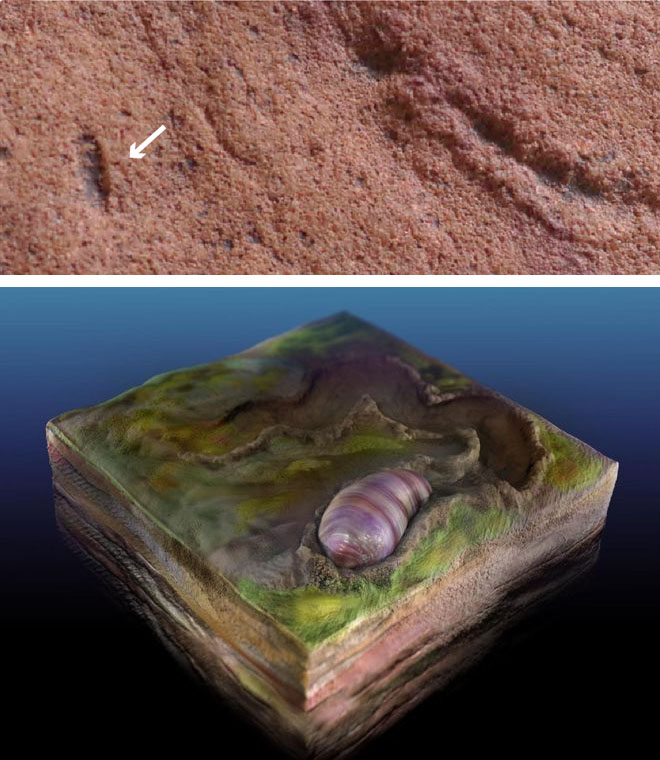
Palaeobiologists from the US and Australia have scoured the famous Ediacara Hills of South Australia for traces of burrowing and signs of the animal that did it (Evans, S.D. et al. 2020. Discovery of the oldest bilaterian from the Ediacaran of South Australia. Proceedings of the National Academy of Sciences, v. 117, online; DOI: 10.1073/pnas.2001045117). One Ediacaran trace fossil, known as Helminthoidichnites is preserved as horizontal trails on the tops and bottoms of thin, discontinuous sand bodies. Luckily, these are sometimes accompanied by elongate ovoids, like large grains of rice. From numerous laser scans of these suspected burrowers, and the traces that they left the authors have reconstructed them as stubby, possibly segmented, worm-like animals that they have called Ikaria wariootia, which may have grazed on algal mats. This name is derived from the local Adnyamathanha people’s word (Ikara  or ‘meeting place’) for the locality, a prominent landmark, near Warioota Creek. The age of the sedimentary sequence is between 551 to 560 Ma, and perhaps a little earlier. They could be the earliest-known bilaterians, but the sandy nature of the rocks in which they occur precludes preservation of the necessary detail to be absolutely sure: that would require silt- or. clay-sized granularity

See also: Fossil worm shows us our evolutionary beginnings (BBC, Science and Environment)

Dinosaur corner

Many adjectives have been applied to dinosaurs: terrifying; lumbering; long-dead; fierce; huge; nimble, carnivorous; herbivorous and so on. But exquisite and tiny do not immediately spring to mind. The mineral amber – strictly speaking a mineraloid because it isn’t crystalline – having formed from resins exuded by trees, preserves materials, including animals, that became trapped in the resin. The shores of the Baltic Sea used to be the main source of this semi-precious gemstone, but it has been overtaken by high-quality supplies from Kachin State in Myanmar. Most specimens contain small invertebrates, including spiders and insects, in varying states of preservation. Once in a while truly spectacular amber pebbles turn up. In early March 2020 the world’s media splashed a unique find: a miniature dinosaur (Xing, L. et al. 2020. Hummingbird-sized dinosaur from the Cretaceous period of Myanmar. Nature v. 579, p. 245–249; DOI: 10.1038/s41586-020-2068-4).

Amber pebble from Myanmar containing a tiny vertebrate’s skull (credit: Lida Xing, China University of Geosciences)

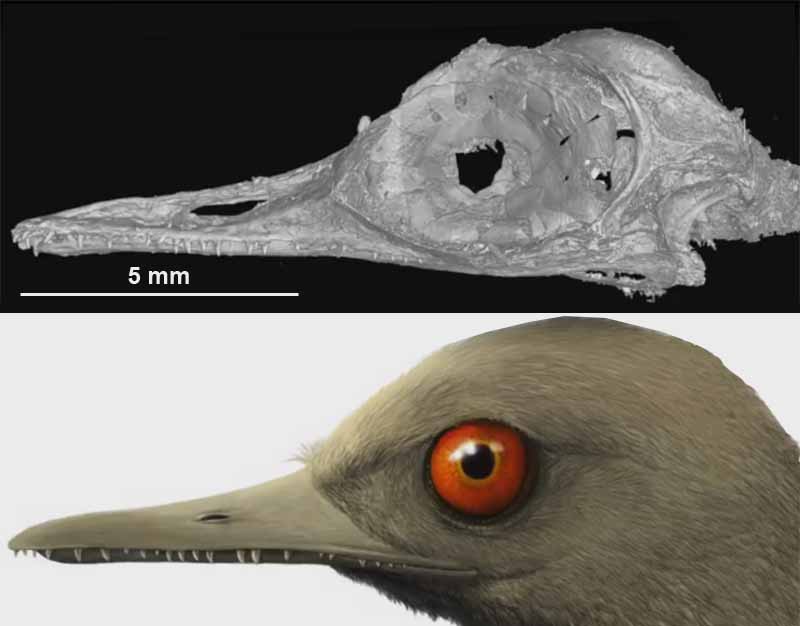
The amber specimen, from Middle Cretaceous (99 Ma) sediments, contains a perfectly preserved skull less than 2 cm long. At first glance it appears to be that of a tiny bird. The authors used micro-CT scanning to reconstruct the entire skull in 3-D. Although superficially resembling that of a bird, with eye sockets ringed by scleral ossicles that modern birds also have. These suggest that the animal was active during the daytime. Its beak-like jaws have many small teeth, as do many ancient fossil birds but not modern ones. These features led to its name: Oculudentavis khaungraaeI, translated as ‘eye-tooth bird’. So, is it a bird? A number of features shown by the skull suggest that, strictly speaking, it is not. Anatomically, it is a dinosaur, possibly descended from earlier types, such as the Jurassic winged and feathered dinosaur Archaeopterix, which evolved to early, true birds with which Oculudentavis coexisted during the Cretaceous Period. Having teeth, it was probably carnivorous and preyed on invertebrates: it may have been fatally attracted to tree resin in which insects had been trapped.

Micro-CT image of Oculudentavis khaungraaeI skull (top); artist’s impression of it in life (bottom) (credits: Xing, L. et al. 2020; Jingmai O’Connor, China University of Geosciences)

Even if it was a bird , it is smaller than the smallest living example, the bee hummingbird (Mellisuga helenae) and, weighing an estimated 2 grams,  Oculudentavis is about one-sixth the size of the smallest known fossil bird. As a dinosaur, it is two orders of magnitude smaller than the most diminutive example of those found as fossils, the chicken-sized Compsognathus. Rather than being just an oddity, Oculudentavis demonstrates that extreme miniaturisation among avian dinosaurs held out evolutionary advantages.

Watch a video about the discovery and analysis of the tiny dinosaur

See also: Benson, R.B.J. 2020. Tiny bird fossil might be the world’s smallest dinosaur. Nature, v. 579, p. 199-200; DOI: 10.1038/d41586-020-00576-6.

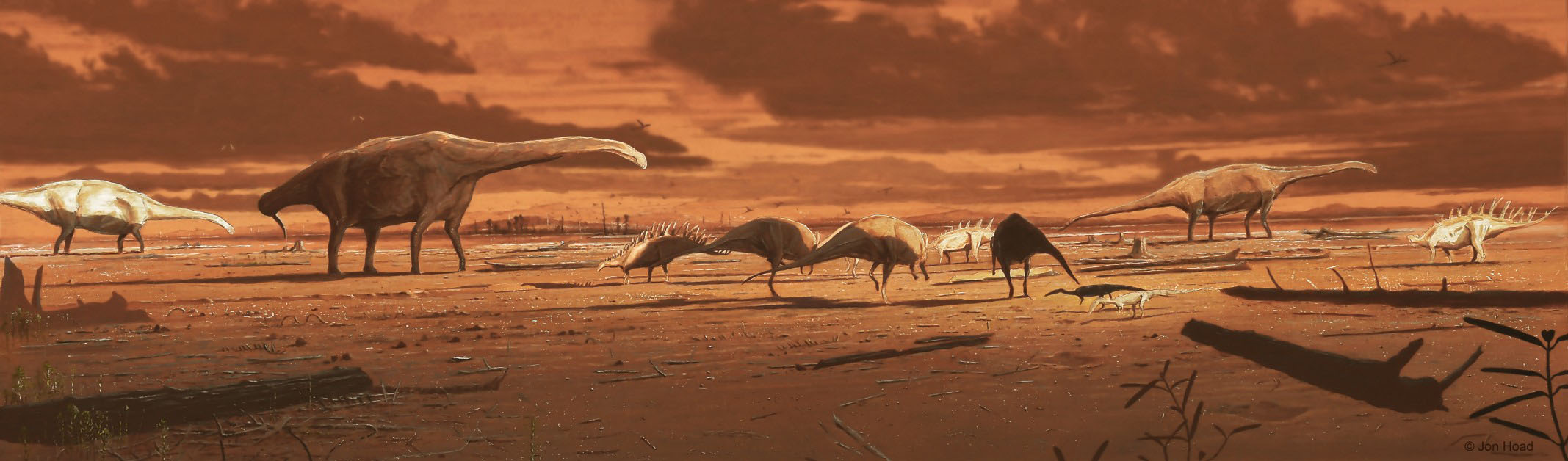
Artist’s rendering of a Middle Jurassic coastal plain in what is now the Isle of Skye across which a mixed dinosaur megafauna is migrating (credit: De Polo et al. 2020; Fig. 24; artist Jon Hoad)

And now for the lumbering and sometimes scary kinds of dinosaur. Since discovery of Middle Jurassic sauropod and theropod trackways with up to 0.5 m wide footprints at Brothers’ Point on the Trotternish Peninsula of Skye, the Inner Hebridean island has become a magnet for those wishing to commune with big beasts. Now the same team from the University of Edinburgh report more from the same locality (De Polo, P.E. and 9 others 2020. Novel track morphotypes from new tracksites indicate increased Middle Jurassic dinosaur diversity on the Isle of Skye, Scotland. PLoS ONE, v. 15, article e0229640; DOI: 10.1371/journal.pone.0229640). One set, referred to as Deltapodus was probably made by a species of stegosaur: the one with vertical plates on its back and a tail armed with large spikes, animated caricatures of which figure in inane YouTube clips, especially beating off Tyrannosaurs. The new locality preserves 50 dinosaur tracks that suggest a rich community of species. The most prominent suggest bipedal ornithopod herbivores and small, possible carnivorous theropods, both with three-toed feet, large quadripedal sauropods whose prints resemble those of elephants, as well as those with larger back feet than front attributed to stegosaurs. The sediment sequence displaying the tracks contains structures typical of deposition on a wide coastal plain.

Earliest plate tectonics tied down?

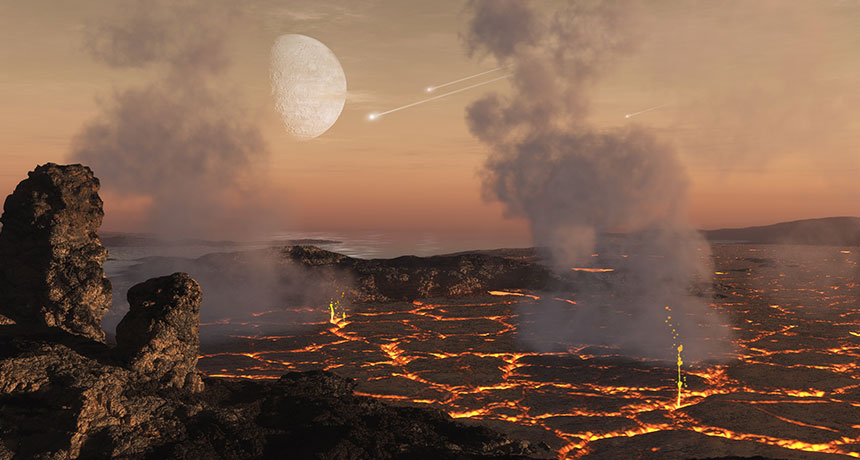
Papers that ponder the question of when plate tectonics first powered the engine of internal geological processes are sure to get read: tectonics lies at the heart of Earth science. Opinion has swung back and forth from ‘sometime in the Proterozoic’ to ‘since the very birth of the Earth’, which is no surprise. There are simply no rocks that formed during the Hadean Eon of any greater extent than 20 km2. Those occur in the 4.2 billion year (Ga) old Nuvvuagittuq greenstone belt on Hudson Bay, which have been grossly mangled by later events. But there are grains of the sturdy mineral zircon ZrSiO4)  that occur in much younger sedimentary rocks, famously from the Jack Hills of Western Australia, whose ages range back to 4.4 Ga, based on uranium-lead radiometric dating. You can buy zircons from Jack Hills on eBay as a result of a cottage industry that sprang up following news of their great antiquity: that is, if you do a lot of mineral separation from the dust and rock chips that are on offer, and they are very small. Given a laser-fuelled SHRIMP mass spectrometer and a lot of other preparation kit, you could date them. Having gone to that expense, you might as well analyse them chemically using laser ablation inductively coupled plasma mass spectrometry (LA-ICP-MS) to check out their trace-element contents. Geochemist Simon Turner of Macquarie University in Sydney, Australia, and colleagues from Curtin University in Western Australia and Geowissenschaftliches Zentrum Göttingen in Germany, have done all this for 32 newly extracted Jack Hills zircons, whose ages range from 4.3 to 3.3 Ga (Turner, S. et al. 2020. An andesitic source for Jack Hills zircon supports onset of plate tectonics in the HadeanNature Communications, v. 11, article 1241; DOI: 10.1038/s41467-020-14857-1). Then they applied sophisticated geochemical modelling to tease out what kinds of Hadean rock once hosted these grains that were eventually eroded out and transported to come to rest in a much younger sedimentary rock.

Artist’s impression of the old-style hellish Hadean (Credit : Dan Durday, Southwest Research Institute)

Zircons only form duuring the crystallisation of igneous magmas, at around 700°C, the original magma having formed under somewhat hotter conditions – up to 1200°C for mafic compositions. In the course of their crystallising, minerals take in not only the elements of which they are mainly composed, zirconium, silicon and oxygen in the case of zircon , but many other elements that the magma contains in low concentrations. The relative proportions of these trace elements that are partitioned from the magma into the growing mineral grains are more or less constant and unique to that mineral, depending on the particular composition of the magma itself. Using the proportions of these trace elements in the mineral gives a clue to the original bulk composition of the parent magma. The Jack Hills zircons  mainly  reflect an origin in magmas of andesitic composition, intermediate in composition between high-silica granites and basalts that have lower silica contents. Andesitic magmas only form today by partial melting of more mafic rocks under the influence of water-rich fluid driven upwards from subducting oceanic lithosphere. The proportions of trace elements in the zircons could only have formed in this way, according to the authors.

Interestingly, the 4.2 Ga Nuvvuagittuq greenstone belt contains metamorphosed mafic andesites, though any zircons in them have yet to be analysed in the manner used by Turner et al., although they were used to date those late-Hadean rocks. The deep post-Archaean continental crust, broadly speaking, has an andesitic composition, strongly suggesting its generation above subduction zones. Yet that portion of Archaean age is not andesitic on average, but a mixture of three geochemically different rocks. It is referred to as TTG crust from those three rock types (trondhjemite, tonalite and granodiorite). That TTG nature of the most ancient continental crust has encouraged most geochemists to reject the idea of magmatic activity controlled by plate tectonics during the Archaean and, by extension, during the preceding Hadean. What is truly remarkable is that if mafic andesites – such as those implied by the Jack Hills zircons and found in the Nuvvuagittuq greenstone belt – partially melted under high pressures that formed garnet in them, they would have yielded magmas of TTG composition. This, it seems, puts plate tectonics in the frame for the whole of Earth’s evolution since it stabilised several million years after the catastrophic collision that flung off the Moon and completely melted the outer layers of our planet. Up to now, controversy about what kind of planet-wide processes operated then have swung this way and that, often into quite strange scenarios. Turner and colleagues may have opened a new, hopefully more unified, episode of geochemical studies that revisit the early Earth . It could complement the work described in An Early Archaean Waterworld published on Earth-logs earlier in March 2020.

Further back in the Eurasian human story

About 800 to 950 thousand years (ka) ago the earliest human colonisers of northern Europe, both adults and children, left footprints and stone tools in sedimentary strata laid down by a river system that then drained central England and Wales. The fossil flora and fauna at the Happisburgh (pronounced ‘Haze-burra’) site in Norfolk suggest a climate that was somewhat warmer in summers than at present, with winter temperatures about 3°C lower than now: similar to the climate in today’s southern Norway. At that time the European landmass extended unbroken to the western UK, so any hunter-gatherers could easily follow migrating herds and take advantage of seasonal vegetation resources. These people don’t have a name because they left no body fossils. A group known from their fossils as Homo antecessor had occupied Spain, southern France and Italy in slightly earlier times (back to 1200 ka). Since the discovery of their unique mix of modern and primitive traits, they have been regarded as possible intermediaries between H. erectus and H. heidelbergensis – once supposed to be the predecessor of Neanderthals and possibly anatomically modern humans (AMH). Since the emergence about 10 years ago of ancient genomics as the prime tool in examining human ancestry the picture has been shown to be considerably more complex. Not only had AMH interbred with Neanderthals and Denisovans, those two groups were demonstrably interfertile too, and a complex web of such relationships had been pieced together by 2016. But there has been a new development.

700 ka Homo erectus from Java: a possible Eurasian ‘super-archaic’ human (credit: Gibbons 2020)

Population geneticists at the University of Utah, USA, have devised sophisticated means of making more of the detailed ATCG nucleotide sequences in ancient human DNA, despite there being very few full genomes of Neanderthals and Denisovans (Rogers, A.R. et al. 2020. Neanderthal-Denisovan ancestors interbred with a distantly related hominin. Science Advances, v. 6, article eaay5483; DOI: 10.1126/sciadv.aay5483). In Earth-logs you may already have come across the idea of the ancestral ‘ghosts’ that are represented by unusual sections of genomes from living West African people. Those sections seem likely to have resulted from interbreeding with an unknown archaic population – i.e. neither Neanderthal nor Denisovan. It now seems that both Neanderthal and Denisovan genomes also show traces of such introgression with ‘ghost’ populations during much earlier times. The ancestors of both these groups separated from the lineage that led to AMH perhaps 750 ka ago. Rogers et al. refer to the earliest as ‘neandersovans’ and consider that they split into the two groups after they entered Eurasia, at some time before 600 ka – perhaps around 740 ka. This division may well have occurred as a result of a population of ‘neandersovans’ having spread over the vastness of Eurasia and growing genetic isolation. The reanalysis of both sets of genomes show evidence of a ‘neandersovan’ population crash before the split. Thereafter, the early Neanderthal population may have risen to around 16 thousand then slowly declined to ~3400 individuals.

A ‘state-of-play’ view of human interbreeding in Eurasia since 2 Ma ago (credit: Gibbons 2020)

However, the ‘neandersovans’ did not enter a new continent devoid of hominins, for as long ago as 1.9 Ma archaic H. erectus had arrived from Africa.  Both Neanderthal and Denisovan genomes record the presence of sections of ‘super-archaic’ DNA, which reflect early  interbreeding with earlier Eurasian populations. Indeed, Denisovans seem to have repeated their ancestors’ sexual exploits, once they became a genetically distinct group.  From the ‘ghost’ DNA fragments Rogers et al. conclude that the ‘super-archaics’ separated from other humans about two million years ago. They were descended from the first ‘Out-of-Africa’ wave of humans, represented by the fossils humans from Dmanisi in Georgia (see First out of Africa, November 2003 and An iconic early human skull,  October 2013 in Earth-logs Human evolution and migrations). A measure of the potential of novel means of analysing available ancient human DNA is the authors’ ability even to estimate the approximate population size of the interbreeding ‘super-archaic’ group at 20 to 50 thousand. Long thought to be impossible, it now seems possible to penetrate back to the very earliest human genetics, and the more DNA that can be teased out of other Neanderthal and Denisovan fossils the more we will know of our origins.

See also: Gibbons, A. 2020. Strange bedfellows for human ancestors. Science, v. 367, p. 838–839; doi:10.1126/science.367.6480.838

An Early Archaean Waterworld

In Earth-logs you may have come across the uses of oxygen isotopes, mainly in connection with their variations in the fossils of marine organisms and in ice cores. The relative proportion of the ‘heavy’ 18O isotope to the ‘light’ 16O, expressed by δ18O, is a measure of the degree of fractionation between these isotopes under different temperature conditions when water evaporates. What happens is that H216O, in which the lighter isotope is bound up, slightly more easily evaporates thus enriching the remaining liquid water in H218O. As a result the greater the temperature of surface water and the more of evaporates, the higher is its δ18O value. Shells that benthonic (surface-dwelling) organism secrete are made mainly of the mineral calcite (CaCO3). Their formation involves extracting dissolved calcium ions and CO2 plus an extra oxygen from the water itself, as calcite’s formula suggests. So plankton shells fossilised  in ocean-floor sediments carry the δ18O and thus a temperature signal of surface water at the place and time in which they lived. Yet this signal is contaminated with another signal: that of the amount of water evaporated from the ocean surface (with lowered  δ18O) that has ended up falling as snow and then becoming trapped in continental ice sheets. The two can be separated using the δ18O found in shells of bottom-dwelling (benthonic) organisms, because deep ocean water maintains a similar low temperature at all time (about 2°C). Benthonic δ18O is the main guide to the changing volume of continental ice throughout the last 30 million year or so. This ingenious approach, developed about 50 years ago, has become the key to understanding past climate changes as reflected in records of ice volume and ocean surface temperature. Yet these two factors are not the only ones at work on marine oxygen isotopes.

Artistic impression of the Early Archaean Earth dominated by oceans (Credit: Sci-news.com)

When rainwater flows across the land, clays in the soil formed by weathering of crystalline rocks preferentially extract 18O and thus leave their own δ18O mark in ocean water. This has little, if any, effect on the use of δ18O to track past climate change, simply because the extent of the continents hasn’t changed much over the last 2 billion years or so. Likewise, the geological record over that period clearly indicates that rain, wet soil and water flowing across the land have all continued somewhere or other, irrespective of climate. However, one of the thorny issues in Earth science concerns changes of the area of continents in the very long term. They are suspected but difficult to tie down. Benjamin Johnson of the University of Colorado and Boswell Wing of Iowa State University, USA, have closely examined oxygen isotopes in 3.24 billion-year old rocks from a relic of Palaeoarchaean ocean crust from the Pilbara district of Western Australia that shows pervasive evidence of alteration by hot circulating ocean water (Johnson, B.W. & Wing, B.A. 2020. Limited Archaean continental emergence reflected in an early Archaean 18O-enriched ocean. Nature Geoscience, v. 13, p. 243-248; DOI: 10.1038/s41561-020-0538-9). Interestingly, apart from the composition of the lavas, the altered rocks look just the same as much more recent examples of such ophiolites.

The study used many samples taken from the base to the top of the ophiolite along some 20 traverses across its outcrop. Overall the isotopic analyses suggested that the circulating water responsible for the hydrothermal alteration 3.2 Ga ago was much more enriched in 18O than is modern ocean water. The authors’ favoured explanation is that much less continental crust was exposed above sea level during the Palaeoarchaean Era than in later times and so far less clay was around on land. That does not necessarily imply that less continental crust existed at that time compared with the Archaean during the following 700 Ma , merely that the continental ‘freeboard’ was so low that only a few islands emerged above the waves. By the end of the Archaean 2.5 Ga ago the authors estimate that oceanic δ18O had decreased to approximately modern levels. This they attribute to a steady increase in weathering of the emerging continental landmasses and the extraction of 18O into new, clay-rich soils as the continents emerged above sea level. How this scenario of a ‘drowned’ world developed is not discussed. One possibility is that the average depth of the oceans then was considerably less than it was in later times: i.e. sea level stood higher because the volume available to contain ocean water was less. One possible explanation for that and the subsequent change in oxygen isotopes might be a transition during the later Archaean Eon into modern-style plate tectonics. The resulting steep subduction forms deep trench systems able to ‘hold’ more water. Prior to that faster production of oceanic crust resulted in what are now the ocean abyssal plains being buoyed up by warmer young crust that extended beneath them. Today they average around 4000 m deep, thanks to the increased density of cooled crust, and account for a large proportion of the volume of modern ocean basins.