Earthquakes in Nepal

The magnitude 7.8 Gorkha earthquake hit much of the Himalayan state of Nepal on 25 April 2015, to be followed by one of magnitude 7.3 150 km to the east 18 days later. As would have happened in any high-relief area both events triggered a huge number of landslides as well as toppling buildings, killing almost 9000 people and leaving 22 000 injured in the capital Kathmandu and about 30 rural administrative districts. Relief and reconstruction remain hindered 9 months on in many of the smaller villages because they are accessible only by footpaths. Nepal had remained free of devastating earthquakes for almost 6 centuries, highlighting the perils of long quiescence in active plate-boundary areas.

Damage in Kathmandu, Nepal, after the Gorkha earthquake in May 2015 (Credit: CNN)

The International Charter: Space and Major Disasters consortium of many national space agencies was activated, resulting in one of the largest ever volumes of satellite images ranging from 30 to 1 m resolution to be captured and made freely available for relief direction, analysis and documentation. This allowed more than 7500 volunteers to engage in ‘crowd mapping’ coordinated by the Humanitarian OpenStreetMap Team (HOT) to provide logistic support to the Nepal government, UN Agencies and other international organizations who were swiftly responding with humanitarian relief. Most important was the location of damaged areas using ‘before-after’ analysis and assessing possible routes to remote areas. The US NASA and British Geological Survey with Durham University coordinated a multinational effort by geoscientists to document the geological, geophysical and geomorphological factors behind the mass movement of debris in landslides etc that was triggered by the earthquakes, results from which have just appeared (Kargel, J.S. and 63 others 2016. Geomorphic and geological controls of geohazards induced by Nepal’s 2015 Gorkha earthquake. Science, v. 351, p. 140 – full text purchase).

The large team mapped 4312 new landslides and inspected almost 500 glacial lakes for damage, only 9 had visible damage but none of them showing signs of outbursts. As any civil engineer might have predicted, landslides were concentrated in areas with slopes exceeding 30° coincided with high ground acceleration due to the shaking effect of earthquakes. Ground acceleration can only be assessed from the actual seismogram records of the earthquakes, though slope angle is easily mapped using existing digital elevation data (e.g. SRTM). It should be possible to model landslide susceptibility to some extent over large areas by simulation of ground shaking based on various combinations of seismic magnitude and epicenter depth modulated by maps of bedrock and colluvium on valley sides as well as from after-the-event surveys. The main control over distribution of landslides seems to have been the actual fault mechanism involved in the earthquake, assessed from satellite radar interferometry, with the greatest number and density being on the downthrow side (up to 0.82 m surface drop): the uplifted area (up to 1.13 m) had barely any debris movements. Damage lies above deep zones where brittle deformation probably takes place leading to sudden discrete faults, but is less widespread above deep zones of plastic deformation.

The geoscientific information gleaned from the Gorkha earthquake’s effects will no doubt help in assessing risky areas elsewhere in the Himalayan region. Yet so too will steady lithological and structural mapping of this still poorly understood and largely remote area. As regards the number of lives saved, one has to bear in mind that few people buried by landslides and collapsed buildings survive longer than a few days. It seems that rapid response by geospatial data analysts to the logistics of relief and escape has more chance of positive humanitarian outcomes.

In the same issue of Science appears another article on Nepalese seismicity, but events of the 12th to 14th centuries CE (Schwanghart, W. and 10 others 2016. Repeated catastrophic valley infill following medieval earthquakes in the Nepal Himalaya. Science, v. 351, p. 147-150). As the title suggests, this relates to recent geology beneath a valley floor in which Nepal’s second city Pokhara is located. It lies immediately to the south of the 8000 m Annapurna massif, about 50 km west of the Gorkha epicentre. Sections through the upper valley sediments reveal successive debris accumulations on scales that dwarf those moved in the 2015 landslides. Dating (14C) of interlayered organic materials match three recorded earthquakes in 1100, 1255 and 1344 CE, each estimated to have been of magnitude 8 or above. The debris is dominated by carbonate rocks that probably came from the Annapurna massif some 60 km distant. They contain evidence of extreme pulverisation and occur in a series of interbeds some fine others dominated by clasts. The likelihood is that these are evidence of mass movement of a more extreme category than landslides and rockfalls: catastrophic debris flows or rock-ice avalanches involving, in total, 4 to 5 km3 of material.

Carbon emissions: It’s an ill wind…

The original saying emerged in Shakespeare’s Henry IV Part 2 (Act 5, Scene 3) during a jocular exchange when Ancient Pistol brings news from Court to Sir John Falstaff and other old codgers at dinner in Gloucestershire. Falstaff: ‘What wind blew you hither, Pistol?’ Pistol: ‘Not the ill wind which blows no man to good’. In the present context it seems anthropogenic CO2 emissions have staved off the otherwise inevitable launch of another glacial epoch. Climate-change deniers will no doubt pounce on this in the manner of a leopard seizing a tasty young monkey.

Auyuittuq National Park: Penny Ice Cap
Penny Ice Cap on Baffin Island ( credit: Wikipedia)

Climatologists at the Institute for Climate Impact Research in Potsdam, Germany, Potsdam University and the Santa Fe Institute in New Mexico, USA set out to develop a means for predicting the onset of ice ages (Ganopolski, A. et al. 2016. Critical insolation-CO2 relation for diagnosing past and future glacial inception. Nature, v. 529, p. 200-203) Many researchers have concluded from the oxygen isotope data in marine sediments, which tracks changes in the volume of glacial ice on land, that the end of previous interglacial periods by inception of prolonged climatic cooling may be attributed to reduction of solar heating in summer at high northern latitudes. This conclusion stems from Milankovic’s predictions from the Earth’s astronomically controlled orbital parameters and fits most of previous interglacial to glacial transitions. But summer insolation at 65°N is now more or less at one of these minima, with no signs of drastic global cooling; rather the opposite, as part of 7 thousand years of constant global sea level during the Holocene interglacial.

The latest supercomputer model of the Earth System (CLIMBER-2) has successfully ‘predicted’ the last eight ice ages from astronomical and other data derived from a variety of climate proxies. It also forecasts the next to have already begun, if atmospheric CO2 concentration was 240 parts per million; the level during earlier interglacials most similar to that in which we live. But the pre-industrial level was 280 ppm and the model suggests that would have put off the return of huge ice caps in the Northern Hemisphere for another 50 thousand years – partly because the present insolation minimum is not deep enough to launch a new ice age with that CO2 concentration – making the Holocene likely to be by far the longest interglacial since ice-age cycles began about 2.5 Ma ago. Based on current, industrially contaminated CO2 levels and a rapid curtailment of carbon emissions the model suggests no return to full glacial conditions within the next 100 ka and possibly longer; a consequence of the sluggishness of natural processes that draw-down CO2 from the atmosphere.

English: Ice age Earth at glacial maximum. Bas...
Simulation of the Earth at a glacial maximum. (Photo credit: Wikipedia)

So, does this indicate that unwittingly the Industrial Revolution and subsequent growth in the use of fossil fuels tipped the balance away from global cooling that would eventually have made vast tracts of both hemispheres uninhabitable? At first sight, that’s the way it looks. But the atmospheric carbon content of the 17th century would have resulted in much the same long drawn out Holocene interglacial; an unprecedented skipping of an ice age in the period covering most of the history of human evolution. This raises a question first posed by Bill Ruddiman in 2003: did human agriculture and associated CO2 emission begin the destabilisation of the Earth system shortly after Holocene warming and human ingenuity made farming and herding possible since about 10 thousand years ago?

But, consider this, the CLIMBER-2 Earth System model is said to be one of ‘intermediate complexity’ which is shorthand for one that relies on the ages-old scientific method of reductionism or basing each modelled scenario on modifying one parameter at a time. Moreover, for many parameters of the Earth’s climate system – clouds, dust, the cooling effect of increased winter precipitation as snow, and much else – scientists are pretty much in the dark (Crucifix, M. 2016. Earth’s narrow escape from a big freeze. Nature, v. 529, p. 162-163). Indeed it is still not certain whether CO2 levels have a naturally active or passive role in glacial-interglacial cycles, or something more complex than the simple cause-effect paradigm that still dominates much of science.

Further pounding for ideas on the Ediacaran fauna

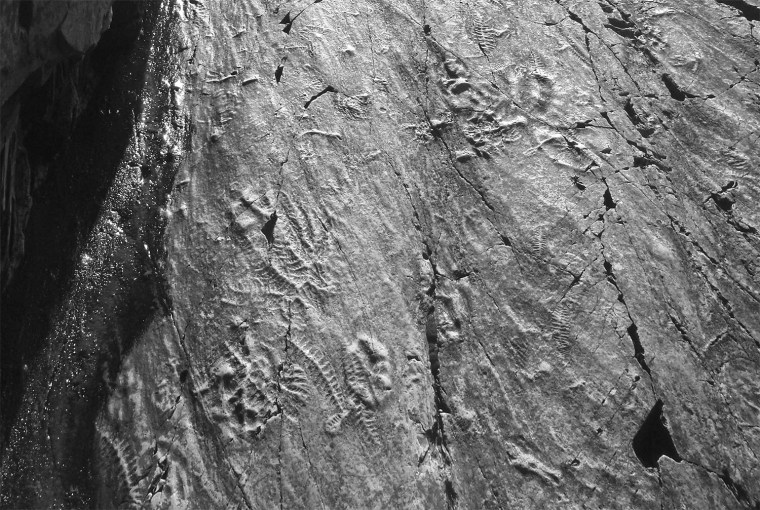
About 635 Ma ago fossils of large-bodied organisms first appeared in the geological record: some quilt like, others with a crude bilateral symmetry, more looking like ‘mud-filled bags’ and ribbed discs but none that can easily be distinguished as animals, plants or colonial microorganisms. First found abundantly in the Ediacara Hills of South Australia, hence their sack-name the Ediacaran biota, it now seems that they were distributed globally in the late Neoproterozoic Era. Interpreting their metabolism is risky enough – some are reckoned to be animals that absorbed nutrients through their skin, others said to be dependent on photosynthesis – but a controversy has raged for many years over the kind of environment in which they thrived. In a detailed 2012 study of sedimentary structures petrography in the South Australian sandstones from which they were first described, Gregory Retallack of the University of Oregon inferred that some lived on land and are now found in palaeosols: they include Spriggina, Dickinsonia and Charnia that are among the most favoured candidates for being animals or some kind. Others inhabited shallow water. Anticipating fiery disputes a Nature editorial appeared in same issue in which Retallack published his paper .

Rich fossil assemblage of the Ediacaran Mistaken Point Formation, Newfoundland. (Credit: Alex Liu, Earth Sciences, University of Bristol)

Retallack has now moved on to the even more fossil-rich Ediacaran sediments of Newfoundland (Retallack, G.J 2016. Ediacaran sedimentology and paleoecology of Newfoundland reconsidered. Sedimentary Geology, v. 333, p. 15-31). Eye-wateringly detailed sequence stratigraphy of the now famous Mistaken Point locality and others suggests that the ecosystem there was an intertidal salt marsh. In detail it contains evidence for shallow-water graded bedding, signs of regular storms and perhaps tsunamis together with interbedded palaeosols and subaerial volcanic crystal tuffs whose feldspars survive intact. The palaeosols can be subdivided into several pedogenic types akin to those used to classify modern soils. Unlike the arid setting of the South Australian Ediacaran sediments, whose palaeosols show signs of freezing, the Newfoundland package indicates humid, cool-temperature climes

As in Australia, the palaeosols are rich in Ediacaran fossils, including the best known; the leaf-like Charnia and its discoidal support structure that appears in Retallack’s reconstruction of the environment in an analogous way to salt-tolerant shrubs in modern tidal flats. They occur together with encrusting fossils that bear some resemblance to modern foliose fungi or lichens. Further chuntering in the palaeontological community seems inevitable, but the sedimentological observations alone knock one hypothesis on the head: it has been said that the graded bedding common to both major Ediacaran assemblages constitutes evidence for deep marine origins from turbidity currents. But there is further compost in which controversy may thrive, in that Retallack ascribes the repeated palaeosols to glacially controlled sea-level fluctuations: the Newfoundland sequence contains two diamictites interpreted as tillite, one dated at ~583 Ma the other undated but at the top of the sequence.

More on early life

A rational view of the start of human influences on Life and Geology

Regular readers will know that I have strong views on attempts to burden stratigraphy with a new Epoch: the Anthropocene. The central one is that the lead-in to a putsch has as much to do with the creation of a bandwagon, to whose wheels all future geologists will be shackled, as it does to any scientific need for such a novelty. Bound up as it is with the fear that Earth may be experiencing its sixth mass extinction, the mooted Anthropocene will likely become a mere boundary marked by future stratigraphers as a Global Boundary Stratotype Section and Point or GSSP between the existing Holocene Epoch and that sequence of sedimentary strata and their fossil record that will be laid down on top of it. Or not, if humanity becomes extinct should the economically induced, dangerous modifications of our homeworld of the last few decades or centuries not be halted. Either way, it defies the stratigraphic ‘rule book’.

No one can deny that humanity’s activities are now immensely disruptive to surface geological processes. Nor is it possible to rule out such disruptive change to the biosphere in the near-future that a latter-day equivalent of the K/Pg or end-Permian events is on the cards: such confidence does not spring from the interminable succession of grand words and global inaction reiterated in December 2015 by the UN Paris Agreement on economically-induced climate change. Still, it was a bit of a relief to find that palaeontological evidence, or rather statistics derived from the fossil record in North American sedimentary rocks since the Carboniferous, emphasises that there is no need for the adoption of Anthropocene as an acceptable geological adjective.

To ecologists, extinctions are not the be all and end all of disruption of the biosphere. Major shifts in life’s richness are also recorded by the way entire ecosystems become disrupted. A classic, if small-scale, example is that way in which the ecosystem of the US Yellowstone National Park changed since the eradication by 1926 of the few hundred grey wolves that formerly preyed mainly on elk. In the 20 years since wolf reintroduction to the Park in 1995 the hugely complex but fragile Yellowstone ecosystem has showed clear signs of recovery of its pre-extirpation structure and diversity.

A consortium of mainly US ecologists, led by Kathleen Lyons of the National Museum of Natural History at the Smithsonian Institution in Washington DC, has assessed linkages between species of fossil animal and plants since the Carboniferous (S.K. Lyons and 28 others, 2015. Holocene shifts in the assembly of plant and animal communities implicate human impacts. Nature, published on-line 16 December 2015 doi:10.1038/nature16447). They found that of the 350 thousand pairs of species that occurred together at different times throughout the late Palaeozoic to the last Epoch of the Cenozoic, the Holocene, some pairs appeared or clustered together more often than might be expected from random chance. Such non-random association suggests to ecologists that the two members of such a pair somehow shared ecological resources persistently, hinting at relationships that helped stabilise their shared ecosystem. For most of post-300 Ma time an average of 64% of non-random pairs prevailed, but after 11.7 ka ago – the start of the Holocene – that dropped to 37%, suggesting a general destabilisation of many of the ecosystems being considered. This closely correlates with the first human colonisation of the Americas, the last of the habitable continents to which humans migrated. This matches the empirical evidence of early Holocene extinctions of large mammals in the Americas, which itself is analogous to the decimation of large fauna in Australasia during the late Pleistocene following human arrival from about 50 to 60 ka ago. Significant human-induced ecological impact seems to have accompanied their initial appearance everywhere. The ecological effects of animal domestication and agriculture in Eurasia and the Americas mark the Holocene particularly. In fact, in Europe the presence of Mesolithic hunter gatherers is generally inferred, in the face of very rare finds of artefacts and dwellings, from changes in pollen records from Holocene lake and wetland sediments, which show periods of tree clearance that can not be accounted for by climate change.

There is no need for Anthropocene, other than as a political device.