How did African humans survive the 74 ka Toba volcanic supereruption?

The largest volcanic eruption during the 2.5 million year evolution of the genius Homo, about 74 thousand years (ka) ago, formed a huge caldera in Sumatra, now filled by Lake Toba. A series of explosions lasting just 9 to 14 days was forceful enough to blast between 2,800 to 6,000 km3 of rocky debris from the crust. An estimated 800 km3 was in the form of fine volcanic ash that blanketed South Asia to a depth of 15 cm. Thin ash layers containing shards of glass from Toba occur in marine sediments beneath the Indian Ocean, the Arabian and South China Seas. Some occur as far off as sediments on the floor of Lake Malawi in southern Africa. A ‘spike’ of sulfates is present at around 74 ka in a Greenland ice core too. Stratospheric fine dust and sulfate aerosols from Toba probably caused global cooling of up to 3.5 °C over a modelled 5 years following the eruption. To make matters worse, this severe ‘volcanic winter’ occurred during a climatic transition from warm to cold caused by changes in ocean circulation and falling atmospheric CO2 concentration, known as a Dansgaard-Oeschger event.

There had been short-lived migrations of modern humans out of Africa into the Levant since about 185 ka. However, studies of the mitochondrial DNA (mtDNA) of living humans in Eurasia and Australasia suggest that permanent migration began about 60 ka ago. Another outcome of the mtDNA analysis is that the genetic diversity of living humans is surprisingly low. This suggests that human genetic diversity may have been sharply reduced globally roughly around the time of the  Toba eruption. This implies a population bottleneck with the number of humans alive at the time to the order of a few tens of thousands (see also: Toba ash and calibrating the Pleistocene record; December 2012). Could such a major genetic ‘pruning’ have happened in Africa? Over six field seasons, a large team of geoscientists and archaeologists drawn from the USA, Ethiopia, China, France and South Africa have excavated a rich Palaeolithic site in the valley of the Shinfa River, a tributary of the Blue Nile in western Ethiopia. Microscopic studies of the sediments enclosing the site yielded glass shards whose chemistry closely matches those in Toba ash, thereby providing an extremely precise date for the human occupation of the site: during the Toba eruption itself (Kappelman, Y. and 63 others 2024. Adaptive foraging behaviours in the Horn of Africa during Toba supereruption. Nature, v. 627; DOI: 10.1038/s41586-024-07208-3).
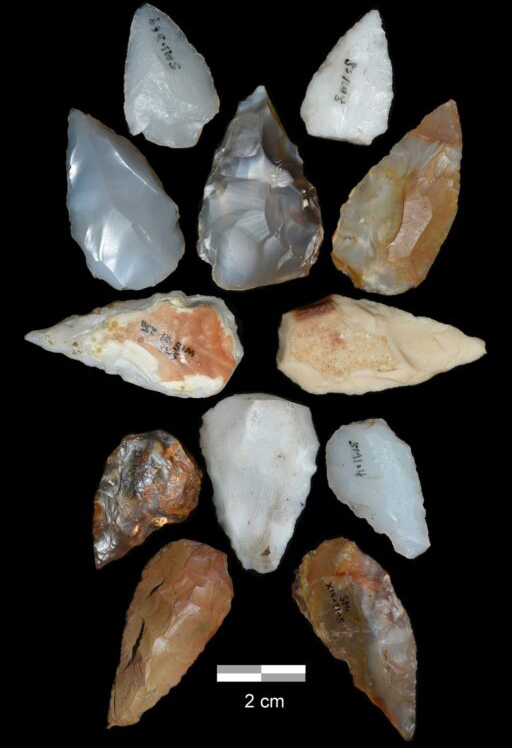
Selection of possible arrowheads from the Shinfa River site (Credit: Kappelman et al.; Blue Nile Survey Project)

The artifacts and bones of what these modern humans ate suggest a remarkable scenario for how they lived. Stone tools are finely worked from local basalt lava, quartz and flint-like chalcedony found in cavities in lava flows. Many of them are small, sharp triangular points, some of which show features consistent with their use as projectile tips that fractured on impact; they may be arrowheads, indeed the earliest known. Bones found at the site are key pointers to their diet. They are from a wide variety of animal, roughly similar to those living in the area at present: from monkeys to giraffe, guinea fowl to ostrich, and even frogs. There are remains of many fish and freshwater molluscs. Although there are no traces of plant foods, clearly those people who loved through the distant effects of Toba were well fed. Although a period of global cooling may have increased aridity at tropical latitudes in Africa, the campers were able to devise efficient strategies to obtain victuals. During wet seasons they lived off terrestrial prey animals, and during the driest times ate fish from pools in the river valley. These are hardly conditions likely to devastate their numbers, and the people seem to have been technologically flexible. Similar observations were made at the Pinnacle Point site in far-off South Africa in 2018, where Toba ash is also present. Both sites refute any retardation of human cultural progress 74 ka ago. Rather the opposite: people may have been spurred to innovation, and the new strategies may have allowed them to migrate more efficiently, perhaps along seasonal drainages. In this case that would have led them or their descendants to the Nile and a direct route to Eurasia; along ‘blue highway’ corridors as Kappelman et al. suggest.

Yet the population bottleneck implied by mtDNA analyses is only vaguely dated: it may have been well before or well after Toba. Moreover, there is a 10 ka gap between Toba and the earliest accurately dated migrants who left Africa – the first Australians at about 65 ka. However, note that there is inconclusive evidence that modern humans may have occupied Sumatra by the time of the eruption.  Much closer to the site of the eruption in southeast India, stone artifacts have been found below and above the 74 ka datum marked by the thick Toba Ash. Whether these were discarded by anatomically modern humans or earlier migrants such as Homo erectus remains unresolved. Either way, at that site there is no evidence for any mass die-off, even though conditions must have been pretty dreadful while the ash fell. But that probably only lasted for little more than a month. If the migrants did suffer very high losses to decrease the genetic diversity of the survivors, it seems just as likely to have been due to attrition on an extremely lengthy trek, with little likelihood of tangible evidence surviving. Alternatively, the out-of-Africa migrants may have been small in number and not fully representative of the genetic richness of the Africans who stayed put: a few tens of thousand migrants may not have been very diverse from the outset.

Human evolution and revolution in Africa

Toba eruption: a hindrance or a spur to humans?

English: Erosional dissection of an ash deposi...
Ash-fall blanket at Mount Pinatubo volcano in the Philippines. (credit: Wikipedia)

The eruption that created the 100 by 30 km Toba caldera 74 ka ago was the largest recorded volcanic event during the two million years of the genus Homo’s evolution. It ejected an estimated 800 cubic kilometres of ash to blanket the land surface thousands of kilometres away. By analogy with the known effects of stratospheric ash and sulfate aerosols from  the much smaller 1991 eruption of the Mount Pinatubo in the Philippines, which  reduced mean global temperature by 0.5 °C, Toba might be expected to have had an even larger cooling effect, perhaps by as much as 10° C. Such a scenario has led palaeoanthropologists to suggest that there would have been major effects on humans migrating across Eurasia at the time, such as dramatic population reduction and maybe a genetic ‘bottleneck’ that could have led to rapid evolution among surviving generations. Yet, not only are stone tools found below the Toba Ash in Sumatra, but also in South India and immediately above it too. Yet analysis of Toba’s environmental effects recorded by sediments on the bed of Lake Malawi in southern African reveal little if any sign of a global ‘volcanic winter’.

A letter in Nature, published online on 15 March 2018 (Smith, E.J. and 15 others 2018. Humans thrived in South Africa through the Toba eruption about 74,000 years ago. Nature, v. 555; doi:10.1038/nature25967) decisively refutes any retardation of human cultural progress, in southern Africa at least, and suggests the opposite. Smith and colleagues from South Africa, Australia and the US found ash dated at around 74 ka 9,000 km away from Toba in sedimentary sequences that contain anatomically modern human remains and artefacts at the coastal Vleesbaai and Pinnacle Point sites in Cape Province South Africa. To check on the likelihood of a fortuitous coincidence of another eruption having shed the ash, the team compared detailed geochemical analyses of ash samples with those from other volcanoes and bona fide Toba samples, with a clear confirmation of provenance. In the archaeological record, rather than any sign of a cultural setback, the intensity of use of the sites increased after the ash-fall event, accompanied by significant technological innovations. Perhaps the Pinnacle Point community was lucky and also responded in the spirit of the adage ‘necessity is the mother of invention’. Discovery of the Toba ash at other ancient human sites would resolve the issue.

Hominin cultural revolution 320,000 years ago

As regards stone tools, the Olorgesailie Basin in southern Kenya is about as good as it gets; a long-used ‘factory’ that covers a time span from about 1. 2 to 0.03 Ma. In places, large areas of the surface underlain by sedimentary strata, some of which have become major tourist attractions, are liberally strewn with tools and debitage from their manufacture. The area is ideal for stone-tool makers: being within the East African Rift it contains outcrops of many hard, fine-grained volcanic rocks and cherts formed by hot springs interleaved with its dominant fill of lake and riverine sediments. There are two dominant sedimentary units: the Olorgesailie Formation (1.2 to 0.49 Ma) overlain by the Oltulelei  Formation (0.32 to 0.05 Ma), the time gap between the two marking an extended period of regional erosion. Despite the rich tool assemblages, hominin remains have yet to be unearthed from the sediments, although there are plenty of bones from potential prey mammals. Olorgesailie was  good place to live, especially as the Rift would have channelled migrating herds predictably between its steep-sided flanks.

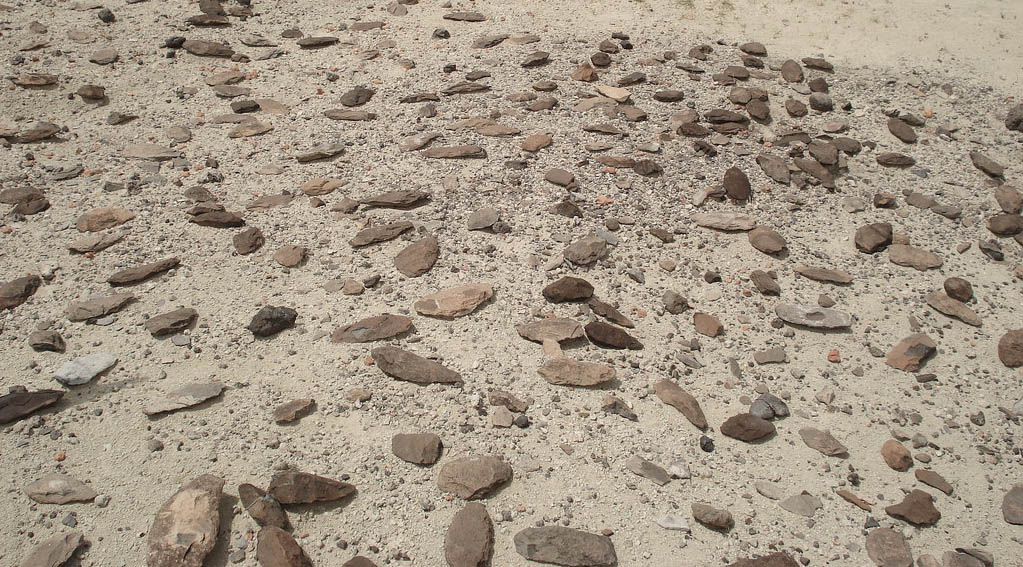
Acheulean biface tools strewn on a bedding surface in the Olorgesailie Basin, Kenya (credit: mmercedes_78 https://www.flickr.com/photos/27325832@N06/3833105587)

The older formation has yielded biface tools of the Acheulean technology from bottom to top. The earliest Acheulean tools in Africa date back to about 1.7 Ma and have been attributed to Homo ergaster/erectus, although examples in Europe are associated with H. antecessor and H. heidelbergensis – the technology was active for about 1.4 Ma. The Acheulean method involved striking flakes from large blocks of rock to result in a symmetrical, pear-shaped core that served as a multipurpose tool.   The oldest strata in the Oltulelei  Formation contain exclusively tools that are very different , having been made by a significantly more complicated procedure and covering a wide variety of designs with different uses. This Levallois technique focused on thin flakes produced from cores after careful preparation, which enabled similar tools to be made repeatedly rather than relying on chance fracturing. Precise dating of the oldest of these assemblages gives an age of 320 ka (Deino, A.L. et al. 2018. Chronology of the Acheulean to Middle Stone Age* transition in eastern Africa. Science, v. 359 online; DOI: 10.1126/science.aao2216). The makers clearly were able to visualize the finished product within the original lump of raw stone, but in a more nuanced way than did the makers of Acheulean biface tools. The first-described Levallois tools were associated with European Neanderthals.

English: Levallois flake obtained by the prefe...
Producing a flake by the Levallois technique (credit: Wikipedia)

Sometime in the 500 to 320 ka interval removed by erosion a major shift in technology and almost certainly cognition took place. Not only was this a technological revolution, but the Levallois tools are found in association with a variety of pigments, such as ochres, which show signs of having been worked, presumably for decoration of some kind. Also, the tool makers seemed to have a clear preference for specific rocks – black, glassy obsidian and cherts of white and green hues from sources 25 to 90 km from the tool-making sites (Brooks, A.S. and 14 others 2018. Long-distance stone transport and pigment use in the earliest Middle Stone Age. Science, v. 359 online; DOI: 10.1126/science.aao2646). The sheer volume of tools at each site and the evidence for long-distance transport of the raw materials have prompted the authors to hazard a guess at some kind of trade, or at least cooperative intergroup interaction. Together with the use of pigment, probably for body ornamentation, this suggests individual and perhaps group identity within a kind of social network.

Of course, the big question is: Who made the leap? That’s a hard one in the absence of human remains associated with the tool-making factories at Olorgesailie . The authors of both papers argue for the earliest modern humans. But, to me, this seems like an assumption based on the age of the transition rather than any convincing evidence. The original Levallois tools from northern France were found in association with skeletal remains of Neanderthals but much later in the Pleistocene. An age of 320 ka does place the Olorgesailie tools in the same ballpark as early AMH fossils from Morocco, later than the genetically derived date of separation of Neanderthals and AMH. However, the 180 ka time gap in which the technological revolution took place gives some room for so-called African ‘archaic modern humans’ (not subdivided as are similar fossils from Europe) are known from Zimbabwe, Tanzania and Ethiopia. If the Neanderthals were using the Levallois technique in Europe there is every reason to suspect that they, or their possible forebears H. heidelbergensis, may have brought it with them from Africa.

The Olorgesailie tools figure in a third paper in the same volume of Science, but one with less shaky grounds (Potts, R. and 14 others 2018. Environmental dynamics during the onset of the Middle Stone Age in eastern Africa. Science, v. 359 online; DOI: 10.1126/science.aao2200). The wet-dry cycle of the Pleistocene, related to global warming and cooling in interglacial and glacial episodes respectively, had become more marked after the 500 to 320 ka period of tectonically induced erosion. In itself, this would have resulted in more marked shifts in the ecosystems of the basin – perhaps a case of necessity being the mother of invention. Yet, the evidence base for changing climate cycles in Africa is not from local lake-sediment stratigraphy, micropalaeontology or geochemistry, but from the modelled variation of insolation based on Milankovich’s hypothesis.

*Note:  The Middle Stone Age in Africa does not correlate with the Mesolithic of Europe, but is a legacy of the development of archaeology in Africa. It corresponds to the European Middle Palaeolithic.

See also:  Gibbons, A. Complex behaviour arose at dawn of humans. Science, v. 359, p. 1201-1202 (with video)