Middle Palaeolithic Neanderthals and Denisovans of East Asia

During the Middle Palaeolithic (250 to 30 ka) anatomically modern humans (AMH) and Neanderthals were engaged in new technological developments in Europe and Africa as well as in migration and social interaction. This is reflected in the tools that they left at occupation sites and the fact that most living non-Africans carry Neanderthal DNA. One of the major cultural developments was a novel means of manufacturing stone implements. It developed from the Levallois technique that involved knapping sharp-edged flakes of hard rock from larger blocks or cores. A type of tool first found at a Neanderthal site near La Quina in France is a thick flake of stone with a broad, sharp edge that shows evidence of having been resharpened many times. Most other flake tools seem to have been ‘one-offs’ that were discarded after brief usage. The Quina version was not only durable but seems to have been multipurpose. Analysis of wear patterns on the sharpened edges suggest that they were deployed in carving wood and bone, removing fat and hair from animal hides, and butchery. Such scrapers have been found over a wide area of Europe, the Middle East and NE Asia mostly at Neanderthal sites, including the famous Denisova Cave of southern Siberia that yielded the first Denisovan DNA as well as that of Neanderthals.

Making a typical Quina scraper and related tools. The toolmaker would flake pieces of stone off the core and then carefully shape the Quina scraper. (Image credit: Pei-Yuan Xiao)

Until now, the early humans of East Asia were thought not to have proceeded beyond more rudimentary tools during the Middle Palaeolithic: in fact that archaeological designation hasn’t been applied there. Recent excavations at Longtan Cave in south-west China have forced a complete revision of that view (Ruan, Q.-J., et al. 2025. Quina lithic technology indicates diverse Late Pleistocene human dynamics in East Asia. Proceedings of the National Academy of Sciences, v. 122, article e2418029122; DOI: 10.1073/pnas.2418029122). The Longtan site has yielded more than fifty scrapers and the cores from which they had been struck that clearly suggest the Quina technology had been used there. They occur in cave sediments dated at between 60 and 50 ka. As yet, no human remains have been found in the same level at Longtan, although deeper levels dated at 412 ka have yielded hominin crania, mandibular fragments, and teeth, that have been suggested to be Homo erectus.

Quina type tools in East Asia may previously have been overlooked at other hominin sites in China: re-examination of archived tool collections may show they are in fact widespread. The technology could have been brought in by migrating Neanderthals, or maybe it was invented independently by local East Asian hominins. Because most living people in China carry Denisovan DNA in the genomes so perhaps that group developed the technique before interbreeding with AMH immigrants from the west. Indeed there is no reason to discard the notion that  early AMH may have imported the Quina style. A lot of work lies ahead to understand this currently unique culture at Longtan Cave. However, interpretation of another discovery published shortly after that from Longtan has spectacularly ‘stolen the thunder’ of the Qina tools, and it was made in Taiwan …

Right (top) and downward (lower) views of the partial Penghu mandible. Credit: Yousuke Kaifu University of Tokyo, Japan and Chun-Hsiang Chang Tunghai University, Taichung, from Tsutaya et al. Fig. 1 (inset)Taiwan.

About 10 years ago, Taiwanese fishers trawling in the Penghu Channel between Taiwan and China were regularly finding bones in their nets. Between 70 to 10 ka and 190 to 130 ka ago much lower sea level due to continental ice cap formation exposed the Penghu seabed. Animals and humans were thus able to move between the East Asian mainland and what is now Taiwan. The bones brought to the surface included those of elephants, water buffaloes and tigers, but one was clearly a human lower jawbone (mandible). Its shape and large molar teeth are very different from modern human mandibles and molars. A multinational team from Japan, Denmark, Taiwan and Ireland has extracted proteins from the mandible to check its genetic affinities (Tsutaya, T. and 14 others 2025. A male Denisovan mandible from Pleistocene Taiwan. Science, v. 388, p. 176-180; DOI: 10.1126/science.ads3888). Where DNA has not been preserved in bones proteomics is a useful tool, especially if results are matched with other bones that have yielded both DNA and protein sequences. In the case of the Penghu mandible, proteins from its teeth matched those of Denisovans from the Denisova Cave in Siberia which famously yielded the genome of this elusive human group. They also matched proteins from a rib found in Tibet associated with Denisovan mitochondrial DNA in cave sediments that enclosed the bones.

The three sites (Denisova, Baishiya Cave in Tibet and Penghu Channel) that have produced plausible Denisovan specimens span a large range of latitudes and altitudes. This suggests that Denisovans were capable of successful subsistence across much of East Asia. The Penghu mandible and teeth are similar to several hominin specimens from elsewhere in China that hitherto have been attributed to H. erectus. Apart from the Denisovan type locality, most of the sites have yet to be accurately dated. Having been immersed in sea water for thousands of years isotopes used in dating have been contaminated in the Panghu specimen. It can only be guessed to have lived when the seabed from which it was recovered was dry land; i.e. between 70 to 10 ka and 190 to 130 ka. China was undoubtedly occupied by Homo erectus during the early Pleistocene, but much younger fossils have been attributed to that species by Chinese palaeoanthropologists. Could it be that they are in fact Denisovans? Maybe such people independently developed the Quina knapping technique

See also: Marwick, B. 2025.  Unknown human species in East Asia used sophisticated tools at the same time Neanderthals did in Europe. Live Science, 31 March 2025; Ashworth. J. 2025. Denisovan jawbone helps to reveal appearance of ancient human species. Natural History Museum News 11 April 2025.

A fully revised edition of Steve Drury’s book Stepping Stones: The Making of Our Home World can now be downloaded as a free eBook

Early hominin dispersal in Eurasia

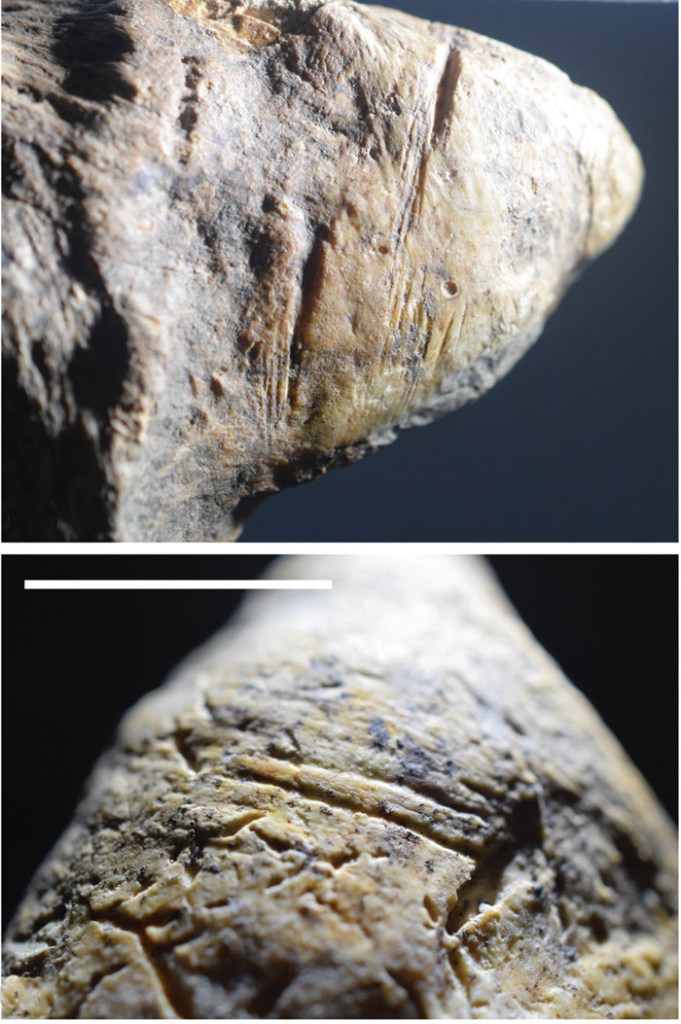
Evidence from Dmanisi in Georgia that Homo erectus may have been the first advanced hominin to leave Africa about 1.8 Ma ago was a big surprise (see: First out of Africa? November 2003). Remains of five individuals included one skull of an aged person who face was so deformed that he or she must have been cared for by others for many years. So, a second surprise from Dmanisi was that human empathy arose far earlier than most people believed. Since 2002 there has been only a single further find of hominin bones of such antiquity, at Longgudong in central China. For the period between 1.0 and 2.0 Ma eight other sites in Eurasia have yielded hominin remains. If finds of stone tools and evidence of deliberate butchery – cut marks on prey animals’ bones – are accepted as tell-tale signs, the Eurasian hominin record is considerably larger, and longer,. There are 11 Eurasian sites that have yielded such evidence – but no hominin remains – that are older than Longgudong: in Russia, China, the Middle East, North Africa and northern India. The oldest, at Masol in northern India is 2.6 Ma old. In January 2025 the earliest European evidence for hominin activity was reported from Grăunceanu in Romania (Curran, S.C. and 15 others 2025. Hominin presence in Eurasia by at least 1.95 million years ago. Nature Communications, v. 16, article 836; DOI: 10.1038/s41467-025-56154-9) in the form of animal bones showing clear signs of butchery, as well as stone tools, but no hominin fossils.

Animal bones showing cut marks from the 1.95 Ma old Grăunceanu site in Romania. (Credit: Curran et al. 2025, Figs 2A and C)

There were stone-tool makers who butchered prey in Africa as early as 3.4 Ma ago (see: Stone tools go even further back; May 2015), but without direct evidence of which hominin was involved. Several possible candidates have been suggested: Australopithecus; Kenyanthropus; Paranthropus. The earliest known African remains of H. erectus have been dated at around 2.0 Ma. So, all that can be said with some certainty about the pre-2 Ma migrants to Eurasia, until fossils of that antiquity are found, is that they were hominins of some kind: maybe advanced australopithecines, paranthropoids or early humans. Those from Longgudong and Dmanisi probably are early Homo erectus, and 2 others (1.7 and 1.6 Ma) from China have been designated similarly. Younger, pre-1.0 Ma Eurasian hominins from Israel, Indonesia, Spain and Turkey are currently un-named at the species level, but are allegedly members of the genus Homo.

So, what can be teased from the early Eurasian hominin finds? Some certainly travelled thousands of kilometres from their assumed origins in Africa, but none penetrated further north than about 50°N. Perhaps they could not cope with winters at higher latitudes, especially during ice ages. To reach as far as eastern and western Eurasia suggests that dispersal following exit from Africa would have taken many generations. There is no reason to suppose continual travel; rather the reverse, staying put in areas with abundant resources while they remained available, and then moving on when they became scarce. Climate cycles, first paced at around 40 ka (early Pleistocene) then at around 100 ka (mid Pleistocene and later), would have been the main drivers for hominin population movements, as it would have been for game and vegetation.

After about 3 Ma the 40 ka climate cyclicity evolved to greater differences in global temperature between glacial and interglacial episodes, and even more so after the mid Pleistocene transition to 100 ka cycles (see Wikipedia entry for the mid-Pleistocene Transition). Thus, it seems likely that chances of survival of dispersed bands of hominins decreased over hundreds of millennia. Could populations have survived in particularly favourable areas; i.e. those at low latitudes? If so did both culture and the hominins themselves evolve? Alternatively, was migration in a series of pulses out of Africa and then dispersal in all directions, most ending in regional extinction? Almost certainly, pressures to leave Africa would have been driven by climate, for instance by increased aridity as global temperatures waned and sea-level falls made travel to Eurasia easier. There may also have been secondary, shorter migrations within Eurasia, again driven by environmental changes. Without more data from newly discovered sites we can go little further. Within the 35 known, pre-1 Ma hominin sites there are two clusters: southern and central China, and the Levant, Turkey and Georgia. Could they yield more developments? A 2016 article in Scientific American about Chinese H. erectus finds makes particularly interesting reading in this regard.

Neanderthals and the elusive Denisovans began to establish permanent Eurasian ranges, after roughly 600 ka ago. Both groups survived until after first contact with waves of anatomically modern humans in the last 100 ka, with whom some interbred before vanishing from the record. However, evidence from the DNA of both groups suggests an interesting possibility. Before the two groups split genetically, their common ancestors (H. heidelbergensis or H. antecessor?) apparently interbred with genetically more ancient Eurasian hominins (see Wikipedia entry for Neanderthal evolution). This intriguing hint suggests that more may be discovered when substantial remains of Denisovans – i.e. more than a few teeth and small bones – are discovered and yield more DNA. My guess is such a future development will stem from analysis of early hominin remains in China, currently regarded as H. erectus. See China discovers landmark human evolution fossils. Xinhua News Agency 9 December 2024)

A fully revised edition of Steve Drury’s book Stepping Stones: The Making of Our Home World can now be downloaded as a free eBook

The first Europeans at the Ukraine-Hungary border

Until this year, the earliest date recorded for the presence of humans in Europe came from the Sierra de Atapuerca in the Province of Burgos, northern Spain. The Sima del Elefante cave yielded a fossil mandible of a human dubbed Homo antecessor from which an age between 1.2 to 1.1 Ma was estimated from a combination of palaeomagnetism, cosmogenic nuclides and stratigraphy. Stone tools from the Vallonet Cave in southern France are around the same age. There is a time gap of about 200 ka before the next sign of human ventures into Europe, probably coinciding with an extreme ice age. They reappear in the form of stone tools and even footprints that they left between 1.0 to 0.78 Ma in ancient river sediments beneath the crumbling sea cliffs of Happisburgh in Norfolk, England. Although no human fossils were preserved, they too have been assigned to H. antecessor.

Topographic map of Europe (click to see full resolution in a new window). The Carpathian Mountains form an arc surrounding the Pannonian Basin (Hungarian Plains) just below centr. Korolevo and other Homo erectus and H. antecessor sites are marked by red spots (Credit: Wikipedia Commons)

In 1974 Soviet archaeologists discovered a site bearing stone tools by the River Tisza at Korolevo in the Carpathian Mountains close to the borders between Ukraine, Romania and Hungary. Korolevo lies at the northeastern edge of the Pannonian Basin that dominates modern Hungary. Whoever left the tools was on the westward route to a huge, fertile area whose game might support them and their descendants. The route along the Tisza leads to the River Danube and then to its headwaters far to the west. Going eastwards leads to the plains north of the Black Sea and eventually via Georgia to the Levant. On that route lies Dmanisi in Georgia, famous for the site where remains of the first hominins (H. erectus, dated at ~1.8 Ma) to leave Africa were found (see: Consider Homo erectus for what early humans achived). The tools from Korolevo are primitive, but have remained undated since 1974. 50 years on, Roman Garba of the Czech Academy of Sciences with colleagues from Czechia, Ukraine, Germany, Australia, South Africa and Denmark have finally resolved their antiquity (Garba, R. and 12 others 2024. East-to-west human dispersal into Europe 1.4 million years ago. Nature v. 627, p. 805–810; DOI: 10.1038/s41586-024-07151-3). Without fossils it is not possible to decide if the tool makers were H. erectus or H. antecessor.

The method used to date the site is based on radioactive 10Be and 26Al formed from oxygen and silicon in quartz grains by cosmic ray bombardment while the grains are at the surface. Since the half life of 26Al (0.7 Ma) is less than that of 10Be (1.4 Ma), after burial the 26Al/10Be ratio decreases and is a guide to the age of the sediment layer that contains the quartz grains. In this case the ag is quite precise (1.42 ± 0.28 Ma). The decreasing age of H. erectus or H. antecessor sites from the 1.8 Ma of Dmanisi in Georgia in the east, through 1.4 Ma (Korolevo) to 1.2 in Spain and France could mark the slow westward migration of the earliest Europeans. It is tempting to suggest possible routes as Garba et al. have. But such sparse and widely separated sites can yield very little certainty. Indeed, it is equally likely that each known site marks the destination of separate migrations at different times that ended in population collapse. The authors make an interesting point regarding the Korolevo population. They were there at a time when three successive interglacials were significantly warmer than the majority during the Early Pleistocene. Also glacial cycles then had ~41 ka time spans before the transition to 100 ka about 1 Ma ago. Unfortunately, no information about the ecosystem that the migrants exploited is available

See also: Prostak, S. 2024. 1.4-Million-Year-Old Stone Tools Found in Ukraine Document Earliest Hominin Occupation of Europe. Sci News, 7 March 2024. (includes map showing possible routes of early human dispersal)

Environmental change and early-human innovation

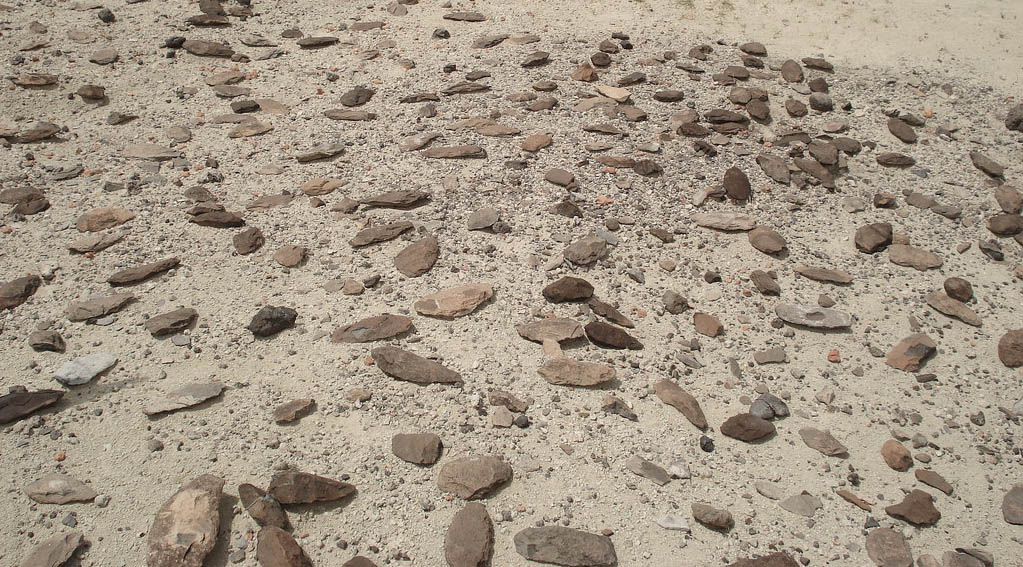
Acheulean biface tools strewn on a bedding surface in the Olorgesailie Basin, Kenya (credit: mmercedes_78 Flickr)

The Olorgesailie Basin in Southern Kenya is possibly the world’s richest source for evidence of ancient stone-tool manufacture. For early humans, it certainly was rich in the necessary resources from which to craft tools. Lying in East Africa’s active rift system, its stratigraphy contains abundant beds of hydrothermal silica (chert), deposited by hot springs, and flows of fine grained lavas. Its sediments spanning the last 1.2 million years show that the Basin hosted lakes and extensive river systems for the earlier part of this period: it was rich in food resources too. The tools, together with bones from dismembered prey, bear witness to long-term human occupation, but hominin remains themselves have yet to be discovered. The time span suggests early occupation by Homo erectus, who probably manufactured Acheulean biface stone tools in large quantities that litter the surface at some archaeological sites.

There is a break in the stratigraphic sequence from about 500 to 320 thousand years ago caused by erosion during a period of tectonic uplift. Younger sediments reveal a striking change in archaeology. The earlier large cutting tools give way to a more diverse ‘toolkit’ of smaller tools produced by more sophisticated techniques than those used to make the Acheulean ‘hand axes’. In African archaeological parlance, the <320 ka-old tools mark the onset of the Middle Stone Age (NB not equivalent to the much younger Mesolithic of Europe). The sedimentary gap also marks what seems to have been very different human behaviour. The stone resources used in the 1.2 to 0.5 Ma sequence were local: no more than 5 km from the tool-yielding sites. After the gap a much more varied range of lithologies was used, from as far afield as 95 km. Not only that, but rock unsuitable for tools appears: soft pigments such as hematite.

The foregoing was known from three major papers that appeared in March 2018 (see: Human evolution and revolution in Africa, March 2018 – specifically the section Hominin cultural revolution 320,000 years ago). Now, many members of the teams who produced that published evidence report detailed analysis of samples from a deep drill core through the stratigraphy in a similar, nearby basin (Potts, R. and 21 others 2020. Increased ecological resource variability during a critical transition in hominin evolutionScience Advances, v. 6, article eabc8975; DOI:10.1126/sciadv.abc8975). As well as calibrating the timing of stratigraphic changes using 40Ar/39Ar dating from 22 volcanic layers, the team analysed sedimentary structures, body- and trace fossils, variations in sediment geochemistry, palaeobotany and carbon isotopes, to suggest variations in environmental conditions and ecology throughout the section in greater detail than previously achieved anywhere in Africa.

They conclude that as well as a change in topography resulting from the 500-320 ka period of tectonic uplift and erosion, the climate of this part of East Africa became more unstable. Combined, these two factors transformed the ecosystems of the Olorgesailie Basin. Between 1.2 to 0.5 Ma the Acheulean tool makers inhabited dominantly grassy plains with substantial, permanent lakes – a stable period of 700 thousand years, well suited to large herbivores and thus to these early humans. Tectonic and climatic change disrupted a ‘land of plenty’; the herbivores left to be replaced by smaller prey animals; vegetation shifted back and forth from grassland to woodland with the unstable climate; lakes became smaller and ephemeral. The problem in linking environmental change to changed human practices in this case, however, is the 180 thousand-year gap in the geological record. Lead author Richard Potts, director of the Human Origins Program at the Smithsonian’s National Museum of Natural History, and his team suggest that the change contributed to the ecological flexibility of the probable Homo sapiens who left the fancier, more diverse tools during the later phase. Yet 1.6 million years beforehand early H. erectus had sufficient flexibility to cross 30 to 40 degrees of latitude and end up on the shores of the Black Sea in Georgia! The likely late-stage H. erectus of Olorgesailie may have moved out around 500 ka ago and sometime later early H. sapiens moved in with new technology developed elsewhere. We know that the earliest known anatomically modern humans lived in Morocco at around 315 ka (see: Origin of anatomically modern humans, June 2017): but we don’t know what tools they had or where they went next. There are all sorts of possibilities that cannot be addressed by even the most intricate analysis of secondary evidence. The important issue seems, I think, to centre on the transition from erects to sapiens, in anatomical, cognitive and behavioural contexts, via some intermediary such as H. antecessor, to which this study can contribute very little. That needs complete stratigraphic records: ironically, the other basin from which the core was drilled is apparently more complete, especially for the 500 to 320 ka ‘gap’. That seems likely to offer more potential. Yet, such big questions also demand a much broader brush: perhaps on a continental scale. It’s to early to tell …

See also: Turbulent era sparked leap in human behavior, adaptability 320,000 years ago (Science Daily,21 October 2020)

Multiple invention of stone tools

Steadily, the record of stone tools has progressed further back in time as archaeological surveys have expanded, especially in East Africa (Stone tools go even further back, May 2015). The earliest known tools – now termed Lomekwian – are 3.3 million years old, from deposits in north-western Kenya, as are cut-marked bone fragments from Ethiopia’s Afar region. There is no direct link to their makers, but at least six species of Australopithecus occupied Africa during the Middle Pliocene. Similarly, there are various options for who made Oldowan tools in the period between 2.6 and 2.0 Ma, the only known direct association being with Homo habilis in 2.0 Ma old sediments from Tanzania’s Olduvai Gorge; the type locality for the Oldowan.

The shapes of stone tools and the manufacturing techniques required to make them and other artefacts, are among the best, if not the only, means of assessing the cognitive abilities of their makers. A new, detailed study of the shapes of 327 Oldowan tools from a 2.6 Ma old site in Afar, Ethiopia has revealed a major shift in hominin working methods (Braun, D.R. and 17 others 2019. Earliest known Oldowan artifacts at >2.58 Ma from Ledi-Geraru, Ethiopia, highlight early technological diversity. Proceedings of the National Academy, v. 116, p. 11712-11717; DOI: 10.1073/pnas.1820177116). The sharp-edged tools were made by more complex methods than the Lomekwian. Analysis suggests that they were probably made by striking two lumps of rock together, i.e. by a deliberate two-handed technique. On the other hand, Lomekwian tools derived simply by repeatedly bashing one rock against a hard surface, not much different from the way some living primates make rudimentary tools. But the morphology of the Ledi-Geraru tools also falls into several distinct types, each suggesting systematic removal of only 2 or 3 flakes to make a sharp edge. The variations in technique suggest that several different groups with different traditions used the once lake-side site.

oldowan
Various 2.6 Ma old Oldowan stone tools from Ledi-Geraru, Ethiopia (credit: Braun et al., 2019)

Ledi-Geraru lies about 5 km from another site dated about 200 ka earlier than the tools, which yielded a hominin jawbone, likely to be from the earliest known member of the genus Homo. A key feature that suggested a human affinity is the nature of the teeth that differ markedly from those of contemporary and earlier australopithecines. It appears that the tools are of early human manufacture. The ecosystem suggested by bones of other animals, such as antelope and giraffe was probably open grassland – a more difficult environment for hominin subsistence. The time of the Lomekwian tools was one of significantly denser vegetation, with more opportunities for gathering plant foods. Perhaps this environmental shift was instrumental in driving hominins to increased scavenging of meat, the selection pressure acting on culture to demand tools sharp enough to remove meat from the prey of other animals quickly, and on physiology and cognitive power to achieve that.

See also: Solly, M. 2019. Humans may have been crafting stone tools for 2.6 million years (Smithsonian Magazine)

The earliest humans to leave Africa, in China

Since discovery in 2010 that remains of the genus Homo at Dmanisi in Georgia were about 1.85 Ma old several more instances of bones and stone tools a few hundred thousand years less than that age have turned up in China. All have been ascribed to H. erectus, although there are dissimilarities with African examples of the species and its predecessor H. ergaster. The technological breakthrough that led H. erectus/ergaster to knap the distinctive bifacial or Acheulean ‘handaxe’ was achieved at about the same time as the Dmanisi humans left Africa, yet there is no sign of such tools in eastern Asia until much later, most ancient artefacts there being of a more primitive, ‘Oldowan’ type. That is perhaps because more serviceable tools were fashioned from less durable materials than fine-grained rock that takes an edge. Maybe the skills were lost en route or the forebears of eastern Asian tool makers left Africa before the breakthrough. At any rate, the genus Homo is generally conferred on any being that had a tool-making culture, so that the presence of tools alone in a sedimentary deposit signifies that humans probably once inhabited that site. The earliest tools (3.3 Ma) from the Turkana area of Kenya were made half a million years before the first known appearance of well-documented remains of an un-named member of the genus Homo at  Ledi-Geraru in Afar, Ethiopia (2.8 Ma). At sites in Olduvai, Tanzania (1.9 Ma) and Turkana, Kenya (2.1 Ma) fossils of Homo habilis are found in association with ‘Oldovan’ stone tools.

Sites where early human fossils an tools have been found. (Credit: John Kappelman, Nature 2018; doi:10.1038/d41586-018-05293-9)

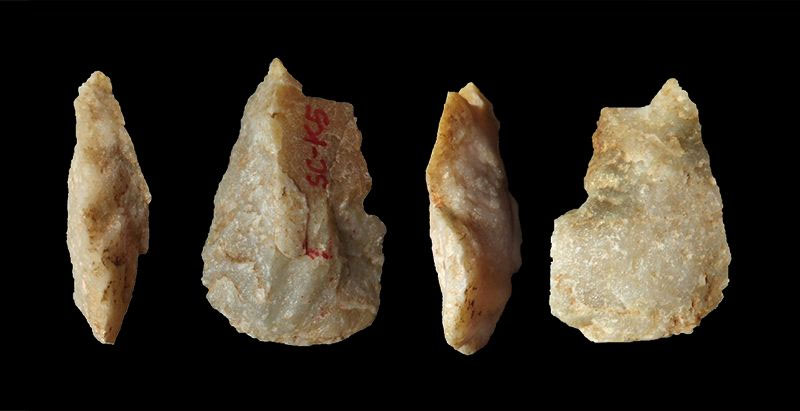
The latest development in the origin and wanderings of early humans has emerged from studies of a thick deposit of windblown silt or loess that makes up the Loess Plateau (Latitude 34°N) between the Yellow and Yangtze Rivers in central-east China. The loess is divided into several sequences by thin soil horizons (palaeosols). The entire stratigraphy contains tiny grains of iron minerals whose magnetic polarity was aligned with the Earth’s magnetic field at the time of deposition. This allows periods of normal and reversed geomagnetic polarity to be detected with considerable precision. Measurements have been taken at 10 cm intervals throughout the loess, to give an unbroken record of events throughout the Pleistocene Epoch that can be matched to a dated reference called the geomagnetic polarity timescale (GPTS). Palaeoclimate researchers have been able to show that the layers of loess correspond to successive glacial stages, whereas the palaeosol represent warm interglacials, exactly as recorded in sea-floor sediment profiles   A team of archaeologists from China and Britain have found primitive, Oldowan-type, artefacts in both the loess and palaeosol horizons at 17 different levels (Zhu, Z. and 10 others 2018. Hominin occupation of the Chinese Loess Plateau since about 2.1 million years ago. Nature, v. 559 advance publication online doi:10.1038/s41586-018-0299-4. See also). The artefacts are positioned at levels dated at between 1.26 to 2.12 Ma by the palaeomagnetic dating (from the Réunion to Cobb Mountain normally polarized subchrons).

Primitive stone tool (four sides shown) from the Loess Plateau of China. (Credit: Zhu et al./Nature 2018)

So, in both cool and warm conditions (34°N has cold winters today) toolmakers were regularly present in central, east China for almost 900 ka. The earliest must have made a 14 thousand km trek from tropical Africa across several climatic zones, and been physically, cognitively and technologically capable of surviving and reproducing for the one- to three-thousand years the journey must have taken (based on a dispersal rate of 5 to 15 km a year estimated from modern hunter-gatherers’ activities). Either there were repeated migrations of this scale or a pioneer population survived on or within reach of the loess steppe for hundreds of thousand years. The earliest emigrants would have been neither Homo erectus nor ergaster, for neither had evolved. Their age suggests that they may have been H. habilis, a view that has been expressed for the ancestors of the diminutive H. floresiensis known to have been present of the Indonesian island of Flores for around 700 ka. Until actual fossils are unearthed – not easy as the sequence is exposed in very steep slopes characteristic of dissected loess terrains – who the first occupants of China were remains mysterious. But one thing stands out: If early humans from that long ago could arrive, survive and prosper half a world away from their place of origin, then paleoanthropologists must consider the possibility of continual diffusion of the genus Homo away from its African origins once equipped with the ability to make tools. China may become the focus for early-human research as it became for that into the origins of birds and feathered dinosaurs.

You can read more about early humans and their evolution here.

A fully revised edition of Steve Drury’s book Stepping Stones: The Making of Our Home World can now be downloaded as a free eBook

Clear signs of a hominin presence on the Philippines at around 700 ka

For over half a century the presence of crude stone tools on several SE Asian islands, such as Flores and Sulawesi in Indonesia and Luzon in the Philippines, have hinted at their colonisation by Asian Homo erectus. Hominin fossils have yet to be exhumed, outside of Flores (Homo floresiensis) and dating the earlier finds has been imprecise, but evidence continues to accumulate. As regards the Philippines, the earliest hominin fossil is a modern human toe bone dated at 66.7 ka. Another curious feature of these isolated parts of what might be termed  ’Wallacea’, on broader floral and faunal grounds, is the presence in the Pleistocene fossil record of large mammals, or at least dwarfed species of megafauna found in mainland Asia. These include elephants, rhinos and deer.

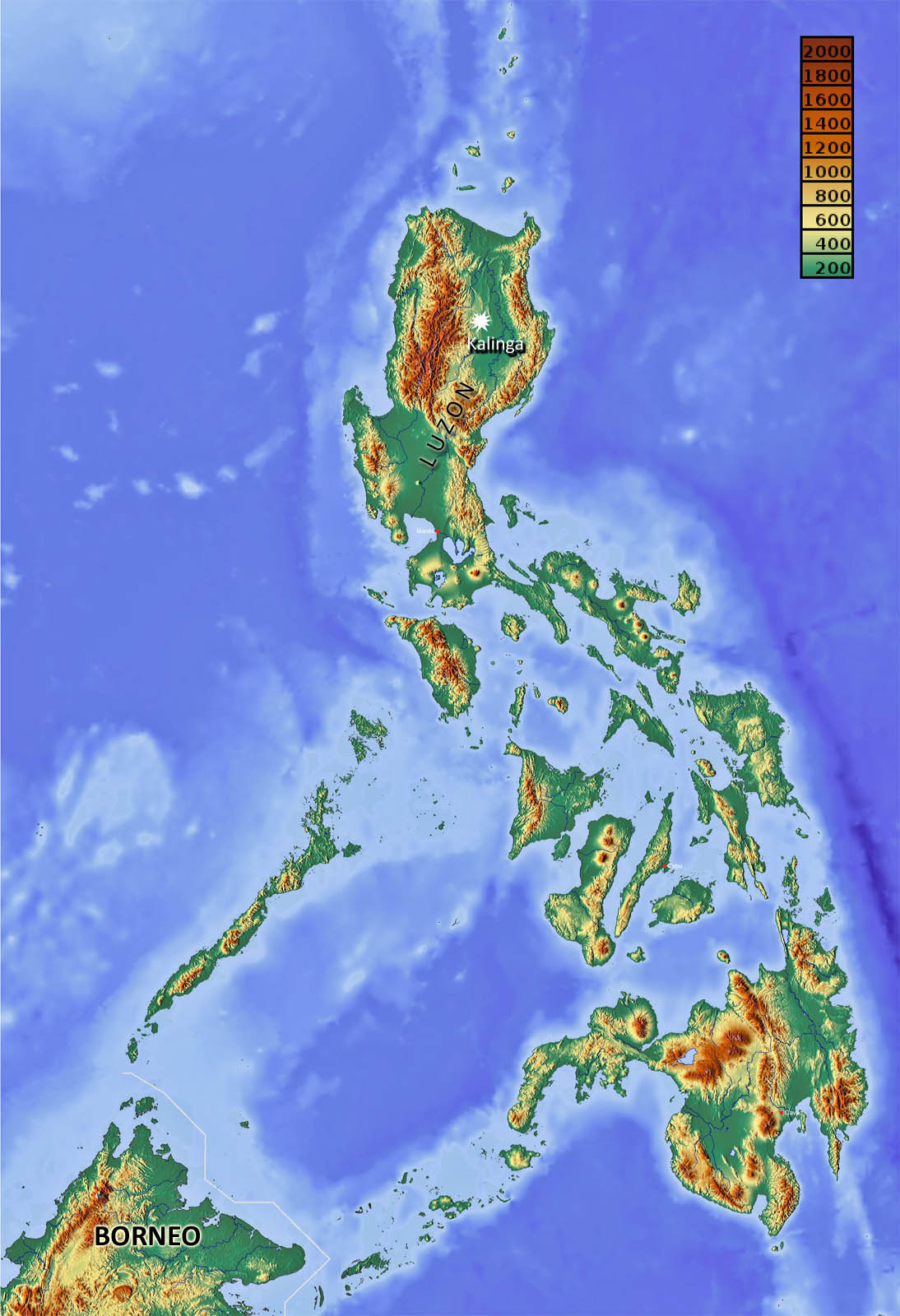
Topography of the Philippines, showing location of the Kalinga site. Palest blue sea would have been above sea level during glacial maxima. At such times Borneo would have been part of Sundaland – linked to mainland Asia (credit: Wikipedia)

A large team, with members from France, Philippines, Australia, Spain, Germany, Holland, Spain and Greece, has been excavating a tool- and fossil-rich site in thick alluvium at Kalinga in northern Luzon since 2014 (Ingicco, T. and 22 others 2018. Earliest known hominin activity in the Philippines by 709 thousand years ago. Nature, published online). It occurs in an erosional channel filled with mud. Stone artefacts comprise 56 flakes, hammer stone and cores, the tools being crude – a common feature of the Asian H. erectus lithic culture, unlike that in Africa and Europe. As well as fragments of other animals, the site is notable for a 75% complete, but disarticulated, skeleton of a rhinoceros scattered over a small area. That in itself suggests that the beast may have been butchered, and is confirmed by cut marks and signs of smashing on several of the bones. Uranium-thorium dating of one of the animal’s teeth (709±68 ka) and sediment grains from above and below the fossiliferous unit by electron-spin resonance (701±70 and 727±30 ka respectively) confirms the great antiquity of the site. Dating of volcanic plagioclase crystals from sediments by the 40Ar/39Ar method yields even older dates around 1 Ma, but the crystals may have been washed for older volcanic ash deposits.

It seems beyond doubt that early hominins, possibly H. erectus, colonised Luzon some 700 ka ago, yet, according to the authors, ‘it still seems too farfetched to suggest that H. erectus, or another unknown Pleistocene ancestral candidate … were able to construct some sort of simple watercraft and deliberately cross sea barriers’. That seems to be pushing caution a little too far. Do the authors not believe their own – to me compelling – evidence and analyses? But the paper spent a year in review, so maybe they came up against a singularly pernickety referee (three are named but one remains anonymous). Presumably, if a hominin fossil turns up during on-going excavations, that would change everything apart from the question, ‘Did they walk, swim or navigate?’ Luzon and the Philippines archipelago as a whole are surrounded by sea shallow enough for them to have been a single landmass during a glacial maximum when sea level was around 100 m lower than at present. At such a juncture a less than 20 km sea journey would have separated the Philippines from Borneo, then part of a vast area of lowland to the SW (Sundaland) that was connected to the Asian mainland.

A fully revised edition of Steve Drury’s book Stepping Stones: The Making of Our Home World can now be downloaded as a free eBook