A major breakthrough in carbon capture and storage?

Carbon capture and storage is in the news most weeks and is increasingly on the agenda for some governments. But plans to implement the CCS approach to reducing and stopping global warming increasingly draws scorn from scientists and environmental campaigners. There is a simple reason for their suspicion. State engagement, in the UK and other rich countries, involves major petroleum companies that developed the oil and gas fields responsible for unsustainably massive injection of CO2 into the atmosphere. Because they have ‘trousered’ stupendous profits they are a tempting source for the financial costs of pumping CO2 into porous sedimentary rocks that once contained hydrocarbon reserves. Not only that, they have conducted such sequestration over decades to drive out whatever petroleum fluids remaining in previously tapped sedimentary strata. For that second reason, many oil companies are eager and willing to comply with governmental plans, thereby seeming to be environmentally ‘friendly’. It also tallies with their ambitions to continue making profits from fossil-fuel extraction. But isn’t that simply a means of replacing the sequestered greenhouse gas with more of it generated by burning the recovered oil and natural gas; i.e. ‘kicking the can down the road’? Being a gas – technically a ‘free phase’ – buried CO2 also risks leaking back to the atmosphere through fractures in the reservoir rock. Indeed, some potential sites for its sequestration have been deliberately made more gas-permeable by ‘fracking’ as a means of increasing the yield of petroleum-rich rock. Finally, a litre of injected gas can drive out pretty much the same volume of oil. So this approach to CCS may yield a greater potential for greenhouse warming than would the sequestered carbon dioxide itself.
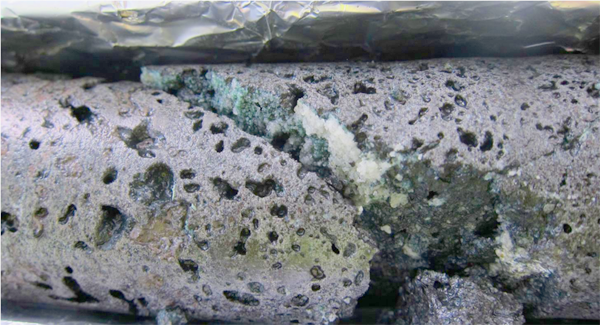
Image of calcite (white) and chlorite (cyan) formed in porous basalt due to CO2-charged water-rock interaction at the CarbFix site in Iceland. (Credit: Sandra Ósk Snæbjörnsdóttir)

Another, less widely publicised approach is to geochemically bind CO2 into solid carbonates, such as calcite (CaCO­3), dolomite (CaMgCO3), or magnesite (MgCO3). Once formed such crystalline solids are unlikely to break down to their component parts at the surface, under water or buried. One way of doing this is by the chemical weathering of rocks that contain calcium- and magnesium-rich minerals, such as feldspar (CaAl2Si2O8), olivine ([Fe,Mg]2SiO4) and pyroxene ([Fe,Mg]CaSi2O6) . Mafic and ultramafic rocks, such as basalt and peridotite are commonly composed of such minerals. One approach involves pumping the gas into a Icelandic borehole that passes through basalt and letting natural reactions do the trick. They give off heat and proceed quickly, very like those involved in the setting of concrete. In two experimental field trials 95% of injected CO2 was absorbed within 18 months. Believe it or not, ants can do the trick with crushed basalt and so too can plant roots. There have been recent experiments aimed at finding accelerants for such subsurface weathering (Wang, J. et al. 2024. CO2 capture, geological storage, and mineralization using biobased biodegradable chelating agents and seawater. Science Advances, v. 10, article eadq0515; DOI: 10.1126/sciadv.adq0515). In some respects the approach is akin to fracking. The aim is to connect isolated natural pores to allow fluids to permeate rock more easily, and to release metal ions to combine with injected CO2.

Chelating agents are biomolecules that are able to dissolve metal ions; some are used to remove toxic metals, such as lead, mercury and cadmium, from the bodies of people suffering from their effects. Naturally occurring ones extract metal ions from minerals and rocks and are agents of chemical weathering; probably used by the aforesaid ants and root systems. Wang and colleagues, based at Tohoku University in Japan, chose a chelating agent GLDA (tetrasodium glutamate diacetate –  C9H9NNa4O8) derived from plants, which is non-toxic, cheap and biodegradable. They injected CO2 and seawater containing dissolved GDLA into basaltic rock samples. The GDLA increases the rock’s porosity and permeability by breaking down its minerals so that Ca and Mg ions entered solution and were thereby able to combine with the gas to form carbonate minerals. Within five days porosity was increased by 16% and the rocks permeability increased by 26 times. Using electron microscopy the authors were able to show fine particles of carbonate growing in the connected pores. In fact these carbonate aggregates become coated with silica released by the induced mineral-weathering reactions. Calculations based on the previously mentioned field experiment in Iceland suggest that up to 20 billion tonnes of CO2 could be stored in 1.3 km3 of basalt treated in this way: about 1/25000 of the active rift system in Iceland (3.3 x 10⁴ km2 covered by 1 km of basalt lava). In 2023 fossil fuel use emitted an estimated 36.6 bllion tons of CO2 into the atmosphere.

So, why do such means of efficiently reducing the greenhouse effect not receive wide publicity by governments or the Intergovernmental Panel on Climate Change? Answers on a yellow PostIt™ please . . .

Naturally occurring hydrogen: an abundant green fuel?

Burning hydrogen produces only water vapour, so it is not surprising that it has been touted as the ultimate ‘green’ energy source, and increasingly attracts the view that the ‘Hydrogen Economy’ may replace that based on fossil fuels. It is currently produced from natural gas by ‘steam reforming’ of methane that transforms water vapour and CH4 to hydrogen and carbon monoxide. That clearly doesn’t make use of the hydrogen ‘green’ as the CO becomes carbon dioxide because it reacts with atmospheric oxygen; it is termed ‘grey hydrogen’. But should it prove possible to capture CO and store it permanently underground in some way then that can be touted as ‘blue hydrogen’ thereby covering up the carbon footprint of all the rigmarole in getting the waste CO into a safe reservoir. However, if carbon-free electricity from renewables is used to electrolyse water into H and O the hydrogen aficionados can safely call it ‘green hydrogen’.   It seem there is a bewildering colour coding for hydrogen that depends on the various options for its production: ‘yellow’ if produced using solar energy; ‘red’ if made chemically from biowaste; ‘black’ by coking coal using steam; ‘pink’ is electrolysis using nuclear power; and even ‘turquoise’ hydrogen if methane is somehow turned into hydrogen and solid carbon using renewables – a yet-to-be-developed technology! Very jolly but confusing: almost suspiciously so!

But not to be forgotten is the ‘white’ variety, applied to hydrogen that is emitted by natural processes within the Earth. Eric Hand, the European news editor for the major journal Science has written an excellent Feature article about ‘white’ hydrogen in a recent issue (Hand, E. 2023. Hidden hydrogen. Science, v. 379, article adh1460; DOI: 10.1126/science.adh1460). Hand’s feature is quirky, but well-worth a read. It is based on the proceedings of a Geological Society of America mini-conference about non-petroleum, geological energy resources  held in October 2022. He opens with a bizarre anecdote related by a farmer who lives in rural Mali. The only drilling that ever went on in his village was for water, and many holes were dry. But one attempt resulted in ‘wind coming out of the hole’. When a driller looked in the hole, the ‘wind’ burst into flame – he had a cigarette in his mouth. The fire burned for months. Some 20 years later the story reached a Malian company executive who began prospecting the area’s petroleum potential, believing the drilling had hit natural gas. Analysis of the gas revealed that it was 98% hydrogen – now the village has electricity generated by ‘white’ hydrogen.

Mantle rock in the Oman ophiolite, showing cores of fresh peridotite, surrounded by brownish serpentinite and white magnesium carbonate veins (credit: Juerg Matter, Oman Drilling Project, Southampton University, UK)

So how is hydrogen produced by geological processes? Some springs in the mountains of Oman also release copious amounts of the gas. The springs emerge from ultramafic rocks of the vast ophiolite that was emplaced onto the Arabian continental crust towards the end of the Cretaceous. The lower part of this obducted mass of oceanic lithosphere is mantle rock dominated by iron- and magnesium-rich silicates, mainly olivine [(Mg,Fe)2SiO4 – a solid solution of magnesium and iron end members]. When saturated with groundwater in which CO2 is dissolved olivine breaks down slowly but relentlessly. The hydration reaction is exothermic and generates heat, so is self-sustaining. Olivine’s magnesium end member is hydrated to form the soft ornamental mineral serpentine (Mg3Si2O5(OH)4) and magnesium carbonate. Under reducing conditions the iron end member reacts with water to produce an iron oxide, silica and hydrogen:

3Fe2SiO4 + 2H2O → 2 Fe3O4 + 3SiO­2 +3H2

Gases emanating from mid-ocean ridges contain high amounts of hydrogen produced in this way, for example from Icelandic geothermal wells. But Mali is part of an ancient craton, so similar reactions involving iron-rich ultramafic rocks deep in the continental crust are probably sourcing hydrogen in this way too. Hydrogen production on the scale of that discovered in Mali seems to be widespread, with discoveries in Australia, the US, Brazil and the Spanish Pyrenees that have pilot-scale production plants. The US Geological Survey has estimated that around 1 trillion tonnes of ‘white’ hydrogen may be available for extraction and use

Hydrogen, like other natural gases, may be trapped below the surface in the same ways as in commercial petroleum fields. But petroleum-gas wells emit little if any hydrogen mixed in with methane. That absence is probably because petroleum fields occur in deep sedimentary basins well above any crystalline basement. The geophysical exploration that discovers and defines the traps in petroleum fields has never been deployed over areas of crystalline continental crust because as far as the oil companies are concerned they are barren. That may be about to change. There is another exploration approach: known hydrogen seepage seems to deter vegetation so that the sites are in areas of bare ground, which have been called ‘fairy circles’. These could be detected easily using remote sensing techniques.

Artificially increasing serpentine formation by pumping water into the mantle part of ophiolites, such as that in Oman, and other near-surface ultramafic rocks is also a means of carbon sequestration, which should produce hydrogen as a by-product (see: Global warming: Can mantle rocks reduce the greenhouse effect?, July 2021). A ‘two-for-the-price-of-one’ opportunity?

In the mantle wet may not imply soft

For half a century the Earth’s planetary dynamism – plate movements, mantle convection and so on – has been ascribed to its abundance of water. Experiments on the ductility of quartz seemed to show that it became much weaker under hydrous conditions, and that was assumed to hold for all common silicates, a view backed up by experiments that deformed minerals under varying conditions. It was widely believed that even a few parts per million in a rock at depth would weaken it by orders of magnitude, a view that increasingly dominated theoretical tectonics on scales up to the whole lithosphere and at different mantle depths. Strangely, the founding assertion was not followed up with more detailed and sophisticated work until the last year or so. Though rarely seen in bulk, the dominant mineral in the mantle is olivine and that is likely to be a major control over ductility at depth, in plumes and other kinds of convection.

Peridotite xenoliths in basalt—olivines are li...
Peridotite xenoliths —olivines are light green crystals, pyroxenes are darker. (credit: Wikipedia)

Experimental work at the temperatures and pressures of the mantle has never been easy, and that becomes worse the more realistic the mineral composition of the materials being investigated. High-T, high-P research tends to focus on as few variables as possible: one mineral and one variable other than P and T is the norm. This applies to the latest research (Fei, H. et al. 2013. Small effect of water on upper mantle rheology based on silicon self-diffusion coefficients. Nature, v. 498, p. 213-215) but the measurements are of the rate at which silicon atoms diffuse through olivine molecules rather than direct measurements of strain. The justification for this approach is that one of the dominant processes involved in plastic deformation is a form of structural creep in which atoms diffuse through molecules in response to stress – the other is ‘dislocation creep’ achieved by the migration of structural defects in the atomic lattice.

Contrary to all expectations, changing the availability of water by 4 to 5 orders of magnitude changed silicon diffusion by no more than one order. If confirmed this presents major puzzles concerning Earth’s mantle and lithosphere dynamics. For instance, the weak zone of the asthenosphere cannot be a response to water and nor can the relative immobility of hotspots. Confirmation is absolutely central, in the sense of repeating Fei et al.’s experiments and also extending the methods to other olivine compositions – magnesium-rich forsterite was used, whereas natural olivines are solid solutions of Mg- and Fe-rich end members – and to materials more representative of the mantle, e.g.  olivine plus pyroxene as a minimum (Brodholt, J. 2013. Water may be a damp squib. Nature, v. 498, p. 18-182)