The end-Triassic mass extinction and ocean acidification

Triassic reef limestones in the Dolomites of northern Italy. Credit: © Matteo Volpone

Four out of six mass extinctions that ravaged life on Earth during the last 300 Ma coincided with large igneous events marked by basaltic flood volcanism. But not all such bursts of igneous activity match significant mass extinctions. Moreover, some rapid rises in the rate of extinction are not clearly linked to peaks in igneous activity. Another issue in this context is that ‘kill mechanisms’ are generally speculative rather than based on hard data. Large igneous events inevitably emit very large amounts of gases and dust-sized particulates into the atmosphere. Carbon dioxide, being a greenhouse gas, tends to heat up the global climate, but also dissolves in seawater to lower its pH. Both global warming and more acidic oceans are possible ‘kill mechanisms’. Volcanic emission of sulfur dioxide results in acid rain and thus a decrease in the pH of seawater. But if it is blasted into the stratosphere it combines with oxygen and water vapour to form minute droplets of sulfuric acid. These form long-lived haze, which reflects solar energy beck into space. Such an increased albedo therefore tends to cool the planet and create a so-called ‘volcanic winter’. Dust that reaches the stratosphere reduces penetration of visible light to the surface, again resulting in cooling. But since photosynthetic organisms rely on blue and red light to power their conversion of CO­2­ and water vapour to carbohydrates and oxygen, these primary producers at the base of the marine and terrestrial food webs decline. That presents a fourth kill mechanism that may trigger mass extinction on land and in the oceans: starvation.

Palaeontologists have steadily built up a powerful case for occasional mass extinctions since fossils first appear in the stratigraphic record of the Phanerozoic Eon. Their data are simply the numbers of species, genera and families of organisms preserved as fossils in packages of sedimentary strata that represent roughly equal ‘parcels’ of time (~10 Ma). Mass extinctions are now unchallengeable parts of life’s history and evolution. Yet, assigning specific kill mechanisms involved in the damage that they create remains very difficult. There are hypotheses for the cause of each mass extinction, but a dearth of data that can test why they happened. The only global die-off near hard scientific resolution is that at the end of the Cretaceous. The K-Pg (formerly K-T) event has been extensively covered in Earth-logs since 2000. It involved a mixture of global ecological stress from the Deccan large igneous event spread over a few million years of the Late Cretaceous, with the near-instantaneous catastrophe induced by the Chicxulub impact, with a few remaining dots and ticks needed on ‘i’s and ‘t’s. Other possibilities have been raised: gamma-ray bursts from distant supernovae; belches of methane from the sea floor; emissions of hydrogen sulfide gas from seawater itself during ocean anoxia events; sea-level changes etc.

The mass extinction that ended the Triassic (~201 Ma) coincides with evidence for intense volcanism in South and North America, Africa and southern Europe, then at the core of the Pangaea supercontinent. Flood basalts and large igneous intrusions – the Central Atlantic Magmatic Province (CAMP) – began the final break-up of Pangaea. The end-Triassic extinction deleted 34% of marine genera. Marine sediments aged around 201 Ma reveal a massive shift in sulfur and carbon isotopes in the ocean that has been interpreted as a sign of acute anoxia in the world’s oceans, which may have resulted in massive burial of oxygen-starved marine animal life. However, there is no sign of Triassic, carbon-rich deep-water sediments that characterise ocean anoxia events in later times. But it is possible that bacteria that use the reduction of sulfate (SO42-) to sulfide (S2-) ions as an energy source for them to decay dead organisms, could have produced the sulfur isotope ‘excursion’. That would also have produced massive amounts of highly toxic hydrogen sulfide gas, which would have overwhelmed terrestrial animal life at continental margins. The solution ofH2S in water would also have acidified the world’s oceans.

Molly Trudgill of the University of St Andrews, Scotland and colleagues from the UK, France, the Netherlands, the US, Norway, Sweden and Ireland set out to test the hypothesis of end-Triassic oceanic acidification (Trudgill, M. and 24 others 2025. Pulses of ocean acidification at the Triassic–Jurassic boundary. Nature Communications, v. 16, article 6471; DOI: 10.1038/s41467-025-61344-6). The team used Triassic fossil oysters from before the extinction time interval. Boron-isotope data from the shells are a means of estimating variations in the pH of seawater. Before the extinction event the average pH in Triassic seawater was about the same as today, at 8.2 or slightly alkaline. By 201 Ma the pH had shifted towards acidic conditions by at least 0.3: the biggest detected in the Phanerozoic record. One of the most dramatic changes in Triassic marine fauna was the disappearance of reef limestones made by the recently evolved modern corals on a vast scale in the earlier Triassic; a so-called ‘reef gap’ in the geological record. That suggests a possible analogue to the waning of today’s coral reefs that is thought to be a result of increased dissolution of CO2 in seawater and acidification, related to global greenhouse warming. Using the fossil oysters, Trudgill et al. also sought a carbon-isotope ‘fingerprint’ for the source of elevated CO2, finding that it mainly derived from the mantle, and was probably emitted by CAMP volcanism. So their discussion centres mainly on end-Triassic ocean acidification as an analogy for current climate change driven by CO2 largely emitted by anthropogenic burning of fossil fuels. Nowhere in their paper do they mention any role for acidification by hydrogen sulfide emitted by massive anoxia on the Triassic ocean floor, which hit the scientific headlines in 2020 (see earlier link).

Milankovich precession and the Palaeocene-Eocene Thermal Maximum

About 56 Ma ago there occurred some of the most dramatic biological changes since the mass extinction at the Cretaceous-Palaeogene boundary. They included rapid expansion and diversification of mammals and land plants, and a plunge in the number of deep-water foraminifera. Global cooling from the Cretaceous hothouse was rudely reversed by sudden global warming of about 5 to 10°C. Some climatologists have ascribed bugbear status to the Palaeocene-Eocene Thermal Maximum (PETM) as a possible scenario for future anthropogenic global warming. The widely accepted cause is a massive blurt into the Palaeocene atmosphere of greenhouse gases, but what caused it is enthusiastically debated. The climate shift is associated with a sudden decrease in the proportion of 13C in marine sediments: a negative spike in δ13C. Because photosynthesis favours the lighter 12C, organic matter has a low δ13C, so a great deal of buried organic carbon may have escaped from the ocean floor, most likely in the form of methane gas. However, massive burning of living terrestrial biomass would produce the same carbon-isotope signal, but absence of evidence for mass conflagration supports methane release. Methane is temporarily held in marine sediments in the form of gas hydrate (clathrate), an ice-like solid that forms at low temperatures on the deep seafloor. Warming of deep sea water or a decrease in pressure, if sea level falls, destabilise clathrates thereby releasing methane gas: the ‘clathrate gun hypothesis’. The main issue is what mechanism may have pulled the trigger for a monstrous methane release.

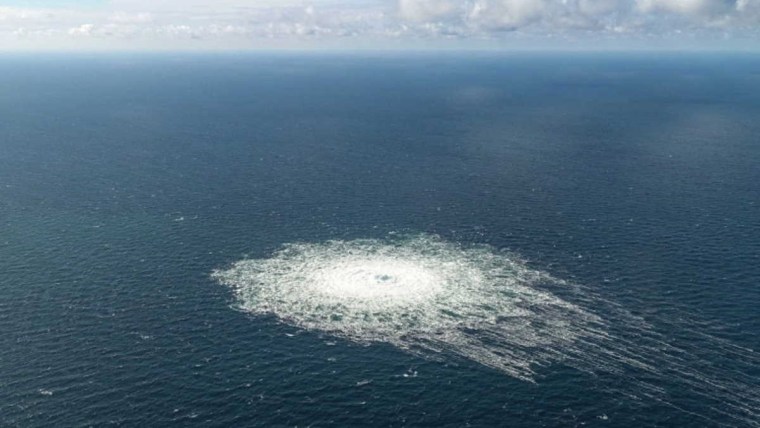
Massive leak of natural gas – mainly methane – off Sweden in the Baltic Sea, from the probably sabotaged Nord Stream pipeline. (Source: Swedish coastguard agency)

Many have favoured a major igneous event. Between 55.0 and 55.8 Ma basaltic magmatism– continuing today in Iceland – formed the North Atlantic Igneous Province. It involved large-scale intrusion of sills as well as outpourings of flood basalts and coincided with the initial rifting of Greenland from northern Europe (see: Smoking gun for end-Palaeocene warming: an igneous connection; July/August 2004). The occurrence of impact ejecta in end-Palaeocene sediments off the east coast of the US has spawned an extraterrestrial hypothesis for the warming, which could account for the negative spike in δ13C as the product of a burning terrestrial biosphere (see: Impact linked to the Palaeocene-Eocene boundary event; October 2016). Less headline-grabbing is the possibility that the event was part and parcel of the Milankovich effect: an inevitability in the complex interplay between the three astronomical components that affect Earth’s orbital and rotational behaviour: eccentricity, axial tilt and precession. A group of geoscientists from China and the US, led by Mingsong Li of Peking University, have investigated in minute detail the ups and downs of δ13C around 56 Ma in drill cores recovered from a sequence of Palaeocene and Eocene continental-shelf sediments in Maryland, USA (Li, M., Bralower, T.J. et al. 2022. Astrochronology of the Paleocene-Eocene Thermal Maximum on the Atlantic Coastal Plain. Nature Communications, v. 13, Article 5618; DOI: 10.1038/s41467-022-33390-x).

The study involved sampling sediment for carbon- and oxygen-isotope analysis at depth intervals between 3 and 10 cm over a 35 m section through the lower Eocene and uppermost Palaeocene. Calcium abundances in the core were logged at a resolution of 5 mm using an X-ray fluorescence instrument. The results link to variations in CaCO3 in the sediments across the PETM event. Another dataset involves semi-continuous measurements of magnetic susceptibility (MS) along the core. These measurements are able to indicate variations in delivery to the ocean of dissolved calcium and detrital magnetic minerals as climate and continental weathering vary through time. They are widely known to be good recorders of Milankovich cycles. After processing, the Ca and MS data sets show cyclical fluctuations relative to depth within the cores. ‘Tuning’ their frequencies to the familiar time series of Milankovich astronomical climate forcing reveals a close match to what would be expected if the climate fluctuations were paced by the 26 ka axial precession signal. My post of 17 June 2022 about the influence of precession over ‘iceberg armadas’ during the Pleistocene might be useful to re-read in this context. This correlation enabled the researchers to convert depth in the cores to time, so that the timing of fluctuations in carbon- and oxygen-isotope data that the PETM had created could be considered against various hypotheses for its cause. The ‘excursions’ of both began at the same time and reached the maxima of their changes from Palaeocene values over about 6,000 years. The authors consider that is far too long to countenance the release of methane as a result of asteroidal impact, or by massive burning of terrestrial vegetation. The other option that the beginning of the North Atlantic Igneous Province had been the trigger may also be ruled out on two grounds: the magmatism began earlier, and it continued for far longer. The onset of the PETM coincides with an extreme in precession-related climatic forcing. So Li et al. consider that a quirk in the Milankovich Effect could have played a role in triggering massive methane release. This might also explain features of the global calcium record in seafloor sediments as results of a brief period of ocean acidification during the PETM. Such an event would play havoc with carbonate-secreting organisms, such as foraminifera, by lowering the dissolved carbonate ion content on which they depend for their shells: hence their suffering considerable extinction. Of course, the other elements of astronomical forcing – eccentricity and axial tilt – would also have been operating on global climate at the time.  The long-term 100 and 405 ka eccentricity cycles may have played a role in amplifying warming, which may have resulted in increased burial of organic carbon and thus the amount of methane buried beneath the seabed.