An evolutionary bottleneck and the emergence of Neanderthals, Denisovans and modern humans

The genetic diversity of living humans, particularly among short, repetitive segments of DNA, is surprisingly low. As they are passed from generation to generation they have a high chance of mutation, which would be expected to create substantial differences between geographically separated populations. In the late 1990s and early 2000s some researchers attributed the absence of such gross differences to the human gene pool having been reduced to a small size in the past, thereby reducing earlier genetic variation as a result of increased interbreeding among survivors. They were able to assess roughly when such a population ‘bottleneck’ took place and the level to which the global population fell. Genetic analysis of living human populations seemed to suggest that around 74 ka ago the global human population fell to as little as 10 thousand individuals. A potential culprit was the catastrophic eruption of the Toba supervolcano in Sumatra around that time, which belched out 800 km3 of ash now found as far afield as the Greenland and Antarctic ice caps. Global surface temperature may have fallen by 10°C for several years to decades. Subsequent research has cast doubt on such a severe decline in numbers of living hummans; for instance archaeologists working in SE India found much the same numbers of stone tools above the Toba ash deposit as below it (see: Toba ash and calibrating the Pleistocene record: December 2012). Other, less catastrophic explanations for the low genetic diversity of modern humans have also been proposed. Nevertheless, environmental changes that placed huge stresses on our ancestors may repeatedly have led to such population bottlenecks, and indeed throughout the entire history of biological evolution.

An improved method of ‘back-tracking’ genetic relatedness among living populations, known as fast infinitesimal time coalescence or ‘FitCoal’, tracks genomes of individuals back to a last common ancestor. In simple language, it expresses relatedness along lineages to find branching points and, using an assumed mutation rate, estimates how long ago such coalescences probably occurred. The more lineages the further back in time FitCoal can reach and the greater the precision of the analysis. Moreover it can suggest the likely numbers of individuals, whose history is preserved in the genetics of modern people, who contributed to the gene pool at different branching points. Our genetics today are not restricted to our species for it is certain that traces of Neanderthal and Denisovan ancestry are present in populations outside of Africa. African genetics also host ‘ghosts’ of so-far unknown distant ancestors. So, the FitCoal approach may well be capable of teasing out events in human evolution beyond a million years ago, if sufficient data are fed into the algorithms. A team of geneticists based in China, Italy and the US has recently applied FitCoal to genomic sequences of 3154 individual alive today (Hu, W.and 8 others 2023. Genomic inference of a severe human bottleneck during the Early to Middle Pleistocene transition. Science, v. 381, p. 979-984; DOI I: 10.1126/science.abq7487). Their findings are startling and likely to launch controversy among their peers.

Their analyses suggest that between 930 and 813 ka ago human ancestors passed through a population bottleneck that involved only about 1300 breeding individuals. Moreover they remained at the very brink of extinction for a little under 120 thousand years. Interestingly, the genetic data are from people living on all continents, with no major differences between the analyses for geographically broad groups of people in Africa and Eurasia. Archaeological evidence, albeit sparse, suggests that ancient humans were widely spread across those two continental masses before the bottleneck event. The date range coincides with late stages of the Mid-Pleistocene climatic transition (1250 to 750 ka) during which glacial-interglacial cycles changed from 41 thousand-year periods to those that have an average duration of around 100 ka. The transition also brought with it roughly a doubling in the mean annual temperature range from the warmest parts of interglacials to the frigid glacial maxima: the world became a colder and drier place during the glacial parts of the cycles.

Genomes for Neanderthals and Denisovans suggest that they emerged as separate species between 500 and 700 ka ago. Their common ancestor, possibly Homo heidelbergensis, H. antecessor or other candidates (palaeoanthropologists habitually differ) may well have constituted the widespread population whose numbers shrank dramatically during the bottleneck. Perhaps several variants emerged because of it to become Denisovans, Neanderthals and, several hundred thousand years later, of anatomically modern humans. Yet it would require actual DNA from one or other candidate for the issue of last common ancestor for the three genetically known ‘late’ hominins to be resolved. But Hu et al. have shown a possible means of accelerated hominin evolution from which they may have emerged, at the very brink of extinction.
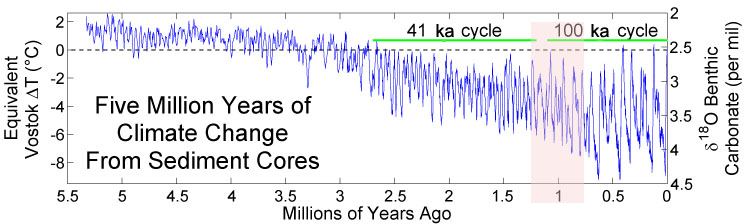
Oxygen-isotope record and global temperature changes over the last 5 million years, green lines showing the times dominated by 41 and 100 ka climatic cycles. The mid-Pleistocene climatic transition is shown in pink (Credit: Robert A Rohde)

There is a need for caution, however. H. erectus first appeared in the African fossil record about 1.8 Ma ago and subsequently spread across Eurasia to become the most ‘durable’ of all hominin species. Physiologically they seem not to have evolved much over at least a million years, nor even culturally – their biface Acheulean tools lasted as long as they did. They were present in Asia for even longer, and apparently did not dwindle during the mid-Pleistocene transition to the near catastrophic levels as did the ancestral species for living humans. The tiny global population suggested by Hu et al. for the latter also hints that their geographic distribution had to be very limited; otherwise widely separated small bands would surely have perished over the 120 ka of the bottleneck event. Yet, during the critical period from 930 to 813 ka even Britain was visited by a small band of archaic humans who left footprints in river sediments now exposed at Happisburgh in Norfolk. Hu et al. cite the scarcity of archaeological evidence from that period – perhaps unwisely – in support of their bottleneck hypothesis. There are plenty of other gaps in the comparatively tenuous fossil and archaeological records of hominins as a whole.

The discovery of genetic evidence for this population bottleneck is clearly exciting, as is the implication that it may have been the trigger for evolution of later human species and the stem event for modern humans. Hopefully Hu et al’s work will spur yet more genetic research along similar lines, but there is an even more pressing need for field research aimed at new human fossils from new archaeological sites.

See also: Ashton, N. & Stringer, C. 2023. Did our ancestors nearly die out? Science (Perspectives), v. 381, p. 947-948; DOI: 10.1126.science.adj9484.

Ikarashi, A. 2023. Human ancestors nearly went extinct 900,000 years ago. Nature, v. 621; DOI: 10.1038/d41586-023-02712-4

Di Vicenzo, F & Manzi, G. 2023. An evolutionary bottleneck and the emergence of Neanderthals, Denisovans and modern humans. Homo heidelbergensis as the Middle Pleistocene common ancestor of Denisovans, Neanderthals and modern humans. Journal of Mediterranean Earth Sciences, v, 15, p. 161-173; DOI: 10.13133/2280-6148/18074

Out of Africa: a little less blurred?

DNA from the mitochondria of humans who live on all the habitable continents shows such a small variability that all of us must have had a common maternal ancestor, and she lived in Africa about 160 ka ago. Since this was first suggested by Rebecca Cann, Mark Stoneking and Allan Wilson of the University of California, Berkeley in 1987 there has been a stream of data and publications – subsequently using Y-chromosome DNA and even whole genomes – that both confirm an African origin for Homo sapiens and illuminate it. Analyses of the small differences in global human genetics also chart the routes and – using a ‘molecular clock’ technique – the timings of geographic and population branchings during migration out of Africa. As more and better quality data emerges so the patterns change and become more intricate: an illustration of the view that ‘the past is always a work in progress’. The journal Nature published four papers online in the week ending 25 September 2016 that demonstrate the ‘state of the art’.

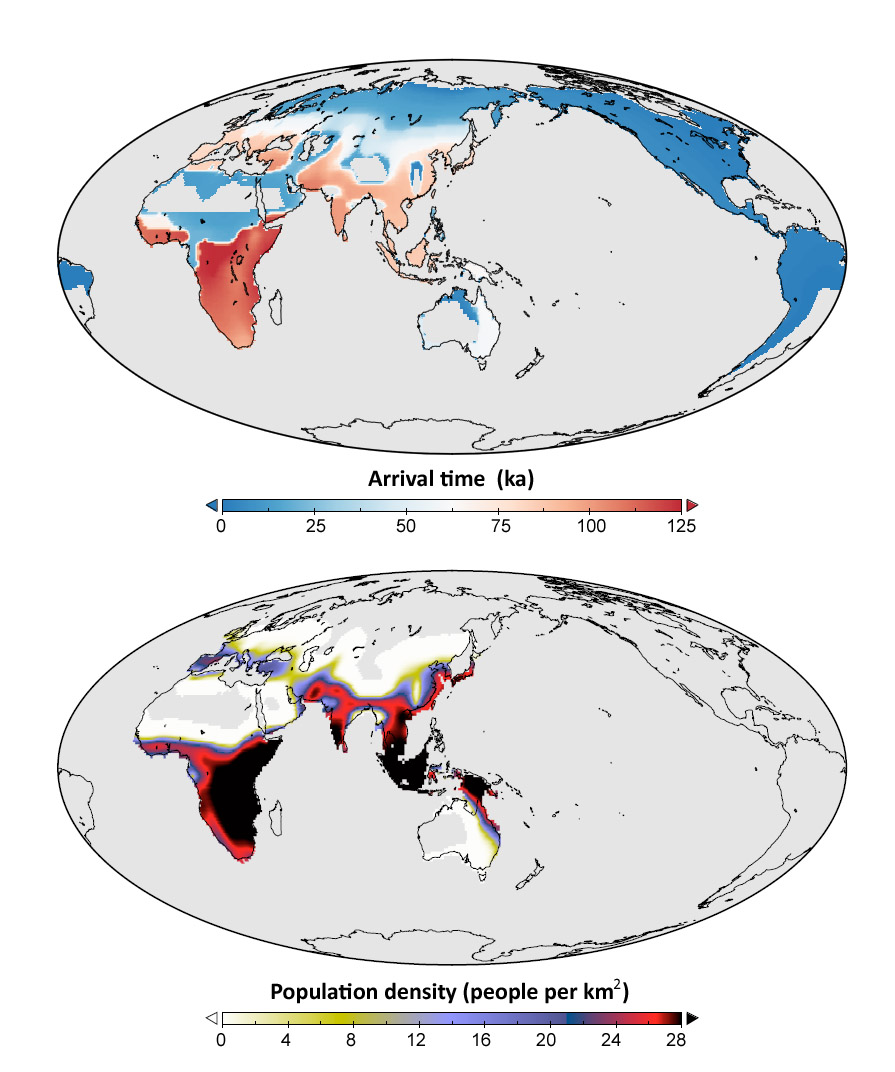
Three of these papers add almost 800 new, high-quality genomes to the 1000 Genomes Project that saw completion in 2015. The new data cover 270 populations from around the world including those of regions that have previously been understudied for a variety of reasons: Africa, Australia and Papua-New Guinea. All three genomic contributions are critically summarized by a Nature News and Views article (Tucci, S & Akey, J.L. 2016. A map of human wanderlust. http://dx.doi.org/10.1038/nature19472). The fourth paper pieces together accurately dated fossil and archaeological findings with data on climate and sea-level changes derived mainly from isotopic analyses of marine sediments and samples from polar ice sheets (Timmermann, A & Friedrich, T. 2016. Late Pleistocene climate drivers of early human migration. Nature, doi:10.1038/nature19365). Axel Timmermann and Tobias Friedrich of the University of Hawaii have attempted to simulate the overall dispersal of humans during the last 125 ka according to how they adapted to environmental conditions; mainly the changing vegetation cover as aridity varied geographically, together with the opening of potential routes out of Africa via the Straits of Bab el Mandab and through what is now termed the Middle East or Levant. They present their results as a remarkable series of global maps that suggest both the geographic spread of human migrants and how population density may have changed geographically through the last glacial cycle. Added to this are maps of the times of arrival of human populations across the world, according to a variety of migration scenarios. Note: the figure below estimates when AMH may have arrived in different areas and the population densities that environmental conditions at different times could have supported had they done so. Europe is shown as being possibly settled at around 70-75 ka, and perhaps having moderately high densities for AMH populations. Yet no physical evidence of European AMH is known before about 40 ka. Anatomically modern humans could have been in Europe before that time but failed to diffuse towards it, or were either repelled by or assimilated completely into its earlier Neanderthal population: perhaps the most controversial aspect of the paper.

timmermann
Estimated arrival time since the last continuous settlement of anatomically modern human migrants from Africa (top); estimated population densities around 60 thousand years ago. (Credit: Axel Timmermann University of Hawaii)

The role of climate change and even major volcanic activity – the 74 ka explosion of Toba in Indonesia – in both allowing or forcing an exodus from African homelands and channelling the human ‘line of march’ across Eurasia has been speculated on repeatedly. Now Timmermann and Friedrich have added a sophisticated case for episodic waves of migration across Arabia and the Levant at 106-94, 89-73, 59-47 and 45-29 ka. These implicate the role of Milankovich’s 21 ka cycle of Earth’s axial precession in opening windows of opportunity for both the exodus and movement through Eurasia; effectively like opening and closing valves for the flow of human movement. The paper is critically summarised by a Nature News and Views article (de Menocal, P.B. & Stringer, C. 2016. Climate and peopling of the world. Nature, doi:10.1038/nature19471.

This multiple-dispersal model for the spread of anatomically modern humans (AMH) finds some support from one of the genome papers (Pangani, L. and 98 others 2016. Genomic analyses inform on migration events during the peopling of Eurasia. Nature (online). http://dx.doi.org/10.1038/nature19792). A genetic signature in present-day Papuans suggests that at least 2% of their genome originates from an early and largely extinct expansion of AMH from Africa about 120 ka ago, compared with a split of all mainland Eurasians from African at around 75 ka. It appears from Pangani and co-workers’ analyses that later dispersals out of Africa contributed only a small amount of ancestry to Papuan individuals. The other two genome analyses (Mallick, S. and 79 others 2016. The Simons Genome Diversity Project: 300 genomes from 142 diverse populations. Nature (online) http://dx.doi.org/10.1038/nature18964; Malaspinas, A.-S. and 74 others 2016. A genomic history of Aboriginal Australia. Nature (online). http://dx.doi.org/10.1038/nature18299) suggest a slightly different scenario, that all present-day non-Africans branched from a single ancestral population. In the case of Malaspinas et al. an immediate separation of two waves of AMH migrants led to settlement of Australasia in one case and to the rest of Mainland Eurasia. Yet their data suggest that Australasians diverged into Papuan and Australian population between 25-40 ka ago. Now that is a surprise, because during the lead-up to the last glacial maximum at around 20 ka, sea level dropped to levels that unified the exposed surfaces of Papua and Australia, making it possible to walk from one to the other. These authors appeal to a vast hypersaline lake in the emergent plains, which may have deterred crossing the land bridge. Mallick et al. see an early separation between migrants from Africa who separately populated the west and east of Eurasia, with possible separation of Papuans and Australians from the second group.  These authors also show that the rate at which Eurasians accumulated mutations was about 5% faster than happened among Africans. Interestingly, Mallick et al. addressed the vexed issue of the origin of the spurt in cultural, particularly artistic, creativity after 50 ka that characterizes Eurasian archaeology. Although their results do not rule out genetic changes outside Africa linked to cultural change, they commented as follows:

‘… however, genetics is not a creative force, and instead responds to selection pressures imposed by novel environmental conditions or lifestyles. Thus, our results provide evidence against a model in which one or a few mutations were responsible for the rapid developments in human behaviour in the last 50,000 years. Instead, changes in lifestyles due to cultural innovation or exposure to new environments are likely to have been driving forces behind the rapid transformations in human behaviour …’.

Variations in interpretation among the four papers undoubtedly stem from the very different analytical approaches to climate and genomic data sets, and variations within the individual sets of DNA samples. So it will probably be some time before theoretical studies of the drivers of migration and work on global human genomics and cultural development find themselves unified. And we await with interest the pooling of results from all the different genetics labs and agreement on a common data-mining approach.

Surprising modern-human migrations into China and Africa

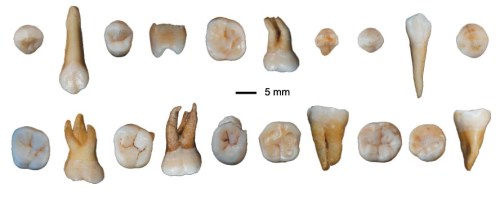
Caves figure highly in discoveries of hominin remains, fossil riches from those near Johannesburg in South Africa and at Atapuerca in northern Spain having set the world of palaeoanthropology reeling in the last few months. As often as not the caves chosen by hominins for day-to-day living, refuge or ritual, places where carnivores dragged some of our early relatives, or into which they fell accidentally, formed in limestones. There are few places so well endowed with karst features than southern China, a fair number of caves in them having rich deposits of bat guano to which farmers have beaten well-trodden paths to dig it out for fertiliser. One such is Fuyan Cave in Daoxian County, Hunan. Manure mining there had done a great deal of the heavy work faced by archaeologists, having stopped when it reached a hard layer of calcite speleothem or flowstone that underpaves more or less the entire cave floor. Initial trial investigations found three clearly human teeth at the surface, encouraging further work. Digging through the flowstone revealed sediments rich in fossils, mainly teeth which preserve better than other remains in humid conditions. As well as teeth from a variety of mammals, large and small, 47 human teeth emerged. Close study revealed dental features that are irrefutably those of anatomically modern humans (Liu, W. and 13 others 2015. The earliest unequivocally modern humans in southern China. Nature, doi:10.1038/nature15696). Remarkably, many of the teeth are in far better condition than my own, and those of many living people with access to dental expertise.

Some of the Daoxian human teeth. (Credit: Song Xing and Xiu-jie Wu of the 1Key Laboratory of Vertebrate Evolution and Human Origins at the Chinese Academy of Sciences
Some of the Daoxian human teeth. (Credit: Song Xing and Xiu-jie Wu of the 1Key Laboratory of Vertebrate Evolution and Human Origins at the Chinese Academy of Sciences)

The true significance of the excavation emerged only when 230Th dating revealed the age of the flowstone cap to the old cave sediments. A small stalagmite protruding from its surface yielded a minimum age of ~80 ka: by far the oldest date for anatomically modern human remains outside of Africa and the eastern Mediterranean. The dating produced older ages around 120 ka with equally good precision. Before this discovery the date of migration of Africans to populate Eurasia was thought to be about 60 ka from imprecise dating based on genetics of a range of living Eurasians and Africans – a ‘molecular clock’ – and the earliest sign of humans found in Australia. Consequently, finds in South India of artefacts beneath 74 ka ash from the super-eruption of the Mount Toba caldera have been regarded by many, other than the finders, as having been made by Homo erectus. Dates of 100 ka for modern human occupation of the Levant were thought to represent a failed attempt at migration out of Africa by a northern route. Both these important findings now take on renewed significance. Yet a 30 to 40 ka time gap between the Fuyan people and the previous dates for the earliest signs of migration into China, Borneo and Australia (40-50 ka) begs the question, ‘Did this early group of far-travelled migrants survive to become ancestors of modern Chinese people?’ There are many possible scenarios that only future discoveries might validate: simply goiung extinct; failure to survive the encounter with earlier migrants, such as H. erectus or the Denisovans; assimilation into those older populations.

Mitochondrial DNA-based chart of large human m...
Mitochondrial DNA-based chart of large human migrations: the consensus before these new data. Numbers are millennia before present. ( credit: Wikipedia)

As if to counter this, a multinational group of collaborators have sequenced and analysed the genome from a 4500 year-old male skeleton discovered in the Mota Cave of the Gamo highlands of southern Ethiopia (Llorente, M.G. and 18 others 2015. Ancient Ethiopian genome reveals extensive Eurasian admixture throughout the African continent. Science, DOI: 10.1126/science.aad2879). Comparison with what is now a virtual library of living human genomes showed that this man’s genetic make-up most closely matched that of the Ari, a tribe living in the area today. What was most interesting is that part of the modern Ari genome – between 4 to 7% – is not present in the 4500 year-old sequence. Instead, it matches those of modern Sardinians and a prehistoric German farmer. Yet it occurs in people living not only in Ethiopia, but also in central, western and southern Africa to varying degrees. There seems to have been a ‘backflow’ of people into the whole of Africa from Eurasia, estimated to have occurred some 3500-4000 years ago and probably involving a large influx. By that time farming was already established in Africa, so the migrants may have had some advantage, either culturally or physically, to encourage their wide spread through the continent.

In tropical climates, DNA is likely to break down quickly and little if any fossil DNA has been recovered from prehistoric Africans. In this case, burial in a cave at high elevation may have helped preserve it, but also the target for extraction was the petrous bone from the inner ear whose density seems to allow DNA a better change of long-term survival. With continually improving DNA analysis and sequencing techniques more news is surely going to emerge from past African populations.

More on human migrations

Related articles

Gibbons, A. 2015. Prehistoric Eurasians streamed into Africa, genome shows. Science, v. 350 (9 October 2015), p. 149.