Early hominin dispersal in Eurasia

Evidence from Dmanisi in Georgia that Homo erectus may have been the first advanced hominin to leave Africa about 1.8 Ma ago was a big surprise (see: First out of Africa? November 2003). Remains of five individuals included one skull of an aged person who face was so deformed that he or she must have been cared for by others for many years. So, a second surprise from Dmanisi was that human empathy arose far earlier than most people believed. Since 2002 there has been only a single further find of hominin bones of such antiquity, at Longgudong in central China. For the period between 1.0 and 2.0 Ma eight other sites in Eurasia have yielded hominin remains. If finds of stone tools and evidence of deliberate butchery – cut marks on prey animals’ bones – are accepted as tell-tale signs, the Eurasian hominin record is considerably larger, and longer,. There are 11 Eurasian sites that have yielded such evidence – but no hominin remains – that are older than Longgudong: in Russia, China, the Middle East, North Africa and northern India. The oldest, at Masol in northern India is 2.6 Ma old. In January 2025 the earliest European evidence for hominin activity was reported from Grăunceanu in Romania (Curran, S.C. and 15 others 2025. Hominin presence in Eurasia by at least 1.95 million years ago. Nature Communications, v. 16, article 836; DOI: 10.1038/s41467-025-56154-9) in the form of animal bones showing clear signs of butchery, as well as stone tools, but no hominin fossils.
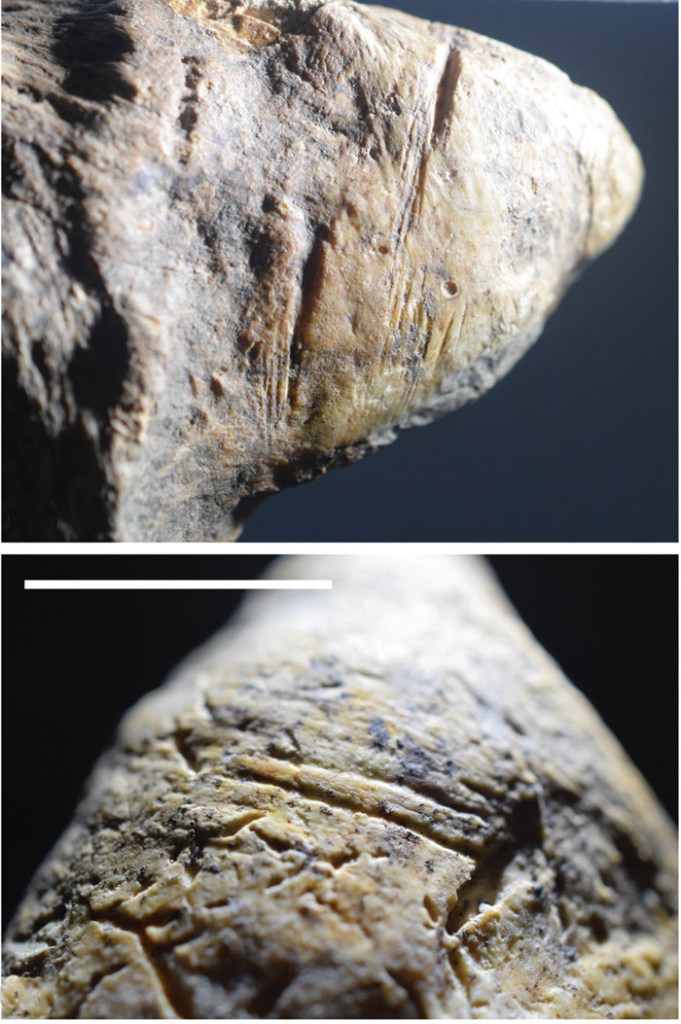
Animal bones showing cut marks from the 1.95 Ma old Grăunceanu site in Romania. (Credit: Curran et al. 2025, Figs 2A and C)

There were stone-tool makers who butchered prey in Africa as early as 3.4 Ma ago (see: Stone tools go even further back; May 2015), but without direct evidence of which hominin was involved. Several possible candidates have been suggested: Australopithecus; Kenyanthropus; Paranthropus. The earliest known African remains of H. erectus have been dated at around 2.0 Ma. So, all that can be said with some certainty about the pre-2 Ma migrants to Eurasia, until fossils of that antiquity are found, is that they were hominins of some kind: maybe advanced australopithecines, paranthropoids or early humans. Those from Longgudong and Dmanisi probably are early Homo erectus, and 2 others (1.7 and 1.6 Ma) from China have been designated similarly. Younger, pre-1.0 Ma Eurasian hominins from Israel, Indonesia, Spain and Turkey are currently un-named at the species level, but are allegedly members of the genus Homo.

So, what can be teased from the early Eurasian hominin finds? Some certainly travelled thousands of kilometres from their assumed origins in Africa, but none penetrated further north than about 50°N. Perhaps they could not cope with winters at higher latitudes, especially during ice ages. To reach as far as eastern and western Eurasia suggests that dispersal following exit from Africa would have taken many generations. There is no reason to suppose continual travel; rather the reverse, staying put in areas with abundant resources while they remained available, and then moving on when they became scarce. Climate cycles, first paced at around 40 ka (early Pleistocene) then at around 100 ka (mid Pleistocene and later), would have been the main drivers for hominin population movements, as it would have been for game and vegetation.

After about 3 Ma the 40 ka climate cyclicity evolved to greater differences in global temperature between glacial and interglacial episodes, and even more so after the mid Pleistocene transition to 100 ka cycles (see Wikipedia entry for the mid-Pleistocene Transition). Thus, it seems likely that chances of survival of dispersed bands of hominins decreased over hundreds of millennia. Could populations have survived in particularly favourable areas; i.e. those at low latitudes? If so did both culture and the hominins themselves evolve? Alternatively, was migration in a series of pulses out of Africa and then dispersal in all directions, most ending in regional extinction? Almost certainly, pressures to leave Africa would have been driven by climate, for instance by increased aridity as global temperatures waned and sea-level falls made travel to Eurasia easier. There may also have been secondary, shorter migrations within Eurasia, again driven by environmental changes. Without more data from newly discovered sites we can go little further. Within the 35 known, pre-1 Ma hominin sites there are two clusters: southern and central China, and the Levant, Turkey and Georgia. Could they yield more developments? A 2016 article in Scientific American about Chinese H. erectus finds makes particularly interesting reading in this regard.

Neanderthals and the elusive Denisovans began to establish permanent Eurasian ranges, after roughly 600 ka ago. Both groups survived until after first contact with waves of anatomically modern humans in the last 100 ka, with whom some interbred before vanishing from the record. However, evidence from the DNA of both groups suggests an interesting possibility. Before the two groups split genetically, their common ancestors (H. heidelbergensis or H. antecessor?) apparently interbred with genetically more ancient Eurasian hominins (see Wikipedia entry for Neanderthal evolution). This intriguing hint suggests that more may be discovered when substantial remains of Denisovans – i.e. more than a few teeth and small bones – are discovered and yield more DNA. My guess is such a future development will stem from analysis of early hominin remains in China, currently regarded as H. erectus. See China discovers landmark human evolution fossils. Xinhua News Agency 9 December 2024)

A fully revised edition of Steve Drury’s book Stepping Stones: The Making of Our Home World can now be downloaded as a free eBook

Why did the largest ever primate disappear?

Chinese apothecary shops sell an assortment of fossils. They include shells of brachiopods that when ground up and dissolved in water allegedly treat rheumatism, skin diseases, and eye disorders. Traditional apothecaries also supply  ‘dragons’ teeth’, said by Dr Subhuti Dharmananda, Director of the Institute for Traditional Medicine in Portland, Oregon to treat epilepsy, madness, manic running about, binding qi (‘vital spirit’) below the heart, inability to catch one’s breath, and various kinds of spasms, as well as making the body light, enabling one to communicate with the spirit light, and lengthening one’s life. Presumably have done a roaring trade in ‘dragons’ teeth’ since they were first mentioned in a Chinese pharmacopoeia (the Shennong Bencao Jing) from the First Century of the Common Era. In 1935 the anthropologist Gustav von Koenigswald came across two ‘dragons’ teeth’ in a Hong Kong shop. They were unusually large molars and he realised they were from a primate, but far bigger (20  × 22 mm) than any from living or fossil monkeys, apes or humans.

Eventually, in 1952 (he had been interned by Japanese forces occupying Java), von Koenigswald formally described the teeth and others that he had found. Their affinities and size prompted him to call the former bearer the ‘Huge Ape’ (Gigantopithecus). By 1956 Chinese palaeontologists had tracked down the cave site in Guangxi province where the teeth had been sourced, and a local farmer soon unearthed a complete lower jawbone (mandible) that was indeed gigantic. More teeth and mandibles have since been found at several sites in Southern and Southeast Asia, with an age range from about 2.0 to 0.3 Ma. Anatomical differences between teeth and mandibles suggest that there may have been 4 different species. Using mandibles as a very rough guide to overall size it has been estimated that Gigantopithecus may have been up to 3 m tall weighing almost 600kg.

Above: Size comparison of G. blacki with a 1.8 m tall human male; NB G.blacki probably walked on all fours, as do living orangutans when they rarely descend from the forest canopy. (Credit: Frido Welker) Below: Mandible of Gigantopithecus blacki from India (Credit: Prof. Wei Wang, Photo retouched by Theis Jensen)

Plaque on some teeth contain evidence for fruit, tubers and roots, but not grasses, which suggest suggest that Gigantopithecus had a vegetarian diet based on forest plants. Mandibles also showed affinities with living and fossil orangutans (pongines). Analysis of proteins preserved in tooth enamel confirm this relationship (Welker, F. and 17 others 2019. Enamel proteome shows that Gigantopithecus was an early diverging pongine. Nature, v.576, p. 262–265; DOI: 10.1038/s41586-019-1728-8). It was one of the few members of the southeast Asian megafauna to go extinct at the genus level during the Pleistocene. Its close relative Pongo the orangutan survives as three species in Borneo and Sumatra. Detailed analysis of material from 22 southern Chinese caves that have yielded Gigantopithecus teeth has helped resolve that enigma (Zhang, Y. and 20 others 2024. The demise of the giant ape Gigantopithecus blacki. Nature, v. 625; DOI: 10.1038/s41586-023-06900-0).

At the time Gigantopithecus first appeared in the geological record of China (~2.2 Ma), it ranged over much of south-western China. The early Pleistocene ecosystem there was one of diverse forests sufficiently productive to support large numbers of this enormous primate and also the much smaller orangutan Pongo weidenreichi.  By 295 to 215 ka, the age of the last known Gigantopithecus fossils, its range had shrunk dramatically. The teeth show marked increases in size and complexity by this time, which suggests adaptation of diet to a changing ecosystem. That is confirmed by pollen analysis of cave sediments which reveal a dramatic decrease in forest cover and increases in fern and non-arboreal flora at the time of extinction. One physical sign of environmental stress suffered by individual late G. blacki is banding in their teeth defined by large fluctuations of barium and strontium concentrations relative to calcium. The bands suggest that each individual had to change its diet repeatedly over its lifetime. Closely related orangutans, on the other hand survived into the later Pleistocene of China, having adapted to the changed ecosystem, as did early humans in the area. It thus seems likely that Gigantopithecus was an extreme specialist as regards diet, and was unable to adapt to changes brought on by the climate becoming more seasonal. Today’s orangutans in Indonesia face a similar plight, but that is because they have become restricted to forest ‘islands’ in the midst of vast areas of oil palm plantations. Their original range seems to have been much the same as that of Gigantopithecus, i.e. across south-eastern Asia, but Pongo seems to have gone extinct outside of Indonesia (by 57 ka in China) during the last global cooling and when forest cover became drastically restricted.

Environmental change and early-human innovation

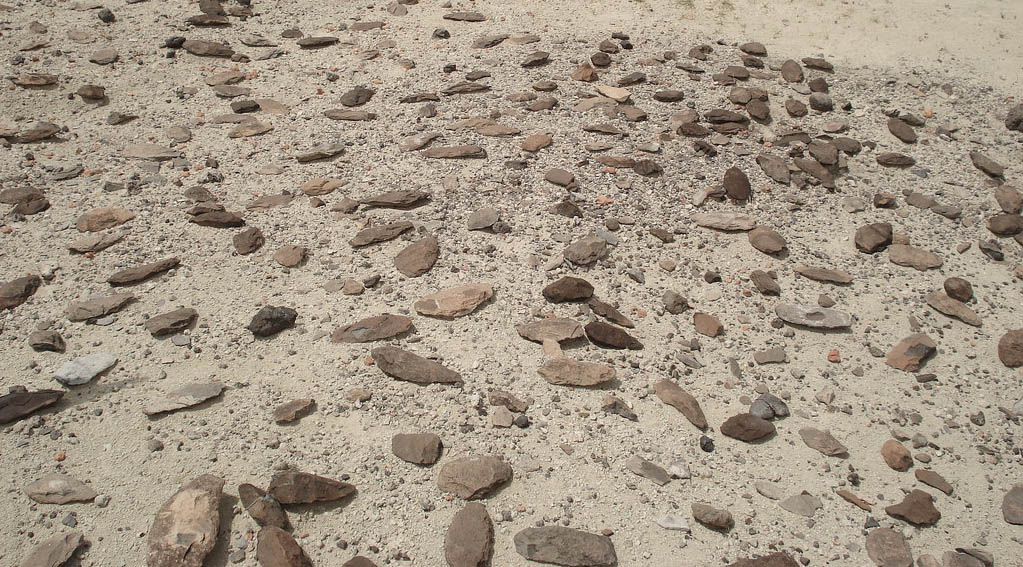
Acheulean biface tools strewn on a bedding surface in the Olorgesailie Basin, Kenya (credit: mmercedes_78 Flickr)

The Olorgesailie Basin in Southern Kenya is possibly the world’s richest source for evidence of ancient stone-tool manufacture. For early humans, it certainly was rich in the necessary resources from which to craft tools. Lying in East Africa’s active rift system, its stratigraphy contains abundant beds of hydrothermal silica (chert), deposited by hot springs, and flows of fine grained lavas. Its sediments spanning the last 1.2 million years show that the Basin hosted lakes and extensive river systems for the earlier part of this period: it was rich in food resources too. The tools, together with bones from dismembered prey, bear witness to long-term human occupation, but hominin remains themselves have yet to be discovered. The time span suggests early occupation by Homo erectus, who probably manufactured Acheulean biface stone tools in large quantities that litter the surface at some archaeological sites.

There is a break in the stratigraphic sequence from about 500 to 320 thousand years ago caused by erosion during a period of tectonic uplift. Younger sediments reveal a striking change in archaeology. The earlier large cutting tools give way to a more diverse ‘toolkit’ of smaller tools produced by more sophisticated techniques than those used to make the Acheulean ‘hand axes’. In African archaeological parlance, the <320 ka-old tools mark the onset of the Middle Stone Age (NB not equivalent to the much younger Mesolithic of Europe). The sedimentary gap also marks what seems to have been very different human behaviour. The stone resources used in the 1.2 to 0.5 Ma sequence were local: no more than 5 km from the tool-yielding sites. After the gap a much more varied range of lithologies was used, from as far afield as 95 km. Not only that, but rock unsuitable for tools appears: soft pigments such as hematite.

The foregoing was known from three major papers that appeared in March 2018 (see: Human evolution and revolution in Africa, March 2018 – specifically the section Hominin cultural revolution 320,000 years ago). Now, many members of the teams who produced that published evidence report detailed analysis of samples from a deep drill core through the stratigraphy in a similar, nearby basin (Potts, R. and 21 others 2020. Increased ecological resource variability during a critical transition in hominin evolutionScience Advances, v. 6, article eabc8975; DOI:10.1126/sciadv.abc8975). As well as calibrating the timing of stratigraphic changes using 40Ar/39Ar dating from 22 volcanic layers, the team analysed sedimentary structures, body- and trace fossils, variations in sediment geochemistry, palaeobotany and carbon isotopes, to suggest variations in environmental conditions and ecology throughout the section in greater detail than previously achieved anywhere in Africa.

They conclude that as well as a change in topography resulting from the 500-320 ka period of tectonic uplift and erosion, the climate of this part of East Africa became more unstable. Combined, these two factors transformed the ecosystems of the Olorgesailie Basin. Between 1.2 to 0.5 Ma the Acheulean tool makers inhabited dominantly grassy plains with substantial, permanent lakes – a stable period of 700 thousand years, well suited to large herbivores and thus to these early humans. Tectonic and climatic change disrupted a ‘land of plenty’; the herbivores left to be replaced by smaller prey animals; vegetation shifted back and forth from grassland to woodland with the unstable climate; lakes became smaller and ephemeral. The problem in linking environmental change to changed human practices in this case, however, is the 180 thousand-year gap in the geological record. Lead author Richard Potts, director of the Human Origins Program at the Smithsonian’s National Museum of Natural History, and his team suggest that the change contributed to the ecological flexibility of the probable Homo sapiens who left the fancier, more diverse tools during the later phase. Yet 1.6 million years beforehand early H. erectus had sufficient flexibility to cross 30 to 40 degrees of latitude and end up on the shores of the Black Sea in Georgia! The likely late-stage H. erectus of Olorgesailie may have moved out around 500 ka ago and sometime later early H. sapiens moved in with new technology developed elsewhere. We know that the earliest known anatomically modern humans lived in Morocco at around 315 ka (see: Origin of anatomically modern humans, June 2017): but we don’t know what tools they had or where they went next. There are all sorts of possibilities that cannot be addressed by even the most intricate analysis of secondary evidence. The important issue seems, I think, to centre on the transition from erects to sapiens, in anatomical, cognitive and behavioural contexts, via some intermediary such as H. antecessor, to which this study can contribute very little. That needs complete stratigraphic records: ironically, the other basin from which the core was drilled is apparently more complete, especially for the 500 to 320 ka ‘gap’. That seems likely to offer more potential. Yet, such big questions also demand a much broader brush: perhaps on a continental scale. It’s to early to tell …

See also: Turbulent era sparked leap in human behavior, adaptability 320,000 years ago (Science Daily,21 October 2020)

Early human migrations in southern Africa

Comparing the DNA profiles of living people who are indigenous to different parts of the world has achieved a lot as regards tracing the migrations of their ancestors and amalgamations between and separations from different genetic groups along the way. Most such analyses have centred on alleles in DNA from mitochondria (maternal) and Y chromosomes (paternal), and depend on the assumption that rates of mutation (specifically those that have neither negative nor positive outcomes) in both remain constant over tens of thousand years and genetic intermixing through reproduction. Both provide plausible hypotheses of where migrations began, the approximate route that they took and the timing of both departures from and arrival at different locations en route. Most studies have focused on the ‘Out of Africa’ migration, which began, according to the latest data, around 80 ka ago. Arrival times at various locations differ considerably, from around 60 ka for the indigenous populations of Australia and New Guinea, roughly 40 ka for Europe and ~12 ka for the Americas. Yet an often overlooked factor is that not all migrating groups have descendants that are alive today. For instance, remains of anatomically modern humans (AMH)have been found in sediments in the Levant as old as 177 ka (see: Earliest departure of modern humans from Africa, January 2018), and between 170 to 210 ka in southern Greece (See: Out of Africa: The earliest modern human to leave). Neither have yielded ancient DNA, yet nor are their arrival times compatible with the ‘route mapping’ provided by genetic studies of living people. Such groups became extinct and left no traceable descendants, and there were probably many more awaiting discovery. Maybe these mysteries will be penetrated by DNA from the ancient bones, should that prove possible.

The recorded history of AMH within Africa began around 286 to 315 ka in Morocco (see: Origin of anatomically modern humans, June 2017) and their evolutionary development may have spanned much of the continent, judging by previously discovered fossils in Ethiopia and South Africa that are older than 200 ka. Again, ancient DNA has not been extracted from the oldest fossils; nor is that likely to be possible because the double helix breaks down quickly in hot and humid climates. Genetic data from living Africans are growing quickly. An additional 198 African mtDNA genomes reported recently have pushed up the total available for analysis, the bulk of them being from eastern and southern Africa (Chan, E.K.F. and 11 others 2019. Human origins in a southern African palaeo-wetland and first migrations. Nature, v. 575, p. 185-189; DOI: 10.1038/s41586-019-1714-1). The study focuses on data from the KhoeSan ethnic group, restricted to areas south of the Zambezi River, who speak a language with distinctive  click consonants. Some KhoeSan still practice a hunter-gatherer lifestyle. Previous genetic studies showed the KhoeSan to differ markedly from other inhabitants of southern Africa, and they are widely regarded as having inhabited the area for far longer than any other groups. A sign of this emerges from their mtDNA in a genetic lineage signified as L0. Comparing KhoeSan mtDNA with the wider genetic database allowed the researchers to plot a ‘family tree’. Measures of the degree of difference between samples push back the origin of L0 and the KhoeSan themselves to roughly 200 ka.

okavango
The Okavango Delta today during the wet season (Credit: Wikimedia Commons)

It turns out that the LO lineage has several variants, whose geographic distributions allow the approximate place of origin for the lineage and directions of later migration from it to be mapped. It seems that LO was originally indigenous to the modern Okavango Delta and Makgadikgadi salt flats of Botswana. People carrying the original (L0k) variant are estimated to have remained in the broad area for about 70 thousand years. During that time it was all lush, low-lying wetland around a huge, now vanished lake. The hydrology of the area was dramatically split by regional tectonic activity at around 60 ka. The lake simply evaporated to form the salt pan of the Makgadikgadi, leaving only the seasonal Okavango Delta as a destination for flood water. People carrying Lok stayed in the original homeland whereas other shifted. Migration routes to the northeast and towards the southwest and south are crudely mapped by the distribution of the other L0 variants among modern populations. They followed ‘green corridors’ between 130 and 110 ka, the collapse of the ecosystem leaving a small group of the founding population isolated from its descendants.

The paper claims that the former Botswana wetlands were the cradle of the first modern humans. Perhaps in southern Africa, but other, older AMH remains found far off and perhaps undiscovered elsewhere are more likely. But that can only be reconciled with the KhoeSan study by ancient DNA from fossils. Criticism of the sweeping claims in the paper has already been voiced, on these grounds and the study’s lack of data on paternal DNA or whole genomes from the sampled population.

See also: Gibbons, A. 2019. Experts question study claiming to pinpoint birthplace of all humans. Science (online); DOI: 10.1126/science.aba0155