Evolution of pigmentation in anatomically modern humans of Europe: a new paradigm?

The colours of human skin, eyes and hair in living people across the world are determined by variants of genes (alleles) found at the same place on a chromosome. Since chromosomes are inherited from both mother and father, an individual may have the same two alleles (homozygous), or one of each (heterozygous). A dominant allele is always expressed, even if a single copy is present. A recessive allele is only expressed if the individual inherits two copies of it. Most characteristics of individuals result from the interaction of multiple genes, rather than a single gene. A commonly cited example is the coloration of eyes. If we had a single gene for eye colour – that of the iris – that had alleles just for blue (recessive or ‘b’) and one for brown (dominant or ‘B) pigmentation, brown-eyed individuals would have one or two ‘B’ alleles (bB or BB), whereas those with blue eyes would have to have two ‘blue’ alleles (bb). But inheritance is more complicated than that: there are people with green, hazel or grey eyes and even left- and right eyes of different colour. Such examples suggest that there are more than two genes affecting human eye colour, and each must have evolved as a result of mutations. Much the same goes for hair and skin coloration.

A group of scientists from the University of Ferrara in Italy have analysed highly detailed ancient DNA in anatomically modern human remains from Russia (Palaeolithic), Sweden (Mesolithic) and Croatia (Neolithic) to tease out the complexities of pigmentation inheritance. Then they applied a statistical approach learned from that study to predict the likely skin-, eye- and hair pigmentation in 348 less detailed genomes of ancient individuals whose remains date back to 45 Ma ( Silvia Perretti et al, 2025. Inference of human pigmentation from ancient DNA by genotype likelihood. Proceedings of the National Academy of Science, v. 122, article e2502158122; DOI: 10.1073/pnas.2502158122).

An artist’s impression of a Mesolithic woman from southern Denmark (credit: Tom Bjorklund)

All the hunter-gatherer Palaeolithic individuals (12 samples between 45 and 13 ka old) bar one, showed clear signs of dark pigmentation in skin, eyes and hair – the outlier from Russia was probably lighter. Those from the Mesolithic (14 to 4 ka) showed that 11 out of 35 had a light eye colour (Northern Europe, France, and Serbia), but most retained the dark skin and hair expected in descendants of migrants from Africa. Only one 12 ka hunter-gatherer from Sweden had inferred blue eyes, blonde hair, and light skin.  The retention of dark pigmentation by European hunter-gatherers who migrated there from Africa has been noted before, using DNA from Mesolithic human remains and in one case from birch resin chewed by a Mesolithic woman. This called into question the hypothesis that high levels of melatonin in skin, which protects indigenous people in Africa from cancers, would result in their producing insufficient vitamin D for good health. That notion supposed that out-of-Africa migrants would quickly evolve paler skin coloration at higher latitudes. It is now known that diets rich in meat, nuts and fungi – staple for hunter-gatherers – provide sufficient vitamin-D for health at high latitudes. A more recent hypothesis is that pale skins may have evolved only after the widespread Neolithic adoption of farming when people came to rely on a diet dominated by cereals that are a poor source of vitamin-D.

However, 132 Neolithic farmers (10 to 4 ka ago) individuals studied by Perretti et al. showed increased diversity in pigmentation, with more frequent light skin tones, yet dark individuals persisted, particularly in southern and eastern Europe. Hair and eye colour showed considerable variability, the earliest sign of red hair showing up in Turkey. Even Copper- and Bronze Age samples ( 113 from 7 to 3 ka) and those from Iron Age Europeans (25 from 3 to 1.7 ka ago) still indicate common retention of dark skin, eyes and hair, although the proportion of lighter pigmentation increased in some regions of Europe. Other analyses of ancient DNA have shown that the Palaeo- and Mesolithic populations of Europe were quickly outnumbered by influx of early farmers, probably from the Anatolian region of modern Turkey, during the Neolithic. The farming lifestyle seems likely to have allowed the numbers of those who practised it to rise beyond the natural environment’s ‘carrying capacity’ for hunter-gatherers. The former inhabitants of Europe may simply have been genetically absorbed within the growing population of farmers. Much the same absorption of earlier groups seems to have happened with the westward migration from the Ukrainian and Russia steppes of the Yamnaya people and culture, culminating in the start of the European Bronze Age that reached western Europe around 2.1 ka, The Yamnaya introduced metal culture, horse-drawn wheeled vehicles and possibly Indo-European language.

So the novel probabilistic approach to ancient DNA by Perretti et al. also casts doubt on the diet-based evolution of light pigmentation at high latitudes. Instead, pulses of large population movements and thus changes in European population genetics probably account for the persistence of abundant evidence for dark pigmentation throughout Europe until historic times. The ‘lightening’ of Europeans’ physiognomy seems to have been vastly more complex than previously believed. Early Europe seems to have been almost bewilderingly diverse, which make a complete mockery of modern chauvinism and racism. The present European genetic ‘melting pot’ is surprisingly similar to that of Europe’s ancient past.

Geology cracks Stonehenge mysteries

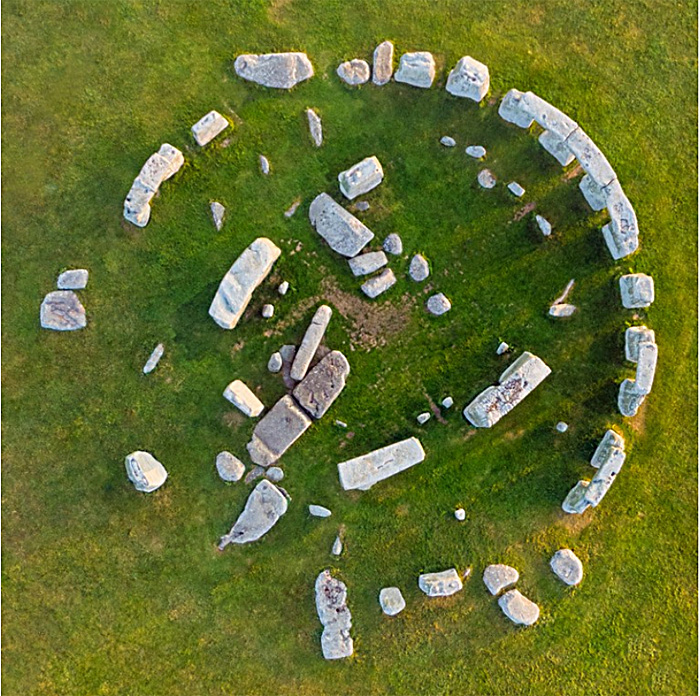
High resolution vertical aerial photograph of Stonehenge. (Credit: Gavin Hellier/robertharding/Getty)

During the later parts of the Neolithic the archipelago now known as the British Isles and Ireland was a landscape on which large stone buildings with ritual and astronomical uses were richly scattered. The early British agricultural societies also built innumerable monuments beneath which people of the time were buried, presumably so that they remained in popular memory as revered ancestors. Best known among these constructions is the circular Stonehenge complex of dressed megaliths set in the riot of earlier, contemporary and later human-crafted features of the Chalk downs known as Salisbury Plain. Stonehenge itself is now known to have been first constructed some five thousand years ago (~3000 BCE) as an enclosure surrounded by a circular ditch and bank, together with what seems to have been a circular wooden palisade. This was repeatedly modified during the following two millennia. Around 2600 BCE the wooden circle was replaced by one of stone pillars, each weighing about 2 t. These ‘bluestones’ are of mainly basaltic igneous origin unknown in the Stonehenge area itself. The iconic circle of huge, 4 m monoliths linked by 3 m lintel stones that enclose five even larger trilithons arranged in a horseshoe dates to the following two-centuries to 2400 BCE coinciding with the Early Bronze Age when newcomers from mainland Europe – perhaps as far away as the steppe of western Russia – began to replace or assimilate the local farming communities. This phase included several major modifications of the earlier bluestones.

It might seem that the penchant for circular monuments began with the Neolithic people of Salisbury Plain, and then spread far and wide across the archipelago in a variety of sizes. However, it seems that building of sophisticated monuments, including stone circles, began some two centuries earlier than in southern England in the Orkney Islands 750 km further north and, even more remote, in the Outer Hebrides of Scotland. A variety of archaeological and geochemical evidence, such as the isotopic composition of the bones of livestock brought to the vicinity of Stonehenge during its period of development and use, strongly suggests that people from far afield participated. Remarkably, a macehead made of gneiss from the Outer Hebrides turned up in an early Stonehenge cremation burial. Ideas can only have spread during the Neolithic through the spoken word. As it happens, the very stones themselves came from far afield. The earliest set into the circular structure, the much tinkered-with bluestones, were recognised to be exotic over a century ago. They match late Precambrian dolerites exposed in western Wales, first confirmed in the 1980s through detailed geochemical analyses by the late Richard Thorpe and his wife Olwen Williams-Thorpe of the Open University. Some suggested that they had been glacially transported to Salisbury Plain, despite complete lack of any geological evidence. Subsequently their exact source in the Preseli Hills was found, including a breakage in the quarry that exactly matched the base of one of the Stonehenge bluestones. They had been transported 230 km to the east by Neolithic people, using perhaps several means of transport. The gigantic monoliths, made of ‘sarsen’ – a form of silica-cemented sandy soil or silcrete – were sourced from some 25 km away where Salisbury Plain is still liberally scattered with them. Until recently, that seemed to be that as regards provenance, apart from a flat, 5 x 1 m slab of sandstone weighing about 6 t that two fallen trilithon pillars had partly hidden. At the very centre of the complex, this had been dubbed the ‘Altar Stone’, originally supposed to have been brought with the bluestones from west Wales.

The stones of Stonehenge colour-coded by lithology. The sandstone ‘Altar Stone’ lies beneath fallen blocks of a trilithon at the centre of the circle. (Credit: Clarke et al. 2024, Fig 1a)

A group of geologists from Australia and the UK, some of whom have long been engaged with Stonehenge, recently decided to apply sophisticated geochemistry at two fragments broken from the Altar Stone, presumably when the trilithons fell on it (Clarke, A. J. I. et al.2024.  A Scottish provenance for the Altar Stone of Stonehenge. Nature v.632, p. 570–575; DOI: 10.1038/s41586-024-07652-1). In particular they examined various isotopes and trace-elements in sedimentary grains of zircon, apatite and rutile that weathering of igneous rocks had contributed to the sandstone, along with quartz, feldspar, micas and clay minerals. It turned out that the zircon grains had been derived from Mesoproterozoic and Archaean sources beneath the depositional site of the sediment (the basement). The apatite and rutile grains show clear signs of derivation from 460 Ma old (mid-Ordovician) granites. The basement beneath west Wales is by no stretch of the imagination a repository of any such geology. That of northern Scotland certainly does have such components, and it also has sedimentary rocks derived from such sources: the Devonian of Orkney and mainland Scotland surrounding the Moray Firth. Unlike the lithologically unique bluestones, the sandstone is from a thick and widespread sequence of terrestrial sediments colloquially known as the ‘Old Red Sandstone’. The ORS of NE Scotland was deposited mainly during the Devonian Period (419 to 369 Ma) as a cyclical sequence in a vast, intermontane lake basin. Much the same kinds of rock occur throughout the sequence, so it is unlikely that the actual site where the ‘Alter Stone’ was selected will ever be known.

To get the ‘Alter Stone’ (if indeed that is what it once was) to Stonehenge demanded transport from its source over a far more rugged route, three times longer than the journey that brought the bluestones from west Wales: at least 750 km. It would probably have been dragged overland. Many Neolithic experts believe that transport of such a large block by boat is highly unlikely; it could easily have been lost at sea and, perhaps more important, few would have seen it. An overland route, however arduous, would have drawn the attention of everyone en route, some of whom might have been given the honour of helping drag such a burden for part of the way. The procession would certainly have aroused great interest across the full extent of Britain. Its organisers must have known its destination and what it signified, and the task would have demanded fervent commitment. In many respects it would have been a project that deeply unified most of the population. That could explain why people from near and far visited the Stonehenge site, herding livestock for communal feasting on arrival. Evidence is now pointing to the construction and use of the ritual landscape of Salisbury Plain as an all-encompassing joint venture of most of Neolithic Britain’s population. It would come as no surprise if objects whose provenance is even further afield come to light. It remained in use and was repeatedly modified during the succeeding Bronze Age up to 1600 BCE. By that time, the genetic group whose idea it was had been assimilated, so that only traces of its DNA remain in modern British people. This seems to have resulted from waves of immigrants from Central Europe, the Yamnaya, who brought new technology and the use of metals and horses.

See also: Gaind, N. & Smith, R. 2024. Stonehenge’s enigmatic centre stone was hauled 800 kilometres from Scotland. Nature, v. 632, p. 484-485; DOI: 10.1038/d41586-024-02584-2; Addley, E. 2024. Stonehenge megalith came from Scotland, not Wales, ‘jaw-dropping’ study finds. The Guardian, 14 August 2024.

Holocene migrations of people into Britain

People assigned to a variety of human species: Homo sapiens H. neanderthalensis (Swanscombe, 400 ka and several later times ) H heidelbergensis (Boxgrove, ca 500 ka, )H. antecessor (Happisburgh, ca 950 ka) – have left signs of their presence in Britain. Human occupancy has largely depended on climate. Around 9 times since the first known human presence here, much of Britain was repeatedly buried by glacial ice to become a frigid desert for tens of thousands of years. Between 180 and 60 ka only a couple of flint artefacts found in road excavations in Kent hint at Neanderthal visitors. For most of the Late Pleistocene the archipelago seems to have been devoid of humans. Arguably, Europe’s first known anatomically modern humans occupied several caves in Devon, Derbyshire and South Wales as early as around 43 ka, while climate was cooling, only to abandon Britain during the Last Glacial Maximum (24 to 18 ka ago). As climate warmed again thereafter, sporadic occupation by Late Palaeolithic hunter-gatherers occurred up to the sudden onset of the frigid Younger Dryas (12.9 ka). Once warming returned quickly 11,700 years ago, sea level was low enough for game and hunter gatherers to migrate to Britain; this time for permanent occupancy. Bones of the earliest known of these Mesolithic people have yielded DNA and a surprise: they were dark skinned and so far as we can tell remained so until the beginning of Neolithic farming in Britain around 6100 years ago. The DNA of most living Britons with pale skins retains up to 10% of inheritance from these original hunter gatherers.  Much the same is known from elsewhere in NW Europe. In the early Holocene it was possible to walk across what is now the southern North Sea thanks to Doggerland. Following a tsunami at around 8.2 ka this rich area of wetland vanished, so that all later migration demanded sea journeys.  

Mesolithic people remained in occupation of the British Isles for another two millennia. A wealth of evidence, summarised nicely in Ray, K. & Thomas, J. 2018, Neolithic Britain, Oxford University Press, suggests that there was a lengthy period of overlap between Mesolithic and Neolithic occupation around 4100 BCE. The main difference between the two groups was that Neolithic communities subsisted on domesticated grains and animals, while those of the Mesolithic consumed wild resources. Cultural clues in archaeological finds, however, suggest a lot in common, such as the erection of various kinds of monuments. Posts of tree trunks, sometimes arranged in lines, were raised in the Mesolithic and lines of probably ritual pits were dug. Both ‘traditions’ continued into the Neolithic and evolved to stone monuments, to which were added burials of different kinds. It is worth noting that Stonehenge was developed on a site that held much earlier, large totem-pole like posts, with a nearby spring that had hosted regular gatherings of Mesolithic people. Signs of Mesolithic occupation in Britain extend just as widely as do those of Neolithic practices. A study of DNA from 7 Mesolithic skeletons and 67 of early Neolithic age (Brace, S. and 20 others 2019. Population Replacement in Early Neolithic Britain. Nature Ecology & Evolution, v. 3, p. 765-771; DOI: 10.1038/s41559-019-0871-9) revealed that early Neolithic people did not wipe out the genetic make-up (either by complete displacement or annihilation) of their predecessors. About 20 to 30% of Neolithic DNA was inherited from them; as would be expected from assimilation of a probably much smaller number of hunter-gatherers into a larger population  of  immigrants who brought farming and herding from Asian Turkey (Anatolia). Such ‘hybrid’ genetics was widespread in Europe and they are referred to as the Early European Farmers (EEF). As Ray and Thomas suggest, aspects of Mesolithic culture may have been adopted by the newcomers across the British Isles from Orkney to Wiltshire.

Around 2400 BCE the earliest Neolithic ceremonial site at Brodgar on Orkney was destroyed to the accompaniment of an enormous feast that consumed several hundred cattle. At about the same time several men, whose tooth geochemistry indicated an origin in the European Alps, were buried on Salisbury Plain together with the earliest metal artefacts known from Britain (copper knives), the accoutrements of archery and distinctive, bell-shaped pottery beakers. Stonehenge was ‘remodelled’ shortly afterwards, with the addition of its giant trilithons, four of which were later adorned with carvings of metal axes and daggers. The Early Bronze (or Chalcolithic) Age had arrived! A 2018 study of ancient DNA from Bronze Age burials in Europe suggested a far more drastic swamping of Neolithic genetic heritage by the ‘Beaker people’ (Olalde, I. and a great many others 2018. The Beaker phenomenon and the genomic transformation of northwest Europe. Nature, v. 555, p. 190-196; DOI: 10.1038/nature25738). The skeletons from Britain analysed by Olalde et al. apparently suggested that, within a few hundred years, up to 90% of the Neolithic gene pool had been removed from the British population. Who were these people who used metals and the distinctive Bell Beakers, where did they come from and what did they do?

The closest match to the British and western European Bronze Age DNA was that associated with the Yamnaya people from the steppes of SE Ukraine and Southern Russia who had developed a culture centred on herding. They had also adopted the wheel from people of the Mesopotamian plains and had domesticated the horse for riding and pulling carts: ideal for their semi-nomadic lifestyle and for moving en masse. After 3000 BCE they spread into Europe, as widely recorded by their distinctive beakers and the presence of their DNA in the genomes of later Europeans. Their burials – in ‘kurgans’ – resembled the round barrows that appeared on Salisbury Plain and elsewhere during the Bronze Age. The DNA replacement data from 2018 were limited and held few clues to how it happened. One possibility for such a dramatic change could be a violent takeover that drove down the population of British Neolithic people. To address the broader influence of migration in more detail and over a loner time span, a team led by the Universities of York and Vienna, and Harvard Medical School (Patterson, N. and a great many others 2021. Large-scale migration into Britain during the Middle to Late Bronze Age. Nature, early online release; DOI: 10.1038/s41586-021-04287-4) used ancient DNA from 793 individuals excavated in Britain (416 individuals) and continental Europe (377) from Bronze- to Iron Age sites (2300 to ~100 BCE).

The proportion of Early European Farmers DNA in British individuals from the Bronze Age (2400 BCE) to the Iron Age (750 BCE to 43 CE). Note the ‘fuzzy’ nature of the data, and that the decline in EEF in British individuals was not as great as earlier analyses had shown. Remarkably, the ‘Amesbury Archer’, who brought the first metals to Britain, had a higher proportion of EEF ancestry than the Early Bronze-Age average. (Credit: Patterson et al. Fig. 3)

The new data from Britain suggest that the migrants, who crossed the Channel later in the Bronze Age, were of mixed ethnicity, but most carried EEF genes. The influence of earlier migrants from the Yamnaya heartlands is present, but so too are relics of Mesolithic ancestry. Interestingly, the British data show a much larger increase in the genes associated with lactase persistence, which marks the ability of adults to digest milk, than was apparent in the wider European population (50% compared with about 7% in Eastern Europeans of the time). Whatever the impact of the first influx of metal-using people – it may have been culturally decisive in Britain – by the end of the Bronze Age the EEF ‘signature’ had increased in peoples’ genomes. Rather than some kind of invasion, the influx was more likely to have been a sustained movement of people to Britain over several hundred years By the Iron Age, almost half the ancestry of Britain, particularly in England and Wales, was once again predominantly of EEF origin (around 40% of the mixture), but culture had become completely different. There are even suggestions that the influx brought with it the beginnings of Celtic languages. Yet the data leave a great deal of further analysis to be undertaken.

See also: Drury, S.A. 2019. Genetics and the peopling of Britain: We are all hybrids, People and Nature; Ancient DNA Analysis Reveals Large Scale Migrations Into Bronze Age Britain, SciTechDaily, 28 December 2021.

A Bronze Age catastrophe: the destruction of Sodom and Gomorrah?

“…The sun was risen upon the earth when Lot entered into Zoar. Then the Lord rained upon Sodom and Gomorrah brimstone and fire from the Lord out of heaven. And overthrew those cities, and all the plain, and all the inhabitants of the cities, and that which grew upon the ground. But his wife looked back from behind him, and she became a pillar of salt …”

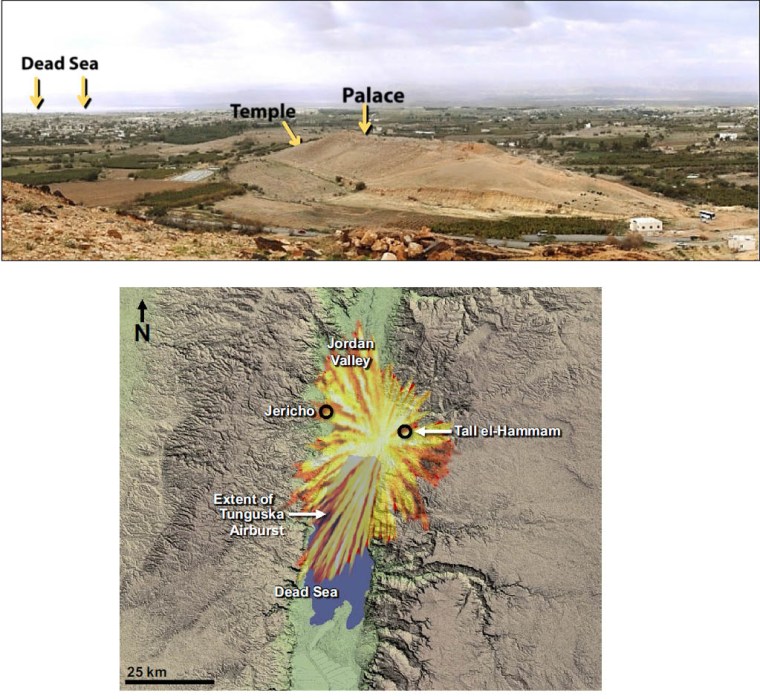
This is the second catastrophe recorded in the Old Testament of the King James Bible (Genesis 19:23-26), after the Noachian Flood (Genesis 7 and 8). The Flood is now regarded by many geoscientists to be a passed-down and mythologised account of the rapid filling of the Black Sea when the Bosporus was breached around 7600 years ago, as global see level rose in the early Neolithic. Eleven Chapters and a great many begotten people later comes the dramatic punishment of the ‘sinners’ of Sodom and Gomorrah. The two legendary settlements are now considered to have been in the Lower Jordan Valley near the Dead Sea. Being on the major strike-slip fault that defines the Jordan Rift, related to the long-active spreading of the Red Sea, the most obvious rationalisation of the myth is a major earthquake. The sedimentary sequence contains sulfide-rich clays and silts, as well as thick salt beds. Major seismicity would have liquidised saturated sediments full of supersaturated salt water and the release of large volumes of hydrogen sulfide gas. There are also remains of early settlements in the form of large mounds known locally as ‘talls’. The largest  and archaeologically  most productive of these is Tall el Hammam in Jordan, whose excavation has proceeded since 2005. It lies just to the north of the Dead Sea on the eastern flank of the Jordan valley, 15 km from Jericho on the occupied West Bank.

The Tall el Hammam mound is formed from layers of debris, mainly of mud bricks, dwellings being built again and again on the remains of earlier ones. It seems to have been continuously occupied for three millennia after 6650 ka ago (4700 BCE) at the core of a presumably grain-based city state with upwards of 10 thousand inhabitants. The site was destroyed around 3600 Ka (1650 BCE). The catastrophic earthquake hypothesis can be neither confirmed nor refuted, but the destruction toppled structures with walls up to 4 m thick.. Whatever the event, 15 years of excavation have revealed that it was one of extremely high energy. There is evidence for pulverisation of mud bricks and at some dwellings they were apparently blown off-site: a possibility in a large magnitude earthquake. Unusually, however, mud bricks and clay used in pottery and roofing had been partially melted during the final destruction. Various analyses suggest temperatures were as high as 2000 °C.

Top – oblique aerial view of the mound at Tal el Hammam looking to the south-west; Bottom – the Lower Jordan Valley and Bronze age talls superimposed by the extent of the area devastated by the 1908 Tunguska air-burst. (credit: Bunch et al. 2021, Figs 1b and 52)

A detailed summary of results from the Tall el Hammam site has just appeared (Bunch T.E., and 20 others 2021. A Tunguska sized airburst destroyed Tall el-Hammam a Middle Bronze Age city in the Jordan Valley near the Dead SeaNature Scientific Reports, v. 11, article 18632; DOI: 10.1038/s41598-021-97778-3). As the title indicates, it comes to an astonishing conclusion, which rests on a large range of archaeological and geochemical data that go well beyond the earlier discovery of the tall’s destruction at very high temperatures. Radiocarbon dates of 26 samples from the destruction layer reveal that it happened in 1661±21 BCE – the mid- to late Bronze Age, as also suggested by the styles of a variety of artefacts. The most revealing data have emerged from the debris that caps the archaeological section, particularly fine-grained materials in it. There are mineral grains indicating that sand-sized grains were melted, some to form spherules or droplets of glass. Even highly refractory minerals such as zircon and chromite were melted. Mixed in with the resulting glasses are tiny nuggets of metals, including platinum-group metals. As well as high temperatures the event involved intense mechanical shock that produced tell-tale lamellae in quartz grains, familiar from sites of known extraterrestrial impacts. One specimen shows a micro-crater produced by a grain of carbonaceous material, which is now made up of ~ 1 μm diamond-like carbon (diamondoids) crystals. There is abundant evidence of directionality in the form of linear distributions of ceramic shards and carbonised cereal grains that seem to have been consistently transported in a SW to NE direction: a kind of high-speed ‘blow-over’. In the debris are also fragments of pulverised bone, most too small to assign to species. But among them are two highly damaged human skulls and isolated and charred human limb- and pelvic bones. Forensic analysis suggests at least two individuals were decapitated, dismembered and incinerated during the catastrophe. Isolated scatters of recognisable human bones indicate at least 10 people who suffered a similar death. Finally the destruction layer is marked by an unusually high concentration of salt, some of which has been melted.

Such a range of evidence is difficult to reconcile by hypotheses citing warfare, accidental burning, tornadoes or earthquakes. However, the diversity of phenomena associated with the destruction of Tall el Hammam has been compared with data from nuclear explosion sites, suggesting the huge power of the event. The authors turned to evidence linked to the air-burst detonation of a cosmic body over Tunguska, Siberia in 1908 which had a power estimated at between 12- to 23 megatonnes of TNT equivalent. Such an event seems to fit the fate of Tall el Hammam. The Tunguska event devastated an area of 2200 km2. The tall and another at Jericho lies within such an area. Perhaps not coincidentally, the destruction of Jericho was also in the mid- to late Bronze Age sometime between 1686 and 1626 BCE: i.e. statistically coeval with that of Tall el Hammam.

Archaeologists working in the Lower Jordan Valley have examined 15 other talls and more than a hundred lesser inhabited sites and have concluded that all of them were abandoned at the end of the Middle Bronze Age. The whole area is devoid of evidence for agricultural settlements for the following three to six centuries, although there are traces of pastoralist activity. The high amount of salt in the Tall el Hammam debris, if spread over the whole area would have rendered its soils infertile until it was eventually flushed out by rainfall and runoff. If, indeed, the event matches the biblical account of Sodom and Gomorrah, then Lot and his remmaing companions would have found it difficult to survive without invading the lands of other people who had escaped, much as recorded later in Genesis. Of more concern is what will become of Ted Bunch and his 20 US colleagues? Will they be charged with blasphemy?

See also: Tunguska-Sized Impact Destroyed Jordan Valley City 3,670 Years Ago, SciNews, 29 September 2021; Did an impact affect hunter gatherers at the start of the Younger Dryas? Earth-logs, 3 July 2020.